


Introduction
Reliable instrumental records of Earth’s climate have only been collected since the late 19th century; of these, high-resolution records of Southern Hemisphere climate are geographically sparse and rarely extend back more than 50 years. A longer perspective on climate variability can be obtained by studying natural archives that provide proxies for past climate, such as tree rings, sediment cores and ice cores.
Antarctic ice cores are a valuable resource for reconstructing the climate of the past because they can provide sub-annually resolved, continuous proxy records of atmospheric temperature, atmospheric circulation, precipitation, the El Niño–Southern Oscillation and sea-ice extent, among others (Reference Jouzel, Merlivat, Petit and LoriusJouzel and others, 1983; Reference Mayewski, Elliot and BlaisdellMayewski and others, 1995, Reference Mayewski2004; Reference Cullather, Bromwich and van WoertCullather and others, 1996; Kreutz and others, 1997, 2000a; Reference Meyerson, Mayewski, Kreutz, Meeker, Whitlow and TwicklerMeyerson and others, 2002). Furthermore, strong teleconnections link the continent to the mid- and low latitudes (Reference CarletonCarleton, 1992), ensuring that records of Southern Hemisphere climate are captured in the chemistry of its snow and ice layers.
Sulfate (SO4 2–) is one of the major chemical species present in Earth’s atmosphere, and its aerosols are involved in many important atmospheric processes. SO4 2– aerosols play a significant role in the heat budget of the global atmosphere, mainly through the scattering of incoming solar radiation and through indirect effects involving clouds (Reference Charlson, Langner and RohdeCharlson and others, 1990). SO4 2– from large explosive volcanic eruptions significantly affects stratospheric chemistry, inducing a higher catalytic destruction rate of ozone and resulting in enhanced levels of ultraviolet-B (UV-B) radiation at the Earth’s surface (Reference Berresheim, Wine, Davis and SinghBerresheim and others, 1995).
The isolated Antarctic continent is an ideal place to study natural atmospheric SO4 2– variability, thanks to its remoteness from major anthropogenic SO4 2– sources that can confound the investigation of natural variability compared to more populated regions (Reference ShawShaw, 1982; Reference LegrandLegrand and Mayewski, 1997).
Sulfate sources and transport pathways
Sea-salt (ss) SO4 2– reaches West Antarctica almost exclusively through the lower troposphere, and as a result can contribute over 25% of the total SO4 2– budget to coastal and low-elevation sites (Reference Dixon, Mayewski, Kaspari, Sneed and HandleyDixon and others, 2004). Interpreting the significance of excess (xs) SO4 2– concentrations in Antarctica is complicated because the xsSO4 2– arrives from a variety of sources. The major source is biogenic xsSO4 2– that results from vigorous biological activity in the surrounding oceans during the Southern Hemisphere summer months (Reference Bates, Lamb, Guenther, Dignon and StoiberBates and others, 1992; Reference LegrandLegrand and Mayewski, 1997). The strong seasonality of biogenic xsSO4 2– production and transport results in well-defined annual peaks in all of the ice-core records used in this study (Reference Dixon, Mayewski, Kaspari, Sneed and HandleyDixon and others, 2004). Biogenic source xsSO4 2– reaches a peak from November to January (Reference MinikinMinikin and others, 1998) and arrives inWest Antarctica via two major transport pathways. Biogenic xsSO4 2–, produced south of 60˚ S (Reference MinikinMinikin and others, 1998), is transported mainly through the lower troposphere, whereas biogenic xsSO4 2–, primarily from low–mid-latitude sources, is transported through the mid–upper troposphere (Reference ShawShaw, 1982; Reference Legrand, Feniet-Saigne, Saltzman and GermainLegrand and others, 1992; Reference MinikinMinikin and others, 1998). The ssSO4 2– fraction reaches a peak during the winter/spring transition, when intense cyclonic activity and intrusions of lower-tropospheric marine air masses are common (Reference Legrand, Feniet-Saigne, Saltzman and GermainLegrand and others, 1992; Reference Whitlow, Mayewski and DibbWhitlow and others, 1992; Reference HoganHogan, 1997).
Other important sources of West Antarctic xsSO4 2– are volcanic eruptions and the multiple-source stratospheric SO4 2– layer that is comprised of background volcanic, biogenic and potentially anthropogenic contributions. Volcanic xsSO4 2– input to West Antarctica from large explosive eruptions is episodic. The major transport pathway for this source of xsSO4 2– is the mid–upper troposphere and stratosphere (Reference Legrand and DelmasLegrand and Delmas, 1987; Reference Dibb and WhitlowDibb and Whitlow, 1996; Reference Legrand and WagenbachLegrand and Wagenbach, 1999). The stratospheric contribution of SO4 2– is generally assumed to be minimal (Legrand, 1997; Reference Bergin, Meyerson, Dibb and MayewskiBergin and others, 1998) except after large explosive volcanic eruptions (Legrand and Delmas, 1987; Reference Dibb and WhitlowDibb and Whitlow, 1996). Volcanic xsSO4 2– from small volcanic eruptions may travel through the lower troposphere but usually does not travel far from the eruption source.
Polynyas are an important local source of ssSO4 2– and xsSO4 2– in coastal Antarctic precipitation. Although relatively small in area, coastal polynyas are areas of considerable sea-ice production and salt flux in winter, and regions of greatly enhanced primary and secondary production in summer (Reference Arrigo and van DijkenArrigo and Van Dijken, 2003; Reference Kaspari, Mayewski, Dixon, Sneed and HandleyKaspari and others, 2005). The largest polynya in the Southern Ocean is the Ross Sea Polynya, which is one of the most biologically productive regions around Antarctica (Reference Arrigo, Worthen, Schnell and LizotteArrigo and others, 1998). It forms annually as a result of the strong katabatic winds flowing off the Ross Ice Shelf into the southwestern Ross Sea (Reference Bromwich, Carrasco and StearnsBromwich and others, 1992).
Traditionally, bubble bursting at the open-ocean water surface was considered to be the sole source of sea-salt aerosols in Antarctic precipitation, but more recently Southern Ocean sea-ice extent (SIE) has been shown to play an important role in controlling concentrations of ssSO4 2– in coastal Antarctic precipitation through the formation of highly saline frost flowers on the surface of new sea ice (Reference WagenbachWagenbach and others, 1998; Reference Rankin, Auld and WolffRankin and others, 2000, Reference Rankin, Wolff and Martin2002). Highly saline brine forms at the surface of new sea ice, and below –8˚C sodium sulfate decahydrate (mirabilite: Na2SO410H2O) precipitates from the brine (Reference RichardsonRichardson, 1976). This process produces aerosols strongly depleted in SO4 2– relative to Na+ from the brine (Reference Rankin, Wolff and MartinRankin and others, 2002). Several studies report negative winter xsSO4 2– values from aerosol, snow and ice-core samples at coastal sites (Reference Mulvaney and WolffMulvaney and Peel, 1988; Reference WagenbachWagenbach and others, 1998), indicating that the brine associated with frost flowers is a dominant source of marine aerosols to coastal sites in winter. However, Kreutz and others (2000b), using the Siple Dome ice core, and Reference Kaspari, Mayewski, Dixon, Sneed and HandleyKaspari and others (2005), using International Trans-Antarctic Scientific Expedition (ITASE) cores, show that the ice-core sea-salt record is a proxy for the strength and position of the Amundsen Sea low, indicating that wind strength is still a major control of sea-salt aerosols in Antarctic precipitation whether the aerosols are derived from frost flowers or the open-ocean surface.
The influence of lower-tropospheric air masses diminishes with increasing elevation and distance from the coast, causing ssSO4 2– concentrations to decrease concurrently. The influence of mid–upper tropospheric and stratospheric air masses on coastal sites is minor (Reference MinikinMinikin and others, 1998; Reference Legrand and WagenbachLegrand and Wagenbach, 1999) compared to higher-elevation interior areas. As a result, large explosive volcanic eruptions are most clearly distinguished in ice-core xsSO4 2– records from higher-elevation interior areas.
SIE is also linked to concentrations of xsSO4 2– in the Antarctic atmosphere (Reference Welch, Mayewski and WhitlowWelch and others, 1993; Reference Peel, Mulvaney, Pasteur, Chenery, Jones, Bradley and JouzelPeel and others, 1996; Reference Meyerson, Mayewski, Kreutz, Meeker, Whitlow and TwicklerMeyerson and others, 2002; Reference Curran, van Ommen, Morgan, Phillips and PalmerCurran and others, 2003) via its strong, consistent association with the methanesulfonate (MS) seasonal cycle of marine productivity (Reference MinikinMinikin and others, 1998). Reference Peel, Mulvaney, Pasteur, Chenery, Jones, Bradley and JouzelPeel and others (1996) show that in areas adjacent to the Weddell Sea, extensive sea-ice cover appears to suppress emissions of the xsSO4 2– precursor dimethylsulfide (DMS). However, other studies reveal a positive relationship between increased MS at coastal sites and increased SIE in adjacent longitudinal ocean sectors (Reference Welch, Mayewski and WhitlowWelch and others, 1993; Reference Curran, van Ommen, Morgan, Phillips and PalmerCurran and others, 2003). Reference Meyerson, Mayewski, Kreutz, Meeker, Whitlow and TwicklerMeyerson and others (2002) note a positive relationship between South Pole MS concentrations and Amundsen– Ross region SIE.
In this study, chemistry data from 16, 50–115m deep, sub-annually dated ice-core records (Fig. 1) are used to investigate recent spatial and temporal concentration variability of the soluble ssSO4 2– and xsSO4 2– in ice cores over West Antarctica. We investigate associations between the xsSO4 2– and ssSO4 2– concentration time series from each core and SIE and we discuss the importance of the SIE–SO4 2– correlations in terms of the 1940 background xsSO4 2– rise observed in our previous study (Reference Dixon, Mayewski, Kaspari, Sneed and HandleyDixon and others, 2004).

Fig. 1. Location map of sites for all ice cores used in this study. RA, RB and RC represent core sites RIDS-A, RIDS-B and RIDS-C, respectively. Red lines (A–B, C–D and E–F) are transects referred to in Figure 2. Map created using the RADARSAT-1 Antarctic Mapping Project (RAMP) digital elevation model (Reference Liu, Jezek, Li and ZhaoLiu and others, 2001)
Methodology
The ice cores used in this study were collected during Antarctic field seasons 1994–2001. The eight older cores (SP-95, SDM-94, RIDS-A, -B and -C, CWA-A and -D and Up-C) were sectioned using the ultra-clean procedures described in Reference Buck, Mayewski, Spencer, Whitlow, Twickler and BarrettBuck and others (1992). The eight new US ITASE cores were sampled at high resolution using the University of Maine melter system (up to 50 samples m–1; Table 1) to develop sub-annually resolved time series (Reference Dixon, Mayewski, Kaspari, Sneed and HandleyDixon and others, 2004). To prevent contamination, only the inner portion of each core was sampled, and, prior to melting, the ends of each core section were scraped using a sterile surgical stainless-steel blade. Each sample was analyzed for its soluble major-ion content (Na+, K+, Mg2+, Ca2+, Cl–, NO3 –, SO4 2–) using a Dionex® DX-500 ion chromatograph coupled to a Gilson® autosampler, and concentrations are reported in μg L–1 (ppb). To determine anion (Cl–, SO4 2– and NO3 –) concentrations, the chromatograph was set up with an AS-11 column with 6mM NaOH eluent. For cation (Na+, Ca2+, Mg2+ and K+) concentrations, a CS-12a column with 25mM MSA eluent was used. All ion concentrations are determined with an accuracy of better than 0.1 ppb.
Table 1. Information for each ice core used in this study

The high-resolution section of every ice core is dated by matching seasonal peaks from each of the major-ion time series in accord with seasonal timing identified by previous research (e.g. Whitlow and others, 1992; Reference Wagenbach, Wolff and BalesWagenbach, 1996; Reference Legrand and MayewskiLegrand and Mayewski, 1997; Kreutz and Mayewski, 1999; Reference Dixon, Mayewski, Kaspari, Sneed and HandleyDixon and others, 2004). The counting of annual peaks between known large explosive volcanic events in our ion records, such as the 1815 eruption of Tambora, Indonesia, the 1883 eruption of Krakatau, Indonesia, the 1963 eruption of Agung, Indonesia, and the 1991 eruption of Pinatubo, Philippines, confirms that each year is preserved in each high-resolution ice-core record and allows a dating accuracy of better than 1 year (Reference Dixon, Mayewski, Kaspari, Sneed and HandleyDixon and others, 2004).
Each ice-core SO4 2– time series is separated into its primary constituents, ssSO4 2– and xsSO4 2–, using the technique described by Reference O’Brien, Mayewski, Meeker, Meese, Twickler and WhitlowO’Brien and others (1995). The ssSO4 2– fraction is calculated by applying a standard sea-water ratio of 30.61(Na+), 1.1(K+), 3.69(Mg2+), 1.16(Ca2+), 55.04(Cl–) and 7.68(SO4 2–) to the ion concentrations in each sample (Reference HollandHolland, 1978). The concentration values are reduced incrementally according to this ratio until a value of zero is reached in one of the six ion concentrations. The ion that reaches zero concentration first is considered to be the conservative ion for that sample, and the concentration values for the other five ions are recorded. These become the excess (xs) concentrations for that sample. This technique is used in preference to the total-Na+ conservative method because it takes all of the sea-salt ions into account when calculating sea-salt concentrations and therefore lessens the likelihood of a possible ssSO4 2– to Na+ ratio bias caused by frost flower fractionation (Reference Rankin, Wolff and MartinRankin and others, 2002). Previous research reveals no significant correlations between snow ion concentration and accumulation rate for Antarctic glaciochemical series in general (e.g. Reference Mulvaney and PeelMulvaney and Wolff, 1994; Kreutz and Mayewski, 1999; Kreutz and others, 2000a) or for the glaciochemical series used in this study (Reference Dixon, Mayewski, Kaspari, Sneed and HandleyDixon and others, 2004), so flux corrections for accumulation were not applied.
In order to characterize and compare the total ssSO4 2– and xsSO4 2– concentration at each ice-core site, we calculate mean values for the period 1952–91 (Fig. 2). We use 1952–91 because this is the longest time period for which we have a large number of continuous ice-core time series (mean value for site 01-6 is calculated from 1978–91, the full length of the record). Raw ssSO4 2– and xsSO4 2– time series for the last 200 years are plotted to determine the seasonal and longer-term variance in each of the ice-core SO4 2– records (Fig. 3).
Fig. 2. Mean excess (red) and sea-salt (blue) sulfate concentrations in ppb for the years 1952–91 for each ice core used in this study. Green dots represent elevation in meters. Purple dots represent distance from nearest open water in kilometers. Red lines (A–B, C–D and E–F) are transects from Figure 1 (not to scale).
Fig. 3. Raw excess (red lines) and sea-salt (green lines) sulfate concentrations in ppb for the years 1800–2002 for each ice core used in this study. Black lines (excess) and blue lines (sea salt) represent 35- to 51-point running averages. Vertical lines represent 5 year increments. Shaded areas represent periods of increased xsSO4 2– input from known global-scale volcanic events.
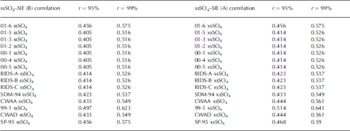
Linear correlations of annually averaged ssSO4 2– and xsSO4 2– concentrations from each core vs SIE data from 1973 to 1996 (Reference JackaJacka, 1983) are performed (the Up-C core is not used because of data gaps) to determine how SIE is related to SO4 2– concentrations at the South Pole and across West Antarctica. The annual xsSO4 2– concentration is calculated for each year from June to June (referred to as type A), and the annual ssSO4 2– concentration is calculated from January to January (type B), as these periods best cover the annual concentration peak in each SO4 2– time series. The SIE data were compiled from satellite-derived maps (US Navy and US National Oceanic and Atmospheric Administration Joint Ice Center) which by definition have the ice edge determined by a sea-ice concentration of >15% (Reference JackaJacka, 1983, and monthly updates). For each month (January 1973–December 1996), a latitudinal position of the sea-ice edge is available for every 108 of longitude (Reference Simmonds and JackaSimmonds and Jacka, 1995), yielding 36 separate time series. The only missing data are for August 1975 for all longitudes. The August average (1973–96) for each longitude series was substituted for these missing values. The SIE data are annually averaged from June to June (A) and from January to January (B), resulting in annual SIE records that span the time periods 1974–96 and 1973–96 respectively. Correlations are performed between the xsSO4 2– (A) and SIE (A) data and the ssSO4 2– (B) and SIE (B) data. Longitudinal SIE segments that correlate above 95% significance are plotted on polar stereographic maps of Antarctica (see Table 2 for corresponding r values).
Table 2. Pearson’s r values for the 95% and 99% significance level in correlations between annually averaged sea-ice extent and annually averaged xsSO4 and ssSO4 concentrations
Results and Discussion
50 year mean concentrations
Sites 01-6, 01-5, 01-3, 01-2, 00-1, 00-4 and 00-5 are located along transect A–B from eastern to central to western West Antarctica (Fig. 1). The sites increase in elevation from ~1200m to ~1800m from east to west. Mean xsSO4 2– concentrations along this transect display relatively uniform values from eastern to central West Antarctica, and an increase from central to western West Antarctica (Fig. 2). The increase in mean xsSO4 2– concentration towards the west is believed to be the result of increased downward flow of sulfate-laden air from the mid– upper atmosphere over the Executive Committee Mountain Range, inferred from atmospheric flow models in this area (Reference Guo, Bromwich and CassanoGuo and others, 2003).
Ice-core sites RA, RB and RC are located in a ~300km northeast–southwest transect (C–D) descending from the ice divide into the Ross Ice Shelf catchment area (Fig. 1). Concentrations of xsSO4 2– along this transect exhibit an increasing trend toward site RC (Fig. 2), most likely as a consequence of closer proximity to the turbulent atmosphere over the Ross Ice Shelf area (Reference Kreutz and MayewskiKreutz and Mayewski, 1999) and the biological productivity of the Ross Sea Polynya. Concentrations of ssSO4 2– remain relatively constant over the spread of sites 01-6, 0-5, 0-3, 0-2, 0-1, 0-4, 0-5, RA, RB and RC.
Sites SDM-94, Up-C, CWA-A, 99-1, CWA-D and SP-95 lie on transect E–F and range in elevation from 620m at the edge of the Ross Ice Shelf to 2850m at South Pole (Fig. 1). Concentrations of xsSO4 2– decrease with increasing elevation up to site CWA-D, and the trend reverses between CWA-D and SP-95 (Fig. 2) as a result of multiple input sources (tropospheric and stratospheric) for xsSO4 2– in this area (Reference PropositoProposito and others, 2002; Reference Dixon, Mayewski, Kaspari, Sneed and HandleyDixon and others, 2004). Concentrations of ssSO4 2– along the same transect decrease steadily toward South Pole with increasing elevation and distance from the coast, indicating a single lower-tropospheric source for marine ions that reach the polar plateau.
Raw concentrations
Plots of raw (unprocessed) ssSO4 2– and xsSO4 2– concentrations against time (Fig. 3) illustrate the large (more than an order of magnitude in some cases) increases in xsSO4 2– immediately following several global-scale large explosive volcanic eruptions (Tambora (1815), Cosiguina, Nicaragua (1835), Krakatau (1883), Agung (1963) and Pinatubo (1991)) in the sub-annually resolved data from all cores except SDM-94, Up-C and CWA-A (Reference Dixon, Mayewski, Kaspari, Sneed and HandleyDixon and others, 2004).
The majority of the West Antarctic ice-core sites in this study (01-6, 01-5, 01-3, 01-2, 00-1, 00-4, 99-1, RA, RB, RC, Up-C, CWA-A and CWA-D) have high annual xsSO4 2– variance, commonly displaying low winter xsSO4 2– concentrations in the 0–10 ppb range. Site 01-5 (Fig. 3) has high xsSO4 2– concentration variance and low winter xsSO4 2– concentrations, but it contains numerous large xsSO4 2– peaks that are not related to global-scale volcanic eruptions because they do not appear at any other site and do not correspond to historic global-scale volcanic events. The large peaks in 01-5 may be a result of local volcanism, biogenic xsSO4 2– input from nearby polynyas, or evaporite dust input from the nearby Ellsworth Mountains. The most likely cause for the majority of these large peaks is evaporite dust because of coincident large Ca2+ peaks.
Site SP-95 (Fig. 3) maintains a relatively high xsSO4 2– baseline (~50 ppb) and low (~30–70 ppb) variance throughout the year compared to other sites. It also contains unusually large (sometimes more than an order of magnitude above the mean) xsSO4 2– signatures from global-scale volcanic eruptions. The SP-95 xsSO4 2– volcanic signatures are a result of its high (~2850 m) elevation and direct access to upper-tropospheric/stratospheric air masses (Reference Dixon, Mayewski, Kaspari, Sneed and HandleyDixon and others, 2004).
Non-volcanic xsSO4 2– concentrations at site 00-5 (Fig. 3) are similar in structure to those at SP-95 (high background, low variance) during several short periods over the last 200 years (e.g. 1942–47, 1908–13) but are similar to the majority of West Antarctic sites for the remainder of the record (low winter values, high variance). The change in xsSO4 2– deposition style at site 00-5 may reflect changes in the strength of downward airflow over the Executive Committee Range (as discussed earlier). Periods of strengthened downward flow may cause the xsSO4 2– signature at site 00-5 to be more similar to that at SP-95.
The mean xsSO4 2– concentrations at SDM-94 (Fig. 3) frequently decrease to ~30 ppb, comparable to, or lower than, the mean ssSO4 2– concentration at that site, suggesting a high event frequency of at least one of the major xsSO4 2– sources to the site, probably marine biogenic xsSO4 2–. The low elevation and proximity to the coast of the SDM-94 site signify that its major SO4 2– sources are sea salt and marine biological productivity from the adjacent ocean area. Therefore, a likely cause for the observed xsSO4 2– fluctuations is variability of Ross Sea climatic conditions. Interestingly, the xsSO4 2– fluctuations in the SDM-94 record are not observed at Up-C or CWA-A as would be expected from events of this magnitude. Another reason for the independent behavior of SDM-94 xsSO4 2– concentrations may be the location of the site. The SDM-94 core site is located on the top of a 600m high dome; this protruding geography may prevent certain air masses from reaching the ice-core drill site and could well be a factor regarding the unique character of the glaciochemical concentrations.
Almost every core in this study has a mean ssSO4 2– to xsSO4 2– ratio between 0.13 and 0.29 (Table 1); the exceptions are SP-95 with a ratio of 0.05, and SDM-94 with a ratio of 0.40. The low ratio at SP-95 is caused by a combination of extremely low ssSO4 2– concentrations resulting from its high elevation and distance from the coast, and the fact that xsSO4 2– concentrations at this site maintain a relatively constant baseline (~50 ppb) and low (~30–70 ppb) variance throughout the year. The high ssSO4 2– to xsSO4 2– ratio at SDM-94 is a result of extremely high ssSO4 2– concentrations resulting from proximity to the Ross Ice Shelf edge and Ross Sea Polynya.
Sea-ice correlations
Linear correlation between monthly values of SIE and monthly values of SDM-94 xsSO4 2– (from 1973–94) was performed to determine if SIE exhibited any significant associations with xsSO4 2– concentrations in precipitation (Fig. 4). We chose SDM-94 to begin with because it is the nearest to open water of our low-elevation sites. The monthly values were calculated by resampling the original time series to 12 samples per year based on the assumption that the annual xsSO4 2– peak occurs near the December/ January transition (Reference MinikinMinikin and others, 1998). The results show that the strongest correlations are obtained when records are lead/lagged 2–3 months. This is because the maximum and minimum SIE occurs in September/October and March/April respectively and the xsSO4 2– peak falls on the December/January transition. To overcome any further possible autocorrelation problems, we resampled both time series to annual resolution. The results for SDM-94 xsSO4 2– and SIE reveal that the most robust correlation (r > 0.6 > 99% significance) occurs with no leads or lags. Figure 5 shows that the strongest correlations occur with SIE from longitudes 70–80˚, 130–150˚ and 200–240˚.
Fig. 4. Correlation results for SDM-94 monthly excess sulfate concentrations against every 10˚ monthly sea-ice data segment from 0 to 360˚ longitude.
Fig. 5. Correlation results for SDM-94 annual excess sulfate concentrations against every 10˚ annual sea-ice extent data segment from 0 to 360˚ longitude. (N = 22; r≥ 0.433 = 95% significant; r≥ 0.549 = 99% significant.)
Linear correlations with annually averaged SIE from 1973–96 were also performed on the annually averaged xsSO4 2– and ssSO4 2– records from each core (Figs 6 and 7) for the full period of data overlap. With SIE calculated as a function of latitude in Figures 6 and 7, a positive correlation means decreased SIE when SO4 2– concentrations are high, and a negative correlation means increased SIE when SO4 2– concentrations are high. The statistically significant (>95%) results show that in general the SIE closest to West Antarctic ice-core sites, in the Ross, Amundsen and Bellingshausen Seas, is negatively correlated with ssSO4 2– (r≥ 0.405–0.537) and positively correlated with xsSO4 2– (r≥ 0.414–0.561) concentrations.
Fig. 6. Correlations between annually averaged sea-ice extent and excess sulfate. All plotted sites represent correlations above 95% significance. A ‘+’ indicates a positive correlation and a ‘–’ indicates a negative correlation for each associated ice-core site. Latitudinal position of text has no significance. RA, RB and RC represent core sites RIDS-A, RIDS-B and RIDS-C, respectively. SD, CWA, CWD and SP represent SDM-94, CWA-A, CWA-D and SP-95 respectively. Map created using the RAMP digital elevation model (Reference Liu, Jezek, Li and ZhaoLiu and others, 2001).
Fig. 7. Correlations between annually averaged sea-ice extent and sea-salt sulfate. For details see Figure 6 caption.
West Antarctic ice-core sites (SDM-94, 00-1, 00-4, 01-3 and RIDS-A) exhibit increased concentrations of xsSO4 2– when SIE in the Bellingshausen–Amundsen–Ross (Pacific) region is reduced (Fig. 6). At the same time, when xsSO4 2– concentrations at site 01-3 are higher, the SIE in the Pacific region is reduced and the SIE in the Weddell (Atlantic) region is increased. If the primary xsSO4 2– source for site 01-3 is the Weddell region, our result is in agreement with several previous studies (Reference Welch, Mayewski and WhitlowWelch and others, 1993; Reference Meyerson, Mayewski, Kreutz, Meeker, Whitlow and TwicklerMeyerson and others, 2002; Reference Curran, van Ommen, Morgan, Phillips and PalmerCurran and others, 2003); but if, as is more likely, the primary xsSO4 2– source for site 01-3 is the Bellingshausen–Amundsen–Ross region, our results suggest that the SIE–xsSO4 2– relationship is opposite to that of SIE–MS. The associations present in the Weddell region may be related to the Antarctic dipole, which manifests itself as out-of-phase retreat (advance) of sea ice in the Atlantic (Pacific) ocean basins (Reference Yuan and MartinsonYuan and Martinson, 2000). Assuming the latter to be true, differences between our results and those of previous studies (Reference Welch, Mayewski and WhitlowWelch and others, 1993; Reference Curran, van Ommen, Morgan, Phillips and PalmerCurran and others, 2003) may be due to the fact that none of our sites are truly coastal locations (although SDM-94 has some coastal characteristics). Also, we examine xsSO4 2– concentrations rather than MS, and the ice-core locations for all previous studies are in East Antarctica.
Linear correlation between ssSO4 2– and SIE (Fig. 7) reveals that concentrations of ssSO4 2– are higher at several West Antarctic sites (CWA-A, 00-1, 00-4, 00-5, RIDS-A, RIDS-B and CWA-D) when there is greater SIE in the Amundsen, Ross and Bellingshausen Seas. There could be several possible mechanisms for this association. One is increased sea-ice production leading to greater frost flower growth and resulting in greater volumes of highly saline aerosols (Rankin and others, 2002; Reference Kaspari, Mayewski, Dixon, Sneed and HandleyKaspari and others, 2005). Another is increased meridional transport and higher wind speeds over the open-ocean surface during colder years, causing greater concentrations of ss aerosols to reach the ice sheet (Reference Curran, van Ommen and MorganCurran and others, 1998; Kreutz and others, 2000b). The most likely explanation is that both of these mechanisms are responsible to varying degrees for the observed relationship between ssSO4 2– and SIE.
Our study of xsSO4 2– does not reveal strong associations between longitudinal bands of SIE in the Amundsen–Ross region and SP-95 xsSO4 2– concentrations, but it does show a positive association between increased SP-95 xsSO4 2– concentrations and reduced SIE in the Weddell Sea region. The SP-95 SIE correlation of Reference Meyerson, Mayewski, Kreutz, Meeker, Whitlow and TwicklerMeyerson and others (2002) is based upon smoothed (seven-point running mean) monthly MS and SIE values and an average SIE calculated from 185˚ to 245˚ longitude; this may explain why we do not see similar correlation patterns in our study. The positive association we observe between increased SP-95 xsSO4 2– concentrations and reduced SIE in the Weddell Sea region suggests that the source region for SP-95 xsSO4 2– is probably different to that of the West Antarctic cores in this study.
An important consideration on the sulfur budget of West Antarctica is the effect of coastal polynyas. Three of the four most productive Antarctic polynyas surround West Antarctica, and the dominant polynya with respect to total area-weighted production is in the Ross Sea, accounting for half of the total polynya production on the entire Antarctic continental shelf (Reference Arrigo and van DijkenArrigo and Van Dijken, 2003). The peak production in January averaged over all polynya waters is more than three times higher than the average for the entire offshore Southern Ocean (Reference Arrigo and van DijkenArrigo and Van Dijken, 2003). As a result, polynyas may be a significant source of both ssSO4 2– (in winter) and xsSO4 2– (in summer) to West Antarctic sites.
Background sulfate concentrations
There are no significant trends apparent in the robust spline-smoothed ssSO4 2– concentrations over the last 200 years (Fig. 8). In a previous study (Reference Dixon, Mayewski, Kaspari, Sneed and HandleyDixon and others, 2004) we showed that a significant rise in background xsSO4 2– concentrations occurs from 1940 to the present at central West Antarctic ice-core sites (00-1, 00-4, 00-5, RIDS-A, RIDS-B and RIDS-C; Fig. 8). We argued that the rise could not be attributed to anthropogenic activities since it does not show up in all our high-elevation xsSO4 2– concentration records. Here we suggest that the 1940 xsSO4 2– rise cannot be attributed to changes in sea-ice extent since xsSO4 2– concentrations at sites 00-5, RIDS-B and RIDS-C are not statistically related to SIE (in the Ross, Amundsen and Bellingshausen Seas) above 95% significance, and sites 00-1, 00-4 and RIDS-A are not related to SIE (in the Ross, Amundsen and Bellingshausen Seas) above 99% significance. Figures 6 and 7 show that the core sites displaying the strongest xsSO4 2– association with SIE are SDM-94 and 01-3; conversely sites 00-4, RIDS-A and CWA-D display the strongest ssSO4 2– association with SIE. This suggests that central West Antarctica is not significantly affected by lower-tropospheric coastal air masses during the summer months but is significantly affected by these air masses during the winter period.
Fig. 8. Robust spline-smoothed annual excess sulfate (black) and sea-salt sulfate (red) concentrations for each ice core for the years 1800– 2002. All concentrations are in ppb. Note scale change from site to site.
A study by Reference KaspariKaspari and others (2004) shows that central West Antarctic precipitation is statistically linked to the mid– low latitudes. This may suggest that the 1940 rise in xsSO4 2– is related to a change in production in the mid–low latitudes and/or increased transport from the mid–low latitudes to central West Antarctica.
Conclusions
In this study, we present the ssSO4 2– and xsSO4 2– records from 16 sub-annually resolved ice cores from West Antarctica. There are several sources and transport pathways of ssSO4 2– and xsSO4 2– and these vary from site to site and can only be resolved from a multiple core study.
Linear correlations between SIE and the ssSO4 2– and xsSO4 2– records from 15 of the cores in this study reveal that for several sites ssSO4 2– concentrations are higher with increased SIE, and xsSO4 2– concentrations are higher when SIE is decreased. It is important to note that although our results demonstrate a strong association between SIE and SO4 2– concentrations in West Antarctica, they do not necessarily imply direct causal links. The two parameters (SIE and SO4 2–) may be teleconnected to a third parameter that forces both simultaneously. Our SIE–ssSO4 2– association supports the concept that frost flower growth on sea ice may be an important source of ssSO4 2– aerosol to inland West Antarctic sites as noted by Rankin and others (2002) and Reference Kaspari, Mayewski, Dixon, Sneed and HandleyKaspari and others (2005). Conversely, our SIE– xsSO4 2– association suggests that during periods of decreased SIE in the Bellingshausen–Amundsen–Ross region, more xsSO4 2– is deposited in West Antarctica. This latter result does not agree with the results of previous studies that find a positive association between elevated MS concentrations and increased SIE (Reference Welch, Mayewski and WhitlowWelch and others, 1993; Reference Curran, van Ommen, Morgan, Phillips and PalmerCurran and others, 2003) but it is consistent with the observations of Reference Peel, Mulvaney, Pasteur, Chenery, Jones, Bradley and JouzelPeel and others (1996) who find that extensive sea-ice cover tends to suppress emissions of DMS. The association between SIE and SP-95 xsSO4 2– in this study shows that the SP-95 site receives more xsSO4 2– when SIE in the Weddell region is decreased, the opposite relationship to our West Antarctic sites that receive more xsSO4 2– when SIE in the Bellingshausen–Amundsen–Ross region is decreased.
The out-of-phase behavior between SIE in the Weddell region and the rest of Antarctica is a common pattern for Southern Ocean sea ice and is evident in our SIE–SO4 2– associations. It is most likely related to the structure of the Antarctic dipole (Reference Yuan and MartinsonYuan and Martinson, 2001) and it highlights the strong links between Antarctic climate and the climate of the tropical and mid-latitude Southern Hemisphere. Reference Yuan and MartinsonYuan and Martinson (2000) found consistent and statistically significant teleconnection patterns linking Antarctic SIE variations (including an out-of-phase relationship between Pacific and Atlantic polar regions) to those of mid- and low-latitude climate that are verified by our study.
The 1940 rise in xsSO4 2– background concentrations in our central West Antarctic ice cores cannot be attributed to changes in SIE. The most likely explanation for this trend is an increase in xsSO4 2– production in the mid–low latitudes around 1940 and/or an increase in transport efficiency from the mid–low latitudes to central West Antarctica at that time.
The influence of coastal polynyas on the West Antarctic SO4 2– budget is of utmost importance to the understanding and interpretation of ice-core records. Future work should focus on the associations between summer and winter polynya activity and the ssSO4 2– and xsSO4 2– time series in ice cores, particularly from western West Antarctica.



