


Consuming plain water to meet hydration needs is associated with numerous health benefits, including a reduction in energy intake and obesity, a decrease in dental caries and improved cognitive functioning in children(Reference Daniels and Popkin1–Reference Kenney, Long and Cradock7). Studies show that many children are underhydrated(Reference Kenney, Long and Cradock7,Reference Drenowski, Rehm and Constant8) and more susceptible to dehydration than adults, due to a proportionally higher body water content and greater body-surface-to-body-mass ratio(Reference Popkin, D’Anci and Rosenberg9,Reference Falk and Dotan10) . They are also less likely to restrict their physical activity during hours of peak temperature(Reference Bar-David, Urkin and Kozminsky5).
Children spend substantial waking hours at school. Because many children arrive at school underhydrated(Reference Stookey, Brass and Holliday11), it is important to provide safe, plentiful, easily accessible and appealing water sources on school campuses.
Over the past 10 years in the USA, the federal government, states and local school districts have passed policies related to drinking water quality and accessibility. In 2010, the Healthy, Hunger-Free Kids Act required all public schools participating in the National School Lunch Program to provide free potable water to students where meals are served(12). State plumbing codes set standards for the density of water fixtures in public buildings and impact how available water is to students(Reference Onufrak, Park and Wilking13). The Water Infrastructure Improvements for the Nation Act of 2016(14) and America’s Water Infrastructure Act of 2018(15) authorised funds for lead testing in schools and water system improvements for communities struggling to meet Safe Water Drinking Act requirements(16). In addition to these federal initiatives, individual states, cities and school districts are enacting initiatives to support water in schools, through a variety of innovative measures. These measures range from ordinances that require installation of water bottle filling stations in lieu of traditional fountains to district wellness policy language encouraging reusable water bottle use in schools to policy-mandated lead testing in all public schools in California(17–22).
These policy efforts are indicative of increased awareness of the importance of water in schools; however, the standards set by these policies may not optimally promote student hydration. In 2010, 75 % of California schools provided free potable water in food service areas, while 87 % met this benchmark in 2016 (EA Altman, KL Lee, CA Hecht, KE Hampton, G Moreno and AI Patel, unpublished results)(Reference Patel, Hecht and Hampton23). These are encouraging statistics; however, it is important to remember that compliance can simply mean having a drinking fountain somewhere in the cafeteria, which may not promote water intake if students do not have drinking vessels or if the fountain water is not appealing to students(Reference Hood, Turner and Colabianchi24,Reference Kenney, Gortmaker and Carter25) . In fact, many students have reported avoiding school drinking fountains due to concerns about cleanliness and water quality(Reference Onufrak, Park and Sharkey26,Reference Patel, Bogart and Klein27) , while others report avoiding tap water altogether in favor of bottled water(Reference Patel, Bogart and Klein27–Reference Gorelick, Gould and Nimmer29).
In 2016–2018, we conducted a study assessing drinking water quality and accessibility in a representative sample of 240 California public schools. In the current study, schools were characterised as having ‘excellent’ water access if they met each of the following criteria: provided water in at least four of five key school locations (food service area, classrooms, gym, outdoor physical activity areas or common areas), had one water source for every twenty-five students, offered at least one non-fountain water source, provided safe and appealing water and offered clean and maintained water sources (EA Altman et al., unpublished results). In assessing a school’s ‘excellence’, we looked beyond the minimum standard of providing water in the cafeteria to examine if schools provide water that will increase consumption. From 2010 to 2016, the percentage of schools meeting excellence criteria in cross-sectional surveys of California public schools increased by 13 %. After controlling for school characteristics, only student enrolment was significantly associated with drinking water excellence, with smaller schools being more likely to meet excellence (EA Altman et al., unpublished results).
To date, most studies related to drinking water initiatives in schools have been quantitative in nature. Further, no previous studies have examined factors that enable some schools to surpass the minimal mandated requirements to ensure that students have excellent access to safe, appealing drinking water, thus encouraging better student hydration. The objective of the current study was to fill that gap by generating a rich picture of the facilitators and barriers associated with excellent water quality and accessibility in schools. Such study findings could be used to identify strategies to more effectively support all schools in providing excellent drinking water to students.
Methods
Methods used to collect and summarise the data in the current study followed the ‘Consolidated Criteria for Reporting Qualitative Studies’ (COREQ) protocol(Reference Tong, Sainsbury and Craig30).
Overview of study design and procedure
Of the 240 schools participating in 2016, forty-two met the five criteria for excellence (herein, termed ‘high performing’), and nine schools met zero or one of the excellence criteria (herein, termed ‘low performing’). Additional details regarding methods are described in Patel et al. (Reference Patel, Hecht and Hampton23). Between April 2018 and February 2019, we conducted semi-structured interviews with principals and other school staff involved in drinking water initiatives in our 2016 study. The goal of the interviews was to better understand the contributing and impeding factors associated with providing excellent water quality and accessibility. We hypothesised that studying high-performing schools in more detail would highlight the factors and strategies contributing to their success, providing valuable information for other schools or organisations wishing to support improvements in water access. Studying low-performing schools would also provide insight into barriers that may prevent some schools from achieving excellence in drinking water access. Using qualitative research methods, we explored factors such as social interactions, cultural influences and organisational norms that have been described in the literature as important in distinguishing top-performing organisations(Reference Economos, Mueller and Schultz31,Reference Lachance, Quinn and Kowalski-Dobson32) .
Sampling strategy
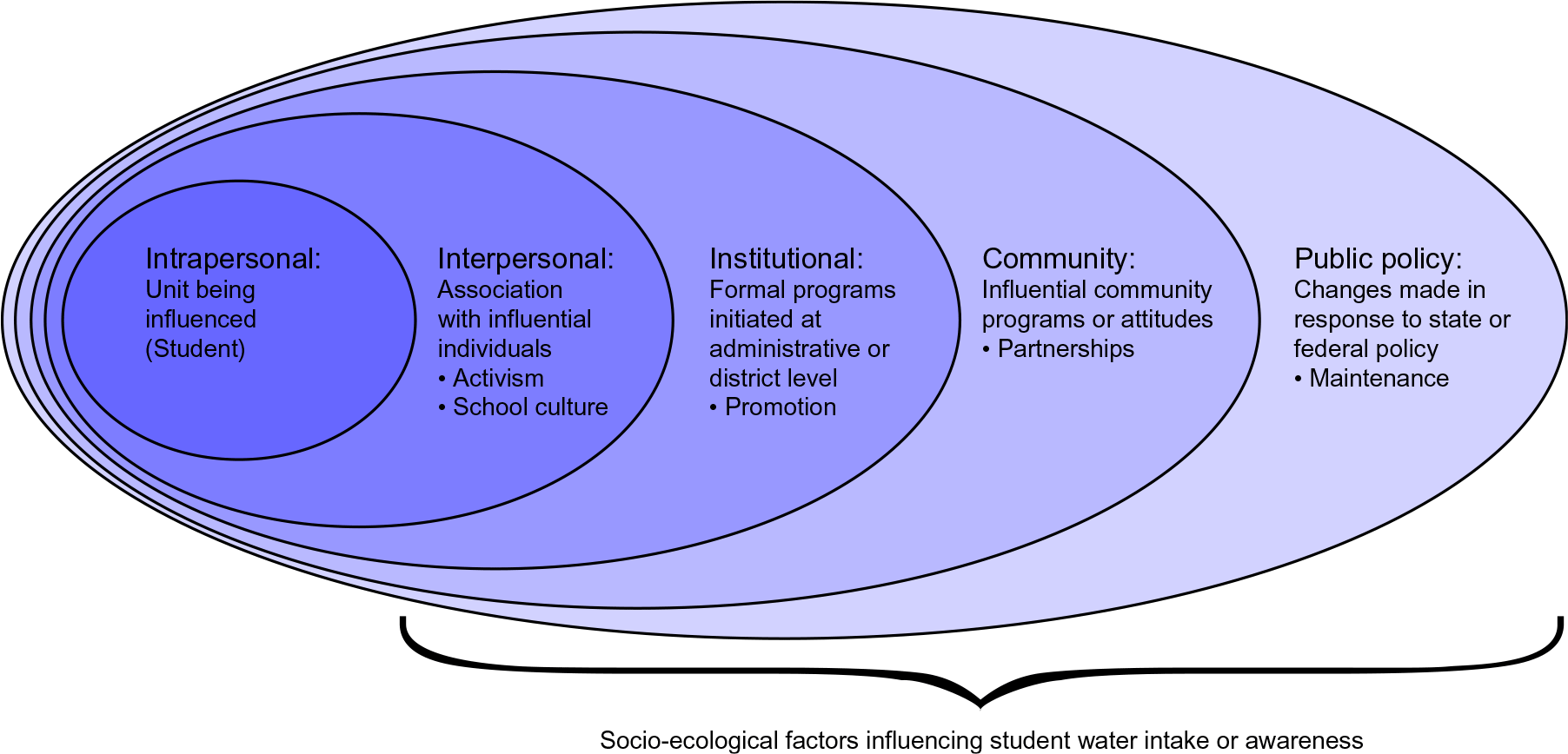
To narrow our pool of highest- and lowest-performing study schools to a manageable size for in-depth qualitative interviews, we used purposive sampling to select for highest- and lowest-performing schools based on activism, school culture, water promotion, community partnerships and strong maintenance programs. Selection criteria were identified by content area experts as important and diverse factors affecting water quality and accessibility in schools. High-performing schools were identified based on in-depth review of the fourty-two ‘excellent’ schools from the 2016 sample of 240 California schools. One member of our research team created a spreadsheet containing pertinent information describing each school, then three members of the research team met and identified schools that appeared to have incorporated one or more of the predetermined selection factors in an innovative and effective way. We then used the socio-ecological model (SEM)(33,Reference McLeroy, Bibeau and Steckler34) (Fig. 1) as a framework to guide our coding. Of the nine low-performing schools, the first five schools that respond also participated in the current study.
A socio-ecological framework of factors influencing students’ intake of drinking water in schools
All participating schools provided consent for this qualitative study. To recruit participants, we first called administrative assistants to provide a study overview and to schedule an interview with the principal. In the larger 2016 study of 240 California public schools, principals were the primary respondents surveyed about drinking water access, policies and practices on school campuses. Since the principal was the primary contact for the parent study, these administrators were also the first contact for this qualitative study. The principal was asked, however, to identify all respondents at the school who were knowledgeable about drinking water initiatives. We then used a snowball sampling approach(Reference Patton35) to contact additional respondents who were involved in water access, promotion or quality until we had reached all knowledgeable school representatives. Interviewees received a $10 gift card for participation.
A current master’s student and the first author of this manuscript (AYC) were trained and conducted telephone interviews lasting between 15 and 40 min. Interviews were audio recorded, transcribed and reviewed to remove personal identifiers and to confirm accuracy.
Instrument development
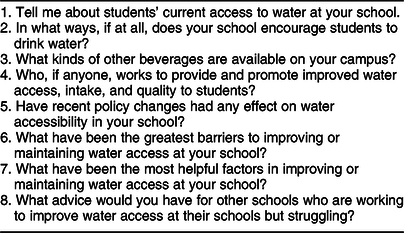
Three team members developed a semi-structured interview guide (Table 1) with discussion points based on selection criteria domains and a review of the literature for related studies. The interview guide was refined iteratively according to input from experts in drinking water intervention, policy research and qualitative research.
Interview guide: in-depth qualitative assessment of drinking water access in schools
Data analysis
Data analysis for the current study consisted of a hybrid approach utilising both deductive and inductive coding(Reference Patton35). This approach facilitated deeper exploration of the research aim by allowing the tenets of the SEM to be integral to the process of deductive thematic analysis while still allowing for themes to emerge directly from the data via inductive coding. Neither the original excellence criteria (e.g. density and location of drinking water sources) nor the selection criteria were incorporated into the analysis. Instead, four broad code categories were developed a priori, based on the research question and the SEM (school, district, community and policy levels) to allow for themes to emerge more organically, though still organised within these parameters provided by the SEM. Preliminary inductive analysis led to new code categories as they emerged from the interview content, as well as refinement of the previously defined code categories. Transcripts underwent several rounds of evaluation until a master codebook was developed.
Inter-rater reliability tests with accompanying discussion and adjudication were conducted throughout the coding process to check definitional drift(Reference Guest and MacQueen36,Reference Saldana37) . A pooled Cohen’s κ of 0·83 was achieved during the final coding process(Reference Campbell, Quincy and Osserman38).
After coding, researchers systematically inspected excerpts across all major codes to identify emergent patterns, connections and themes. Transcripts were organised and coded using Dedoose™(39).
Descriptive statistics are reported for the parent study of 240 schools, high- and low-performing schools and those schools in the current qualitative study in Table 3.
Results
We conducted a minimum of one and a maximum of six interviews with stakeholders at each school, leading to a total of thirty-one interviews and three email exchanges with separate personnel to obtain further information. Respondents included maintenance and facilities personnel, teachers, nutrition services staff and other district employees (Table 2). All high-performing schools participated. One low-performing school refused and was replaced by another low-performing school.
Stakeholders interviewed at California public schools with high and low excellence in drinking water quality and access, April 2018–Feb 2019
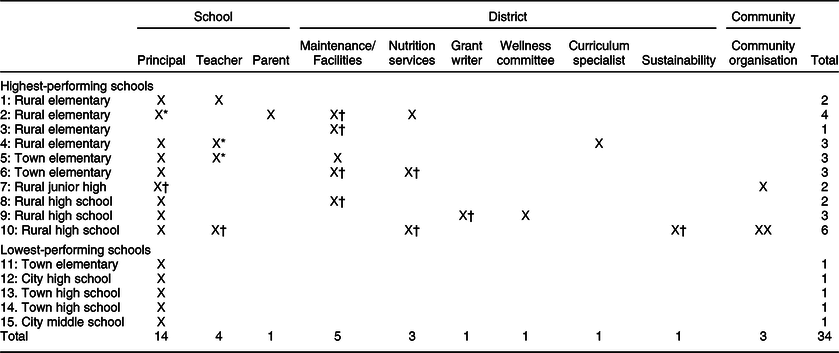
* Interview conducted via email.
† No audio recording – analysis conducted using notes taken during and directly following interview.
Many high-performing schools were rural, elementary, had lower numbers of enrolled students and had a smaller percentage of students eligible for free or reduced meals as compared with low-performing schools (Table 3). The majority of schools in the current study obtained water from a community water system; only two schools, both high-performing schools, had their own water supply. We found that all water systems in both the high- and low-performing schools were compliant with federal regulations; however, one of the low-performing schools was previously noncompliant to chloramine in 2012 and 2018. Three of fifteen schools tested water for lead through the mandated California lead testing program(22). Of these schools, two high-performing schools had no lead violations; one low-performing school found one drinking fountain with lead at 8 ppb, technically compliant with EPA standards (15 ppb for tap water) but above the U.S. Food and Drug Administration (FDA) standard for bottled water (5 ppb)(40).
Characteristics of study schools subsampled from study of 240 randomly sampled California public schools, 2016–2018
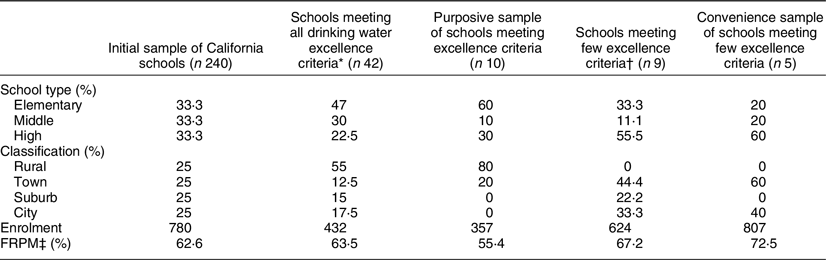
* Excellence criteria (top schools meet all 5):
1. Water sources in at least four of five key locations (food service area, classrooms, gym, outdoor physical activity areas, common areas).
2. One water source for every twenty-five students.
3. Non-fountain water sources that promote water intake.
4. Provision of safe and appealing water.
5. Clean and maintained water sources.
† Schools in this category meet 0 or 1 of the above criteria.
‡ FRPM, Free or Reduced-Price Meals (% students eligible).
School administrator descriptions of water access in their schools correlated with what was reported in our 2016 surveys. All had water available in the cafeteria, with high-performing schools reporting higher numbers and more varied water sources. School availability of beverages did not seem indicative of a school’s level of excellence providing water for students. One school in each of the high-performing and the low-performing groups had vending machines on campus which dispensed sports drinks and other lower sugar beverages. In addition to providing water, every study school interviewed also offered milk and juice at meal times.
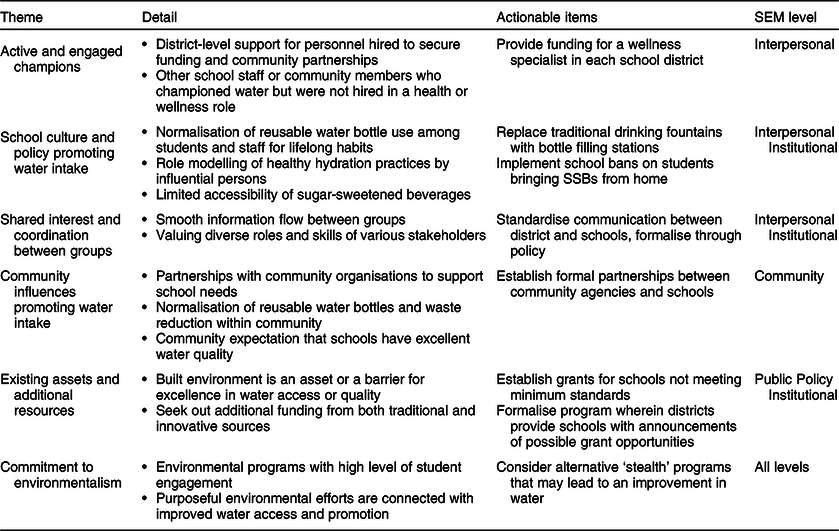
Six themes emerged as prominent facilitators to a school’s success in promoting healthy hydration habits to its students: active and engaged champions, school culture and policy promoting water intake, shared interest and coordination between groups, community influences promoting water intake, existing assets and additional resources and commitment to environmentalism. These themes correspond with the levels defined by the SEM (Table 4).
Themes, details, action items and corresponding socio-ecological model level from interviews with schools with highest excellence in drinking water access
Active and engaged champions
All successful water programs were propagated by a passionate and driven champion. Champions fell into two categories: (i) district personnel hired specifically to secure funding or community partnerships to improve student wellness or (ii) school staff or community members who championed water but were not hired in a health or wellness role. Champions were always well-integrated into the school network and had sufficient influence to move the project forward. A rural elementary school respondent described how para-educators advocated for enhanced water access:
The noon-duty staff came and said, you know, the kids … they’re not getting enough water to drink when they’re outside playing. Could we ask the cafeteria staff to move our water dispenser outside? And so they do it. So my noon-duties come a little before recess and they move the water dispenser outside and you know bring it back in at the end of lunch. (School 4, principal)
Students were also commonly cited as drivers of change. Student motivation often stemmed from curricula centred on health or environmentalism. At a rural high school, the principal reported that the AP environmental science class wrote a grant to a local agency to fund water bottle filling stations (School 10).
Some low-performing schools also had athletic coaches or teachers who recognised the importance of water and encouraged its consumption. However, none of these efforts spread beyond the individual sports team or classroom to influence a school-wide program. Most low-performing schools seemed uncertain about who, if anyone, was monitoring the condition of fixtures at their school and maintaining acceptable water quality and accessibility.
School culture and policy promoting water intake
Administrators at high-performing schools were conscientious about creating an environment in which drinking healthy beverages was the easy choice. The principal of rural elementary school #4 noted, ‘a lot of things can be cured with water… so we’ve added that to our repertoire, along with band-aids and ice packs’.
Six high-performing schools had implemented complimentary reusable water bottle distribution programs for students, and all ten high-performing schools had recently replaced traditional drinking fountains with water bottle filling stations, thereby establishing a norm of reusable water bottle use among students and staff for lifelong habits. A healthy hydration culture was further reinforced through school staff role-modelling and limited accessibility of sugar-sweetened beverages (SSBs).
The kids learn it’s fun to fill the bottle of water, but then they drink it, so it becomes a natural thing to hydrate. So it starts at the elementary level, … then it becomes the norm as they progress in age. We’re going to fill our bottles at the purifier. It’s a larger volume of water – it’s not like a fountain where you have a little stream. It encourages them to drink water. It becomes a natural part of their day (School 3, facilities director).
Low-performing schools commonly stated that teachers and athletes carried water bottles, and many made admirable efforts to promote the cause, even using their own resources. For example, one low-performing elementary school had a group of teachers who fundraised to provide students in their classrooms with reusable water bottles for use throughout the year. However, these efforts did not translate into school-wide adoption of these practices, with one principal going so far as to say, ‘Kids don’t like tap water. A lot of adults don’t like water. So they’d rather go ahead and buy something’ (School 14, principal).
Shared interest and coordination between groups
Principals at nearly all high-performing schools noted clear communication from their district regarding the scope and timing of projects related to drinking water source improvements or testing. Principals at low-performing schools generally had little to no information about such projects and stated that the district would alert them if there were any problems. Low-performing schools frequently were frustrated with malfunctioning water fixtures that went unrepaired for extended periods. While a lack of funding or competing priorities likely contributed to such delays, a lack of communication between schools and the district likely heightened frustration with district response times.
Establishing and supporting a healthy hydration culture in schools goes beyond providing safe and appealing drinking water. In high-performing schools, improvements in physical access to drinking water were often accompanied by education and promotion to encourage water intake. Such efforts often involved a coordinated effort among diverse stakeholders within the school, district and community and a recognition of the values and diverse roles and skills that these different groups brought to the table.
If we’re gonna be saying bring water bottles, we want to have stations that make it all easier. And that’s in the best interest of the public utility and water suppliers here… And so they use it in their conservation and education money, to say, we’ll provide the stations, and then facilities, the school district facilities, says, ‘okay, we’ll find some funding… and we’ll make sure we put a station in instead of a drinking fountain or a combination thereof’. And then [the watershed alliance] says, ‘we promise to do the education part of it’, (School 10, community watershed education director).
Community influences promoting water intake
High-performing schools regularly sought out and established partnerships with community organisations to support their needs. Five of the high-performing schools in the current study mentioned specific community organisations and the importance that these partnerships played in supporting their water programs. Partnerships led to enrichment of educational curricula, donations of reusable water bottles or deliveries of bottled water when drinking water was contaminated or fixtures were nonfunctional.
Community norms, such as an emphasis on clean water, use of reusable water bottles or waste reduction also influenced school water programs. One school sought out a grant to fund installation of water filters due to the community’s wariness of water quality and the expectation that schools should have excellent water quality:
Twenty years ago, there was a leak at a gas station in town and it contaminated the water and so people have always been very suspicious. It was contaminated with benzene, so people have always been very suspicious of the water, me included. So they were able to clean it up and fix it and all, but still, it’s that feeling of you never know. It happened once and it can happen again, right? So it was really important to us to get the filtered water. (School 7, grant writer)
Low-performing schools did not mention partnerships with community organisations as influential in shaping their existing school water programs.
Existing assets and additional resources
The built environment within schools can be either an asset or a barrier to achieving excellence in drinking water access. All high-performing schools had recently installed water bottle filling stations, and many mentioned their stations contributed to their excellent water access and healthy hydration culture. Another built environment asset is that schools with a greater number of existing water fixtures may have an advantage as older drinking water fixtures can be modernised at a lower cost. Indeed, lower-performing schools often reported having fewer water fixtures, putting them at a disadvantage since accessing new water lines is cost prohibitive for many schools.
All of the highest-performing schools procured some type of funding to support healthy hydration efforts. Many used grant money that was awarded specifically for improving drinking water fixtures. Other schools utilised bond measures or identified water access as a priority on the school Local Control and Accountability Plan (a blueprint that describes goals, actions and resources needed to support positive student outcomes). One school used funds from an update of the state science curriculum and a settlement from a nearby wildfire to support improvements in school drinking water.
Though all low-performing schools provided free, safe drinking water to students, they commonly reported issues with appeal and reliability of school water fixtures as barriers. Specifically, respondents noted that non-refrigerated drinking fountains in warm climates and drinking fountains with low water pressure led to low water intake at school. These schools were often unable to prioritise drinking water accessibility and quality due to other competing demands on funding and time:
… I don’t hear people talk about water here. I hear people making sure people have enough sleep. We open up at 7:15. We have migrant workers and a lot of their families leave their house at 5:00 in the morning so we make sure they always have enough food… Nutrition is very, very important. (School 14, principal)
Commitment to environmentalism
Interestingly, four high-performing schools in the current study had large environmental programs with high levels of student participation. Environmentalism was a cause that students and the community were often enthusiastic about rallying around, leading to an increase in social and material support. One community partner who ran environment and sustainability clubs in multiple schools explained that environmental efforts and improved drinking water access go hand-in-hand.
Students are involved in lunch room audits as well as campus-wide recycling audits and we often see the common issue of plastic drinking containers. And so once the kids see those and get a sense of how many of those are being produced on campus and start doing the math of what that looks like throughout the year, then that’s something that they typically take on as a project. Like, hey, that’s a no-brainer. We can implement water bottle filling stations and have reusable bottles. (School 10, community watershed project director)
More than one district representative noted that high levels of student engagement helped promote school wide buy-in for environmental causes, including use of reusable water bottles, among other students.
So that’s a very visible thing. Those students are going to the local schools and putting on these [environmental] shows annually. So sort of an unintended consequence is that the kids just love it and they want to be part of it, which is not something we were anticipating when we started the club. (School 10, community watershed project director)
Discussion
To our knowledge, this is the first in-depth qualitative study to explore factors influencing a school’s ability to meet excellence in water access and quality for students. The six themes that emerged from the data correspond to multiple levels of the SEM (Table 4). Students’ water intake is influenced not only by interactions with faculty and staff within the school but also by water promotion programs initiated by the district, cultural values within the community and state or federal funding and policies. This reinforces the primary tenet of the SEM, which is that behaviour and practices affect, and are affected by multiple levels of the environment(Reference McLeroy, Bibeau and Steckler34). Keeping this in mind, it is almost certain that high- and low-performing schools face different challenges. Implementation of new school initiatives is complex, requiring an individual recipe for each school, due to the unique facilitators and barriers to programs present at the community, school and individual levels. In the current study, we hypothesise that low-performing schools, which tended to be larger and more urban, were probably dealing with more pressing issues (i.e. drugs, homelessness, violence) and had inadequate staffing, supplies and funding to put towards drinking water initiatives(Reference Hudley41).
Though monetary resources may appear to be the most obvious barrier faced by schools in upgrading drinking water access, it was rarely mentioned directly by school administrators and staff. Much more frequently mentioned were the ongoing maintenance of existing fixtures, competing priorities and student attitudes toward water. In schools with an active champion, where water was identified as a priority, funding appeared to be fairly easily procured through a grant or community partnership.
The current study was prompted in part by policies that required schools to provide water in food service areas, but policy was rarely mentioned by interviewees. This suggests that while policies can and should provide a foundation for improving water quality and access in schools, grassroots school and community efforts can have an added impact.
The six themes that emerged through thematic analysis are interconnected. Champions are key for procuring additional resources and establishing community partnerships. Coordination between groups, which is often facilitated by champions, can help schools capitalise on existing assets, acquire new resources and more efficiently implement programs. Finally, platforms, such as environmentalism, promote widespread buy-in and engage diverse school stakeholders, including students, teachers, facilities and school administrators. These platforms can indirectly lead to improvements in drinking water quality and access.
The importance of a champion for change and innovation is supported in the literature in various fields including but not limited to patient safety, quality improvement, nutrition and healthcare reform(Reference Soo, Berta and Baker42–Reference Shaw, Howard and West44). One concern is that some schools may have difficulty identifying a champion and sustaining the champion’s efforts over time. For this reason, instead of relying on temporary volunteers, funding to support a health and wellness coordinator or grant writer could help ensure that student well-being is addressed on a long-term basis.
The power of bringing together individuals or groups from multiple disciplines to address key issues is supported by the tenets of Collective Impact Approach(Reference Kania and Kramer45). Schools with the highest excellence in drinking water quality and access noted that coordination among key groups allowed for the best use of each group’s strengths and resources, particularly when a champion leads and coordinates the effort. A highly engaged nutrition department may focus on the harms of SSBs, but if school administration is not on board or aware of the campaign, drinking fountains may not be maintained, promotional messages will not be reinforced and students will not receive promotional messages.
In the current study, high-performing schools addressed water quality and access indirectly through another distinct but related cause. As noted, many schools with excellent drinking water cultures had environmentally active schools and communities. Promoting school water access due to environmental concerns rather than focusing on the potential health impacts parallels the ideology behind the ‘stealth intervention’ or the concept that health behaviours are more readily changed through focusing on a separate but related social, cultural, ethical or environmental issue(Reference Robinson46). Another stealth strategy that may engage administrators and teachers is focusing on the positive effects of hydration on student learning and memory(Reference Bar-David, Urkin and Kozminsky5,Reference Benton and Burgess6) . As the environmental or academic focus gains traction within the school community, water becomes integrated into the culture. It becomes natural for students to think about drinking water, where it comes from and why it is important.
School demographic characteristics and implications
Among the schools participating in the current study, high- and low-performing schools represented markedly different groups of schools, which provide additional insight into factors contributing to water excellence. Rural and elementary schools were vastly overrepresented among highest-performing schools. This may be due to the fact that in rural areas, schools also tend to be more integrated with the community(Reference Schafft47), providing community members with a greater opportunity to support or champion changes in school practices.
Elementary schools and rural schools, which typically have lower enrolment numbers than other types of schools, may face less red tape in effecting change. Smaller schools may also have fewer water sources and fixtures, making it easier to modernise and maintain them. Finally, elementary schools may be overrepresented because young children are more reliant on adults to provide physical care for them, leading to greater efforts to provide easily accessible, appealing and potable water in these settings.
Limitations
Our study has several limitations. First, while valuable, the current study did not investigate student and parent perspectives. Because water consumption is not only reinforced by school culture but also by attitudes and behaviours of students and parents, it is important to examine the viewpoints of these other stakeholders. Second, social desirability response bias(Reference Fisher48), in which participants misrepresent their improvement efforts to provide desirable answers, may be a concern. To protect against this, we interviewed multiple personnel at each site and monitored the consistency of responses across respondents. Finally, due to the purposive selection of schools within California, study findings may not be generalisable to all schools.
Conclusions
Public policy plays an important role in setting and achieving minimum standards for water quality and access in schools. The current study suggests that achieving an excellent drinking water culture, however, requires additional internal or external resources such as committed champions, coordinated and structured collaboration among diverse stakeholders and supportive cultures or ideologies. Because resources and interest vary among schools, district support for additional staff working to advance student health and wellness may be needed to reduce disparities in drinking water excellence across schools, particularly in schools with large enrolment numbers. The current study also suggests that strategies akin to ‘stealth interventions’ may be worth exploring to advance student wellness initiatives.
Acknowledgements
Acknowledgements: The authors wish to thank the schools and key informants that participated in the study. The authors also wish to thank Kevin Lee from California Food Policy Advocates and Karla Hampton, Intuitive Mind Consulting, LLC, for reviewing the interview guide. The authors gratefully acknowledge Sylvia Bereknyei Merrell for her guidance with the data analysis software. Financial support: This research was supported by a Robert Wood Johnson Foundation Healthy Eating Research Program grant, #73248. Conflict of interest: None. Authorship: A.I.P. formulated research question; A.Y.C. and A.I.P. designed study; A.Y.C., E.A., C.E.H., J.B. and A.I.P. designed research tool; A.Y.C. conducted the interviews; A.Y.C. and E.A. analysed data; A.Y.C. and A.I.P. wrote the paper, and all authors edited the paper. Ethics of human subject participation: The current study was conducted according to the guidelines laid down in the Declaration of Helsinki, and all procedures involving research study participants were approved by the Institutional Review Board at Stanford University. Verbal informed consent was obtained from all subjects. Verbal consent was witnessed and formally recorded.



