

Hostname: page-component-77f85d65b8-grvzd Total loading time: 0 Render date: 2026-04-18T10:05:48.843Z Has data issue: false hasContentIssue false

Dynamic and stationary shapes of rotating toroidal drops in viscous linear flows

Published online by Cambridge University Press:  21 July 2021

Sumit Malik
Affiliation:
Department of Chemical Engineering, Technion-Israel Institute of Technology, Haifa 3200003, Israel
O.M. Lavrenteva
Affiliation:
Department of Chemical Engineering, Technion-Israel Institute of Technology, Haifa 3200003, Israel
A. Nir*
Affiliation:
Department of Chemical Engineering, Technion-Israel Institute of Technology, Haifa 3200003, Israel
*
Email address for correspondence: avinir@tx.technion.ac.il

Abstract

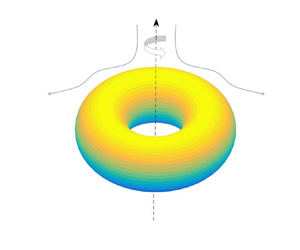
Dynamic and stationary axisymmetric deformation of viscous toroidal drops submerged in slow viscous flow are studied numerically. The immiscible ambient fluid is subject to a combination of rotation and extensional/compressional (biextensional) flow. The creeping flow approximation is assumed. The numerical simulations are performed with the help of the boundary integral method. The process under consideration is governed by three dimensionless parameters: the capillary number that characterizes the ratio of viscous and surface tension forces; the Bond number, that characterizes the ratio of centrifugal and surface tension forces; and the ratio of viscosity of the two fluids. Our simulations for the equal viscosity case demonstrated that, depending on the governing parameters, the toroidal drop either collapses, extends indefinitely or it attains a stationary toroidal shape. The latter may be stable or unstable with respect to axisymmetric disturbances. Conditions for the realization of each of the dynamic regimes and stationary states in terms of governing parameters are presented. In particular, stable toroidal shapes result under the combined action of rotation and extensional flow, and were not found under the action of rotation and compressional flow.

Information

Type
JFM Papers
Copyright
© The Author(s), 2021. Published by Cambridge University Press

Access options

Get access to the full version of this content by using one of the access options below. (Log in options will check for institutional or personal access. Content may require purchase if you do not have access.)

Article purchase

Temporarily unavailable