

12.1 Introduction
Sustainability transitions are about societal transformation and involve structural changes in existing structures and regimes. If transitions require – by definition – regime change, as much of the state-of-the-art would argue, then it follows that transitions inherently involve changes in power relations. Hence, understanding power – what it means, how it works and how it changes – is an important prerequisite for understanding transitions. However, the field of sustainability transitions has been elaborately critiqued for ignoring or downplaying the role of power in processes of innovation and transition, and how this relates to an underdeveloped understanding of the role of politics, actors and decision-making (e.g. Hendriks, Reference Hendriks2009; Scoones et al., Reference Scoones, Leach and Newell2015; Smith and Stirling, Reference Smith and Stirling2010; Shove and Walker, Reference Shove and Walker2007; Meadowcroft, Reference Meadowcroft2009; Voß et al., Reference Voß, Smith and Grin2009; Kern, Reference Kern2011; Hess, Reference Hess2013). Some of these critiques are accompanied by attempts to conceptualise power in relation to innovation and transitions, often in the energy context (e.g. Ahlborg, Reference Ahlborg2017; Avelino, Reference Avelino2017; Brisbois, Reference Brisbois2019; Geels, Reference Geels2014; Hoffman, Reference Hoffman2013; Sovacool and Brisbois, Reference Sovacool and Brisbois2019).
Notwithstanding this increasing attention to notions of power, research that empirically analyses transitions in explicit power terms has remained scarce. This is problematic because much research about transitions tends to revolve around issues of power, that is individuals, organisations and systems’ (in)capacity to mobilise various types of resources to achieve a certain goal. A more systematic use of power concepts could provide insights into the socio-political dynamics of transitions. In this chapter, we will shortly discuss the state of the art of power discussions and propose two conceptual frameworks to analyse different dimensions of power. We illustrate these power frameworks with case studies of Community Supported Agriculture. Last but not least, we discuss challenges for future research on power in transitions.
12.2 A Short History of the Power Concept
Amongst debates about the meaning of power and the best ways to study it, most scholars tend to agree that power is relationally constituted and that it ‘resides in the social context’ (Barnes, Reference Barnes and Haugaard2002, p. 127). As Clegg puts it, people ‘possess power only insofar as they are relationally constituted as doing so’ (Reference Clegg and Haugaard1989, p. 257). This means that when the social context changes, power relations are bound to change as well, and that as such, changing power relations form an inevitable dimension of social change and innovation. While most power scholars agree that power is inherently relational, they fiercely disagree on how such power relations should be understood and studied.
Providing a state-of-the-art overview of power theories is a challenging task, because power is one of the most contested concepts in social and political theory. Power definitions range from actor-specific resources used in the pursuit of self-interest (Weber, Reference Weber1946) to the capacity of social systems to mobilise resources for collective goals (Parsons, Reference Parsons and Haugaard1967). There are many debates about how we should define and understand power. For instance, political theorists like Foucault (Reference Foucault1980, Reference Foucault1982) [A1] have focused on structural power over, that is how structures exercise power ‘over’ actors, while others like sociologist Parsons (Reference Parsons and Haugaard1967[A2]) and political philosopher Arendt (Reference Arendt and Haugaard1979)[A3] have focused more on power ‘to’ as a capacity of actors and collectives. Another considerable contestation in the history of power debates in political science is the question of how and to what extent power is centred or diffused. Dahl[A4] (Reference Dahl and Haugaard1968) argued that centralised power as a king or monarch had it in the past has become decentralised in modern democracies. Bachrach and Baratz (Reference Bachrach and Baratz1962) [A5] on the other hand pointed out that also in democracies, there is still the power of agenda-setting and of agenda-setting elites. Moreover, Lukes (Reference Lukes and Haugaard1974) [A6] argued that there is also the more invisible power of preference shaping, a process in which preferences and choices can be manipulated. There are many more debates about power, whether it is consensual or conflictual, constraining or enabling and the extent to which power preceding knowledge or shapes knowledge (see Avelino Reference Avelino2021). Within these many contestations about power, we argue that rather than ‘choosing sides’ within these power debates or attempting to ‘solve’ them, we need to acknowledge these power contestations as different dimensions of power (ibid.). When we do this, we can define power in a broader and open way as the (in)capacity of actors to mobilise means to achieve ends (ibid.). Here, the use of the double meaning ‘(in)capacity’ serves to recognise that capacity by one actor at one level can imply incapacity elsewhere, and that power is both enabling and constraining (cf. Follet, Reference Follett1998; Foucault, Reference Foucault and Haugaard1977). More relevant than such a generic definition, however, is to then further enriches this broad notion of power with a more context sensitive, complex set of dimensions and to operationalise different dimensions of power into a research design.
There are a broad range of multi-dimensional power frameworks in power studies, which aim to synthesise different perspectives on power. Two notable examples include the three circuits of power by Clegg (Reference Clegg and Haugaard1989), distinguishing between relational, dispositional and structural power, and the four dimensions of power by Haugaard (Reference Haugaard2012, Reference Haugaard2020), which distinguishes between (1) power as violence, coercion and authority, (2) power conflicts over structures and dominant ideology, (3) the social construction of norms, knowledge and consciousness and (4) the ‘making of the social subject’ that is processes of subjectification. In the field of sustainability transitions, several authors have built on these and other power frameworks to explore different dimensions of power in transition processes. For instance, Grin et al. (Reference Grin, Rotmans and Schot2010) relates Clegg’s concepts of power to the multi-level perspective on transitions, arguing that ‘niches’ exercise relational power, while dispositional power is exercised at the level ‘regimes’ and structural power at the level of the so-called landscape. In turn, Geels (Reference Geels2014) builds on Grin et al. (Reference Grin, Rotmans and Schot2010) and several others, to distinguish instrumental, discursive, material and institutional forms of power exercised specifically by regime actors to resist transformative change.
Insightful as these frameworks may be, one of the challenges in existing concepts and framework of power is that they tend to focus on (the interaction with) regime structures and power elites. Therefore, in this chapter, we focus on sharing two power frameworks that take a more relational and complex perspective on different dimensions of power. Both frameworks draw on debates on power within political sciences and sociology and have been applied to the field of sustainability transitions, as we explain in Sections 12.2 and 12.3. Specifically, both frameworks deviate from the understanding of power as a resource, something owned and exercised by agents independently of their embedded context, which implies a static manifestation of power that is incompatible with the changing dynamics inherent to sustainability transitions. However, they offer two different approaches to the concept, illuminating different power dimensions that shape the winners and losers of sustainability transitions, and configure structural barriers or opportunities for change. By applying these two frameworks, we show the diversity of power analyses possible in sustainability transitions research.
First, we introduce the distinction between power to, power over and power with. This framework is exclusively related to the realm of human agency and analyses how power relations between actors (can) change over time and influence the process and outcomes of sustainability transitions. Then, we introduce a typology of power that includes three distinct and interrelated types of relational power: (1) The power of intentional actions and abilities of human actors (i.e. action-theoretical power), (2) the co-constitution of power during interactions between human and non-human actors (i.e. constitutive power) and (3) the influence of historical and situated processes on all forms of agency and power relations (i.e. systemic power). This typology decentralises the analysis from human exercise of power to also examine how human and non-human interactions and historical processes configure power relations that enable or constrain sustainability transitions.
12.2.1 Power to, Over and With
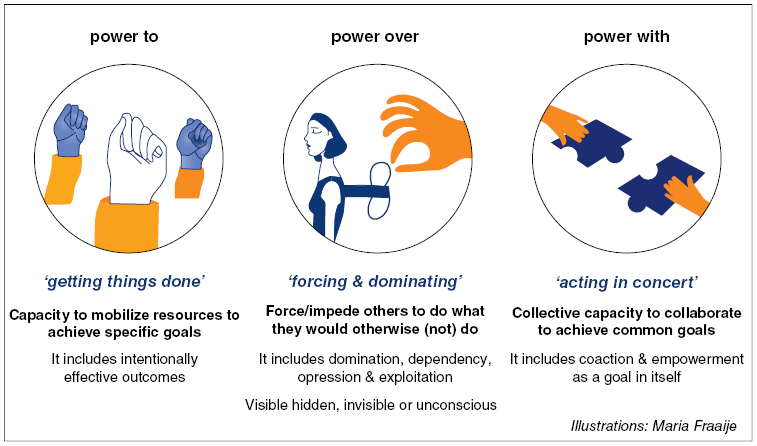
We propose to focus on the distinction between power to, over and with, following the work of authors such as Partzsch (Reference Partzsch2017), Pansardi and Bindi (Reference Pansardi and Bindi2021) and Avelino et al. (Reference Avelino, Hielscher, Strumińska-Kutra, de Geus, Widdel, Wittmayer and Crudi2023). While power over refers to an asymmetrical relation between two or more actors or groups of actors, power to consists of the ability of the actor herself to carry out certain specific outcomes, and power with refers to the ability of a group to act together in view of collective outcomes or goals (Pansardi and Bindi, Reference Pansardi and Bindi2021).
Power is derived from the Latin word potere – ‘to be able’. Some argue that power ‘is always a concept referring to an ability, capacity or dispositional property’ (Morriss, Reference Morriss2002, p. 283). Such understandings of power as capacity are referred to as power to perspectives. Power to refers to the capacity to intentionally mobilise resources and/or to achieve specific goals, that is ‘getting things done’, which includes intentionally affecting outcomes. Theories that focus on power to as a capacity include definitions of power as the capacity of humans to act in concert (e.g. Arendt, Reference Arendt and Haugaard1979) or the capacity of systems to achieve collective goals (Parsons, Reference Parsons and Haugaard1967). These theories are criticised for ignoring the relational or oppressive aspects of power ‘over’ others (Lukes, Reference Lukes and Haugaard1974). Understandings of power to are also criticised for ‘fail[ing] to account for individuals or groups in the community who, though they do not exercise power, nonetheless have power, in the sense that many people try assiduously to anticipate their reactions’ (Dahl and Stinebrickner, Reference Dahl and Stinebrickner2003 in reference to Bachrach and Baratz, Reference Bachrach and Baratz1962). Or in other words, even when actors are not intentionally exercising ‘power to’ achieve a goal, they can still be involved in the exercise of structural power, also referred to as ‘power over’.
Such power over perspectives have a more structuralist focus on coercion, force and domination, which includes forcing others to do things they would not do otherwise, or the constraining of agency by impeding structures. Power over includes processes of coercion, domination, dependency, oppression and exploitation, and it can manifest in different, more or less transparent ways, including visible, hidden and invisible as well as unconscious ways. Structural power can be both centred and authoritative as well as more subtle and diffused. While authoritative power ‘comprises definite commands and conscious obedience’, diffused power ‘spreads in more spontaneous, unconscious, decentred ways throughout a population, resulting in similar social practices that embody power relations but are not explicitly commanded’ (Mann in: Stewart, Reference Stewart2001, p. 25). An essential trait of diffused power is ‘normalisation’, that is the belief that certain practices are ‘moral’ or in the ‘common interest’, which relates to Luke’s (Reference Lukes and Haugaard1974) idea of power as preference-shaping, and to various discursive interpretations of power as found in Foucauldian analysis. The ability of oppressing without blunt violence is regarded by some as the essential characteristic of power over. According to Foucault ‘power is a form of pacification which works by codifying and taming war through the imposition of particular knowledge as truth’ (Foucault, Reference Foucault and Haugaard2002, p. 185). Here, it is relevant to acknowledge that power over is not necessarily a negative or undesirable phenomenon. As argued by Haugaard when discussing what he calls the second dimension of power: ‘Contrary to common sense perception, the exclusion of certain forms of decisions through structural constraint is not inherently normatively reprehensible, and two-dimensional power does not necessarily entail domination. In fact, as an empirical process, the second dimension of power constitutes one of the conditions of possibility for justice’ (Reference Haugaard2012, p. 40).
Power with is a third dimension (cf. Partzsch, Reference Partzsch2015; Pansardi and Bindi, Reference Pansardi and Bindi2021). Power with is about the collective capacity to collaborate to achieve collective goals, and includes co-action and empowerment as a goal in itself. From a power with perspective, actors can enhance their joint power, as is the case in Parsons’ definition of power as the capacity of a societal system to achieve collective goals (Reference Parsons and Haugaard1967, p. 93). This notion of power with builds on Arendt’s interpretation of power as ‘the human ability not just to act but to act in concert’ (Reference Parsons and Haugaard2002, p. 137). With this definition, Arendt emphasises that: ‘Power is never the property of an individual; it belongs to a group and remains in existence only so long as the group keeps together. When we say of somebody that he is ‘in power’ we actually refer to his being empowered by a certain number of people to act in their name’ (ibid.). As such, an important difference between power to and power with is that in power with, the aspect of coaction and empowerment are both conditions and goals of power in and of themselves. As such, in power with, the sharing of power, as a goal, supersedes more individual goals aspired to in the exercise of power to. As emphasised by Partzsch, in reference to Arendt: ‘Finding agreement becomes an end in itself and does not (only) serve the assertion of particular interests’ and ‘the actions of individuals (and their self-interests) are not irrelevant in processes of power with; however, individuals only unfold their power when acting together with others’ (Partzsch Reference Partzsch2015, p. 195).
Taken together, power to, over and with can be used to explain persistence of the status quo as well as change when studying innovation and transitions. While they are distinct, they are not exercised independently from one another. In analysing how these different types of power are intertwined (Partzsch and Fuchs, Reference Partzsch and Fuchs2012), we gain deeper insights into the dynamic interplay between different kinds of actors and initiatives, representing diverse interests, values and agendas.
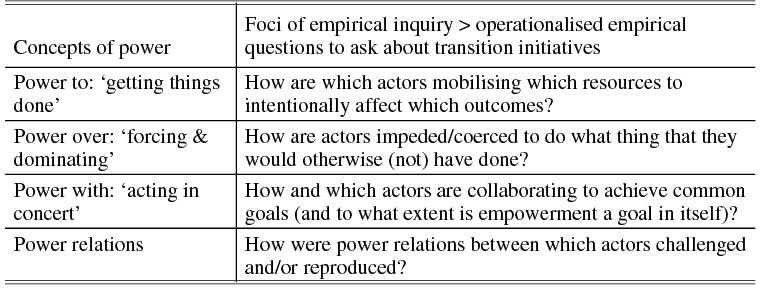
We see the interplay of power to/over/with as a conceptual tool that can be used across disciplines and beyond academia to increase inter- and transdisciplinary understanding of power dynamics in transitions. As such, we conclude with a conceptual framework that uses the three dimensions of power. The purpose of Figure 12.1 is to synthesise debates about power, as discussed above, in three accessible and recognisable notions of power. The point of this conceptual framework, as visible in Table 12.1, is not to treat power to/over/with as separate or static characterisations of power exercises at one point in time. Rather, the aim is to also acknowledge how these different dimensions of power relate to each other and to gain understanding of how power relations (can) change over time, including power to/over/with relations.
Visual conceptualisation of power to, power over and power with

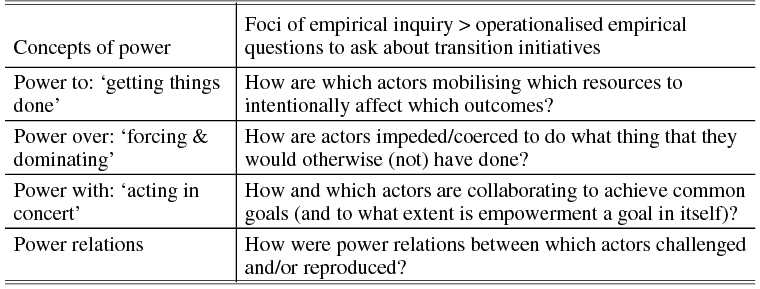
In addition, these three notions of power were applied to formulate empirical questions to study initiatives that aim to contribute to sustainability transitions, hereafter referred to as transition initiatives. Section 12.2.2 will illustrate how these questions were answered for a transition initiative.
12.2.2 Three Relations of Power
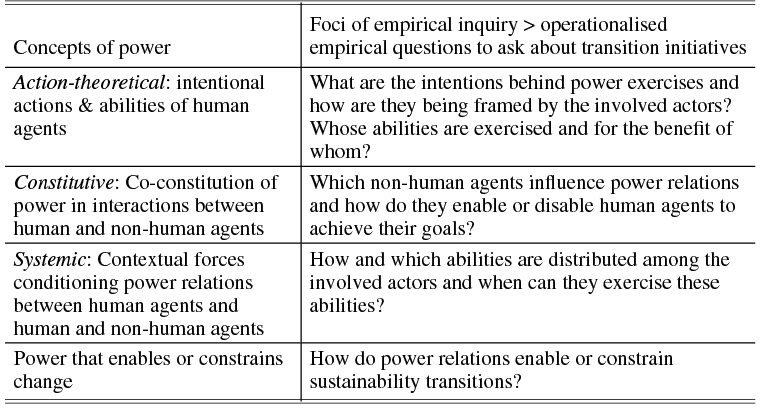
Another framework that captures different dimensions of relational power is suggested by Allen (Reference Allen and Zalta2021). This framework is based on a thorough review of political and social sciences debates on power and suggests that one’s power is defined through her/his/their position in a system of social and material relations and during interactions with other actors and social structures. A typology of three relations of power emerge from this approach and distinguishes power as the intentional actions and abilities of one person in relation to another (i.e. action-theoretical power) and to nonhuman agents (i.e. constitutive power) and the influence of contextual factors conditioning these relationships (i.e. systemic power). Following different applications of this typology of power in sustainability transitions (Ahlborg, Reference Ahlborg2017; Raj et al., Reference Raj, Feola, Hajer and Runhaar2022, Reference Raj, Feola and Runhaar2024), we discuss each relation of power below.
Action-theoretical power is exclusively related to the power of human agents, and its focus is two-fold: their intentional actions or personal abilities. First, the focus on actions invites us to analyse the intentions behind one’s exercise of power towards others and the surrounding environment. This approach is linked to the ‘power to, over and with’ framework presented earlier. For example, in the context of conflict, someone may intend to act or refrain from action (power to), which can take form as dominance (power over) or joining forces to resist domination (power with). Second, the focus on personal abilities highlights the attributes of human agents that may be exercised depending on the situation. For example, elite actors have decision-making abilities that can be more easily exercised in political disputes. Within the context of sustainability transitions, examples of action-theoretical power include collaborative actions exercised by grassroots initiatives to resist government’s decisions and push forward their bottom-up agenda on agri-food transitions (Laforge et al., Reference Laforge, Anderson and McLachlan2017). Also, the strategies and tactics of grassroots initiatives to align the interests of internal members, to mobilise crucial resources and seize opportunities to achieve their goals are also examples (Gregg et al., Reference Gregg, Nyborg, Hansen, Schwanitz, Wierling, Zeiss and Gilcrease2020).
Constitutive powercorresponds to the ‘fundamentally transindividual and relational ways in which individuals and the social worlds they inhabit are themselves constituted by power relations’ (Allen, Reference Allen and Zalta2021, p. 3). This approach to power highlights how various elements interact within a system, shifting focus from just human agents and expanding the constitution of power to emerge also during interactions between human and non-human agents. Put simply, constitutive power refers to nonhuman elements that can co-constitute human’s capabilities (e.g. the hammer in the hand of a worker) or constrain them (e.g. complex technical devices that unskilled people cannot use). Analysing constitutive power is important for sustainability transitions studies as it enables us to examine how the relationship between human agents and sustainability infrastructure and technology may lead to success, or failure of, socio-technical interventions. These dynamics have been illustrated in the case of energy and water infrastructure influencing sustainability transitions in Spain (Castan Broto, Reference CastanBroto2016) and gender and class inequalities entrenched in technology access in energy transitions in Tanzania (Ahlborg, Reference Ahlborg2017).
Lastly, systemic power refers to ‘the ways in which broad historical, political, economic, cultural and social forces enable some individuals to exercise power over others, or inculcate certain abilities and dispositions in some actors but not in others’ (Allen, Reference Allen and Zalta2021, p. 3). This perspective of power draws our attention to contextual forces that condition power relations within a given system. For example, systemic power is manifested through culturally institutionalised practices, legal frameworks and discourses that condition power relations. The historical development of these apparatuses, and their geographical situatedness, has reflected and reinforced structures of oppression within our societies. As such, systemic power refers to hierarchical relations among different genders, classes, races, sexualities and other social markers of difference that produce unequal distribution of abilities and opportunities among agents. Like other frameworks of power in sustainability transitions, systemic power is aligned with a systems thinking approach and unveils how agency in innovation processes is empowered or hindered by social conditions historically constituted and geographically situated (Grin et al., Reference Grin, Rotmans and Schot2010; Castan Broto, Reference CastanBroto2016; Swilling et al., Reference Swilling, Musango and Wakeford2016; Ahlborg, Reference Ahlborg2017).
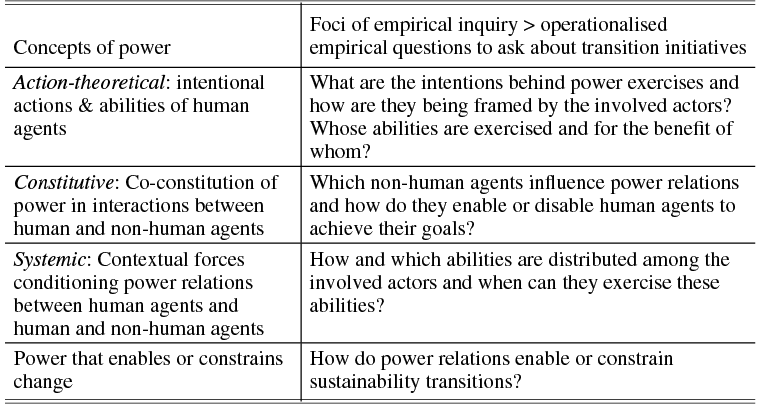
The analytical purpose of the three relations of power framework lays in shifting attention to the emerging and productive nature of power relations and how they are configured according to the social, cultural, economic and political context within which they are embedded (Allen, Reference Allen and Zalta2021). This framework, as visible in Table 12.2, provides a nuanced and critical examination of the contextual circumstances under which power relations emerge and provide the conditions for societal change to unfold (i.e. power enabling sustainability transitions) or create barriers for societal change, or to some aspects of it (i.e. power constraining sustainability transitions).
12.3 Empirical Illustrations of Power Dimensions in Community Supported Agriculture
We explore power in sustainability transitions by using the case of community-supported agriculture (CSA) in the pursuit of socially just and ecologically sound agri-food systems.Footnote 1 We first introduce the case and then we apply the two power frameworks to (i) uncover the various issues of power shaping the process and outcomes of agri-food transitions and (ii) examine the role of power in sustainability transitions. Additionally, the analysis highlights the partial, tentative and ambiguous nature of shifting power relations that is key to understanding real-life sustainability transitions not as a silver bullet for ongoing socio-ecological problems; instead, it is a process of continuous negotiation between different actors with contrasting interests and positions for or against change.
Community-supported agriculture is an agri-food grassroots initiative where local consumers support the farmer by providing upfront financing for a harvest season in exchange for a weekly supply of fresh produce. This way, CSA shields food producers from the pressures of the food market and creates a space favourable for experimenting with agri-food operations that are closely aligned to the values and objectives of the members involved. CSA Guadiana, located in rural Alentejo, South Portugal, showcases the role that CSA can play in agri-food transitions as a space for politicisation and community action. It serves as a platform for agri-food collaborations and has the potential to address social and environmental injustices in agri-food systems. The initiative, a partner of the Portuguese CSA Network, aligns with the network’s goal of promoting food sovereignty, food as a commons and agroecology. CSA Guadiana is one of the few active agri-food initiatives that pursue an alternative to the dominant industrial agri-food system in rural Alentejo.
Established in 2019, CSA Guadiana consisted of six farmers and fluctuates between 20 and 30 consumer-members each harvest season. The initiative primarily comprised immigrant neo-rurals, who are often individuals migrating from urban centres to rural regions in search of a lifestyle change and proximity to the natural environment. A significant aspect of CSA Guadiana was the diversity of gender and sexual identities among its farmers and consumer-members, which starkly contrasted with rural Alentejo’s mainstream heteronormative socio-cultural context. Members self-identified their sexual orientation as bisexual, gay, fluid, trans fluid, undefined and heterosexual, while their gender identities include cis-women, cis-men,Footnote 2 creative and non-binary. However, the initiative has never discussed gender and sexuality collectively and issues of inclusivity and diversification were not included in their agenda.
Particularly for queerFootnote 3 individuals, participating in CSA Guadiana provided a heightened sense of dignity compared to other interactions with conventional farmers and local agri-food actors unrelated to the CSA. One queer cis-woman farmer supplying artisanal cheese for CSA Guadiana mentioned ‘I am grateful for the CSA because it allows me to exist. It is a place where I can express myself, where I can be creative and where I am respected for the work I do. CSA members trust and appreciate my work. When selling outside the CSA, I am viewed as unprofessional, and my cheese production is viewed only as a hobby’. Besides, queer members encountered discrimination against their gender and sexuality when searching for land, selling or purchasing food in local agri-food venues, or integrating into the rural community. However, the same farmer highlighted that she received recognition and valorisation for both their farming work and queer identities within the CSA Guadiana, ‘the CSA members treat us as a couple, not as friends. They not only accept it but also respect it. This is very important for me’.
The farmers and consumer-members met weekly to assemble and distribute the vegetable baskets, fostering conviviality, community-building and collective work. These gatherings also provided a space for discussing local politics and exploring ways for the CSA to act as a political agent. For example, CSA Guadiana has partnered with the local government to organise a farmers’ market featuring small-scale producers from the region that are often excluded from the conventional agri-food circuit for not complying with industrial and commercial requirements.
An interesting case concerns the involvement of CSA members with a local social movement that opposed the construction of a photovoltaic power plant spanning 816 hectares in their region. Several CSA members found support within the CSA to join the social movement due to concerns about the plant’s adverse effects on health, economy, society and the environment. Of particular concern was the lack of concrete information about the plant’s effects on the ecosystem and landscape, which could directly affect the quality and diversity of local food production. The decision to build the plant had been unilaterally made by regional government representatives and an international engineering company without sufficiently consulting civil society representatives. The actors behind the plant’s construction saw it as an opportunity to foster the energy transition in Portugal by supplying renewable energy to an important nearby harbour and the country’s capital, Lisbon.
The social movement took action with the support of many CSA members who participated at different levels, including distributing informative posters, creating audio-visual content for awareness campaigns and engaging with the press to report on the movement’s objectives. Two immigrant queer cis-women farmers assumed prominent roles on the movement’s board, organising meetings at their farm, conducting awareness campaigns and hosting public events to inform the local population about their concerns and mobilise a critical mass. In October 2021, the social movement presented a precautionary measure to halt the plant’s construction, targeting the regional government and the German company.
However, the interactions between CSA members, the local political system and other native residents were marked by discrimination and heightened self-awareness of socio-economic privileges. Some segments of the local population resisted joining forces with the social movement. Local politicians and members of affluent families questioned the credibility and legitimacy of social movement leaders as they were immigrants, women and lacked affiliation with wealthy local families. Working-class residents showed a lack of alignment with their arguments elucidating ecological and social benefits over the economic gains promised by the local government. Based on this experience, CSA members acknowledged their limited understanding of the local culture and politics, realising that the CSA formed a bubble of socio-economically and intellectually privileged rural residents that cultivated values and practices that were not representative of the native population in their region.
12.3.1 Power to, Over and With
Power to: In the context of CSA Guadiana, multiple actors strategically mobilise resources to achieve their desired outcomes. For instance, CSA Guadiana created a community platform that provided an economic opportunity for small-scale farmers to exist and develop their farming careers by deploying agroecological methods on their envisioned production scale. The platform also provided recognition and valorisation for queer farmers, allowing them to combine their professional and queer identities without risking access to important farming resources due to gender and sexuality discrimination. Moreover, CSA members found support from the local government to expand their assistance for small-scale farming, as exemplified in the creation of a local farmers’ market.
Power over: Instances of external pressures restricting or coercing members’ agency are evident in the case of CSA Guadiana. Two examples of dominating forces stand out. First, queer members encountered discrimination against their sexuality and gender when engaging in various activities tied to the mainstream industrial agri-food system in their region. This discrimination hindered their ability to access land, conduct commercial transactions and other agri-food operations, thereby relegating them to a marginalised position. Second, the conventional values embodied by the native working class, affluent families and political system of rural Alentejo acted as coercive forces. These conventional values emphasised notions of family status and localism which, in turn, undermined the legitimacy of the propositions made from CSA members and the social movement. The issue at stake was not the content of their propositions, but mainly the identities and affiliations of CSA members. The resulting clash between these disparate positions limited the empowering potential of CSA Guadiana across various class and political divisions within the native population, preventing the CSA from fully realising its goals and objectives among different segments of the community.
Power with: A range of actors engaged in collaborative efforts to achieve common objectives within and through CSA Guadiana. Notably, the three pillars of food sovereignty, food as a commons and agroecology facilitated the empowerment of members to (a) align their interests and desires for the agri-food system and (b) streamline operations accordingly. Also, queer and cisgendered and heterosexual residents of rural Alentejo converged around the principles of food sovereignty, food as a commons and agroecology. This alignment allowed them to embody and act upon their values and objectives, and to experiment with practices that were at odds with prevailing market pressures. The collaboration enabled them to work together based on their abilities, and not on their gender and sexual identities; however, this was mainly the case in CSA operations, and less so during interactions between queer folks and other local actors unrelated to the CSA, which suggests a limitation of empowerment. Moreover, CSA members extended their collaborative efforts by joining forces with the social movement to protect the diversity and quality of local food production. Through collective action, actors gained the power to uphold their chosen way of life and resist external pressures that would otherwise impede their pursuits.
The role of power in sustainability transitions: With the power to/over/with framework, we are able to analyse how power relations between which actors were challenged and/or reproduced and shaped sustainability transitions. In the case of CSA Guadiana, we observed various power relations being challenged or reproduced. Notably, the CSA challenged the unsustainable conditions for small-scale farming imposed by the dominant industrial agri-food system in rural Alentejo. It provided a shield against market pressures for small-scale producers while creating a safe space for queer members to pursue their preferred agri-food activities. Subsequently, it empowered small-scale farmers and consumer-members across and beyond gender and sexual identities originally marginalised by the conventional agri-food system. Moreover, the involvement of CSA members in the social movement confronted the top-down approach to sustainability transitions. By mobilising resources from internal members, this initiative adopted a bottom-up approach to contest the formal decision to construct a power plant. This strategic move reconfigured the power balance between the regional government, engineering corporations and civil society.
12.3.2 Three Relations of Power
Action-theoretical power: CSA Guadiana served as a platform for farmers and consumer-members to exercise their ability to negotiate and align their interests and mobilise resources to prefigure an alternative to the dominant industrial agri-food system in rural Alentejo. Additionally, the involvement of CSA members in the social movement reinforced the movement’s intention to protect the quality and diversity of local food production, which resulted in confrontational interactions with the regional government and different segments of the local population.
Constitutive power: The significance and influence of the power plant were co-constituted through the interplay between the energy infrastructure and the diverse interpretations attributed to it by the CSA, local government and different segments of the native population. These different perspectives resulted in tensions among these actors. Through their involvement in the social movement, CSA members gained awareness of these different positions. Therefore, it was primarily the framings about the power plant and whom they benefited, instead of the power plant in itself, that led CSA members to align their interests and assert their position against it. Doing so, they created a critical understanding of structural issues and power imbalances in the region and how they could articulate their actions accordingly.
Systemic power: Social structures of gender, class and sexuality conditioned the transformative potential of CSA Guadiana to different extents. CSA Guadiana created a safe space for a gender and sexually underrepresented group to flourish and pursue their agri-food interests and objectives by participating in the CSA operations. However, the same group was mainly neo-rural and enjoyed a degree of socio-economic and intellectual privilege that allowed them to comply with the principles and prices reproduced in the CSA that, in turn, were not representative of the worldviews and practices of most of the native population. Thus suggesting a limitation of the empowerment potential of CSA Guadiana.
The role of power in sustainability transitions: The three relations of power framework allow us to examine how power emerges from human agency, human and non-human interactions and historical processes and enable or constrain sustainability transitions. Several examples are found in the case study. CSA Guadiana constituted community relationships that enabled its members to enact their farming and political abilities that were otherwise constrained when acting individually. The initiative also created a politicisation space that enabled its members to critically analyse the local food politics, articulate their needs, demands and intentions when collaborating with the local government and social movements, and become aware of socio-economic disparities in their region. Because of the strengthened or newly acquired abilities that emerged from these politicised community relationships, CSA members contested the conflicting meanings local authorities attributed to the power plant planning. This human and non-human interaction enabled CSA members to contest who were the winners and losers of the energy transition and reclaim recognition of their interests in the planning. Lastly, while CSA guadiana enabled the empowerment of a historically gender and sexually marginalised community, it promoted values, prices and activities that constrained the participation of another historically socially economic marginalised community. This highlights how systemic power may challenge the balancing of inclusivity and accessibility within transition initiatives.
12.4 On-going Debates and Emerging Research on Power in Transition
Research on power in transitions is rapidly expanding. New empirical applications are regularly explored (e.g. Raj et al., Reference Raj, Feola, Hajer and Runhaar2022; Schägg et al., Reference Schägg, Becker and Pradhan2022), and new approaches and theories are being developed (e.g. Brisbois et al., Reference Brisbois, Torres Contreras, Loe, Balest, Smith, Sareen and Sovacool2024; Thombs, Reference Thombs2019; Haas, Reference Haas2019). There is a healthy academic community, especially amongst doctoral candidates, who are engaging deeply with questions of power. This is helping to create perspectives and tools that are suitable for pursuing a wide range of power-related aims in different contexts. In this respect, research on power in transitions is active and thriving.
Despite this, attention to power in transitions research remains insufficient. This is clearly not because of a dearth of research on power, but rather because wider research on transitions often fails to account for the implications of power in developing theory or causal explanations of empirical outcomes. As a result, power un-aware theories and explanations are often inadequate and fail to effectively identify and address important drivers for, and barriers to, sustainability transitions.
This pattern may be partly due to the interdisciplinary nature of transitions studies. Rooted in innovation studies and organisational management, transition studies attract scholars with a wide range of epistemological foundations and from diverse disciplinary backgrounds. For those trained in fields like sociology or critical geography, attention to power and its implications is often second nature. For those from more positivist fields, it may not be immediately obvious how, for example, power inherently shapes technological innovation system (TIS) functions and their outcomes. The answer to calls for more attention to power in transitions is thus not (only) for more direct research on power, but for researchers who do not study power as a focus to improve their understanding of this core social concept and work to integrate this expanded understanding into their project conceptualisation, design and analysis, regardless of the empirical focus of their work.
One of the key strengths of power-aware research is that it moves often-hidden issues, dynamics and structures from the black box of ‘context’ into the analytical frame. In doing so, it can both reveal what needs to change for transitions to progress, and provide insight into how change can be supported and actioned. The empirical analysis in this chapter illustrates two power-aware frameworks that can support sustainability transitions researchers to (i) uncover the various issues of power shaping the process and outcomes of transitions and (ii) examine the role of power in sustainability transitions, for example, shifting power relations (power to/over/with framework) or power enabling or constraining transition (three relations of power framework).
These, and other power frameworks, provide insights that are necessary to accurately represent and support transition processes. However, examination of power often inevitably ends up politicising analysis as the power structures that define transitions are themselves inherently political. Transition studies are increasingly embracing the political nature of change processes (e.g. Feola, Reference Feola2020; Loewen, Reference Loewen2022) but, again, this is not reflected in all scholarship. The challenge is thus to determine ways to advance power-aware perspectives on transitions research, even in situations when they might raise uncomfortable questions about deeply entrenched values, beliefs and structures.
Within power-focused transitions research, there is still much to be done. One promising area of research is the exploration of theories and perspectives on power from non-Western cultures, and from more diverse authors. Most of the classical power theorists upon which (often female) contemporary transitions scholars (e.g. Avelino, Brisbois, Partzsch and Ahlborg) are building are white, male and from Western backgrounds (e.g. Dahl, Lukes, Parsons, Mann, Foucault and Giddens). Other traditions have perspectives on power but these are often articulated as responses to oppression and colonialism, rather than as explicit contributions to Western power theory. Indeed, these perspectives on resistance and emancipation are increasingly relevant as global contexts become more conflicted and destabilised. There is thus significant potential for broadening and deepening perspectives on power in transitions by working with diverse perspectives.
There is a vast body of non-Western scholarship to build upon, although it is not always available through Western publication systems as a result of inequalities in access and representation. Potential perspectives include, but are certainly not limited to, Latin American theorists such as Paulo Friere’s pedagogy of the oppressed (Reference Freire1996), or Orlando Fals Borda’s ‘positive subversion’ (Reference Fals-Borda1969). From the African diaspora, Achilles Mbembe has articulated ‘necropolitics’ (Reference Mbembe, Morton and Bygrave2008), which discusses how power relations, and specifically racism, create systems where the lives of some are considered more valuable than others. Indian-Ugandan Mamdani (Reference Mamdani1996) examines post-colonial states and how systems of ongoing oppression are created and maintained. Indigenous ontologies and epistemologies present fundamentally new ways of understanding power relations and our relation to the natural world and others (e.g. Kimmerer, Reference Kimmerer2013). Other perspectives, drawn from all parts of the world, have much to say about how power and its implications can be understood and shaped through transitions research.
Using perspectives on power that have emerged from lived experiences of struggle tends to foreground wider structural conditions that shape transition pathways. For example, work that explicitly examines or responds to coloniality as a key power-related dynamic has much to say about how colonial logics pervade the business models, development strategies and governance systems that shape sustainability transitions, even in places like Europe (Arora and Stirling, Reference Arora and Stirling2023). Likewise, Indigenous philosophies that understand relationships between humans and the natural world, and all its animate and inanimate component parts, as two-way and actively relational creates a fundamentally different perspective on who comprises relevant ‘actors’ in a given socio-technical system.
Other emerging research areas include the exploration of post-marxist perspectives that focus on building and expanding more equitable, and often deliberative, democratic practices and societies, and understanding the role of conflict and struggle therein. There are wider moves to integrate these perspectives into broad sustainability transformations literature. For example, Kalt (Reference Kalt2024), Harry et al. (Reference Harry, Maltby and Szulecki2024), Patterson et al. (Reference Patterson, Feola and Kim2024)[A7] and Wanvick and Haarstad (Reference Wanvik and Haarstad2021) all examine the ways that conflict manifests and creates outcomes in sustainability transformations, often with a focus on populist or popular movements. Kalt (Reference Kalt2024) takes up this line of research specifically from a sustainability transitions perspective.
Also using post-marxist perspectives is related sustainability research that explores how power dynamics shape transition potential and pathways. For example, Keil and Steinberger (Reference Keil and Steinberger2024[A8]) examine how structural constraints introduced by capitalist profit logics in the automobile sector are impeding mobility transitions, while Machin (Reference Machin2020)[A9] takes up these questions in the context of nuclear expansion. These framings, ideas and perspectives are clearly applicable to transitions in socio-technical systems and can be fruitfully explored and integrated with transition framings and perspectives.
There is no ultimate end game for the study of power in transitions. As the fundamental concept in the social sciences (Russell, Reference Russell1938), power relations will exist no matter where transitions take us. There will thus be an ongoing need to develop, adapt and apply research on power to whatever futures we transition towards. However, at present, there is a pressing need for research on resisting and shifting unsustainable structures, building solidarities and prefiguring systems where power relations are better at facilitating socially and environmentally sustainable transitions. This includes both through direct research on power, and by ensuring that all transitions research reflects an understanding of how power is shaping transitions.

 Open access