





Introduction
The lesser grain borer, Rhyzopertha dominica (F.) (Coleoptera: Bostrichidae), is a destructive primary pest of stored cereals, grains, and processed food products, causing up to 40% post-harvest losses (Joshi and Tiwari, Reference Joshi and Tiwari2019; Sarazin, Cathala and Fleurat-Lessard, Reference Sarazin, Cathala and Fleurat-Lessard2023). It poses a severe threat to food security and storage stability and has developed resistance against various insecticides, including phosphine, bifenthrin, deltamethrin, and Spinosad (Doherty et al., Reference Doherty, Camano-Flores, Sun and Wilson2025; Ortega et al., Reference Ortega, Bacca, Silva, Canal and Haddi2021).
The continuous and indiscriminate use of synthetic insecticides has accelerated the development of resistance and environmental contamination. Their frequent application exerts selection pressure, favoring resistant pest populations while necessitating higher doses (Mishra et al., Reference Mishra, Sahu, Dungdung, Ahmed, Baitharu and Izah2023). Moreover, chemical residues in food commodities pose long-term health hazards and raise consumer safety concerns (Ali et al., Reference Ali, Ullah, Sajjad, Shakeel and Hussain2021). Despite these limitations, the global pesticide market continues to grow, with an estimated worth of nearly 80 billion USD (Khursheed et al., Reference Khursheed, Rather, Jain, Rasool, Nazir, Malik and Majid2022). This global dependency underscores the need to explore alternative pest control strategies that are both effective and environmentally friendly.
In response to these challenges, plant-derived essential oils have emerged as a promising alternative to synthetic insecticides, offering biodegradability, renewability, low mammalian toxicity, and ecological safety (Pavoni et al., Reference Pavoni, Benelli, Maggi and Bonacucina2019). Extracted via steam or hydrodistillation, they consist of complex blends of terpenoids, phenolics, and aromatic compounds whose insecticidal activity varies with plant genotype, growth conditions, and extraction methods (Reyes-Jurado et al., Reference Reyes-Jurado, Franco-Vega, Ramírez-Corona, Palou and López-Malo2015). Terpenoids and phenylpropanoids in essential oils are potential active ingredients for biopesticide formulations (Gupta et al., Reference Gupta, Singh, Muthusamy, Sharma, Grewal, Singh and Batish2023). Their efficacy lies in multi-target modes of action, including interference with octopaminergic and GABAergic signaling, disruption of detoxifying enzymes, inhibition of acetylcholinesterase, impairment of mitochondrial respiration, and induction of oxidative stress (Hikal, Baeshen and Said, Reference Hikal, Baeshen and Said2017). Because of these diverse biochemical effects, essential oils are particularly suitable for integration into stored-grain pest management systems (Spinozzi et al., Reference Spinozzi, Ferrati, Cappellacci, Caselli, Perinelli, Bonacucina, Maggi, Strzemski, Petrelli and Pavela2023).
Although bioinsecticides derived from essential oils are environmentally friendly, their practical application is limited by volatility, poor water solubility, and sensitivity to temperature, light, and other environmental factors (Maurya et al., Reference Maurya, Yadav, Soni, Paul, Banjare, Jha, Dwivedy and Dubey2024). To overcome these limitations, nanoemulsion formulations have emerged as an advanced technological solution that improves the physicochemical stability of essential oils, enhances penetration through the insect cuticle, and ensures more uniform dispersion on grain surfaces (Ozogul et al., Reference Ozogul, Karsli, Durmuş, Yazgan, Oztop, McClements and Ozogul2022). Such formulations extend residual activity, reduce evaporation, and enable controlled release, which collectively increase the bioavailability and efficacy of active components (Xiong et al., Reference Xiong, Duan, Cao, Su, Chen, Zhao, Wang, Wang, Lu and Yu2025). Recent investigations have demonstrated that essential oil nanoemulsions exhibit greater insecticidal potential and improved storage stability compared to bulk oils (Draz et al., Reference Draz, Tabikha, Eldosouky, Darwish and Abdelnasser2022; Fang et al., Reference Fang, Zhang, Yu, Wang, Yang, Wang and Hua2023).
Among botanicals, Lawsonia inermis (henna) (Lythraceae) is a particularly promising candidate due to its rich phytochemical profile, including lawsone, linalool, and α-pinene, which contribute to its antimicrobial, antioxidant, and insecticidal effects (Al-Snafi, Reference Al-Snafi2019; Ragavendran et al., Reference Ragavendran, Kamaraj, Natarajan, Al-Ghanim, Magesh, Nicoletti and Govindarajan2024). While its insecticidal activity has been reported against Callosobruchus maculatus (Suleiman and Suleiman, Reference Suleiman and Suleiman2014), its nanoemulsion formulation has yet to be systematically explored for stored-product pest management. The use of L. inermis essential oil nanoemulsion can provide advantages over synthetic and botanical insecticides, such as prolonged residual protection, reduced volatility, and compatibility with existing storage systems, without requiring specialized equipment.
Stored-grain product pests, such as R. dominica, encounter control agents through multiple exposure pathways, including fumigant vapor, direct surface contact, and repellency-mediated avoidance. Therefore, evaluating insecticidal potential through a combination of fumigant, contact, and repellent bioassays provides a realistic assessment of efficacy under storage conditions. This study investigates the physicochemical properties, insecticidal performance, and repellency of L. inermis essential oil and its nanoemulsions against R. dominica. Additionally, it examines the influence of formulation parameters such as stirring and sonication on nanoemulsion stability, droplet size, and zeta potential. The findings of this research provide a scientifically grounded framework for developing stable, efficient, and eco-friendly nanoformulations that can be incorporated into integrated pest management programs, thereby reducing the dependence on conventional insecticides while supporting food safety and environmental sustainability.
Materials and methods
Insect rearing
Adult specimens of R. dominica were collected from various grain storage facilities in Lahore, Punjab, and Pakistan, during June 2022. To ensure uniform susceptibility across these diverse field origins, the collected adults were pooled into a single founding colony after taxonomic identification. The insects were then reared on chickpeas within 1000 ml containers under controlled conditions in an incubator set at 30 ± 1°C, 60 ± 5% relative humidity, and a 12:12 h light–dark cycle. The colony was maintained for 1 year (approximately 12 generations, based on a life cycle duration of ~30 days under these conditions) without insecticide exposure at the Integrated Pest Management Research Laboratory, Institute of Zoology, University of the Punjab, Lahore. This extended rearing period under uniform laboratory conditions facilitated population homogenization through natural genetic mixing and adaptation, ensuring consistent susceptibility for bioassays. For all bioassays evaluating the insecticidal efficacy of the essential oil and its nanoemulsion formulation, 14-day-old adult beetles were selected.
Plant materials and extractions of essential oil
Fresh leaves of L. inermis were taxonomically identified and collected from the Pakistan Council of Scientific and Industrial Research (PCSIR) in Lahore (GPS coordinates: Longitude, 31.52°N; Latitude, 74.32°E). The plant species was taxonomically verified at the Herbarium of the Institute of Botany, University of the Punjab, Lahore, where a voucher specimen (BD50810) was deposited for future reference. Essential oil extraction was performed using hydrodistillation with a Clevenger-type apparatus for 180 min, following the standard protocol outlined in the European Pharmacopoeia (EDQM, 2005). The extracted oil was dried over anhydrous sodium sulfate, filtered, and stored in airtight vials at −4°C until further analysis. The essential oil yield is quantified as the volume of oil extracted per unit weight of dried leaves (v/w).
Chemical composition of essential oil
The chemical composition of the essential oil was characterized using gas chromatography–mass spectrometry (GC–MS), following the procedure outlined by Qurat-ul-Ain, Butt and Siddique (Reference Qurat-ul-Ain, Butt and Siddique2024). A 0.5 μl aliquot of essential oil, diluted in a 1:5 split ratio, was injected via an AOC-20i autosampler onto a DB-5 MS capillary column (30 m × 0.25 mm × 0.25 μm). As the carrier gas, helium was maintained at a constant flow rate of 1 ml min−1. The column temperature was programmed to increase from 40°C to 240°C at a rate of 3°C min−1. The injector and detector temperatures were set at 240°C and 280°C, respectively.
Separation of essential oil components was achieved using a GC–MS-QP 2010 Plus (Shimadzu, Japan) operating in electron ionization mode at 70 eV. Compound identification was performed by comparing the obtained mass spectra with established spectral libraries and matching their linear retention indices (LRIs) to published data. LRIs were determined using a homologous series of n-alkanes (C₈–C₂₅) analyzed under identical temperature conditions. The relative percentage of each identified compound was estimated based on peak area integration, without applying any correction factors (Adams, Reference Adams2017; NIST, 2021).
Preparation of nanoemulsion
Essential oil nanoemulsions were formulated using a modified emulsification method of Giunti et al. (Reference Giunti, Campolo, Laudani, Zappalà and Palmeri2021), employing essential oil, Tween 80® [Polyoxyethylene (20) sorbitan monooleate, CAS Number: 9005-65-6, Sigma Aldrich, Germany], and distilled water. The essential oil concentration was maintained at 5% (v/v) in all formulations. The surfactant and water concentrations were adjusted according to the respective surfactant-to-oil ratio (SOR). Three formulations were prepared: 2:1 SOR (10% surfactant, 85% water), 2.5:1 SOR (12.5% surfactant, 82.5% water), and 3:1 SOR (15% surfactant, 80% water). Emulsification was achieved by gradually introducing distilled water (1 ml min−1) into a mixture of essential oil and Tween 80® using a magnetic stirrer operating at 2400 RPM. The resulting nanoemulsions were characterized, and their stability and insecticidal activity were evaluated to determine the optimal SOR. The nanoemulsions formulated at a 2.5:1 SOR exhibited the most promising results and were subsequently subjected to sonication for 10, 15, 20, 25, and 30 min. The sonication process was carried out using an ultrasonicator (Model MEDI-II, J.P. Selecta, S.A., Spain) under the following conditions: amplitude set to 0.8, power output of 200 W, voltage of 230 V, and operating frequency of 80/60 Hz. The procedure was performed in an ice-cooled environment to prevent the degradation of essential oil components during sonication. A control solution was prepared by dissolving 15% Tween 80® in distilled water, using the same method as the formulations. All prepared nanoemulsions were stored in sealed glass vials under controlled environmental conditions (25 ± 1°C and 50 ± 5% relative humidity) for subsequent analyses.
Nanoemulsions characterization
The characterization of nanoemulsions focused on evaluating their physical properties, including particle size, polydispersity index (PDI), and stability. These properties were assessed at different SORs (2:1, 2.5:1, and 3:1), after various sonication durations (10–30 min), and over a 28-day storage period.
Dynamic light scattering was used to determine the average droplet size, zeta potential, and PDI of the nanoemulsion using a Zetasizer Nano analyzer at 25°C. The nanoemulsions were diluted (1:200) to minimize multiple scattering effects. (Campolo et al., Reference Campolo, Giunti, Laigle, Michel and Palmeri2020). A PDI < 0.3 indicated good homogeneity (Koroleva and Yurtov, Reference Koroleva and Yurtov2021), while average droplet sizes <300 nm classified the formulations as nanoemulsions (Pascual-Villalobos et al., Reference Pascual-Villalobos, Guirao, Díaz-Baños, Cantó-Tejero, Villora and Koul2019). A zeta potential approaching ±30 mV was associated with enhanced stability (Singh and Pulikkal, Reference Singh and Pulikkal2023).
Viscosity was assessed using a Brookfield viscometer (DV-II+ Pro EXTRA, USA) equipped with Rheocalc software, operated at 60 rpm and maintained at a temperature of 25 ± 1°C. The pH values of the nanoemulsion formulations were measured at 25°C using a pre-calibrated digital pH meter (UltraBasic, USA).
Stability evaluation of nanoemulsions under stress conditions
The stability of the formulated nanoemulsions was tested under various stress conditions to simulate potential storage and application challenges, following the approach described by Feng et al. (Reference Feng, Feng, Zheng, Tan, Zhong, Liao, Liu, Li and Hu2022). To assess stability, nanoemulsions were centrifuged at 4000 rpm for 30 min, and any signs of phase separation were recorded. Thermal stability was evaluated by exposing the formulations to elevated temperatures (up to 90°C) for 30 min, simulating high-temperature conditions that may occur during storage or application. To assess resilience against temperature fluctuations, freeze–thaw stability was tested by alternately storing nanoemulsions at 37°C (representing warm storage conditions) and −20°C (mimicking freezing conditions). Each temperature was maintained for 48 h before switching, and this cycle was repeated twice.
Additionally, pH stability was examined by exposing nanoemulsions to acidic (pH 4.0) and basic (pH 8.0) environments, which may be encountered during storage or practical application. Nanoemulsions were diluted in pH 4.0 and 8.0 buffer solutions and incubated for 24 h at 25 ± 1°C with 50 ± 5% relative humidity.
Fumigation toxicity of essential oil and nanoemulsion
Fumigation toxicity of the essential oil and nanoemulsions against adult R. dominica was evaluated using the method of Brito et al. (Reference Brito, Baptistussi, Funichello, Oliveira and de-Bortoli2006). Preliminary range-finding studies were conducted to determine the concentration ranges that were used to assess the toxicity of the essential oil and its nanoemulsion. Based on these studies, five graded essential oil and nanoemulsion concentrations, ranging from 40 to 140 μl l−1 air, were used for the fumigation assay. For comparison, five pirimiphos-methyl (Actellic 500 EC, Syngenta) concentrations ranging from 60 to 180 μl l−1 air were used as a positive control. Acetone was used as the negative control for essential oil assays, while a mixture of Tween 80 and distilled water served as the negative control for nanoemulsion assays.
Twenty 14-day-old unsexed adults were placed in 25 ml vials with filter paper discs (2 cm) treated with test concentrations on the caps. Vials were sealed with parafilm and kept in the dark at 30 ± 1°C and 60 ± 5% RH for 24 h, after which mortality was recorded based on lack of response to gentle stimulation.
Experiments were conducted using a completely randomized design, with five replicates per treatment. The relative efficiency (RE) of fumigation toxicity was determined using the formula: RE = (LC50 bulk formulation – LC50 nanoformulation)/LC50 bulk formulation, as described by Mohamed, Abdelgaleil and Rasoul (Reference Mohamed, Abdelgaleil and Rasoul2009).
Contact toxicity of essential oil and nanoemulsion
The contact toxicity of essential oil and its nanoemulsion was evaluated against R. dominica following the procedure described by Zhao et al. (Reference Zhao, Zhou, Liu, Du and Deng2012). Based on preliminary range-finding studies, five graded concentrations were prepared for each formulation: 0.60 to 1.80 μl cm−2 for the essential oil and 0.15 to 0.75 μl cm−2 for the nanoemulsion. Pirimiphos-methyl was used at five concentrations ranging from 0.10 to 0.60 μl cm−2 as a positive control.
Acetone was used as the solvent and negative control for essential oil assays, while Tween 80 with distilled water served as a negative control for nanoemulsion tests. In the bioassay, Whatman No. 1 filter paper discs (9 cm diameter) were placed at the base of petri dishes, and the test solutions were uniformly applied using a micropipette. The treated dishes were left at ambient room temperature for 30 min to allow complete solvent evaporation. Subsequently, 20 unsexed adult R. dominica were introduced into each petri dish. To prevent insect escape, the dishes were sealed with glass lids. All assays were conducted in darkness under controlled environmental conditions (30 ± 1°C and 60 ± 5% relative humidity) for a duration of 24 h, following a completely randomized design. Each essential oil and nanoemulsion treatment was replicated five times.
Mortality was recorded after 24 h, and the lethal concentration required to kill 50% of the insects (LC₅₀) was calculated.
Repellency bioassay
The repellent activity of the essential oil and nanoemulsions against adult R. dominica was evaluated using the area preference technique (Tapondjou et al., Reference Tapondjou, Adler, Fontem, Bouda and Reichmuth2005). Whatman No. 1 filter paper discs (9 cm in diameter) were cut in half, creating test areas of 31.80 cm2 each. Essential oils were dissolved in acetone, and nanoemulsions were prepared with Tween 80 and distilled water. Preliminary tests determined suitable toxicity ranges. For repellency assays, four graded concentrations of 0.1 to 0.4 μl cm−2 were applied to half of each filter paper disc using a micropipette. N,N-diethyl-3-methylbenzamide (DEET) was used at the same concentrations as a positive control. To ensure complete solvent evaporation, treated filter paper halves were air-dried for 10 min. The two halves were then affixed with cellophane tape to prevent cross-contamination and placed at the base of a petri dish. Acetone was the negative control for essential oil trials, while a stirred mixture of Tween 80 and distilled water was used as the negative control for nanoemulsion experiments.
Twenty unsexed adult R. dominica were released in each Petri dish, with five replicates per concentration. Dishes were covered with muslin cloth and kept in the dark at 30 ± 1°C and 60 ± 5% RH. Insect distribution on treated and untreated areas was recorded after 1, 6, 12, 18, and 24 h. Percentage repellency values were computed using the formula from Tapondjou et al. (Reference Tapondjou, Adler, Fontem, Bouda and Reichmuth2005):
 $$ \mathrm{PR}=\left(\mathrm{Nc}-\mathrm{Nt}\right)/\left(\mathrm{Nc}+\mathrm{Nt}\right)\times 100 $$
Nc represents the number of insects on the control side, and Nt represents the number on the treated side during each observation.
Statistical analysis
Nanoformulation parameters were expressed as mean ± SE and tested for normality (Kolmogorov–Smirnov test). One-way ANOVA with Tukey’s post hoc test assessed the effects of surfactant ratio, sonication time, and storage stability. Mortality data, presented as mean ± SE, were adjusted using Abbott’s formula (Abbott, Reference Abbott1925). Dose–response mortality was analyzed using Probit analysis (Finney, Reference Finney1971), while the chi-squared test was applied to evaluate data heterogeneity. The Kruskal–Wallis H test was conducted to compare LC₅₀ values among different treatments.
Repellency data (mean ± SE) were tested for normality and analyzed by one-way ANOVA with Tukey’s HSD. All analyses were performed using Minitab 21.4.0 (Minitab®, LLC, Pennsylvania, 2021).
Results
Yield and chemical composition of essential oil
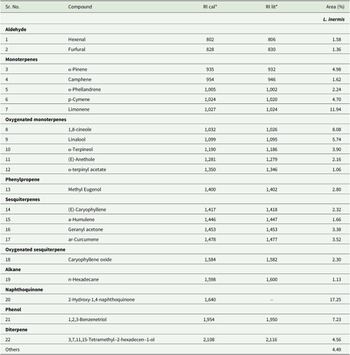
The measured essential oil yield from L. inermis was 2.40 ± 0.15% (v/w). The gas chromatography–mass spectrometry (GC/MS) analysis of the essential oil revealed a complex chemical profile (Table 1). The oil was characterized by a diverse range of compounds, including phenol, aldehydes, monoterpenes, oxygenated monoterpenes, phenylpropenes, sesquiterpenes, oxygenated sesquiterpenes, alkanes, naphthoquinones, and diterpenes. Notably, 2-hydroxy-1,4-naphthoquinone (lawsone), a naphthoquinone, was present at a significant concentration of 17.25%. Among the monoterpenes, limonene was the most abundant, comprising 11.94% of the oil. Other significant components included 1,8-cineole (8.08%), 1,2,3-benzenetriol (7.23%), linalool (5.74%), α-pinene (4.98%), p-cymene (4.70%), and 3,7,11,15-tetramethyl-2-hexadecen-1-ol (4.56%). The presence of these diverse compounds suggests a potential for various bioinsecticidal activities associated with L. inermis essential oil.
Chemical composition of the Lawsonia inermis essential oil

RI cal*: retention indices (RIs) relative to C9–C25 n-alkanes on DB-5 column. RI lit*: retention indices (RIs) from literature. –: not detected.
Nanoemulsion characterization and stability
The physicochemical properties of L. inermis essential oil nanoemulsions, prepared without sonication, were evaluated to determine the optimal formulation by varying the SORs. As the SOR increased, the nanoemulsions transitioned from a milky white to a translucent appearance. Notably, all formulations exhibited excellent stability under multiple stress conditions, including centrifugation, acid–base stress, thermal stress, and freeze–thaw cycles (Table 2).
Physicochemical characteristics of nanoemulsions under varied stress conditions

T80: tween 80, SOR: surfactant-to-oil ratio.
* Thermal stress was tested at progressively increasing temperatures (60, 70, 80, and 90°C) for 30 min in a controlled water bath.
The optimal nanoemulsion formulation was determined by analyzing droplet size, PDI, zeta potential (ζ-potential), viscosity, and pH. Significant variations were observed in L. inermis nanoemulsions, with the 2.5:1 SOR exhibiting the smallest droplet size, lowest ζ-potential, and a PDI below 0.3. A significant difference in the droplet size (F 7,32 = 800, p < 0.001), ζ-potential (F 7,32 = 620, p < 0.001), PDI (F 7,32 = 25, p < 0.001), viscosity (F 7,32 = 70, p < 0.001), and pH (F 7,32 = 9.22, p < 0.001) was observed in the nanoformulations of L. inermis with variable SOR (Table 3). An increase in the SOR led to a corresponding rise in viscosity and pH in the nanoemulsions. Among all formulations, the SOR of 2.5:1 exhibited the most favorable physicochemical properties, ensuring superior stability across all essential oils, making it the optimal formulation choice.
Characterization of nanoemulsions at different surfactant-to-essential oil ratios and sonication time
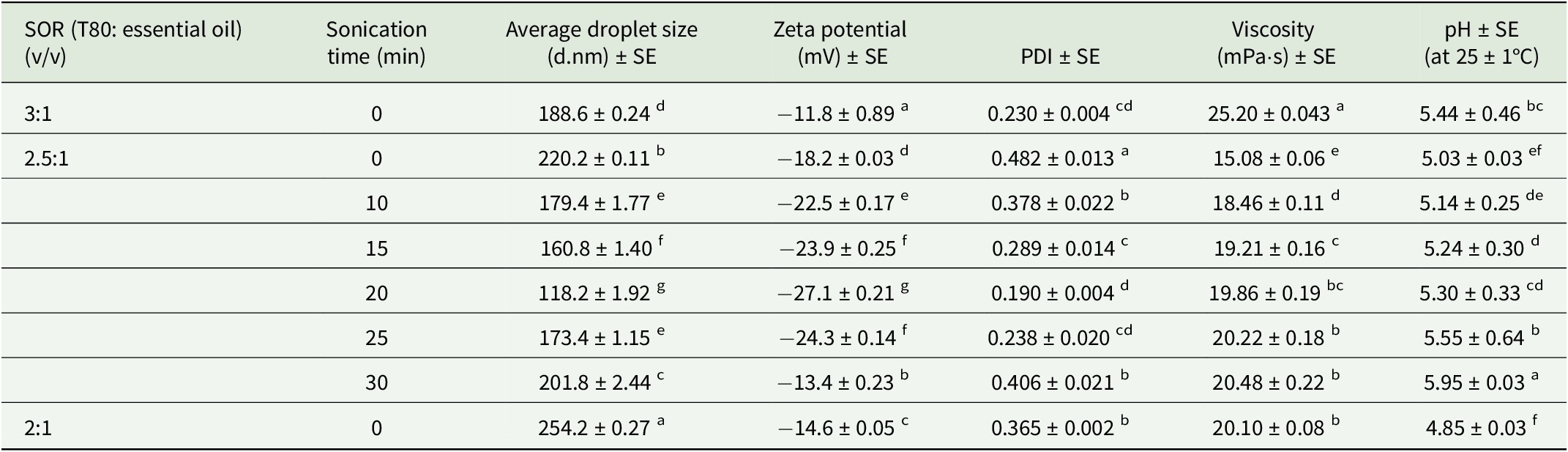
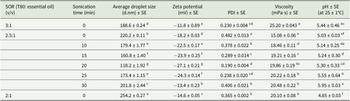
T80: tween 80, SOR: surfactant-to-oil ratio, 0 sonication time: no sonication applied, SE: standard error. Values having different letters in a column differ significantly (p < 0.05) due to different surfactant concentrations in treatment and different sonification times within each formulation according to Tukey’s Post Hoc test.
To determine the most suitable sonication duration for achieving a stable nanoemulsion, the formulation with a 2.5:1 SOR was subjected to varying sonication times and subsequently evaluated for its physicochemical properties (Table 3). Among the tested durations, the 20-min sonication in combination with the 2.5:1 SOR produced the most favorable results, including the smallest droplet size (118.2 nm), the most negative ζ-potential (−27.1 mV), and an optimal PDI of 0.190 (Table 3).
Storage stability of nanoemulsions
The stability of the nanoemulsion formulated with an SOR of 2.5:1 and 20 min of sonication was assessed over 28 days by monitoring changes in average droplet size, PDI, ζ-potential, viscosity, and pH. The absence of phase separation during the entire storage period reflected the formulation’s high physical stability. However, a slight increase in droplet size, ζ-potential, PDI, viscosity, and pH was recorded over time (Table 4), suggesting minimal structural alterations while maintaining overall nanoemulsion integrity.
Storage stability of Lawsonia inermis essential oil nanoemulsions

Experiment conditions: SOR was 2.5:1 and sonication time was 20 min, PDI: polydispersity index, SE: standard error, SOR: surfactant-to-oil ratio. Values having different letters differ significantly (p < 0.05) in columns due to different time points (Days 7, 14, 21, 28) within each formulation according to Tukey’s post hoc test.
Comparative insecticidal efficacy of essential oil and nanoemulsion
Fumigation toxicity
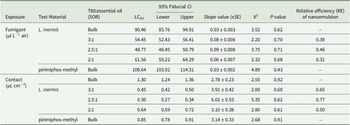
The fumigation toxicity of nanoemulsions formulated with varying SORs (2:1, 2.5:1, and 3:1) was assessed against R. dominica. The 2.5:1 SOR nanoemulsion exhibited the highest efficacy, followed by 2:1 and 3:1 (Table 5). A significant difference in LC50 values was observed among the essential oil, nanoemulsions, and pirimiphos-methyl treatments (H = 13.58, df = 8, p = 0.024). The nanoemulsions demonstrated significantly higher potency (LC50 = 48.77 μl l−1 air) than the parent L. inermis essential oil (LC50 = 90.46 μl l−1 air; RE = 0.46). The essential oil and its nanoemulsions exhibited superior fumigant toxicity compared to pirimiphos-methyl (LC50 = 108.64 μl l−1 air; Table 5), at equivalent LC50 exposure.
Comparison of fumigant and contact toxicity of Lawsonia inermis essential oil and nanoemulsion against Rhyzopertha dominica

T80: tween 80, SOR: surfactant-to-oil ratio, LC50: concentration that causes 50% of adult mortality Cl: confidence limit, SE: standard error, X2: Chi-square value, RE: (LC50 of bulk formulation—LC50 of nanoformulation)/LC50 of bulk formulation. Pirimiphos-methyl was used as a positive control.
Contact toxicity
The contact toxicity of L. inermis essential oil and its nanoemulsion formulations was evaluated against R. dominica. Statistical analysis using the Kruskal–Wallis H test indicated significant variation in LC₅₀ values among the tested treatments, including essential oil, nanoemulsions, and the synthetic insecticide pirimiphos-methyl (H = 12.35, df = 8, p = 0.017). Among the nanoformulations, the one prepared with SOR of 2.5:1 demonstrated markedly greater toxicity compared to formulations with SORs of 3:1 and 2:1, as well as the bulk essential oil. The essential oil and its nanoemulsions exhibited significantly stronger contact toxicity than pirimiphos-methyl (Table 5).
Notably, the nanoemulsions demonstrated high potency (LC₅₀ = 0.30 μl cm−2) compared to L. inermis essential oil (LC₅₀ = 0.39 μl cm−2; RE = 0.77). Additionally, the nanoemulsions exhibited enhanced contact toxicity compared to pirimiphos-methyl (LC₅₀ = 0.85 μl cm−2), further highlighting their potential as an effective bioinsecticidal alternative (Table 5).
Repellent assay
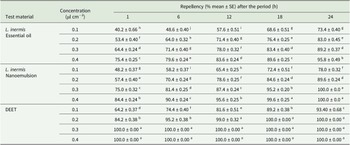
L. inermis essential oil’s repellency and nanoemulsions (SOR = 2.5:1, 20 min sonication) against R. dominica were assessed over a 24-h exposure period. The results demonstrated a dose-dependent and time-dependent positive repellency, with nanoemulsions exhibiting a higher repellent effect than the parent essential oil at all tested concentrations and time intervals (Table 6).
Repellency percentage (mean ± SE) shown by adult Rhyzopertha dominica to different concentrations of essential oil and nanoemulsions (SOR = 2.5:1 and 20 min sonication) after 1, 6, 12, 18, and 24 h of exposure

SE: standard error, SOR: surfactant-to-oil ratio, DEET: N,N-diethyl-3-methylbenzamide, each result is the mean of 5 repeats, including 20 individuals (n = 100). The means repellency in a COLUMN followed by a different letter(s) (LOWERCASE, abcd) differs significantly due to varying concentrations of a given treatment (Tukey’s HSD test). All F-values are significant at p ≤ 0.001.
The standard synthetic repellent, DEET, exhibited significantly higher repellency against adult R. dominica compared to both the L. inermis essential oil and its nanoemulsion formulations. DEET was included primarily as a reference standard to benchmark the efficacy of the L. inermis formulations; therefore, its concentrations were matched to those used for the essential oil and nanoemulsion. As higher DEET doses (≥ 0.3 μl cm−2) achieved complete repellency, dose–response modeling was not performed for DEET.
The nanoemulsions displayed 100% repellency at 0.3 and 0.4 μl cm−2 after 24 h exposure. However, the nanoemulsions consistently outperformed the essential oil, highlighting their enhanced bioactivity and potential as a more effective repellent formulation.
Discussion
The potent insecticidal and repellent activities of L. inermis essential oil and its nanoemulsion against R. dominica observed in this study are attributed to the oil’s complex phytochemical profile and the enhanced delivery mechanisms provided by nanoemulsification. GC–MS analysis identified key bioactive compounds, including 2-Hydroxy-1,4-naphthoquinone (lawsone), limonene, 1,8-cineole, and pyrogallol, consistent with previous characterizations of henna essential oil composition (Mengoni et al., Reference Mengoni, Peregrina, Censi, Cortese, Ricciutelli, Maggi and di Martino2016; Ogunbinu et al., Reference Ogunbinu, Ogunwande, Walker and Setzer2007; Satyal et al., Reference Satyal, Paudel, Poudel and Setzer2012). These constituents are known to act through complementary pathways that may disrupt insect physiology at multiple levels, which could help explain the dose-dependent mortality and behavioral effects observed in this study (Elaguel et al., Reference Elaguel, Kallel, Gargouri, Amor, Hadrich, Messaoud, Gdoura, Lassoued and Gargouri2019). For example, oxygenated monoterpenes like limonene and 1,8-cineole disrupt the insect nervous system by acting on octopamine receptors and modulating GABA-gated chloride channels, which leads to neural hyperexcitation and paralysis (Jankowska et al., Reference Jankowska, Rogalska, Wyszkowska and Stankiewicz2017). Phenolic compounds like pyrogallol contribute to membrane disruption and enzymatic interference, further compromising cellular integrity and hormonal balance (Shin, Park and Lee, Reference Shin, Park and Lee2019). At the same time, naphthoquinones, such as lawsone, undergo redox cycling to generate reactive oxygen species, which damage mitochondria and other cellular components. This oxidative assault overwhelms the pest’s antioxidant defences, weakening detoxification enzymes and increasing susceptibility to further damage (Nair et al., Reference Nair, Sekar, Gan, Kumarasamy, Subramaniyan, Wu, Rani, Ravi and Wong2024). The presence of multiple toxic chemotypes in the essential oil helps explain the steady increase in mortality and repellency with dose, as R. dominica experiences simultaneous disruptions in metabolism and neurotransmission, thereby impairing detoxification pathways (Miri, Reference Miri2025; Suleiman and Suleiman, Reference Suleiman and Suleiman2014).
This multi-target profile may reduce the likelihood of rapid resistance development, although this requires long-term validation under storage conditions. Monoterpenes in the essential oil primarily target neural signaling, whereas quinones, such as lawsone, target detoxification enzymes. Moreover, the lipophilic nature of these compounds enables rapid penetration through the insect’s cuticle and spiracles, enhancing vapor-phase efficacy compared to water-soluble insecticides (Devrnja, Milutinović and Savić, Reference Devrnja, Milutinović and Savić2022; Usseglio, Dambolena and Zunino, Reference Usseglio, Dambolena and Zunino2022). In a stored-grain context, this is critical: small oil droplets and vapors diffuse easily in the confined space of a grain bulk, ensuring close, prolonged contact with pests. Thus, the combination of fast penetration and multiple attack routes results in rapid adult mortality and an effective fumigant action.
Nanoemulsification overcomes the essential oil’s limitations—volatility, poor water solubility, and rapid degradation—by encapsulating bioactive compounds in nanoscale droplets, thereby enhancing stability, penetration, and controlled release (Giunti et al., Reference Giunti, Campolo, Laudani, Palmeri, Spinozzi, Bonacucina, Maggi, Pavela, Canale, Lucchi and Koul2023). A well-formulated nanoemulsion (small droplet size, with low polydispersity, and high negative zeta potential) remains monodisperse and stable over time, preventing phase separation or rapid volatilization. Notably, prior studies indicate that essential oil nanoemulsions exhibit very low mammalian toxicity and do not harm seed viability, even at bioactive concentrations (Safaya and Rotliwala, Reference Safaya and Rotliwala2020; Salvia-Trujillo et al., Reference Salvia-Trujillo, Rojas-Graü, Soliva-Fortuny and Martín-Belloso2015).
The insecticidal potential of L. inermis essential oil constituents has gained increasing recognition, yet critical gaps remain in understanding the mechanisms of its most bioactive compound, particularly in vapor-phase applications. However, its mode of action, particularly in vapor-phase applications, remains poorly understood despite showing efficacy against stored-grain pests such as R. dominica (Abubakar, Suleiman and Wagini, Reference Abubakar, Suleiman and Wagini2021), Tribolium castaneum (Biswas, Sharmin and Rabbi, Reference Biswas, Sharmin and Rabbi2016), and C. maculatus (Jose and Adesina, Reference Jose and Adesina2014; Suleiman and Suleiman, Reference Suleiman and Suleiman2014). This investigation offers a significant contribution to stored-grain pest management by revealing the enhanced bioactivity of L. inermis nanoemulsions and advancing botanical insecticide research through improved formulation strategies. Using Tween 80 as a surfactant, the optimized formulation (SOR of 2.5:1 and 20 min sonication) yielded droplets <200 nm with a ζ-potential of −33 mV, promoting electrostatic repulsion to prevent aggregation and phase separation (Adak et al., Reference Adak, Barik, Patil, Gadratagi, Annamalai, Mukherjee and Rath2020; Mansouri et al., Reference Mansouri, Pajohi-Alamoti, Aghajani, Bazargani-Gilani and Nourian2021). This reduced size increases surface area for cuticular interaction, while improving water compatibility and ensuring uniform grain coverage and prolonged exposure (Paradva and Kalla, Reference Paradva and Kalla2023). Sonication time critically influenced nanoemulsion stability, with 20 min identified as the optimal duration; longer durations led to droplet aggregation (Nirmala et al., Reference Nirmala, Durai, Gopakumar and Nagarajan2019; Pongsumpun, Iwamoto and Siripatrawan, Reference Pongsumpun, Iwamoto and Siripatrawan2020). The controlled release of nanoemulsion protects volatiles from environmental factors such as UV and oxidation, thereby extending shelf life and residual activity (Zhang et al., Reference Zhang, Qin, Li, Zhou, Wang and Kan2017). These physicochemical properties also account for its prolonged stability, as the negative surface charge prevents coalescence and the emulsion remains intact for weeks without phase separation (Campolo et al., Reference Campolo, Giunti, Laigle, Michel and Palmeri2020). Possible interactions between surfactants and phytochemicals may contribute to enhanced fumigant and contact toxicity, as well as reduced environmental impact, although this remains to be directly tested (Sarmah et al., Reference Sarmah, Anbalagan, Marimuthu, Mariappan, Angappan and Vaithiyanathan2025). Electron microscopy and biochemical assays have revealed that nanoemulsion droplets penetrate tissues, disrupt cellular architecture, and inhibit enzymes in insect pests, which explains the increased mortality observed with prolonged exposure time and higher concentrations (Nasser et al., Reference Nasser, Ibrahim, Fouad, Ahmad, Li, Zhou, Yu, Chidwala and Mo2024). Their toxicity studies also indicate low mammalian risk at effective doses, preserving grain viability (Echeverría and de Albuquerque, Reference Echeverría and de Albuquerque2019; Maurya et al., Reference Maurya, Singh, Das, Prasad, Kedia, Upadhyay, Dubey and Dwivedy2021). The optimized nanoemulsion in this study outperformed pirimiphos-methyl in the lab. This demonstrates that nanoformulation can enhance the intrinsic bioactivity of the essential oil.
The superior fumigant toxicity of the L. inermis essential oil and its nanoemulsion compared to pirimiphos-methyl may be associated with a multi-target mode of action, where compounds such as lawsone induce oxidative stress and enzyme inhibition, potentially complementing the neurotoxic effects of monoterpenes like limonene and 1,8-cineole on octopamine receptors and GABA-gated channels (Miri, Reference Miri2025; Jankowska et al., Reference Jankowska, Rogalska, Wyszkowska and Stankiewicz2017; Moutawalli et al., Reference Moutawalli, Benkhouili, Doukkali, Benzeid and Zahidi2023; Suleiman and Suleiman, Reference Suleiman and Suleiman2014). Nanoemulsification further amplifies this by improving volatility control, cuticular penetration, and sustained release through reduced droplet size and stable ζ-potential (Giunti et al., Reference Giunti, Campolo, Laudani, Palmeri, Spinozzi, Bonacucina, Maggi, Pavela, Canale, Lucchi and Koul2023; Paradva and Kalla, Reference Paradva and Kalla2023). Previous studies have reported that essential oils and their nanoemulsions can be equally good or outperform pirimiphos-methyl in bioassays against stored-grain pests, and some of these oils were noted to contain constituents that are also present in L. inermis essential oil (Akinbuluma, Reference Akinbuluma2020; Eesiah et al., Reference Eesiah, Yu, Dingha, Amoah and Mikiashvili2022; Filomeno et al., Reference Filomeno, Barbosa, Teixeira, Pinheiro, de Sá Farias, Ferreira and Picanço2020; Zimmermann et al., Reference Zimmermann, Aragao, Araújo, Benatto, Chaaban, Martins, do Amaral, Cipriano and Zawadneak2021; Zimmermann et al., Reference Zimmermann, Poitevin, Bischoff, Beger, da Luz, Mazarotto, Benatto, Martins, Maia and Sari2022). Additionally, L. inermis-specific studies corroborate its insecticidal potential, with extracts causing mortality in R. dominica (Abubakar, Suleiman and Wagini, Reference Abubakar, Suleiman and Wagini2021) and repellency in C. maculatus (Pandey, Palni and Tripathi, Reference Pandey, Palni and Tripathi2014). These findings position L. inermis nanoemulsions as a promising, eco-compatible alternative, mitigating resistance risks associated with single-mode synthetics (Karabörklü and Ayvaz, Reference Karabörklü and Ayvaz2023).
The dose-dependent repellent activity of L. inermis nanoemulsions is likely influenced by volatile monoterpenes interacting with R. dominica’s olfactory system, potentially triggering avoidance behaviors. Limonene and 1,8-cineole overstimulate chemoreceptors at higher concentrations, modulating neural pathways and activating repellent circuits more effectively in this species due to its specialized sensitivity (Cao et al., Reference Cao, Jian, Athanassiou, Yang, Hu, Zhang, Dai and Maggi2024; Suleiman and Suleiman, Reference Suleiman and Suleiman2014; Yadav et al., Reference Yadav, Rathee, Sharma and Patil2024). While DEET exhibited rapid repellency and achieved 100% repellency at concentrations ≥0.3 μl cm−2, these higher doses were primarily included as reference standards to benchmark L. inermis formulations, rather than for dose–response modeling, which was performed only for the essential oil and nanoemulsion. This approach ensured a valid comparative framework, free from confounding effects resulting from DEET’s saturation-level responses. Although DEET offers faster repellency, L. inermis nanoemulsions provide sustainable control through a combination of repellency, toxicity, and biodegradability, minimizing environmental persistence and resistance risks (Ahmed et al., Reference Ahmed, Alam, Saeed, Ullah, Iqbal, Al-Mutairi, Shahjeer, Ullah, Ahmed and Ahmed2021; Ngegba et al., Reference Ngegba, Cui, Khalid and Zhong2022; Pavoni et al., Reference Pavoni, Benelli, Maggi and Bonacucina2019). Thus, the L. inermis nanoemulsion is especially attractive for organic or low-residue storage systems where the use of synthetic pesticides is prohibited.
Laboratory distillation yields may differ substantially from field-scale extraction. Previous studies have reported yields of up to ~6.8% (w/w) from henna leaves under optimized conditions (Elaguel et al., Reference Elaguel, Kallel, Gargouri, Amor, Hadrich, Messaoud, Gdoura, Lassoued and Gargouri2019). This suggests that targeted process improvements (e.g., optimized distillation, better drying) could increase essential oil output. Upscaling the lab protocol appears feasible, though validation through pilot trials is required to confirm yield consistency under field-scale conditions. Field-grown plants may vary in essential oil content due to soil, climate, or plant age, so validating yield and bioactivity in real situations is crucial (Azam et al., Reference Azam, Butt, Arshad and Qurat-ul-Ain2025). While the yield reported in this study indicates a substantial biomass requirement for large-scale application, it is within a practical range for a botanical insecticide when considering the plant’s high growth yield and the possibility of using agricultural waste or dedicated cultivation (Gautam and Kumar, Reference Gautam and Kumar2025). The superior efficacy of the nanoemulsion formulation, which demonstrated significantly lower LC₅₀ values than both the bulk oil and the synthetic standard pirimiphos-methyl, means that the effective dosage per unit area of grain storage is reduced, thereby mitigating the challenge of biomass. Furthermore, the development of a stable, optimized nanoemulsion directly addresses the question of scalability. The reproducible formulation protocol, using food-grade surfactants and standardized sonication parameters, is designed to minimize deviations during industrial-scale production. Based on these outputs, a key systemic recommendation is the integration of L. inermis cultivation into local agricultural systems to create a sustainable biomass supply chain, alongside the adoption of nanoemulsion technology to ensure product stability, enhance efficacy, and reduce the environmental footprint compared to synthetic alternatives.
This study demonstrates that the L. inermis nanoemulsion is more than a laboratory concept; its robust efficacy across fumigant, contact, and repellent bioassays presents a tangible, multi-modal tool for real-world Integrated Pest Management programs. This versatility could allow it to be deployed as a space fumigant, a protective grain spray, or a repellent barrier. In addition to its technical merits, the formulation must be evaluated within a broader sustainability context, including farmer adoption, compatibility with grain quality standards, and environmental safety, to ensure real-world feasibility in renewable agriculture systems. More importantly, these technical strengths translate directly into sustainability benefits that align with the goals of renewable food systems. The high potency at low concentrations suggests a path to reducing both the economic and environmental load of pest control. Sourcing the active ingredient from a cultivable plant aligns with the principles of a circular bioeconomy, potentially creating value-added opportunities for agricultural communities. By effectively overcoming the volatility and instability that have historically limited botanicals, nanoemulsion technology bridges the critical gap between laboratory proof-of-concept and the practical, field-ready sustainable solutions needed to reduce post-harvest losses, minimize reliance on synthetic pesticides, and enhance the resilience of the food supply chain.
While this study demonstrates the significant laboratory efficacy of the L. inermis nanoemulsion, we fully acknowledge that its potential for integration into renewable agriculture and food systems is contingent upon future validation beyond these controlled conditions. The scalability of this nanoemulsion, formulated with food-grade ingredients using a reproducible protocol, makes it suitable for various settings. For small-scale farms, it can be a cost-effective and locally sourced option for treating bagged or small-binned stored grain. For industrial applications, the concentrate could be produced centrally and diluted on-site for large-volume spray or fumigation systems. However, transitioning from laboratory proof-of-concept to field-ready product requires addressing key challenges. The natural variation in essential oil composition necessitates chemotyping and standardization (Azam et al., Reference Azam, Butt, Arshad and Qurat-ul-Ain2025), and natural efficacy must be validated under variable environmental conditions (temperature, grain moisture) against mixed-age insect populations. Equally important is evaluating the broader relevance of this technology to farming communities. This requires testing cost-effectiveness, farmer acceptability, and compatibility with existing storage practices, alongside assessments of non-target safety, grain quality, long-term stability, and overall cost–benefit. These steps are essential to move L. inermis nanoemulsions from a promising laboratory innovation to a sustainable tool for stored-grain protection within renewable agriculture systems.
Therefore, the immediate future work arising from this foundational study must focus on bridging this gap between laboratory proof-of-concept and field readiness. This includes confirming the proposed mechanisms of action (e.g., AChE/octopamine inhibition) through biochemical assays, conducting large-scale field trials in operational storage facilities, and optimizing the formulation for specific application technologies. Isolating the key volatile compounds responsible for repellency could also lead to highly targeted bio-repellent products. Ultimately, this research lays a framework for developing advanced, sustainable pest management tools that leverage the synergy between plant biochemistry and nanoformulation science to create effective and environmentally responsible solutions.
Conclusion
This study demonstrates that L. inermis essential oil nanoemulsions hold strong potential as eco-compatible alternatives to synthetic insecticides for managing R. dominica in stored grains. By optimizing SORs and sonication parameters, stable nanoemulsions with favorable physicochemical properties were developed, resulting in significantly enhanced bioactivity compared to both bulk oil and pirimiphos-methyl. While the results highlight the laboratory efficacy of these formulations, their successful translation into renewable agriculture systems will depend on further validation. Future work should focus on assessing performance under semi-field and operational storage conditions, evaluating impacts on grain quality, non-target organisms, and long-term stability, and determining cost-effectiveness and potential for farmer adoption. Addressing these considerations will be essential to integrating L. inermis nanoemulsions into practical pest management programs and ensuring they contribute to more sustainable and resilient food systems.
Acknowledgements
The authors acknowledge the use of OpenAI’s ChatGPT (free version, GPT-3.5) to assist with improving the clarity and fluency of the English language in the manuscript. The AI tool was employed only after the authors had written the initial draft and was subsequently used to enhance grammar, syntax, and expression without altering the scientific content or interpretations. No content, data analysis, image creation, or scientific insight was generated using AI tools. The tool was accessed online at https://chat.openai.com, and its assistance was limited solely to language editing. The final manuscript was critically reviewed and revised by the authors to ensure it aligned fully with the study’s objectives and the journal’s formatting and submission requirements. The use of ChatGPT occurred from November 2024 to May 2025.
Funding statement
This research received no specific grant from any funding agency, commercial, or not-for-profit sectors.
Competing interests
The author(s) declare none.



 Open access

