


Introduction
The Viking Age (c. AD 750–1050) witnessed a complex Scandinavian diaspora that brought fundamental and lasting transformations to the northern world (Brink & Price Reference Brink and Price2008). A thousand years later, the Vikings are among the most recognised—but also most stereotyped—cultures of the prehistoric past. This problematic legacy manifests itself in countless ways, from product branding to popular entertainment, along with the recycling of Viking culture via a constant flow of international exhibitions and syntheses. Within this tangle of history, myth and cliché, however, one particular figure has been the subject of special fascination for as long as the Viking Age has been studied: the image of the warrior woman—both in the human form of the famous shield maidens and in the supernatural guise of their Valkyrie sisters.
In September 2017, the American Journal of Physical Anthropology published an article by the current authors entitled ‘A female Viking warrior confirmed by genomics’ (Hedenstierna-Jonson et al. Reference Hedenstierna-Jonson, Kjellström, Zachrisson, Krzewińska, Sobrado, Price, Günther, Jakobsson, Götherström and Storå2017). It presented the results of extensive ancient DNA analysis, following earlier osteological studies. These showed that the body interred in a richly appointed Viking Age burial on the island town of Birka, Sweden, was not biologically male—as had always been assumed—but female. This was significant because the grave, which was excavated in 1878, had long been seen, and repeatedly published, as a spectacular example of a high-status warrior burial—an identity with intriguing implications in the light of our new sex determination.
In the weeks following the online publication of our article, the research was covered by more than 130 international news agencies, and was discussed across some 2200 individual online accounts, accessed by millions of followers. Altmetric ranked our article as the forty-third most frequently accessed scientific paper of some 2.2 million published globally during 2017, and placed it at 265 of the 11.7 million outputs ever scored by them (as of early September 2018). This level of interest took us by surprise and raises the important question: why did this one single grave generate such global attention?
Our objective in the present article is to bring these issues together, at greater interpretive depth than was possible in our earlier publication, which primarily focused on the genomic analysis. How should we understand this burial, what kind of person was interred there and how can we tell? Particularly, what implications does the burial have for understanding Viking Age funerary archaeology, and the ways in which we engender the societies of that time? In order to focus here on the contextualised interpretation of the grave, our article is accompanied by extensive online supplementary material (OSM) that presents the burial in greater detail, along with a discussion of source-critical issues regarding its recording, archiving and analysis. The OSM also addresses possible archaeological parallels from the Viking Age and the medieval written sources that mention female warriors.
Birka and grave Bj.581
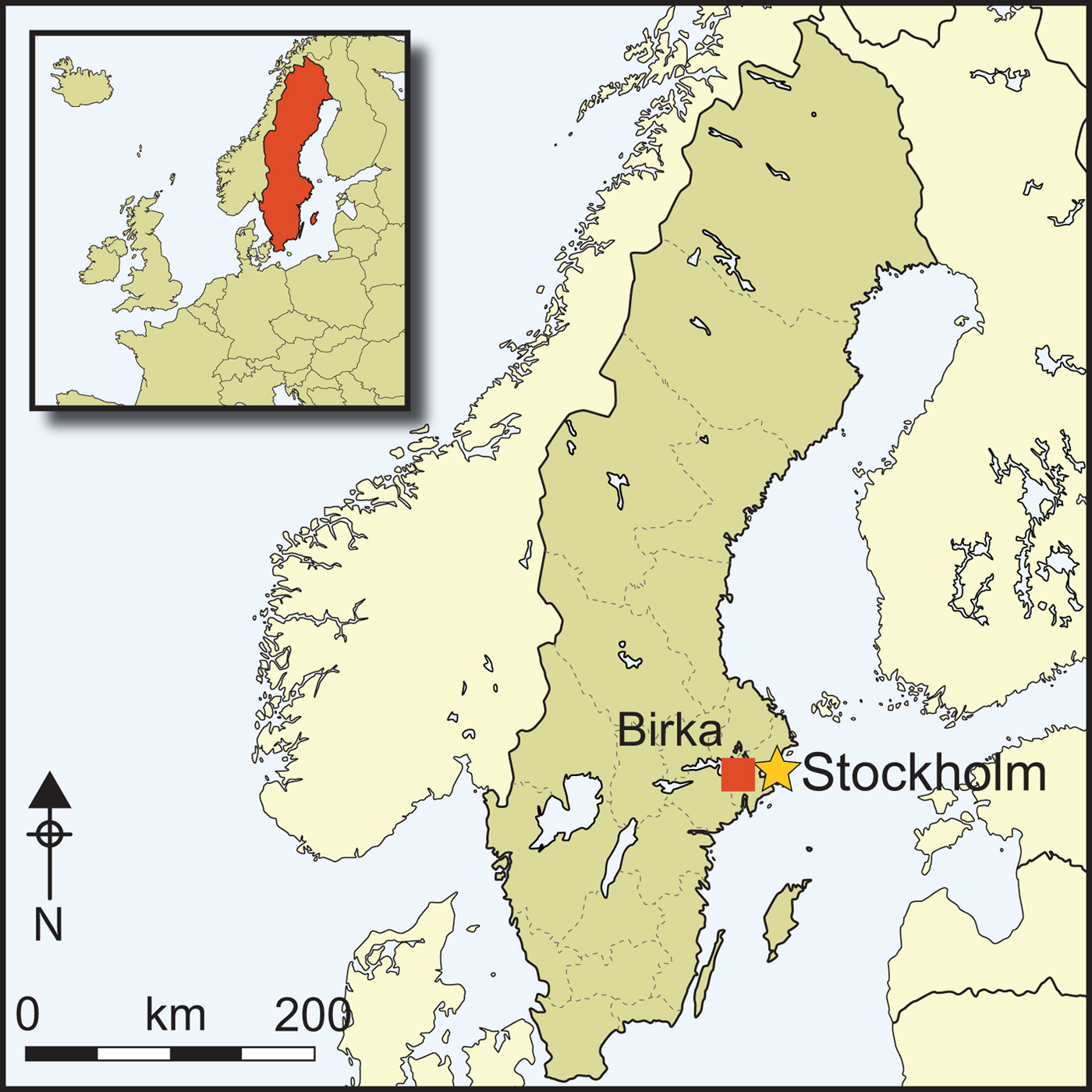
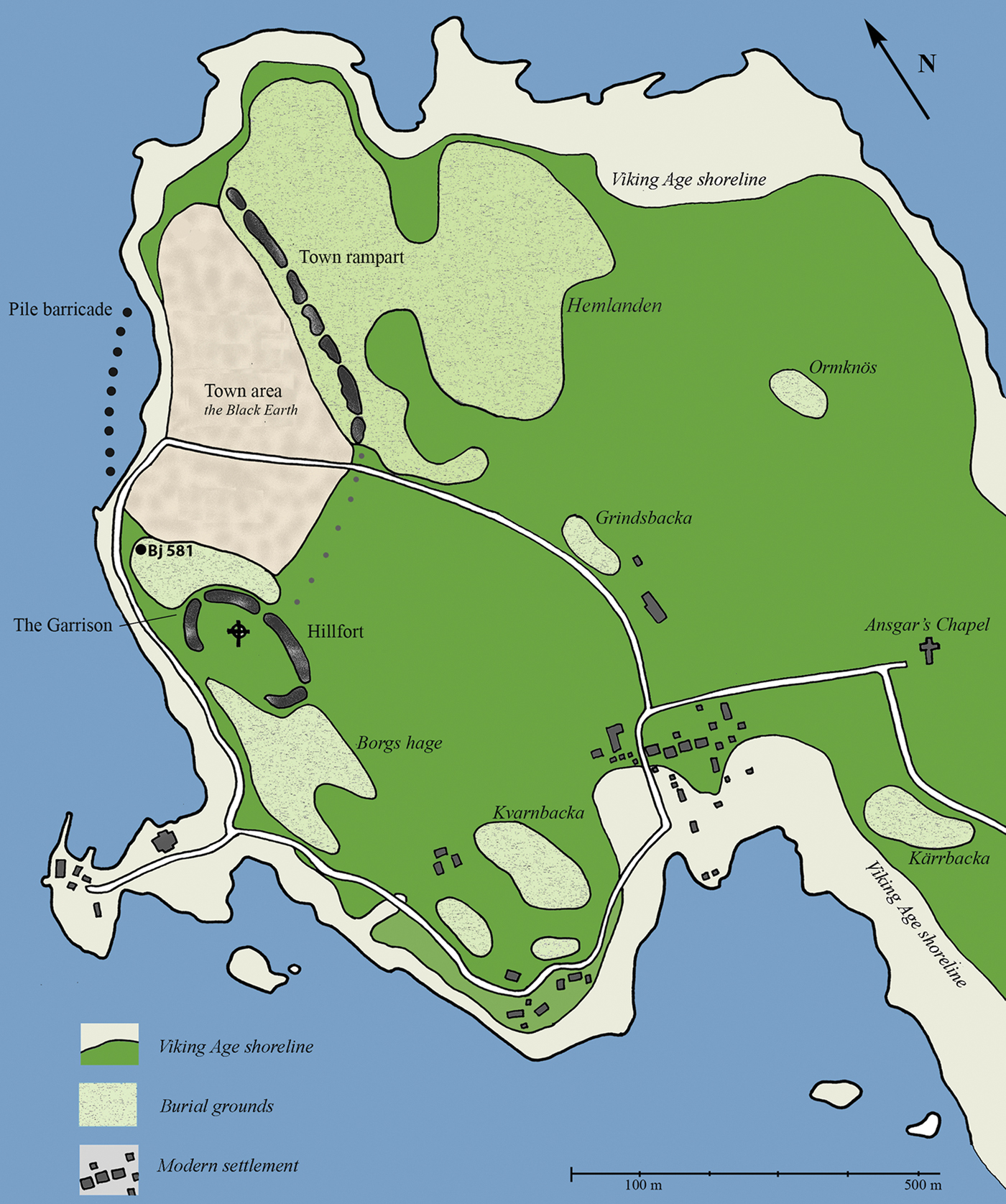
The Viking Age settlement of Birka on the island of Björkö in Lake Mälaren, Uppland, is well known as the first urban centre in what is now Sweden. It was founded c. AD 750 and supported a population of perhaps 700–1000 inhabitants for the next 200 years, until its relocation to a new site (Ambrosiani Reference Ambrosiani, Brink and Price2008). The town comprised a large settled area fronting the lake, bounded by an earthen rampart with a hillfort at its south-west terminus (Figure 1). Around the perimeters of the site are several cemeteries, together containing some 3000 visible mound burials, with many more identified through geophysical prospection. Approximately 1100 of these graves were excavated in the late nineteenth century by antiquarian Hjalmar Stolpe, using pioneering recording methods that have stood the test of time; he was, for example, one of the first archaeologists to use graph paper for field drawings (Jensen Reference Jensen2018: 176–79). The graves and finds were published long after the excavations in a series of landmark volumes (Geijer Reference Geijer1938; Arbman Reference Arbman1940, Reference Arbman1943; Gräslund Reference Gräslund1980; Arwidsson Reference Arwidsson1984, Reference Arwidsson1986, Reference Arwidsson1989; Duczko Reference Duczko1985), together with specialist studies in the form of doctoral theses from the 1950s onwards.
Plan of the Viking Age island market centre of Birka, showing the ‘Black Earth’ settled area, the surrounding cemeteries and the location of Bj.581 outside the hillfort gates (figure prepared by Charlotte Hedenstierna-Jonson).
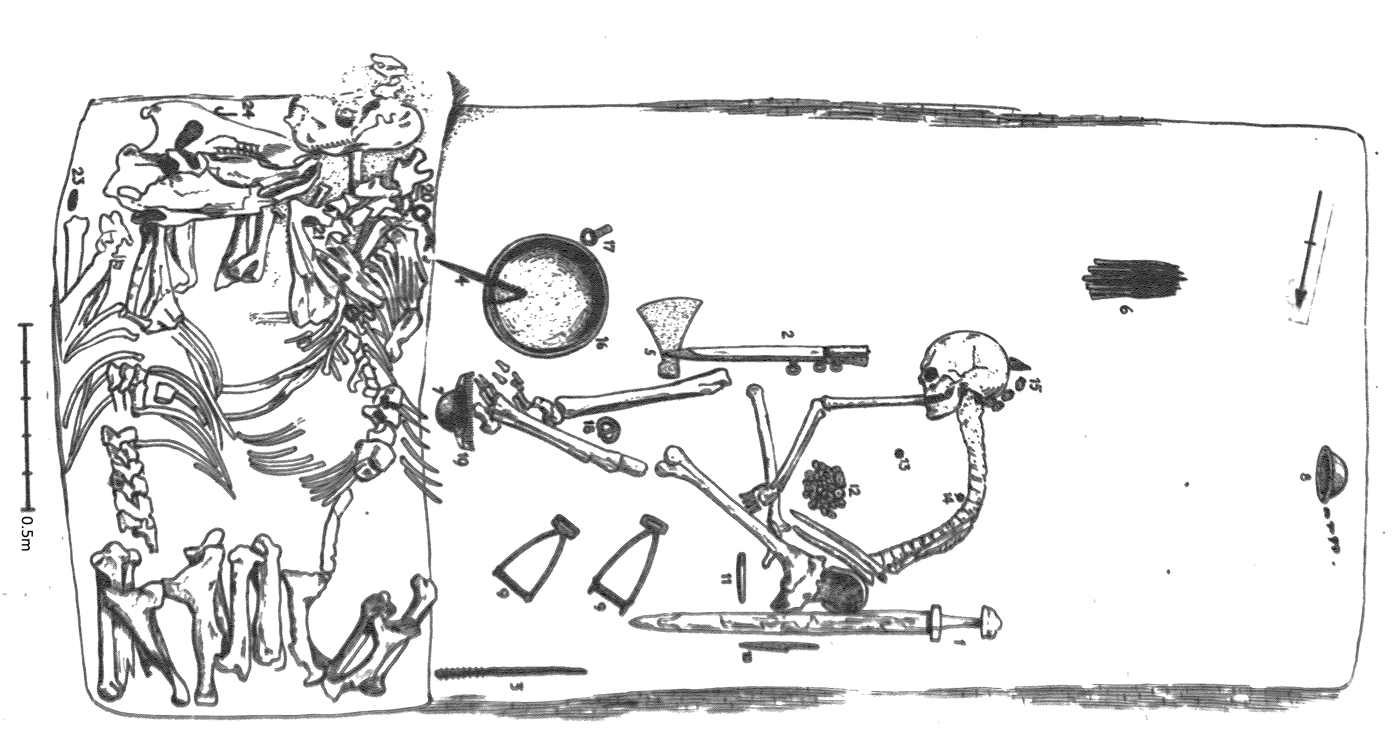
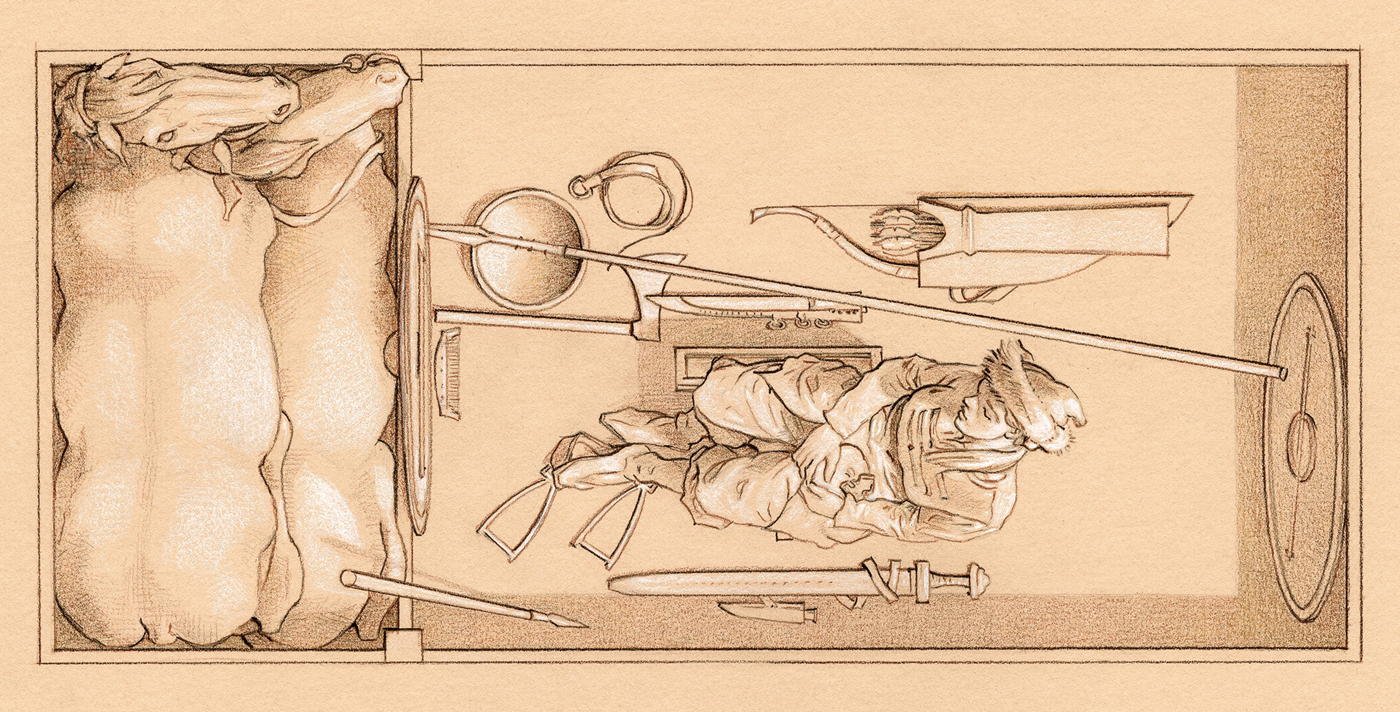
One of the burials investigated by Stolpe—designated Bj.581—was recognised even at the time as being of unusual character (Figure 2); Stolpe himself described it in his unpaginated report to the Royal Academy as “perhaps the most remarkable of all the graves in this field” (Reference Stolpe1879, translated by N. Price). In an underground wooden chamber, a body had been interred, dressed in clothing with details evoking the fashions of the Eurasian Steppe; two horses, one of which was bridled for riding, had been arranged on a platform at the chamber's edge (Figure 3). The deceased individual was surrounded by a large number of weapons; a bag of gaming pieces was placed in the person's lap and a gaming board was propped up beside them. The burial was located at the extreme perimeter of the grave-field, outside the hillfort's northern gate and adjacent to the road leading from the fortress into the town. Bj.581 is, in fact, the westernmost grave at Birka, situated high on the rocky promontory overlooking the lake and originally marked by a large boulder, which would have been visible from both the settlement and the water below.
Plan of chamber grave Bj.581 by Harald Olsson, redrawn from Stolpe's field records. This image accompanied the primary publication of the burial (Arbman Reference Arbman1943: 188–90).
Chamber grave Bj.581, as it may have looked when the burial was closed (drawing by Þórhallur Þráinsson).
Stolpe's notes, sketches and excavation plans of Bj.581 are available online (Stolpe Reference Stolpe1870–1888, Reference Stolpe1879). The grave was fully published in the main Birka burial catalogue (Arbman Reference Arbman1943: 188–90, with plates in his 1940 volume) and additionally was analysed by Gräslund (Reference Gräslund1980: 27–42) in the companion publication on the funerary customs; the weapons are considered in a series of papers in Arwidsson's Reference Arwidsson1986 collection.
The grave of a high-status warrior?
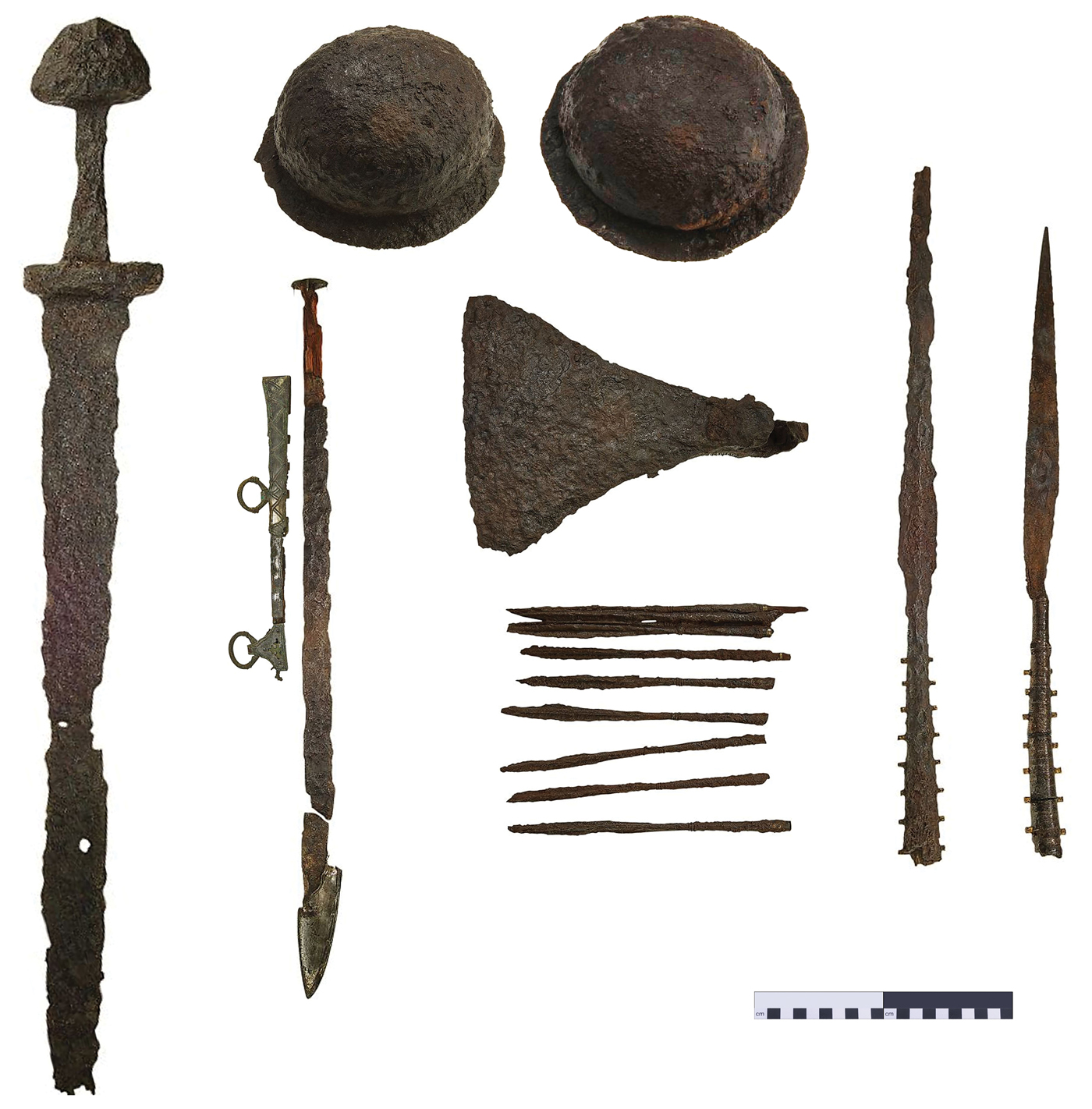
Of the more than 1100 excavated burials on Birka, only 75 contain one or more offensive weapons (Thålin-Bergman Reference Thålin-Bergman and Arwidsson1986: 5). Bj.581 is one of only two burials from the entire island with a full complement of weapons, and has been grouped among the 20 richest graves on the site (Thålin-Bergman Reference Thålin-Bergman and Arwidsson1986: 5; Ringstedt Reference Ringstedt1997: 94). From the very beginning, the Bj.581 burial was interpreted as that of a high-status warrior. Weapons were present in unusual profusion and variety, suggesting the equipment of a professional—probably a mounted archer able to deploy a remarkable repertoire of fighting techniques (Figure 4). This in itself implies both skill and considerable expense: war-gear of excellent quality, intended for someone of high social standing. Conversely, there were no finds of a more domestic character, such as tools or agricultural implements.
The weapons from chamber grave Bj.581: a sword, axe, fighting knife, two lances, two shields and 25 armour-piercing arrows (photographs courtesy of Christer Åhlin, Swedish History Museum).
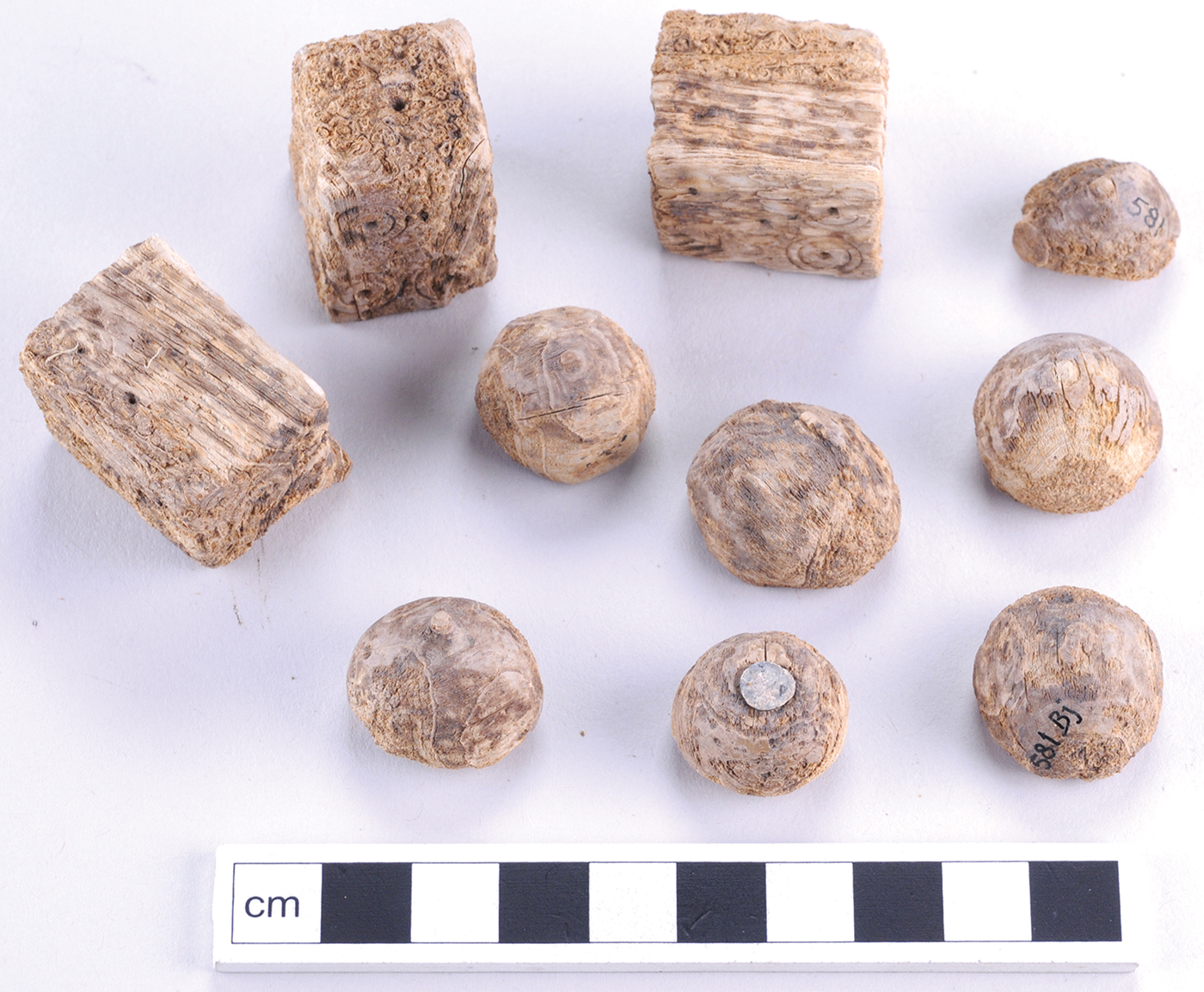
The gaming pieces add an extra dimension (Figure 5). As individual objects, they are not uncommon in Viking Age burials, but rare as full sets with iron-bound boards (for a discussion of the Birka examples, see Selling Reference Selling1940). They particularly occur in relation to military leaders; for example, being present in most of the larger boat graves (Whittaker Reference Whittaker2006; Hall Reference Hall2016), where they are employed symbolically, such as boards laid out with pieces in play (e.g. in Valsgärde boat burial 7, Arwidsson Reference Arwidsson1977: pl. 45; and Ultuna, Ljungkvist Reference Ljungkvist2006: 214). The presence of a full gaming set and board in Bj.581, and their deliberate placement in direct proximity to the body, suggests a potential command role, in addition to the high status implied by the quality of the military equipment.
A selection of the gaming pieces from chamber grave Bj.581 (photograph by Charlotte Hedenstierna-Jonson).
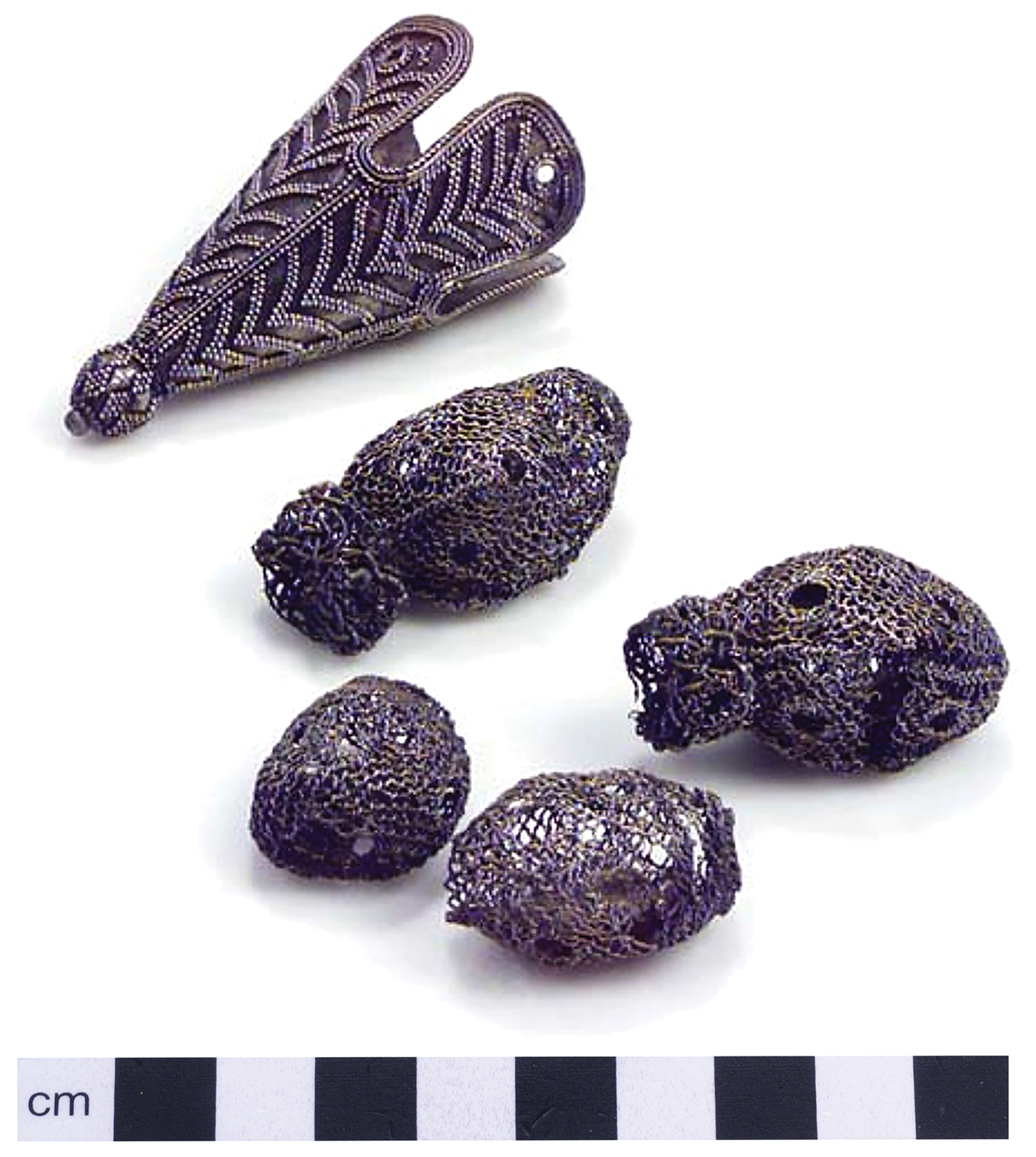
The individual's clothing has also been analysed, with Birka's leading textile specialist arguing—based on a broad range of comparative data—that the person in Bj.581 was a cavalry commander under the immediate authority of a royal war-leader (Hägg Reference Hägg, Brandt, Müller-Wille and Radtke2002: 204). The tasselled cap in particular is unusual. It was possibly manufactured in Kiev and, according to Ingmar Jansson (Reference Jansson, Roesdahl and Wilson1992: 261), was of a type made for “the leading members of society” (Figure 6).
The silver terminal and tassels from the cap in chamber grave Bj.581 (photograph courtesy of Christer Åhlin, Swedish History Museum).
As synthetic works on the Vikings began to appear after Birka's publication, from the 1960s onwards, Bj.581 not only continued to be consistently interpreted as a high-status warrior, but was even upheld as an archetype, a kind of ‘ultimate Viking’ of the tenth century (e.g. Almgren Reference Almgren1967: 44–45; Jones Reference Jones1968: 170–71; Gräslund Reference Gräslund1980: 41; Lofterud Reference Lofterud1981: 16–17; Thunmark-Nylén Reference Thunmark-Nylén1981: 136–37; Ambrosiani & Eriksson Reference Ambrosiani and Eriksson1991: 42; Ambrosiani Reference Ambrosiani1992: 17; Gräslund & Müller-Wille Reference Gräslund, Müller-Wille, Roesdahl and Wilson1992: 187; Magnus Reference Magnus2000: 19; Hall Reference Hall2007: 224; Herget Reference Herget and Koch2008: 76–77; Magnus & Gustin Reference Magnus and Gustin2009: 67; Roesdahl Reference Roesdahl2016: 162–63). As far as we are aware, this warrior interpretation has never been challenged. It should also be emphasised that the material culture of an elite warrior class on Birka has been the subject of extensive study in its own right, with clear overtones of eastern influence from the Rus cultural sphere (e.g. Olausson Reference Olausson2001; Hedenstierna-Jonson Reference Hedenstierna-Jonson2006; Hedenstierna-Jonson & Holmquist Olausson Reference Hedenstierna-Jonson and Olausson2006; Holmquist Olausson & Olausson Reference Holmquist Olausson and Olausson2009); this provides an additional context for the Bj.581 burial.
The landscape setting of the grave itself also reinforces a warrior interpretation—being situated outside the gate of the Birka hillfort and adjacent to two other burials containing numerous weapons. This entire area has also long been regarded as having been set aside as a burial ground for the rich (Figure 7; Arbman Reference Arbman1939: 75; for the weapon burials, Bj.495 and Bj.496, see Thålin-Bergman Reference Thålin-Bergman and Arwidsson1986). In 1998, the nearby discovery of the so-called ‘garrison’ building, a 20m-long hall containing a unique assemblage of weaponry, further strengthened this spatial link (Kitzler Reference Kitzler2000; Holmquist Olausson & Åhlfeldt Reference Holmquist Olausson and Åhlfeldt2002). This structure had been burned during an attack, preserving pieces of shields that seem to have been hanging on the walls, together with fragments of at least nine spears, three swords, two axes, two fighting knives, more than 50 arrows and dozens of rare pieces of both chainmail and lamellar armour. In addition, some 300 knives had been incorporated into the floors and walls of the structure, while the terrace on which it was raised contained a dedicatory deposit of lanceheads; in essence, the structure was a hall built of blades, founded on spears. The hillfort contained no known structures, perhaps functioning as a place of refuge. The hall has therefore been interpreted as part of the garrison, housing the fort's defenders in the course of their regular duties (Holmquist Olausson & Åhlfeldt Reference Holmquist Olausson and Åhlfeldt2002).
Bj.581 shown in relation to the Birka hillfort and the ‘garrison’ hall (figure by Charlotte Hedenstierna-Jonson incorporating material courtesy of Lena Holmquist, overlain on the 1888–1889 base survey by J.J. Nordstrand, Antiquarian Topographical Archives, Stockholm).

The assumption that the buried individual in Bj.581 must have been a man began during the excavation itself—as Stolpe clearly states in his field notes; this interpretation has persisted ever since, as reproduced in the works cited above. In addition to the presence of weaponry, normatively taken to indicate a male, this sex attribution was based on the absence of jewellery, weaving equipment and other objects conventionally associated with women. It is important to remember that when Bj.581 was recorded, male biological sex was not only conflated with a man's gendered identity, but also that warriorhood was presumed to be an exclusively masculine pursuit; the same interpretation would undoubtedly have been made had no human bone survived at all.
The immediate environs of Bj.581 have received far less attention. The two other weapon graves, Bj.495 and Bj.496, for example, have been noted above; both were chambered inhumations, one of which included a horse burial. The closest grave of all, Bj.608, appears to be that of a child, buried without any associated objects (Arbman Reference Arbman1943: 201; Gräslund Reference Gräslund1980: 11). Immediately to the east is Bj.585 (Arbman Reference Arbman1943: 191–92), which would traditionally be interpreted as a high-status woman's burial, due to the presence of a jewellery set. A recent isotopic study has shown that this person probably originated in Denmark (Price et al. Reference Price, Arcini, Gustin, Drenzel and Kalmring2018: 36). We do not know the relationship, if any, between these four adults and the child, but there is clearly scope for further study.
Given this weight of interpretation and assumption, accumulating over many decades, the results of our new analysis of Bj.581 prompted interesting questions. The data and analyses for determination of the sex of the buried individual are presented in our 2017 article, and in the OSM for both that paper and the present one. The OSM also details—and counters—the objections that were immediately raised, as to whether we had analysed the correct skeleton, and whether there had been a second body in the grave. The simple and secure conclusion is that we have the right individual, who was buried alone, and that this person has been proven to be biologically female.
The implications
It is worth stating that, despite the controversy following our 2017 article, the human and artefactual contents of grave Bj.581 remain entirely unchanged since their excavation in 1878. The buried person has always carried two X chromosomes, even if this was unknown before our recent work; the occupant of Bj.581 will never be biologically male again. The research history of the grave provides an instructive case study at the intersection of evidential constraints (e.g. Wylie Reference Wylie1992), the influence of contemporary epistemological positions (e.g. Gero Reference Gero1985, Reference Gero, Gero and Conkey1991; Joyce Reference Joyce2008) and the phenomenon of cumulative false assumptions in forensic decision-making (e.g. Nakhaeizadeh et al. Reference Nakhaeizadeh, Dror and Morgan2014; Dror et al. Reference Dror, Morgan, Rando and Nakhaeizadeh2017).
The archaeology of death and burial has a rich general literature of theoretical interpretation (e.g. Parker Pearson Reference Parker-Pearson1999; Nilsson Stutz & Tarlow Reference Nilsson Stutz and Tarlow2013), and has been explored in depth for the early medieval period, particularly in an Anglo-Saxon context (e.g. Williams Reference Williams2006; Sayer & Williams Reference Sayer and Williams2009). We strongly believe that the interpretation of all burials must be undertaken with care, and that we should be naturally cautious in assuming that items buried with the dead represent their own possessions, or reflect their activities in life. This is crucially important in relation to gender, which has long been identified as a problematic aspect of funerary archaeology, as traditionally interpreted. Many scholars have wrestled with the need to reanalyse burials, and with the consequences of doing so (e.g. Arnold Reference Arnold, Walde and Willows1991; Dowson Reference Dowson, Geller and Stockett2006; Geller Reference Geller2009); the issues that we face with Bj.581 are far from new. Too often concepts have been collapsed, and the crucial distinctions between sex and gender have been blurred (Ghisleni et al. Reference Ghisleni, Jordan and Fioccoprile2016). In the context of Bj.581, this naturally connects to deeper studies of women, gender and social norms, specifically in Viking Age Scandinavia, both in archaeology and text (e.g. Sørensen Reference Sørensen1983; Jesch Reference Jesch1991, Reference Jesch2015: 87–118; Jochens Reference Jochens1995, Reference Jochens1996; Arwill-Nordbladh Reference Arwill-Nordbladh1998; Anderson & Swenson Reference Anderson and Swenson2002; Solli Reference Solli2002; Back Danielsson Reference Back Danielsson2007; Moen Reference Moen2011; Friðriksdóttir Reference Friðriksdóttir2013; Coleman & Løkka Reference Coleman and Løkka2014; Hauptmann Reference Hauptmann, Hauptmann and Näversköld2014; Raffield et al. Reference Raffield, Price and Collard2018). There are also useful and well-referenced studies of the archaeological identification of female warriors more widely (e.g. Jordan Reference Jordan2009), which identify many of the same issues that we have encountered, including interpretive tropes that see such individuals in terms that are purely relative to men (Jordan (Reference Jordan2009: 97–98) refers to ‘the Appendage', ‘the Symbol' and ‘the Honorary Male’, for example). It must be clearly stated that we are only beginning to discern the overarching patterns of normative—and deviant—mortuary practices in the Viking Age, as the literature on the funerary record is vast and covers tens of thousands of excavated graves (e.g. Svanberg Reference Svanberg2003; Gansum Reference Gansum2004; Andersson Reference Andersson2005; Price Reference Price, Brink and Price2008a & Reference Price, Whitley and Hays-Gilpinb, Reference Price2010, Reference Price2014; Gardeła Reference Gardeła, Słupecki and Simek2013).
Can we be sure that the person in Bj.581 was a woman, in a gendered sense? No, we cannot. She may have taken on a man's social role, while retaining a feminine identity (cf. Clover Reference Clover1993). Queer theory also provides a potentially fruitful means of engaging with this individual, and their sense of self may have been—in our terms—non-binary or gender-fluid; identity may have been something to negotiate, to choose and re-choose on a daily basis (e.g. Solli Reference Solli2002; Reeder Reference Reeder, Cooney and Graves-Brown2008; Geller Reference Geller2017). Of all the many suggestions that we have received since our 2017 article, both from academics and the public alike, probably the most common has been a transgendered reading. While we understand this line of thinking in the context of contemporary social debates, it should be remembered that this is a modern politicised, intellectual and Western term, and, as such, is problematic (some would say impossible) to apply to people of the more remote past. All this is also inevitably speculative, considering the limitations of the archaeological material. There are many other possibilities across a wide gender spectrum, some perhaps unknown to us, but familiar to the people of the time. We do not discount any of them.
Can we prove that the occupant of Bj.581 was a warrior? This depends on definitions. We can first consider the non-literal interpretations. Perhaps she was a farmer, a housewife, a fisherwoman, a merchant, a craftworker, a poet or a slave, buried with expensive and dangerous things that did not belong to her, and with none of her own possessions. Perhaps she was, for some reason, interred with objects that conferred a proxy identity that she never had when alive. Equally, she may have lived as a warrior, but in a symbolic sense. In this light, we should also consider other early medieval cemeteries, both in Scandinavia and beyond, where we find people buried with what were clearly non-functional weapons, either unfinished or in such poor repair as to be useless. Similarly, we find operational weapons interred with individuals such as young children, who could never have physically wielded them (e.g. Lindqvist Reference Lindqvist2004: 76–77). There are more variants on a similar theme. What is important here, however, is that all these combinations of artefacts and individuals—whether preserved from life or bestowed after death—refer to the concept of bearing arms, the gendered notion of ‘warrior-ness’ (the extensive literature on Viking ‘warrior’ ideology, ritual and burial includes Jakobsson Reference Jakobsson1992; Nørgård Jørgensen & Clausen Reference Nørgård Jørgensen and Clausen1997; Nørgård Jørgensen Reference Nørgård Jørgensen1999; Biddle & Kjølbye-Biddle Reference Biddle, Kjølbye-Biddle, Graham-Campbell, Hall, Jesch and Parsons2001; Price Reference Price2002; Pedersen Reference Pedersen2014; Harrison & Ó Floinn Reference Harrison and Floinn2014). To be a warrior was, at least in part, a social construct, and not necessarily directly connected to entering actual combat. If such a thing applied to the person in Bj.581, we do not know exactly how this operated, and it is possible that we are just seeing the high-end ‘straight-to-Valhöll’ option from the Birka funeral directors, but it would have made this individual a warrior nonetheless.
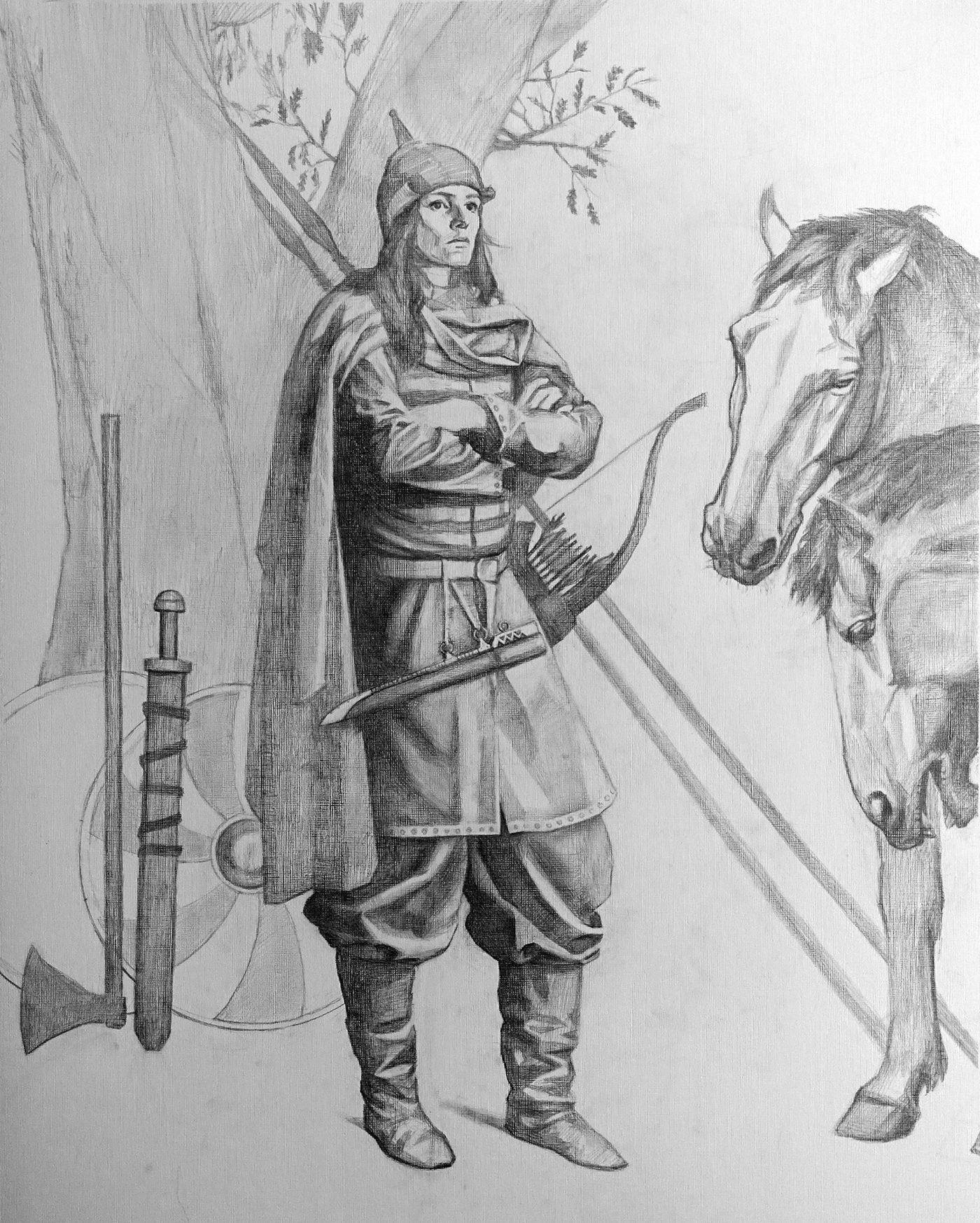
Despite these possibilities, however, we contend that there is far better contextual evidence for the more literal and traditional interpretation, as summarised above. The person in Bj.581 was buried in a grave full of functional weapons and war-gear (and little else), in close proximity to other burials with weapons, next to a building saturated with weapons, outside the gate of a fortress. Furthermore, the interment took place at a time when the hillfort and ‘garrison’ were at their zenith. Many other interpretations of both funerary treatment and gender are possible, but Occam's razor would suggest that to reach for them as a first resort is to attempt to ‘explain away’ what seems to be the most obvious and logical conclusion. In our opinion, Bj.581 was the grave of a woman who lived as a professional warrior and was buried in a martial environment as an individual of rank (Figure 8).
The occupant of Bj.581, reconstructed as a female warrior of high status. Clothing details are based on material from the Birka chamber burials and on the contemporaneous graves from Moshchevaya Balka in the North Caucasus (Knauer Reference Knauer2001) (drawing by Tancredi Valeri).
In our 2017 article—as its title indicates—we strongly followed the same military reading as has been proposed for Bj.581 by a long series of archaeological authorities, and for the same sensible reasons that are far from arbitrary. In doing so, we find no problem in adjusting for the new sex determination. To those who do take issue, however, we suggest that it is not supportable to react only now, when the individual has been shown to be female, without explaining why neither the warrior interpretations nor any supposed source-critical factors were a problem when the person in Bj.581 was believed to be male.
Viking warrior women: fact or fiction?
Birka grave Bj.581 suggests to us that at least one Viking Age woman adopted a professional warrior lifestyle and may well have been present on the battlefield. We would be very surprised if she was alone in the Viking world; other women may have taken up arms in the same seasonal or opportunistic context as many male Viking raiders. A few may have risen to positions of command—indeed, the quality of the individual's clothing, and the presence of the gaming set, implies that she may have been one of them.
In interpreting such individuals, we must question our assumptions and categories. What constitutes a weapon or a warrior, and how might we tell? What links do we make between buried individuals and the items accompanying them? What are our perceptions of gender and personal identity? How do we extrapolate from archaeologically recorded individuals to society in general? We must be especially aware that such perceptions are ours and not necessarily those of Viking Age people. Similarly, such critique must be applied broadly, and not just in contexts where the implications are inconvenient for preconceived interpretations. In that light, we also need to examine ourselves as scholars—our own biases and prejudices—asking what we are prepared to find acceptable in the past, and why.
We have not ‘gone looking’ for female Viking warriors. The case of Bj.581 arose after the discrepancy in sex determination was discovered through Kjellström's original study on the Mälar population (see the OSM); since then, we have followed the trail of data and analysis. Similarly, the DNA work that confirmed the female sex of the individual was part of a much larger genomic study, not specifically directed at Bj.581. We feel no intrinsic need for there to have been a female warrior buried in the grave, nor for such individuals to have existed more widely. We simply find it interesting that this seems to have been the case. In the course of our research—and even more so after the 2017 publication—it has been enlightening to discover how many people apparently need that not to be so.
Time will prove us right or wrong, but we think it probable that more Viking Age female warriors will be found in the archaeological record—either as new discoveries or as reinterpretations of old finds, perhaps using genomics, as we have done. Given the enormous numbers of buried individuals from this period that have been sexed only indirectly using associated artefacts, it is even possible that female warriors will eventually appear in some quantity. Currently, the figure of the woman with weapons seems to be an exception, but this does not mean that she can be deconstructed out of existence—especially on the basis of Pavlovian scepticism. She adjusts and nuances our interpretations, and challenges our stereotypes. She adds still further dimensions to our understanding of the Viking Age as a time of critical cultural transformation and social encounter.
Clearly, the investigation of Bj.581 has relevance for archaeological studies of gender (including feminist and queer theory), violence, mortuary behaviour, symbolism and many other fields, both in general and with specific reference to the Viking Age. At the same time, the relatively meagre data from this single, unusual (and exceptional?) grave cannot be made to bear an infinite burden of expectation and agenda—whether in support of, or in resistance to, our conclusions. This article is not, and for practical reasons cannot be, an attempt to achieve a greater understanding of Viking Age sex/gender systems in their totality. Instead, this is a case study that, in some ways, presents more questions than answers, but which also opens up previously unexpected possibilities. Not least, we stand before the collective corpus of excavated Viking Age burials with an urgent task of patient and careful reassessment, in relation to not only gender, but also concerning the social signals encoded within every aspect of funerary ritual. In the specific case of Bj.581, of course, one may draw different conclusions, but the integrity of the grave and the biological sex determination are secure. It is now for others to decide how they deal with the wider implications.
Acknowledgements
The research project on Bj.581 is led by Charlotte Hedenstierna-Jonson, under the dual auspices of the ‘ATLAS of 1000 Ancient Genomes’ and ‘The Viking Phenomenon’ projects at the Universities of Stockholm and Uppsala. Funding is provided by the Swedish Foundation for Humanities and Social Sciences (grant M13-0904:1), and by the Swedish Research Council (grants 2013-1905 and 2015-00466). We gratefully acknowledge the following for their comments and assistance during the writing of this paper: Clare Downham, Itiel Dror, Marianne Hem Eriksen, Leszek Gardeła, Alban Gautier, Cat Jarman, Marianne Moen, Anne Pedersen, Peter Pentz, Anita Saukel, Lars Stenvik, Amica Sundström, Þórhallur Þráinsson, Tancredi Valeri, Kenton Vaughan, Marit Synnøve Vea, Anna Wessman, Gareth Williams and two anonymous reviewers. In addition, we wish to thank the seminar and lecture audiences who have contributed valuable feedback over the years of the project. Lastly, particular thanks go to Terry Gunnell and the University of Iceland for a critical period of calm in which this paper could be finished.
Supplementary material
To view supplementary material for this article, please visit https://doi.org/10.15184/aqy.2018.258


 Open access

