




Introduction
Nāu te rourou, nāku te rourou, ka ora ai te iwi
(Māori whakatauki/proverb: With your food basket and my food basket the people will thrive)
Native forests in Aotearoa/New Zealand are at significant risk from the plant diseases myrtle rust and kauri dieback (Phytophthora agathidicida) and myrtle rust (Austropuccinia psidii) that are widely known to be killing kauri (Agathis australis) and myrtle (Myrtaceae/Myrtus) trees, such as ramarama, kānuka, maire tawake, pōhutukawa and various species of rātā. There is an urgent need to co-develop lasting solutions that draw on expertise from Western knowledge and mātauranga Māori (Māori knowledge). Historically, Western knowledge systems have dominated forest disease research and management in Aotearoa, as exemplified by the case of kauri dieback (Lambert et al., Reference Lambert, Waipara, Black, Mark-Shadbolt, Wood, Urquhart, Marzano and Potter2018). Māori efforts to assert indigenous environmental approaches are widely known to have been constrained by colonial histories and systematic marginalisation, despite it being well-founded to contribute significantly to addressing forest pathogens like kauri dieback and myrtle rust (Lambert et al., Reference Lambert, Waipara, Black, Mark-Shadbolt, Wood, Urquhart, Marzano and Potter2018, p. 110). In 2019, following significant government funding directed at kauri dieback and myrtle rust, the Biological Heritage National Science Challenge (BHNSC), a government-funded science research organisation, sought to build trust with rights-holders (Social Protection & Human Rights, 2025) and stakeholders, to support research and investment in biosecurity and biodiversity research utilising Māori and science knowledge. Mobilising for Action (2024; MFA), one of seven research investments in the BHNSC Ngā Rākau Taketake programme (Saving our Iconic Trees), focused on exploring the social dimensions of forest health. Over four years, MFA’s Māori and Pākehā (non-Māori of European, mainly British descent) co-leads engaged researchers (social science, humanities, creative arts, mātauranga Māori experts and scientists), artists, iwi/hapū (tribes/sub-tribes) and communities, in transdisciplinary research aimed to empower and support them in their efforts to address forest disease and promote forest health. A waka houora (double-hulled canoe) framework guided the MFA co-leads in their efforts to enable Western knowledge systems to operate equally alongside mātaurangā Māori, allowing for collaboration, cross-cultural learning and Indigenous empowerment.
This article examines how the MFA programme (2020–2024) implemented the waka hourua methodology through its research projects focused on forest health. A number of MFA projects involved artistic research or engaged with arts practices as part of their focus, including: the engagement of school children through various creative arts approaches in the Toitū te Ngahere project; the curation of Māori artists through a range of approaches, including photography, video art with Māori tikanga (protocols), a graphic novel and community workshops in the Toi Taiao Whakatairanga project; and the partnership with māra kai growers (food gardens) in the Māra Tau Tautāne (garden for the gods) project. We propose that through various creative arts approaches, MFA built relationships and partnerships between different people (Māori and non-Māori), across different knowledge and value systems and with forests, in addition to developing novel research methods in forest health through storytelling and narratives. This article, which has been written from a Māori and Pākehā collaborative perspective, mirroring MFA itself, begins by exploring the waka hourua methodology, followed by a discussion of the three projects, with examples of how this methodology has been applied. We note that we have discussed only as much as is culturally appropriate to share in this article, with the aim of also protecting Māori data sovereignty, which is why we have covered some projects less extensively here. We have also attempted to adopt the Māori cultural value of humility in presenting our findings and reflections in this article, in an effort to respect the voices and cultural contributions of our collaborators.
Waka houora
MFA co-developed a research programme to explore the meanings people have around te taiao (the environment), ngahere (forests) and species that are taonga (considered to be of value and treasured), including native kauri and Myrtacae (Myrtle) species in Aotearoa; how to support and foster people’s connections to them; and the ways people may be empowered to help native and taonga species flourish. Towards this, early in 2020, the co-leads of MFA (Marie McEntee and, at that time, Natasha Tassell-Matamua) engaged over 150 people in korero (conversations) from research organisations, iwi and hapū, communities and industry around Aotearoa, as well as partners in global contexts. As a result of this scoping exercise, MFA developed an extensive research programme comprising twelve research projects under a waka hourua methodological framework, reflecting a recognition of how mātauranga Māori and Western knowledge can equally contribute to exploring the social dimensions of ngahere ora (forest health). The framework took up the challenge of kaumatua (elder) Hori Parata of Ngāti Wai, Ngā Puhi, Ngāti Hine iwi, who called for its use in forest biosecurity to provide a framework for equal investment and engagement in Māori and non-Māori knowledge systems.
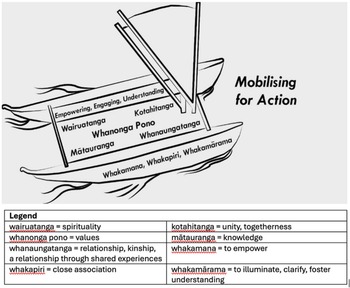
In the waka hourua framework, each hull of the canoe represents areas of knowledge and knowledge production, with mātauranga Māori on one side and Western knowledge on the other (see Figure 1). Its users, like MFA, aim to place equal value on Māori knowledge and Western knowledge, as a kind of conceptual partnership. This extends beyond the widely considered colonial and positivist science perspectives, which do not view Indigenous ways of knowing as having equivalent standing or value (Durie, Reference Durie2004). MFA was particularly concerned with human perspectives around forest health and related cultural knowledge, particularly myrtle rust and kauri dieback, which were having a significant impact on the health of forests in Aotearoa. Uniting the two hulls is a papa noho, a physical structure that connects each hull. The papa noho serves as a metaphor for how the knowledges, researchers and others using the knowledge can engage collaboratively, each informing the other, while respecting the mana motuhake (sovereignty and self-determination) of Māori over Māori knowledge. Working with this framework resulted in both Māori-led and non-Māori-led research and outcomes in MFA, as well as direct collaborations within and between projects and among researchers.
Waka Hourua framework (Mobilising for action, 2024).

The waka hourua reflects the approach outlined by Rata et al., (Reference Rata, Hutchings and Liu2012), who frame it as an interface between research exploring mātauranga Māori and Western science. Mātauranga Māori can involve all forms of knowledge and, in Western terms, “disciplines”. In addition to mātauranga Māori, MFA included many disciplines such as social science, visual art, performing arts, curating, journalism and ecology science. MFA also endeavoured to embrace the dominant Māori perspective that mātauranga Māori, as a terrain of knowledge production and research, also includes forms of science, including ancient empirical-based knowledge and methods around forest and human health combined, such as rongoā Māori (Māori medicine), plant species knowledge and rāhui (controls on access to locations often for conservation and protection). MFA’s view contrasted with attempts by some to publicly refute that Māori knowledge involves perspectives of science (Ngata, Reference Ngata2021). Such views have been widely critiqued for undermining mātauranga Māori and are widely seen as colonial, reactionary and anti-Māori populist racism and not grounded in evidence (ibid; Hikuroa, Reference Hikuroa2017).
The waka hourua methodology we propose is a dynamic one, as it is based on Māori principles, values and concepts, allowing for adaptation throughout the research duration (Rata et al., Reference Rata, Hutchings and Liu2012), including partnership and collaboration across cultures. For Rata et al., Reference Rata, Hutchings and Liu(2012, p. 64), it is a Māori metaphor of duality legitimising mātauranga Māori “as a platform for generating new knowledge”. We add that MFA aimed to simultaneously do the same with Western knowledge, including, initially, Western science. In mātauranga Māori, all things are interconnected and related, including whakapapa (genealogy), which connects and structures all things (Hikuroa, Reference Hikuroa2017; Mahuika, Reference Mahuika2019). Therefore, it can be seen as natural to apply a framework like the waka hourua, which provides space for mātauranga Māori and offers a zone for connecting and weaving different cultural knowledges. MFA also provided space and resources for Māori-led and run projects to develop independently, drawing from Western knowledge and institutional systems only when Māori researchers and communities deemed it necessary for their empowerment. The intention here was to embody the values of cultural partnership in the model, rather than initiating an explicit collaboration between Māori and non-Māori research and cultural practices at every step. Settler researchers giving space for Indigenous researchers to do their work is a form of partnership that we propose.
Informing the waka hourua for MFA was a range of settler-Indigenous collaborative approaches in Aotearoa. One of these is an application of Te Tiriti o Waitangi (The Treaty of Waitangi), the founding document of the nation–state of Aotearoa, signed in 1840. Te Tiriti, for short, implies that Māori retain sovereignty and that there is a partnership between them and the Crown (Orange, Reference Orange1987). The Crown here represents all non-Māori in Aotearoa. We propose that the waka hourua applies Te Tiriti by embodying this legal framework, allowing for Māori to control all things Māori in partnership with non-Māori in the research. And, like in Te Tiriti, each group of partners, we propose, can unite, mutually inform and collaborate while appreciating and learning from each other’s differences. Another point of reference here has been Alison Jones and Kuni Jenkins’ (2014) bicultural collaboration concept of working in a hyphen space. They call for knowledge generation and collaboration based on respectful relations between Māori and Pākehā (Europeans of mainly British descent), and “from difference” (p. 48).
In application of the waka hourua framework, a number of MFA’s projects were led by “Māori for Māori”, focusing on Māori perspectives, issues, aspirations/priorities and knowledge systems. Other projects were Māori and non-Māori-led, while others operated within a Western social science framework focusing on co-design, transdisciplinary engagement, fieldwork and knowledge generation.
Toitū te Ngahere
Toitū te Ngahere (uplifting the forest through the arts, TTN) was a transdisciplinary project combining creative arts, social science, education and mātauranga Māori, with various cultural values and local knowledge, site-responsiveness and place-making around kauri dieback and myrtle rust. It encompassed partnerships between five primary schools that have records in engaging with environmental care over two years, their students and teachers, our researchers, artists, a local iwi (tribe), local government and scientists. At the heart of this project was the waka hourua approach, where Pākeha and Māori co-led and co-designed the project, combining the above-mentioned knowledge areas. TTN aimed to empower school students around the well-being of these native tree species and forest health, through the creative arts informed by mātauranga Māori, ecological science and social science. Toitū te Ngahere aimed to demonstrate how school students can be empowered to have a voice and contribute to public awareness about ecological and environmental issues. This area is often underrepresented in Aotearoa and internationally among the general public. Outcomes of the project included the students making and presenting creative arts work in a range of disciplines, while being informed of Māori knowledge, science and their local environment. Building connections and empowering them with their local communities was also we propose one of the project’s outcomes.
The participating schools involved in TTN were situated in both years in suburban Tāmaki Makaurau (West Auckland), around native forests and in the second year in rural Aotea (Great Barrier) Island, which is mainly a conservation park. In Tāmaki Makaurau, we worked with around 200 students, and on Aotea Island, we had around 100 participants. Students in the Auckland schools were in years five and six, ten to eleven years old and on Aotea, ranging from years one to eight, aged five to thirteen years old. On Aotea, we developed a partnership with the local hapū (sub-tribe), specifically Ngāti Rehua of Ngāti Wai iwi, which contributed by involving a matua (male teacher) from their community to guide the students, teachers, artists and researchers in our project development. In each school, we contracted artists, including those from four local iwi, to deliver workshops, and facilitated the students and teachers to make creative arts works around the themes of forest health, myrtle rust and kauri dieback. TTN spent six months each year working with the schools and their research programmes, culminating in exhibitions and performances within the schools, as well as four public exhibitions at the schools, an art gallery and two public festivals. The public exhibitions aimed to build community awareness from the students’ perspectives. To further learning opportunities and empowerment for the school children, each year TTN had students from each school present their projects and learnings to university students at Waipapa Taumata Rau (The University of Auckland), in lectures in an undergraduate course on education and student empowerment.
The creative arts forms that TTN brought into the schools and that the students produced varied depending on what the students and teachers chose to engage in. The mediums included sound art, drawing and illustrations, print-making, drama, dance, photography, video, creative writing, mural creation and designing and making games. Key to all of this was a sense of co-design in that the students we propose had a voice and sense of power over what they learnt about in terms of arts genres and what they produced.
Informing TTN’s engagement with the creative arts in building forest health awareness and environmental management is how Heggen et al. (Reference Heggen, Sageidet, Goga, Grindheim, Bergan, Krempig, Utsi and Lynngård2019) and Hickey-Moody et al. (Reference Hickey-Moody, Horn, Wilcox and Florence2021) note that arts-based engagement provides alternative and expressive forms of communication and learning, not otherwise found in other approaches. Examples of this for them include visual art, performance and play. While the arts are often used to foster pro-environmental behaviour, TTN attempted to go further than this with arts-making as a form of inquiry and knowledge production with students (Hunter et al., Reference Hunter, Aprill, Hill and Emery2018). In doing so, we propose that students had the opportunity through TTN to express and explore ecological complexities and be mobilised to apply their learnings and values around building forest health. This aligns with what is widely established across the surrounding field of environmental education, including the use of transdisciplinary collaboration and place-based methods, as well as problem-based learning (Brundiers et al., Reference Brundiers, Barth, Cebrián, Cohen, Diaz, Doucette-Remington, Dripps, Habron, Harré, Jarchow, Losch, Michel, Mochizuki, Rieckmann, Parnell, Walker and Zint2021; Eames et al., Reference Eames, Cowie and Bolstad2008; Evans, Reference Evans2015; Kates et al., Reference Kates, Clark, Corell, Hall, Jaegar, Lowe and Svedin2001; Somerville & Green, Reference Somerville and Green2015). Active inquiry, student-led approaches like these, are widely regarded as catalysing deep learning, with teachers serving as facilitators rather than knowledge transmitters (Budwig & Alexander, Reference Budwig and Alexander2021; Darbellay, Reference Darbellay2015). The emphasis on mātauranga Māori in TTN, where people were approached as being interconnected with the forest ecosystem, also aligns with scholarship that calls for “less human-centred, hierarchical, or controlling” education (Morse et al., Reference Morse, Blenkinsop and Jickling2021, p. 263; Priyadharshini, Reference Priyadharshini2021).
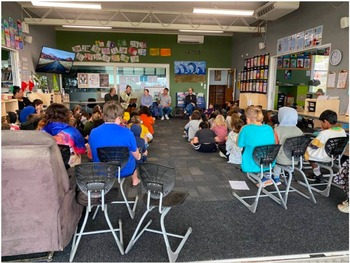
One case study spanning over two years for TTN was with Kauri Park School on the North Shore of Tāmaki Makaurau (see Figure 2). Initially, the students from a range of cultural backgrounds, including a small number of Māori Tamariki (children), were guided in a mapping exercise where they physically explored their school and the surrounding forest. They identified native species and how people engage with this site through a listening exercise. From this, they developed a collective map of what they regarded as important for them. We propose that this aided their sense of awareness and social connections with the surrounding ecosystem, including their school food gardens and other non-forested locations. It became clear to them in our observations that they applied how, as is widely known in te ao Māori (the Māori world), people are deeply interconnected with the environment. And, as part of this, they revealed through their conversations their understandings of how the two rely on each other for well-being. For instance, on the one hand, the children reported feeling happier and more relaxed around the forest around their school and on the other, the native species in the area need their care in terms of removing introduced non-native pest plants and animals for their survival. This was followed in the coming week with a session with a matua from local iwi, Pita Turei (Ngāti Poua, Ngāti Whatua o Orakei iwi), who shared pūrākau (Māori stories of origin) to do with interconnections between people and forests, forest health and specific details around some of the native tree species in the project, like rātā trees. He reinforced with the students the concept of kaitiakitanga (caring for and guardianship of the environment, among other things), and how people need to play this role in native forests. The TTN team observed this being reinforced by the teachers and the students themselves in what they later made and how they expressed this.
TTN Wānanga with Kauri Park School and Auckland Council Staff (McEntee et al., Reference McEntee, Harvey, Mullen, Houghton and Craig-Smith2023).

For the rest of the school term, the TTN team brought in artists, as well as ecologists. The ecologists taught the students about myrtle plants and kauri. The artists led the students in workshops to develop their knowledge and capabilities in arts practices and mātauraranga Māori around the forest, including in drawing, sound art making, script-writing, creative dance and print-making, with, for instance, local iwi artist Charlotte Graham (Te Kawerau ā maki, Ngāti Mahuta, Ngāi Tai ki Tāmaki, Ngāti Whanaunga, Ngāti Pāoa, Ngāti Tamaoho iwi). Charlotte began her workshop with whakawhānaungatanga (relationship building) with the students and teachers, a widely considered key Māori approach to working and collaborating with others, enabling deep mutual understanding, learning and empathy for one another. Charlotte then had the students engage in a Māori breathing exercise to aid their sense of focus and connection to the spiritual aspects of the forest and how they are part of them in te ao Māori. They all then collected leaves from the native myrtle species and kauri in the surrounding forest while she shared her knowledge with the children. Additionally, they brainstormed about their role and connections with the forest from a Māori perspective. While collecting the leaves, Charlotte performed karakia (spiritual incantations) as a traditional Māori way of giving back to the forest and trees for taking from them. This is an example of the commonly known aspect of reciprocity, exchange and our interconnections as a fundamental worldview in te ao Māori. Charlotte proceeded in later sessions to share pūrākau around the leaves and forest and guided the students into developing prints of the leaves, with Māori kowhaiwhai (patterns) from Charlotte’s whakapapa. This can be seen to function as a form of material exchange between the artist and students, through a contemporary Māori kaupapa (platform). The results of this waka hourua process of weaving Māori and non-Māori knowledge were exhibited alongside a parallel TTN school project at Konini School, at the Te Uru contemporary art gallery in Titirangi, West Auckland, six months into the project. It provided an opportunity for the school, whānau (families), friends and the general public to explore and learn from the students’ creative works (see Figure 3).
Toitū te Ngahere exhibition, te uru gallery (McEntee et al., Reference McEntee, Harvey, Mullen, Houghton and Craig-Smith2023).

At the end of the first year of working with the school, it became apparent to the TTN research team that students and teachers were expressing a lack of understanding and disempowerment over why the local forest park, also called Kauri Park, had been closed off from entry to the public for the last six years. The TTN team noted from parallel observations in other MFA projects that this was a common trend where members of the public expressed feeling alienated and disempowered from decision-making around such local forest closures by the local government. As a result, the TTN team set up and facilitated a wānanga (learning session where exchange is valued) between the students, teachers and local government environmental staff. The children all shared their questions and concerns with the staff. And the staff were able to address them. The students and teachers were shown that the park closure was part of the rāhui (a customary control of access, often for conservation purposes), established by the local mana whenua (iwi with designated authority over the area), Te Kawerau ā Maki, as a means to prevent the spread of kauri dieback. It is noted here that rāhui are an ancient Māori practice, dating back to conservation efforts long before Europeans, which are not permanent and depend on the environment’s healing time (Lambert et al., Reference Lambert, Waipara, Black, Mark-Shadbolt, Wood, Urquhart, Marzano and Potter2018). With this new understanding, the students offered suggestions on how the local council could educate locals about the forest park rāhui. After some collective brainstorming, the idea of the children creating signage emerged. This culminated in the students creating a mural on a large shipping container, facilitated by TTN researchers, that contained information for the public about why there is no access to the forest and how mātauranga Māori and Western knowledge have worked together to inform this.
One of the aims of TTN was to work with ako. Ako, or reciprocal and holistic teaching, is a common goal in kaupapa Māori education settings, where students and teachers learn from one another (Bishop, Reference Bishop2003). Ako is widely considered to raise their mana (status, power, influence, sense of integrity, charisma and spiritual power), based on how it addresses the need for Māori children to be listened to in educational settings (Panuku, Reference Panuku2016). Kia Eke Panaku notes how ako aligns with other collaborative, student-led approaches that embrace and recognise the cultures of students, instead of the dominant colonial hierarchical, individualist approaches (ibid) – that are widely considered to privilege Pākehā while excluding and marginalising Māori children (Bishop, Reference Bishop2003; Durie, Reference Durie2011; Statistics NZ, 2022). Additionally, much research across the education field shows that this kind of approach leads to deeper engagement and learning for all involved and the undoing of epistemic injustice in terms of disparities between students (Bishop, Reference Bishop2003; Fricker, Reference Fricker2007; Panuku, Reference Panuku2016; Highfield & Webber, Reference Highfield and Webber2021; Rata & Al-Asaad, Reference Rata and Al-Asaad2019). For the TTN researchers and MFA co-leads, this wānanga with Kauri Park School and local council staff demonstrated how an ako approach through its relationship-building, mutual learning, reciprocal decision-making and co-design with the creative arts can be effective in building deeper understandings and empowerment around caring for forests for all involved. We note that another recognised aspect of ako, family involvement (Morrison & Vaioleti, Reference Morrison and Vaioleti2019), was not achieved in the participating suburban schools, like Kauri Park. We propose that this is due to the culture and large size of public schools, where families are not often very involved. However, we suggest that this aspect of ako was achieved with the smaller rural schools in TTN when parents participated in workshops on Aotea Island.
While there is significant research on the viability of ako with Māori students, the TTN team observed that all participants engaged with passion and commitment, leading them to conclude that this approach can also be effective in developing deeper learning and empowerment around forest care with children from a wide range of cultures. TTN’s findings here for us align with Rameka and Paul-Burke’s (Reference Rameka and Paul-Burke2015) call to reclaim space for Māori and things that are Māori, in response to colonial processes in education that usually exclude children from decision-making and active relation-based learning, by including the voices of Tamariki. As many Māori researchers argue, this type of shared dialogical learning can foster greater inclusivity for students from all cultures (Bishop, Reference Bishop2003). This can be seen to apply the waka hourua framework in that a kaupapa Māori approach to teaching, ako, was informing how to engage with aspects of non-Māori knowledge and practices, including Western science through contemporary art approaches to forest health in mainly non-Māōri state education contexts, where Māori are only a part of the school population. Ako, as a method of co-produced, participatory, dialogic and inclusive education, can be seen as an example of what Leeuwis (Reference Leeuwis2011) argue is an effective approach to environmental custodianship here, by applying these same aspects – co-production, participation, inclusivity and a sense of dialogical knowledge development.
Toi Taiao Whakatairanga
Toi Taiao Whakatairanga (Reference Whakatairanga2024; uplifting the environment through the arts) was a four-year transdisciplinary, creative arts project aimed to empower and educate communities, including Māori hapori (communities) and iwi/hapū around kauri die back and myrtle rust. Toi Taiao Whakatairanga (TTW) commissioned nine Māori artists to create public creative arts works in relation to these aims. In application of the waka hourua approach, the project had a Māori leader and was made up of a team of Pākehā and Māori researchers, including curators, mātauranga Māori specialists, social scientists, an ecology and plant pathogen scientist, Māori designers and a publicist, each combining and co-designing their work, with the artists and participating iwi/hapū and community members.
A goal of the project was to activate and honour kaupapa Māori values and practices where possible through the creative arts in relation to forest health. A rationale behind this is that, as noted above, mātauranga Māori-based responses around kauri die back and myrtle rust were widely known not to be valued in many public, conservation and science circles dominated by non-Māori (Lambert et al., Reference Lambert, Waipara, Black, Mark-Shadbolt, Wood, Urquhart, Marzano and Potter2018) – a form of epistemic injustice. The arts were also not often seen at the time of commencing the project as a field of knowledge generation that can inform the fields of biosecurity, plant pathogen research and conservation in general in Aotearoa. Additionally, knowledge about these pathogens was not commonly considered high across both Māori and non-Māori communities. This can be seen as particularly a concern for Māori, considering that much Māori whenua (land) and a third of Aotearoa consists of native forests and habitats, where kauri and myrtle species are common. The TTW team aimed to address these issues by working with practices of creative arts made by Māori in partnership with Western scientific perspectives around these pathogens. Through this, TTW aimed to apply and practice its concepts, in contrast to how Moweka Barnes et al. (Reference Moweka Barnes, Harmsworth and McCreanor2021) note that transdisciplinary research often remains theoretical. The creative arts forms TTW engaged with were varied in form, including photography, video art, digital game design, installation, painting, design, graphic novel creation, social based approaches, billboard design and creation, embroidery, print-making and the development of Māori tikanga and kaupapa with traditional arts methods, like weaving with fish traps and rongoā Māori (Māori medicine). Additionally, TTW provided and supported workshops with iwi/hapū and public communities, as well as public exhibitions and seminars. TTW required the artists to make a koha (donation) to their own iwi/hapū or community through their work, as a way of building a sense of reciprocity and uplifting mana, which is widely seen as fundamental in te ao Māori contexts. TTW engaged with members of over ten iwi/hapū nationwide, especially from the north and east of the Te Ika o Māui (the North Island). The project also partnered and/or engaged with a range of other organisations and individual researchers, including two Crown Research Institutes (Aotearoa government science agencies), three universities, The Kauri Project, a public arts non-government organisation, three public art museums and galleries, such as at Te Uru Art gallery, other research projects, like Toitū te Ngahere and the Māori research group Ōranga under MFA’s parent funding body Ngā Rākau Taketake, academics, PhD students, a Post Doctoral Fellow and research assistants.
The TTW methodology was multiplex. Key to this we propose was its application of a te Tiriti o Waitangi partnership framework, which the team labelled as a hyphen-space project, in line with Jones and Jenkins (2014). Similar to Jones and Jenkins’s model, this was where Māori could have mana motuhake (self-determination and autonomy) over their own knowledge production in the creative arts, as well as related research and all things Māori, supported by non-Māori collaborators and Western knowledge approaches. As mentioned, these tukanga (approaches) are, in turn, part of MFA’s waka hourua framework. Within this context, TTW developed its projects through the notion of auaha (creating and shaping), or, in Western terms, artistic research (Slager, Reference Slager and Slager2021), which enables emergent and open-ended knowledge production through arts practices. The planning and implementation of the project were supported by a Western social science Action Research framework (Haseman, Reference Haseman, Barrett and Bolt2007). TTW’s processes were structured through action cycles, with different stages of development, implementation and reflection, culminating in two public exhibitions: one at Te Uru Gallery and the other touring iwi/hapū marae (traditional Māori tribal gathering spaces) around the North Island. Similar to the TTN project, qualitative research methods, including interviews and theme analysis, were interwoven within TTW’s reflection processes.
Relationship building was a central part of TTW’s processes. It was influenced by both Māori and non-Māori perspectives. In one sense, it was influenced by the last twenty years of the Western contemporary art genre of social practice, where relationships between artists and communities are widely regarded as a crucial ingredient in creating art. However, for the TTW researchers, this served as a point of departure. This is because social practice is often seen as being subsumed by dominant Western capitalist art norms (Kraus, Reference Kraus2018, p. 11), leading to the exploitation of communities and participants, while artists benefit from it (Davis, Reference Davis2013). TTW instead approached their work through continued whakawhānaungatanga (Macfarlane, Reference Macfarlane2006). As part of this relationship-building, they incorporated care through sharing knowledge in decision-making, collaboration and co-curation, internally, with artists and partnering with communities and institutions. Underpinning this process is the need to continually maintain and work on whakawhānaungatanga (Rata & Al-Asaad, Reference Rata and Al-Asaad2019, p. 220). The feedback from external collaborators and partners to TTW regarding this initiative was that it helped them engage more deeply with kaupapa Māori and their connection to the forest, myrtles and kauri, as evidenced by conversations, interviews and a survey (Toi Taiao Mullen et al., Reference Mullen, Harvey, Craig-Smith, Jerram, McBride, Waipara, Ware, Sadeghi-Yekta, Prentki and al Kurdi2025; Whakatairanga, Reference Whakatairanga2024). Two examples of TTW’s commissioned projects are presented below.
Kaimanāki o te Ngahere (Toi Taiao Whakatairanga, Reference Whakatairanga2024) by Tanya Ruka (Ngāpuhi, Waitaha iwi) was a video project that led to the development of a digital game intended to empower and educate Māori and others about myrtle rust from a kaupapa Māori perspective. Together with her whānau, she responded to myrtle rust and its impacts on native myrtle species within her community’s communal forest. She began researching the topic with scientists and then involved tikanga Māori experts, such as her mother, Jane Ruka (Ngāpuhi, Waitaha iwi). As part of this process, Jane created a karakia in response to myrtle rust, along with tikanga to perform with it. The karakia asks myrtle rust to find where it belongs, rather than harming native plant and tree species. This can be seen to differ from dominant non-Māori approaches to biosecurity in Aotearoa, where there is usually simply a call to remove pest species. We propose this emphasises how in te ao Māori all living things are seen to have a role to play together, albeit not in places where they are not seen to fit. Jane performing the karakia in their community forest is a central part of the Kaimanāki o te Ngahere video presented at the TTW Te Uru exhibition and its subsequent game. The karakia was offered as a gift to all others willing to engage with it around places where they identify myrtle rust, provided its tikanga is followed. The karakia has been adopted nationwide by a wide range of networks, including commercial and public nurseries, educational institutions, scientists and other researchers, artists and a diverse group of iwi/hapū members. Another aspect of Kaimanāki o te Ngaherei is how it draws from Western science and applies the waka hourua approach by combining Māori and Western knowledge. The project has also resulted in Tanya setting up signs around their community forest with barcodes linking to a website featuring information on each native species, myrtle rust, her video and the karakia, as a form of ongoing legacy and another way to give back, or in one sense, koha, to her hapori.
Myrtle Rust (2023) by Aroha Novak (Ngāi Tūhoe, Ngaiterangi, Ngāti Kahungunu iwi) was a graphic novel, part mātauranga Māori and Western science, fiction-spoof and humourous engagement with myrtle rust, intended to educate the public, especially rangatahi (youth) (see Figure 4). It was developed in collaboration with teenagers, Western scientists and the TTW curatorial team. The graphic novel narrative focuses on a teenager, Māra Karaka, who contracts myrtle rust at her school, Myrtaseae High School, due to an unchecked corporate science misadventure. The karakia by Jane Ruka in Tanya Ruka’s project appears at this point in the story, alongside a collection of Western scientists and doctors who attempt to heal Māra, where all else has failed. This project we propose serves as another example of where the waka hourua is applied, in terms of combining contemporary Western arts, science and Māori knowledge. By co-designing this project with teenagers, it has engaged with youth, children and adults from a wide range of cultures around myrtle rust and its associated mātauranga Māori and Western knowledge, who we believe may likely not tune in to it otherwise. The graphic novel continues to be disseminated and used for educational purposes around the country, in institutions, Māori contexts, by policymakers, schools, art galleries, museums and other research projects.
Snippets from myrtle rust (Novak, Reference Novak2023), graphic novel.

Māra Tautāne
In recent years a widespread movement within te ao Māori has grown towards food sovereignty for Māori, including growing māra kai (food crops) and re-igniting epistemic injustice or lost knowledge around this due to approximately 200 years of colonial processes related to gardening, loss of land and culture and industrialised agriculture and supply chains (Hutchings, Reference Hutchings2015; Tassell-Matamua et al., Reference Tassell-Matamua, Boasa-Dean and McEntee2023). Teina Boasa-Dean (Ngāi Tūhoe iwi) has played a leading role in the Te Māhurehure hapū in the Rūātoki Valley, Bay of Plenty, in Aotearoa’s North Island, in endeavouring to form a local circular economy, based on her interpretation of Kate Raworth’s Doughnut Economics (Reference Raworth2017), using a Māori Doughnut Economics model (Shareef & Boasa-Dean, Reference Shareef and Boasa-Dean2020). This is, in itself, an example of the waka hourua approach we propose. The approach supports the hapū in growing their own food crops, including those with Māori ancestral provenance, such as kūmara (sweet potato), a prominent food source for the hapū. As is widely known in te ao Māori, before colonisation, all aspects of food producing and life in general were deeply intertwined with spiritual practices. This included various practices, such as karakia and māra (gardens) for atua (gods). These gardens for the atua (gods), known as māra tautāne, were places where crops were not to be eaten by people (Boasa-Dean, Reference Boasa-Dean2022). Such practices have largely disappeared (ibid). From 2020 to 2022, the MFA co-leads Tassell-Matamua and McEntee partnered with Boasa-Dean and other wahine of the Te Māhurehure hapū of Ngāi Tūhoe iwi, to record, primarily through video, the revitalisation of a māra tuatāne. Additionally, a story map and booklet were created for wider dissemination. Co-design occurred between core team members from the hapū and the MFA co-leads, ensuring a fully collaborative process for video production and other outreach efforts. While TTN and TTW had the creative arts as the main platform for knowledge production, the Māra Tautāne project used the arts and artistic processes, but not as a central component. Instead, the project’s core drivers were its Māori spiritual aspects. However, an intention behind the hapū’s public outreach was for other Māori communities to be inspired by this project to re-create their own ancestral spiritual connections to their māra and forests (ibid).
The Māra Tautāne drew on re-established māra kai practices of the Te Māhurehure hapū. The garden itself was fenced off with pou (carved pillars) representing the whakapapa of the kūmara, in addition to specific atua to protect and watch over the valley, and kaitiaki (care, guard and uplift the mana) of the people, environment and all living things in Rūātoki. The pou were made of wood from the native myrtle tree, kānuka and co-designed with a tohunga whakairo (master carver). Kawakawa leaves were supplied from the surrounding forest, and kūmara from ancient ancestral seed stocks were provided for the māra. The ceremonial use of these native species, and in the case of kūmara, a non-native but ancestral plant, we propose that emphasises their significance for Māori. And, in the case of kānuka, how vulnerable such cultural practices can be in light of forest pathogens, such as myrtle rust.
The Māra Tautāne celebrated the well-being of people, including through their food supply, as well as the surrounding environment that supports it, encompassing the food crops, the surrounding forest, the weather, and its deep connection to Māori ancestry, all of which contribute to a spiritual sense of health. Additionally, as research around Māori identity has shown, it is enhanced by connecting with the environment (Apiti et al., Reference Apiti, Tassell-Matamua, Lindsay, Dell, Pomare, Erueti, Masters-Awatere and Te Rangi2022; Tassell-Matamua et al., Reference Tassell-Matamua, Lindsay, Bennett and Masters-Awatere2021). Re-creating and developing māra practices on customary land for the hapū by investing in and revitalising cultural practices has enabled deep connections to the environment. Re-establishing māra tautāne by supporting its re-creation and associated rituals can be seen to enrich other related knowledges, such as engaging with maramataka (Māori moon cycles) for growing and harvesting, and educational practices with children and the community, while empowering them to value their identity as Māori and their connection to the environment.
Conclusion
Naku te rourou nau te rourou ka ora ai te iwi
(Māori whakatauki/proverb: With your basket and my basket the people will live)Through its twelve research projects, MFA has attempted to bridge the ongoing divisions and gulf between settler and Māori knowledge sharing and production around the social dimensions of kauri dieback and myrtle rust. It has aimed to educate and empower communities, including Māori and non-Māori, as well as the wider public, on these forest health themes. In this way, MFA has attempted to engage and empower people through a range of approaches that utilise the creative arts, applying the waka hourua framework, thereby moving beyond the dominance of Western science approaches in conservation and ecology. A key aspect of this for us has been to empower Māori voices and efforts through these themes. We have provided examples of three research projects here that employ novel methods and narratives, drawing on mātauranga Māori and Western knowledge: Toitū te Ngahere (TTN), Toi Taiao Whakatairanga (TTW) and Māra Tautāne. The emphasis in this discussion has been especially on the TTN project, given what is culturally appropriate to share and what is not.
To address the epistemic injustices around forest health knowledge, research and education, we propose that this has begun to be achieved through MFA’s projects by applying the waka hourua framework around supporting Māori to lead and create initiatives in relation to the creative arts and other mātauranga Māori approaches, like tikanga Māori – even if this is on a micro-scale in places. In applying the waka hourua, TTN operated by interweaving Māori and Western knowledges. Additionally, the other two projects aimed to provide space for Māori-led and Māori-made research, with support from non-Māori approaches and researchers when needed. By applying the waka hourua framework to MFA’s projects, we propose that we have been able to enrich the way we educate and empower communities around kauri dieback and myrtle rust, to levels we may not have achieved otherwise. Key to this has been relationship-building through whakawhānaungatanga and co-design, bringing together a range of experts and researchers with communities, artists, educators, from Māori and Western knowledge contexts, through place-making approaches and care for forests and people together, on equal terms. This has been achieved through a range of artistic approaches and other methods, where the arts have played a key part.
From our findings, MFA’s projects have contributed to increased reciprocal relations between humans and more-than-human communities, as well as deeper understandings of mātauranga Māori and related practices. They have catalysed passion and commitment, empowering community members to care for forests, enhancing embodied and spiritual interconnectedness, supporting Māori self-determination and autonomy and advancing epistemic justice for all beings.
For us, this marks only the beginning of our journey, as these plant pathogens continue to rise in Aotearoa. The current government has cut funding to initiatives like this, as it does not value related transdisciplinary, arts, social science, humanities and Māori research that is not explicitly focused on monetary gain, as is commonly known. However, MFA we propose can serve to inform future research and on-the-ground community applications in relation to critical forest studies, other ecological contexts and related challenges in the future.
Acknowledgements
We would like to thank research collaborators in MFA, including Natasha Tassell-Matamua (co-lead of MFA), Teina Boasa-Dean (Māra Tautāne), the other collaborators across MFA and the participants and communities in this research.
Financial support
This work was previously funded by the Ministry of Business, Innovation and Employment (Mobilising for Action theme of the Ngā Rākau Taketake programme of the Biological Heritage National Science Challenge in Aotearoa/New Zealand C09X1817).
Ethical standard
Human Ethics Approval has been approved for these projects under Mobilising for Action by the University of Auckland Human Ethics Committee, under project numbers: 23,279 and 22,395.
Author Biographies
Mark Harvey (School of Creative Arts, the University of Auckland) is an artist, researcher and Senior Lecturer focussing on creative arts research and transdisciplinary contexts in relation to mātauranga Māori and te Tiriti o Waitangi approaches, ecology and social justice.
Marie McEntee (School of Environmental Studies, Faculty of Science, the University of Auckland) is a social scientist and Senior Lecturer, focussing on transdisciplarity around the social aspects of the e Waitangi approaches, ecology and social justice. nvironment.
Molly Mullen (School of Education, Faculty of Arts and Education, the University of Auckland) is an arts and community researcher and Senior Lecturer, focussing on community arts and arts advocacy in a range of contexts.


 Open access

