





Demand for farmed salmon heavily outweighs the availability of the raw materials, fishmeal (FM) and fish oil (FO), historically used to formulate feeds. According to the National Research Council( 1 ), the nutritional requirements for this carnivorous species during the freshwater stages include 42–50 % protein, containing essential amino acids, and 16–24 % lipid with an emphasis on long-chain (LC) n-3 fatty acids; EPA (20 : 5n-3) and DHA (22 : 6n-3) (0·5–1 %). Availability of these ingredients from marine resources is finite and alternative protein and lipid sources are required in order to sustain aquaculture development. Vegetable-derived proteins and oils are logical alternatives because of their high availability and relatively low production costs.
However, inclusion of plant ingredients in salmonid feeds can result in reduced feed utilisation. This may suggest a digestive and/or metabolic interference which can cause reduced growth performance and health issues. Reduced digestibility of plant ingredients in salmonid diets has been shown to correlate with reduced retention of protein and energy( Reference Refstie, Storebakken and Roem 2 – Reference Wacyk, Powell and Rodnick 5 ), indicating lower metabolic activity and ultimately resulting in lower growth performance. Moreover, health implications such as distal intestinal (DI) enteritis, have been highlighted with some vegetable-based diets( Reference Bæverfjord and Krogdahl 6 – Reference De Santis, Ruohonen and Tocher 11 ). Several anti-nutritional factors (ANF) have been associated with detrimental effects on growth performance and health when using vegetable-based diets in aquafeeds( Reference Francis, Makkar and Becker 12 , Reference Gatlin, Barrows and Brown 13 ). Advances in feed technology have allowed further enrichment and refinement for several vegetable-based protein ingredients such as the processing of plant meals into protein concentrates, that is soya protein concentrate (SPC) by alcohol extraction, pea protein concentrate (PPC) by air classification, and wheat gluten (WG) by physical extraction( Reference Gatlin, Barrows and Brown 13 , Reference Drew, Borgeson and Thiessen 14 ). These processes can reduce or remove ANF and ultimately reduce the associated health implications on gut morphology posed for salmonids( Reference van den Ingh, Olli and Krogdahl 7 , Reference Drew, Borgeson and Thiessen 14 – Reference Burel, Boujard and Tulli 17 ). Regardless, high inclusion of refined ingredients may still cause detriment to salmonids as seen in SPC( Reference Mambrini, Roem and Cravédi 18 ) and PPC( Reference Penn, Bendiksen and Campbell 10 ) but, at lower levels, such ingredients appear to be successful( Reference Refstie, Storebakken and Roem 2 , Reference Refstie, Storebakken and Bæverfjord 19 – Reference Øverland, Sørensen and Storebakken 22 ). Moreover, blending reduced levels of SPC and faba bean protein concentrate previously demonstrated improved performance in salmon and reduced negative alterations to the gut transcriptome when compared with individual use of each ingredient( Reference Król, Douglas and Tocher 23 ). Continuous refinement of alternative feeds is necessary to maximise benefits and minimise detrimental effects to the fish, with the aim to match the efficiency of traditional feeds optimally designed for carnivorous salmonids.
Nutritional programming has been considered as an option that may help to overcome problems associated with dietary replacement of FM and FO in aquafeeds. This concept involves nutritionally stimulating a physiological function during sensitive, early developmental stages, and has been shown to ‘programme’ or redirect particular metabolic processes in several different mammalian species( Reference Lucas 24 ). The phenomenon has been investigated for several years with studies largely focused on rodents. Prenatal and postnatal investigations have concluded that a nutritional stimulus can trigger particular cellular development that can impact life development, for example growth performance( Reference Daenzer, Ortmann and Klaus 25 ) and health( Reference Heywood, Mian and Milla 26 – Reference Khan, Dekou and Douglas 28 ). The idea gained interest in human health studies, and animals such as primates( Reference Mott, Jackson and DeLallo 29 , Reference Mott and Lewis 30 ) and pigs( Reference Guilloteau, Zabielski and Hammon 31 ) have been used as models to understand lasting impacts of such nutritional interventions because of their similarities to human physiology. Typically, investigations have concluded that controlled prenatal or early postnatal nutrition can improve growth and development, and reduce incidence or severity of particular health issues such as obesity and CVD. With regards to agriculture, understanding the consequential importance of the impact of early nutrition will help to (i) improve production and (ii) mitigate potential problems. Evidence suggested that improved performance and increased parasitic resistance in sheep could result from nutritional interventions during the weaning period( Reference Knox, Deng and Nolan 32 ). To date, there have been only a few similar studies in teleost species. A short exposure of a soyabean meal (SBM) diet at first feeding in rainbow trout (Oncorhynchus mykiss) improved the palatability and utilisation of the same diet later in life( Reference Geurden, Borchert and Balasubramanian 33 ). The programming theory has also been investigated in zebrafish (Danio rerio) and an early nutritional intervention has shown to alter carbohydrate digestion in later life( Reference Fang, Liang and Zhou 34 ). Moreover, investigation of early programming on a molecular level appears to alter some physiological pathways involved in gut function in both zebrafish (D. rerio) and Gilthead seabream (Sparus aurata)( Reference Perera and Yúfera 35 , Reference Perera and Yúfera 36 ).
The overall objective of the present study was to determine if the concept of nutritional programming could operate in Atlantic salmon. The specific aims were, first, to determine whether the provision of Atlantic salmon fry with a vegetable-based diet at first exogenous feeding was able to physiologically adapt the fish to accept and more efficiently utilise the same diet at a later life stage without compromising growth performance and health. Second, given the growing interest in the use of triploid fish in aquaculture, and indications that growth performance and feed efficiency (FE) and, in turn, dietary requirements, may vary between triploid and diploid salmon( Reference Fjelldal, Hansen and Lock 37 – Reference Sacobie, Burke and Lall 40 ), the concept was tested in both diploid and triploid salmon in order to establish, not only if there were differences in their performance in response to such changes in raw materials, but also to determine if the concept of nutritional programming was affected by ploidy.
Methods
The feeding trial was carried out at the University of Stirling temperate freshwater facilities with all experimental procedures conducted in compliance with the Animals Scientific Procedures Act 1986 (Home Office Code of Practice, HMSO, London, January 1997) under project licence PPL70/7916 ‘Environmental Regulation of Fish Physiology’ H. M.) in accordance with EU regulation (EC Directive 86/609/EEC). All experimentation performed at the Institute of Aquaculture (IoA) was subject to an ethical review process carried out by the University of Stirling Animal Welfare and Ethical Review Board before the work being approved.
Experimental diets
Diets used in this study were formulated by BioMar UK Ltd and manufactured at the BioMar Tech Centre. Diet formulations and compositions are shown in Table 1. In brief, the marine stimulus diet (Diet Mstimulus) was a formulation almost exclusively based on FM (80 % FM) as protein source and FO (4 % FO) as lipid source. The vegetable-based stimulus diet (Diet Vstimulus) contained only a low proportion of FM (10 % FM) and a mixture of plant protein concentrates (SPC, PPC and WG) as protein sources, whereas rapeseed oil was the sole added lipid source (0 % FO). The vegetable-based challenge diet (Diet Vchallenge) contained the same FM/FO % and ingredients as Diet Vstimulus, only a different composition to account for size of pellet.
Formulation, proximate composition and fatty acid composition of the high marine diet (Diet Mstimulus) and low fishmeal/fish oil diets (Diet Vstimulus and Diet Vchallenge) used in the respective feeding phases

SPC, soya protein concentrate; PPC, pea protein concentrate; LA, linoleic acid; ALA, α-linolenic acid.
* Feed Services Bremen.
† Aker BioMarine.
‡ Caramuru.
§ Cargill.
|| Agrident.
¶ WN Lindsay.
** ED&F Man.
†† DSM.
‡‡ Evonik.
Fish stock and culture conditions
Eggs and milt from unrelated Atlantic salmon two sea-winter broodstock (Landcatch Natural Selection Ltd) were collected in December 2014 and transferred to the IoA (University of Stirling, Scotland) where the experiment took place in the temperate freshwater recirculation facility. Eggs were divided into two groups (approximately 1680 eggs each) for ploidy differentiation. Triploidy was induced in one group, with eggs subjected to 9500 psi (pounds per square inch) of hydrostatic pressure for 6·25 min at 8°C, 37 min post-fertilisation( Reference Johnstone and Stet 41 ). Both groups of eggs were incubated at a relatively low temperature of 5·6±0·1°C to account for the triploid salmon requiring a lower thermal regimen for optimal performance( Reference Fraser, Hansen and Fleming 42 ). Towards the end of the alevin stage (approximately 950°d), fish were transferred to 12×0·3 m² tanks under 24 h light, and water temperature was increased over 11 d before first feeding and maintained until the end of the experiment at 12·7±0·5°C.
Feeding trial
During the first 3 weeks of exogenous feeding, termed the ‘stimulus’ phase, diploid (2 N) and triploid (3 N) salmon were fed either Diet Mstimulus or Diet Vstimulus using automatic feeders (Arvo-Tec Feeding System) for two 4-h periods daily. Each of the four treatments (2NM, 3NM, 2NV, 3NV) were triplicated with 260 fish stocked per tank. During the ‘marine’ phase, all groups were fed a commercial marine-based diet (55 % protein and 20 % lipid, with blends containing FM and FO) for 15 weeks under the same conditions. The ‘challenge’ phase consisted of all groups then being fed Diet Vchallenge for a further 6 weeks before the trial was concluded. Throughout the experiment, all groups of fish were fed to satiation plus 10 % excess and survival was monitored daily. The only time the fish in the present study were fed different diets was during the stimulus phase when fish were fed either Diet Mstimulus or Diet Vstimulus. For simplicity, the terms ‘M-fish’ and ‘V-fish’ will be used, respectively.
Verification of ploidy
To confirm ploidy status, red blood smears were prepared from samples taken from the caudal peduncle of euthanised fish (n 20/ploidy). Air dried slides were fixed in 100 % methanol and then placed into Giemsa stain for 10 min. Slides were digitised using a slide scanner at 20× magnification (Axio Scan.Z1; Zeiss) and erythrocyte length and diameter was determined by Fiji software (ImageJ). A total of thirty randomly chosen nuclei per slide were measured to the nearest 0·01 μm and a total mean taken for presumed diploid and triploid fish. Diploid groups had significantly smaller erythrocyte nuclear lengths, with no overlaps with the pressure shocked triploid groups (2 N, 7·4–8·5 μm; 3 N, 9·5–11·3 μm) confirming that all fish that were subjected to hydrostatic pressure shock were likely to be triploid.
Sampling procedures
For growth assessment, following a 24-h fasting period, individuals (n 30/tank) were weighed (body weight, BW) at the relevant dietary transition periods from the initial (i) to the final (f) sampling point. Fish were sedated before weight measurement (Tricaine, 50 parts per million (ppm); Pharmaq). Growth rate was calculated using the thermal growth coefficient (TGC, % BW °C/d). For carcass and tissue analyses, fish were randomly selected and euthanised (Tricaine, 1000 ppm; Pharmaq).
Feed intake
Feed intake (FI) was monitored during the final 16 d of the marine phase and for the duration of the challenge phase (41 d). All waste was siphoned out of the tank and uneaten feed was separated from faeces and any detritus. The uneaten pellets were weighed and converted to pellet number and dry weight from earlier calculations. FI was measured and revised for contrasting growth rates between populations; per 100 g average BW (% BW/d). The response of BW gain to FI during the challenge phase was measured as FE) and calculated as (BWf−BWi)/FI. Nutrient and energy utilisation efficiency was calculated using determined biochemical compositions (proximate analysis) of whole body fish and feeds with the influence on BW gain.
Proximate composition
Proximate composition of feeds and 24-h starved whole fish were determined according to standard procedures( 43 ). Samples were collected at relevant transition periods after lethal anaesthesia (Tricaine, 1000 ppm) as described above. Whole fish were homogenised in a blender (Waring Laboratory Science) to produce pates, and feeds were ground before analyses. Moisture contents were obtained after drying in an oven at 110°C for 24 h and ash content determined after incineration at 600°C for 16 h. Crude protein content was measured by determining N content (N×6·25) using automated Kjeldahl analysis (Tecator Kjeltec Auto 1030 analyser; Foss) and crude lipid content was determined after acid hydrolysis followed by Soxhlet lipid extraction (Tecator Soxtec system 2050 Auto Extraction apparatus; Foss). Energy content was measured using bomb calorimetry calibrated with benzoic acid (Gallenkamp Autobomb; Gallenkamp & Co. Ltd).
Fatty acid composition
Total lipid was extracted from diets, whole fish and tissue pates by homogenisation in chloroform/methanol (2:1, v/v)( Reference Folch, Lees and Sloane-Stanley 44 ). Fatty acid methyl esters (FAME) were prepared from total lipid by acid-catalysed transesterification at 50°C for 16 h( Reference Christie 45 ), and FAME extracted and purified as described previously( Reference Tocher and Harvie 46 ). FAME were separated and quantified by GLC using a Fisons GC-8160 (Thermo Scientific) equipped with a 30 m×0·32 mm internal diameter×0·25 μm ZB-wax column (Phenomenex), on-column injector and a flame ionisation detector. Data were collected and processed using Chromcard for Windows (version 2.01; Thermoquest Italia S.p.A.). Individual FAME were identified by comparison to known standards and published data( Reference Tocher and Harvie 46 ).
Distal intestine histology
Randomly selected fish were euthanised (Tricaine, 1000 ppm) after a 24 h fasting period at the end of the marine (n 2/tank) and the challenge phase (n 5/tank). The entire DI was dissected and rinsed of faecal material in 4°C saline solution before storage in Serra fixative (ethanol–formalin–glacial acetic acid; 6:3:1) for 24 h and subsequently in ethanol (70 %). Samples were later processed according to standard histological methods. In brief, the samples were dehydrated in ethanol, equilibrated in xylene and embedded in paraffin. Longitudinal cuts (i.e. perpendicular to the macroscopically visible circular folds) of approximately 5 μm were stained with haematoxylin–eosin. The sections were examined by experienced personnel in three independent blinded evaluations. The following histological characteristics were evaluated according to a previous study( Reference Urán, Scharama and Rombout 47 ): width of the lamina propria (LP) and sub-epithelial mucosa (SEM), infiltration of SEM by eosinophilic granulocytes (EG), infiltration of the intra-epithelial spaces by lymphocytes (IEL) and the mitotic activity in mucosal fold base. Details of the histopathological scoring system utilised for the DI samples is given in Table 2.
Description of scoring system covering a range of parameters used to assess severity of enteritis( Reference Fraser, Hansen and Fleming 42 )
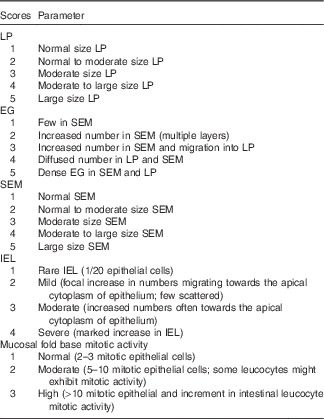
LP, lamina propria; EG, eosinophilic granulocytes; SEM, sub-epithelial mucosa; IEL, intra-epithelial lymphocytes.
Statistical analysis
Minitab 17 Statistical Software (2010) was used for all statistical analyses. After confirming normality and homogeneity of variance in the data using the Kolmogorov–Smirnov test and Levene’s test, a two-way ANOVA was performed on independent parameters considering nutritional history (NH, Diet Mstimulus and Diet Vstimulus), ploidy (2 N and 3 N), and their interaction. Percentage data were transformed using the arcsine square root function. Significance was accepted at P<0·05 and Tukey’s post hoc test was used to compare significantly different means. To investigate solely nutritional influence, differences shown within a given ploidy were analysed using a Kruskal–Wallis test. Histological scores were analysed statistically using a Kruskal–Wallis test followed by Dunn’s post hoc test for non-parametric, categorical comparison.
Results
Growth performance
Survival (%) was slightly lower in V-fish and triploids during both the stimulus and marine phases (Table 3). However, during the challenge phase, there were no effects of nutritional history or ploidy on survival. During the stimulus phase, growth rate as measured by TGC was higher in M-fish compared with V-fish, and in diploids compared with triploids (Table 3). There was also a significant difference in growth rate during the marine phase with M-fish showing higher TGC than V-fish, although this was only significant in diploids. In general, triploids significantly outgrew diploids (P<0·05) during the marine phase. These effects on growth were observed in the BW of the fish at the beginning and end of the FI trial carried out in the last 16 d of the marine phase, with both initial and final BW being higher in M-fish than V-fish, significantly so in both ploidies, and also significantly higher in triploids than in diploids (Table 4). In contrast, during the challenge phase, growth rate for both diploids and triploids was significantly greater in V-fish compared to M-fish as evidenced by the higher TGC values (Table 3). Growth of triploids was also significantly greater than that of diploids during the challenge phase. These growth differences were reflected in final BW so that, despite the fact that weights of M-fish were higher than those of V-fish at the beginning of the challenge phase, there were no significant differences in final BW of V-fish and M-fish at the end of the challenge phase (Table 5).
Survival, growth rate and feed efficiency of fish during each of the three nutritional phases; stimulus, marine and challengeFootnote † (Mean values with their standard errors, n 3)

NH, nutritional history; TGC, thermal growth coefficient; BW, body weight.
a,b Significant differences between diets within a given ploidy.
* Significant differences between phases within a given treatment.
† Based on their ploidy status (diploid or triploid) and their nutritional history during the stimulus phase (Diet Mstimulus or Diet Vstimulus). Percentage data were arcsine transformed for statistical analysis. Significance was calculated between ploidy, NH and their interaction (Ploidy×NH), and was accepted at P<0·05.
Growth parameters, feed intake (FI) and feed utilisation during the marine phaseFootnote * (Mean values with their standard errors, n 3)

NH, nutritional history; BW, body weight.
a,b Significant differences within a given ploidy.
* Based on their ploidy status (diploid or triploid) and their nutritional history during the stimulus phase (Diet Mstimulus or Diet Vstimulus). Percentage data were arcsine transformed for statistical analysis. Significance was calculated between ploidy, NH and their interaction (Ploidy×NH), and was accepted at P<0·05.
Growth parameters, feed intake (FI) and feed utilisation during the challenge phaseFootnote * (Mean values with their standard errors, n 3)

NH, nutritional history; BW, body weight.
a,b Significant differences within a given ploidy.
* Based on their ploidy status (diploid or triploid) and their NH during the stimulus phase (Diet Mstimulus or Diet Vstimulus). Percentage data were arcsine transformed for statistical analysis. Significance was calculated between ploidy, NH and their interaction (Ploidy×NH), and was accepted at P<0·05.
Feed intake
When FI was corrected (% BW/d), no impacts of nutritional history or ploidy were observed between treatments during either feeding phase (Tables 4 and 5).
Feed utilisation
During the marine phase FE was higher in M-fish compared with V-fish, significantly so with diploids (Table 3). This resulted in M-fish showing higher protein, lipid and energy gains and retentions in the marine phase compared with V-fish, again significant in diploids with triploids showing identical trends (Table 4). In contrast, the opposite effects on nutrient and energy utilisation were observed during the challenge phase. Thus, FE was higher in V-fish compared with M-fish, significantly so in diploids (Table 3). This resulted in V-fish showing higher protein, lipid and energy gains compared with M-fish, although only significant with lipid and energy gain in diploids. Consistent with these data, protein, lipid and energy retentions in the challenge phase were higher in V-fish than M-fish, significant in diploids with triploids showing identical trends (Table 5). The effects on nutrient utilisation efficiency/retention were therefore consistent across all nutrients, reflected in the fact that there was no effect of nutritional history on whole body proximate composition (Table 6).
Whole fish proximate composition before and after the challenge periodFootnote † (Mean values with their standard errors, n 3)

NH, nutritional history.
Significant differences between diets within a given ploidy.
* Significant differences between phases within a given treatment.
† Percentage data were arcsine transformed for statistical analysis.
Fatty acid retention and composition
The same trend as observed for the macronutrients was also found in EPA and DHA retention in the marine and challenge phases, respectively (Tables 4 and 5). Importantly, M-fish lost EPA during the challenge phase, whereas V-fish positively retained EPA (Table 5). In contrast, all fish retained DHA during the challenge phase although retention was far greater in V-fish than in M-fish. Unsurprisingly, the reverse trend was seen during the marine phase, with M-fish have the greater EPA and DHA retentions. As with most parameters, the effects of nutritional history on EPA and DHA retentions were significant for diploids, with triploids showing identical but non-significant trends. Fatty acid profiles of whole body, liver, and pyloric caeca pre-challenge (end of marine phase) and post-challenge phase reflected the dietary fatty acid compositions of the commercial diet (fed in the pre-challenge phase) and Diet Vchallenge (fed during the challenge phase) in all fish irrespective of nutritional history or ploidy (Table 7). Therefore, total SFA and n-3 PUFA (especially EPA and DHA) decreased, and total monoenes and n-6 PUFA (especially linoleic acid, 18 : 2n-6) increased in all tissues in all fish from pre- to post-challenge. The differences in EPA and DHA retention (based on absolute contents of whole body) between fish of different nutritional history were not reflected in the relative proportions of the fatty acids in whole body.
Fatty acid compositions (% fatty acid methyl esters) of whole body, liver and pyloric caeca before and after the challenge phaseFootnote † (Mean values and standard deviations, n 3)

NH, nutritional history.
a,b Significant differences between diets within a given ploidy.
* Significant differences between phases within a given treatment.
† Based on their ploidy status (diploid or triploid) and their NH during the stimulus phase (Diet Mstimulus or Diet Vstimulus). Percentage data were arcsine transformed for statistical analysis. Significance was calculated between NH within each ploidy and was accepted at P<0·05.
Distal intestine histology
Generally, histological assessment of DI at the end of the marine phase (pre-challenge) indicated that total enteritis scores were low and comparable across the four treatment groups (Table 8). No differences were found in the parameters analysed except for SEM, where V-diploids showed increased size compared with M-diploids, and lastly for IEL, where M-triploids showed significantly higher prevalence than V-triploids. Similarly, there were generally few significant effects of nutritional history or ploidy on enteritis scores in the distal intestine post-challenge (Table 8). However, in diploids, significantly higher SEM in V-fish compared with M-fish, as well as significantly higher total scoring of combined histological characteristics between these groups, was observed post-challenge phase. There were differences in scores within a given treatment between the pre- and post-challenge phases with all overall scores tending to be higher, although only significantly in V-triploids. Furthermore, EG scoring was significantly higher post-challenge regardless of nutritional history or ploidy. LP scoring was generally higher post-challenge, but only significantly so in M-triploids, and SEM was significantly higher in triploids post-challenge.
Total scores and individual scores before and after the challenge phase for the different parameters used to determine severity of enteritis( Reference Fraser, Hansen and Fleming 42 ) Footnote †(Mean values with their standard errors, n 3)

NH, nutritional history; LP, lamina propria; EG, eosinophilic granulocytes; SEM, sub-epithelial mucosa; IEL, intra-epithelial lymphocytes; MFBMA, mucosal fold base mitotic activity.
a,b Significant differences between diets within a given ploidy.
* Significant differences between phases within a given treatment.
† Based on their ploidy status (diploid or triploid) and their NH during the stimulus phase (Diet Mstimulus or Diet Vstimulus). Significance was calculated between ploidy, NH and their interaction (Ploidy×NH), and was accepted at P<0·05.
Discussion
The present study confirmed that a short exposure to a vegetable-based diet (Diet Vstimulus) during first exogenous feeding prepared or adapted Atlantic salmon, irrespective of ploidy, to better utilise a similar diet (Diet Vchallenge) when challenged later in life. This result is consistent with a previous trial which demonstrated a physiological adaptation in rainbow trout (O. mykiss) through nutritional programming( Reference Geurden, Borchert and Balasubramanian 33 ). In addition, the present study showed that while this ‘nutritional programming’ effect was highly significant in diploid salmon, the effect was also clearly apparent in triploid salmon albeit the greater variation in the triploid data often reduced the significance of these responses.
Throughout the majority of the trial, there was no significant difference in survival rates between nutritional histories within each ploidy. However, a difference was detected in the stimulus phase. V-fish showed a lower survival rate irrespective of ploidy. The same trend was found for growth during the stimulus phase as V-fish showed a lower growth rate. Reluctance to feed on vegetable-based diets is well documented in salmon and other species, especially when first presented( Reference Fournier, Huelvan and Desbruyeres 48 – Reference Pratoomyot, Bendiksen and Bell 50 ) and so it is likely that the greater mortality and lower growth in V-fish was initially because of the poor acceptance of Diet Vstimulus leading to reduced FI, although this could not be accurately measured in the first feeding fry in the present study. Failure or impaired establishment of first feeding of Diet Vstimulus may be explained by the physiological characteristics of a carnivorous teleost. Typically, Atlantic salmon develops anatomically according to the type and level of nutrients present in the maternal egg reserves( Reference Palace and Werner 51 ). This has been reviewed in several species concerning important organismal systems including reproductive structure and performance( Reference Izquierdo, Fernandez-Palacios and Tacon 52 ). With regards to the gastrointestinal tract (GIT), morphological and functional differentiation occurs in the very early life stages and is influenced by environment and nutrition( Reference Zambonino-Infante and Cahu 53 ). Overall, triploids had a lower survival rate during the stimulus and marine phases, which was consistent with previous studies( Reference McGeachy, Benfey and Friars 54 – Reference Cotter, O’Donovan and Drumm 56 ). Similarly, lower growth rates in triploid Atlantic salmon fry during the stimulus phase was also consistent with previous studies( Reference Galbreath, St Jean and Anderson 57 , Reference Taylor, Preston and Guy 58 ). The experimental diets used in the present study were generally based on formulations for diploid salmon, and recent studies have indicated that triploid Atlantic salmon may have different nutritional requirements for certain physiological development, principally during the freshwater stage( Reference Fjelldal, Hansen and Lock 37 , Reference Taylor, Waagbø and Diez-Padrisa 38 , Reference Smedley, Clokie and Migaud 59 , Reference Sambraus, Fjelldal and Remø 60 ). One may speculate that the increased proportions of vegetable-based proteins and oils currently used in commercial salmon feeds may have reduced nutrient bioavailability compared with FM/FO diets, which could perhaps highlight dietary deficiencies for triploids. However, high-quality protein concentrates have shown to be similar or more digestible than FM( Reference Glencross, Carter and Duijster 61 , Reference Denstaldi, Storebakken and Svilhus 62 ). The reduced performance and survival of triploid fry during the stimulus phase may be explained by missing micronutrients in the formulation( Reference Hamre, Sissiner and Lock 63 , Reference Hemre, Lock and Olsvik 64 ). Also, this drawback may not be solely consequent of nutritional deficiency, but ploidy itself should be considered as a factor.
At the end of the stimulus phase V-fish were about 30 % smaller than M-fish, which was a potential confounding factor during the rest of the trial as fish size itself affects subsequent fish performance. This was taken fully into account in the present study. Ideally, therefore, the stimulus phase should not induce any major phenotypic changes. Very recent data on early nutritional stimuli suggested that 3 d may be sufficient to prompt a physiological adaptation to diet in zebrafish (D. rerio)( Reference Perera and Yúfera 35 ), although species-specific variation should not be excluded. During the marine phase, M-diploids had a higher growth rate than V-diploids. As discussed above, the difference in BW at the beginning of this phase could have had some impact on growth rate, but another factor could be potentially reduced acceptability of the commercial diet in V-fish. An investigation of nutritional programming in rainbow trout (O. mykiss) concluded that early nutritional intervention can alter transcriptional and physiological characteristics of the olfactory and gustatory systems to suit specific feed formulations( Reference Geurden, Borchert and Balasubramanian 33 , Reference Balasubramanian, Panserat and Dupont-Nivet 65 ). Therefore, in this respect we can speculate that M-fish were already adapted for a commercial diet, whereas V-fish would have required time to adapt to it. FI was not measured at this point but was determined at the end of the marine phase when no difference between M-fish and V-fish was observed.
There was no difference in survival rate between fish during the challenge phase, but V-fish demonstrated significantly higher growth rates than M-fish. The switch in performance in response to Diet Vchallenge had a positive effect that appeared to be related to the initial dietary stimulus. V-fish adapted to Diet Vchallenge better than M-fish suggesting there was a degree of memory to the dietary stimulus. It has been previously described that environmental triggers can influence ‘multidimensional plasticity’ in different organisms, and suggested that transcriptional and physiological changes during early development could significantly affect the resilience of these organisms to different stressors( Reference West-Eberhard 66 ). The weights of V-fish at the end of the challenge phase were not higher than those of M-fish, because of the fact that V-fish were initially smaller due to lower growth during the stimulus and marine phases. However, the weights were comparable between nutritional histories, confirming the greater weight gain and higher growth rate (TGC) in V-fish during the challenge. The higher growth performance was reflected in greater protein, lipid, and energy gains of V-fish compared with M-fish during the challenge phase. Although these differences were generally not statistically significant, with the exception of lipid and energy gain in diploids, every nutrient group showed higher values in V-fish. Moreover, there was a ploidy effect as triploids appeared to gain significantly more macronutrients than diploids which has previously been reported in increased lipid uptake( Reference Nuez-Ortín, Carter and Wilson 67 ). This may indicate physiological and metabolic differences between ploidy, with increased storage capacity as a consequence of larger cells being hypothesised( Reference Small and Benfey 68 ). An earlier study suggested that morphological differences in the GIT, predominantly caused by a reduction in intestinal cell numbers, could hinder the gut’s absorptive capability and therefore the intestinal efficiency of nutrient absorption in triploid salmon compared with diploid siblings( Reference Peruzzi, Hagen and Jobling 69 ). Therefore, the data in the present study were not consistent with this hypothesis and highlighted the need for further research into the effects of ploidy on GIT morphology, physiology, enzymatic activities and intestinal nutrient absorption.
Because of the lower weight of V-fish, FI measurements during the marine and challenge phases were normalised to enable comparisons between groups, to account for the effect of fish weight on consumption rates. Previously, palatability has been an issue in salmonids fed with feeds containing low levels of marine and high amounts of plant-derived ingredients as fish have shown reluctance to consume these diets. Lower voluntary FI was observed in a previous study( Reference Refstie, Storebakken and Roem 2 ) when Atlantic salmon were fed a SBM diet compared with a FM diet during the initial stages of the trial, although consumption rates were comparable towards the end of the trial suggesting that the fish finally accepted the diet possibly reflecting an adaptation to it. In the present study, there was no difference in FI irrespective of nutritional history or ploidy either at the end of the marine phase or during the challenge phase. However, there was a significant effect of nutritional history on FE, with V-fish having higher efficiency. Thus, the superior growth performance of V-fish during the challenge phase was likely the result of improved dietary nutrient utilisation. Furthermore, FE also confirmed that nutritional history had opposite effects during the marine and challenge phases, as previously discussed for growth performance. Thus, during the marine phase, M-fish exhibited higher FE compared with V-fish, consistent with the better growth of the M-fish during this phase, and the reverse trend was observed throughout the challenge. The FE data confirmed that the initial, brief exposure of salmon fry to Diet Vstimulus had a positive impact on these fish when they were challenged with Diet Vchallenge, and further suggested that physiological and metabolic changes and adaptations in these fish were, at least partly, responsible for the observed improvement in the utilisation of Diet Vchallenge by V-fish. In contrast, a higher FI in rainbow trout was observed when re-introduced to a vegetable-based diet after an earlier nutritional stimulus( Reference Geurden, Borchert and Balasubramanian 33 ), suggesting that exposure to the diet early in life reduced the aversion of the fish to the challenge diet later in life. However, the trout initially fed the vegetable-based diet also showed improved FE when challenged with this diet later in life. The slight difference in the results between the earlier trout study and the present salmon study in terms of palatability may be related to differences in the dietary formulations used. For example, in the trout study the vegetable diet was completely devoid of marine ingredients (0 % FM and 0 % FO) and this may have posed an even more extreme challenge specifically in terms of palatability, but species-specific response should not be excluded. This highlighted the importance of optimising dietary formulations based on both taste preference and utilisation efficiency.
Retention of nutrients and energy was higher in diploid V-fish during the challenge phase which agreed with data in the earlier trial in trout mentioned above( Reference Geurden, Borchert and Balasubramanian 33 ). As with other parameters, this was the reverse trend from the previous marine phase which showed M-fish having better retentions than V-fish. Although an identical trend for all nutrients was observed in triploids, no significant differences between M- and V-triploid salmon were observed in either of the two phases. The present findings, however, could reflect the limited existing knowledge on the precise nutritional requirements of triploid salmon, which have been shown in previous studies to be higher than in diploids specifically in relation to phosphorus( Reference Fjelldal, Hansen and Lock 37 , Reference Smedley, Clokie and Migaud 59 ) and histidine requirements( Reference Taylor, Waagbø and Diez-Padrisa 38 , Reference Sambraus, Fjelldal and Remø 60 ). V-fish positively retained EPA (20 : 5n-3) during the challenge phase whereas M-fish showed negative retention and, although DHA (22 : 6n-3) retention was positive in all fish irrespective of nutritional history or ploidy, retention was considerably greater in V-fish. This trend was found within both ploidies, but only significantly in diploids. Retention of DHA was consistently greater than that of EPA in all treatments, which is in accordance with previous reports suggesting selective catabolism of EPA over DHA in addition to a possible production of the fatty acids by endogenous biosynthesis pathways( Reference Tocher, Bell and Dick 70 , Reference Torstensen, Frøyland and Lie 71 ). Thus, when considering the EPA and DHA retention data, any value that exceeds 100 % will include a proportion of the fatty acids that were biosynthesised from α-linolenic acid (ALA) (18 : 3n-3). Net production of DHA has previously been reported when Atlantic salmon( Reference Sanden, Stubhaug and Berntssen 72 ) and rainbow trout( Reference Turchini, Francis and Keast 73 ) were fed with high inclusion of vegetable oil, and therefore low levels of dietary EPA and DHA. In the present study, net production of EPA was found in V-fish during the challenge period. This result is consistent with other studies( Reference Turchini, Francis and Keast 73 , Reference Rosenlund, Torstensen and Stubhaug 74 ) where salmonids had received similarly low levels of dietary EPA and DHA (0·7 % of total FA). The selective retention of DHA over EPA, possibly tissue (i.e. neural tissue) specific, has been reported previously in several fish species( Reference Tocher 75 – Reference Glencross 77 ). DHA has a greater physiological importance in cell membrane composition and function when compared with EPA and therefore a higher valued essential fatty acid. The greater retention of both EPA and DHA in V-fish found in this study may reflect one possible and obvious metabolic adaptation in V-fish. It is likely that there is increased LC-PUFA biosynthesis through up-regulation of fatty acyl desaturase and elongase activities( Reference Tocher 76 , Reference Leaver, Bautista and Björnsson 78 ). In an earlier trial in sea bass (Dicentrarchus labrax)( Reference Vagner, Robin and Zambonino-Infante 79 ), expression of Δ-6 desaturase (Δ6D or fads2d6) was up-regulated in juveniles that had been previously fed an n-3 LC-PUFA-deficient diet as larvae. The Δ6D enzyme is the reported rate-limiting step in the conversion of ALA to EPA( Reference Bell and Tocher 80 ). However, the early nutritional stimulus had no major effect on the final fatty acid compositions of either whole body or tissues in the present study. Perhaps as expected, fish and tissue fatty acid profiles at the end of the challenge phase reflected the dietary fatty acid compositions and therefore showed increased percentages of plant-derived C18 fatty acids (18 : 1n-9, 18 : 2n-6 and 18 : 3n-3) and decreased proportions n-3 LC-PUFA (EPA and DHA) in all treatment groups with no major influence of nutritional history (or ploidy)( Reference Tocher 81 ). This change in tissue fatty acid profiles is in accordance with many studies on FM and FO substitution with alternative vegetable-based diets in salmon( Reference Torstensen, Frøyland and Lie 71 , Reference Bell, McEvoy and Tocher 82 – Reference Turchini, Ng and Tocher 86 ). It is well established that, whereas up-regulation of LC-PUFA biosynthesis through increased expression and activity of fatty acid desaturase activities is a consistent response to vegetable diets in salmon, it is not sufficient to fully compensate for the lack of dietary EPA and DHA( Reference Tocher 81 , Reference Torstensen and Tocher 87 ). However, the challenge phase was 6 weeks, which is relatively short compared with most earlier studies on the effects of FO replacement with vegetable oils, and the differences in EPA and DHA retention between V- and M-fish recorded in the present study are large, and so it would be interesting to confirm if these would translate into higher levels of these key LC-PUFA in V-fish after longer feeding.
Overall, there were few notable differences in intestinal morphology before and after the challenge phase. Many of the earlier incidences of morphological changes in the gut and enteritis in Atlantic salmon were specifically related with the use of SBM in the diet( Reference Knudsen, Jutfelt and Sundh 8 – Reference Urán, Scharama and Jaafari 9 , Reference Krogdahl, Bakke-McKellep and Bæverfjord 88 ). Aqueous alcohol extraction of proteins from soyabeans or soya flour for the manufacturing of SPC, as used in the present study, reduces contents of specific ANF including saponins, lectins and soy-antigens( Reference Drew, Borgeson and Thiessen 14 , Reference Bureau, Harris and Cho 16 ), which have been shown to be implicated in intestinal inflammation in salmon fed SBM( Reference Francis, Makkar and Becker 12 , Reference Hedrera, Galdames and Jimenez-Reyes 89 ). Still, a significant difference in inflammation was found in V-diploids compared with M-diploids after the challenge phase. In a similar study investigating nutritional programming in zebrafish (D. rerio)( Reference Perera and Yúfera 35 ), fish previously exposed to SPC were shown to be more prone to intestinal inflammation when refed SPC than groups that had never been exposed to it. Although further processing of diets seem to be reducing incidence of enteritis, the present result suggests that further refinements are needed to equal the responses to current diets. The only treatment that showed an increase in the total scoring of intestinal integrity from pre- to post-challenge analysis was V-triploids. This could suggest that triploid salmon may be more sensitive to vegetable-based diets than their diploid counterparts and again highlighted the lack of knowledge regarding effects of ploidy on salmon morphological and physiological responses.
Conclusions
The present study has indicated that nutritional programming may help to improve utilisation of a diet and reduce potential negative impacts associated with the use of alternative raw materials in aquafeeds. In particular, the present study has successfully demonstrated for the first time that Atlantic salmon can be adapted to utilise a vegetable-based diet more efficiently after an early nutritional intervention. Further optimisation of an effective stimulus both in terms of diet formulation and duration may further unlock the potential of this strategy. Importantly, the potential of salmon to apparently be programmed to be net producers of EPA and DHA should be further investigated. Biosynthesis of these health-promoting n-3 fatty acids shows promise when considering the limitation of raw material sources. Several metabolic pathways and key biochemical and physiological regulators have shown to be influenced in response to consumption of vegetable-based diets in Atlantic salmon( Reference Morais, Pratoomyot and Taggart 90 , Reference Tacchi, Secombes and Bickerdike 91 ). Therefore, further studies are in progress to determine the molecular mechanisms potentially involved in this physiological adaptation.
Acknowledgements
This study received funding (including fellowships for JFT, CM and LMV) from the European Union Seventh Framework Program (FP7/2007–2013) under the grant agreement no. 288925, Advanced Research Initiatives for Nutrition & Aquaculture (ARRAINA). The funders had no role in the design, analysis or writing of the article. Additional funding for M. C. was provided by a Biotechnology and Biological Sciences Research Council (BBSRC) grant (BB/M013049/1, SALMOTRIP+: Optimisation and implementation of sterile triploid salmon in Scotland).
Author contributions were as follows. M. C.: primarily carried out research, data collection/analysis and article writing; H. M.: project co-leader, research supervision and article reviewing; C. M.: supported data collection, histological analysis, article reviewing; L. M. V. D.: supported data collection, article reviewing; D. L.: design and formulation of experimental feed; secondary reviewing; D. R. T.: project leader, diet/experimental design, research supervision and article writing; and J. F. T.: experimental design, supported data collection, research supervision and article reviewing.
The authors declare that there are no conflicts of interest.


 Open access

