





Introduction
Farmers face increasing challenges associated with the growing pressure to expand production amidst escalating challenges presented by climate change. Farmers can use protected structures exclusively or as part of their crop production systems to ensure consistent yields and thus protect their livelihoods in the face of climate uncertainty (Jensen and Malter, Reference Jensen and Malter1995; Blomgren and Frisch, Reference Blomgren and Frisch2007; Alabama Cooperative Extension System, 2015). High tunnels (HTs) are protected structures used for agricultural crop production (Lamont, Reference Lamont2009; Orzolek, Reference Orzolek2013). Typically, HTs are structures with steel frames in various shapes covered in polyethylene plastic (Mefferd, Reference Mefferd2017). A primary reason growers use protected structures as part of their crop production systems is for season extension. Extending the growing season allows farmers to enter markets with their crops earlier and stay in them later than in a typical open-field growing season (Johnny's Selected Seeds, n.d.; Mefferd, Reference Mefferd2017). Farmers in colder climates can grow tomatoes in the winter under an HT (Mefferd, Reference Mefferd2017), and farmers in hotter climates can use HTs to protect crops from rainfall events (Footer, Reference Footer2020). HTs are a passive means of controlled production; e.g. ventilation and temperature control are naturally achieved by opening and closing sidewalls. Greenhouses, in contrast, are active protected crop production systems characterized by electrically powered ventilation (Gruda, Bisbis and Tanny, Reference Gruda, Bisbis and Tanny2019). However, the use of space heaters and fans inside HTs on occasions of extreme temperatures has been reported. Closely related types of passively ventilated structures include polytunnels, hoop houses, and low tunnels. This study focused on passively ventilated structures exclusively and referred to all passively ventilated structures as HTs for simplicity. HTs can help manage climate risk and maintain and even increase yields compared to open fields (Belasco et al., Reference Belasco, Galinato, Marsh, Miles and Wallace2013); they provide a controlled environment in the face of climate uncertainties and market dynamics.
The original use of protected structures dates back to 17th-century Europe (Mefferd, Reference Mefferd2017). In Asia, Europe, and the Middle East, using HTs and other protected structures in farming operations was well-established for decades before gaining popularity in the United States. The first HT use reported in the United States was not until 1953 by Dr Emery Emmert at The University of Kentucky (Carey et al., Reference Carey, Jett, Lamont, Nennich, Orzolek and Williams2009; Orzolek, Reference Orzolek2013). HT use has increased meaningfully in the United States since the early 1990s when interest emerged in the utility of producing vegetables in HTs (Carey et al., Reference Carey, Jett, Lamont, Nennich, Orzolek and Williams2009; Lamont, Reference Lamont2009). The information available at the time focused on HT production as a season extension in cold climates. The best practices of HTs in warm climates began to receive increased attention starting in the 2010s (Alabama Cooperative Extension System, 2015), as evidenced by the increase in peer-reviewed literature, gray literature, and adoption of HTs nationwide.
Generally, HTs are low-cost means for farmers to control for climate and market uncertainties compared with open-field production. HTs protect against crop damage from excessive rainfall, enhance crop vigor and soil quality, and provide protection from pesticide drift from nearby operations (National Resources and Conservation Service, [n.d.]b). HTs are highly customizable, meaning farmers are able to decide what specific features to invest in. For example, some HT structures have automated sidewalls that open or close based on temperature sensor readings. This feature is helpful when an HT is located in close proximity to a power source but may not be financially sound for a small acreage farm or a farm with few HT structures where sidewalls can be manually rolled up, and money can be best invested elsewhere.
High tunnels offer a relatively affordable way for farmers to extend the growing season of crops, although they require a considerable economic investment upfront. The Natural Resources Conservation Service (NRCS) offers cost-share funding for farmers in the United States to help pay for most of the cost of the structure and provides technical support for participants. The NRCS High Tunnel Initiative pilot program was launched in 2009; a major tenet of this program is cultivating and maintaining soil health by implementing soil conservation practices under the HT structure (Coleman, Reference Coleman1992). This cost-share program assists farmers interested in installing a high tunnel in their operation. Historically, underserved farmers are eligible for the highest rate of financial assistance. Program recipients must follow guidelines to receive assistance, including maintaining the structure for a minimum of 4 years, using pre-manufactured HT kits, growing crops directly in soil under the HT, and the structure must be 6 feet in height at minimum (National Resources and Conservation Service, [n.d.]b). Raised beds up to 12 inches are allowable under the NRCS program (United States Department of Agriculture, 2015). NRCS has local offices throughout the United States and territories that administer the program. Prospective participants work closely with NRCS service providers to apply to the program. Applications are then ranked by the projected benefit to resource conservation priorities (National Resources and Conservation Service, [n.d.]a).
There are, however, resource inefficiencies associated with using high tunnels. The intensive management (e.g. tilling) of soil repeatedly for continuously growing crops leads to the depletion of organic matter content and textural changes that can cause erosion (Perkus et al., Reference Perkus, Grossman, Pfeiffer, Rogers and Rosen2022). One way to address this issue is to install a moveable tunnel, which is an HT on a track or rail that can be shifted to avoid intensively using the same soils, effectively implementing crop rotation strategies for the tunnel structure (Baumbauer and Burgess, Reference Baumbauer and Burgess2020); the NRCS funding does not cover these kinds of high tunnels. Another way to conserve soil health would be to employ hydroponic methods inside the high tunnel, although NRCS does not allow this practice initially upon receipt of their funding. Also, no organic certification is available for hydroponic methods (Mefferd, Reference Mefferd2017). Additionally, there are water-related inefficiencies associated with high tunnel use. The structure is covered, so the system relies entirely on irrigation. In other words, growers cannot take advantage of rainfall unless they employ some kind of rainwater harvesting method and irrigate with that harvested rainwater. Shading screens over the structure can also help conserve water (Gruda, Bisbis and Tanny, Reference Gruda, Bisbis and Tanny2019).
The economic return on the initial investment in an HT structure and associated materials (e.g. plastic covering, irrigation system) and practices (e.g. grafting) via increased yields can vary by year (Nian et al., Reference Nian, Zhao, Tian, Zhao and Gao2022), as with any investment resulting from a management-based decision. Farmers can couple the economic benefit of protected structures by employing biologically beneficial strategies, such as cover crops. The biological return on this strategy (e.g. improved soil health) can also take years (Digiacomo et al., Reference Digiacomo, Gieske, Grossman, Jacobsen, Peterson and Rivard2023). Exploring the various management strategies employed in protected agriculture in the context of water and soil efficiency can inform viable solutions for meeting increased yield demand while ensuring resilience to climate and market uncertainties.
Generally, funding for the NRCS High Tunnel Initiative has steadily increased since the program's start (National Sustainable Agriculture Coalition, 2016). Figure 1 shows national data from 2016 through 2020 of the total contracts, financial obligation, and square footage from the NRCS High Tunnel Initiative. Funding increased over time from 2016 to 2020, with a peak in contracts, obligations, and square footage in 2019, leading to greater adoption of HTs over time and more agricultural research conducted in HTs. An assessment of the current knowledge to date is essential as the HT adoption trend continues nationally.
National totals of NRCS High Tunnel Initiative contracts, financial obligations, and square footage by year 2016–2020. Includes data from Environmental Quality Incentives Program (EQIP), Agricultural Management Assistance (AMA), and Regional Conservation Partnership Program (RCPP).

To date, there has been one systematic literature review of high tunnels in North America (Janke, Altamimi and Khan, Reference Janke, Altamimi and Khan2017) and a meta-analysis of protected systems broadly as a response to climate change (Gruda, Bisbis and Tanny, Reference Gruda, Bisbis and Tanny2019). To our knowledge, no previous bibliometric or scientometric analyses on the peer-reviewed HT literature have been published at the time of this publication. Bibliometrics is a quantitative approach to analyzing a collection of written works (Jones, Reference Jones, Payne-James and Byard2016). Scientometrics can be considered synonymous with bibliometrics (Jones, Reference Jones, Payne-James and Byard2016) or distinguished by a focus on scientific publications exclusively (Mejia et al., Reference Mejia, Wu, Zhang and Kajikawa2021) by quantifying a body of peer-reviewed literature. Quantitative methods of scientometrics include co-citation and cluster analysis. The metrics generated by scientometric methods show the evolution of a scientific discipline and reveal gaps to address with future research and inform policy. There is no agreed-upon definition of bibliometrics, scientometrics, or the closely related term informetrics, and these terms are treated as overlapping, interchangeable, and distinguished by the discipline they represent (Yang, Yuan and Dong, Reference Yang, Yuan and Dong2020). All the analyses described for the present study are referred to as scientometric. While meta-analyses use statistical analysis to analyze methodologies and findings across many studies (Moher et al., Reference Moher, Liberati, Tetzlaff and Altman2009), scientometrics analyzes the characteristics (i.e. keywords, authors, citations, institutions) of the group of studies exclusively. The co-citation analysis functionality in CiteSpace generates networks of cited references from the dataset over time. The links between the references signify the co-citation robustness. Cluster analysis in CiteSpace groups the references by assigning a keyword to each cluster that represents the fundamental domains within the overall scientific discipline of the dataset (Chen, Reference Chen2017). The nodes in each network represent the number of metrics in the analysis, e.g. publications, authors, and institutions (Yang, Yuan and Dong, Reference Yang, Yuan and Dong2020). Overall, these analyses reveal the impacts and importance of advancements in a given field of science (Chen, Reference Chen2017). The present study focuses on the status of HT literature in the United States to date since the launch of the NRCS program to identify trends and gaps in knowledge and direct further research.
Methods
Data collection
The initial search used the following keywords: ‘high tunnel’, ‘crop’, ‘crops’, ‘cropping’, ‘quality’, ‘high-tunnel’, ‘hoop house’, ‘hoophouse’, ‘low tunnel’, ‘caterpillar tunnel’, and ‘season extension’. We based the selection of terms for the initial search on literature identified from key seminal papers and the research question. We assembled an expert panel of researchers that assisted in identifying appropriate search terms for validation and re-calibration of the initial search. We identified potential panel members from different agricultural disciplines based on their experience with research on high tunnel systems. The final sample of four included at least one researcher from each of the following disciplines: horticulture, entomology, and plant pathology. First, we sent a Qualtrics form to the panel members that asked them to enter and rank search terms they believed would capture the full scope of the body of knowledge on high tunnels. Then, a facilitated discussion was conducted based on the summarized responses the panel members submitted via the Qualtrics form. The objective of the discussion was to generate an agreed-upon list of the final search terms for this study. Institutional Review Board (UFIRB202102347) approval was obtained for the expert panel. The following keywords were added based on the expert panel input: ‘plant health’, ‘soil quality’, ‘pest’, ‘disease’, and ‘crop performance’. No additional articles emerged. This study used the Web of Science (WoS) database to search the literature on crop production in high tunnels (HTs). The search was delimited to peer-reviewed journal articles published in English with studies conducted in the United States between 2009 and 2023. The search was last performed on 27 February 2023. The search yielded a total of 133 records. Table 1 details the search parameters of the present study.
Detailed search setting parameters

* Searches for any words and variants of that word that includes that stem. For example, crop* includes crops and cropping.
Research design and analysis
This study used scientometric analysis methods to evaluate the published literature on the effects of HT systems on crop vigor and quality. This type of analysis maps the characteristics of a body of knowledge mathematically and graphically. Scientometrics has been used across scientific disciplines to identify the development of a field of research over time (Olawumi and Chan, Reference Olawumi and Chan2018). We used WoS for descriptive analysis and CiteSpace 6.2.R1 and Gephi for network analyses. Specifically, we visualized the document co-citation and collaboration networks among authors and institutions. This scientometric analysis provided an overview of the HT literature to assess the current knowledge dating from the NRCS High Tunnel Initiative program launch in 2009. This study's data analysis approach was informed by Zhang et al. (Reference Zhang, Yan, Guo, Zhang and Ruiz-Menjivar2018) and Liu et al. (Reference Liu, Ruiz-Menjivar, Hu, Zavala and Swisher2022). We conducted co-citation network analysis using the CiteSpace software to elucidate the relationships among the literature by revealing pairs of articles cited by other publications. The strength of these relationships is directly related to the number of co-citations (Cho, Kim and Park, Reference Cho, Kim and Park2021). Then, we conducted citation clustering to identify the prominent research areas. We employed clustering to distinguish distinct thematic areas for analysis within the HT literature. Additionally, we conducted co-author, co-institution network analysis to determine the primary relationships between authors and institutions. Figure 2 summarizes the research design. This study presents and assesses networks through visualizations and reports the network density, betweenness centrality, and closeness centrality.
Diagram of the research design.

We conducted scientometric analyses in the present study using CiteSpace 6.2.R1 and Gephi 0.9.2. We used CiteSpace to create network visualizations for the present study. CiteSpace is available to download at http://cluster.cis.drexel.edu/~cchen/citespace/ (accessed on January 15, 2023) and was developed by Chen, Ibekwe-SanJuan and Hou (Reference Chen, Ibekwe-SanJuan and Hou2010). We used CiteSpace to conduct the co-citation network analysis. The time frame employed was 2009–2023 with a one-year slice length. We set the top N per slice to five to identify the top five most cited publications by each year over time. The threshold was set at 19. We used Gephi to generate the network density, betweenness centrality, and closeness centrality statistics reported in the present study. Gephi is available for download at https://gephi.org/ (accessed on January 15, 2023).
Results and discussion
Descriptives of publication years and cited journals
We used WoS for descriptives of the publication years and cited journals. One hundred thirty-three peer-reviewed articles about the effects of HT use on crop production in the United States have been published since the NRCS High Tunnel Initiative launched in 2009. Figure 3 shows the number of citations and publications each year from 2009 through February 2023. The number of citations grew consistently from 2013 through 2021, while the number of publications increased consistently from 2017 through 2021. Generally, the number of citations and publications in the United States has increased steadily since 2009, which reflects increased funding of HT research, interest from researchers in crop production in HTs, and adoption of HT systems over time.
WoS visualization showing the number of publications and citations for HT literature published in the United States from 2009 to February 2023.

Table 2 lists the top five peer-reviewed journals for articles about HT crop production. The journal with the greatest number of HT publications is HortTechnology, with over 30% of all publications since 2009. HortScience was the next leading journal, with over 20% of the HT articles. Both journals are published by the American Society for Horticultural Science (ASHS). Horticulture is the predominant discipline of the top journals with HT publications.
Top 5 journals with peer-reviewed articles about HTs

Table 3 lists the top five subject categories for the peer-reviewed HT literature. Horticulture was the highest subject category of the HT literature. This is consistent with the leading journals housing these articles, with horticulture being in the title of four out of the top five journals. All the subject categories fall under the general scientific discipline of agriculture.
Top five subject categories of peer-reviewed HT articles

Co-citation network analysis
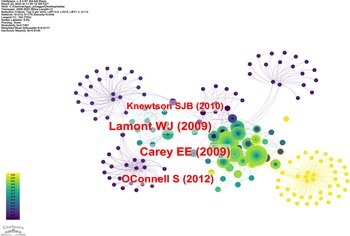
Figure 4 shows the co-citation network (214 nodes, 763 edges, 7.131 average degrees, and 0.033 network density). Co-citation has increased steadily since 2019 alongside the number of publications (see Fig. 3). The co-citation frequency peaked in 2021 and 2022, consistent with the distribution of the number of publications in Figure 3. There were only two articles with citation bursts in the dataset. Figure 5 shows these two articles, which both focus on tomato production in high tunnels.
The co-citation network visualization from CiteSpace.

Top two references with the Strongest Citation Bursts visualization from CiteSpace.

The top five most cited articles based on co-citation are in Table 4. Carey et al. (Reference Carey, Jett, Lamont, Nennich, Orzolek and Williams2009) is the most co-cited article with a frequency of 43. The subsequent most co-cited publication was Lamont (Reference Lamont2009), with a frequency of 42. Both articles provide general information about crop production in high tunnels in the United States and globally.
Top five articles based on co-citation frequency

Citation clustering network analysis
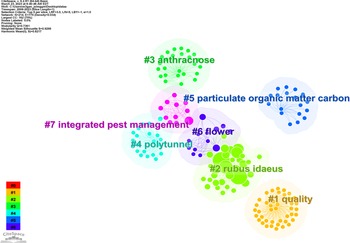
We employed the ‘All in one’ feature in CiteSpace to generate clusters for the co-citation network by keyword. Figure 6 and Table 5 show the results of the citation-clustering network analysis for the co-citation network. Table 5 reports the cluster size, which is the number of publications belonging to that cluster. The silhouette values reported in Table 5 are a value of 1 or close to 1, representing a high quality of clusters. Values at or close to 1 mean the clusters are distinct from each other, and the terms within each cluster are homogenous (Rousseeuw, Reference Rousseeuw1987). The year column in Table 5 is the mean year of publications within that cluster.
Co-citation network keyword clusters visualization from CiteSpace.

Top five terms in co-citation network clusters

We categorized clusters into two distinct time periods based on the mean year, 1 (prior to 2005) and 2 (2005 onward). In Category 1, the literature focused on nutrient management, plant pathology, and general characteristics of protected structures. The top five terms in each cluster (see Table 5) show the various recurring iterations of HT (‘hoop housed low tunnel’) and the term ‘anthracnose’, which demonstrate the research emphasis in Category 1. The more recent studies in Category 2 centered on trials of specific crops and integrated pest management in HTs. Recurring terms in Category 2 included ‘rubus idaeus’ and ‘integrated pest management’, which characterize the research focus in this more recent time period. The trend in articles more recently published focusing on specific crops is consistent with the only two articles with citation bursts noted earlier, focusing on tomato production in high tunnels.
Co-authorship network analysis
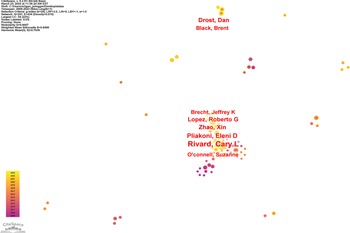
Figure 7 shows the collaboration network (241 nodes, 430 edges, 3.568 average degrees, and 0.015 network density) among authors for the literature about crop production in high tunnel systems in the United States. The average degree and network density suggest that the prominent researchers who published HT research generally do not collaborate on publications with one another. Table 6 reports the degree centrality, betweenness centrality, and closeness centrality for the top five authors in the co-authorship network. The leading researchers publishing literature about the effects of using HTs on crop vigor and quality were Dr Cary Rivard (Professor of Horticulture and Natural Resources at Kansas State University), Dr Eleni D. Pilakoni (Professor of Urban Food Production and Postharvest Handling at Kansas State University), Dr Xin Zhao (Professor of Horticultural Sciences at the University of Florida), Dr Roberto G. Lopez (Associate Professor, Department of Horticulture at Michigan State University), and Dr Dan Drost (Professor of Horticulture, Department of Plants, Soils and Climate at Utah State University).
Co-authorship network visualization from CiteSpace.

Top five authors in the co-authorship network

Institution collaboration network analysis
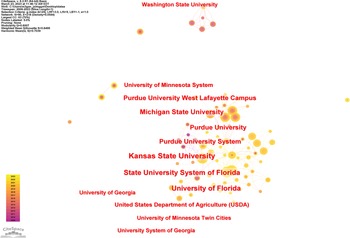
Figure 8 shows the collaboration network (90 nodes, 212 edges, 4.711 average degrees, and 0.054 network density) among institutions for the HT literature. The average degree and network density indicate there is slightly more collaboration among institutions than authors, although the institution collaboration network is still quite dispersed. The degree centrality, betweenness centrality, and closeness centrality for the top five institutions in the collaboration network are reported in Table 7. The principal institutions publishing HT literature were Kansas State University, the University of Florida, Michigan State University, Purdue University, and the University of Minnesota. The first two authors listed in Table 6 are affiliated with Kansas State University, reinforcing the high impact and influence of the HT literature coming out of this institution.
Institutional collaboration network visualization from CiteSpace.

Top five institutions in the collaboration network

Conclusions
The present study conducted network analysis using CiteSpace and Gephi software to investigate the salient research areas and collaboration networks in the peer-reviewed literature about the effects of HT use on crop vigor and quality. We used WoS to acquire our final dataset (N = 133) of the HT literature published in the United States since the launch of the NRCS High Tunnel Initiative in 2009. Figure 9 maps the dataset of peer-reviewed publications analyzed in the present study to assess the current HT body of knowledge and inform trends and future research trajectories.
Mind map of present study.

Generally, there has been an increase in the peer-reviewed HT literature that followed a rise in NRCS High Tunnel Initiative contracts, financial obligations, and square footage over time as shown in Figures 1 and 3, respectively. A notable rise in NRCS HT investment in 2019 likely contributed to a subsequent increase in HT literature citations and publications in 2021. The literature centered around seven primary topics, with the bulk of the publications focusing on the characteristics of HTs, nutrient management experiments, trials of specific crops (e.g., raspberries, tomatoes, cut flowers) in HTs, or comparing open field production to HT production, plant pathology, and pest management in HT production. We organized the literature based on salient clusters: Category 1 (prior to 2005) and Category 2 (2005 onward). In Category 1, the publications centered on general information about HT structures, nutrient management, and plant pathology. On the other hand, Category 2 contained literature that focused on specific crop trials and integrated pest management in HTs. The high-impact articles were Carey et al. (Reference Carey, Jett, Lamont, Nennich, Orzolek and Williams2009), Lamont (Reference Lamont2009), with these articles belonging to Category 2. The primary journals that published HT literature in the United States since 2009 were HortTechnology, HortScience, Horticulturae, Scientia Horticulturae, and Renewable Agriculture and Food Systems. Our findings revealed the leading HT researchers were Dr Cary Rivard, Dr Eleni D. Pilakoni (both from Kansas State University), Dr Xin Zhao (University of Florida), Dr Roberto G. Lopez (Michigan State University), and Dr Dan Drost (Utah State University). The top institution publishing HT literature since 2009 was Kansas State University.
The findings from this study provide guidance for future directions of HT research. Season extension technologies, such as HTs, were historically more prevalent in cooler climates. With the rapid increase in high tunnel adoption nationally, due in part to the NRCS High Tunnel Initiative, farmers have been using HTs in hotter climates more over time (Ernst et al., Reference Ernst, Woods, Butler, Wolff and Jacobsen2020). Manipulating the timeline of the growing season with the help of a protected structure in warm climates allows farmers to have access to the consumer demand for seasonal crops at times when those crops are traditionally considered out of season for field conditions. The information about HT best practices historically centered on season extension in cold climates (Mefferd, Reference Mefferd2017), leaving a considerable opportunity to explore and establish best practices for hotter climates. Our findings are consistent with this overall trend, with Kansas State University being the leading institution and the two top authors, Dr Cary Rivard and Dr Eleni D. Pilakoni, both being faculty members at Kansas State University. A notable exception is the University of Florida, landing in the second spot among the top five institutions in the collaboration network. Dr Xin Zhao from the University of Florida ranked third among leading researchers publishing literature about the effects of using HTs on crop vigor and quality. This result reveals an interest in investigating best practices for higher temperatures in the scientific literature since 2009. There is added pest and disease pressure in hotter climates (Alabama Cooperative Extension System, 2015; Frey et al., Reference Frey, Zhao, Brecht, Huff and Black2020), and farmers using HTs in these areas would benefit from well-established best practices for managing pest and disease pressure over time. Cover cropping, grafting, and solarization techniques can be used to maintain soil health and control pests and diseases (Digiacomo et al., Reference Digiacomo, Gieske, Grossman, Jacobsen, Peterson and Rivard2023; Gamliel and van Bruggen, Reference Gamliel and van Bruggen2016; Nian et al., Reference Nian, Zhao, Tian, Zhao and Gao2022; Rodriguez Izaba, Guan and Torres, Reference Rodriguez Izaba, Guan and Torres2021). The tenets of integrated pest management (IPM) can be helpful for high tunnel systems in both regions of cooler and hotter climates (Pottorff and Panter, Reference Pottorff and Panter2009), which is consistent with recent HT literature trends as evidenced in the present study's cluster analysis. Considerations for managing climate start with the choice of the structure itself (i.e., materials, height, design) and the type of plastic covering material. For instance, farmers in hurricane-prone areas might focus on features for reinforcing sidewalls; in contrast, farmers in areas with significant snowfall annually might select a gothic HT roof designed to withstand large loads of snow (Mefferd, Reference Mefferd2017). Besides climate considerations, there is considerable variance across soil textures and levels of organic matter across the United States. This has implications for water resource management and, thus, decisions about irrigation type and scheduling warrant further investigation.
The prospect of agricultural disciplines outside of horticulture exists to explore the effects of HT use on crop vigor and quality, such as entomology, plant pathology, agricultural economics, and the social sciences. Contributions to the HT body of literature across various scientific disciplines would enhance our understanding of the use, benefits, and challenges of using HT in farm operations. For example, the long-term economic impact of HT maintenance and inputs compared to market yield and sales could help HT users make important management decisions over time. Finally, there is also a lot of possibility regarding collaboration across institutions and authors, as evidenced by the study's findings. The majority of the top authors had their departmental affiliation in horticulture, which is consistent with the crop-specific focus of HT research. Continued HT research could benefit from additional publications by authors in scientific fields outside of horticulture. Generally, there is considerable opportunity to assess the long-term economic and environmental implications of HT use in hotter climates. These perspectives could potentially offer exciting new methodologies, findings, and directions for HT crop production systems in the United States
Limitations and future directions
The peer-reviewed literature represents only a fraction of published information about HT use. Besides peer-reviewed publications, data and information on HT research are also disseminated in technical reports from the United States Department of Agriculture (USDA), Sustainable Agriculture Research and Education (SARE), and Cooperative Extension. These technical reports offer considerable information about selected best practices for crop production in high tunnels at various regional and local scales. Also, the focus on literature published in the United States and since 2009 substantially limited the amount of data for analysis. There is a significant amount of established literature on high tunnel use globally. However, the focus of this study was justified by the unique effect the NRCS High Tunnel Initiative program had on HT use in the United States. Findings from this study may be of interest to scholars conducting HT research and those who make funding decisions about research. The present study offers a foundation to be built along a needs assessment by involving farmers and stakeholders (e.g. crop consultants, NRCS representatives, HT manufacturers) in what future research may be needed to complement current and past programmatic efforts. HT adoption is a practice that contributes to sustainable agriculture by responding to the need to produce in smaller spaces as the global population continues to increase over time, placing extreme demand on agricultural production systems. Future scientometric analyses could broaden the scope of all literature published globally and in languages other than English and include records (i.e. technical reports and bulletins) from the gray literature that could inform the potential scope (e.g. region-specific, crop-specific, revenue-specific) for systematic reviews.
Data availability statement
Data used for this study came from WoS.
Acknowledgments
We are grateful for the feedback we received on this paper from project team members of ‘Adapting and Expanding High Tunnel Organic Vegetable Production for the Southeast’ and ‘Cover Crops for Sustainable Southern Agroecosystems.’
Current appointments and qualifications
Megan Donovan, research social scientist, United States Department of Agriculture, Agricultural Research Service, Range Management Research Unit; coursework in soil, water and ecosystem sciences and professional direct engagement experience with farmers. Jorge Ruiz-Menjivar, assistant professor of Family, Youth and Community Sciences at the University of Florida; expertise in agricultural economics. Timothy Coolong, professor of Horticulture at the University of Georgia and Sustainable Agriculture Research and Education (SARE) Program Georgia State Coordinator; expertise in vegetable production in high tunnels. Marilyn E. Swisher, professor of Family, Youth and Community Sciences at the University of Florida, Director of the Center for Sustainable and Organic Food Systems at the University of Florida and Sustainable Agriculture Research and Education (SARE) Program Florida State Coordinator; expertise in social science methodologies, community development and sustainable agriculture.
Author contributions
M. D.: conceptualization, methodology, formal analysis, project administration, writing-original draft, writing-review and editing, validation. J. R.-M.: conceptualization, methodology, writing-original draft, writing-review and editing, validation, funding acquisition. T. C.: writing-review and editing. M. E. S.: funding acquisition, writing-review, and editing. All authors have read and agreed to the published version of the manuscript.
Funding statement
This work was supported by (1) the U.S. Department of Agriculture/National Institute of Food and Agriculture (USDA/NIFA) Organic Agriculture Research and Extension Initiative (OREI) project titled ‘Adapting and Expanding High Tunnel Organic Vegetable Production for the Southeast’, grant no. 2017-51300-26813, and (2) and the USDA/NIFA Hatch Multistate project titled ‘Cover Crops for Sustainable Southern Agroecosystems’ (S1085), grant no. FLA-FYC-005952.
Competing interests
None.








 Open access

