




1 Introduction
This article investigates the advancement of change in the context of dialect levelling by exploring dynamic vowel changes in a single phonetic phenomenon: Cockney diphthong shift. Through seventy-five years of apparent-time data we trace diphthong shift reversal in a Cockney community which relocated to Essex in the 1950s: the Debden Estate. We discuss the observed linguistic changes in the context of sociohistorical changes affecting the community in comparison to observed dialect levelling in the region. In particular, we compare the results in Debden to previous findings in the south-eastern towns of Milton Keynes and Reading where apparent-time change away from a shifted vowel system and towards the pan-regional standard was also observed (Kerswill & Williams Reference Kerswill and Williams2000, Reference Kerswill and Williams2005). Compared to both Milton Keynes and Reading, Debden has a distinct pattern of population resettlement and, as a result, the timing and advancement of change is distinct. This article contributes towards our understanding of the process and contributing factors of dialect levelling by examining the roles that patterns of population resettlement and community play in this process.
1.1 Cockney diphthong shift
In this article, we look at the factors conditioning the rates of change in the reversal of a systematic vowel change, the Cockney diphthong shift, in South East England. Cockney is a term often used to refer to the white working class in East London as well as the variety of English that they speak (see Wells Reference Wells1982: 301–2). A shifted vowel system has been widely documented in Cockney speakers (Matthews Reference Matthews1938; Sivertsen Reference Sivertsen1960; Wells Reference Wells1982; Labov Reference Labov1994; Tollfree Reference Tollfree, Foulkes and Docherty1999; Kerswill, Torgersen & Fox Reference Kerswill, Torgersen and Fox2008; Mott Reference Mott2012). Labov (Reference Labov1994) considers this shift to be a component of a broader phenomenon which he calls ‘Southern shift’ (named after the Southern US where the shift is also present), and which he believes is a continuation of the Great Diphthong shift of the fifteenth century. The Cockney diphthong shift is not limited to Cockney; in England alone, it is also present to a lesser extent in East Anglia, southern England and the West Midlands (Britain Reference Britain2001). In addition, the shift is present in several non-British varieties of English, particularly Australian and New Zealand English where the shift is most advanced (Trudgill Reference Trudgill2004).
Amongst Cockney speakers, the ʊ-diphthongs, mouth and goat, are rotated clockwise, compared to Received Pronunciation (RP) in which they are [aʊ] and [əʊ]. In contrast, the ɪ-diphthongs face, price and choice show an anti-clockwise movement compared to the RP [eɪ], [aɪ] and [ɔɪ] (Wells Reference Wells1982; Labov Reference Labov1994; Mott Reference Mott2012; Kerswill, Torgersen & Fox Reference Kerswill, Torgersen and Fox2008). Cockney speakers have a fronted mouth vowel, whilst price has a backed and raised onset, goat has a lowered onset, face has a very open onset and choice has a raised onset (see table 1). The fronted and somewhat raised onset of mouth and the backed and raised onset of price can lead to a crossing of their trajectories which has been termed the ‘Cockney price–mouth crossover’ (Wells Reference Wells1982; see also Cole & Strycharczuk Reference Cole and Strycharczuk2019). In addition, the fleece vowel has been reported as diphthongal with a centralised onset which is connected to the lowering of face and subsequent fronting of price (Cockney: Sivertsen Reference Sivertsen1960; Wells Reference Wells1982: 306, Labov Reference Labov1994). Furthermore, goose is substantially fronted in Cockney and can be diphthongal with a centralised onset such that it may overlap with RP goat (Reference WellsWells 1982: 306, 307). A shifted diphthong system is to some extent socially salient and associated with Cockney. For instance, shifted diphthongs are represented orthographically in late nineteenth-century literature or descriptions (either prescriptivist or descriptivist) of Cockney (Gerwin Reference Gerwin2018). For instance, fronted and raised choice (‘biled’ for ‘boiled’ in Dickens (Reference Dickens1836–7)); lowered face (‘tykin’ for ‘taken’ in Tuer (Reference Tuer1890)) (Gerwin Reference Gerwin2018).
Vowel shift in Cockney compared to RP (adapted from Wells Reference Wells1982: 308, 310)

In this article, we discuss the process and rate of diphthong shift reversal in Debden in comparison to alternative developments of the Cockney diphthong shift reported in the literature for different speech communities in South East England. Debden provides an interesting study case, housing a community with Cockney heritage which has been displaced to a new location. This affords us insight into the process of dialect levelling in South East England as well as the factors which condition differing rates or trajectories of change.
1.2 Dialect levelling and Cockney diphthong shift reversal in South East England
Regional dialect levelling, or supralocalisation, are terms which refer to one variant emerging as dominant after the mixing of different dialects in contact situations (see Britain Reference Britain, Llamas and Watts2010 for an overview). Both mobility and dialect contact have been amply linked to dialect levelling. Through face-to-face interaction, linguistic accommodation takes place which over the course of time can stabilise as language change (Trudgill Reference Trudgill1986). South East England is England's most populous area and is characterised by high mobility (Jansen & Amos Reference Jansen and Amos2020). In addition, there is a ‘commuter belt’ which covers much of the region in which people commute from surrounding areas for work (Britain Reference Britain, Llamas and Watts2010). These factors have created an environment for potentially extensive dialect levelling in the region.
Previous research has found evidence that young speakers in South East England are diverging from shifted vowel forms and are adopting supraregional variants found in RP. Kerswill & Williams found evidence of change in the vowel system in Milton Keynes, a new-build town that was constructed in the 1960s to ease the overpopulation of London. Kerswill & Williams were interested in Milton Keynes's circumstances of population settlement as a New Town and how this related to language change. In the period 1967–88, 76.2 per cent of those who migrated to Milton Keynes had moved there from other areas in the South East, and of those, half were from London (Kerswill & Williams Reference Kerswill and Williams2000: 78). There was evidence of change in the diphthong system away from diverse pronunciations towards a levelled vowel system with RP targets. For speakers recorded in the 1990s, the majority variant amongst older speakers for the price vowel was a raised and backed onset [ɔɪ], whilst young speakers used [ɑɪ]. This latter variant was considered an intermediate form between RP [aɪ] and broad London [ɑ:]. Similarly, raised variants of the mouth vowel such as [ɛʊ̟] were found in some older speakers, whilst young speakers used forms which most clearly resembled the RP form [aʊ] (Kerswill & Williams Reference Kerswill and Williams2000, Reference Kerswill and Williams2005). For the face vowel, working-class speakers across all ages produced a lowered onset close to [æɪ] or [ɐɪ] which contrasted with the [e̞ɪ] found in middle-class speakers (Williams & Kerswill Reference Williams, Kerswill, Foulkes and Docherty1999). There was no significant change in the goat vowel except that adolescent girls had a fronted offset. The authors concluded that the mixing of diverse southern accents in the town had resulted in dialect levelling.
The authors compared the findings in Milton Keynes to another town found on the peripheries of London: Reading (Kerswill & Williams Reference Kerswill and Williams2005). Unlike Milton Keynes, Reading is not a New Town but an established market town with an existing population and dialect. Nonetheless, there was also evidence of diphthong shift reversal in Reading. Older speakers produced a somewhat shifted diphthong system, whilst younger speakers were moving towards RP forms. However, compared to Milton Keynes, change was occurring less rapidly, which was attributed to the relative stability of the existing population and dialect. Whilst in Milton Keynes a number of substrate varieties fed into the rapid formation of a levelled ‘New Town Koine’ within one generation, in Reading there was an existing levelled dialect. Kerswill & Williams did not believe that dialect levelling in either of these towns was simply a result of dialect contact as RP is not a majority variety in South East England. Instead, RP is a pan-regional standard and, as such, the observed change represents a shift towards a socially and regionally unmarked form (Kerswill & Williams Reference Kerswill and Williams2005). More recently, the term ‘Standard Southern British English’ (SSBE; or, omitting ‘English’, simply SSB) has emerged to refer to the broader regional standard in South East England which has evolved linguistically from traditional RP (Lindsey Reference Lindsey2019).
It is worth noting, however, that SSBE is not the target for all communities in South East England. Instead, in East London, Multicultural London English (MLE) has emerged amongst some young speakers as a result of considerable cultural and linguistic heterogeneity (see Cheshire et al. Reference Cheshire, Kerswill, Fox and Torgersen2011; Fox Reference Fox2015). Nonetheless, in this article we examine diphthong shift reversal in South East England towards SSBE forms which we find to be present in our community of interest: Debden.
1.2 Community interest: the Debden Estate
The construction and inhabitation of the Debden Estate in the late 1940s and early 1950s forms part of the so-called ‘Cockney diaspora’ (Watt, Millington & Huq Reference Watt, Millington and Huq2014). This term refers to the large-scale, post-World War II relocation of East Londoners into the London peripheries and the surrounding counties, particularly East London's bordering county Essex. The Cockney diaspora was provoked by many interrelated factors such as elective relocation as a result of the high rates of poverty and overcrowding in East London; the loss of employment through de-industrialisation such as the closure of the London Docks; the acute shortage of adequate housing, particularly after World War II; and the 1920s–60s government-led, slum-clearance programmes (Watt, Millington & Huq Reference Watt, Millington and Huq2014; Fox Reference Fox2015).
The Debden Estate (Debden) was constructed in the town of Loughton in south-west Essex in approximately 1949 as part of a governmental ‘slum-clearance’ programme to reduce poverty and overcrowding in East London (Greater London Plan: Abercrombie Reference Abercrombie1944). According to traditional sociolinguistic measures of class based on occupational, educational and economic patterns, in the early decades of the Debden Estate, the community was undoubtedly identifiable as working class. Nonetheless, there was a reconfiguration of traditional class measures in the 1980s through Thatcherite policies which sought to eradicate traditional class distinctions. As a result, since this time, Debden has experienced a stark increase and diversification in educational attainment, employment type and house ownership (see Cole & Evans Reference Cole and Evans2020 for an overview of class mobility in Debden).
An analysis of the rate and development of diphthong shift reversal in Debden provides a point of comparison with previous findings in Milton Keynes and Reading. Debden's distinct sociohistorical background and pattern of population resettlement sheds some light on the processes and factors conditioning dialect levelling in South East England. It is known that the process and timing of dialect levelling differed between Milton Keynes and Reading as a result of the diversity of the respective populations and, as a result, the diversity of their accents which inputted into the levelling process. Debden, like Milton Keynes but unlike Reading, was a New Town construction which was formed of a resettled population; however, the towns differ in terms of the heterogeneity of their incoming residents. The early inhabitants of Debden were almost entirely from East London. Therefore, Debden's early inhabitants would most likely have spoken varieties of English which were, firstly, more heterogeneous than Milton Keynes and, secondly, more closely resembling Cockney with a more shifted diphthong system compared to both Milton Keynes and Reading. To broaden our understanding of the process of dialect levelling, we examine the rate and development of diphthong shift reversal in Debden in the context of the community's sociohistoric background as well as that of other communities in the region.
2 Methods
2.1 Speakers
Fifty-two speakers (F = 31; M = 21) living in Debden were recruited for a sociolinguistic interview. Speakers’ years of birth ranged from 1926 to 2002 (average age at time of recording = 44.9, SD = 24). All speakers had heritage in working-class, East London families. Speakers aged over 72 years had been born in East London and had relocated to Debden at various stages of adulthood. In contrast, all speakers under this age had lived in Debden since birth or since they were children.
2.2 Materials
The participants completed a sociolinguistic interview designed to elicit speech in a range of different styles: an open interview, reading of a phonetically balanced passage (an adaptation of the popular children's story Chicken Little and reading of a word list). They also completed a background information form that elicited key demographic information, and an identity questionnaire. In the identity questionnaire, participants responded using a seven-item Likert scale, ranging from strongly disagree to strongly agree. The participants were asked whether they liked their own accent (q1); whether they spoke with an Essex accent (q2), an East London accent (q3), a Cockney accent (q4); whether they were proud to be from or live in Debden (q5); and whether they considered themselves to be a Cockney (q6). Forty-five out of the 52 speakers in our study completed the identity questionnaire. Speakers were not provided with definitions of these terms, and if they asked, they were told to interpret the terms in whatever way felt most intuitive to them.
The word list included all English vowels, as well as consonantal features known to be of sociolinguistic interest in the South East. Whilst the word list targeting vowel production aimed to include words in the /h/-V-/d/ or /b/-V-/d/, this was not always possible. A pilot study showed the need to use high-frequency words and words with transparent spelling. Thus, we also included some high-frequency words which did not fit the desired format, for example, mouth, toad, boy. Of the 52 speakers, 6 speakers read the word list and not the passage, and 3 speakers read the passage and not the word list.
2.3 Procedure
All interviews were conducted in 2017 by one of the authors, who is from Debden and whose grandparents were relocated by the then London County Council from East London to Debden in the early 1950s. A majority of recordings took place in a quiet room in this author's parents’ home, or in participants’ homes. The participants were seated at a table or on a sofa with the microphone placed on a table in front of them. The recordings for those aged between 14 and 16 years took place in their school in a quiet classroom after consent was obtained from the school's headteacher and the participants’ parents. Each subject read the passage once, followed by two repetitions of the items in the word list. The words were presented individually in a random order. The speakers were instructed to read the words and the passage as if they were talking to a friend or family member.
2.4 Data processing
For the purpose of the current article, we only used data from the word list and the passage. Although this restricts us to analysing relatively more formal speech styles, this methodological decision has the advantage of controlling for the phonological environment, when comparing data from different speakers. The recordings were forced-aligned using the University of Pennsylvania Forced Aligner (FAVE: Rosenfelder et al. Reference Rosenfelder, Fruehwald, Evanini, Seyfarth, Gorman, Prichard and Yuan2014) and checked by an undergraduate research assistant for major issues with alignment. Individual vowel boundaries were not checked. For all vowels, we extracted vowel duration, as well as continuous trajectory measurements for the first two formants. We selected all the available tokens for the following vowels: mouth (N = 1,154), goat (N = 1,086), goose (N = 1,172), price (N = 1,786), face (N = 1,047), fleece (N = 1,172).
2.5 Analysis
We conducted two types of analysis. The first type explained in section 2.5.1 below is by-vowel analysis of formant trajectory shape. The main aim of this analysis is to understand how the first two formant trajectories vary depending on speaker age and gender. Significant age effects are interpreted as evidence of sound change, and they allow us to determine which vowels undergo change in apparent time. The second type of analysis focuses on vowel systems within individual speakers, and its main aim is to investigate which vowel changes co-occur within individuals, and how such co-occurrence is structured. More detail about this analysis is given in section 3.9, once the relevant changes have been identified.
2.5.1 Modelling formant trajectory changes
The main sociolinguistic variables we consider are speaker's year of birth and gender. In order to investigate how these variables affect formant trajectories, we modelled the F1 and F2 trajectories of each vowel using General Additive Mixed Modelling (GAMM: Wood Reference Wood2017), using the mgcv, itsadug and tidymv packages (van Rij et al. Reference van Rij, Wieling, Baayen and Rijn2017; Wood Reference Wood2017; Coretta Reference Coretta2019). We downsampled the data for this to eleven measurements per trajectory at 10 per cent intervals. For each trajectory, we followed the same modelling procedure. As a first step, we fitted a model with the normalised formant values as the dependent variable, and the following predictors:
– parametric effect of speaker gender (F or M);
– smooth term for normalised time;
– smooth term for normalised time by speaker gender;
– smooth term for speaker year of birth;
– smooth term for vowel duration;
– tensor product interaction for normalised time and speaker year of birth;
– tensor product interaction for normalised time and vowel duration;
– random by-speaker smooth for normalised time;
– random by-item smooth for normalised time;
This model allows the mean formant values as well as trajectory shape to vary by gender and by year of birth, whilst also including random by-speaker and by-item variation. The duration terms are included to capture the fact that vowels of different duration will have a different trajectory shape (Sóskuthy et al. Reference Sóskuthy, Foulkes, Hughes and Haddican2018).
We tested the significance of gender and year of birth based on model comparison. This was done in two steps. We fitted a model without year of birth effects (the smooth or the interaction), and compared the model fit to the full model, using Maximum Likelihood comparison. We then fitted a model without gender effects (the parametric term or the by-gender smooth), and compared the fit to the full model. Model improvement below the level of .05 was considered significant.
We then investigated the effect of the predictors visually, by plotting the model fit and confidence intervals, excluding the random effects. At this stage, we used an AR version of the full model specified above, in order to reduce the residual autocorrelation and obtain more reliable confidence intervals (Baayen et al. Reference Baayen, van Rij, De Cat, Wood, Speelman, Heylen and Geeraerts2018). The individual effect plots for year of birth and gender are presented in section 3 for individual vowels. All plots follow the same format, and use the same scale to facilitate comparison of the magnitude of differences involved whenever we find variation. Asterisks indicate significant effects, as determined by model comparison.
3 Results
3.1 mouth
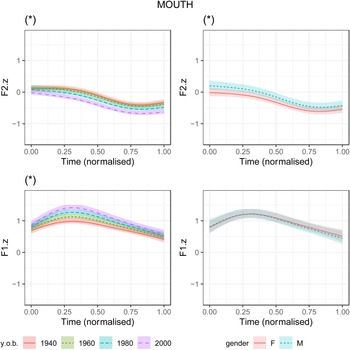
Figure 1 presents the trajectory results for the mouth vowel. We find an effect of both year of birth and gender on F2. There is an overall decrease in F2 in apparent time, consistent with vowel retraction. This effect is apparent through the entire vowel trajectory. Females show lower F2 values compared to males, which is once again apparent through the entire trajectory, and which suggests that females lead in mouth retraction.
Results for mouth vowel

The F1 for mouth also varies depending on speakers' year of birth. F1 rises in apparent time, consistent with vowel lowering. In this case, however, the change is most apparent in the F1 target, which also results in increased curvature of the entire trajectory, which suggests ongoing diphthongisation along the F1 dimension. This change represents a move away from the characteristic Cockney [æ:] to a diphthongal vowel. Variation in mouth F1 was not systematically affected by gender.
3.2 goat
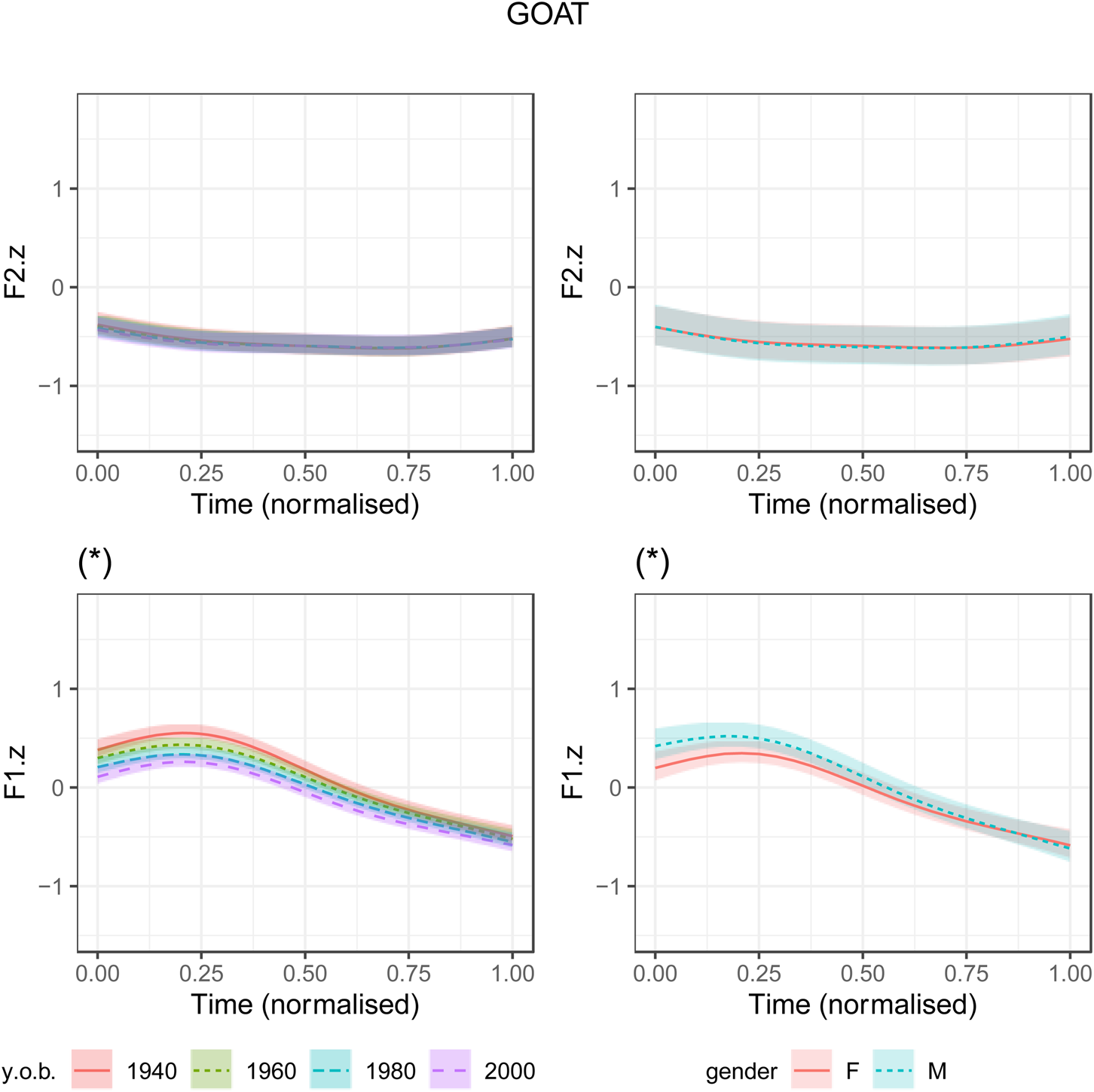
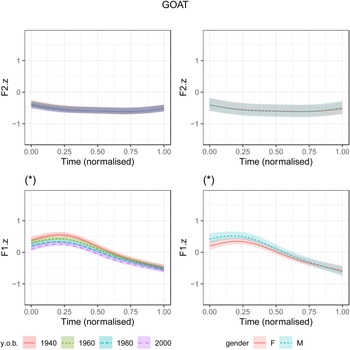
For the goat vowel, we find systematic variation along the F1 dimension but not along the F2 dimension, as illustrated in figure 2. There is F1 lowering, depending on year of birth, limited to the first part of the trajectory. We can interpret this as an apparent-time raising of the first acoustic target for this diphthong. This pattern is also affected by gender, with females showing more F1 lowering, also in the initial part of the trajectory, which suggests a shift to towards the SSBE target. Males, in comparison, show a relatively more Cockney pronunciation in which the onglide for goat is lowered.
Results for goat vowel
3.3 goose
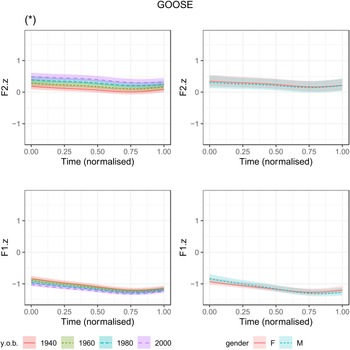
The only significant effect we find for the goose vowel is F2 raising, depending on year of birth. This effect is apparent through the entire F2 trajectory, which is consistent with the well-documented phenomenon of goose-fronting, as observed across multiple English accents in the past few decades, including the South of England. The goose-fronting is not systematically affected by gender in our data. We do not find any systematic variation in the F1. In terms of its dynamic profile, there does seem to be a small F1 trough in the second part of the trajectory, which is consistent with the presence of a slightly raised offglide. The dynamic F1 profile shows some variation, but there are no significant effects. The trajectory results for goose are visualised in figure 3.
Results for goose vowel

3.4 price
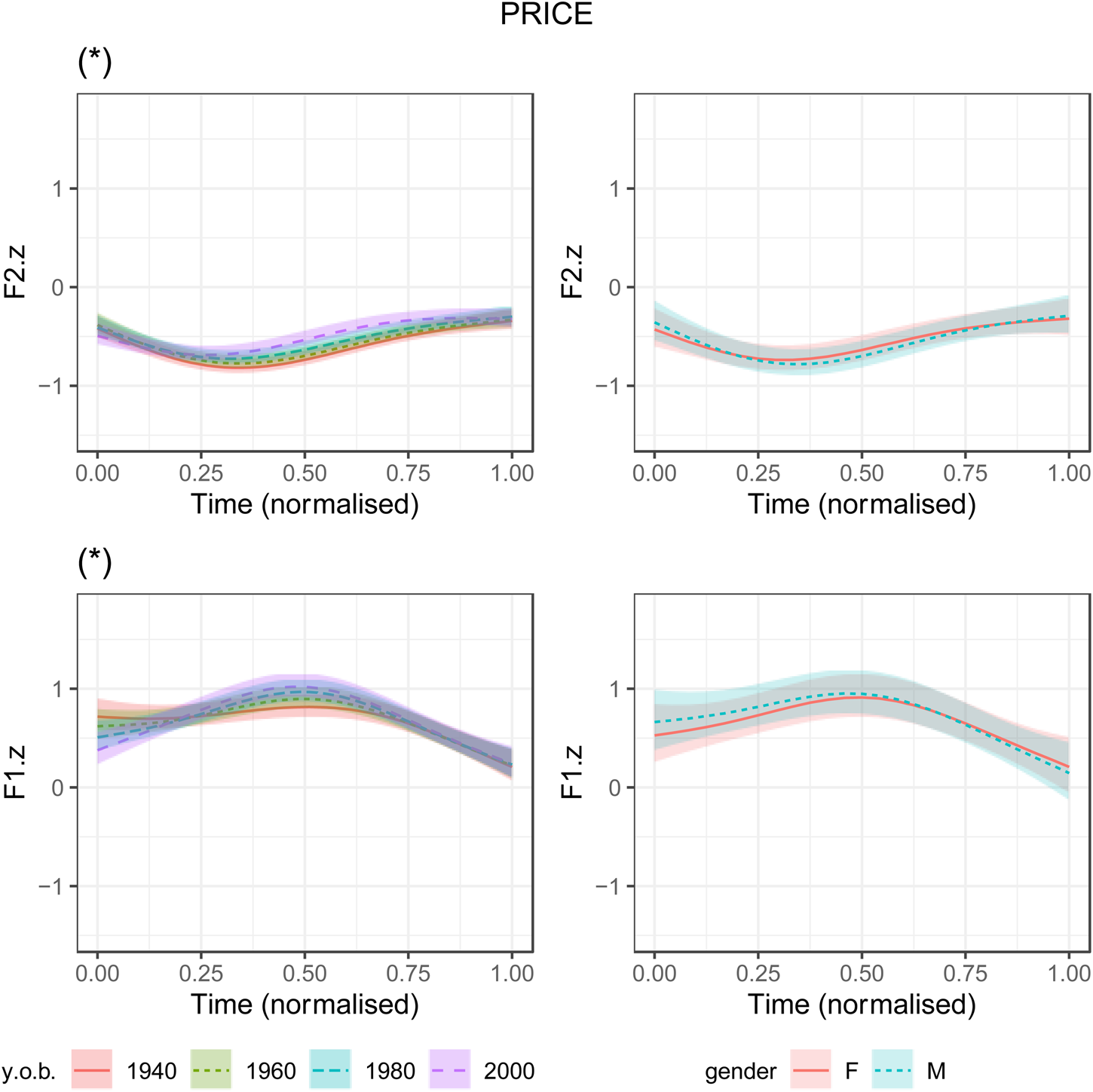
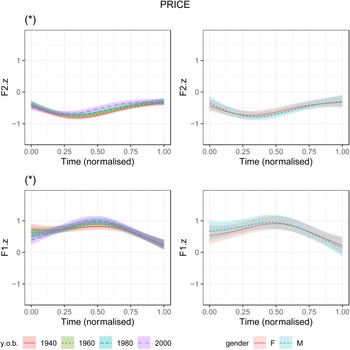
For the price vowel, we find year of birth affecting both F2 and F1, as shown in figure 4. F2 is raising proportionally to year of birth, which is mostly apparent through the mid-to-latter part of the trajectory. This is consistent with a pattern of fronting, but also some flattening of the trajectory in apparent time. F1 raises as a function of year of birth, again around the mid part of the trajectory. This can be interpreted as lowering of the onglide in apparent time, accompanied by increased diphthongisation along the F1 dimension. There seems to be a trend in the gender variation that suggests females moving towards the SSBE variant (fronting and lowering of price), but it is not significant.
Results for price vowel
3.5 face
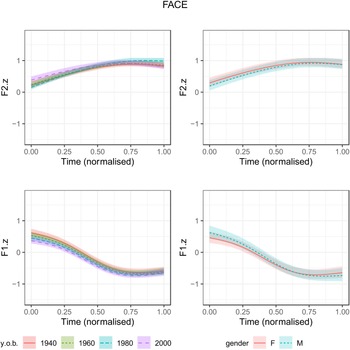
For the face vowel, we find no significant effects of either year of birth or gender, and this holds for both F2 and F1. The trajectory plots in figure 5 suggest that there is variation in the initial part of the F1 and F2 trajectories, suggesting variation between more traditional Cockney variants with lowered and somewhat retracted onglide, and SSBE variants. However, this variation is not systematically conditioned by the variables we have considered.
Results for face vowel

3.6 fleece
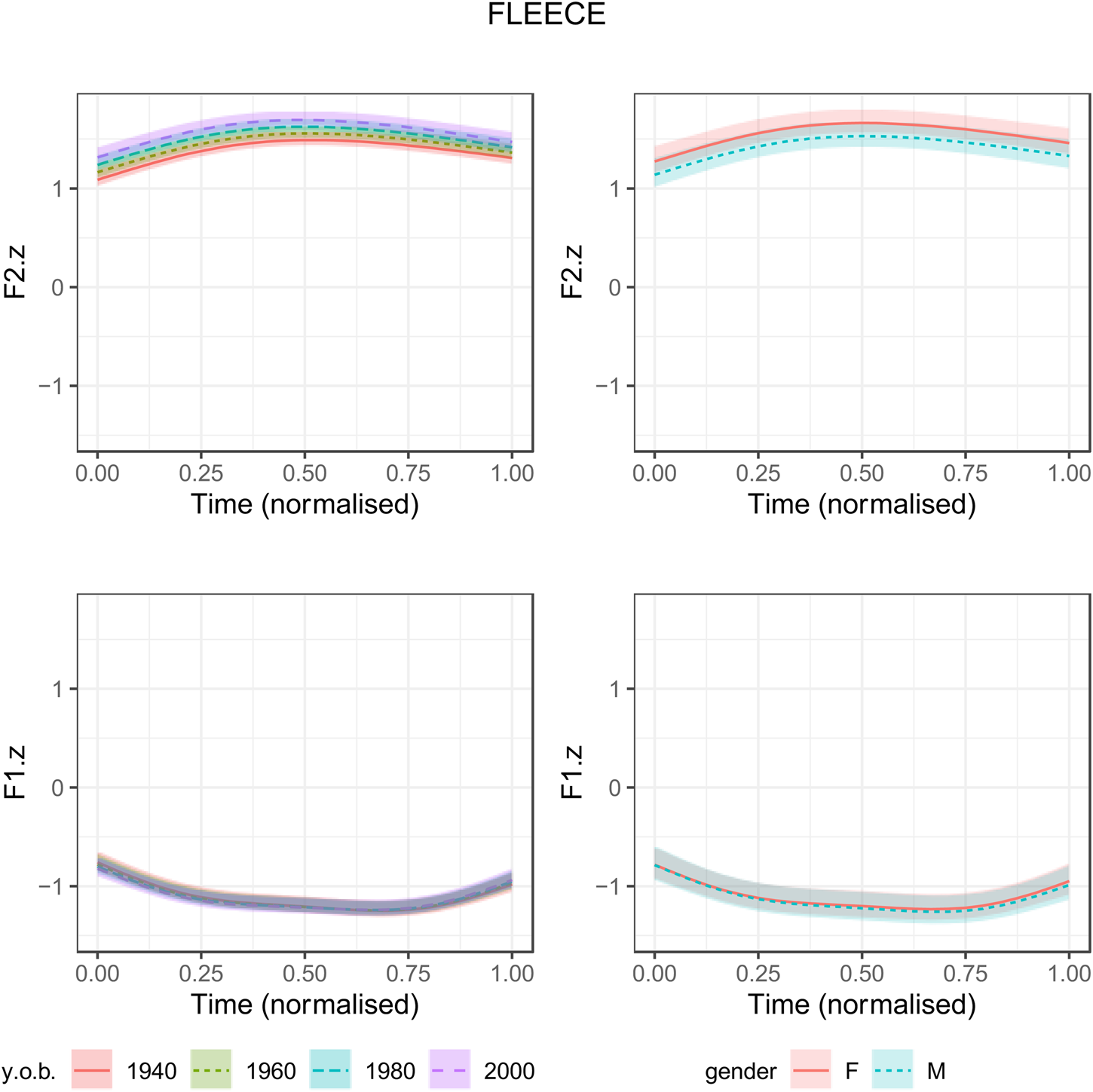
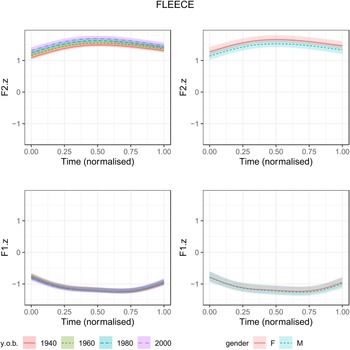
Similarly to the face vowel, there are no significant effects in the models of fleece (see figure 6). There is some variation along the F2 dimension, which could be a push effect of goose-fronting, but unlike goose-fronting, the effect is not systematic in apparent time. The overall curvature of the F1 and F2 trajectories is consistent with a modest degree of diphthongisation, as previously reported for Cockney, although it is less than for diphthongs such as face or price. There is no apparent-time change in this respect, nor a gender effect.
Results for fleece vowel
3.7 Interim summary
Under the hypothesis that the community is moving from a Cockney system to an SSBE one, we would expect a clockwise shift in the ʊ-diphthongs and a counter-clockwise shift in the ɪ-diphthongs in apparent time. For ɪ-diphthongs, we only see a shift in the price vowel in the expected direction, but not in the face vowel. However, it would not be accurate to say that only traditional Cockney face variants are found in the community: rather, there is variation, but no systematic change. There is no dynamic change affecting fleece. For ʊ-diphthongs, we see a counter-clockwise shift for both mouth and goat in apparent time, consistent with ongoing regional levelling, with retraction of the mouth onglide and raising of the goat onglide. The onglide of goose does not participate in this shift specifically, but the goose vowel is fronting along its entire trajectory. In terms of gender variation, females tend to show more levelling towards SSBE, but this is limited to just two changes: mouth-retraction and goat-raising.
At the average community level, it would appear that the Cockney diphthong shift is being reversed in apparent time; however, it does not systematically affect the face vowel, and it also seems that fleece and goose are not part of the diphthong system. However, it would appear that there is further individual variation that is not structured according to the two variables we have considered, i.e. year of birth and gender. In order to examine this in more detail, we conducted an exploratory analysis of individual vowel systems. In this part of the analysis, we also consider Likert scale responses on the identity questionnaire as potential predictors for differences between vowels systems. Thus, in section 3.8 we model only the 45 speakers for whom we had data on all vowels and who also filled in the questionnaire.
3.8 Variation in individual vowel systems
In order to reduce the number of dimensions per individual, whilst retaining dynamic information about the vowels, we parametrised the individual vowel trajectories, using Discrete Cosine Transformation (DCT; Harrington & Cassidy Reference Harrington and Cassidy1994; Williams & Escudero Reference Williams and Escudero2014). We extracted the first three DCT coefficients for each trajectory, which capture information relating to the mean formant value (k0), the slope of the trajectory (k1) and the curvature of the trajectory (k2). We then extracted the mean DCT coefficients per speaker per vowel, and used the values as the basis of k-means clustering. Each row of values in the analysis represents one speaker, and the purpose of the analysis is to determine whether there are any clusters within the vowel systems.
We determined the optimal number of clusters using the Silhouette method, which relies on a measure of similarity between any classified object to its own cluster, relative to other clusters (Kaufman & Rousseeuw Reference Kaufman and Rousseeuw1990). According to this procedure, the optimal number of clusters in our data is two, where clusters correspond to broad types of vowel systems. We visualise these two systems in figure 7. This figure is based on mean formant values by-cluster, plotted in the normalised F1–F2 vowel space.
Mean formant trajectories for the two speaker clusters identified in the data. The data include all speakers

Cluster 1 (23 speakers) is a traditional Cockney system, showing the features described in section 1.2: retracted and somewhat monophthongised price, lowered onglide for face, fronted mouth and lowered goat. Cluster 2 (22 speakers) can be described as the SSBE system along the lines of Lindsey (Reference Lindsey2019). Compared to Cockney, price is fronted, mouth is retracted and goat is raised. All these observations line up with the apparent-time changes identified through the GAMM analysis in section 3. However, there are also differences between cluster 1 and cluster 2 vowel systems that do not line up with community-level change. Specifically, there is raising of onglide in face and goat-fronting for cluster 2, relative to cluster 1.
In order to map the bottom-up clustering of speaker/vowel systems onto the explanatory variables we have, we built a conditional inference tree model, with cluster (cluster 1 or cluster 2) as the predictor variable. This was implemented using the party package (Hothorn et al. Reference Hothorn, Hornik and Zeileis2006b, Reference Hothorn, Bühlmann, Dudoit, Molinaro and Van Der Laana). The explanatory variables were year of birth, gender and the responses to the identity questionnaire (questions 1–6, as listed in section 2.2). Our rationale for including the identity data is that year of birth and gender failed to account for all the observed variation in our initial analysis. We reasoned that attitudes might provide additional insights into individual variation.
The model correctly classified 39 out of 45 speakers according to their cluster. This translates into 86 per cent accuracy. Out of all the predictors, two were found to be significant. Since the algorithm is recursive, the predictor structure is visualised in figure 8. The main split in the data is based on year of birth. Overwhelmingly speakers born after 1992 belong to cluster 2 (16 out of 17 speakers), meaning that they have an SSBE system. There is one speaker in that age group, a male born in 1994, who shows a more conservative, Cockney system. He considers himself to speak with an Essex accent. For speakers born in or before 1992, there is variation. Most of them belong to cluster 1 (traditional Cockney), but not all. Here, a further explanatory variable is the response to question 4 (‘I consider myself to speak with a Cockney accent’). Speakers who scored above 2 on that question, and therefore believe they speak Cockney, or at least are ambivalent about it, do pattern with the Cockney cluster (18 speakers). Speakers who categorically do not consider themselves to speak with a Cockney accent, however, vary. Some of them pattern with cluster 2 (SSBE, 4 speakers), whilst others pattern with the Cockney cluster (5 speakers).
Partitioning tree showing explanatory variables for speaker classification as either cluster 1 or cluster 2
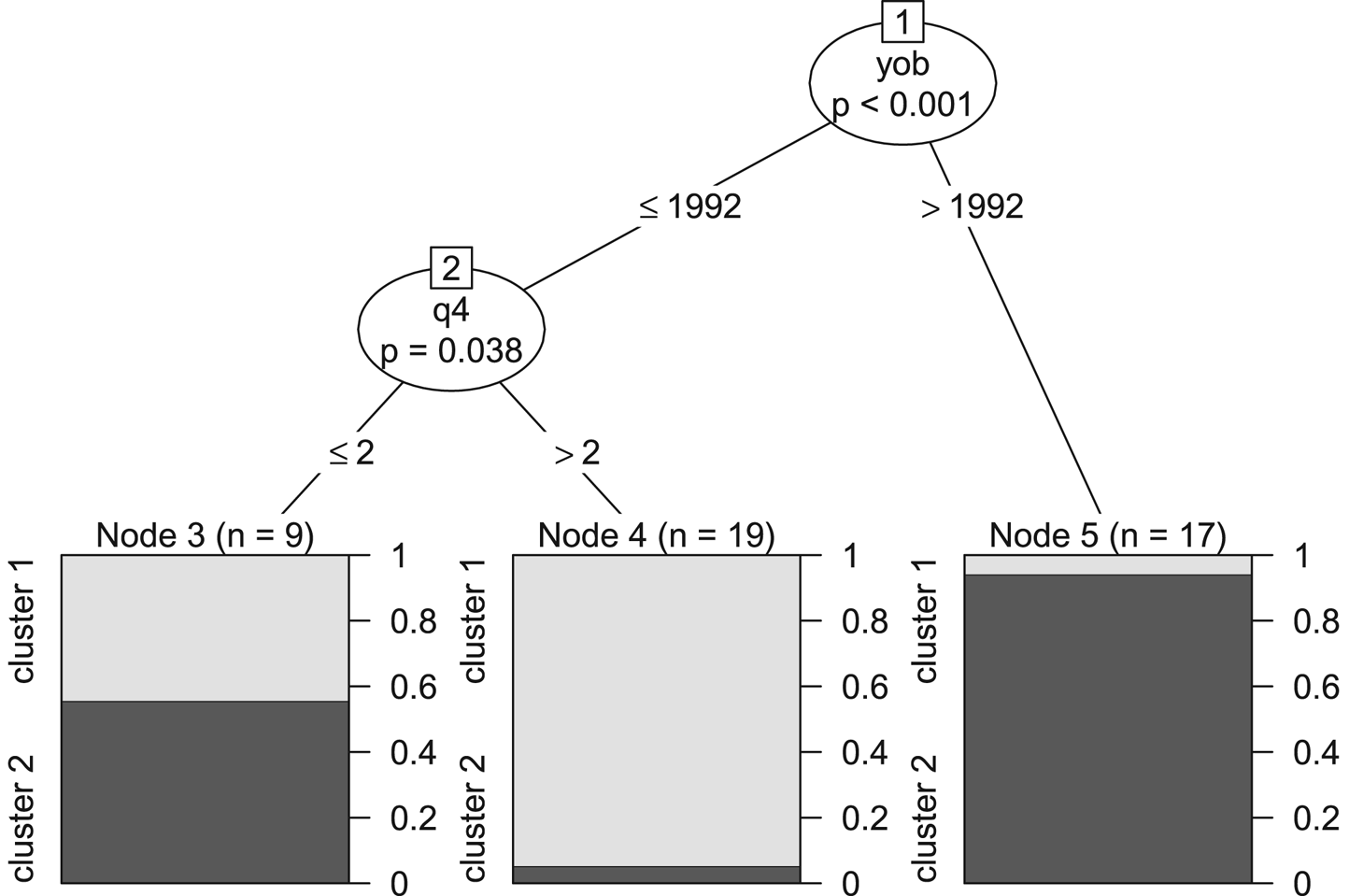
Speakers born in or before 1992 who do not identify with Cockney warrant a further investigation (node 3 in figure 8), because at least some of them do not seem to conform to the majority pattern. As such, they might represent the transitional state between Cockney and SSBE, even if they are not picked out as a separate cluster. The mean formant values for these speakers are plotted in figure 9, by-cluster. The cluster 2 speakers in this group are no different from the general cluster 2 pattern in figure 7. They essentially have the SSBE vowel system. However, the speakers classed as Cockney in this group show some differences from the traditional Cockney system shown in figure 7. Specifically, these speakers show some mouth-retraction, although not as much as the more levelled speakers in cluster 2, and also some price-fronting. In contrast, they do not participate in face or goat-raising. Thus, they represent a hybrid system, in which some vowels show a shift away from Cockney, but other vowels do not.
Mean by-cluster formant trajectories for speaker born before or in 1992 who do not consider themselves to speak with a Cockney accent

3.9 Summary
Our data show a number of systematic sound changes affecting vowels in speakers from Debden. Some of these changes are consistent with a reversal of the Cockney diphthong shift: retraction of mouth, fronting and lowering of price, and raising of goat. We also observe systematic goose-fronting, which is not specific to this community but, rather, a part of more general vowel changes affecting the South of England. For some of these changes, we also find gender effects: females lead in mouth-retraction and goat-raising. In addition, we observe some Cockney features affecting the dynamic profile of fleece and goose. Both of these vowels show a degree of diphthongisation, which appears to be stable in apparent time, and not subject to gender-based variation. Similarly, we do not observe a systematic change affecting the face vowel, although there is clearly variation in how this vowel is realised in the community.
The nature of variation affecting the price vowel is further illuminated by the second part of our analysis, focused on exploring the broader types of vowel systems across the community, rather than on individual vowels. A combination of Discrete Cosine Transformation and unsupervised k-means clustering applied to our data suggests that speakers in Debden fall into two broad types based on their diphthong systems. One system is similar to a traditional Cockney vowel system as illustrated in table 1, and characterised by considerable mouth–price crossover, and lowered price and goat. The other system approaches SSBE. By and large, speakers born after 1992 tend to have the SSBE system. However, a proportion of speakers born in or before 1992 also have this system. Interestingly, some speakers born in or before 1992 show a hybrid system, in which there is some degree of mouth-retraction and price-fronting, i.e. the crossover is being reversed, but at the same time price and goat are lowered. The speakers with this hybrid system do not identify their own accent as Cockney. We discuss these findings in section 4 below.
3.10 Open science statement
The data and code used in this research are available as an Open Science Framework repository at the following URL https://osf.io/kvejg/
4 Discussion
This article has traced the reversal of Cockney diphthong shift in Debden. More broadly, it compares the advancement of change for the same phonetic process in Debden to other speech communities in South East England in the context of their differing sociohistoric circumstances. An analysis of the variable rates of change across different speech communities contributes towards our understanding of the role of population resettlement and community in dialect levelling processes. In some ways, the change observed in Debden is analogous to that observed to differing extents in both Milton Keynes and Reading: a shift towards the pan-regional standard. In Debden, the ʊ-diphthongs, mouth and goat are rotating anti-clockwise whilst the ɪ-diphthongs price and choice show a clockwise movement towards SSBE targets. In contrast, the goose vowel is fronting, which initially appears to be consistent with an advancement of Cockney diphthong shift. Furthermore, fleece had a modest degree of diphthongisation as traditionally associated with Cockney (Sivertsen Reference Sivertsen1960; Wells Reference Wells1982; Labov Reference Labov1994). Nonetheless, in recent decades, goose fronting and fleece diphthongisation are found in many parts of South East England, including in SSBE (goose: Harrington, Kleber & Reubold Reference Harrington, Kleber and Reubold2008; fleece: Lindsey Reference Lindsey2019). Perhaps as a result of London's enduring influence on the accents of South East England (Altendorf & Watt Reference Altendorf, Watt, Kortmann and Upton2008; Wells Reference Wells1997; Przedlacka Reference Przedlacka2002), these traditional Cockney features have been reinterpreted as forming part of the pan-regional standard. As such, the diphthongisation of fleece and the fronting of goose are consistent with change towards SSBE, the broader regional standard in South East England, and not towards its predecessor the more supralocal, class-marked standard, RP.
Whilst all other diphthongs are in a process of reversal, no significant age effects are found for the face vowel. The lack of a significant, apparent-time change is, in part, explained by the imperfect mapping of age onto the variation in vowel production. The variance in linguistic production by year of birth reduces the confidence in modelling change. Whilst younger speakers do tend to be more standard, there are also some standard speakers in the older age group. However, the raised onset in some young speakers suggests potentially emerging community-level change. It is possible that the reversal of the face vowel is lagging behind other diphthongs as a result of the vowels’ relative social meanings. Although more research is required, it is possible that much like a diphthongised fleece, and the fronting of goose, a lowered face vowel is relatively widespread across the region and has been reinterpreted as forming part of the pan-regional standard. As a result, in Debden, Milton Keynes and Reading, Cockney diphthong shift is reversing towards SSBE forms, yet in all three communities, the face vowel has remained stable.
In Debden, as found in Milton Keynes and Reading, linguistic change is not occurring towards a local, majority variety which could be attributed to dialect contact and face-to-face interaction. Instead, in spite of the different starting points of linguistic change, the three areas are sensitive to broadly the same pressures of community-level dialect levelling towards pan-regional standard features. It seems that larger-scale pan-regional sociolinguistic influences weigh more overall than community-level influences. Despite vowel shift often being considered a prime example of linguistically motivated change (cf. Labov's three principles of chain-shifting 1994), in South East England, diphthong shift is reversing as a result of sensitivity to pan-regional unmarked forms. A case in point is the advancement of Cockney diphthong shift in Australian and New Zealand Englishes which has far outstripped the extent and speed observed in any British variety (Trudgill Reference Trudgill2004). This distinction is most easily attributed to the different social evaluation and social meaning of a shifted system. Unlike in England, not only is a shifted vowel system not stigmatised in Australia or New Zealand Englishes, it has been incorporated into the shared concept of national language which may have been key to the formation of a national identity (see Hickey Reference Hickey2003).
In comparison, in diverse areas of South East England a common process of levelling towards the pan-regional standard is occurring, seemingly as a result of sensitivity to standard language ideology. Indeed, the accents spoken in South East England have often been considered to occur on a continuum between Received Pronunciation (RP) and Cockney which parallels the class continuum (Wells Reference Wells1982: 302; Altendorf & Watt Reference Altendorf, Watt, Kortmann and Upton2008; see also ‘Estuary English’: Przedlacka Reference Przedlacka2002; Altendorf Reference Altendorf2003). Whilst the Cockney variety of English has long been found to be negatively evaluated, particularly in terms of overt prestige (Giles Reference Giles1970; Bishop, Coupland & Garrett Reference Bishop, Coupland and Garrett2005; Cole Reference Cole2021), RP has long been imagined as the correct and neutral variety (Milroy Reference Milroy2001; Agha Reference Agha2003). Therefore, the reversal of Cockney vowel shift towards RP's pan-regional, south-eastern descendent, SSBE, most likely represents an ideological shift away from a working-class variety and sensitivity to standardised norms. As a result, a similar process is found in Milton Keynes, Reading and Debden regardless of the size of the communities and the density or configuration of dialect contact or face-to-face interactions.
Nonetheless, whilst the target of change in Milton Keynes, Reading and Debden seems to be consistent, there are some notable differences in the timing and advancement of change. Firstly, the vowel system found in Debden is in many ways dissimilar to that reported in Milton Keynes and Reading. Several speakers in Debden, particularly older speakers, exhibited a traditional shifted Cockney diphthong system which was scarcely present, if at all, in either Milton Keynes or Reading. Even though change was present in all three communities, they do not have the same starting point for change. Whilst all South East England has been linguistically influenced by Cockney throughout the twentieth century (Wells Reference Wells1997; Altendorf & Watt Reference Altendorf, Watt, Kortmann and Upton2008), Debden was originally populated almost entirely by Cockneys and, as a result, the starting point of linguistic change was a more shifted diphthong system compared to either Milton Keynes or Reading.
Furthermore, differences are present between the three communities in the timing of change. As previously discussed, change has not occurred for young speakers in Reading to the same extent as in Milton Keynes as a result of the former town having a more levelled, existing dialect (Williams & Kerswill Reference Williams, Kerswill, Foulkes and Docherty1999). Similarly, linguistic change is not present amongst the speakers born in the 1980s in Debden to the same extent as those born in the same period in Milton Keynes or Reading. It may be that change has emerged at a later chronological point in Debden compared to Milton Keynes as a result of Debden's more levelled existing dialect due to the community's heterogeneous incoming population. In addition, change may be delayed in Debden in relation to both Milton Keynes and Reading as a result of patterns of social class and social mobility. In both Milton Keynes and Reading, Kerswill & Williams (Reference Kerswill and Williams2005) stratified their sample by class to explore differences between working-class and middle-class residents. They found that working-class speakers had more shifted systems than middle-class speakers. By extension, we would not expect rapid change in an invariably working-class community such as in the early decades of Debden.
To some extent, social mobility seems to be related to the abrupt community-level change towards SSBE targets that occurred in those born after 1992. Prior to the 1980s, Debden residents had little incentive to modify their accents as educational and employment opportunities were limited, and social networks were mostly contained within the local sphere. Previous research has established that dialect levelling is less prevalent in areas with lower social mobility as young people ‘remain unconvinced of the value of education as a passport to social mobility and have little incentive to modify their accents’ (Williams & Kerswill Reference Williams, Kerswill, Foulkes and Docherty1999: 160). Individuals in Debden had limited social mobility and would not have been heavily influenced or motivated by pressures of standard language ideology. Whilst age was overwhelmingly the factor that most determined whether a speaker would have a Cockney (born after 1992) or a more SSBE-like vowel system (born in or before 1992), the identity questions did have a limited role in determining a speaker's vowel production. Whilst this article does not have the scope to explore this further, it is possible that an individual's social class, identity and/or mobility patterns may go some way to explaining the variation found between speakers of the same age group.
Debden, then, has provided an interesting test case. Whilst there was substantial resettlement from East London to both Milton Keynes and, to some extent, Reading, the population of Debden was transferred relatively wholesale from a more homogeneous area. As a result, Debden has shown comparatively the greatest resistance to regional dialect levelling. This finding suggests that the key factor for dialect levelling is not exclusively mobility or the size of the existing or incoming population, but rather the retention of community networks which enables the comparatively prolonged maintenance of locally marked forms.
In summary, this article has explored dialect levelling and the roles that patterns of population resettlement, community and, to some extent, identity play in the processes which lead to a move towards pan-dialectal supralocalisation and a loss of locally marked features. We have traced the reversal of Cockney diphthong shift in Debden in relation to the community's sociohistorical context and in comparison to other communities in South East England. The similar trajectory and targets of change in Debden, Milton Keynes and Reading suggest that dialect levelling towards pan-regional, unmarked features is present in South East England which is not occurring exclusively as a result of dialect contact or face-to-face interaction. Whilst all three communities have similar targets for linguistic change, each community exhibits a distinct trajectory and timing of language change which can be attributed to different patterns of movement and resettlement and, in particular, access to social mobility and the retention of community networks.



 Open access

