




Introduction
The World Health Organization (WHO) defines health as ‘a state of complete physical, social and mental well-being, and not merely the absence of disease or infirmity’(1). According to the Ottawa Charter, health promotion is a social and political process, encompassing actions to strengthen individual capacities and to change social, environmental, and economic conditions to reduce their adverse effects on individual and community health(Reference Reid2). As individuals spend more than 7 hours per day at work in Europe(3), work-related health promotion is crucial.
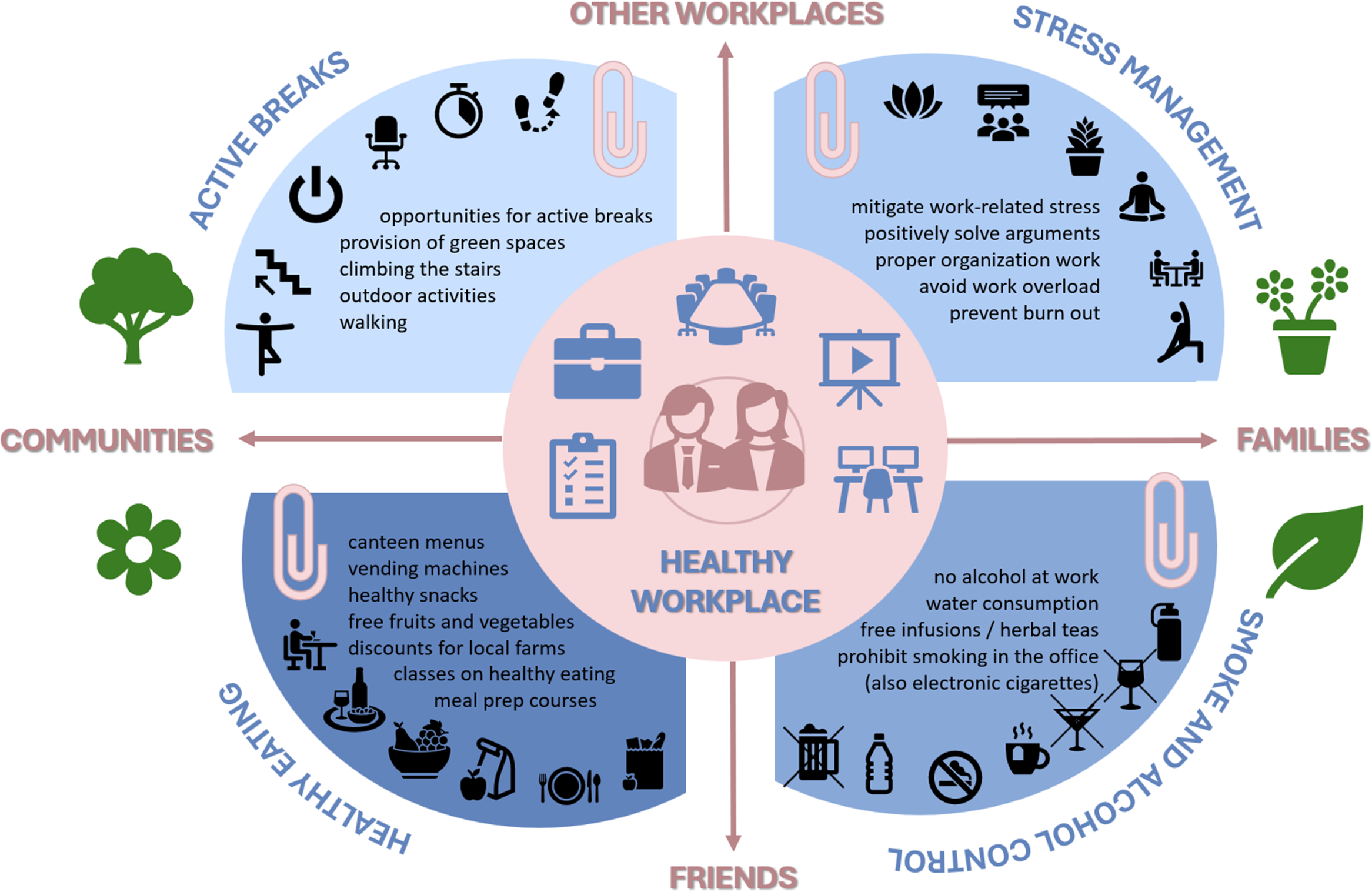
The WHO defined a healthy workplace as one in which workers and managers actively collaborate to protect and promote the health, safety, and well-being of all workers as well as the sustainability of the company(4). A healthy workplace should mitigate employees’ lifestyle risks such as sedentary habits, psychosocial risk, unhealthy eating habits, smoking habits and alcohol consumption(5–Reference Cahalin, Kaminsky, Lavie, Briggs, Cahalin, Myers, Forman, Patel, Pinkstaff and Arena7). Additionally, a healthy workplace should encourage healthy lifestyle habits among employees’ families, impacting the entire community’s health status (Figure 1)(Reference Burton8).
Illustration of a healthy workplace with various strategies for promoting well-being.

The European Action Plan for the Prevention and Control of Noncommunicable Diseases (NCDs) 2016–2025 highlights the importance of worker well-being through healthy eating, adequate physical activity, reduction of smoking and alcohol consumption, and management of work-related stress(6). The Plan encourages the development of policy, legislation, and governance tools targeting occupational and work-related NCDs by providing regulatory and financial incentives, social marketing, monitoring and dissemination of information. Similarly, the WHO Global Action Plan provides 9 global NCD targets to be reached by 2025(5). Creating healthy workplaces represents a prerequisite for achieving the Sustainable Development Goals (SDGs), specifically SDG 1, SDG 3, and SDG 8(Reference Burton8–10).
Workplace health promotion (WHP) is ‘the combined efforts of employers, employees, and society to improve the health and well-being of people at work’(11). WHP programmes can vary and can be classified as internal (involving company personnel), external (partnering with outside entities like universities), or hybrid (combination of external and internal) programmes. They may also differ in delivery mode (individual or group), educational methods (e.g., counselling, training, environmental changes), and the use of technology (e.g., mobile apps, newsletters)(Reference Cahalin, Kaminsky, Lavie, Briggs, Cahalin, Myers, Forman, Patel, Pinkstaff and Arena7). WHP interventions benefit employers and organisations by improving work performance, engagement, ability and retention, while reducing financial burden(Reference Bensa and Širok12). Indeed, employees in better health tend to be more productive, less absent, and enjoy a higher quality of life. Thus, well-designed WHP programmes can be cost-effective and profitable, although the economic impact remains debated(Reference Guazzi, Faggiano, Mureddu, Faden, Niebauer and Temporelli13–Reference O’Donnell15).
Work-related risk factors that contribute to obesity are work stressors, long work hours, night shifts, unhealthy food provision (canteens and/or vending machines), sedentary working habits, and a setting that is not designed to promote active breaks(Reference Cahalin, Kaminsky, Lavie, Briggs, Cahalin, Myers, Forman, Patel, Pinkstaff and Arena7,Reference Tam and Yeung16,Reference Zhu, Yoshikawa, Qiu, Lu, Lee and Ory17) . Noteworthy, several of these are also modifiable risk factors for NCDs(18). Consequently, most WHP programmes focus on promoting a healthy lifestyle, e.g., healthy eating, weight management, physical activity, quitting smoking, reducing alcohol consumption and improving sleep quality(Reference Cahalin, Kaminsky, Lavie, Briggs, Cahalin, Myers, Forman, Patel, Pinkstaff and Arena7), in line with the WHO and the European plan.
Previous systematic reviews(Reference Tam and Yeung16,Reference Madden, Cordon, Bailey, Skouteris, Ahuja, Hills and Hill19–Reference Sarkar, Lai, Zhang, Ni and Webster25) and an umbrella review(Reference Schliemann and Woodside26,Reference Hyży, Jaworski, Cieślak, Gotlib-Małkowska and Panczyk27) have explored the effectiveness of WHP interventions on health outcomes, though there is limited analysis of interventions targeting nutrition-related outcomes.
Hence, this narrative review was conducted to offer a thorough and critical analysis of the current evidence regarding WHP programmes with a nutrition intervention among the WHO healthy lifestyle domains. Narrative reviews are especially appropriate for this aim, as they facilitate an interpretative and contextual analysis of a varied collection of literature, synthesizing results from different interventions, outcomes, and workplace environments. Considering the intricate and multifaceted aspects of WHP programmes, along with the developing evidence following the WHO’s initiative on WHP interventions, a narrative method provides a deeper insight into intervention features and the research gaps that arise, which may not be fully addressed by a purely systematic approach. Furthermore, this narrative review proposes practical recommendations for companies and human resource management to develop more effective WHP initiatives.
Methods
Search strategy and selection criteria
The research question guiding this narrative review was: what are the characteristics and effectiveness of workplace health promotion interventions, evaluated through randomized controlled trials, that include at least one nutrition-related outcome among the adult working population in high-income countries?
This narrative review was intended for public health researchers and occupational health experts focused on WHP and nutrition-centred interventions. It also targeted policymakers and organisational stakeholders engaged in the creation, execution, or assessment of evidence-based WHP initiatives in high-income countries, as well as healthcare professionals and human resources managers engaged in multidisciplinary workplace health strategies.
This review process began in July 2023 with a pilot literature search, which revealed substantial heterogeneity across available studies. Thus, a narrative review approach was adopted to balance methodological rigor with flexibility. A combination of keywords and Boolean operators (AND, OR) was developed through pilot searches, initially outlined by two reviewers and refined through team discussion. Studies were identified from PubMed, including only English-language manuscripts published from 2015 to 2024. The Authors selected this time range in light of the WHO’s 2015 call to action on workplace health promotion(6), which remains highly relevant for contemporary policy and practice. Preprints were excluded and grey literature was not searched; however, ancillary studies related to eligible interventions were also considered. The full search strategy is provided in the Supplementary Materials (Section 1).
Eligibility criteria and study selection
Following the export of search results, duplicates were removed, and two authors independently screened titles and abstracts based on predefined eligibility criteria, followed by full-text screening. Disagreements were resolved through discussion with a third author when necessary.
The eligibility criteria were defined a priori and are outlined below. Specifically, the eligible population was the general adult working population of both sexes, with or without metabolic chronic diseases (e.g., cancer, hypertension, diabetes, and cardiovascular diseases). All types of worksites were considered eligible, including companies, universities, and other work centres.
Randomized controlled trials (RCTs) evaluating WHP programmes that included at least a nutrition intervention among the WHO healthy lifestyle domains were eligible for inclusion. The rationale was to prioritize high-quality evidence and minimize bias in assessing intervention effectiveness. Cluster and stepped-wedge RCTs were also considered eligible. WHP interventions were defined as programmes aimed at improving employees’ health and well-being within the workplace setting(Reference Cahalin, Kaminsky, Lavie, Briggs, Cahalin, Myers, Forman, Patel, Pinkstaff and Arena7,11) , with no restrictions placed on their duration. Besides nutrition intervention, eligible studies might tackle other WHO healthy lifestyle domains (i.e., physical activity, stress management, and smoking) to provide a broader perspective on multidimensional WHP strategies.
No restrictions were applied regarding the type of control.
To be eligible, studies were required to report at least one nutrition-related outcome (e.g., dietary habits, dietary intake, diet quality indicators, or nutrition-related health metrics such as anthropometric measurements or body composition).
Studies focusing on pregnant or lactating women or on workers with specific conditions requiring tailored interventions (e.g., neurodegenerative diseases) were excluded. Indeed, excluding specific groups with unique health needs prevent confounding issues associated with specialized intervention demands. Furthermore, only studies conducted in high-income countries, as defined by the World Bank (June 2022)(28), were included to enhance comparability in terms of workplace organisation and employee lifestyle behaviours.
Thus, despite the narrative review design, several boundaries were established to enhance conceptual clarity and comparability among studies.
Data extraction and data analysis
Data extraction was performed by two authors using standardized electronic templates, with discrepancies s resolved through discussion with a third author. For each eligible study the following information was extracted: study design; publication date; study location (e.g. nation, workplace); population characteristics; intervention; outcomes related to the WHO healthy lifestyle domains (i.e., nutrition, physical activity, stress management, and smoking); results.
Furthermore, to ensure a comprehensive overview, ancillary studies associated with eligible interventions were also identified based on author names, programmes’ titles, and study descriptions.
Outcome and intervention categories were defined after full-text review to avoid a priori unrepresentative clustering, the categorisation of the outcomes and interventions was defined after reading the full text of the articles. Nonetheless, the WHP intervention components were categorised according to a classification system proposed by a previous systematic review(Reference Panchbhaya, Baldwin and Gibson23).
Study findings were narratively described in line with the methodology of a narrative review. Intervention effectiveness was defined as a statistically significant between-group difference (p ≤ 0.05) in at least one pertinent outcome, according to the most comprehensive adjusted analysis available. Within-group comparisons and confidence interval-based results were considered non-significant. All analyses were conducted using Microsoft Excel (version 2410).
Results
313 scientific articles were retrieved after duplicate removal. Afterwards, 76 articles were selected based on title/abstract screening. The eligible papers were then screened by full text reading, resulting in the inclusion of 37 papers in the present narrative review. The authors also performed snowballing on 24 relevant systematic reviews published in Pubmed in the eligible time frame. Therefore, 53 other RCTs were retrieved and of those, 17 RCTs were finally included in the present analysis. Summing up, 54 RCTs were included in this narrative review. For each eligible study, related papers were searched, resulting in the final inclusion of 87 papers in the present narrative review.
Characteristics of included studies
A full summary of study characteristics can be found in the Supplementary materials (Table S1). Furthermore, other published articles related to the eligible ones included are presented in the Supplementary materials (Table S2). 27 (50 %) studies were two parallel arms RCT design, 13 (24%) were cluster randomized controlled trials, 7 (13%) were three parallel arms RCT, and 7 (13 %) other types of design (4 cross-over trials, 1 multiple baseline design, 2 stepped wedge cluster randomised trial).
Of the 54 studies, 30 (56%) were conducted in the USA. Among others, 5 (9%) were from the United Kingdom, 4 (7%) were from Germany, 3 (6%) were from the Netherlands, 2 (4%) were from China, 2 were from Sweden, and 2 were from Denmark. The rest were from Spain, South Korea, Iran, Japan, Finland, and Israel (1 study each, 2%).
Considering all the worksite units, 833 worksites were included. For each intervention, the number of worksites ranged from a minimum of 1 to a maximum of 78 (mean 14 worksites). Specifically, studies conducted interventions in the same type of worksite (46, 85%) or mixed different setting types (8 studies, 15%). In detail, 8 (15%) studies were conducted at the university. Fewer studies were conducted in manufacturing companies (5, 9%), in transport companies (4, 7%), in nursing homes (3, 6%), in fire stations (3, 6%), in schools (2, 4%), in pharmaceutical companies (2, 4%), in construction sites (2, 4%), and petrochemical companies (2, 4%). Other types of worksites included research centres, churches, mechanical companies, retail companies, and a technology company, with 1 study for each type of setting. 2 studies did not specify the type of worksite.
The total number of employees was 70,318, ranging from 24 to 20,327 (mean 1,302, median 348) for each study. Unfortunately, it was not possible to describe the type of employee (white, blue, or pink collar) who received the intervention since only a few studies indicated this information. They were mostly middle-aged adults with a mean age of 45. 5 years old. The majority (54%) were males, although 6 studies (11%) included only males, and 1 study only females.
Regarding race and ethnicity, most of the participants were Caucasian (73%), followed by Black/African/African American (20%), Asian (10%), Hispanic (8%) and others (8%). Unfortunately, 24 studies (44%) did not report either race or the ethnicity of the study sample.
Concerning anthropometric measurements, most of the participants had an excessive weight according to the classification provided by the WHO(29). Indeed, the average Body Mass Index (BMI) was 30 kg/m2 (24 - 37). This value was obtained by calculating the mean of the average BMI reported by each study. Of note, 15 studies (27 %) did not report the BMI of the sample.
Lastly, with regards to dropout rates, 22% of the participants dropped out on average (0%–50%; median 17%), corresponding to a medium rate(30).
Interventions categories
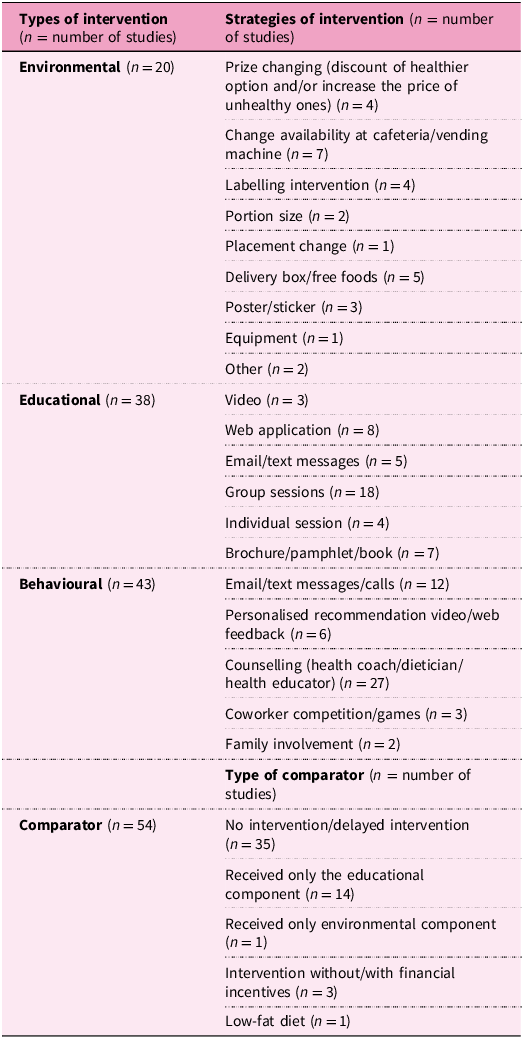
Intervention components were categorised as behavioural, educational or environmental, as suggested by a previous systematic review(Reference Panchbhaya, Baldwin and Gibson23) (Table 1). Specifically, behavioural interventions include e.g., counselling, goal setting, and identifying barriers and facilitators. Interventions were considered educational if they provided nutritional information on healthy diets or the prevention or management of chronic metabolic diseases. On the other hand, environmental interventions targeted only the workplace environment. They could include nudging, posters, or changing the food supply in the cafeteria/vending machines. Of note, each intervention could receive one or more of these labels.
Overview of intervention types (educational, environmental, behavioural, and combined) and corresponding intervention strategies reported across the included studies, noting that individual studies may implement multiple strategies within the same intervention type

Among the 54 eligible studies, 24 (44%) proposed combined interventions of educational plus behavioural strategies, 9 (17%) only behavioural strategies, and 8 (15%) combined interventions of educational, behavioural and environmental strategies. Fewer studies applied environmental strategies (5, 9%), combined educational and environmental strategies (4, 7%), and combined behavioural and environmental (3, 6%). Only one project used an educational strategy alone.
Regarding the 43 studies that applied a behavioural strategy, 5 different strategies were obtained. The majority (27, 63%) was carried out through individual or group sessions of counselling with health coaches, dieticians, or health educators. Fewer studies used email/text messages/calls (12, 28%), applied personalised recommendations through video or web feedback (6, 14%), organised competitions and games between coworkers (3, 7%), or actively involved family members (2, 5%). Among the 38 studies implementing an educational intervention, 6 strategies were identified. 18 (47%) used group sessions, 4 (11%) individual sessions, 8 (21%) web applications, 7 (19%) brochures, pamphlets or books, 5 (13%) email/text messages, and 3 (8%) videos. Finally, as far as environmental interventions are concerned, 8 different strategies were identified across 20 studies. 7 studies (35%) targeted the availability of foods at the cafeteria/vending machine, 4 (20%) the food labels, and 4 (20%) the price. Fewer studies delivered food boxes or provided free foods (5, 25%), used poster and sticker placements (3, 15%), 2 (10%) targeted portion sizes, 1 (5%) food placement on the shelves, and 1 provided equipment to support the evaluate anthropometrics (e.g. BMI calculator and waist circumference–measuring tape).
For the majority of the interventions (35, 65%) the comparators were no intervention or delayed intervention (Table 1) For 14 studies (26%), the control group received a simplified intervention. Specifically, 14 studies (26%) proposed just the educational part of the intervention, 2 (4%) interventions without financial incentives, 1 (2%) only the environmental part, and 1 intervention(Reference Gepner, Shelef, Schwarzfuchs, Zelicha, Tene, Yaskolka Meir, Tsaban, Cohen, Bril, Rein, Serfaty, Kenigsbuch, Komy, Wolak, Chassidim, Golan, Avni-Hassid, Bilitzky, Sarusi, Goshen, Shemesh, Henkin, Stumvoll, Blüher, Thiery, Ceglarek, Rudich, Stampfer and Shai31) compared the intervention with a low-fat diet. Lastly, 1 intervention offered a similar educational intervention but on finance.
As regards duration, most of the interventions lasted 1-3 months (17, 31%), 1-6 months (15, 28%) or 1-12 months (14, 26%). Fewer studies (5, 9%) lasted > 12 months and only 3 studies lasted < 1 month. Of note, 10 studies out of 32 (31%) measured the effects post-intervention after 6 months and 7 (22%) after 12 months.
With regard to the WHO healthy lifestyle domains, of the 54 interventions aimed at improving anthropometrics or dietary habits, 42 (78%) also targeted physical activity, 14 (26%) smoke and stress management, and 5 (9%) alcohol consumption. Overall, considering the multidomain nature of the 54 interventions, 13 (24%) addressed a single domain, 25 (46%) two, 6 (11%) three, and 10 (19%) four or more domains. Lastly, 19 out of 54 projects offered financial incentives (i.e., discount of healthier options or increased prices of unhealthy ones), and 40 used technologies to implement the intervention (e.g., calls, text messages, videos, website, App) during the intervention.
Effect on outcomes
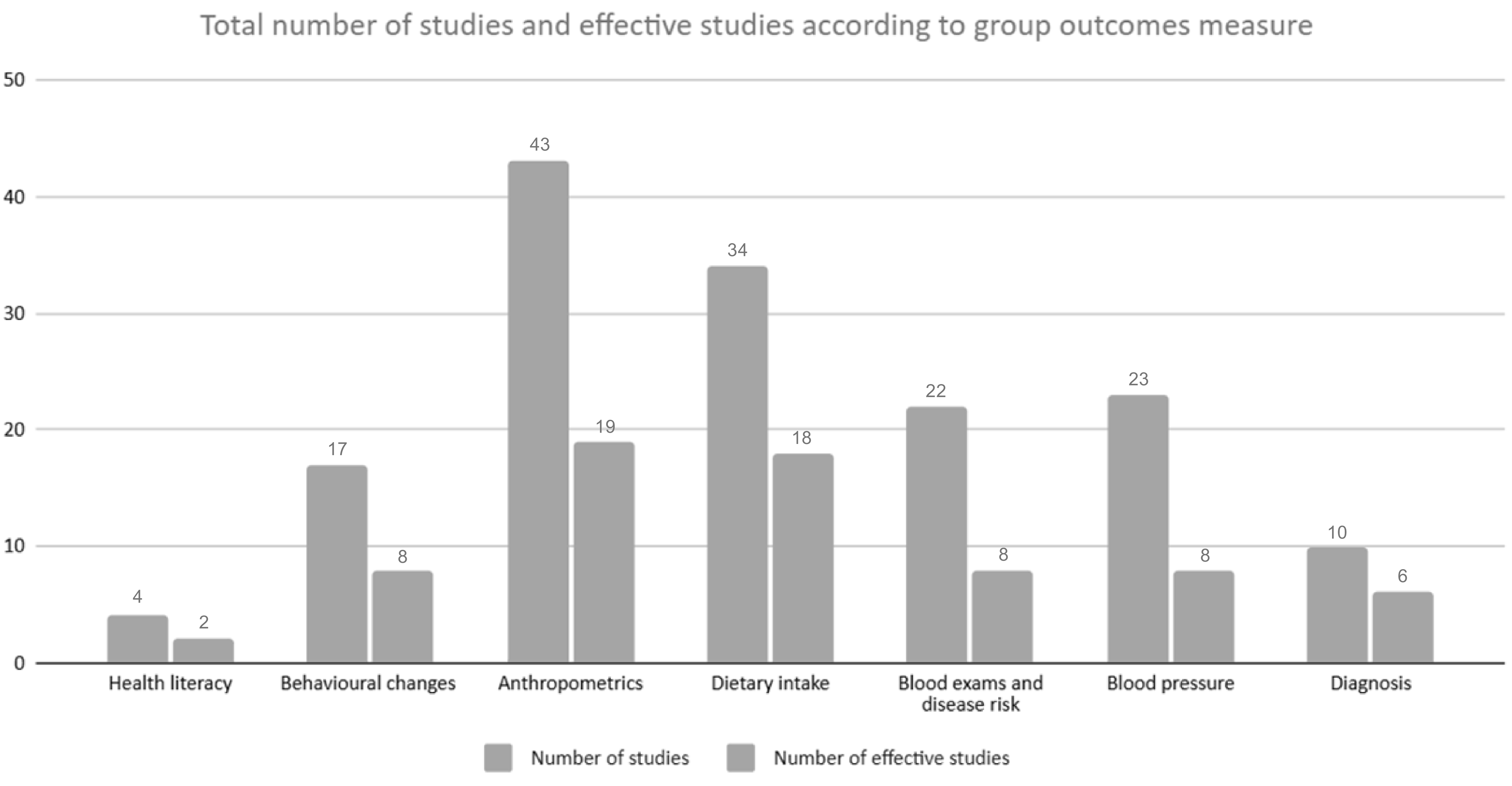
More than 100 outcomes were assessed in the eligible studies, thus showing the great diversity encountered (Supplementary materials, Table S3). They were categorised as follows: health literacy, behavioural changes, anthropometrics, dietary intake, blood exams, blood pressure, and disease diagnosis/score (Figure 2). A detailed description of outcomes and results related to the other WHO healthy lifestyle domains is available in the Supplementary materials (Table S4). An analysis based on the intervention type, including also mixed intervention strategies, is available in the Supplementary materials (Section 2).
Total number of studies and effective studies according to group outcomes measures.

Nutritional knowledge and behavioural changes
4 of 54 studies evaluated the impact of the intervention on food knowledge or health literacy and 2 studies observed a significant improvement in these outcomes. 17 studies assessed behavioural changes and 8 (47%) were effective in improving this outcome. Among the various sub-groups, self-efficacy and generic nutrition behaviour emerged as the most frequently reported outcomes (6 studies for each outcome) followed by goal setting (4 studies). For these outcomes, 50% of the interventions were effective.
Anthropometrics
This outcome category was the one that was reported most frequently (43, 80%); 19 studies (44%) were effective in improving it. Specifically, out of 31 studies measuring BMI, 8 (26%) reported a significant reduction in this variable. Body weight decreased significantly in 11 of 30 studies (37%), waist circumference in 11 of 20 studies (55%), and body fat percentage in 2 of 10 studies (20%).
Dietary intake
Among the 34 studies reporting this outcome category, 18 (53%) found a positive effect on food intake. Delving into details, these effective studies measured the intervention’s impact on the consumption of healthy foods or nutrients (e.g., fruits and vegetables, fibre, polyunsaturated fatty acids, and carbohydrates) and unhealthy foods or nutrients (e.g., sugar-sweetened beverages, saturated fatty acids, dietary cholesterol). Of note, 7 studies out of 18 (39%) observed a significant increase in the intake of healthy foods, while 10 of 17 (59%) had a significant decrease in the intake of unhealthy foods. Also, employees’ food purchases at vending machines or worksite cafeterias were measured in 5 studies. 4 of them (80%) were found to be effective in influencing food purchases toward a healthier diet. Lastly, adherence to a specific dietary pattern (i.e., Mediterranean diet adherence), to National guidelines, and adherence to healthy and balanced diets was measured by 9 studies, of which 3 (33%) resulted in significant improvements.
Blood exams
In total, 22 studies conducted blood tests, and 8 interventions (36%) were effective in improving at least one parameter. In particular, the blood markers most frequently analysed were total cholesterol (19 studies), low-density lipoproteins (16), high-density lipoproteins, (18), and triglycerides (19). Interventions that exerted a positive effect on these variables were 2 (11%), 4 (25%), 3 (17%), and 4 (22%), respectively. Glycated haemoglobin was measured in 11 studies, of which 4 (37%) observed a significant effect in reducing its levels. Similarly, fasting blood glucose was measured in 14 studies; nonetheless, only one of the applied interventions was effective in improving this variable.
Blood pressure
Blood pressure was measured in 22 studies and 8 (36%) exerted a positive effect in decreasing systolic, diastolic or both types.
Disease diagnosis/score
10 (19%) studies performed disease diagnosis/score of one or more diseases: metabolic syndrome, obesity, hypertension, prediabetes, composite score of fatal and non-fatal cardiovascular event, European Society of Cardiology (ESC) Score, diabetes risk score, Framingham risk score. Metabolic syndrome was assessed in 4 studies, of which 2 (50%) reported a significant impact; obesity and hypertension were measured in 3 studies, and 2 (67%) found a significant decrease in prevalence.
Discussion
Overall findings
A healthy, motivated, and well-qualified workforce is the basis of the future social and economic prosperity(Reference Guazzi, Faggiano, Mureddu, Faden, Niebauer and Temporelli13). Therefore, applying effective initiatives to improve employee’s health is of primary importance. This narrative review explored the characteristics of the WHP programmes that included at least one nutrition intervention among the WHO healthy lifestyle domains. From 2024 to 2025, 54 interventions were identified, which were conducted across 833 worksites in 12 high-income countries, involving a total of 70318 employees. To evaluate the nutritional and clinical impact of the interventions, anthropometrics, dietary intake, blood exams and blood pressure were the most reported outcome category. However, significant impacts were identified only in a limited number of interventions. The most frequently reported benefits for employees participating in WHP interventions were reduction in waist circumference, improvements in the consumption of unhealthy food and nutrients, changes in vending machines or worksite cafeteria purchases, and metabolic syndrome diagnosis. These results are in line with previous umbrella reviews, systematic reviews and meta-analyses, reporting a significant positive effect on dietary intakes(Reference Peñalvo, Sagastume, Mertens, Uzhova, Smith, Wu, Bishop, Onopa, Shi, Micha and Mozaffarian21), anthropometric variables(Reference Peñalvo, Sagastume, Mertens, Uzhova, Smith, Wu, Bishop, Onopa, Shi, Micha and Mozaffarian21,Reference Weerasekara, Roberts, Kahn, LaVertu, Hoffman and Das22,Reference Morrow, Walker, Calder-MacPhee and Ozakinci32,Reference Park and Kim33) , and cardiometabolic risk indicators(Reference Peñalvo, Sagastume, Mertens, Uzhova, Smith, Wu, Bishop, Onopa, Shi, Micha and Mozaffarian21). Nonetheless, the results are not yet conclusive, due to the low quality of the studies and conflicting evidence(Reference Bezzina, Clarke, Ashton, Watson and James20,Reference Panchbhaya, Baldwin and Gibson23,Reference Hyży, Jaworski, Cieślak, Gotlib-Małkowska and Panczyk27,Reference Watkins and English34) .
This review highlighted the large variety of multicomponent WHP interventions, with educational and behavioural interventions being the most commonly implemented combination. This combination results in the most consistent benefits on behavioural changes, haematic parameters, and food knowledge. Thus, this programme structure may be promising for the effective prevention of cardiometabolic diseases. However, more studies are needed to confirm this hypothesis.
With reference to WHO dimensions for enhancing health in workplace settings(Reference Cahalin, Kaminsky, Lavie, Briggs, Cahalin, Myers, Forman, Patel, Pinkstaff and Arena7) and to the current European action plan(6), this narrative review highlights that in the last decade, most of the WHP interventions targeting nutrition also addressed two or more healthy lifestyle domains. However, consistent with current scientific literature(Reference Bezzina, Clarke, Ashton, Watson and James20), in this review few interventions simultaneously targeted stress management, alcohol and smoking alongside the nutrition intervention. Given the central role of these factors in achieving a healthy lifestyle, WHP programmes should address all domains, especially when employees are at risk of adopting unhealthy behaviours at work (e.g., sitting for a long time, short meal breaks, and night shifts). Lastly, most of the studies used technology to foster greater participant adherence to the intervention and to ease the process of learning new healthy habits.
Limitation of the studies included in the review
In line with the scientific literature, this review highlights that several factors could have contributed to the ineffectiveness of the WHP programmes(Reference Cahalin, Kaminsky, Lavie, Briggs, Cahalin, Myers, Forman, Patel, Pinkstaff and Arena7,Reference Bensa and Širok12,Reference Lutz, Taeymans, Ballmer, Verhaeghe, Clarys and Deliens14,Reference Tam and Yeung16) . First, on average, almost a quarter of participants dropped out (mean 22%) during the trials. Secondly, there was a significant lack of information regarding blinding and allocation concealment, increasing the risk of performance bias. This issue could be particularly relevant in workplace settings, where coworkers are aware of their allocations and can communicate with one another. Thirdly, long-term follow-up outcomes were frequently not evaluated, preventing the revision of the lasting impact of these interventions on the workforce. Fourth, sample size estimation and intention-to-treat analyses were rarely performed; thus, there might be a reduced statistical power and an increased risk of overestimating the effect of the intervention.
Recommendation for future WHP studies design
The conducted analysis of WHP programmes encompassing a nutrition domain has several implications for employers, human resources offices, government agencies, and policymakers. We here highlight the most relevant ones.
First of all, there is an urgent need to define a worldwide consensus to guide the main stakeholders in properly designing more effective interventions(Reference Watkins and English34). Of note, a meta-analysis(Reference Goetzel, Henke, Tabrizi, Pelletier, Loeppke, Ballard, Grossmeier, Anderson, Yach, Kelly, McCalister, Serxner, Selecky, Shallenberger, Fries, Baase, Isaac, Crighton, Wald, Exum, Shurney and Metz35) on the efficacy of WHP interventions concluded that programmes that were well-designed, well-implemented, and based on the principles of evidence could yield positive economic and health outcomes(Reference Goetzel, Henke, Tabrizi, Pelletier, Loeppke, Ballard, Grossmeier, Anderson, Yach, Kelly, McCalister, Serxner, Selecky, Shallenberger, Fries, Baase, Isaac, Crighton, Wald, Exum, Shurney and Metz35).
Waiting for such a guidance document, a potential best practice could be to rely on WHP reference models developed by authoritative bodies and organisations with proven scientific validity. These include the models developed by the WHO(Reference Burton8), the American Heart Association (AHA)(36), the Centers for Disease Control (CDC)(37) or the American College of Sports Medicine(38). Although they have been developed for several years, their application is currently limited(Reference Cahalin, Kaminsky, Lavie, Briggs, Cahalin, Myers, Forman, Patel, Pinkstaff and Arena7,Reference Guazzi, Faggiano, Mureddu, Faden, Niebauer and Temporelli13) .
Furthermore, multicomponent and multidomain WHP programmes are more likely to lead to positive outcomes, as shown by the present review and by the scientific literature(Reference Upadhyaya, Sharma, Pompeii, Sianez and Morgan39). Therefore, their development should be encouraged. For example, the inclusion of environmental changes as an additional supporting component of a WHP programme has been highlighted by an umbrella review(Reference Schliemann and Woodside26).
Concerning programmes’ contents, WHP intervention and messages should be guideline-based(4,Reference Visseren, Mach, Smulders, Carballo, Koskinas, Bäck, Benetos, Biffi, Boavida, Capodanno, Cosyns, Crawford, Davos, Desormais, Di Angelantonio, Franco, Halvorsen, Hobbs, Hollander, Jankowska, Michal, Sacco, Sattar, Tokgozoglu, Tonstad, Tsioufis, van Dis, van Gelder, Wanner and Williams40) and tailored to the needs and expectations of the target population group to maximize their effectiveness(Reference Cahalin, Kaminsky, Lavie, Briggs, Cahalin, Myers, Forman, Patel, Pinkstaff and Arena7). Indeed, the goal must be fostering the knowledge transition of appropriate and reliable information on healthy lifestyles and the prevention of major non-communicable diseases. Specifically, it is advisable to focus on a central theme and goal to pursue (e.g., reduction of hypertension, SSBS, weight loss or increased fruit and vegetable consumption) for conveying clear and simple messages to employees. Conversely, designing a WHP programme with too many objectives may undermine its effectiveness.
For programme tailoring in the development phase, it is important to consider the setting (e.g., hospital, transportation company), the resources available (time, personnel and money), and the employees’ shifts (e.g., night shifts, few breaks, many hours driving). For instance, a previous screening phase to assess the baseline knowledge and actual needs, as well as the willingness to change, of that specific workforce before designing and implementing the intervention would be advisable.
With regards to best practices for designing behavioural interventions, they should be based on valid nutrition education theories, e.g. social cognitive theory, theory of planned behaviour or transtheoretical model of behaviour change(Reference Raymond and Morrow41). Regarding environmental intervention, developing a partnership with nearby farms, food companies and shops in the area could represent a beneficial way to promote the local economy and facilitate the supply of healthy foods for employees(Reference Thi, Horton, Loyo, Jowers, Rodgers, Smiley, Leversen and Hoelscher42).
Besides the intervention characteristics, strong organisational support by the employer and human resources office is required to properly promote the initiative in the workplace setting(Reference Cahalin, Kaminsky, Lavie, Briggs, Cahalin, Myers, Forman, Patel, Pinkstaff and Arena7). This could ease the implementation and foster long-term integration of the good practices acquired through the intervention. Indeed, internal health-promoting councils(Reference Hannon, Hammerback, Allen, Parrish, Chan, Kohn, Teague, Beresford, Helfrich and Harris43) could foster a long-lasting implementation of the good practice acquired. Finally, the authors highlight the need to strengthen scientific rigour in designing WHP programmes by building partnerships between companies and universities or research centres. This good practice could enhance the quality and effectiveness of WHP programmes, thereby supporting the value of investing in their development and maintenance(Reference Watkins and English34).
Opening the discussion to future prospects emerging in the field, the use of technology(Reference Jung and Cho44,Reference Junker, Böhm and Krcmar45) and artificial intelligence(Reference Miller and Rosemberg46,Reference Jindo, Kai, Kitano, Wakaba, Makishima, Takeda, Iida, Igarashi and Arao47) are under the spotlight for their cost-effectiveness, portability and wide applicability.
Strengths and limitations of the present review
This narrative review, although not systematic, has numerous strengths. Narrative reviews are inherently flexible and are particularly well suited to providing a readable and meaningful synthesis of a heterogeneous body of literature. In this context, the present review provides a detailed summary of workplace health promotion initiatives with nutrition-related outcomes, aiding in the contextualization of existing evidence, pinpointing research deficiencies, and guiding future studies.
From a methodological standpoint, it encompassed only RCTs performed in various worksite environments and involving a total of over 7,000 employees, thus emphasizing robust experimental evidence. Eligibility criteria were methodically and impartially defined a priori, thereby improving rigor and transparency in the reporting of results. Additionally, suitable studies encompassed all key types of nutrition interventions(Reference Panchbhaya, Baldwin and Gibson23) and evaluated one or more WHO health dimensions(Reference Cahalin, Kaminsky, Lavie, Briggs, Cahalin, Myers, Forman, Patel, Pinkstaff and Arena7), allowing for a multidimensional interpretation of WHP strategies.
Nevertheless, several limitations should be acknowledged. An essential feature of narrative reviews is that they do not seek to be comprehensive and openly acknowledge that some pertinent literature may be omitted. Furthermore, only a single database was utilized for study identification; nonetheless, PubMed serves as the main and most commonly used database for biomedical research. Additionally, grey literature was not explored and preprints were omitted, which may restrict the discovery of all pertinent RCTs in this area.
Further limitations pertain to the degree of detail presented in the included studies. In particular, details regarding the professionals conducting the interventions (e.g., nutritionists, psychologists) and the size of groups in educational or counselling sessions were frequently missing, even though these elements could be crucial factors influencing the effectiveness of the interventions(Reference Cahalin, Kaminsky, Lavie, Briggs, Cahalin, Myers, Forman, Patel, Pinkstaff and Arena7). Additionally, while non-communicable diseases are becoming more common in low-and middle-income countries, this review concentrated solely on high-income settings to improve comparability across studies regarding workplace structure, resources, and employee lifestyle habits.
Ultimately, although the interventions and outcomes were objectively categorised, the considerable variability in study designs, intervention types, and outcome measures restricted the capacity to draw broad conclusions. This issue is frequently noted in the assessment of WHP programmes(Reference Cahalin, Kaminsky, Lavie, Briggs, Cahalin, Myers, Forman, Patel, Pinkstaff and Arena7,Reference Bensa and Širok12) and highlights the requirement for future high-quality, well-standardized studies. These studies are crucial for enhancing the evidence base and aiding the creation of more effective, sustainable workplace health promotion initiatives that can provide lasting advantages for both employees and society as a whole.
Conclusion
Despite the central role of the workplace in an adult’s life and its significant potential as a setting for promoting healthy lifestyle practices, most existing intervention programmes have failed to demonstrate sustained effectiveness. This is largely due to a lack of well-designed, evidence-based, and guideline-driven multicomponent and multidomain interventions tailored specifically to this population. Yet, given the favourable cost/benefit ratio, workplace health promotion programmes hold enormous potential to create a chain reaction, positively impacting not only employees but also their families, broader communities, and society at large.
To unlock this potential, the authors strongly advocate for the development of new international guidelines and consensus frameworks. These should aim to assist both employers and researchers in designing scientifically rigorous and contextually feasible interventions. Such frameworks must strike a balance between theoretical soundness and practical applicability, for instance, by offering user-friendly tools, actionable strategies, and clear, thematically focused messaging. These elements are essential to foster meaningful engagement and long-term adherence, ensuring that health-promoting behaviours become embedded within organisational culture and individual routines. Furthermore, future efforts should consider tailoring interventions to the specific needs of diverse workplaces, including factors such as industry type, workforce demographics, and cultural context, to enhance relevance and effectiveness.
Supplementary material
The supplementary material for this article can be found at https://doi.org/10.1017/S095442242610047X
Acknowledgements
None.
Financial support
Project funded under the National Recovery and Resilience Plan (NRRP), Mission 4 Component 2 Investment 1.3 - Call for tender No. 341 of 15 March 2022 of Italian Ministry of University and Research funded by the European Union – NextGenerationEU; Award Number: Project code PE00000003, Concession Decree No. 1550 of 11 October 2022 adopted by the Italian Ministry of University and Research, CUP F13C22001210007, Project title “ON Foods – Research and innovation network on food and nutrition Sustainability, Safety and Security – Working ON Foods”.
Competing interests
None.
Authorship
Conceptualization, S.S., G.V., A.V. and H.C.; methodology, S.S., G.V. and A.V. writing - original draft preparation, S.S., G.V. and A.V.; writing - review and editing, S.S., G.V., A.V. and B.R.; supervision, H.C. S.S. and G.V. contributed equally to this work.


 Open access

