





Functional neurological disorder (FND) is a common condition at the interface of neurology and psychiatry. Symptoms of FND are diverse and include functional (dissociative) seizures, weakness, sensory changes, movement disorders and speech disturbance.Reference Stone, Carson, Duncan, Coleman, Roberts and Warlow1,Reference Hallett, Aybek, Dworetzky, McWhirter, Staab and Stone2 FND is well-recognised and potentially treatable when diagnosed in a timely manner.Reference Hallett, Aybek, Dworetzky, McWhirter, Staab and Stone2
FND affects women disproportionately, with around 70% of study cohorts consisting of females.Reference Lidstone, Costa-Parke, Robinson, Ercoli and Stone3 It most often presents in women of childbearing age, who represent a substantial proportion of women seen in FND clinics.Reference Lidstone, Costa-Parke, Robinson, Ercoli and Stone3 Hence, pregnancy is a common theme when caring for patients with FND.
Emotional neglect and other adverse life events, including physical and sexual abuse, which disproportionately affect women, have consistently been identified as risk factors for developing FND.Reference Ludwig, Pasman, Nicholson, Aybek, David and Tuck4–Reference Baker, Ben-Tovim, Butcher, Esterman and McLaughlin6 Additionally, migraine, pain, fatigue, anxiety and mood disorders, dissociative disorders and post-traumatic stress disorder (PTSD) are common comorbidities of FND,Reference Caoimhe, Ingrid, Verónica, Selma, Caitlin and Jane7–Reference Carle-Toulemonde, Goutte, Do-Quang-Cantagrel, Mouchabac, Joly and Garcin9 and can be both predisposing and precipitating factors. Limb injury, surgical procedures and other painful experiences have also been shown to acutely precipitate FND.Reference Pareés, Maja, Pires, Rubio-Agusti, Saifee and Sadnicka10,Reference Stone, Warlow, Deary and Sharpe11
Pregnancy introduces a cascade of physiological changes in a woman's body, affecting neurobiology and hormonal balance and triggering physical strain. The transition to parenthood also involves important psychological changes, including opportunities to reflect on one's own childhood and experiences of being parented. The perinatal period can be a particularly vulnerable time owing to specific psychosocial stressors of this period, both for first-time parents and for those who already have children. Risks to the mother (and child) such as domestic violence increase during this period, and women with pre-existing neuropsychiatric problems are particularly vulnerable to poorer pregnancy outcomes.Reference Howard and Khalifeh12 Although evidence on this topic is limited, it has been shown that women who have been exposed to prior trauma and maltreatment are more likely to dissociate during labour, which may have implications for the onset of FND in the perinatal period.Reference Choi and Seng13
Despite an existing evidence base on pregnancy-induced changes in other neurological conditions, such as migraine, epilepsy and multiple sclerosis,Reference Kirkpatrick L, Waters J and O'Neal14 little is known about perinatal FND, limiting the amount of information that can be provided to patients. Moreover, there is a lack of clear professional guidance in obstetric, neurological and mental health services on how to best provide care for people who develop perinatal FND.
In this systematic review, we aimed to describe the published literature on perinatal FND, including known clinical presentations and symptom trajectory. Additionally, we aimed to explore any evidence for proposed mechanisms, recommended investigations and therapeutic approaches.
Method
We report the study according to the Preferred Reporting Items for Systematic Reviews and Meta-Analyses (PRISMA) guidelinesReference Page, McKenzie, Bossuyt, Boutron, Hoffmann and Mulrow15 and registered this review on the International Prospective Register of Systematic Reviews (PROSPERO; ID number: 504757).
Search strategy
We searched MEDLINE, PsycInfo and Embase databases from inception to July 2022 using subject headings and free-text terms combining FND and the perinatal period using Boolean operators (Box 1). We applied no language or date restrictions. Given the limited literature, conference abstracts indexed in these databases were also included. Authors of included abstracts were contacted whenever possible to obtain additional data. We electronically excluded duplicate results using Covidence (www.covidence.org). Reference lists of relevant papers were manually screened for additional studies.
Search terms

Eligibility criteria
Inclusion criteria comprised studies of any design reporting any cases meeting established diagnostic criteria of FND occurring during the perinatal period (between conception and 12 months postpartum).Reference Knight, Bunch, Felker, Patel, Kotnis and Kenyon16,17 Cases of dissociative disorder without a neurological symptom as a main presentation were excluded to maintain the focus of this review on perinatal FND and ensure relevance to the audience.
Three independent researchers (V.C., N.S. and C.M.) screened the titles and abstracts of all unduplicated results for potential eligibility, before assessing full texts for eligibility. Any disagreements were resolved through discussion with a fourth author (I.H. or S.V.R.). We extracted data on patient demographics, subtype of FND, timing of symptom onset, comorbidities (obstetric, psychiatric, other functional disorders and other physical health conditions), medications, type of delivery, investigations, treatment, and symptom trajectory and outcomes, when available.
Quality appraisal
A systematic analysis of the quality of the included studies was not performed as only case reports and two case series (one of them a conference abstract) were identified, providing the lowest level of evidence.
Results
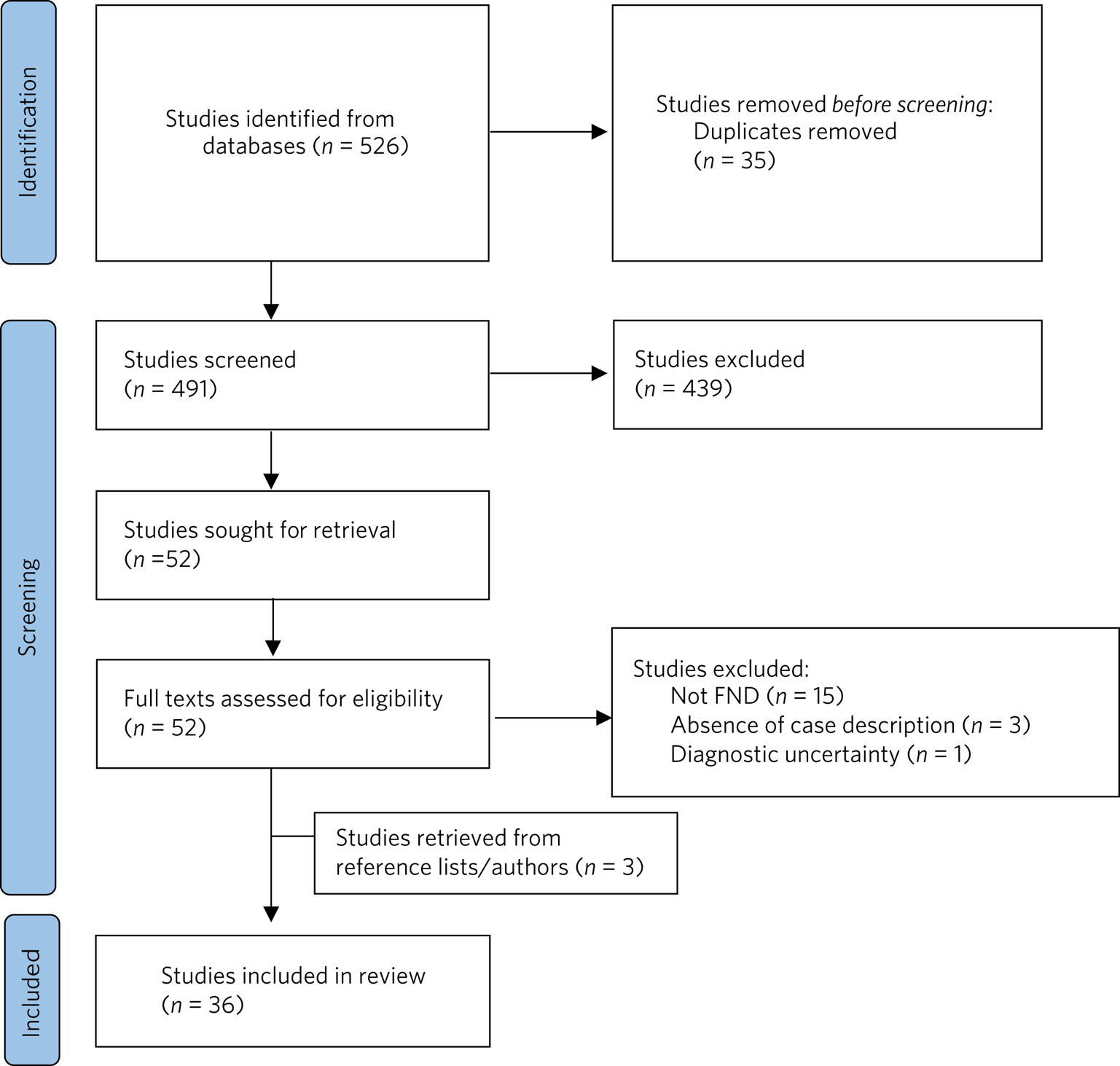
Figure 1 displays the process of study selection. Out of 526 search results, we assessed 52 full texts for eligibility. In total, 36 publications describing 43 patients (34 case reports and 2 case seriesReference DeToledo, Lowe and Puig18,Reference Lodge, Novak, Coebergh and Edwards19 ) were included in our review. No studies included a control group. Publication dates ranged from 1950 to 2022. The median age of reported patients was 29 years. Characteristics of individual studies are described in Supplementary Table 1, available at https://doi.org/10.1192/bjb.2024.70.
PRISMA flowchart: identification of studies via the MEDLINE, Embase and PsycINFO databases. FND, functional neurological disorder.

Perinatal functional neurological symptoms
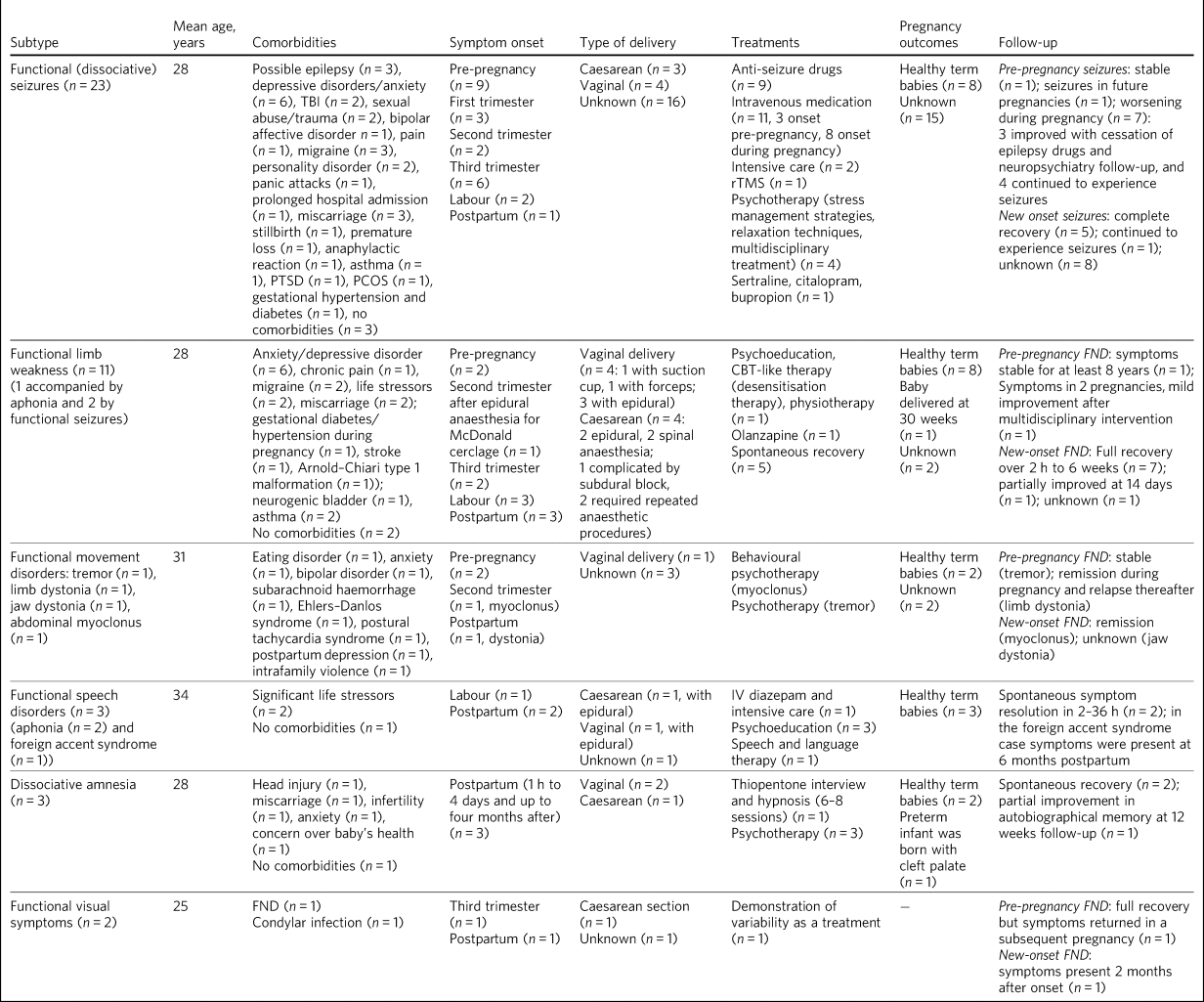
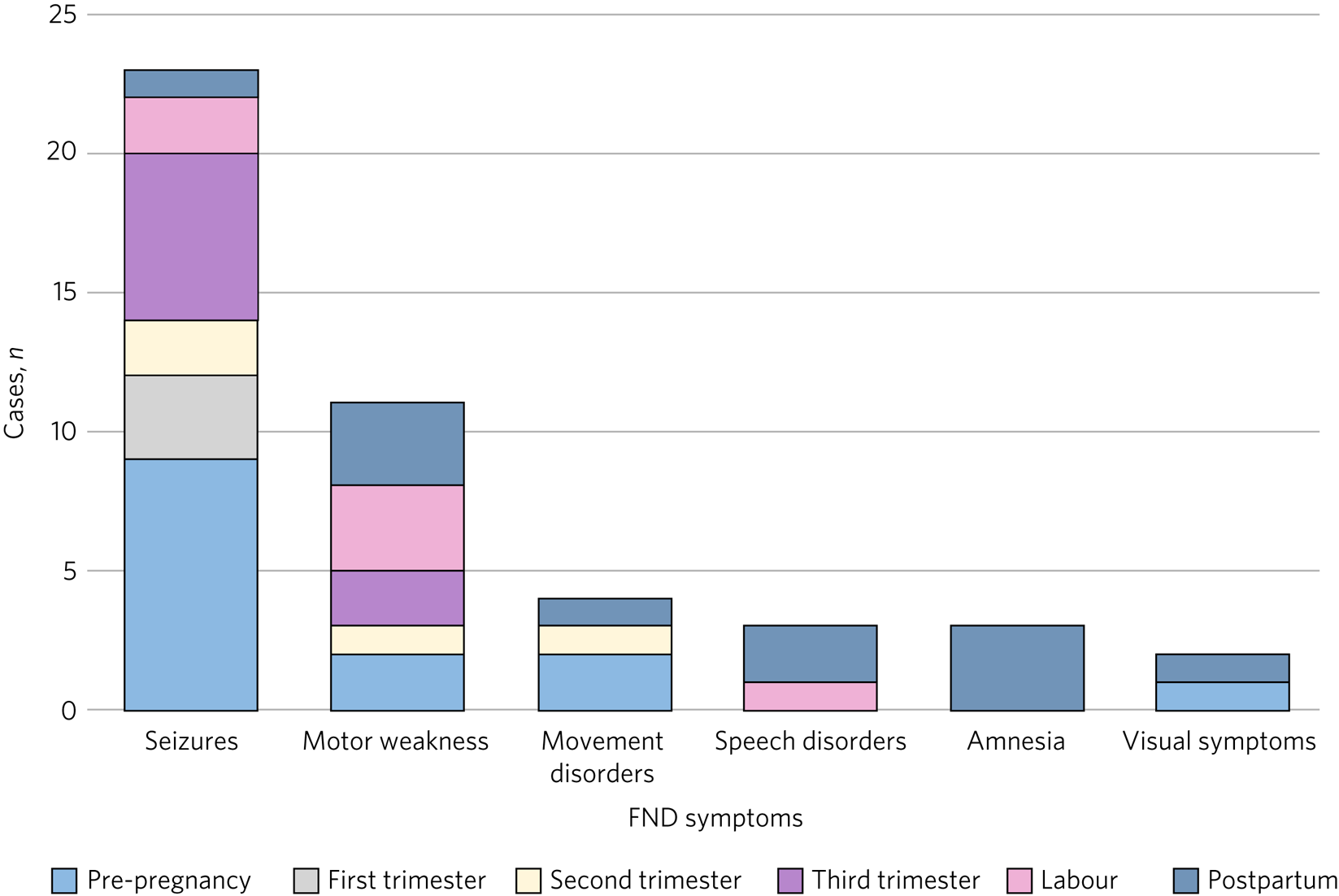
Included cases comprised six FND subtypes: functional seizures (n = 23),Reference DeToledo, Lowe and Puig18–Reference Heru A35 motor weakness (n = 11),Reference Lodge, Novak, Coebergh and Edwards19,Reference Samuel Kanniah, Subhas, Silim, Loo and Tharumalingam27,Reference Pryse-Phillips and Yorkston36–Reference Ehsan, Reza and Alireza44 movement disorders (n = 4),Reference Lodge, Novak, Coebergh and Edwards19,Reference García, Vargaz and Lopez45,Reference Yoon46 speech disorders (n = 3),Reference Ehsan, Reza and Alireza44,Reference Gupta and Luney47,Reference Ng, Lee and Mui48 dissociative amnesia (n = 3)Reference Tharoor, Dinesh, Chauhan, Mathew and Sharma49–Reference Załuska, Zurko, Kuroń, Jakiel and Dudel51 and visual symptoms (n = 2)Reference Manresa, Bonaventura, Martínez, Gómez and Aguilar52,Reference Muth53 (Table 1 and Fig. 2); two patients had mixed phenotypes: seizures and motor FND (n = 2) and motor FND with aphonia (n = 1). Twenty-three (64%) studiesReference Lodge, Novak, Coebergh and Edwards19,Reference Peters, Leach and Larner21–Reference Bensghir, Alaoui, Ahtil, Azendour, Mouhadi and Drissi Kamili29,Reference Devireddy and Sharma31,Reference van Genugten, Morssink and van der Kooi33,Reference Herr, Hatch, Sephien and Hanna34,Reference Pryse-Phillips and Yorkston36–Reference Smith and Farkas38,Reference Elsharkawy, Khanna and Barsoum41,Reference Nguyen, Abola and Schabel42,Reference Ehsan, Reza and Alireza44–Reference Gupta and Luney47,Reference Manresa, Bonaventura, Martínez, Gómez and Aguilar52 reported positive diagnostic features characteristic of FND, including improvement with distraction, long seizure episodes, variability of symptoms and signs, and suggestibility. Thirteen (36%) studies relied on the exclusion of secondary causes to diagnose FND. Four studies noted ‘la belle indifference’ (diminished concern about symptoms).Reference Samuel Kanniah, Subhas, Silim, Loo and Tharumalingam27,Reference Bensghir, Alaoui, Ahtil, Azendour, Mouhadi and Drissi Kamili29,Reference Sleth40,Reference Ng, Lee and Mui48
Functional neurological disorder (FND) presentations during the perinatal period

CBT, cognitive–behavioural therapy; IV, intravenous; PCOS, polycystic ovary syndrome; PTSD, post-traumatic stress disorder; rTMS, repetitive transcranial magnetic stimulation; TBI, traumatic brain injury.
Stacked bar graph showing the six functional neurological disorder (FND) subtypes reported during pregnancy, and respective timing of symptom onset (n = 46 cases, as three patients with motor symptoms had concomitant functional speech disorder and seizures).

Onset of FND symptoms
Thirteen (30%) patients had FND prior to conception.Reference DeToledo, Lowe and Puig18–Reference Peters, Leach and Larner21,Reference Smith, Saunders, Dawson and Kerr25,Reference Heru A35,Reference Pryse-Phillips and Yorkston36,Reference Muth53 In 14 (33%) reported cases, FND symptoms commenced during pregnancy (3 in the first trimester,Reference DeToledo, Lowe and Puig18,Reference Agarwal, Garg, Tikka, Khatri and Goel32,Reference van Genugten, Morssink and van der Kooi33 4 in the second trimesterReference DeToledo, Lowe and Puig18,Reference Caruso23,Reference Mack, Gurvitch and Gadalla37,Reference García, Vargaz and Lopez45 and 7 in the third trimesterReference Banerjee22,Reference Brady and Huff24,Reference Samuel Kanniah, Subhas, Silim, Loo and Tharumalingam27,Reference Carlson and Caplan28,Reference Jain, Jain, Tiruveedhula and Sharma30,Reference Devireddy and Sharma31,Reference Smith and Farkas38 ). Symptoms commenced during labour in 6 (14%) casesReference Collier26,Reference Bensghir, Alaoui, Ahtil, Azendour, Mouhadi and Drissi Kamili29,Reference Sleth40–Reference Nguyen, Abola and Schabel42,Reference Ng, Lee and Mui48 and postpartum in 10 (23%) cases (onset between 2 h and 4 months postpartum).Reference Herr, Hatch, Sephien and Hanna34,Reference Díaz Allegue, González Bardanca, Pato López, Abeledo Fernández and Rama Maceiras39,Reference Bryant, Wharton and Alexander43,Reference Ehsan, Reza and Alireza44,Reference Yoon46,Reference Gupta and Luney47,Reference Tharoor, Dinesh, Chauhan, Mathew and Sharma49–Reference Manresa, Bonaventura, Martínez, Gómez and Aguilar52
Comorbidities
In total, 33 studies provided information on premorbid comorbidities, of which 31 described specific conditions. In these, three (7%) patients had physical health problems during the current pregnancy: gestational diabetes (n = 2),Reference Herr, Hatch, Sephien and Hanna34,Reference Díaz Allegue, González Bardanca, Pato López, Abeledo Fernández and Rama Maceiras39 hypertension (n = 1)Reference Díaz Allegue, González Bardanca, Pato López, Abeledo Fernández and Rama Maceiras39 and urinary tract infection with prolonged hospital admission (n = 1).Reference Samuel Kanniah, Subhas, Silim, Loo and Tharumalingam27 Prior obstetric/gynaecological history included miscarriage (n = 4),Reference Lodge, Novak, Coebergh and Edwards19,Reference Jain, Jain, Tiruveedhula and Sharma30,Reference Díaz Allegue, González Bardanca, Pato López, Abeledo Fernández and Rama Maceiras39,Reference Załuska, Zurko, Kuroń, Jakiel and Dudel51 stillbirth (n = 1),Reference Peters, Leach and Larner21 neonatal loss after premature birth (n = 1), infertility (n = 1)Reference Załuska, Zurko, Kuroń, Jakiel and Dudel51 and dyspareunia due to endometriosis (n = 1).Reference Smith and Farkas38
Twenty-one (49%) patients had a neuropsychiatric or neurological history, including a history of depression, anxiety disorder, postpartum depression (n = 3),Reference Devireddy and Sharma31,Reference Elsharkawy, Khanna and Barsoum41,Reference Yoon46 migraine (n = 5),Reference Caruso23,Reference Jain, Jain, Tiruveedhula and Sharma30,Reference Heru A35,Reference Smith and Farkas38,Reference Nguyen, Abola and Schabel42 and traumatic brain injury (n = 3).Reference Banerjee22,Reference Carlson and Caplan28,Reference Załuska, Zurko, Kuroń, Jakiel and Dudel51 Nine patients had a history of physical health conditions (Supplementary Tables 1 and 2).Reference Lodge, Novak, Coebergh and Edwards19,Reference Smith, Saunders, Dawson and Kerr25–Reference Samuel Kanniah, Subhas, Silim, Loo and Tharumalingam27,Reference Devireddy and Sharma31,Reference Heru A35,Reference Pryse-Phillips and Yorkston36,Reference Nguyen, Abola and Schabel42,Reference Bryant, Wharton and Alexander43,Reference Manresa, Bonaventura, Martínez, Gómez and Aguilar52 Six patients (14%) had no known prior comorbidities.Reference Brady and Huff24,Reference van Genugten, Morssink and van der Kooi33,Reference Sleth40,Reference Ehsan, Reza and Alireza44,Reference Ng, Lee and Mui48,Reference Dogan50 Sixteen (37%) had a history of adverse life events, including abuse (n = 16).Reference Caruso23,Reference Smith, Saunders, Dawson and Kerr25,Reference Collier26,Reference Carlson and Caplan28,Reference Jain, Jain, Tiruveedhula and Sharma30–Reference Agarwal, Garg, Tikka, Khatri and Goel32,Reference Herr, Hatch, Sephien and Hanna34–Reference Díaz Allegue, González Bardanca, Pato López, Abeledo Fernández and Rama Maceiras39,Reference García, Vargaz and Lopez45,Reference Gupta and Luney47,Reference Tharoor, Dinesh, Chauhan, Mathew and Sharma49
Birth outcomes
Data on birth outcomes were available for 21 (51%) babies.Reference Lyman20,Reference Banerjee22,Reference Brady and Huff24,Reference Smith, Saunders, Dawson and Kerr25,Reference Bensghir, Alaoui, Ahtil, Azendour, Mouhadi and Drissi Kamili29,Reference Heru A35,Reference Mack, Gurvitch and Gadalla37–Reference Díaz Allegue, González Bardanca, Pato López, Abeledo Fernández and Rama Maceiras39,Reference Elsharkawy, Khanna and Barsoum41–Reference Ehsan, Reza and Alireza44,Reference Ng, Lee and Mui48–Reference Załuska, Zurko, Kuroń, Jakiel and Dudel51 Two required special care because of prematurity; and one case of cleft palate was reported.Reference Bryant, Wharton and Alexander43,Reference Załuska, Zurko, Kuroń, Jakiel and Dudel51
Type of delivery
Data regarding type of delivery were available for 19 (44%) women.
For those who underwent Caesarean section (n = 10), FND symptoms presented as follows: antenatally (n = 1), during labour (n = 6) and postpartum (n = 3).Reference Collier26,Reference Bensghir, Alaoui, Ahtil, Azendour, Mouhadi and Drissi Kamili29,Reference Herr, Hatch, Sephien and Hanna34,Reference Sleth40–Reference Bryant, Wharton and Alexander43,Reference Ng, Lee and Mui48,Reference Załuska, Zurko, Kuroń, Jakiel and Dudel51,Reference Muth53 Regarding vaginal births (n = 9), FND presented as follows: onset pre-pregnancy (n = 3,), onset during the first trimester (n = 1), second trimester (n = 1), third trimester (n = 1) and postpartum (n = 3) (two of the postpartum cases had involved instrumental delivery with forceps and suction cup).Reference Lodge, Novak, Coebergh and Edwards19,Reference Banerjee22,Reference Smith, Saunders, Dawson and Kerr25,Reference van Genugten, Morssink and van der Kooi33,Reference Mack, Gurvitch and Gadalla37,Reference Ehsan, Reza and Alireza44,Reference Dogan50
Course of FND symptomatology
Data regarding the course of FND symptomatology were available for 38 (88%) women.
In the 13 women whose symptoms commenced pre-pregnancy, symptom trajectory was variable. For ten of these women, symptoms worsened during pregnancy, and six experienced partial improvement postpartum.Reference DeToledo, Lowe and Puig18,Reference Lyman20,Reference Smith, Saunders, Dawson and Kerr25,Reference Heru A35 For two women, symptoms had started in previous pregnancies, never fully resolved and worsened in the context of the current pregnancy.Reference Peters, Leach and Larner21,Reference Pryse-Phillips and Yorkston36 Two women experienced symptoms during pregnancy but symptoms abated between pregnancies.Reference Lodge, Novak, Coebergh and Edwards19,Reference Muth53 In two cases, symptoms continued unchanged throughout pregnancy,Reference Lodge, Novak, Coebergh and Edwards19 and finally in one case symptoms improved during pregnancy, with a relapse thereafter.Reference Lodge, Novak, Coebergh and Edwards19
Of the 30 women with new-onset perinatal FND, follow-up data on symptoms were available for 23. Five of these had persistent symptoms at last known follow-up (seizures, foreign accent syndrome, dissociative amnesia, visual and motor symptoms), ranging from 14 days to 32 weeks of follow-up.Reference Herr, Hatch, Sephien and Hanna34,Reference Díaz Allegue, González Bardanca, Pato López, Abeledo Fernández and Rama Maceiras39,Reference Gupta and Luney47,Reference Tharoor, Dinesh, Chauhan, Mathew and Sharma49,Reference Manresa, Bonaventura, Martínez, Gómez and Aguilar52 Table 1 presents data grouped into the six FND subtypes.
Data for individual subtypes
Functional seizures
Eighteen studies reported perinatal functional seizures (n = 23, 53%). Semiology suggesting functional seizures (Box 2) was described in 13 cases.
Semiology of functional seizures in our review
Eyes closed or rolled back and/or fluttering of the eyelids and/or resistance to eye opening (n = 3)
Arching of the back (n = 1)
Pelvic thrusting (n = 1)
Side-to-side head movements (n = 2)
Asynchronous limb movements (n = 3)
Intermittent nature (wax and waning) (n = 3)
Unresponsiveness to commands or painful stimuli (n = 2)
Absence of post-ictal confusion (n = 5)
Panic attack (shortness of breath and chest pain) preceding the seizure onset
Recovery in 5 min and dissociation after the episode (n = 1)
Duration ranging between 2 min to several hours (n = 10)
Responsiveness, such as attempt to close eyes for pupil examination or blinking (n = 2)
Memory of the episode (n = 3)
Crying during the seizure (n = 1)
Nine women had pre-existing functional seizures (ranging from 18 months to 7 years pre-pregnancy).Reference DeToledo, Lowe and Puig18–Reference Peters, Leach and Larner21,Reference Smith, Saunders, Dawson and Kerr25,Reference Heru A35 Seven of these women experienced seizure worsening throughout pregnancy,Reference DeToledo, Lowe and Puig18,Reference Lyman20,Reference Peters, Leach and Larner21,Reference Smith, Saunders, Dawson and Kerr25,Reference Heru A35 at a frequency of approximately one per week. All but two women visited an emergency department because of seizures at least once during pregnancy. Six women were prescribed anti-seizure medication (one to two drugs) before pregnancy (in one of whom it was commenced as a mood stabiliser for bipolar disorder).Reference DeToledo, Lowe and Puig18,Reference Lyman20,Reference Smith, Saunders, Dawson and Kerr25,Reference Heru A35 In two of these cases the medication was stopped after FND was diagnosed.Reference Lyman20,Reference Smith, Saunders, Dawson and Kerr25 Three of the five women who were prescribed anti-seizure medication for seizure episodes declined to stop the medication because they feared worsening of symptoms and disagreed with the FND diagnosis, despite counselling and neurologist advice.Reference DeToledo, Lowe and Puig18 Attempts to discontinue medications were associated with increased functional seizures and emergency department attendances in two women, with subsequent reinstatement by the primary care physician rather than a neurologist. Three women received intravenous medication during hospital admission (magnesium, phenytoin, diazepam and thiopental), including one woman who was intubated and admitted to intensive care.Reference Peters, Leach and Larner21,Reference Smith, Saunders, Dawson and Kerr25
In the newly diagnosed patients, 14 women had perinatal onset of functional seizures: first trimester (n = 3),Reference DeToledo, Lowe and Puig18,Reference Agarwal, Garg, Tikka, Khatri and Goel32,Reference van Genugten, Morssink and van der Kooi33 second trimester (n = 2),Reference DeToledo, Lowe and Puig18,Reference Caruso23 third trimester (n = 6),Reference Banerjee22,Reference Brady and Huff24,Reference Samuel Kanniah, Subhas, Silim, Loo and Tharumalingam27,Reference Carlson and Caplan28,Reference Jain, Jain, Tiruveedhula and Sharma30,Reference Devireddy and Sharma31 immediately after labour (n = 2)Reference Collier26,Reference Bensghir, Alaoui, Ahtil, Azendour, Mouhadi and Drissi Kamili29 and postpartum period (n = 1).Reference Herr, Hatch, Sephien and Hanna34 Four of these women were also commenced on anti-seizure medications (two on polytherapy because of high seizure frequency during pregnancy – up to 40 episodes per day and five emergency department visits).Reference DeToledo, Lowe and Puig18,Reference Brady and Huff24,Reference Samuel Kanniah, Subhas, Silim, Loo and Tharumalingam27,Reference Jain, Jain, Tiruveedhula and Sharma30 Eight women with FND commencing in pregnancy received intravenous medication in hospitalReference DeToledo, Lowe and Puig18,Reference Banerjee22–Reference Brady and Huff24,Reference Collier26,Reference Jain, Jain, Tiruveedhula and Sharma30 and two (14%) were admitted to intensive care.Reference Brady and Huff24,Reference Jain, Jain, Tiruveedhula and Sharma30
Overall, regarding diagnosis, 18 of the 23 women with perinatal functional seizures were diagnosed using electroencephalography (EEG) and/or video telemetry during a seizure event. All the women for whom data were available (n = 8) delivered healthy babies at term (vaginal: n = 4; forceps: n = 1; Caesarean section: n = 3; unknown: n = 1).Reference Lodge, Novak, Coebergh and Edwards19,Reference Lyman20,Reference Banerjee22,Reference Brady and Huff24,Reference Smith, Saunders, Dawson and Kerr25,Reference Bensghir, Alaoui, Ahtil, Azendour, Mouhadi and Drissi Kamili29,Reference Heru A35 Regarding treatment, one case report described successful use of repetitive transcranial magnetic stimulation (rTMS) in the first trimester.Reference Agarwal, Garg, Tikka, Khatri and Goel32 Other attempted treatment strategies included medication and non-pharmacological strategies such as relaxation techniques and family therapy. Psychodynamic group therapy was described in four case reports,Reference Samuel Kanniah, Subhas, Silim, Loo and Tharumalingam27,Reference Devireddy and Sharma31,Reference van Genugten, Morssink and van der Kooi33,Reference Heru A35 of which one reported reduced seizure frequency.Reference Heru A35
Follow-up outcome data were available for 14 women, ranging from 2 days to 8 years. Of the nine women with pre-pregnancy functional seizures, three experienced fewer seizures with regular neuropsychiatric follow-up, two of whom were able to cease anti-seizure medication,Reference Lyman20,Reference Smith, Saunders, Dawson and Kerr25,Reference Heru A35 and four continued to experience frequent seizures at last known follow-up.Reference DeToledo, Lowe and Puig18,Reference Peters, Leach and Larner21 In those women with perinatal-onset functional seizures (n = 14), five recovered completely.Reference Banerjee22–Reference Brady and Huff24,Reference Bensghir, Alaoui, Ahtil, Azendour, Mouhadi and Drissi Kamili29,Reference Agarwal, Garg, Tikka, Khatri and Goel32
Functional motor (limb) weakness
Eleven case reports (26%) described women with functional motor symptoms, either paraparesis (n = 5), quadriparesis (n = 4) or lateralised limb weakness (n = 2).Reference Lodge, Novak, Coebergh and Edwards19,Reference Samuel Kanniah, Subhas, Silim, Loo and Tharumalingam27,Reference Pryse-Phillips and Yorkston36–Reference Ehsan, Reza and Alireza44 In three cases, functional motor symptoms were accompanied by speech disorder (aphonia) or functional seizures;Reference Lodge, Novak, Coebergh and Edwards19,Reference Samuel Kanniah, Subhas, Silim, Loo and Tharumalingam27,Reference Ehsan, Reza and Alireza44 these three are also discussed under those subtypes. In two women, symptoms commenced pre-pregnancy: one had a 7-year history of FND and somatic symptomsReference Lodge, Novak, Coebergh and Edwards19 and the other had previous perinatal FND on a background of a previous stroke.Reference Pryse-Phillips and Yorkston36 Perinatal-onset functional weakness was mainly reported during labour (n = 3) and postpartum (n = 3). Two cases occurred during the third trimester and one in the second trimester.
Of the 11 women with functional motor weakness, 7 (64%) developed symptoms following epidural (n = 5) or spinal (n = 2) anaesthesia (one complicated by subdural block) and 2 had experienced inadequate pain control.Reference Mack, Gurvitch and Gadalla37,Reference Díaz Allegue, González Bardanca, Pato López, Abeledo Fernández and Rama Maceiras39–Reference Ehsan, Reza and Alireza44 In six of these seven women, functional weakness occurred in the first 12 h post-anaesthesia (n = 6) and in the seventh it arose 7 days after three unsuccessful epidural procedures during labour.Reference Bryant, Wharton and Alexander43
Positive diagnostic signs included Hoover's and thigh abductor signs (n = 1)Reference Lodge, Novak, Coebergh and Edwards19 and variability (n = 2).Reference Elsharkawy, Khanna and Barsoum41,Reference Nguyen, Abola and Schabel42 Other accompanying signs were concurrent patchy sensory loss (n = 1)Reference Ng, Lee and Mui48 and fixed dystonia, pain and memory complaints (n = 1).Reference Pryse-Phillips and Yorkston36 Nine of the eleven patients had unremarkable investigations including: spinal magnetic resonance imaging (MRI) (n = 7), brain MRI (n = 1), computed tomography (CT) head scan (n = 1), as well as electromyography (n = 1), evoked potentials (n = 1) and lumbar puncture (n = 1). Two women were diagnosed based on neurological examination alone, which was deemed incongruent with the clinical presentation.Reference Mack, Gurvitch and Gadalla37,Reference Ehsan, Reza and Alireza44
Of the nine women for whom data on delivery were available, eight delivered their babies at term (Caesarean: n = 4; vaginal delivery: n = 4, one with forceps and one with suction cup; unknown: n = 1); one baby was delivered preterm via Caesarean section at 30 weeks’ gestation.Reference Bryant, Wharton and Alexander43 Of the two women with pre-pregnancy onset of functional weakness, symptoms remained stableReference Lodge, Novak, Coebergh and Edwards19 or improved after physiotherapy and cognitive–behavioural therapy – part of which involved the therapeutic technique of showing the woman photographs of her limbs relaxed under general anaesthesia.Reference Pryse-Phillips and Yorkston36 All other cases of functional weakness showed at least some recovery. Seven women recovered fully between 2 h and 6 weeks post-symptom onset, five without requiring physiotherapy or other specialised therapies.Reference Mack, Gurvitch and Gadalla37,Reference Smith and Farkas38,Reference Elsharkawy, Khanna and Barsoum41,Reference Nguyen, Abola and Schabel42,Reference Ehsan, Reza and Alireza44 One report described incomplete recovery at 14 days postpartum.Reference Díaz Allegue, González Bardanca, Pato López, Abeledo Fernández and Rama Maceiras39
Functional movement disorders
Three conference abstracts described functional movement disorders during pregnancy (n = 4). Two women had symptom onset pre-pregnancy, one of left-sided distractible tremor following a subarachnoid haemorrhage and the other of severe left-arm dystonia.Reference Lodge, Novak, Coebergh and Edwards19 Fatigue, pain, Ehlers–Danlos syndrome and postural tachycardia syndrome were comorbidities in these two cases.Reference Lodge, Novak, Coebergh and Edwards19 The woman with tremor remained stable during pregnancy, whereas the one with dystonia markedly improved during pregnancy but evolved to a fixed clenched-fist posture after a subsequent pregnancy.
Regarding the perinatal onset of functional movement disorders, one case described abdominal myoclonus, which occurred during the second trimester,Reference van Genugten, Morssink and van der Kooi33 and one case described jaw-opening dystonia and an irregular limb tremor, which occurred postpartum.Reference Nguyen, Abola and Schabel42 Both women presented with acute-onset symptoms that changed on distraction and attention, and both had a history of depressive disorder. The case of myoclonus was investigated with blood tests, somatosensory potentials, brain and cervical spinal MRI, electromyography of phrenic nerves and abdominal wall musculature; symptoms resolved after ‘behavioural psychotherapy’. No follow-up data were reported for the woman with jaw dystonia.
Data on delivery or birth outcomes were available only for the two women with symptom onset pre-pregnancy; both delivered healthy babies at term.
Functional speech disorders
Functional speech disorders were reported in three cases, one during labourReference Ng, Lee and Mui48 and two postpartum.Reference Ehsan, Reza and Alireza44,Reference Gupta and Luney47 Two women had received epidural anaesthesia (one during a vaginal delivery and one during Caesarean section); delivery was not described for the third woman. Presentations included aphonia (n = 2)Reference Ehsan, Reza and Alireza44,Reference Ng, Lee and Mui48 and foreign accent syndrome (n = 1).Reference Gupta and Luney47 Concerns about the baby's health immediately post-deliveryReference Ng, Lee and Mui48 and adverse life events, such as social isolation and domestic violence,Reference Gupta and Luney47 were identified as precipitating stressors in two cases. One woman with aphonia, without known comorbidities, received intravenous diazepam (indication unclear) and was transferred to intensive care.Reference Ng, Lee and Mui48 All women with functional speech disorders delivered healthy babies, had unremarkable neurological examinations (outside abnormal speech), brain MRI (n = 2), cardiovascular investigations (n = 1) and EEG (n = 1). The two cases of aphonia resolved within 36 h post-symptom onset, but the case of foreign accent syndrome persisted at 6-month follow-up, with intermittent visual and hearing impairment.Reference Gupta and Luney47
Dissociative amnesia
Dissociative amnesia was described in three women, all during the postpartum period, with onset ranging from 1 h to 4 days postpartum.Reference Tharoor, Dinesh, Chauhan, Mathew and Sharma49–Reference Załuska, Zurko, Kuroń, Jakiel and Dudel51 Adverse life events were reported in two cases (marital conflict and concerns over child's health, and previous miscarriage and infertility).Reference Tharoor, Dinesh, Chauhan, Mathew and Sharma49,Reference Załuska, Zurko, Kuroń, Jakiel and Dudel51 The second woman had delivered a premature baby with cleft palate.Reference Załuska, Zurko, Kuroń, Jakiel and Dudel51 Two women recovered spontaneously pre-discharge.Reference Dogan50,Reference Załuska, Zurko, Kuroń, Jakiel and Dudel51 The third showed only partial improvement in memory following a therapeutic interview with thiopentone and hypnosis.Reference Tharoor, Dinesh, Chauhan, Mathew and Sharma49
Functional visual symptoms
Functional visual symptoms were reported for two women, one of whom with onset pre-pregnancyReference Muth53 and a second postpartum.Reference Manresa, Bonaventura, Martínez, Gómez and Aguilar52 The first woman, who developed sudden blindness during the third trimester that persisted for several days following Caesarean section, had a history of functional weakness and speech and swallowing difficulties. Symptoms recurred in a subsequent pregnancy.Reference Muth53 The second woman presented with gradual visual loss leading to variable blindness during treatment for a mandibular bone infection.Reference Manresa, Bonaventura, Martínez, Gómez and Aguilar52 No ophthalmological, CT head scan (n = 1) and MRI (n = 1), blood (n = 1) and cerebrospinal fluid (CSF) (n = 2) abnormalities were reported in either woman. In the second case, P100 waves (showing integrity of visual pathways) were absent in both eyes on evoked potentials but reverted to normal with patient positioning and positive reinforcement, demonstrating distractibility.Reference Manresa, Bonaventura, Martínez, Gómez and Aguilar52 Both women had uncomplicated deliveries but incomplete recoveries.
Discussion
This review summarises the current literature on characteristics and course of perinatal FND. Although FND is a common neurological disorder in women of childbearing age, we found only 43 descriptions of perinatal FND, all of which were case reports and case series. Despite the limited literature, some potentially noteworthy observations emerge.
Presentation: onset and premorbid conditions
Reported presentations of perinatal FND varied widely, with functional seizures the most frequently reported FND subtype.
Around one-third of reported cases were of FND with onset preceding pregnancy. In this group, a subset of women experienced transient worsening of functional symptoms, often with resolution postpartum, and some women experienced FND (motor, visual and seizures) almost exclusively during pregnancy.Reference Lodge, Novak, Coebergh and Edwards19,Reference Pryse-Phillips and Yorkston36,Reference Muth53
The second group, the largest represented in this review, comprised women with perinatal-onset FND. Notably, the third trimester, labour and postpartum were the most common periods for symptom onset in this group. Although this review does not shed light on why this is case, precipitating factors for FND identified in the literature, including pain, are likely relevant.Reference Pareés, Maja, Pires, Rubio-Agusti, Saifee and Sadnicka10,Reference Stone, Warlow, Deary and Sharpe11 Moreover, despite evidence not being available for FND populations, studies have linked perceived lack of autonomy or dissatisfaction with care during labour, sleep deprivation, fatigue, hormonal and weight changes, and adjustment to new parenthood in the postpartum period, with peri-labour dissociative experiences (including altered time perceptions and derealisation).Reference Choi and Seng13,Reference Zambaldi, Cantilino, Farias, Moraes and Sougey54,Reference Brockington55 These acute stress disorders and dissociative symptoms are more frequent in the cases of premature birth, prolonged, painful or complicated delivery, following emergency Caesarean section, where there is illness in the mother or the child, and with high levels of negative emotions during the pregnancy, including following perinatal loss.Reference Stadlmayr, Bitzer, Amsler, Simoni, Alder and Surbek56–Reference Armstrong, Hutti and Myers58
Premorbid psychiatric and neurological conditions, and a history of adverse events, were present in nearly half of the cases of perinatal FND reported in this review. This is consistent with literature supporting adverse events as a risk factor for FND,Reference Ludwig, Pasman, Nicholson, Aybek, David and Tuck4–Reference Baker, Ben-Tovim, Butcher, Esterman and McLaughlin6 and an association between FND and mental health comorbidities.Reference Carle-Toulemonde, Goutte, Do-Quang-Cantagrel, Mouchabac, Joly and Garcin9 Of note, late pregnancy and the early postnatal period are also recognisable periods of recurrence of pre-existing psychiatric disorders, such as anxiety, psychosis and mood disorders,Reference Howard and Khalifeh12,Reference Paschetta, Berrisford, Coccia, Whitmore, Wood and Pretlove59 as well as an increased risk of disorders in individuals who hitherto have not suffered from mental illness, potentially representing a higher risk period for FND. Whether other modifiable factors, such as anticipatory fear about the delivery, also play a role in perinatal FND remains unclear.
Misdiagnosis and anti-seizure medication
Misdiagnosis of perinatal FND during pregnancy can be dangerous. Anti-seizure medications in women with functional seizures diagnosed incorrectly as epileptic seizures are potentially teratogenic,Reference Schechter, Kaminer, Grienenberger and Amat60 and women can be needlessly exposed to other risks, such as intravenous medications and admissions to intensive care units.Reference Dworetzky, Weisholtz, Perez and Baslet61 More than half of the reported cases of perinatal functional seizures received intravenous medication. The frequently acute and dramatic clinical presentations of pseudostatus epilepticus often pose diagnostic difficulties and likely account for these results. Stopping anti-seizure medications after initiation proved challenging in some,Reference Tomson, Battino and Perucca62 and women expressed the wish to terminate the pregnancy due to anxiety about teratogenicity.Reference McAuley, Patankar, Lang and Prasad63 It is important to proactively review anti-seizure medication prescribed to women without epilepsy or bipolar affective disorder, especially where teratogenic risks are known. Moreover, continuing anti-seizure medication at the expense of other treatments deprives women of potentially helpful treatments targeting functional seizures. Notably, cases where improvement was observed included those who had regular neuropsychiatric follow-up, psychotherapy and/or cessation of anti-seizure medication after diagnostic revision. The optimal management of pseudostatus epilepticus during the perinatal period requires close collaboration between the patient and family, perinatal teams, emergency care clinicians, neurologists and psychiatrists, and efforts to increase diagnostic awareness of FND. This also potentially reduces chances of prematurity from needlessly early delivery. Only 2 out of 21 cases reporting birth outcomes mentioned complications.Reference Bryant, Wharton and Alexander43,Reference Załuska, Zurko, Kuroń, Jakiel and Dudel51 This is consistent with data from an abstract that did not find differences in prenatal, labour or neonatal outcomes, namely increase in neonatal deaths or congenital malformations, between 10 women with epilepsy, 9 with functional seizures and 25 healthy controls (no individual data regarding these women were provided).Reference Fertig, Alexandra, Moreno, Smith and Baraban64
Physical precipitants of functional motor symptoms
Functional motor symptoms almost exclusively occurred during the third trimester, labour and postpartum period, and often followed spinal and epidural anaesthesia. We hypothesise that physical precipitants of functional motor symptoms, such as altered sensory feedback from anaesthesia, could have produced a mismatch between expectations and sensory input.Reference Edwards, Adams, Brown, Pareés and Friston65 This would be consistent with evidence that medical and surgical interventions are risk factors for functional movement disorders,Reference Mason, Renée, Marples, McWhirter, Carson and Stone8,Reference Pareés, Maja, Pires, Rubio-Agusti, Saifee and Sadnicka10,Reference Stone, Warlow, Deary and Sharpe11 which may be in keeping with a slightly higher rate of Caesarean compared with vaginal deliveries in these FND cases. In addition, we can hypothesise that clinicians may have been more likely to recommend elective Caesarean for women experiencing FND symptoms such as severe bilateral leg weakness, or this may have been urgently recommended because of ongoing symptoms such as dissociative events, fatigue or new-onset weakness. We found fewer case reports of functional motor symptoms than functional seizures, even though in practice the frequency appears to be similar. This may just reflect the epidemiology of these subtypes, with functional seizures having a peak onset in the late teens/early 20s, whereas functional motor symptoms have a peak onset in the late 30s.Reference Lidstone, Costa-Parke, Robinson, Ercoli and Stone3
Non-pharmacological interventions
Psychological and physiotherapy interventions, a mainstay of FND treatment, were used in six reported cases, with improved outcomes in four.Reference Devireddy and Sharma31,Reference Herr, Hatch, Sephien and Hanna34–Reference Pryse-Phillips and Yorkston36,Reference García, Vargaz and Lopez45,Reference Dogan50 They remain largely unexplored in this group despite evidence for FND in general.Reference Gutkin, McLean, Brown and Kanaan66,Reference Nielsen, Buszewicz, Stevenson, Hunter, Holt and Dudziec67
Limitations
Our findings have significant limitations. The existing literature is partially populated by conference abstracts, and data were mostly drawn from case reports where reporting and selection bias are likely to be high. It is likely, for example, that authors would be drawn to report new cases of FND during pregnancy, whereas cases of women with prenatal FND whose symptoms had improved or stayed stable are likely to be underrepresented. Variable follow-up data and lack of information on symptom trajectory across the case reports means that long-term outcomes are difficult to determine. Misdiagnosis is a possibility since 20 of the 36 studies were published before 2013, when the new DSM-5 classification of FND defying the traditional mind–body dualistic way of thinking and approach was published. So, some of the diagnostic methods in these studies do not align with current standards for both diagnosis and treatment and current Bayesian understanding of brain–body networks.Reference Aybek and Perez68 Equally, four cases described signs such as ‘la belle indifference’, which have already proved not to be discriminative.Reference Stone, Smyth, Carson, Warlow and Sharpe69 The presence of a normal EEG during episodes of functional seizures counterbalances this concern for at least some reports.
Clinical and research implications
These cases demonstrate the strikingly limited literature on perinatal FND, which does not allow us to answer many of the important questions regarding FND and the perinatal period.
However, this review provides a tentative starting point for well-designed cohort studies. Until then, the management of perinatal FND should follow the standard of care of other FNDs, with the necessary adaptions for the patients’ state. Early diagnosis, communication and multidisciplinary treatment of FND are vital.Reference Hallett, Aybek, Dworetzky, McWhirter, Staab and Stone2 Involvement of families and destigmatisation about the condition are key to progress in this area. Choices of delivery and anaesthetic methods are to be taken by obstetric teams together with the patient, on an individual basis, but currently there are no known contraindications for vaginal or Caesarean delivery.
Future studies should explore the role of perceptions of pregnancy and motherhood in relation to FND symptom onset and trajectory. A greater understanding of the relationship between common psychiatric comorbidities during the postnatal period, including dissociation, postpartum depression, PTSDReference Paschetta, Berrisford, Coccia, Whitmore, Wood and Pretlove59 and FND, would benefit the development of joint care pathways and preventive strategies. For women with previous miscarriage or stillbirth, support after perinatal loss may help reduce vulnerability.Reference Spinelli70 In women with pre-existing FND, more research into the course of symptoms throughout the perinatal period is needed. Particularly, it remains unknown which women are at higher risk of complications of their FND or immediate relapse postpartum, as well as those at risk of new onset of perinatal FND. Our personal experience is that many women with pre-existing FND find that their neurological symptoms improve during pregnancy, especially during the second trimester. The role of fatigue in labour protraction or arrest in patients with FND also remains to be explored, as well as considerations of previous obstetric adversities (including infertility and assistive reproductive technology) as potential risk factors for perinatal-onset FND.
Lastly, in women with FND the desire to raise their own family is often undermined by concerns about physical and emotional repercussions for the mother and the hypothetical interference of FND symptoms in the ability to take care of the newborn. Women also express other worries, such as fear of passing on FND to future generations and concerns over iatrogenic risks of certain pharmacological therapies and the need to interrupt certain treatments. It is likely that FND itself might affect sexual function and libido for some women, which can affect conception. These concerns warrant investigation in forthcoming prospective studies. Collaborative efforts among neurological, psychiatric and perinatal care teams will be key to produce guidance that supports women with FND in their pregnancy and delivery planning.
About the authors
Verónica Cabreira is a clinical research fellow and neurology senior SpR in the Centre for Clinical Brain Sciences, University of Edinburgh, Edinburgh, UK. Caoimhe McLoughlin is a clinical research fellow and consultant liaison psychiatrist in the Centre for Clinical Brain Sciences, University of Edinburgh, Edinburgh, UK. Natasha Shivji is a consultant perinatal psychiatrist at Central and North West London NHS Foundation Trust, London, UK. Alexandra Lodge is a medical student at St George's Hospitals and University, London, UK. Sanne Van Rhijn is a consultant perinatal psychiatrist and neuropsychiatrist with the Perinatal Mental Health Service, West London NHS Trust, London, UK and the Department of Brain Sciences, Imperial College, London, UK. Roxanne C. Keynejad is NIHR clinical lecturer and ST6 trainee in general adult psychiatry in the Department of Health Service and Population Research, King's College London, London, UK. Jan Coebergh is a consultant neurologist at St George's Hospitals and University, London, UK. Alan Carson is a consultant neuropsychiatrist in the Centre for Clinical Brain Sciences, University of Edinburgh, Edinburgh, UK. Jon Stone is a consultant neurologist in the Centre for Clinical Brain Sciences, University of Edinburgh, Edinburgh, UK. Alex Lehn is a consultant neurologist at Princess Alexandra Hospital, Brisbane, Queensland, Australia. Ingrid Hoeritzauer is a consultant neurologist in the Centre for Clinical Brain Sciences, University of Edinburgh, Edinburgh, UK.
Supplementary material
Supplementary material is available online at https://doi.org/10.1192/bjb.2024.70.
Data availability
The data that support the findings of this study are available on request from the corresponding author.
Author contributions
V.C.: conceptualisation, methodology, main analysis, data curation, initial manuscript draft; C.M.: conceptualisation, methodology, manuscript draft edit and review; N.S.: data curation, manuscript draft edit and review; A. Lodge: data curation; S.V.R.: conceptualisation, manuscript draft edit and review; R.C.K.: manuscript draft edit and review; J.C.: manuscript draft edit and review, methodology; A.C.: manuscript draft edit and review; J.S.: conceptualisation, manuscript draft edit and review; A. Lehn: manuscript draft edit and review; I.H.: conceptualisation, supervision, manuscript draft edit and review.
Funding
V.C. and C.M. have received funding from the European Union's Horizon 2020 research and innovation programme under the Marie Skłodowska-Curie grant agreement no. 956673. This article reflects only the authors’ views; the European Commission is not responsible for any use that may be made of the information it contains.
Declaration of interest
J.S. reports personal fees from UptoDate, outside the submitted work, runs a self-help website for patients with functional neurological symptoms (www.neurosymptoms.org), which is free and has no advertising, provides independent medical testimony in personal injury and negligence cases regarding patients with functional disorders and is secretary of the International Functional Neurological Disorder Society. He is a Chief Scientist Office NHS Research Scotland Career Researcher. A.C. is a director of a limited personal services company that provides independent medical testimony in court cases on a range of neuropsychiatric topics on a 50 per cent pursuer–50 per cent defender basis, a paid associate editor of the Journal of Neurology, Neurosurgery and Psychiatry and unpaid president elect of the International Functional Neurological Disorder Society. I.H. reports fees from expert witness work.


 Open access


eLetters
No eLetters have been published for this article.