


Introduction
Bisphenol A (BPA)—a common chemical used in polycarbonate plastics and epoxy resins frequently used to store food and water (e.g., water bottles, dental sealants, canned foods, bottle caps)—is a known endocrine disruptor. BPA exposure has been associated with impaired reproductive health outcomes including immune dysfunction (Clayton et al., Reference Clayton, Todd, Dowd and Aiello2011), fertilization implantation failure (Ehrlich et al., Reference Ehrlich, Williams, Missmer, Flaws, Berry, Calafat, Ye, Petrozza, Wright and Hauser2012), male sexual dysfunction, and altered hormone levels and reduced sperm quality in males (Meeker et al., Reference Meeker, Yang, Ye, Calafat and Hauser2011). Other health outcomes such as hormone-associated cancers (H. Gao et al., Reference Gao, Yang, Li, Feng, Shi, Zhao and Liu2015), cardiovascular diseases (X. Gao & Wang, Reference Gao and Wang2014), diabetes (Sun et al., Reference Sun, Cornelis, Townsend, Tobias, Eliassen, Franke, Hauser and Hu2014), and asthma (Kim et al., Reference Kim, Kim, Kwon, Hong, Kim, Lee, Hong and Bae2014) have also been associated with BPA, but are less established.
A small but innovative crossover study at Harvard University randomly assigned participants to eat fresh soup for lunch daily for five consecutive days and canned soup for five consecutive days (order of soup was blinded) (Carwile et al., Reference Carwile, Ye, Zhou, Calafat and Michels2011). Urinary BPA concentration were over 1,000% higher during the canned soup ingestion week compared to the same individual’s fresh soup consumption week, demonstrating the impact of transient BPA exposures to commercially available foods on concentrations measured in human subjects (Carwile et al., Reference Carwile, Ye, Zhou, Calafat and Michels2011).
Objective
It is well established that canned goods are a common source of BPA. However, it is not understood if some BPA contamination can be washed away by rinsing the food prior to ingestion. We performed a single-blinded crossover experiment to determine whether BPA exposure, as measured by urinary concentrations, could be decreased by rinsing canned beans prior to consumption. Because of the quick metabolism of BPA (half-life ~6 hours), it is reasonable to expect daily variation in measures of exposure and therefore collect samples over multiple days at multiple times of the day (Volkel et al., Reference Volkel, Colnot, Csanady, Filser and Dekant2002).
Methods
Healthy male and female adult volunteers were recruited from among faculty, staff, and students affiliated with The University of Utah Department of Family and Preventive Medicine for this pilot-scale study; participants had no known health issues that would affect BPA consumption or metabolism. Volunteers agreed to consume portions of hummus two times a week for three weeks and to provide urine samples in the morning and afternoon on each of 6 experimental days during the 3-week duration of the study. Hummus was prepared by the same local restaurant for each experimental condition: prepared from dry beans, canned beans that were drained but not rinsed, and canned beans that were drained and rinsed three times for one minute each. Each participant was given one, two-ounce sample of hummus on two consecutive days in a week followed by a washout period of 4–6 days (Figure 1). This was done for all three hummus types.
Study protocol for crossover hummus consumption.

Total BPA was measured in the urine samples using ultra-high-performance liquid chromatography–tandem mass spectrometry (Anderson et al., Reference Anderson, Brozek, Cox, Porucznik and Wilkins2014). In statistical analysis, clustered generalized estimating equations (GEE) with gamma distribution and log link were used to account for three types of hummus with both pre- and post-exposure BPA measurements and multiple measurements per person. The GEE models included indicators for time (pre- or post-hummus), hummus type, and an interaction term between these variables. All models were adjusted for age and sex.
Results
A total of 14 participants were enrolled, including 10 females and 4 males with a mean age of 28.9. +/− 6.3 years (Table 1).
Demographics of study population.

There were 161 samples collected of the 168 expected (95.8% compliance). Table 2 shows BPA concentrations by age and sex.
Geometric mean BPA concentrations (ng/mL) by demographic characteristics.

LLOQ = lower limit of quantitation (0.75 ng/ml) GM = geometric mean, BPA = Bisphenol A.
Figure 2 shows the BPA GM for pre- and post-hummus samples by hummus type. There were no significant differences in the BPA GM pre-hummus. The BPA GM post-hummus with dried beans (GM = 0.97 ng/ml, 95% CI = 0.74, 1.26) was significantly lower than the post-hummus measurements for the rinsed canned beans (GM = 1.89 ng/ml, 95% CI = 1.37, 2.59) and the unrinsed canned beans (GM = 2.46 ng/ml, 95% CI = 1.44, 4.19).
Geometric mean BPA pre- and post-consumption of each hummus type.
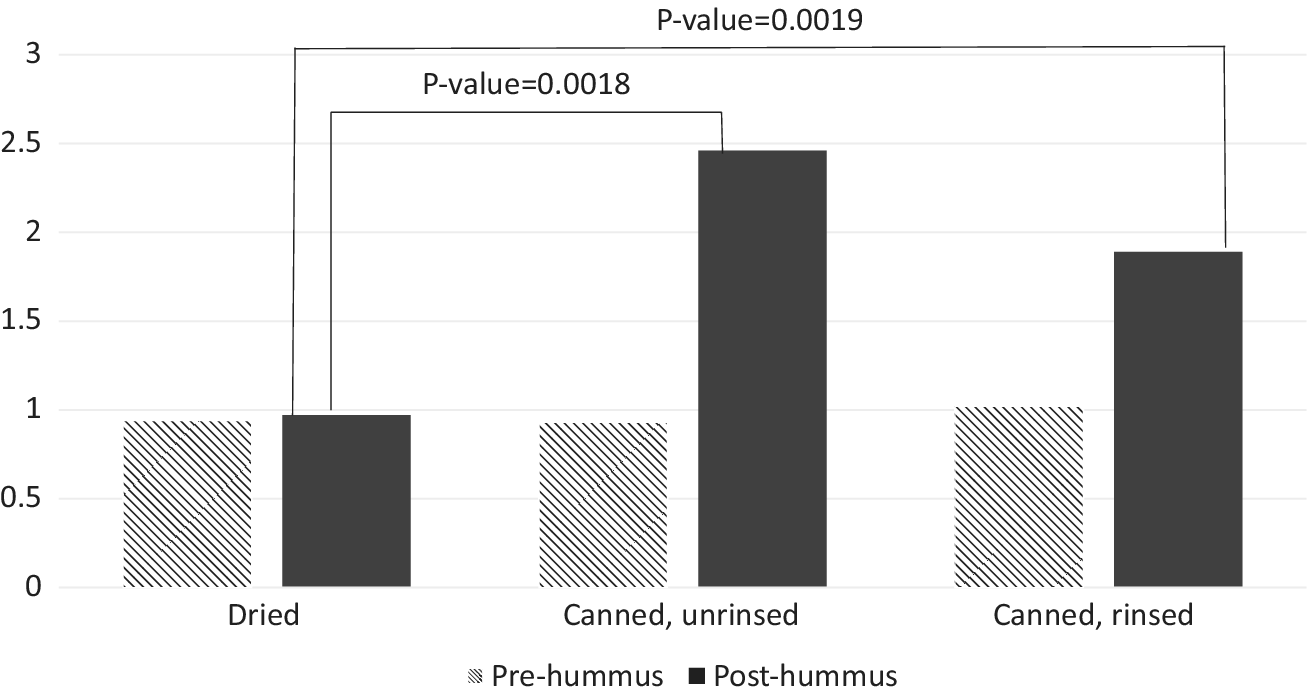
As shown in Table 3, both types of canned beans, had significantly increased BPA from the pre- to post-hummus conditions. We did not see a significant increase from pre- to post-hummus with the dried beans (β = 0.04 ng/ml, p-value = 0.8628). Correspondingly, the DD estimates showed a 1.4 ng/ml increase in BPA from pre- to post-hummus between unrinsed canned beans and rinsed canned beans (p-value = 0.0400).
Model estimates from pre- vs post-hummus eating and difference-in-difference results.

DD = difference-in-difference.
* Adjusted for age and sex.
Discussion
Our results matched the hypothesis of a dose–response increase in BPA from dry beans to rinsed canned beans to unrinsed canned beans and highlights rinsing as one potential way for individuals to reduce BPA exposure. As BPA has been associated with many adverse reproductive effects (Clayton et al., Reference Clayton, Todd, Dowd and Aiello2011; Ehrlich et al., Reference Ehrlich, Williams, Missmer, Flaws, Berry, Calafat, Ye, Petrozza, Wright and Hauser2012; Tomza-Marciniak et al., Reference Tomza-Marciniak, Stepkowska, Kuba and Pilarczyk2018), consumers seek to minimize exposure especially during childhood and reproductive years. While rinsing the beans did not remove all BPA exposure, in adjusted models the estimate from pre- to post-hummus was nearly three (2.88) times lower in the rinsed canned beans compared to the canned beans that were drained but not rinsed.
Conclusions
It has been well established that consumption of canned foods is associated with increased urinary BPA concentrations (Carwile et al., Reference Carwile, Ye, Zhou, Calafat and Michels2011; Hartle et al., Reference Hartle, Navas-Acien and Lawrence2016). Further, canned fruits and vegetables (which includes beans) have been reported to be among the canned foods with the highest BPA concentrations along with soups and pasta (Hartle et al., Reference Hartle, Navas-Acien and Lawrence2016). While it may not be possible to rinse all canned foods, this method has been shown to be effective in our pilot study. This is a cost-effective method that consumers can easily use to reduce BPA exposure. Future studies are needed to examine this with a larger sample size and across other canned foods.
Abbreviations
- BPA
-
Bisphenol A
- GM
-
Geometric mean
- CI
-
Confidence interval
- LLOQ
-
Lower limit of quantitation
- GEE
-
Clustered generalized estimating equations
- DD
-
Difference-in-difference
Authors’ contributions
CP: conceived the study idea, obtained funding, assembled the team, and oversaw all aspects of implementation, analysis, and writing. BB: performed statistical analysis and wrote the first draft of the manuscript. YZ: provided statistical consultation. KC: participated in study design, led the implementation, participated in analysis and writing. DA: performed laboratory analyses. DW: oversaw laboratory analysis, quality control and interpretation of laboratory results. All authors approved the manuscript.
Ethics approval and consent to participate
Ethical oversight was provided by The University of Utah Institutional Review Board (IRB#00080867). Informed consent was obtained by all participants prior to study participation.
Competing interests
The authors declare they have no competing interests
Funding
This project was funded by the Health Studies Fund of the Department of Family and Preventive Medicine at the University of Utah School of Medicine.
Data Availability
Contact the corresponding author for data access.


 Open access


Comments
Comments to the Author: This is an interesting and well-written manuscript. There are several comments: The selection criteria of subjects should be mentioned, such as age, non-smoker, non-pregnant and no renal diseases seem to be included. The authors should present the QA/QC data related precision and accuracy to ensure the quality of their measurement. Some studies have suggested to include urinary creatinine-adjusted levels or creatinine as a covariate to avoid overestimation of results. Another suggestion is that, how to prevent the study subjects from exposure to other sources of BPA, such as canned food intake three experimental periods. In the lines 108-9, the authors mentioned that “DD estimate from pre- to post-hummus was four times lower in the rinsed canned beans compared to the canned beans that were drained but not rinsed”. The authors did not describe how to calculate the estimation of “four times”, and please check the correctness.