


Introduction
Wallacea comprises the area of eastern Indonesia and Timor-Leste that lies between the Sunda and Sahul plates. We focus on Indonesian provinces in Sulawesi, Nusa Tenggara, North Maluku and Maluku. Wallacea’s global biological significance was first highlighted by the work of Alfred Wallace. Today, the area is still rich in biodiversity but growing human populations drive escalating pressures on natural resources. A designated global biodiversity hotspot, Wallacea has many endemic species, and supports over half of Indonesia’s threatened species despite covering only a fifth of the country’s land area (Monk & De Fretes, Reference Monk and De Fretes2012; Burung Indonesia, Reference Indonesia2014; Voigt et al., Reference Voigt, Supriatna, Deere, Kastanya, Mitchell and Rosa2021).
Wallacea’s people are amongst the least prosperous in Indonesia; many score poorly on the metrics of the United Nations Sustainable Development Goals (Badan Pusat Statistik, 2025). Many inhabit remote locations, often lack regular income and have limited access to health care and education. Economies are dominated by agriculture and resource extraction. The distance from major population and economic centres results in limited employment opportunities and poor public services. The populations rely heavily on natural resources for their livelihoods (Burung Indonesia, Reference Indonesia2014). It is a challenge to achieve greater prosperity and resilience to shocks, preserve assets and ensure future opportunities without degrading nature (UNDP, 2017). Conservation initiatives dependent on expanding protected areas conflict with local aspirations to expand production and improve livelihoods. We define livelihoods as the capabilities, assets, and activities people need to improve their basic means of living (DFID, 1999; Ellis, Reference Ellis2000; UNDP, 2017). Traditional adat governance systems have historically regulated land and resource use and conserved species and habitats under local community control. In much of Wallacea and other parts of Indonesia, the term adat is used for traditional Indigenous governance. In Maluku, there is a convention to use the term negeri for this traditional governance. Here, we use the term adat for all traditional governance and soa for clan-based institutions that provide governance at local level. Adat rules are losing effectiveness as in-migration, infrastructure development and land-based investments reshape the landscape.
We examine how six landscapes in Wallacea are navigating the tension between biodiversity conservation and improving local livelihoods. We synthesize insights from previous and ongoing research and argue that collaborative governance based on adat systems could reconcile conservation and development. We focus on local livelihoods but recognize the importance of addressing the broad range of instrumental, cultural and relational values that contribute to the wellbeing of Indigenous people and local communities (Pascual et al., Reference Pascual, Balvanera, Díaz, Pataki, Roth and Stenseke2017).
Methods
We studied six landscapes (Fig. 1) identified by international conservation organizations and the Indonesian government as conservation priorities. These landscapes are the object of interventions by conservation NGOs. We used participatory and transdisciplinary methods to engage with people and attempt to identify development scenarios that would reconcile global biodiversity values with local development needs (Boedhihartono, Reference Boedhihartono2012; Tanah Air Beta, 2019; Langston et al., Reference Langston, Riggs, Boedhihartono, Kastanya and Sayer2020; Margules et al., Reference Margules, Boedhihartono, Langston, Riggs, Sari and Sarkar2020). A landscape approach (Sayer et al., Reference Sayer, Sunderland, Ghazoul, Pfund, Sheil and Meijaard2013) provided the analytical framework for all the studies. Detailed methodologies and site-specific results are described in reports on the original studies by Tanah Air Beta (2019).
Locations of the six landscapes (Pulau Boano, Masihulan–Sawai, Labanu Forest, Hutan Lindung Kebon Kopi, Popayato Paguat and Mbeliling) in Wallacea, Indonesia, where we investigated the tension between biodiversity conservation and improving local livelihoods.

Participatory landscape analysis and scenario development
Community engagement was central to our approach, emphasizing the importance of involving local people from the beginning in co-generating conservation pathways. In each area, we engaged with representatives of the local administration, particularly the local planning boards (Badan Perencanaan Pembangunan Daerah). Numerous meetings were held with village leaders, farmers and fishing communities to collect data on their production activities. We developed landscape scenarios, analysed threats and opportunities, studied historical changes, and used mind maps to understand community perspectives on landscape transitions. Rather than prescribing conservation measures, we used an inductive approach: posing the problem of reconciling nature conservation with achieving livelihood improvements and then encouraging people to propose locally appropriate solutions. We worked with the provincial forest conservation department (Balai Konservasi Sumber Daya Alam) and gave special attention to Pulau Boano and the Masihulan–Sawai landscape in North Seram because of their extremely high biodiversity values and imminent threats. We met with representatives of government, universities, civil society and local stakeholders to seek their views on conservation options.
Sustainable livelihood development
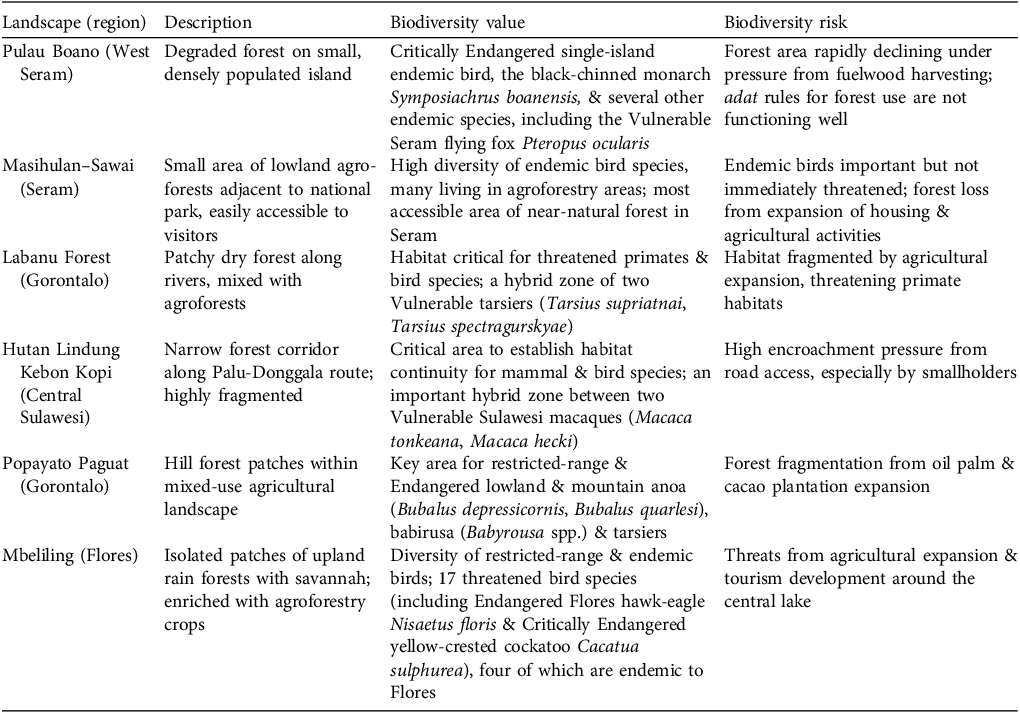
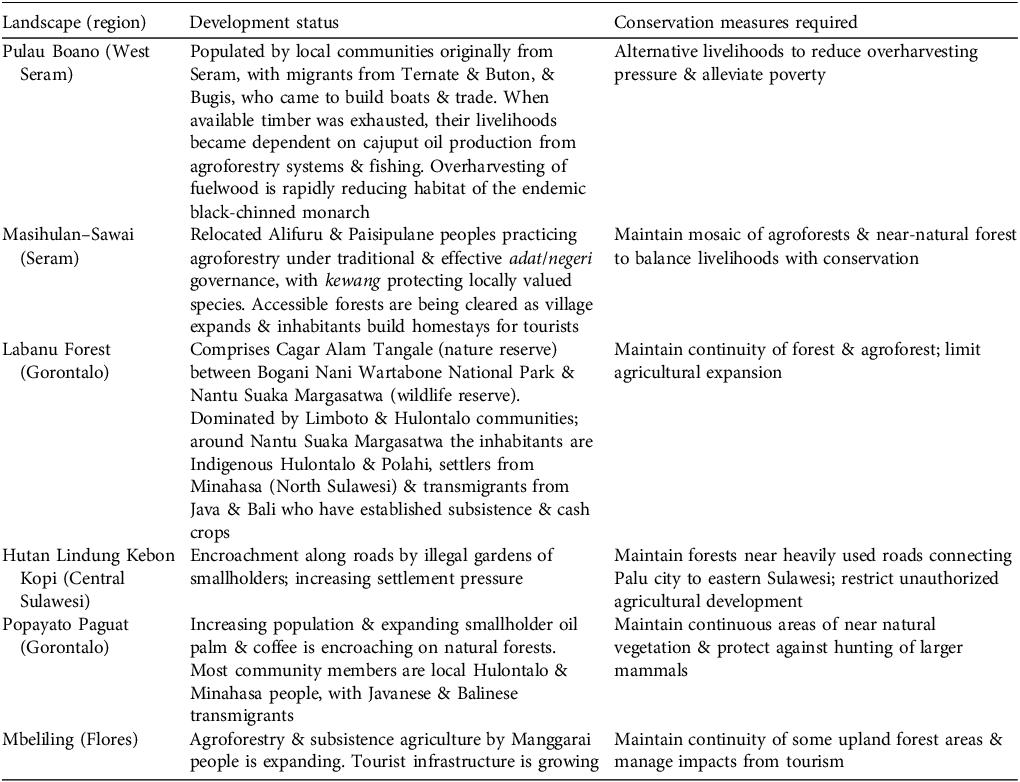
We considered there was an overall imperative to improve peoples’ lives. We defined livelihoods to encompass intrinsic, instrumental and relational values held by people (Pascual et al., Reference Pascual, Balvanera, Díaz, Pataki, Roth and Stenseke2017). The livelihood study also included household economies in and around each landscape, focusing on income and expenditure patterns. On Pulau Boano, we evaluated livelihoods centred on cajuput (Melaleuca) oil production, and prioritized ecotourism potential in North Seram, Mbeliling and Gorontalo. Marine resource dependency was examined in Pulau Boano and Masihulan–Sawai, and forest management, including agroforestry practices and commercial tree crop cultivation, were studied in Gorontalo and Mbeliling. These analyses clarified current resource dependencies and facilitated scenario development to explore land-use options. Table 1 provides an overview of conservation characteristics, and Table 2 summarizes the development status of, and conservation measures required in, each landscape.
Conservation characteristics of the six studied landscapes (Fig. 1).

Development status of the six studied landscapes, and conservation measures required.

Results
We identified conservation dilemmas and strategies in the six selected landscapes. Each area presents unique landscape and biodiversity contexts and faces different threats. Tables 1 and 2 highlight the connections between biodiversity conservation and local livelihoods, particularly in areas where unique species and traditional practices coexist and are subject to complex development trade-offs. We synthesized governance challenges and suggested ways of enhancing community engagement and strengthening local agency in sustainable development. The inductive approach enabled a comprehensive understanding of conservation and local development options, grounded in local contexts and community aspirations (Tanah Air Beta, 2019).
Pulau Boano: forest degradation and economic dependency on cajuput oil
Pulau Boano is home to the black-chinned monarch Symposiachrus boanensis, a Critically Endangered single-island endemic bird. Its small population, estimated to be < 200 individuals (BirdLife International, 2016), inhabits pockets of moist vegetation along water courses and in steep-sided gullies in the centre and north of the island. Forests are being degraded from collection of fuelwood for cajuput oil stills, which provide almost the sole source of income for local people. Forest degradation poses a significant threat to the maintenance of the black-chinned monarch population but also to the sustainability of cajuput oil production (Gunn et al., Reference Gunn, McDonald and Lea1996; Langston et al., Reference Langston, Riggs, Boedhihartono, Kastanya and Sayer2020; Valeri, Reference Valeri2022). Approximately 300 stills depended on fuelwood in 2019, leading to loss of 3% of the black-chinned monarch forest habitat annually during 2014–2018. The poverty level in the population is highlighted by the cajuput oil production system, where one family that we engaged with earned < USD 0.30 per person per day. Their annual harvest was 7 t of leaves from 1,371 Melaleuca sp. trees. This yielded an annual family income of IDR 11.4 million (USD 805.85) (Valeri, Reference Valeri2022).
We facilitated discussions aimed at aligning conservation efforts with local interests (Langston et al., Reference Langston, Riggs, Boedhihartono, Kastanya and Sayer2020). People strongly opposed suggestions to designate a new protected area, and alternatives to fuelwood, such as a diesel-powered distillation system similar to that operating on nearby Seram, face logistical and financial barriers. Despite the recognition of the negative impacts of forest destruction on the sustainability of the cajuput oil industry and biodiversity, local people pointed out that the existence of threatened birds brought them few benefits. They acknowledged that international birdwatchers were willing to pay to visit the island, but most of the revenue goes to international tour guides rather than local communities.
On Pulau Boano, land use is managed by the traditional soa kinship groups. Governance challenges arise from the coexistence of soa and formal government structures (Soselisa, Reference Soselisa and Ellen2007; Widjojo, Reference Widjojo2009). Although illegal activities such as fuelwood harvesting and forest conversion occur, forestry officers are reluctant to punish offenders and prefer to collaborate with community-based forest rangers (kewang) who are appointed by the soa to regulate fuelwood offtake. Customary rules play more significant roles at the field level and any violations of the law are easier to resolve through customary systems. Appointed by the adat government and recruited from the community, kewang are responsible for monitoring forest activities and limiting forest loss and degradation. Kewang do not possess formal law enforcement and punitive authority and rely on local adat rules to settle disputes and achieve conservation.
We explored the potential of the Indonesian designation of Essential Ecosystem Area (Kawasan Ekosistem Esensial), now renamed Preservation Area (Area Preservasi), to support biodiversity conservation within the landscape. However, this designation is restricted to areas outside state-designated forests. Pulau Boano’s forest habitat for the black-chinned monarch does not qualify. Pulau Boano is typical of the smaller islands of Wallacea, with limited access to technology, isolation from markets, evolving and unclear land tenure, and weak institutions. Local management institutions, supported by innovative funding mechanisms that pay local people for environmental services, may be an option to achieve conservation.
Masihulan–Sawai, North Seram: agroforestry and external investment
The agroforests near the adjacent Masihulan and Sawai villages in North Seram, between the boundary of Manusela National Park and the sea, harbour 18 of Seram’s 23 endemic bird species. The majority of the people of Masihulan village come from the interior of Seram but have intermarried with migrants from other islands. The people pursue a diversity of livelihood strategies (Valeri, Reference Valeri2022; Drestanta, Reference Drestanta2023). Established agroforests produce nutmeg, cloves and fruits that support local livelihoods. Adat governance regulates management, with a locally appointed land-use ruler, the Raja Tanah, allocating land rights to households. The landscape includes designated state forests, including production and protection forests, as well as parts of Manusela National Park. However, village expansion, population growth, and the spread of food-crop gardens are reducing forest cover and threatening both village livelihoods and biodiversity. Government-sponsored transmigrants are moving into the district and there are growing foreign investments in shrimp farming, cacao and oil palm production. There is a plan to establish a new sub-district (kecamatan), which is expected to bring new investments and drive economic growth, thus adding to the pressure on forests.
The provincial forestry office has at various times taken initiatives to improve agroforestry practices in the village and to designate the area around the settlements as Village Forest (Hutan Desa). This would encourage the continued production of spices and other forest products, including timber. Such a designation would offer an opportunity to incorporate conservation goals explicitly into management. Yet, 3 years after designation of a Village Forest in Masihulan, many people were still not familiar with this initiative. Amongst the villagers there are divergent views on how forest land should be managed. Short-term economic gains are the predominant drivers of decision-making.
Small-scale ecotourism provides benefits for some villagers, and this means there is widespread understanding and support for the protection of the forest for its tourism values. The village has simple accommodation and guides, and there is accommodation in the nearby coastal resort of Sawai. Encouraged by improved relationships with the national park, some villagers would accept more active government interventions to support conservation. Others believed that their traditional governance is better suited to local needs. There is ambiguity over roles and responsibilities between government and customary institutions. This ambiguity hinders conservation decision-making (Riggs et al., Reference Riggs, Langston and Sayaza2024). The villagers have similar concerns to those of people on Pulau Boano. They recognize that forest protection is desirable but are concerned that government agencies may use regulations as an excuse for burdensome oversight and rent-seeking (Riggs et al., Reference Riggs, Sayer, Margules, Boedhihartono, Langston and Sutanto2016; Sayer et al., Reference Sayer, Boedhihartono, Langston, Margules, Riggs and Sari2021).
Three habitat corridors in Sulawesi: linking forest fragments amidst economic expansion
Sulawesi has high levels of plant and bird diversity and is home to threatened mammals of Sundaland origin. The island faces extensive habitat fragmentation as a result of agricultural expansion and mining. There are only two primate genera, Tarsius and Macaca, but all 17 species in these genera are endemic to Sulawesi. The island has nine national parks, of which two are predominantly marine (Bappenas, 2025). Several terrestrial parks are suffering from significant encroachment by smallholder farmers. The Morowali Wildlife Reserve, one of the main protected areas on Sulawesi, is now the site of a major nickel mining enterprise, with 11 smelters operating and a large population of migrant workers (Supriatna et al., Reference Supriatna, Dwiyahreni, Winarni, Mariati and Margules2017; Zakaria et al., Reference Zakaria, Supriatna, Abinawanto and Shekelle2023). Cacao, oil palm, coffee and maize estates are expanding throughout Sulawesi and smallholder farmers are now inhabiting many forest areas that are nominally protected. Several initiatives to form wildlife corridors that link isolated forest patches are being attempted. We examine three examples below.
The Labanu, Gorontalo Depression
This region is particularly important for primates, with notable populations of the Vulnerable tarsiers Tarsius spectrumgurskyae and Tarsius supriatnai, which overlap and hybridize. These two species are potentially forming a stable new species that would likely be categorized as threatened (Supriatna et al., Reference Supriatna, Shekelle, Fuad, Winarni, Dwiyahreni and Farid2020; Zakaria et al., Reference Zakaria, Supriatna, Abinawanto and Shekelle2023). The area is also near the habitat contact zones of two Vulnerable macaque species, Macaca nigrescens and Macaca nigra. Expansion of smallholder agriculture and investments in estate crops, principally oil palm, cacao, coffee and maize, are leading to increasing forest fragmentation, which isolates primate populations (Supriatna et al., Reference Supriatna, Shekelle, Fuad, Winarni, Dwiyahreni and Farid2020). However, implementing forest protection measures poses challenges. Interventions from government conservation agencies would probably provoke resistance from both local people and local officials. Innovative approaches will be necessary to bridge the gap between traditional governance, local needs and global conservation goals. There is scope for encouraging estate crop companies to establish protected natural forest set-asides in their concessions to balance conservation and local economic needs. Conservation set-asides are a requirement for certification under the Round Table on Sustainable Palm Oil and organic certification. Major food crop investors, notably Mars and Olam, have expressed interest in such schemes, but they have not yet been implemented in Sulawesi.
Hutan Lindung Kebon Kopi, Central Sulawesi
This landscape is facing significant threats from illegal land clearing and agricultural encroachment. Migrants are moving in from other parts of Sulawesi, encouraged by a road corridor between Palu City in Central Sulawesi and Donggala district in Eastern Sulawesi. The road provides access to forested lands, where migrant farmers, including descendants of Javanese and Balinese transmigrants, are expanding agricultural activities, particularly tree crop cultivation. The area is a zone where populations of two species of endemic macaques, Macaca tonkeana and Macaca hecki, meet and hybridize. Although laws exist to protect this forest, enforcement is hampered by the reluctance of the local administration to resist demands for land from the growing smallholder population.
Popayato Paguat landscape, Gorontalo
This landscape includes remnant patches of forest scattered through 354,237 ha across the higher slopes of the central mountain range in Pohuwato and Boalemo Regencies. This mosaic landscape encompasses protection, production, and limited production forests. The landscape includes Nantu Wildlife Sanctuary and Panua Nature Reserve, where effective conservation interventions have supported biodiversity for several decades. However, small agricultural settlements with expanding oil palm and cacao plantations are encroaching on forested areas, threatening the habitat connectivity essential for restricted-range endemic bird species and endangered ungulates such as anoa Bubalus spp. and babirusa Babyrousa celebensis. The need for corridors to link forest patches is crucial for these species, yet restrictions on agricultural expansion into corridor areas face strong local resistance.
The Mbeliling landscape, Flores: integrating traditional forest management and tourism
The Mbeliling landscape is a mosaic of forests, mixed gardens, and savannah, covering 94,000 ha. The landscape is rich in endemic plants and harbours 17 threatened bird species including the endemic Flores hanging parrot Loriculus flosculus, Flores monarch Symposiachrus sacerdotum, Flores crow Corvus florensis and Flores scops owl Otus alfredi. The Schmutz worm snake Indotyphlops schmutzi, Flores giant rat Papagomys armandvillei and a small population of Komodo dragons Varanus komodoensis are present. The local Manggarai people’s traditional adat practices and long-term forest management have supported biodiversity, and local livelihoods benefit from forests enriched with clove trees (Mulu et al., Reference Mulu, Ntelok, Sii and Mulu2020; Ndula et al., Reference Ndula, Kaho and Seran2022). Recent migration and expanding tourism around a central lake have increased settlement pressure, which may compromise forest integrity. Building on collaborative conservation efforts from the 1980s, continued community involvement and sustainable tourism management are playing a crucial role in balancing conservation with the provision of economic benefits for local communities.
Discussion
The six landscapes are a microcosm of the global challenge of balancing conservation with improving the livelihoods of resource-dependent communities. Key pressures on ecosystems arise from the expansion of agriculture, population growth, in-migration of people seeking new agricultural land and the rapid growth in exploitation of critical minerals. The tensions have escalated in a context of growing economic pressures, complex and overlapping jurisdictions and governance, and a reluctance to enforce restrictions on the activities of relatively poor local people.
Local communities consistently prioritize improved road infrastructure, access to health care and education, availability of land and employment options, and provision of piped water and electricity. In no case did the local people support taking land out of production to establish strict conservation areas. In several locations, notably on Pulau Boano, there was explicit opposition to increasing wildlife protection measures. People in the Sulawesi and Flores landscapes recognized the value of corridors between remnant forests for increasing the extent of key habitats but believed that agroforests would provide adequate habitat.
The habitats of conservation concern are provided by near-natural vegetation interspersed with areas subject to cultivation or extractive use. All of the locations include formally designated permanent protection and production forests, but such designations are often not respected locally. Even in nominally protected forests, there are already numerous smallholder farmers, and in some cases commercial plantations are expanding. New road infrastructure, often for mineral extraction and cacao and oil palm plantations, is providing access to forest lands for migrant smallholders.
Reconciling development and conservation
Each landscape in Wallacea is unique, and achieving long-term conservation necessitates flexible, context-sensitive approaches. Successful biodiversity conservation will require continuing collaboration and negotiation with the local people and government agencies that determine land use. All areas require landscape approaches (Sayer et al., Reference Sayer, Sunderland, Ghazoul, Pfund, Sheil and Meijaard2013) to find an acceptable balance between conservation and local development (Margules et al., Reference Margules, Boedhihartono, Langston, Riggs, Sari and Sarkar2020). Although externally imposed conservation measures have been opposed by local people, we see potential in jointly developing conservation initiatives that align with and build upon existing customary governance systems that reflect the priorities and preferences of local communities. Without such alignment, as shown in Mbeliling, conservation efforts are often met with resistance, as local residents prioritize agricultural expansion that provides them with more immediate benefits.
In 2025, the Ministry of Environment and Forestry was split into two entities. The Ministry of Forestry has operational control over all state forests and the Ministry of Environment provides overall guidance on biodiversity issues. The Ministry of Forestry holds jurisdictional power over most forest landscapes but enforcing conservation measures is rarely effective without local support. Only through adaptive strategies that allow agricultural activities alongside conservation of near-natural forest zones can the landscape continue to provide habitat for endemic species. Decades-old designations of land for forestry clash with the needs of Wallacea’s growing population. Hope for effective conservation depends on sustaining a mosaic of land-use zones coupled with targeted measures to address specific conservation needs.
Conservation solutions must allow smallholder farming that brings development benefits to local people. Limiting agricultural expansion is key, but imposing restrictions on the activities of subsistence farmers without providing them with payments or alternative livelihoods will not be acceptable. Building local institutions to foster adaptive management and develop local regulations based upon traditional governance could provide a way forward. However, contexts vary and evolve, and management will need to continuously readjust in partnership with local communities because timely adaptation and responsiveness are more important than grand plans (Sayer et al., Reference Sayer, Bullb and Elliott2008).
Efforts to reconcile local development with national and global conservation goals are ongoing. Designation as Essential Ecosystem Areas appeared to offer potential but has received varying levels of support, especially from sub-national governments. The intention behind Essential Ecosystem Areas was to provide a mechanism for conservation in multi-functional landscapes subject to governance by different sectors and jurisdictions; they were conceptually similar to other effective area-based conservation measures and were attempted in various parts of Java, Sumatera, and Kalimantan. Recent policy (Law No. 23 of 2024) changed the Essential Ecosystem Area designation into Preservation Area and defined this as an area outside Nature Reserves (Kawasan Suaka Alam), Nature Conservation Areas (Kawasan Pelestarian Alam), and Conservation Areas in Marine Waters, Coastal Areas and Small Islands (Kawasan Konservasi Pengelolaan Wilayah Pesisir dan Pulau Pulau Kecil). A comprehensive national framework and standardized criteria for identifying, monitoring, and reporting on these and similar areas is still under development. Integrating these conservation areas into broader spatial planning and sectoral policies will be challenging and will need clear, enforceable regulations to ensure long-term viability. Demonstrating the ecological contributions of areas designated as critical ecosystems requires a robust national monitoring system, which is currently lacking outside formally protected areas (Li et al., Reference Li, Ge and Sayer2023). Many projects are providing lessons, but they lack coherent policy support.
Funding mechanisms supporting local livelihoods
Although conservation of the endemic fauna and flora of Wallacea is a high global priority, the endemic biota offers few direct benefits for the local inhabitants. International conservation funding has increased in recent years but effective means of using these funds to influence land management practices locally remain elusive. Local institutions lack the capacity to manage such conservation actions. Local community organizations focus on the immediate needs of the people and have little sympathy for restricting peoples’ livelihood activities to meet global biodiversity goals.
Traditional governance offers a promising foundation for developing more effective conservation in the region. The Nantu Wildlife Sanctuary in Gorontalo and the Masihulan–Sawai and Mbeliling landscapes are all subject to adat governance. In each of these areas, community-led habitat protection attracts specialized tourism. However, in areas with few tourists, local communities show little inclination to reduce agricultural activities to favour conservation. Local cash payments for conservation are untested in this context but could offer a way forward. Indonesia’s Program for Community Empowerment (Program Nasional Pemberdayaan Masyarakat; Narutomo, Reference Narutomo2014) provides a model for conditional cash payments that could be adopted to include incentives for conservation. Success would hinge on long-term commitment from government or donors to sustain such payments (Wunder et al., Reference Wunder, Campbell, Frost, Sayer, Iwan and Wollenberg2008). Carbon markets present another opportunity where investors are seeking nature-based solutions as part of net zero commitments. These investors may pay a premium for carbon credits that provide demonstrable biodiversity benefits. Such arrangements require clarity on land tenure, however, which is rarely available in rural Wallacea.
International agricultural commodity companies are expanding their presence in Wallacea, with oil palm, coffee, cacao, cloves and nutmeg the major crops involved. Some companies issue magnetic smart cards to the farmers from whom they purchase products. These cards enable the companies to track the performance of individual farmers, control use of inputs such as pesticides and facilitate the purchase of products. The data from these cards could be extended to include conservation relevant metrics, for instance on threatened species affected by production. The existence of such monitoring could provide a basis for payments to individual famers to engage in conservation-friendly practices. Certification as organic or fair trade can require biodiversity set-asides and this has worked in other countries. At recent meetings in Jakarta, some companies have indicated their interest in the potential for cash payments for biodiversity conservation, but we are not aware of any attempts to operationalize such systems in Indonesia.
Strengthening motivation for locally-appropriate conservation outcomes
Local capacity to address global biodiversity values is supported by some external funding, but local capacity is only developing slowly (Boedhihartono et al., Reference Boedhihartono, Bongers, Boot, van Dijk, Jeans and van Kuijk2018). There is a dearth of field-level expertise in the practices needed for locally adaptive management that benefits both people and conservation. For example, the lack of trained staff in Nantu Wildlife Sanctuary has hindered effective monitoring, leading to inadequate response measures that could have been triggered by real-time data. The black-chinned monarch, despite being a Critically Endangered, single-island endemic, lacks any special significance for local stakeholders. Effective interventions for this species, or the diverse endemics of Masihulan, Gorontalo and Mbeliling, will require cautious, progressive and culturally sensitive approaches (Bull et al., Reference Bull, Boedhihartono, Bueno, Cashore, Elliott and Langston2018; Langston et al., Reference Langston, Riggs, Kastanya, Sayer, Margules and Boedhihartono2019; Margules et al., Reference Margules, Boedhihartono, Langston, Riggs, Sari and Sarkar2020). Dialogue that centres on landscape issues, but links to sustainable business and integrated management expertise, should support such approaches (Nikolakis & Innes, Reference Nikolakis and Innes2020; Ros-Tonen et al., Reference Ros-Tonen, Langston and Reed2024). Facilitators of such dialogue should be trusted local agents who understand the context (West et al., Reference West, Haider, Hertz, Mancilla Garcia and Moore2024).
Decentralized conservation institutions with capacity to manage international funding, and a willingness to be driven by local needs, remain scarce. Overall, decision-making remains centralized. We advocate a shift to local levels. Although donor agencies continue to claim, and likely to believe, they are already demand-driven, our observations suggest otherwise. The current models, dominated by international frameworks that prioritize accountability and oversight by distant authorities and use oversimplified metrics, are not delivering satisfactory development and conservation outcomes (Sayer & Wells, Reference Sayer, Wells, McShane and Wells2004). Company biodiversity set-asides and direct cash payments for biodiversity conservation need to be part of the approach. There is a need to empower decentralized institutions to manage these landscapes and enable them to disburse international funding to compensate for the opportunity costs incurred by local people.
Conclusion
Our analyses highlight the difficulties of achieving successful conservation outcomes in six Wallacean landscapes. Addressing biodiversity conservation while also alleviating poverty is a challenge in all these sites. Such challenges are common in other locations, each with their own specific issues and options. The government of Indonesia has recently announced ambitious plans to accelerate the economic development of the eastern parts of the country. Investments in infrastructure, mineral extraction and food estates are increasing, and major transformations in these biodiverse landscapes seem inevitable.
Achieving better outcomes for people and nature from this transformation requires a shift in global funding practices to better support and equip local institutions to tackle challenges. Effective conservation in Wallacea depends on empowering a coalition of local governmental and non-governmental institutions and communities to develop new approaches that ensure agriculture, mining and fisheries sustain local cultural and relational values. Existing frameworks such as the landscape approach of Sayer et al. (Reference Sayer, Sunderland, Ghazoul, Pfund, Sheil and Meijaard2013) offer a foundation, but building institutions to achieve cross-sectoral collaboration, especially across sectors such as agriculture, mining and fisheries, remains a pressing challenge (Riggs et al., Reference Riggs, Achdiawan, Adiwinata, Boedhihartono, Kastanya and Langston2021).
Conserving biodiversity under local governance is needed for effective implementation of the Kunming–Montreal Global Biodiversity Framework in Wallacea. A modest flow of funds to locally managed institutions in such multiple-use landscapes could incentivize behavioural change. Such landscapes could achieve international recognition for their biodiversity values, and designation as other effective area-based conservation measures could allow for international funding linked to robust conservation metrics.
Translating global conservation targets into meaningful local action depends on the participation and support of communities most impacted by these interventions (Li et al., Reference Li, Ge and Sayer2023). In Wallacea, and many other areas populated by poor people, simply announcing global commitments to greatly increase protected areas is futile. The challenge is not to increase areas under protection but to foster local institutions capable of navigating the intersections of global objectives and local needs and thus enable more effective conservation management. Conserving the rich flora and fauna of Wallacea poses challenges similar to those confronted in many parts of the world. International conservation interventions should focus on building local capability and enabling financial flows to cover the opportunity costs of local actors. Success in achieving this in Wallacea could become a model for effective conservation that resonates across biodiversity-rich regions in low-income countries.
Author contributions
Conceptualization: JS, AB; funding acquisition: JS, AB, RR; project administration: AB; investigation: all authors; data curation: RR, AB; formal analysis: AB, JS, QL; visualization: AB, QL; writing: all authors; revision: JS, DS, AB, SA, QL.
Acknowledgements
Inhabitants of villages in and around the six landscapes hosted the authors and provided information on local livelihoods and conservation issues. The research received a grant from the Critical Ecosystem Partnership Fund and individual researchers were supported by grants from the Social Sciences and Humanities Research Council of Canada. Research permits were provided for foreign researchers by the Indonesian National Research and Innovation Agency (BRIN). Pattimura University in Ambon and Burung Indonesia hosted much of the fieldwork and provided support in building relations with local and regional government and local communities.
Conflicts of interest
None.
Ethical standards
All interviews were subject to ethics approval from James Cook University in Australia and the University of British Columbia in Canada: H19-01864 (Vibrant Forest Landscapes); H21-01411 (Sustainable Infrastructure Expansion for Vibrant Forest Landscapes); H21-03357 (Learning from Customary Governance; achieving broader societal benefits from forest landscapes). This research abided by Oryx’s guidelines on ethical standards.
Data availability
The data that support the findings of this study are available in Tanah Air Beta (2019).


 Open access

