


Introduction
Junglerice is one of the predominant weeds in soybean [Glycine max (L.) Merr.] and cotton (Gossypium hirsutum L.) across the mid-South and in particular Tennessee (Perkins et al. Reference Perkins, Mueller and Steckel2020; Tahir Reference Tahir2007). Junglerice and barnyardgrass [Echinochloa crus-galli (L.) P. Beauv.] are the two most common Echinochloa species found in Tennessee (Perkins et al. Reference Perkins, Mueller and Steckel2020). Junglerice is a warm-season annual grass that grows rapidly, has prolific seed production, and an extended emergence period. Testing for herbicide resistance of junglerice in Tennessee indicated that 15% of junglerice populations have a 2-fold to 8-fold resistance level to glyphosate, which is consistent to what Nandula et al. (Reference Nandula, Montgomery, Vennapusa, Jugulam, Giacomini, Ray, Bond, Steckel and Tranel2018) found on selected Mississippi and Tennessee populations (Perkins et al. Reference Perkins, Mueller and Steckel2020).
The increase in junglerice prevalence across the mid-South is believed to be due to the evolution of glyphosate resistance (GR) and dicamba antagonism of glyphosate (Perkins et al. Reference Perkins, Mueller and Steckel2021). Poor junglerice control could be compounded by using the ultra-course nozzles and drift reduction agents that are mandated for dicamba applications (Perkins et al. Reference Perkins, Mueller and Steckel2020). The majority of the hectares across the mid-South, including Tennessee, are receiving at least one glyphosate + dicamba application. The U.S. Department of Agriculture reports that in 2018, 71% of the hectares were planted in dicamba-tolerant soybean and more than 2.2 million kg of dicamba were applied in-crop in the United States (Wechsler et al. Reference Wechsler, Smith, McFadden, Dodson and Williamson2019). Dicamba use increased in 2019 with 16 million soybean hectares planted to Xtend® varieties (Bayer Crop Protection, St. Louis, MO). A recent memorandum issued by the U.S. Environmental Protection Agency on benefits of dicamba in dicamba-tolerant soybean production suggested that 97% of dicamba applications were applied with glyphosate in 2018 and 2019 (Orlowski and Kells Reference Orlowski and Kells2020). The frequent co-application of dicamba with glyphosate and/or clethodim could result in reduced grass control recently observed in the mid-South. In addition, growers have reported Palmer amaranth (Amaranthus palmeri S. Wats.) control failures with glyphosate + dicamba applications, which resulted in some producers using higher dicamba rates (Steckel Reference Steckel2019). Although using higher dicamba rates may improve Palmer amaranth control, it has been reported to decrease glyphosate effectiveness on junglerice (Perkins et al. Reference Perkins, Mueller and Steckel2021).
Colby (Reference Colby1967) describes herbicide antagonism as a result of applying two herbicides in combination, which will result in less control than what is expected based on how the individual herbicide performs alone. A decrease in glyphosate activity on junglerice plus other grass species has been documented from mixtures of glyphosate + dicamba compared with glyphosate applied alone (O’Sullivan and O’Donovan Reference O’Sullivan and O’Donovan1980; Perkins et al. Reference Perkins, Mueller and Steckel2021). In addition, antagonism of graminicides have been observed in other studies when they are applied with auxin herbicides (Blackshaw et al. Reference Blackshaw, Harker, Clayton and O’Donovan2006; Fletcher and Drexler Reference Fletcher and Drexler1980; Mueller et al. Reference Mueller, Witt and Barrett1989; Olson and Nalewaja Reference Olson and Nalewaja1981; Todd and Stobbe Reference Todd and Stobbe1980). Minton et al. (Reference Minton, Shaw and Kurtz1989b) reported that antagonism and synergism responses may vary with the herbicides used in mixtures or sequential applications, and responses may also differ depending on the grass species to be controlled. Minton et al. (Reference Minton, Kurtz and Shaw1989a) also reported decreased control of barnyardgrass when sethoxydim or quizalofop was mixed with the broadleaf herbicides imazaquin, chlorimuron, or lactofen. Those researchers also reported antagonism when either grass product was applied 24 h after imazaquin or lactofen but not with chlorimuron. Mixtures of broadleaf and grass herbicides have been reported to provide less grass control than expected (Byrd and York Reference Byrd and York1987; Croon and Merkle Reference Croon and Merkle1988; Grickar and Boswell Reference Grickar and Boswell1987; Minton et al. Reference Minton, Kurtz and Shaw1989a, 1989b; Vidrine Reference Vidrine1989). Myers and Coble (Reference Myers and Coble1992) reported that sequential applications of broadleaf and grass herbicides have been used to overcome antagonism.
Antagonism plus herbicide resistance can lead to weed control failure after only a few years. Avoiding antagonism from herbicide applications will assist in resistance management as well. Therefore, the objective of this research was to 1) examine whether sequential applications alleviate antagonism observed with dicamba plus glyphosate and/or clethodim mixtures on junglerice control, and 2) determine whether sequential treatments with those herbicides at 24 h, 72 h, or 168 h can improve the consistency of junglerice control.
Materials and Methods
Greenhouse Research
A greenhouse experiment was replicated to determine how applications of glyphosate or clethodim made either 24 h or 72 h before or after an application of dicamba would impact weed control. This study was conducted on six nonrepeating collected populations from Tennessee and was similar to that reported by Perkins et al. (Reference Perkins, Mueller and Steckel2020). The study design is a randomized complete block design with three replications of each population per treatment. Seeds were first planted in flats and then transplanted to 10-cm pots with 2 plants pot−1, using a 50:50 silt loam and potting soil premix. The treatment list contains a nontreated (check), glyphosate (Touchdown Hi-Tech®; Syngenta Crop Protection, Greensboro, NC), clethodim (Select Max®; Valent U.S.A. LLC., Walnut Creek, CA), glyphosate + dicamba (Engenia; BASF Corporation, Ludwigshafen, Germany), and clethodim + dicamba. Touchdown Hi-Tech® applications included 0.25% vol/vol nonionic surfactant and Select Max® applications included 1% vol/vol crop oil concentrate for this experiment. Treatments were applied in a Generation 4 Research Track Sprayer (DeVries Manufacturing, Inc., Hollandale, MN) using a TTI 11003 nozzle. The track sprayer speed was calibrated to deliver 140 L ha−1, and the nozzle height was set to spray approximately 45 cm above the crop canopy. Applications were made when plants reached 8 to 10 cm in height. Greenhouse air temperature was set at 24 to 27 C and 60% relative humidity. Junglerice control was visually estimated on a scale of 0% to 100% where 0 = no injury and 100 = plant death at 28 d after treatment. Plant biomass was taken 28 to 35 d after treatment. Biomass was collected by clipping plants at the soil surface and collecting fresh weights.
Field Research
Because the greenhouse data indicated that a 72-h sequential application mitigated antagonism, field studies having a 72-h and 168-h sequential timing were conducted. The research was arranged in a randomized complete block design. Individual plot size was 1.5 m wide and 9.1 m long at the West Tennessee Research and Education Center (WTREC) in Jackson, TN. Plots at two other locations, Milan Research and Education Center (MREC) and a grower’s field (Burlison, TN) were 1.5 m wide and 6 m long. Depending upon location, there were three (MREC and Burlison) or four (WTREC) replications. The herbicide treatments included a nontreated (check), glyphosate (Roundup Powermax®; Bayer Crop Protection, St. Louis, MO), clethodim (Intensity®; Loveland Products, Greenville, MS), glyphosate + clethodim, glyphosate + dicamba (Engenia; BASF Corporation), clethodim + dicamba, and glyphosate + clethodim + dicamba. In addition, glyphosate and clethodim applications were made at 72 h and 168 h, preceding or following dicamba. Herbicide rates were consistent throughout with glyphosate at 870 g ha−1, dicamba at 560 g ha−1, and clethodim at 105 g ha−1.
Herbicides were applied with a CO2-pressurized backpack sprayer calibrated to apply at 140 L ha−1 using TTI 11003 nozzles. Applications occurred when junglerice plants were 8 to 10 cm in height. Control of junglerice was visually estimated at 7, 14, and 21 d after final treatment on a scale of 0% to 100% where 0 = no injury and 100 = plant death. Aboveground, fresh weight biomass data was collected 21 to 28 d after treatment in a 0.2-m2 area by clipping plants at the soil surface and weighing to the nearest gram. Only the latest evaluations are presented.
Data Analysis
Populations were blocked on site due to differences in junglerice population density and GR. Fixed effects were herbicide treatments. Environment, replication, and any interactions of fixed by random effects were considered random in the model. Each year-location combination was considered an environment sampled at random from a population as described by Carmer et al. (Reference Carmer, Nyquist and Walker1989). Designating the environments random will broaden the possible inference space applicable to the experimental results (Carmer et al. Reference Carmer, Nyquist and Walker1989). Mean separation for individual treatment differences was performed using Fisher’s protected LSD test at P ≤ 0.05. Post-ANOVA single degree of freedom contrasts were then used (SAS v9.4; SAS Institute; Cary, NC) to compare herbicide applications with and without dicamba.
Results and Discussion
Greenhouse Study
There was an overall herbicide effect (P < 0.001) among treatments with glyphosate and clethodim. Glyphosate alone provided 83% junglerice control (Table 1). Glyphosate + dicamba mixture provided numerically less (68%) junglerice control, but this difference was not quite significant at α = 0.06. This is consistent with results reported by Combellack (Reference Combellack1982) that due to the environment and application variability in the field, less control in the field was observed compared with greenhouse applications. The treatment that included dicamba applied 24 h after the glyphosate application resulted in the lowest level of junglerice control (59%). Conversely, when glyphosate was applied 24 h after dicamba, control was similar to that when glyphosate applied alone. When the glyphosate application was separated from the dicamba application for 72 h, regardless of order, junglerice control was not different from that when glyphosate was applied alone. Biomass results in all cases but one supported the control data with no difference detected among the treatments (Table 1).
Junglerice control (21 DAT) comparing 24-h and 72-h sequential applications of glyphosate applications preceding and following dicamba application across six environments (populations) in the greenhouse.a, b

a Means not followed by a common letter are significantly different (P < 0.05).
b Abbreviations: DAT, days after treatment; Df, degrees of freedom; fb, followed by.
c Biomass is recorded in grams per pot.
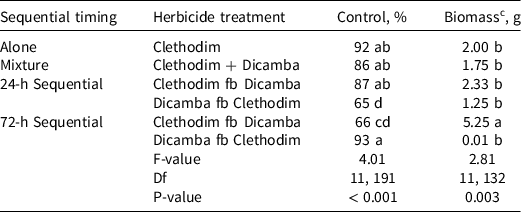
The clethodim treatment provided 92% control of junglerice (Table 2), and the clethodim + dicamba mixture provided similar control (86%). When dicamba was applied 24 h after clethodim, control was consistent with glyphosate alone or in a mixture of clethodim + dicamba. These results are consistent with those reported by Minton et al. (Reference Minton, Kurtz and Shaw1989a) that no antagonism occurred with clethodim when mixed with 2,4-DB on barnyardgrass. However, control was lower (65%) when clethodim was applied 24 h after the dicamba application. When dicamba was applied 72 h after clethodim, junglerice control was reduced by 20%, whereas when clethodim was applied 72 h after dicamba, junglerice control was similar to glyphosate alone (93%). With the exception of the treatment of clethodim applied 24 h after dicamba, the biomass data reflected the control data. These results are consistent with those reported by Minton et al. (Reference Minton, Kurtz and Shaw1989a, 1989b) that fluazifop-P was antagonized by mixing with 2,4-DB.
Junglerice control (21 DAT) comparing 24-h and 72-h sequential applications of clethodim applications preceding and following dicamba application across six environments (populations) in the greenhouse.a, b
a Means not followed by a common letter are significantly different (P < 0.05).
b Abbreviations: DAT, days after treatment; Df, degrees of freedom; fb, followed by.
c Biomass is recorded in grams per pot.
Field Studies
An effect of herbicide treatments on junglerice control was observed in the field studies (P < 0.001). Glyphosate alone provided 59% control (Table 3). The poor junglerice control by glyphosate would suggest that at least one of the locations contained both a segregating glyphosate-resistant and glyphosate-susceptible population. The glyphosate + dicamba application provided similar junglerice control (48%). These results are similar to those reported by Perkins et al. (Reference Perkins, Mueller and Steckel2020) that 57% junglerice control was achieved with a glyphosate + dicamba mixture, but glyphosate alone provided 82% control. This was also similar to observations by Flint and Barrett (Reference Flint and Barrett1989) who reported antagonism with dicamba mixtures on johnsongrass. The glyphosate + clethodim treatment provided the greatest junglerice control at 91%. These results are consistent with those reported by Perkins et al. (Reference Perkins, Mueller and Steckel2020) that 15% of Tennessee junglerice populations could no longer be controlled with glyphosate, but clethodim was still effective. Similarly, a glyphosate + clethodim + dicamba application provided 81% control of junglerice. Glyphosate control was reduced when dicamba was sprayed 72 h before or after glyphosate (55% and 53%, respectively). Similar control was found with a 168-h sequential. From these data, however, a glyphosate + clethodim application preceding or following a dicamba application at both 72 h and 168 h provided the best control of junglerice. Biomass results supported visual control data with no differences detected among the glyphosate or clethodim treatments.
Junglerice control (21 DAT) comparing 72-h and 168-h sequential applications of glyphosate and glyphosate + clethodim applications preceding and following dicamba application across three environments in Tennessee in 2020.a, b

a Means not followed by a common letter are significantly different (P < 0.05).
b Abbreviations: DAT, days after treatment; Df, degrees of freedom; fb, followed by.
c Biomass is recorded in grams per square meter.
Antagonism was observed from a clethodim + dicamba application, which provided only 63% control, whereas clethodim alone provided 86% control (P < 0.001; Table 4). This differs from that reported by Minton et al. (Reference Minton, Kurtz and Shaw1989a) that 2,4-DB did not reduce control of barnyardgrass by clethodim. We observed that adding glyphosate to the clethodim + dicamba mixture improved control (81%), but mixing glyphosate with clethodim did not improve junglerice control (91%) over clethodim alone. When dicamba followed clethodim at 72 h or 168 h later junglerice control was similar to clethodim applied alone. Similarly, dicamba applied first followed 72 h later with clethodim did not reduce junglerice control over clethodim applied alone. However, if clethodim was applied 168 h after dicamba, then junglerice control was greatly reduced (61%). Biomass results were similar and supported these data with no differences detected.
Junglerice control (21 DAT) comparing 72-h and 168-h sequential applications of clethodim and glyphosate + clethodim applications preceding and following dicamba application across three environments in Tennessee in 2020.a, b

a Means not followed by a common letter are significantly different (P < 0.05).
b Abbreviations: DAT, days after treatment; Df, degrees of freedom; fb, followed by.
c Biomass is recorded in grams per square meter.
The addition of dicamba decreased junglerice control by glyphosate and clethodim in some but not all of our studies. As would be anticipated, where GR junglerice existed in the population, control with glyphosate was poor regardless of whether or not dicamba was added. In some of these environments, dicamba hindered clethodim control of junglerice. The level of antagonism observed varied by timing of sequential applications. In the greenhouse, dicamba + clethodim provided excellent control, whereas in the field the same treatment showed a greater than 30% reduction in junglerice control compared with clethodim alone. However, resistance or antagonism was overcome by using a mixture of glyphosate + clethodim. Ultimately, the question of whether junglerice control could be improved by applying glyphosate and waiting 24, 72, or 168 h to apply dicamba or vice versa was not clearly answered. We suggest that the relative GR level of the junglerice influenced the overall control of these sequential applications. However, clethodim applied first followed at either 72 h or 168 h by dicamba provided consistently better control than applying dicamba followed by clethodim.
Mixing glyphosate + clethodim provided the most consistent junglerice control regardless of different application intervals. These data confirm that leaving dicamba out of the spray tank will avoid the possibility of it antagonizing control of junglerice with clethodim. These data along with those reported by Perkins et al. (Reference Perkins, Mueller and Steckel2020) indicate that avoiding dicamba and glyphosate mixtures will also improve the consistency of control with glyphosate-susceptible junglerice. A survey by Perkins et al. (Reference Perkins, Mueller and Steckel2020) reported that on average, 40% of the fields in Tennessee have both Palmer amaranth plus Echinochloa species present at harvest. Thus, the control of both junglerice and Palmer amaranth in the same field can be improved by not co-applying dicamba with glyphosate.
Acknowledgments
We thank Syngenta for providing us the access to conduct research at their facilities in Vero Beach, Florida. We especially thank Ethan Parker, Marshall Hay, Gracee Hendrix, and all the employees at the Vero Beach research station for their assistance and guidance throughout this process. We also thank the support staff and technicians at The University of Tennessee West Tennessee Research and Education Center for their assistance. This research was funded in part by the Tennessee Soybean Promotion Board and Cotton Incorporated. No other conflicts of interest are noted.


 Open access

