





Undernutrition is estimated to affect over 700 million people globally(1). Childhood malnutrition has long-term consequences for development and health(Reference Norris, Frongillo and Black2), and deficiencies in micronutrients impair children’s physical and psychosocial health and development(Reference Bailey, West and Black3). Addressing health and nutrition risks throughout childhood and adolescence is critical to ensure optimal development and to protect earlier life course investments(Reference Black, Victora and Walker4). School feeding programmes are popular safety nets that reach over 400 million children every school day(5). The evidence on school feeding programmes indicates a variety of potential contributions to children’s education, health, nutrition and social protection(Reference Alderman, Bundy and Gelli6).
In Ghana, where food insecurity and malnutrition remain pressing challenges(7), school meals have been recognised as a key strategy to enhance both the health and educational outcomes of children. Currently reaching over 3·8 million primary schoolchildren, the Ghana School Feeding Program (GSFP) is the country’s largest safety net(8). The GSFP is a multisectoral programme with objectives across social protection, education, health, nutrition and agriculture dimensions. A rigorous impact evaluation of the GSFP at scale indicated that the programme can improve cognition and learning outcomes(Reference Aurino, Gelli and Adamba9). The programme has not demonstrated improvements to height-for-age and BMI-for-age z scores overall; however, positive effects on height-for-age have been observed in 5–8 years old children, girls and children from poorer households(Reference Gelli, Aurino and Folson10). The GSFP menus based on a 0·12 USD per child budget are designed to meet approximately 30 % of recommended daily energy and nutrient requirements of schoolchildren and include foods grown by smallholder farmers(Reference Gelli11). However, persistent gaps in financing, food quantity and food quality(Reference Owusu, Colecraft and Aryeetey12) hinder the successful realisation of these goals. Furthermore, little is known about the environmental impacts of school meals in Ghana, which is an important knowledge gap given the growing emphasis on sustainability in food systems.
A supply chain study of the GSFP reported that the main challenges faced by caterers providing the meals included the inability to mitigate the effects of rapid changes in food prices(Reference De Carvalho, Dom and Fiadzigbey13). Caterers respond to these challenges frequently by adapting menus, that is, by reducing portion sizes or by adjusting the quality of the food. The rising costs of food and increasing economic pressure necessitate a re-evaluation of existing meal plans to ensure that they remain financially sustainable while responding to Ghanaian children’s critical dietary gaps.
Linear programming (LP) has been demonstrated to be an effective tool in designing cost-effective, nutritionally adequate diets for Ghanaian families(Reference Nykänen, Dunning and Aryeetey14). The method has also successfully been applied in school canteen settings(Reference Eustachio Colombo, Patterson and Lindroos15–Reference André, Eustachio Colombo and Schäfer Elinder17). This study uses LP, to optimise school food baskets to meet newly proposed food and nutrient targets for school meals based on Ghanaian children’s actual dietary gaps, while considering critical factors such as food affordability, operational costs, anticipated inflation, cultural acceptability and environmental impacts.
Material and methods
Study design
This was a modelling study using established algorithms of LP(Reference Darmon, Ferguson and Briend18) to design school food baskets that fulfilled newly developed food and nutrient targets for school meals in Ghana(19). This study considered aspects related to food affordability (food costs, non-food costs and anticipated inflation), cultural acceptability (minimum deviation from reported baseline usage of foods) and environmental impacts (greenhouse gas emissions (GHGE) and water use (WU)). The optimisation analysis was performed on two distinct school food baskets. First, we optimised the current school food basket. Second, we optimised an improved food basket, which consisted of the current recipes modified by a nutritionist to enhance protein content and quality (see more details below).
Baseline school food baskets
Base menus
Data on current school meal menus, including recipes and ingredients, were collected in ten districts (Ada East, Akyenmansa, Amansie South, Atwima Mponua, Bongo, Nanumba South, Nkwanta North, South Tongu, Tain and Wa West) across five regions in Ghana. Schools were selected by the GSFP on the basis of having a functioning programme. These menus were collected by a team of twenty trained enumerators from the Noguchi Memorial Institute for Medical Research at the University of Ghana. Data collection took place in September 2023, following standard operating procedures. Briefly, at the beginning of each day, the teams of enumerators would visit the targeted schools and begin the calibration of the different measurement scales. Weights of cooking pots used for the meal preparation were recorded, alongside the measurement of weights of raw ingredients before and after they had been cleaned and prepared for cooking. The weight of the cooked meals was then recorded after cooking to allow for the calculation of ingredient proportions and recipes for mixed dishes using the simple ingredient method(Reference Marieke, Christine and Abdelrahman20).
These collected menus (i.e. ‘Base menus’) (see dishes and recipes in online supplementary material, Supplemental Methods) were aggregated and averaged; each individual food item was averaged by dividing its total amount by the number of recipes (where each recipe was intended for one child, consumed once per day) to calculate the average amount (in grams) per child and day. These average amounts of individual food items per child and day were used to construct the first baseline school food basket, upon which the first set of models were applied using LP (models 1–2, Table 1). The baseline school food basket for the Base menus contained a total of forty-five individual food items together with corresponding amounts used (g/child/d) for cooking and average prices (USD/kg of food). Price information was collected from caterers based on their actual purchases. Additional price information was obtained from the price monitoring included in the School Meal Planner Plus database(21).
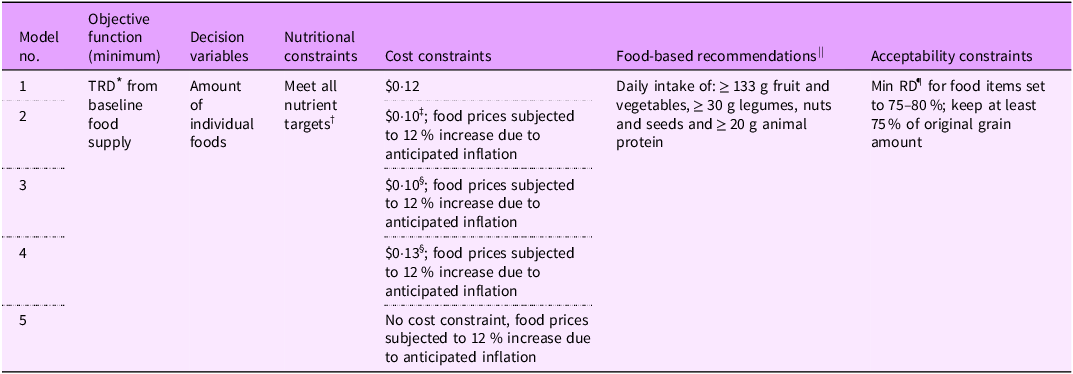
Characteristics of all applied models

TRD, total relative deviation; RD, relative deviation.
* Total relative deviation.
† As per the dietary reference values for school meals in Ghana.
‡ Budget available when subtracting 20 % operational cost from $0·12.
§ Budget available when subtracting 20 % operational cost from $0·16.
|| As per food targets and mealtime recommendations for school meals (lunch) in Ghana(19).
¶ Relative deviation from baseline food consumption.
Improved menus
A set of manual modifications were made on the observed recipes by a senior nutritionist at the Noguchi Memorial Institute for Medical Research with a goal of improving the protein quality and total protein content of school meals, including the addition of eggs, texturised soya protein and other protein-rich foods, factoring in an additional budget allowance of US$ 0·16. This budget adjustment reflects an additional funding envelope provided by donor agencies to improve the protein content of the meals. Including this scenario allowed us to examine how additional resources could impact the nutritional quality and composition of school food baskets while remaining within a realistically funded programme context.
These modified menus (i.e. ‘Improved menus’) (see dishes and recipes in online supplementary material, Supplemental Methods) were aggregated and averaged; each individual food item was averaged by dividing its total amount by the number of recipes (where each recipe was intended for one child, consumed once per day) to calculate the average amount (in grams) per child and day. These average amounts of individual food items per child and day were used to construct the second baseline school food basket, upon which the second set of models were applied using LP (models 3–5, Table 1). The baseline school food basket for the Improved menus contained a total of twenty-nine individual food items together with corresponding amounts used (g/child/d) for cooking and average prices (USD/kg of food).
Nutrient content and environmental impacts
The gram quantities of various food items in the baseline school food baskets for both the Base and Improved menus were linked to their respective nutrient composition using the West African food composition table(Reference Vincent, Grande and Compaoré22) and the RIING nutrient composition table(Reference Bannerman, Soueida and Ohemeng23), which is a compilation of food composition databases relevant to Ghana. We also calculated GHGE and WU for both baseline and optimised menus. Environmental impacts, adjusted to reflect Ghana-specific production systems, were estimated using values adapted from Poore and Nemecek’s systematic review of global environmental footprints(Reference Poore and Nemecek24). Similar to the approach previously applied by the World Wildlife Fund(Reference Loken, Opperman and Orr25), we used a regionalised version of the Poore and Nemecek dataset to estimate environmental impacts of producing foods in Ghana while applying global average impacts for imported foods. These Ghana-specific, context-adjusted factors were provided to the authors by Dr Joseph Poore (personal communication, 2021). The GHGE were aggregated into global warming potential in carbon dioxide equivalents (CO2eq) using the Intergovernmental Panel on Climate Change (2013) characterisation factors with climate-carbon feedbacks. WU was determined based on the freshwater withdrawals associated with food consumption, encompassing irrigation water, livestock drinking water and water utilised in food processing(Reference Poore and Nemecek24).
Optimisation
LP is a powerful tool that has been effectively employed to optimise dietary objectives while navigating a variety of sometimes conflicting constraints(Reference Gazan, Brouzes and Vieux26,Reference Parlesak, Tetens and Dejgard Jensen27) . At its core, this method involves applying an algorithm to either maximise or minimise a linear objective function, which represents the variable of interest. This optimisation is bound by a set of linear constraints, which are predefined requirements that must be met in the context of decision variables – specifically, the quantity of each food item included in the menus(Reference Dantzig and Koopmans28). A solution is deemed feasible when all specified constraints are satisfied. However, if the selected constraints are excessively strict, the algorithm may fail to yield a solution, indicating that there is no feasible answer to the associated mathematical problem. The constraints that are critical in determining whether the objective function can be maximised or minimised – those fully satisfied within their established limits – are referred to as ‘active constraints’(Reference Nocedal and Wright29). For this analysis, linear optimisation was carried out using the COIN-OR Branch and Cut Solver algorithm, which is part of the OpenSolver add-in for Excel® 2016, version 2.9.0(Reference Mason, Klatte, Lüthi and Schmedders30).
We optimised school food baskets in Ghana according to the five different models (Table 1). The relative deviation (RD) from the average amount of each food item was calculated as RD = (wopt – wbas)/wbas, where wopt is the food weight in the optimised school food basket and wbas is the baseline food basket. As the objective function of all LP models, we chose the minimisation of the total relative deviation (TRD, equalling the sum of RD for all foods considered) from the baseline food basket(Reference Darmon, Ferguson and Briend18,Reference Eustachio Colombo, Patterson and Elinder31) . This objective function was implemented to maximise the similarity between the baseline and the optimised food baskets. The decision variables were the amounts of individual food items in the different models. To implement the absolute values of RD into the LP process, the mathematical technique of Darmon and colleagues(Reference Darmon, Ferguson and Briend18) was applied.
All optimisations applied newly developed (albeit preliminary) nutrient and food targets for school meals in Ghana as obligatory constraints. As for energy and macro-/micronutrients, this meant implementing minimum thresholds for kcal, protein, Fe, Zn, vitamin A, vitamin C, folate and vitamin B12 (Table 2) as per the newly developed food and nutrient targets for school meals in Ghana(19). The food targets per meal comprised the minimum amount of 133 g of fruit and vegetables, 30 g of legumes, nuts and seeds and at least 20 g of animal-source foods (ASF) (beef, fish and eggs). These targets were set specifically for the GSFP by a working group convened by the FAO of the UN following a new FAO-World Food Programme methodology for this purpose(19,32) , which considers contextual dietary gaps in children’s diets. In cases where the targets differed depending on age category, the nutritional constraints were averaged (i.e. the average of all age groups was used).
Nutrient coverage of baseline and optimised school food supplies
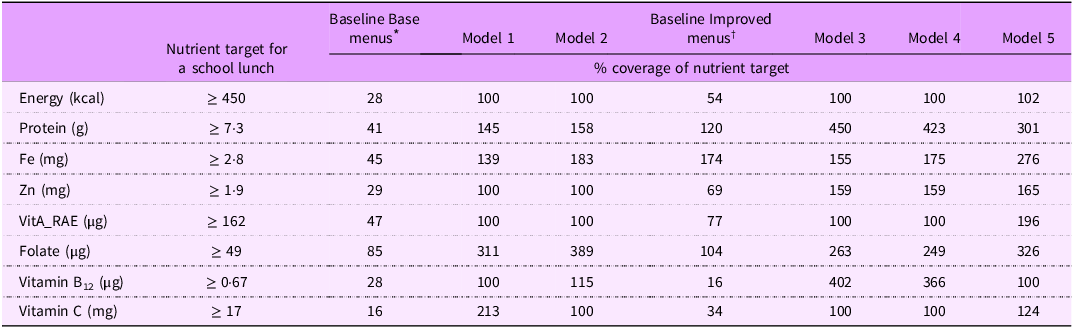
* Baseline food supply for models 1–2.
† Baseline food supply for models 3–5.
Cost constraints were implemented in all models (Table 1). Our initial model (model 1) was constrained to cost equal to or less than the current budget of about GHC1·5 ($0·12)/child/meal. This budget is in theory meant to cover both food and non-food (i.e. operational) costs incurred by caterers. However, there are currently no guidelines or data on how that budget should be/is split. Our fieldwork in the abovementioned districts suggested that approximately 20 % of funds for school meals are used for operational costs (such as salaries for cooks and electricity). Hence, the budget in model 2 was $0·10 ($0·12 minus 20 %). Since food prices are steadily increasing due to inflation, we also implemented a 12 % price increase to all foods in the school food baskets (representing inflation trajectory projected for 3 months into the future) in model 2. Model 3, based on improved recipes, had the same budget as model 2, that is, the current budget, and did also consider operational costs and inflation. Model 4, also based on improved recipes, had a slightly higher budget constraint of $0·13 ($0·16 minus 20 %) while also compensating for the assumed cost effects of inflation. This higher budget has been suggested by stakeholders to allow for more diverse and nutritious school meals. The last model (model 5, also based on the improved recipes) had no budget constraint to allow us to explore what a nutritious and culturally acceptable school food basket would look like if no cost limits existed. This particular scenario was aimed at informing current school meal policy and financing developments for the GSFP.
For all models/scenarios, individual food item quantities were allowed to increase unlimitedly relative to their respective baseline weights; however, similarly to previous optimisation studies(Reference Eustachio Colombo, Patterson and Lindroos15,Reference Elinder, Eustachio Colombo and Patterson16,Reference Eustachio Colombo, Patterson and Elinder31) , we limited individual food quantities to be reduced by a maximum of up to 80 % as an acceptability constraint (Table 1). The average relative deviation (ARD) from the baseline food basket (i.e. the TRD divided by the total number of food items included in the model) was calculated as an output and used as a measure of similarity between the baseline and the optimised food basket and as an assumed proxy for cultural acceptability. Active nutrient constraints (those meeting exactly 100 % of the applied limit(Reference Nocedal and Wright29)) were identified for each solution.
Climate (g CO2eq/child/meal) and water footprints (litres/child/meal) of the baseline and optimised food baskets were calculated for exploratory purposes but were not constrained in the models because of a lack of national targets on these parameters.
In summary, five scenarios/models were explored using LP (Table 1) to attain school food baskets that fulfilled all nutrient constraints and were as similar as possible to:
-
1. the current school food basket, cost equal to or less than the current budget of about GHC1·5 ($0·12)/child/meal, and considering cultural acceptability and food-based constraints if possible.
-
2. the current school food basket, cost equal to or less than the current budget of about GHC1·5 ($0·10)/child/meal, accounting for operational costs and inflation, and considering cultural acceptability and food-based constraints if possible.
-
3. an improved school food basket, cost equal to or less than the current budget of about GHC1·5 ($0·10)/child/meal accounting for operational costs and inflation, and considering cultural acceptability and food-based constraints if possible.
-
4. an improved school food basket and cost equal to or less than an enhanced budget of about GHC2 ($0·13)/child/meal accounting for operational costs and inflation, and considering cultural acceptability and food-based constraints if possible.
-
5. an improved school food basket without a budget constraint accounting for operational costs and inflation, and considering cultural acceptability and food-based constraints if possible.
We adopted an iterative approach where we aimed to apply all constraints (Table 1) if possible and where we had the following order of priorities as for achieving the suggested constraints: (1) budget and nutrient constraints, (2) acceptability constraints, and (3) food-based constraints.
Results
Baseline school food baskets
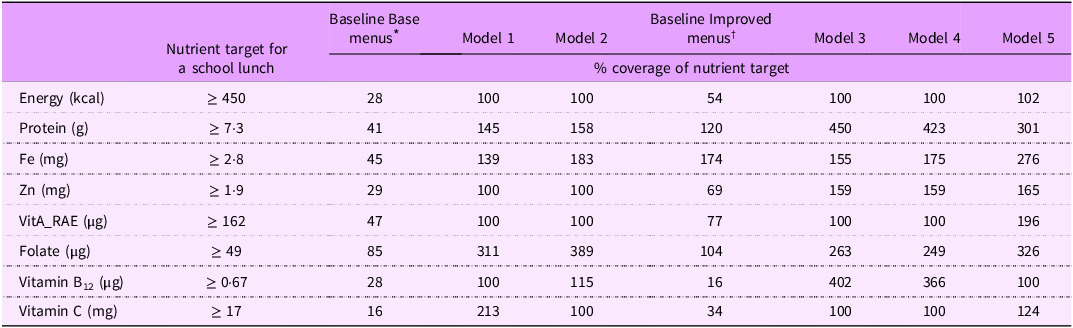
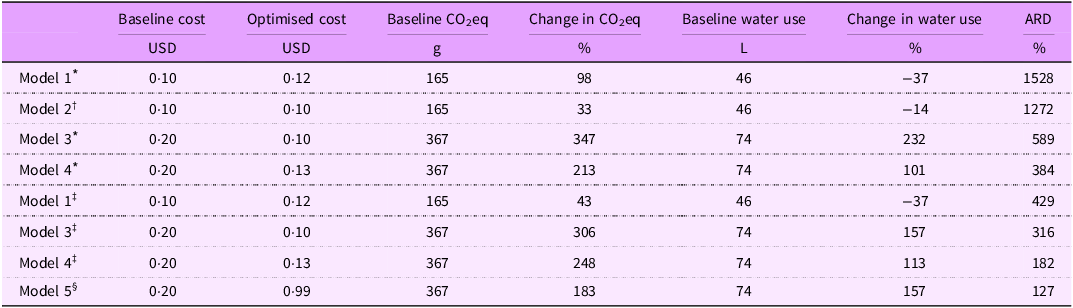
The baseline school food basket for the Base menus provided less energy and protein than the defined school meal nutrient targets (Table 2). It also fell short of the targets for all micronutrients. The baseline school food basket for the Improved menus was slightly less deficient; this food basket was lower than recommended with respect to the targets for energy, Zn and vitamins A, B12 and C. The cost of the baseline school food baskets was US$ 0·10 (Base menus) and US$ 0·20 (Improved menus) per child and day (Table 3). The CO2eq emissions and water footprints of the baseline school food baskets were 165 g/46 L (Base menus) and 367 g/74 L (Improved menus) per meal (Table 3).
Changes in cost and environmental impacts, as well as the ARD for each applied model
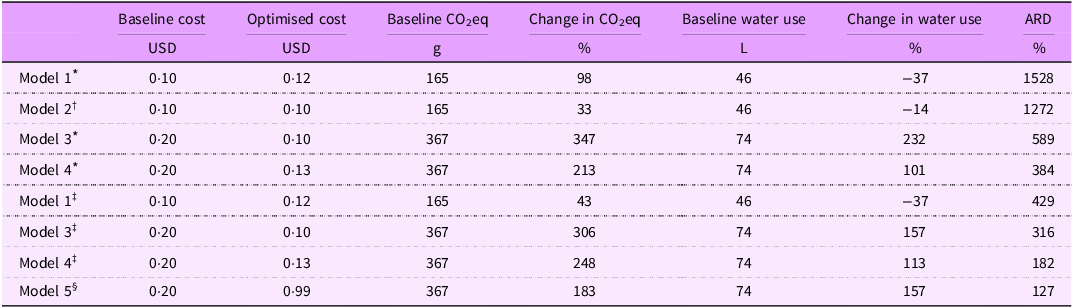
ARD, average relative deviation; CO2eq, carbon dioxide equivalents.
* Model with cost, nutrient and food-based constraints.
† Model with cost and nutrient constraints only (a feasible solution could not be achieved when including either food-based or acceptability constraints; hence, results are only available for one run of model 2).
‡ Model with cost, nutrient and acceptability constraints.
§ Model without a cost constraint but with nutrient, food-based and acceptability constraints.
Optimised school food baskets
It was possible to meet cost and nutrient targets in all optimised models (Tables 2 and 3). Active constraints that prevented a higher similarity to baseline school food baskets were energy, Zn and vitamins A, B12 and C (Table 2). When these constraints were met, the demands on the provision of protein, Fe and folate were automatically achieved, meaning that these nutrients never turn critical if the supply of energy, Zn and vitamins A, B12 and C is sufficient. Food-based constraints were only achievable when the acceptability constraint of keeping at least 20 % of the originally consumed foods was not applied (with the exception of model 5 without a budget constraint). In one case, that is, the optimisation of the Base menus, considering both operational costs and inflation (model 2), a feasible solution was only found when both food-based and acceptability constraints were not applied, hence resulting in a diet with no animal foods, no fats, oils and grains (see online supplementary material, Supplemental Figure 1, Table 4). When applying only nutrient-and food-based constraints, amounts of single foods ranged between 4·4 and 16·3 times higher compared to the baseline food baskets (no data shown), with the highest ARD being for model 1 (Table 3), indicating a very high deviation from baseline. When implementing acceptability constraints, but excluding food-based constraints, the ARD were lower, ranging between 127 and 350 %, with the lowest ARD (127 %) in model 5. In this case (based on the model using improved recipes and considering both operational costs and inflation but without a budget constraint), meals would cost nearly US$ 1 and meet nutrient, food-based and acceptability constraints. Overall, the ARD were higher for the financially more restricted models, making them less culturally acceptable. For example, increasing the budget from US$ 0·12 in model 3 to US$ 0·16 in model 4 (resulting in cost constraints of US$ 0·10 and US$ 0·13 for models 3 and 4, respectively, when considering operational costs and inflation) nearly halved the ARD from 350 to 175 %.
Absolute quantities of food groups at baseline and in the optimised models
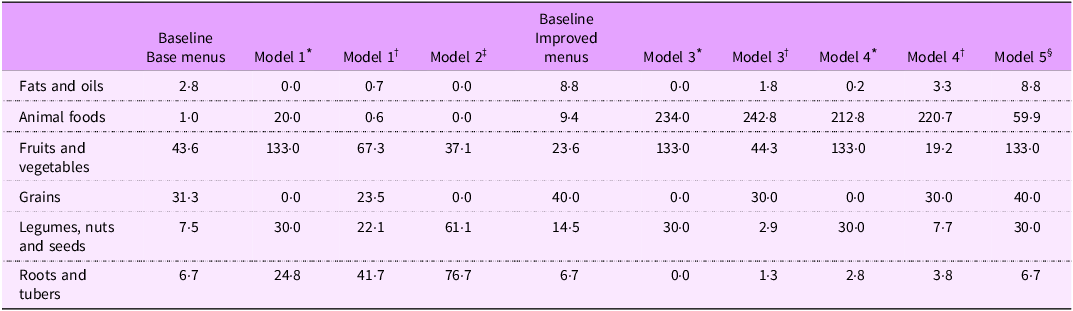
* Model with cost, nutrient and food-based constraints.
† Model with cost, nutrient and acceptability constraints.
‡ Model with cost and nutrient constraints only (a feasible solution could not be achieved when including either food-based or acceptability constraints; hence, results are only available for one run of model 2).
§ Model without a cost constraint but with nutrient, food-based and acceptability constraints.
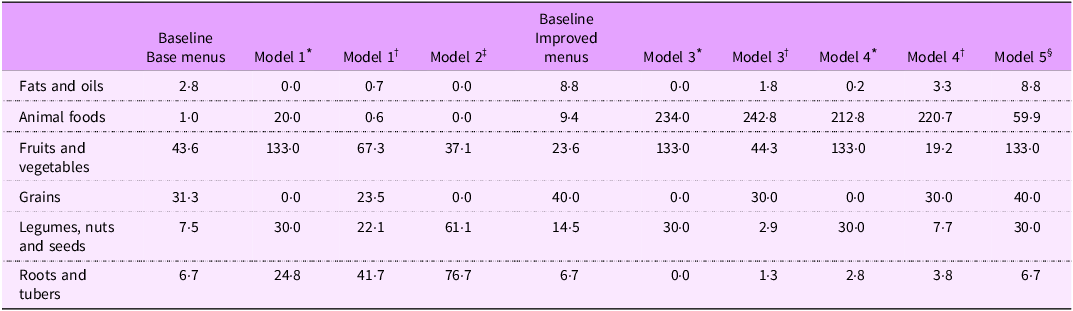
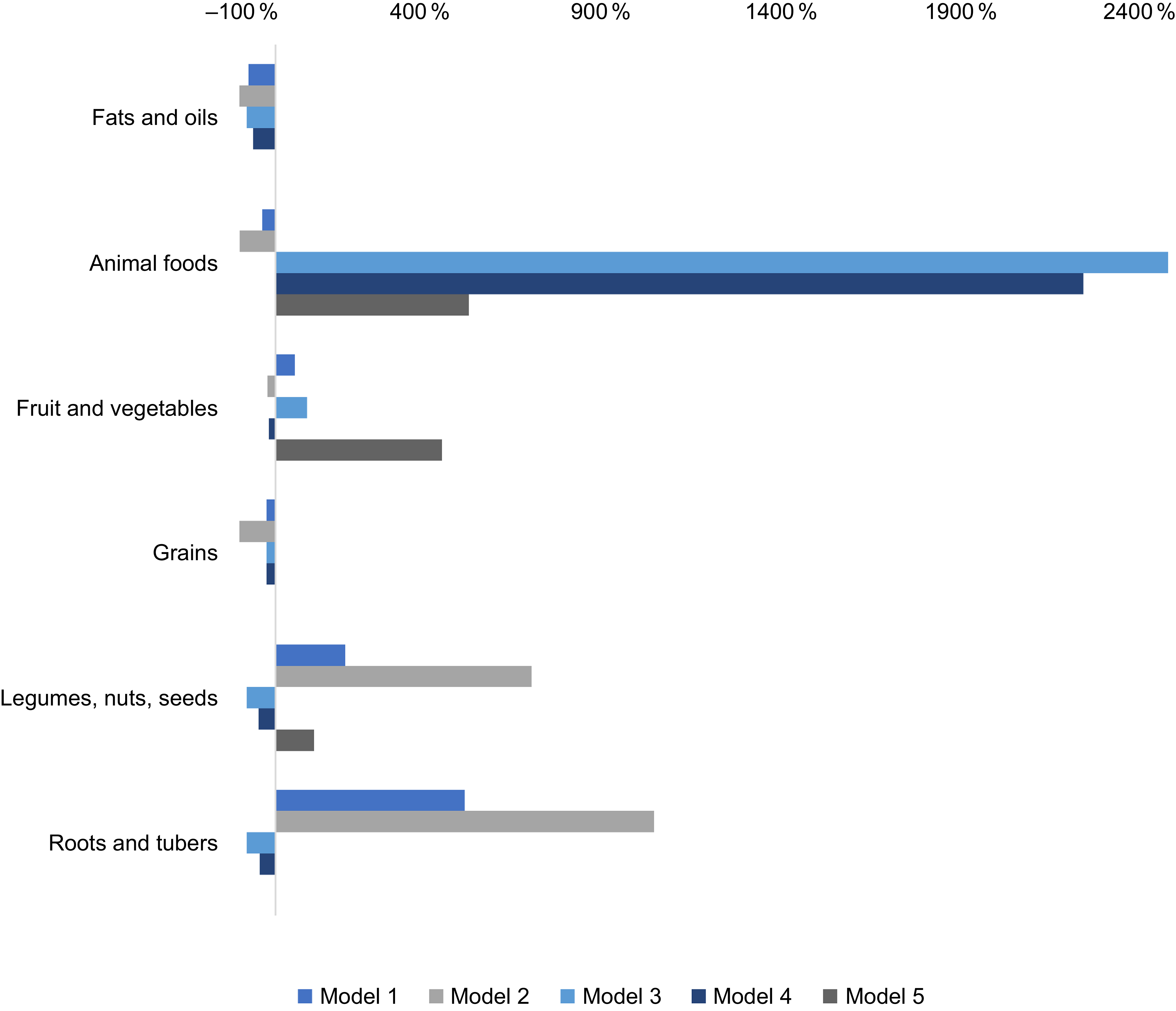
In general, favouring food-based targets over cultural acceptability within a constrained budget meant the exclusion of entire food groups and large increases in others (Figure 1, Table 4). For example, all models excluding acceptability constraints completely/nearly eliminated fats and oils and grains, and in two cases (models 3 and 4), roots and tubers, given that there were no explicit food targets defined for such groups. At the same time, large increases were seen in other food groups such as animal foods that increased 20–25-fold in models 1, 3 and 4.
Changes in food groups in models 1–5 following optimisation. Models 1, 3 and 4 include nutrient, cost and acceptability constraints. Model 2 includes only nutrient and cost constraints. Model 5 includes nutrient, food-based and acceptability constraints.

When favouring acceptability constraints over food-based constraints, no food group was eliminated and the changes to food groups are more balanced (except for animal foods that increase considerably in most models) (Figure 1, Table 4). The model without a budget constraint and with both acceptability and food-based constraints included (model 5) was the most conservative with regard to changes in food groups (Figure 1, Table 4). Here, fats and oils, grains, and roots and tubers remained completely unchanged, and the remaining food groups only increased by about 100–500 % compared to baseline school food baskets (Figure 1).
Compared to the baseline school food baskets, GHGE increased in almost all models (up to +347 % in model 3 with only FBDG and no acceptability constraints) (Table 3) due to the abovementioned increase in animal foods in the optimised school food baskets compared to baseline (Table 4). Similarly, WU was increased in all models but models 1 and 2 (Table 3).
Discussion
Main findings
In this study, LP was demonstrated to be capable of guiding the development of more nutritionally adequate and cost-effective meals for school-aged children in Ghana. Our findings show that baseline school food baskets were significantly deficient in energy, protein and several critical micronutrients, with substantial disparities from nutrient targets. This deficiency reflects the fact that the children receive too little food with inadequate micronutrient density. The optimised diets, derived from our model, addressed these deficiencies while at the same time adhering to defined cost constraints, ranging between US$ 0·10 and US$ 0·13. However, when meeting these cost benchmarks, the optimised school food baskets exhibited considerable deviations from baseline amounts, indicating that achieving nutrient adequacy with a limited budget may require pronounced changes to established school meal provisioning. Moreover, it was noted that food-based constraints could only be met effectively when acceptability constraints, applied to minimise the deviation of individual foods from baseline school food supplies, were excluded, leading to school food baskets omitting entire food groups. The school food baskets examined in Ghanaian schools were found to consist of low nutrient density foods that are not able to provide an adequate proportion of nutrients necessary for healthy growth and development in children. The dramatic changes necessary to achieve nutritional adequacy are caused by the fact that (expensive) foods, particularly of animal origin, are almost absent from the observed school meal food basket. Adding these foods to school meal menus is necessary to provide key micronutrients such as vitamin B12, Fe and Zn. However, meeting nutritional constraints with as little change as possible to the baseline food basket of the Improved menus would cost almost US$ 1 per meal, almost ten times more than the currently available budget when considering operational costs and inflation, highlighting important trade-offs between programme financing, food quality and coverage.
The increased reliance on animal products in the optimised school food baskets contributed to a rise in GHGE, with emissions rising by as much as 347 % compared to baseline school food baskets, surpassing planetary boundaries for climate change(33). Our findings thus highlight the challenge of balancing cost and nutritional needs with consumer preferences and climate targets in the context of limited food diversity and global challenges such as rising food prices.
Interpretation
The baseline school food basket for the Base (current) menus was deficient in multiple nutrients, including Fe, Zn, vitamin A, folate and vitamin B12. This mirrors current deficiencies among Ghanaian children, which include Fe, vitamin A and iodine(Reference Wegmüller, Bentil and Wirth34,Reference Egbi35) . Fe deficiency anaemia is particularly prevalent, affecting 12·2 % of children under five(Reference Wegmüller, Bentil and Wirth34). Vitamin A deficiency affects 20·8 % of children, while iodine deficiency is also common(Reference Wegmüller, Bentil and Wirth34,Reference Egbi35) .
Previous optimisation research in Ghana(Reference Nykänen, Dunning and Aryeetey14) also illustrated the difficulty in achieving nutritional adequacy under financial constraints while considering cultural acceptability. As with the school meals in the study at hand, vitamins A, B12 and C also appeared as active constraints in highly affordable diets for Ghanaian families(Reference Nykänen, Dunning and Aryeetey14). However, the nutritionally optimised school food baskets for Ghanaian families deviated considerably less from the baseline consumption compared to the ARD values found in this study, primarily due to the much larger number of foods (n 152). Therefore, expanding the number of foods being used for Ghanaian school menus (n 45) with those available at Ghanaian markets may achieve nutritionally adequate menus at lower cost than those found in the current study. The foods selected for this menu improvement could be chosen particularly with respect to cost and nutrient density for nutrients that appear as active constraints (Zn and the vitamins A, B12 and C). One example of such a food is red palm oil, an affordable resource for vitamin A(Reference Rice and Burns36).
In our study, food-based constraints were only successfully met when acceptability constraints were removed, which resulted in the exclusion of entire food groups from the school meal provisions. This is grounded on suggested goals of implementing minimum amounts (rather than ranges) of fruits, vegetables, pulses and ASF. These goals deviate considerably from the reality of Ghanaian school menus, explaining the difficulty in achieving optimised solutions for nutritional adequacy which closely resemble what is currently provided. This applies particularly to ASF, which can significantly improve growth, cognitive function and academic performance(Reference Grillenberger, Neumann and Murphy37,Reference Khonje and Qaim38) . The benefits of ASF are presumably attributed to their high content of bioavailable micronutrients, including Fe, Zn, vitamin B12 and vitamin A(Reference Beal39), which also appeared as active constraints in the optimised models of this study. However, access to ASF remains limited in many LMIC, and more research is needed to determine optimal intake levels and strategies for increasing ASF consumption among vulnerable populations(Reference Eaton, Rothpletz-Puglia and Dreker40).
The optimisation of school meals in Ghana, while adhering to nutritional and cost constraints, resulted in an increase of animal products and GHGE in nearly all models applied. This stands in contrast to similar optimisation of diets/school meals in high-income countries such as Sweden(Reference Eustachio Colombo, Patterson and Lindroos15,Reference Eustachio Colombo, Elinder and Lindroos41,Reference Eustachio Colombo, Elinder and Nykänen42) , the UK(Reference Milner, Green and Dangour43) and Germany(Reference Masino, Eustachio Colombo and Reis44), where nutritionally adequate and sustainable diets were achieved by a reduction of animal product consumption. This discrepancy is understandable, given that baseline diets in these high-income countries typically are much more expensive, containing a considerably higher proportion of animal products. Furthermore, diets in high-income countries typically exhibit a large overall food diversity. This diversity allows for nutritional inadequacies to be addressed much more easily, compared with the limited spectrum of foods used for school meals in Ghana. Food diversity thus seems to bear important weight when determining model outcomes. Supporting this perspective, research from Mozambique(Reference Parlesak, Geelhoed and Robertson45) found that increasing food diversity would increase the cost 3-fold compared to a minimum cost diet. The same study showed that optimising food baskets using local, nutrient-dense foods could meet nutrient recommendations. It also emphasised the higher cost associated with achieving a fully nutritious basket which also remains culturally acceptable. Our model without a cost constraint (model 5) aligns with these findings, being the model with the lowest deviation from baseline, but with the highest cost.
Strengths and limitations
Our study employed a robust optimisation framework that aimed to balance nutritional adequacy with cost and cultural acceptability constraints, allowing for a detailed analysis of how different scenario for school meals in Ghana could be designed. It combines an array of plausible scenarios for designing improved school meals in Ghana within limited budgets, based on real local data on school food baskets. By explicitly examining food-based constraints, the study highlights the importance of integrating more diverse food groups into meal planning, thus ensuring that dietary diversity is addressed in the formulations.
Our models are limited by the fact that they only operate based on the foods that were available from the collected data/selected recipes. Achieving full nutritional adequacy for Ghanaian school meals, potentially other nutrients and foods should also be considered. For example, iodine deficiency is a persistent health problem for children in West Africa(Reference Wegmüller, Bentil and Wirth34). Future optimisation studies could investigate what other foods could be available at local level, through home-grown school feeding, and explore the potential of incorporating such foods into the optimisation models. Future optimisation studies could also investigate what other foods could be available at local level that could be promoted through home-grown school feeding. For example, African indigenous leafy vegetables have been associated with increased dietary diversity and improved micronutrient levels, including Zn, Fe and vitamin A(Reference Wakhanu, Nyambaka and Kimiywe46,Reference Lubeka, Kimiywe and Nyambaka47) . In addition, fortified staples such as wheat and maize flour, as well as biofortified foods such as orange-fleshed sweet potato and high-Fe/Zn millet and maize commonly used in Ghana, could contribute to closing persistent micronutrient gaps without substantially increasing meal costs or environmental impacts. Expanding the food list in the optimisation models to include both indigenous and fortified/biofortified foods could allow key limiting micronutrients to be met more cost efficiently and sustainably than relying on increased consumption of ASF alone.
Another limitation of our models relates to budget constraints. While the standard GSFP allocation is US$ 0·12 per child per meal, one scenario incorporated an increased budget of US$ 0·16 per child, reflecting additional donor funding aimed at improving the protein content of the meals. Although this scenario demonstrates potential nutritional gains, the higher budget represents a substantial increase over routine allocations, highlighting challenges for financial feasibility and long-term scalability. While donor support can temporarily enhance meal quality, sustainable implementation would require mechanisms to maintain these improvements, particularly given the higher costs associated with including protein-rich foods and ASF.
The necessity to exclude acceptability constraints (in this case aiming to reflect both local food preferences and what the cooks prepare which is dictated by budget constraints) in order to meet food-based targets may limit the practical applicability of the optimised school food baskets. This could lead to scenarios that are not feasible in real-world settings where local conditions (e.g. budgets available to provide school meals) and preferences play a significant role. The exclusion of entire food groups – in the absence of explicit targets for such groups – when acceptability constraints are removed also raises concerns about the nutritional quality of meals, which may arise from a deficient supply of nutrients not considered in the current optimisations. This could lead to diets that, while optimised for cost and some nutrient targets, may still be deficient in other important vitamins, minerals or macronutrients such as iodine, vitamin E and PUFA (n-3 and n-6). Furthermore, the specific context of the study may limit the generalisability of the findings to other regions or settings that have different cultural, economic and dietary practices. Without a diverse array of contexts being tested, the conclusions may not apply universally.
While optimisation provides a useful approach to create food baskets that consider multiple priorities at the same time, this approach requires advanced technical expertise and significant time investment, limiting scalability in the context of meal planning. For meal planning, there is a need for more user-friendly solutions that cater to the needs of cooks and caterers responsible for delivering and preparing school meals in practice in countries like Ghana.
Conclusions
In summary, this study highlights the utility of LP as a powerful tool for optimising school food baskets in Ghana and for understanding the complex synergies and trade-offs between nutritional adequacy, cost-effectiveness, cultural acceptability and environmental sustainability. The results reveal significant deficiencies in current school meal menus in Ghana, indicating an urgent need for improvement in the service delivery. Furthermore, our findings indicate that current inflationary trends are likely to exacerbate the challenge of meeting targets for nutrients, food groups and palatability with existing budget allocations. Current budgets will likely need to be increased up to 6-fold to meet all requirements for nutrients, food groups and feasibility/cultural acceptability. Though current environmental bounds for the programme are low, GHGE and WU projections for Improved menus will require attention as the programme service improves. Important gaps remain in terms of providing guidance on how to operationalise these findings, including in the short term with current funding constraints. On the medium term, evidence from this study suggests that government planners and development partners increase the financial investment in the GSFP to enable the programme to achieve its ultimate goal of creating a healthier, more equitable food environment for children in Ghana, whilst also recognising that addressing local realities, governance and related constraints will be crucial for the success and sustainability of programmes.
Supplementary material
For supplementary material accompanying this paper visit https://doi.org/10.1017/S136898002610247X
Acknowledgements
Not applicable.
Ethics of human subject participation
This study was categorised as non-human-subjects research.
Authorship
P.E.C. conceived, conducted and interpreted the research, analysed the data, drafted the paper and had primary responsibility for the final content. A.P. contributed to design of the methodology, interpreted the research and critically revised the paper. G.F., B.B., A.A-T., G.A. and L.A-S. provided data, interpreted the research and critically revised the paper. M.V. and R.A. interpreted the research and critically revised the paper. A.G. conceived and interpreted the research, critically revised the paper and maintained study oversight. All authors have read and approved the final manuscript.
Financial support
This research received no specific grant from any funding agency, commercial or not-for-profit sectors.
Competing interests
There are no conflicts of interest.


 Open access

