





Introduction
Social cognition is the ability to perceive, interpret, and respond to social cues and is a fundamental aspect of human development, as it shapes interactions and relationships throughout the lifespan (Baron-Cohen et al., Reference Baron-Cohen, Tager-Flusberg and Cohen2000; Frith & Frith, Reference Frith and Frith2003; Grusec, Reference Grusec, Parke, Ornstein, Rieser and Zahn-Waxler1994). It comprises skills such as emotion recognition, social communication, and understanding of others’ intentions, all of which are critical for successful social functioning. Normative development of social cognition typically shows gradual improvement from early childhood through adolescence (Blakemore, Reference Blakemore2008; Burnett et al., Reference Burnett, Sebastian, Kadosh and Blakemore2011). However, individual trajectories can vary, and early adversity may disrupt or delay this progress, in turn raising the risk for later social and emotional difficulties, including vulnerability to psychopathology (Crick & Dodge, Reference Crick and Dodge1994).Early exposure to adversity has long been associated with impairments across both childhood and adolescence in several social cognitive skills, including social functioning, language, and emotion understanding (Barker et al., Reference Barker, Walton and Cecil2018; Buss et al., Reference Buss, Davis, Shahbaba, Pruessner, Head and Sandman2012; Essex et al., Reference Essex, Shirtcliff, Burk, Ruttle, Klein, Slattery, Kalin and Armstrong2011). Thus, understanding the developmental trajectories of social cognitive skills in the general youth population and the role of early adversity in their variability is very important.
This study was carried out to address this gap. Informed by developmental theories that emphasize the importance of both timing and accumulation of risk, it focused specifically on the potential long-term impact of early-life adversity, particularly during the prenatal and postnatal period, on children’s social cognition. Sensitive period models suggest that during early developmental windows – particularly the prenatal and early postnatal periods – humans are uniquely susceptible to environmental influences due to rapid neurodevelopmental changes (Knudsen, Reference Knudsen2004). In addition, cumulative risk theory that highlights how the accumulation of stressors over time may have additive or synergistic effects on child outcomes also emphasizes the importance of early timing (Evans et al., Reference Evans, Li and Whipple2013). Developmental cascade models further suggest that disruptions in early social and emotional development can lead to a chain of negative consequences across related domains later in life (Masten & Cicchetti, Reference Masten and Cicchetti2010). As such, much interest has been paid over the last twenty years to how early exposure to adversity and stressors – especially during the sensitive prenatal and early postnatal periods – may shape children’s social cognition (Loman & Gunnar, Reference Loman and Gunnar2010). Indeed, there is now much evidence of such a link. For example, social communication difficulties are frequently observed in children exposed to high levels of maternal stress in the prenatal period (Essex et al., Reference Essex, Shirtcliff, Burk, Ruttle, Klein, Slattery, Kalin and Armstrong2011), as are difficulties in emotion recognition, i.e., the interpretation of facial expressions and social signals (Barker et al., Reference Barker, Walton and Cecil2018).
In terms of explanations of this link, maternal prenatal stress has been linked to alterations in fetal neurodevelopment through mechanisms such as heightened maternal cortisol levels (Glover et al., Reference Glover, O’Connor and O’Donnell2010) via dysregulation of the hypothalamic-pituitary-adrenal (HPA) axis (Flouri et al., Reference Flouri, Francesconi, Midouhas and Lewis2020). Elevated maternal cortisol may, in turn, cross the placenta and influence fetal brain development, particularly in areas involved in processing social and emotional cues (Glover et al., Reference Glover, O’Connor and O’Donnell2010; Van den Bergh et al., Reference Van den Bergh, Mulder, Mennes and Glover2005), such as the prefrontal cortex and the amygdala (Buss et al., Reference Buss, Davis, Shahbaba, Pruessner, Head and Sandman2012; Tottenham & Sheridan, Reference Tottenham and Sheridan2010). Evidence from animal studies has also demonstrated that prenatal stress can affect synaptic plasticity and connectivity in these neural circuits, leading to long-term behavioral and social deficits (Charil et al., Reference Charil, Laplante, Vaillancourt and King2010). During the early postnatal period, maternal exposure to stress may also disrupt neurodevelopmental processes in the offspring, albeit via more environmental routes. For example, it can impact infant neurodevelopment by adversely influencing caregiver-infant interactions, attachment, and stability in the environment (Markova & Nguyen, Reference Markova and Nguyen2023; Swain et al., Reference Swain, Kim and Ho2014), leading to disruptions in social learning (Bernier et al., Reference Bernier, Calkins and Bell2016; Campi et al., Reference Campi, Choi, Chen, Holland, Bristol, Sideris, Crais, Watson and Baranek2024). Some recent research has also established the role of another, related, biological process as mediating the link between mother’s exposure to prenatal and early postnatal adversity and child’s social cognition: immune function. For example, Holland et al. (2020) found that early stressor exposure significantly predicted poorer cognitive outcomes, including impairments in social cognition, via alterations in immune function. While our study does not directly test these biological pathways, such findings highlight the plausibility of their role in explaining the effect of early adversity on social cognition.
In conclusion, there is evidence that early adversity, particularly when occurring during the prenatal and early postnatal period, is related to offspring difficulties in social and emotional development. This relationship is thought to reflect the disruption of key neurodevelopmental processes in early life, including brain maturation and stress regulation, which may shape how children perceive and engage in social interactions. However, more research is needed to understand how early maternal adversity may relate to different domains of offspring social cognition, including social communication and emotion recognition, across different stages of development (Beauchamp & Anderson, Reference Beauchamp and Anderson2010). For instance, while social cognitive skills such as emotion recognition typically emerge early and stabilize in late childhood, more complex social communication abilities continue to mature through adolescence (Blakemore, Reference Blakemore2008). These two skills, while related, are supported by partially distinct neurocognitive systems and are taxed differently in the context of different social demands (McClure et al., Reference McClure, Monk, Nelson, Zarahn, Leibenluft, Bilder, Charney, Ernst and Pine2004; Schurz et al., Reference Schurz, Radua, Tholen, Maliske, Margulies, Mars, Sallet and Kanske2021; Uljarevic & Hamilton, Reference Uljarević and Hamilton2013). As such, difficulties in emotion recognition and difficulties in social communication may raise the risk of psychopathology differently.
Our study addressed these questions by examining whether maternal exposure to adverse life events during pregnancy and shortly after birth (until 8 weeks postpartum) predicts difficulties across childhood to adolescence (ages 8 – 17 years) in offspring social cognition, spanning both emotion recognition (at ages 8 and 14) and social communication (at ages 8, 11, 14, and 17). We explored whether these associations differ by social cognitive domain and persist after adjusting for confounders. By having repeated measures of emotion recognition and social communication, we could also test domain-specific sensitivity at two distinct developmental stages – middle childhood and adolescence – when both social demands and underlying neurocognitive maturation differ significantly (Blakemore, Reference Blakemore2008; Happé & Frith, Reference Happé and Frith2014; Mills et al., Reference Mills, Lalonde, Clasen, Giedd and Blakemore2014). Thus, the aim of the current study is to examine whether social cognition difficulties from childhood to adolescence are associated with prenatal and early postnatal stress – specifically maternal exposure to stressful life events in pregnancy and the very early postpartum period – in the general population. We hypothesized that greater maternal exposure to adverse life events during this period would be associated with poorer social communication and poorer emotion recognition in the offspring across development.
Methods and materials
Participants
This study utilized data from the Avon Longitudinal Study of Parents and Children (ALSPAC), a well-established, ongoing birth cohort (Boyd et al., Reference Boyd, Golding, Macleod, Lawlor, Fraser, Henderson, Molloy, Ness, Ring and Davey Smith2013). ALSPAC originally recruited 14,541 pregnant women with expected due dates between April 1991 and December 1992. Over time, additional participants meeting the original eligibility criteria were included when their children reached the age of seven, expanding the cohort to 15,454 pregnancies and a total of 15,589 fetuses. Of these, 14,901 children survived beyond their first birthday (Fraser et al., Reference Fraser, Macdonald-Wallis, Tilling, Boyd, Golding, Davey Smith and Lawlor2013). ALSPAC has conducted annual assessment clinics since the children turned seven, where detailed face-to-face interviews, psychological assessments, and physical examinations were carried out (for further details, see ALSPAC’s data dictionary). Ethical approval for data collection was obtained from the ALSPAC Ethics and Law Committee and relevant NHS Research Ethics Committees (NHS Haydock REC: 10/H1010/70), and all participants provided written informed consent. Social cognition was assessed at multiple developmental stages in ALSPAC, with measures collected at approximately ages 8, 11, 14, and 17 years. For this study, we focused on children who were singletons and had valid data for at least one social cognition measure at any of these time points, resulting in an analytic sample of 10,177 participants.
Measures
Social cognition (ages 8, 11, 14, and 17 years)
This was measured as social communication and emotion recognition using three instruments.
-
a. Parental reports on the Social Communication Disorders Checklist (SCDC) were used to assess social communication skills at ages 8, 11, 14, and 17 years. The SCDC consists of 12 items that evaluate social reciprocity and both verbal and nonverbal communication over the preceding six months. Responses are scored on a scale from 0 (“not true”) to 2 (“very or often true”), with higher total scores reflecting greater difficulties in social communication. To account for missing data, prorated scores were calculated for participants with no more than 50% missing responses. If more than six items were unanswered, the total score was set to missing. Otherwise, the total was adjusted by a scaling factor of 12 divided by the number of completed items and rounded to the nearest whole number. The SCDC has demonstrated strong internal consistency, test–retest reliability, and heritability across sexes (Skuse et al., Reference Skuse, Mandy and Scourfield2005).
-
b. Children’s ability to recognize emotions from facial expressions was assessed using the Diagnostic Analysis of Non-Verbal Accuracy (DANVA) test during a clinic visit at approximately 8 years of age (Nowicki & Duke, Reference Nowicki and Duke1994). This aligns with the test’s intended age range (6 – 10 years) and ensures that its use in our sample is developmentally appropriate. Therefore, the DANVA scores in this study reflect emotion recognition performance in childhood. The faces subtest of the DANVA comprises 24 color photographs of school-aged boys and girls, each displaying one of four emotions: fear, happiness, sadness, or anger. Each image was shown for two seconds, and children were asked to identify the displayed emotion. The photos varied in intensity, classified as either high (easier to recognize) or low (more difficult to recognize). Scoring was based on the number of errors or misattributions per emotion, with separate error counts for high- and low-intensity expressions. In ALSPAC, the distribution of DANVA scores was positively skewed. To address this, cut-off scores for each emotion were established using the top 20% of errors in the cohort, developed in collaboration with the test’s creator, Stephen Nowicki. These cut-offs have been applied in previous ALSPAC-based studies (Barona et al., Reference Barona, Kothari, Skuse and Micali2015; Kothari et al., Reference Kothari, Barona, Treasure and Micali2015; Thompson et al., Reference Thompson, Sullivan, Heron, Thomas, Zammit, Horwood, Harrison and Lewis2011). A score of seven or more errors across all emotions was used to classify children as showing deficits in facial emotion recognition (coded as 1, versus 0 for those with fewer than seven errors). The DANVA has demonstrated strong internal consistency, test–retest reliability, and validity in children aged 6 – 10 years (Nowicki & Duke, Reference Nowicki and Duke1994).
-
c. At age 14, participants completed the computer-based Emotional Triangles test to assess their ability to recognize emotions based on movement patterns. This task involved a black-outlined triangle and a circle, where the triangle’s movements were designed to “convey” specific emotions: happiness, sadness, anger, or fear. For instance, an “angry” triangle was shown repeatedly jabbing at the circle (for further details, see Boraston et al., Reference Boraston, Blakemore, Chilvers and Skuse2007). Each emotion was assessed through four questions – two positive, where the described emotion matched the intended emotion of the triangle (e.g., “Is the triangle happy?” when the movement ‘depicted’ happiness), and two negative, where the described emotion did not match the intended emotion (e.g., “Is the triangle sad?” when the movement was designed to “show” happiness). This resulted in a total of 16 scored questions. Responses were rated on a scale from 0 (“the triangle did not possess the mental state”) to 5 (“the triangle definitely possessed the mental state”). The overall score was calculated by summing responses to positive questions and subtracting responses to negative ones. To ensure all scores remained positive, 40 was added to the final total, creating a range from 0 to 80, consistent with prior studies using this measure (Holland et al., Reference Holland, Khandaker, Dauvermann, Morris, Zammit and Donohoe2020; Warrier & Baron-Cohen, Reference Warrier and Baron-Cohen2018). The Emotional Triangles test has demonstrated strong reliability and validity (Boraston et al., Reference Boraston, Blakemore, Chilvers and Skuse2007).
Life events
Maternal stressful life events were assessed in ALSPAC using checklists completed at two key time points: an antenatal 41-item checklist at 18 weeks of gestation (capturing events since the start of pregnancy) and a postnatal 43-item checklist at 8 weeks postpartum (documenting events occurring since 18 weeks of gestation, i.e., since mid-pregnancy). These measures were adapted from established life event inventories (Barnett et al., Reference Barnett, Hanna and Parker1983; Brown et al., Reference Brown, Sklair, Harris and Birley1973; Honnor et al., Reference Honnor, Zubrick and Stanley1994) and are detailed in Supplementary Table S1. In our analysis we first derived the total life events score for each of the two timepoints. At each time point and for each event, a score of 0 was assigned if the event did not occur and a score of 1 if it did. We then calculated a cumulative adverse life events (ALE) score summing the two events scores. This combined measure was used to capture the overall exposure to adversity during this critical developmental period.
Covariates
We controlled for several confounders, including sex (Dolsen et al., Reference Dolsen, Crosswell and Prather2019; Goel et al., Reference Goel, Workman, Lee, Innala and Viau2014; Hermens et al., Reference Hermens, Kohn, Clarke, Gordon and Williams2005; Thompson and Voyer, Reference Thompson and Voyer2014), ethnicity (Bax et al., Reference Bax, Bard, Cuffe, McKeown and Wolraich2019; Craig et al., Reference Craig, Zhang and Lipp2017; DeSantis et al., Reference DeSantis, Adam, Doane, Mineka, Zinbarg and Craske2007; Richman, Reference Richman2018) and socioeconomic status (SES) (Marsman et al., Reference Marsman, Nederhof, Rosmalen, Oldehinkel, Ormel and Buitelaar2012; Richman, Reference Richman2018; Russell et al., Reference Russell, Ford, Williams and Russell2016) – measured as maternal education and paternal social class (Cuartas, Reference Cuartas2022; Osterhaus et al., Reference Osterhaus, Koerber and Sodian2017).Given the focus on child’s social cognition, we also controlled for mother’s postpartum depression using the Edinburgh Postnatal Depression Scale (Slomian et al., Reference Slomian, Honvo, Emonts, Reginster and Bruyère2019) at 18 weeks postpartum, and child’s Intelligence Quotient (IQ) at age 8 years (around the time social cognition was first measured) using the Wechsler Intelligence Scale for Children. We included maternal postnatal depression as a covariate in view of its strong association with stressor exposure and given its known impact on child socio-emotional development and parenting behaviors (Stein et al., Reference Stein, Pearson, Goodman, Rapa, Rahman, McCallum, Howard and Pariante2014), and we used child IQ to control for general cognitive functioning, associated with social cognitive abilities (Riggs et al., Reference Riggs, Blair and Greenberg2004). Sex, ethnicity, and maternal education were recorded at birth and coded as dichotomous (1 = male vs 2 = female, 1 = white vs 2 = non-white, and 1 = degree vs 0 = non-degree, respectively). Paternal social class was measured as I–V and Armed forces (I = professional occupations, II = managerial and technical occupations, III = skilled occupations, IV = partly skilled occupations, V = unskilled occupations) and then recoded as: 1 = non-manual (I–III) vs 0 = manual (IV – V) with Armed forces removed.
Analytic strategy
All analyses were conducted using Stata 18 (StataCorp, 2019). Descriptive statistics were first calculated to summarize demographic characteristics and social cognition abilities. Pearson’s correlation coefficients were then computed to examine the relationships between all social cognition measures across ages and ALE. Linear and logistic regression models examined the relationships between ALE and emotion recognition scores (i.e., for emotional trianglesscores at age 14 and DANVA cut-offs at age 8, respectively). Finally, growth curve models were employed to investigate the effect of ALE on the trajectory (intercept and slope) of social communication difficulties across the four timepoints (ages 8, 11, 14, and 17). All models were fitted before and after adjustment for covariates. Missingness among the exposures, the outcomes, and the confounders ranged from 0% (sex) to 46.86% (SCDC at age 17). Missing data were handled using multiple imputation by chained equations (MICE) to generate 20 imputed datasets using the mi estimate command in Stata (Azur et al., Reference Azur, Stuart, Frangakis and Leaf2011). Prior to conducting multiple imputation, we examined patterns of missingness across the social cognition outcomes and key covariates which indicated that data were not missing completely at random. This supported the use of multiple imputation under the assumption of data missing at random (MAR), conditional on observed variables (Enders, Reference Enders2010). To assess the robustness of our findings, we estimated all models using both the complete case sample (assuming data missing completely at random, MCAR) and the imputed datasets (assuming MAR). For the growth curve models – our primary longitudinal analysis – we present results from both approaches to highlight consistency across missingness assumptions. For the cross-sectional regression models, results were based on imputed data only, in line with current best practices for handling missing data in longitudinal cohorts with substantial attrition. Finally, to quantify the effect size of the cumulative ALE predictor, we calculated the partial R2, which represents the proportion of residual variance explained uniquely by this variable over and above the covariates. Partial R2 was obtained from the model F-test using the formula partial R2 = (F × df1) / (F × df1 + df2), implemented via Stata’s mi test post-estimation command.
Results
Descriptive statistics
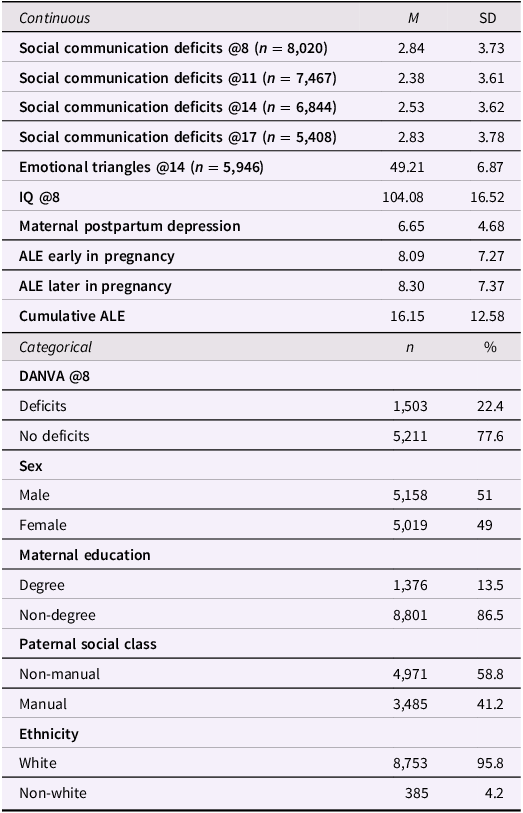
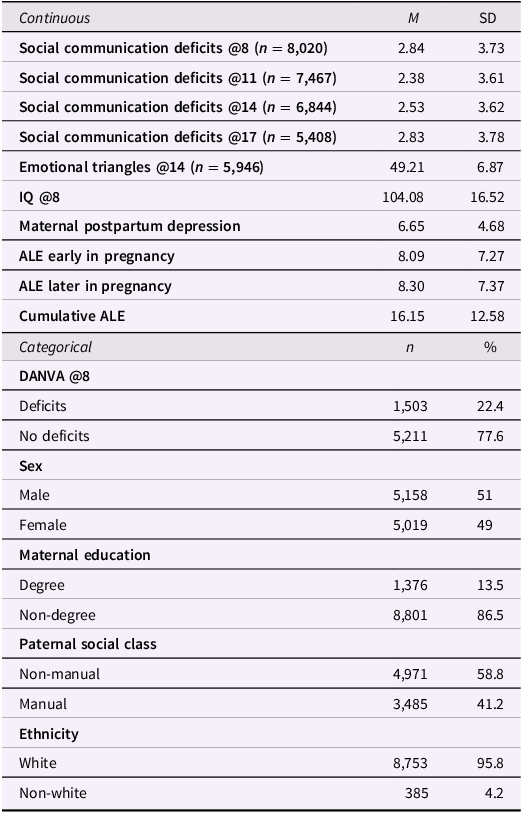
The analytic sample consisted of 10,177 participants from the ALSPAC cohort. As seen in Table 1 below, just over half of the participants were male (51%, n = 5,158). Most identified as white (95.8%, n = 8,753). In terms of SES, 10.7% (n = 1,576) of mothers had a degree, and more than half (58.8%, n = 4,971) of fathers were classified as non-manual workers. Social communication difficulties at age 8 had a mean score of 2.84 (SD = 3.73; n = 8,020). This score slightly decreased by age 11, with a mean of 2.38 (SD = 3.61; n = 7,467), but increased again to 2.53 (SD = 3.62; n = 6,844) at age 14, and 2.83 (SD = 3.78; n = 5,408) by age 17. Emotion recognition, measured through the Emotional Triangles test at age 14, had a mean score of 49.21 (SD = 6.87; n = 5,946). Moreover, deficits in emotion recognition, as assessed by the DANVA at age 8, were observed in 22.4% (n = 1,503) of participants. IQ at age 8 was on average 104.08 (SD = 16.52). Maternal postpartum depression had a mean score of 6.65 (SD = 4.68). ALE earlier and later in pregnancy had similar mean scores, with 8.09 (SD = 7.27) and 8.30 (SD = 7.37), respectively. When combined into a cumulative score, ALE across both time periods averaged 16.15 (SD = 12.58).
Descriptive statistics of the main variables of the study (N = 10,177)
Correlation analysis
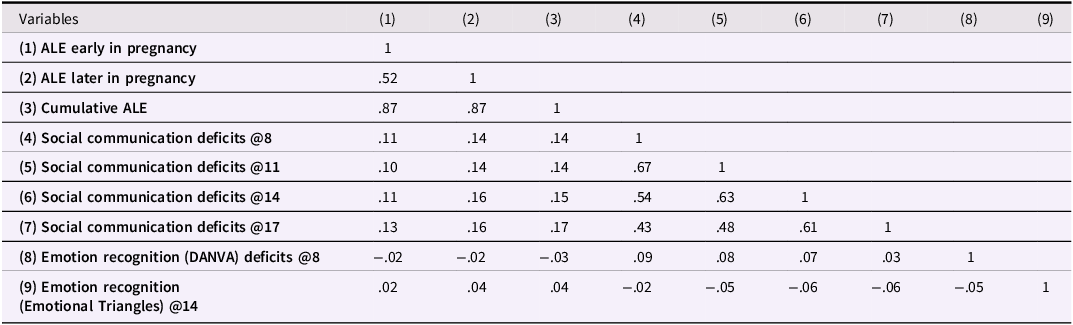
Pairwise correlations examined the associations among ALE, social communication across the four timepoints (8, 11, 14, and 17 years), and emotion recognition abilities (DANVA and Emotional Triangles). The results are presented in table 2. ALE early in pregnancy, ALE later in pregnancy, and the cumulative ALE score were strongly and positively correlated with each other (all p < 0.001). These measures also showed weak but statistically significant positive associations with social communication difficulties at all four ages, with slightly stronger correlations observed at older ages. For example, cumulative ALE showed the strongest association with social communication difficulties at 17 years (r = 0.17, p < 0.001). In terms of emotion recognition, DANVA scores were weakly associated with social communication at earlier ages (e.g., 8 years: r = 0.09, p < 0.001), indicating a very modest relationship between facial emotion recognition and social communication. Emotional Triangles scores also showed weak correlations with social communication at older ages (e.g., 17 years: r = −0.06, p < 0.001), again suggesting these two measures may capture distinct aspects of social–emotional processing. Importantly, the two measures of emotion recognition were also very weakly inter-related, suggesting that facial emotion recognition and emotion recognition using animated stimuli are independent skills. The associations between ALE and emotion recognition at both ages were minimal, but in the opposite to the expected direction, suggesting that ALE exposure increased emotion recognition.
Correlations among the main study variables
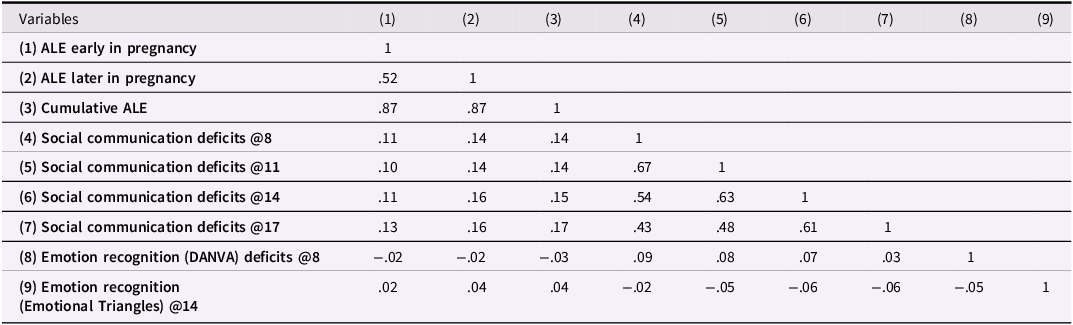
Note. ALE = Adverse Life Events. Values are Pearson correlation coefficients (r). Higher SCDC scores indicate more social communication difficulties; higher DANVA scores indicate greater emotion recognition accuracy.
Regression models
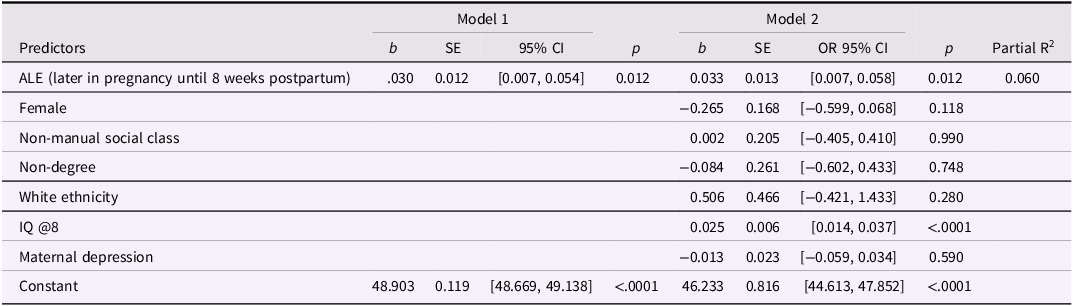
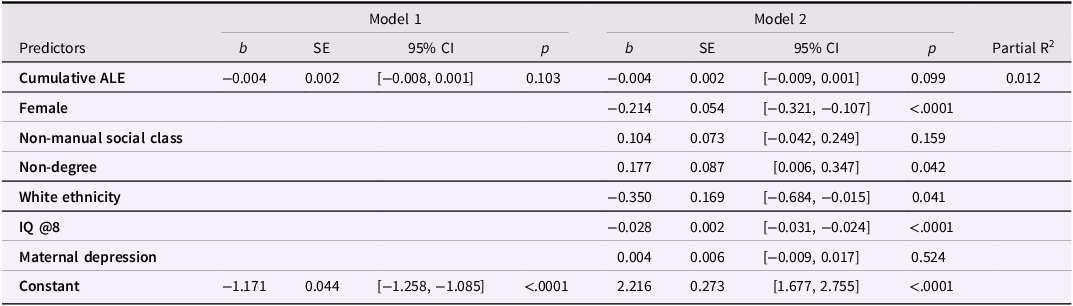
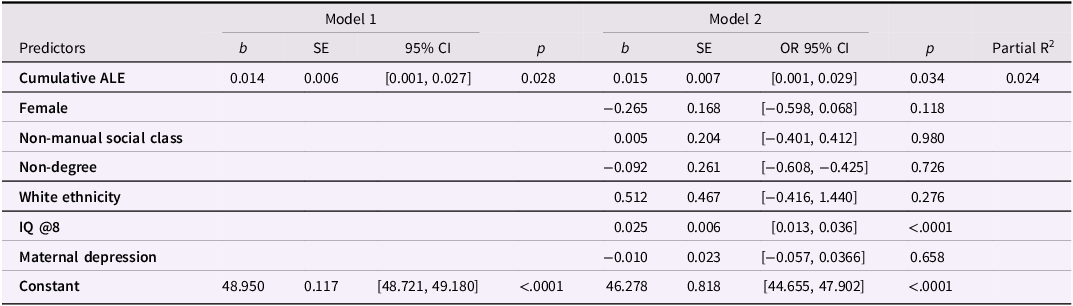
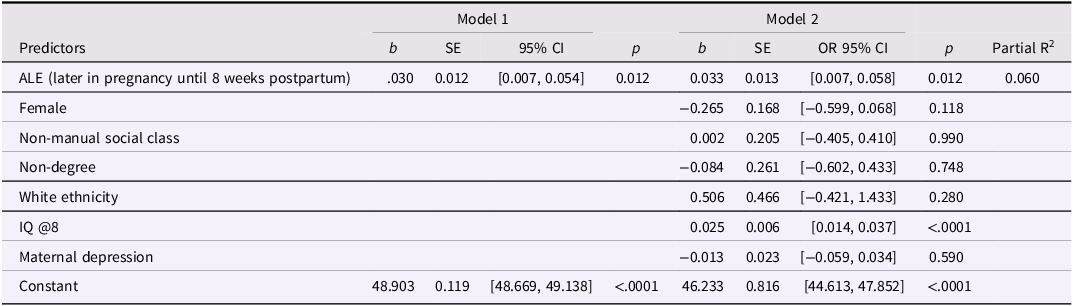
Table 3 presents the logistic regression coefficients of the predictors of emotion recognition abilities (DANVA scores) at age 8 years. In the null model (Model 1), the cumulative ALE score was not significantly associated with emotion recognition and remained nonsignificant in the fully adjusted model (Model 2). Table 4 summarizes the regression results examining the cumulative ALE effect on emotion recognition using the Emotional Triangles test at age 14 years. In the null model (Model 1), cumulative ALE was positively associated with Emotional Triangles scores (b = 0.014, SE = 0.006, z = 2.21, p = 0.028), suggesting that greater exposure to stressful life events was linked to better emotion recognition performance at age 14. This association remained significant in the fully adjusted model (Model 2) (b = 0.015, SE = 0.007, z = 2.14, p = 0.034) too. The effect size was modest, with a partial R2 = 0.024, indicating that cumulative ALE uniquely explained about 2.4% of the variance in emotion recognition scores after adjustment for covariates. To shed light into this unexpected finding we explored the association between each timing of adversity separately. Although adversity in early pregnancy had null effects on emotion recognition at age 14, adversity exposure from mid-pregnancy until the early postpartum period had a positive effect (see Table 5), thus driving the positive cumulative ALE effect on emotion recognition at age 14.
Unstandardized logistic regression coefficients for emotion recognition (DANVA) deficits at age 8 years [n = 10,177 (imputed cases)]
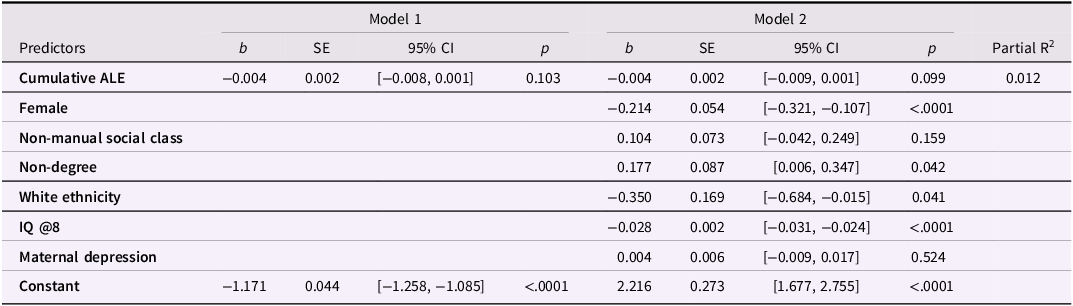
Note. ALE = Adverse Life Events
Unstandardized linear regression coefficients for emotion recognition (Emotional Triangles) at age 14 years [n = 10,177 (imputed cases)]
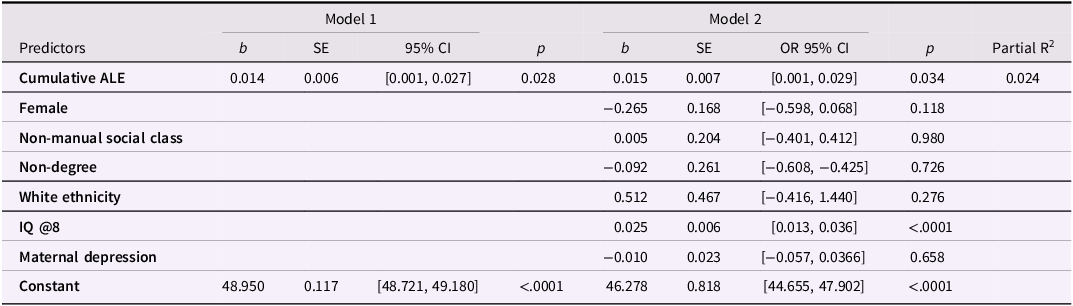
Note. ALE = Adverse Life Events
Unstandardized regression coefficients for emotion recognition (Emotional Triangles) at age 14 years [n = 10,177 (imputed cases)]
Note. ALE = Adverse Life Events
Growth curve models
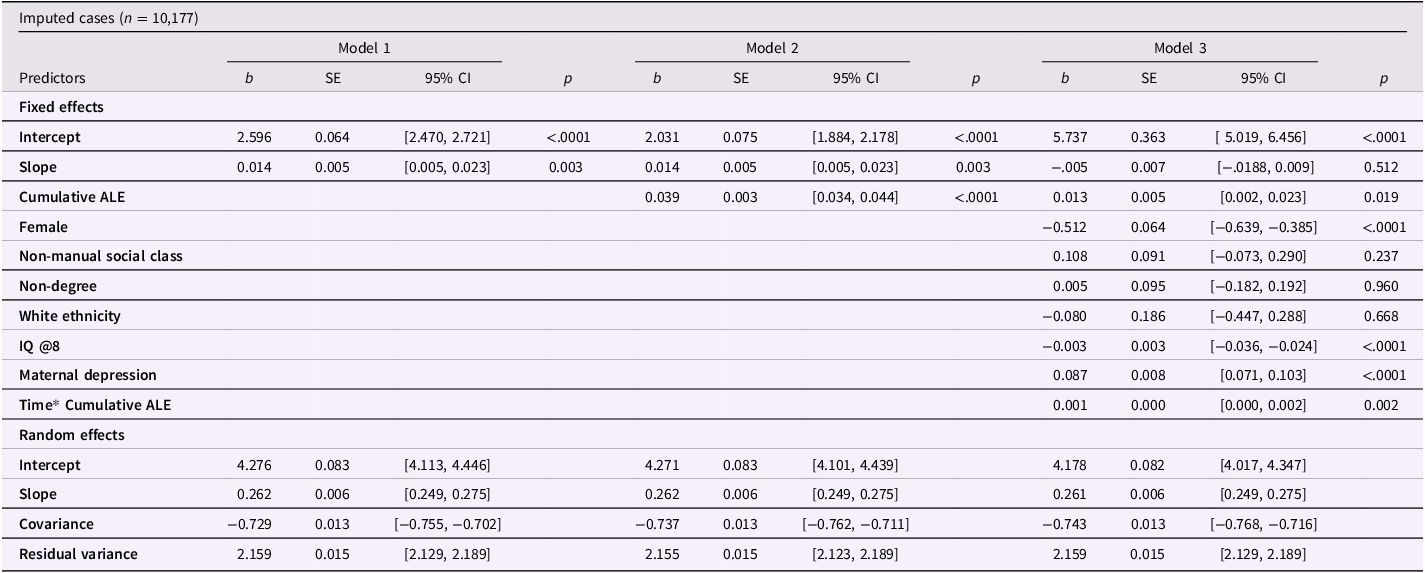
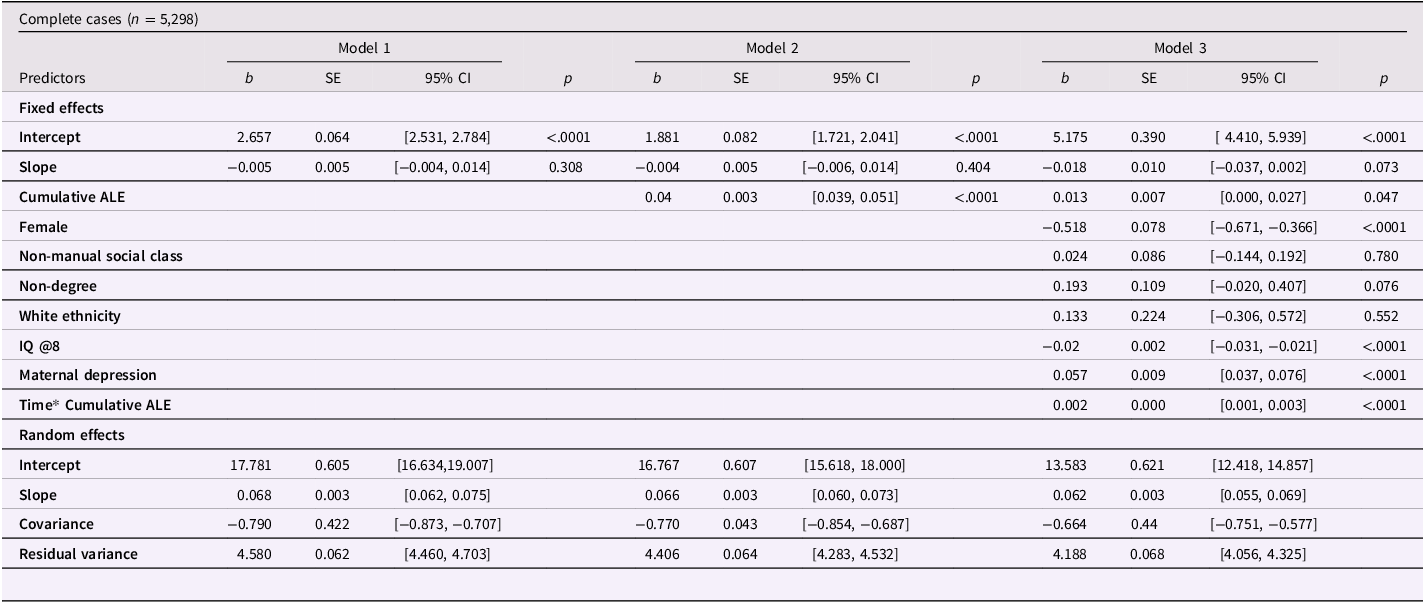
Using growth curve modeling, we examined the role of cumulative ALE on the trajectory of social communication deficits (across ages 8, 11, 14, and 17 years) before and after adjustment for covariates in both imputed (Table 6) and complete cases (Table 7). Model 1 included only the fixed effect of time and showed a significant positive slope, suggesting that, on average, social communication worsened over time. Model 2 introduced cumulative ALE and showed that it was significantly associated with social communication difficulties (b = 0.039, SE = 0.003, p < 0.001). The slope remained positive and significant. Finally, Model 3 which included all the covariates showed that cumulative ALE remained a significant predictor of social communication difficulties (b = 0.013, SE = 0.005, p = 0.019). Importantly, the impact of cumulative ALE on social communication difficulties increased over time (b = 0.001, SE = 0.000, p = 0.002). The growth curve model results on complete cases showed similar trends. As can be seen, cumulative ALE was also a significant predictor in the complete cases models. However, the slope was nonsignificant suggesting no change in social communication difficulties over time, likely due to nonrandom sample loss. Again, the impact of cumulative ALE on social communication difficulties increased over time.
Mixed-effects regression coefficients for the trajectory of social communication deficits (linear model)
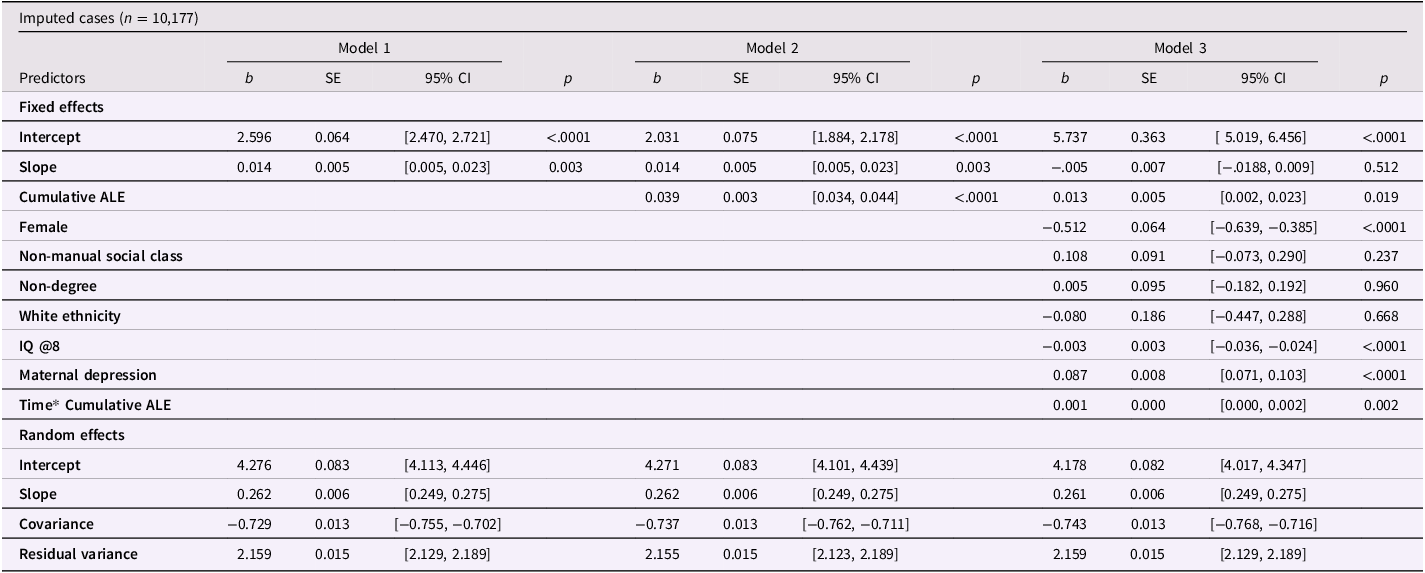
Note. b = Unstandardized regression coefficient; SE = Standard Error, 95% CI = 95% Confidence Interval.
Model 1 = Slopes and intercepts of social communication deficits scores.
Model 2 = Model 1 + cumulative Adverse Life Events (ALE).
Model 3 = Model 2 + sex, social class, maternal degree, ethnicity, IQ, maternal depression, time*cumulative ALE
Mixed-effects regression coefficients for the trajectory of social communication deficits (linear model)
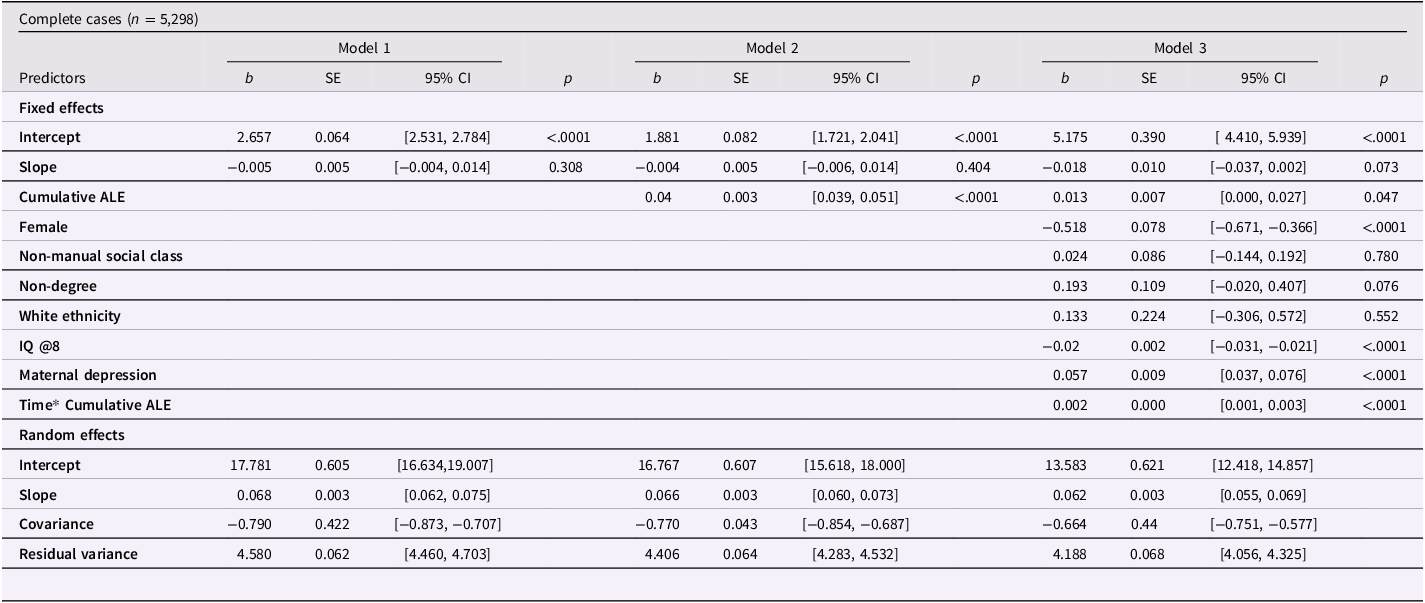
Note. b = Unstandardized regression coefficient; SE = Standard Error, 95% CI = 95% Confidence Interval.
Model 1 = Slopes and intercepts of social communication deficits scores.
Model 2 = Model 1 + cumulative Adverse Life Events (ALE).
Model 3 = Model 2 + sex, social class, maternal degree, ethnicity, IQ, maternal depression, time*cumulative ALE
Supplementary analyses
To shed light on the unexpected finding of a positive link between ALE and emotion recognition at age 14 (Emotional Triangles scores), we also explored the ALE association with specific emotion recognition scores (that is, scores indicating recognition of each of happy, sad, angry, and scared movements). The four scores were moderately and positively inter-related (rs.∼.25). However, all associations with cumulative ALE were nonsignificant, as were all associations with either early ALE or later ALE. Results did not change depending on whether the four specific scores were mutually adjusted in models or not (all results available on request). We also carried out additional analysis to explore any non-linear changes in social communication. We therefore fitted the growth curve model including a quadratic time term. Full results are presented in Supplementary Table S2. This analysis revealed a significant non-linear trajectory of social communication difficulties, with improvements from childhood to early adolescence followed by increases in difficulties in later adolescence. For parsimony and given the small size of the quadratic term effect, however, we decided not to model the ALE × quadratic time term interaction. Finally, we adjusted for maternal ALE in childhood to explore whether early-life ALE rather than ALE across childhood predict social communication difficulties. We therefore adjusted for postnatal maternal ALE exposure up to the first timepoint of SCDC (in ALSPAC this covered maternal ALE from 8 months to 6 years). The association between early-life ALE (i.e., ALE during pregnancy and the very early postpartum period) and offspring social communication remained unchanged (see Supplementary Table S3).
Discussion
This study presented a longitudinal analysis of the relationship between maternal stressor exposure in the prenatal and very early postnatal period and offspring social cognition across childhood and adolescence (ages 8 – 17 years) in the general population. In line with previous research establishing relationships between early-life stress and neurodevelopmental outcomes (Van den Bergh et al., Reference Van den Bergh, Mulder, Mennes and Glover2005; Glover et al., Reference Glover, O’Connor and O’Donnell2018), we found that mother’s exposure to ALE prenatally (i.e., the sum of all stressful events experienced by the mother across pregnancy and the early postpartum period) was inversely associated with child’s social communication. Importantly, it also increased the child’s social communication difficulties over time. This pattern may reflect the growing complexity of social interactions and expectations during adolescence, which can exacerbate social difficulties or make them more visible. As social contexts become more nuanced, children with underlying social communication challenges may struggle to keep up with their peers, leading to greater reported difficulties over time (Norbury et al., Reference Norbury, Gooch, Baird, Charman, Simonoff and Pickles2016). Our findings about social communication skills not showing clear improvement in adolescence are consistent with established developmental frameworks showing that social communication skills continue to mature across adolescence and may be particularly sensitive to early environmental stressors that disrupt key neurodevelopmental processes (Blakemore, Reference Blakemore2008; Van den Bergh et al., Reference Van den Bergh, Mulder, Mennes and Glover2005). Prenatal adversity, our focus, may interfere with the development of neural systems involved in social processing, such as the prefrontal cortex and amygdala, which are known to be sensitive to elevated maternal stress hormones during gestation (Glover et al., Reference Glover, O’Connor and O’Donnell2010; Van den Bergh et al., Reference Van den Bergh, Mulder, Mennes and Glover2005). These early disruptions may result in children experiencing long-term difficulties navigating increasingly complex social environments.
However, the results for the emotion recognition scores (DANVA at age 8 and Emotional Triangles at age 14) revealed distinct patterns in relation to prenatal ALE exposure. According to the findings for the DANVA test, mother’s cumulative ALE was not a significant predictor, suggesting that early-life adversities did not measurably impact children’s ability to recognize emotions from facial expressions. This aligns with research showing that static facial expression tests may not fully capture any nuanced changes in social and emotional processing that develop in response to adversity (Pelzl et al., Reference Pelzl, Travers-Podmaniczky, Brück, Jacob, Hoffmann, Martinelli, Hölz, Wabersich-Flad and Wildgruber2023). As the DANVA test was only administered once, it is also possible that this null finding may underestimate any longitudinal patterns in emotion recognition associated with early-life stress. In contrast, the findings for the Emotional Triangles test suggested that maternal exposure to ALE across pregnancy and the early postpartum period was positively associated with offspring performance in recognizing emotions from nonverbal movement-based cues. This result, though seemingly counterintuitive, aligns with theories suggesting that children exposed to adversity may develop heightened sensitivity to social cues in dynamic and unpredictable environments as an adaptive survival mechanism (Jiang et al., Reference Jiang, Zong, Zheng, Tang, Xia, Lu and Liu2020; Livingstone & Russo, Reference Livingstone and Russo2018).
The divergent findings across the social cognition measures in this study likely reflect both developmental and task-specific differences. Social communication, as measured by the SCDC, captures a broad range of real-world interpersonal challenges that may accumulate or become more visible with age, particularly during adolescence when social demands increase. On the other hand, tasks like the DANVA and Emotional Triangles focus on more specific perceptual skills and are carried out in structured settings. Therefore, they may not pick up on the more subtle effects of early adversity, or they may simply follow different developmental paths. This highlights the importance of viewing social cognition as comprising distinct but related skills, with some areas potentially being more sensitive to early stressor exposure than others.
It is also important to highlight that this ALE effect on the Emotional Triangles score at age 14 was driven by ALE exposure from mid-pregnancy until the early postpartum period, rather than ALE exposure very early in gestation. Previous research has shown that socioemotional functioning in infancy is related to maternal stressor exposure later rather than early in gestation (Class et al., Reference Class, Abel, Khashan, Rickert, Dalman, Larsson, Hultman, Långström, Lichtenstein and D‘Onofrio2014; Hendrix et al., Reference Hendrix, Brown, McKenna, Dunlop, Corwin and Brennan2022; Korja et al., Reference Korja, Nolvi, Grant and McMahon2017; Rice et al., Reference Rice, Harold, Boivin, van den Bree, Hay and Thapar2010). Our study builds on and extends these findings. To the degree that emotion recognition is an integral part of socioemotional functioning, our study suggests that even socioemotional functioning much later in development (i.e., from middle childhood to late adolescence) is related to level of maternal stressor exposure later in gestation and the early postpartum period, with adversity exposure very early in gestation (first 18 weeks of pregnancy) having no effect. However, in our case the effect was positive rather than negative. Our supplementary analyses did not suggest that this pattern was driven by performance in recognizing particular emotions, and our adjustment for important confounders and potential mediators including maternal postnatal depression and child IQ precludes two alternative explanations: first, that mother’s exposure to these stressors increases her risk of postnatal depression and subsequently her child’s hypervigilance to the mother’s state; and second, that mother’s exposure to these stressors impairs the child’s cognitive function resulting in over-mentalizing. Nonetheless, the low correlation between the two emotion recognition tasks remains a concern.
Our study has some notable strengths. It drew on comprehensive, standardized inventories of maternally reported ALE at 18 weeks gestation and 8 weeks postpartum, allowing the creation of a detailed cumulative score across a clearly defined perinatal window (from the beginning of pregnancy to 2 months after birth). We note however that this design alone cannot confirm whether these timepoints represent uniquely sensitive periods for the development of social cognition. Still, our supplementary analysis adjusting for maternal ALE reported thereafter (in ALSPAC from 8 months to 6 years) showed that associations between early-life ALE and offspring social communication remained unchanged. This strengthens the case for the distinct importance of the perinatal period for offspring social cognition. Nevertheless, we urge future research to compare ALE effects across multiple developmental periods for different child outcomes (Crawford et al., Reference Crawford, Schrock and Evans2022).
Our study has also some significant limitations. While it addresses important gaps in understanding the role of prenatal ALE exposure in offspring social cognition, reliance on parent-reported SCDC scores to measure offspring social communication may introduce biases due to subjective parental perceptions (Skuse et al., Reference Skuse, Mandy and Scourfield2005). Although objective measures like the DANVA and Emotional Triangles were included, expanding the range of behavioral assessments, and across time, could provide an even more comprehensive and precise evaluation of social cognition and its development (Nowicki & Duke, Reference Nowicki and Duke1994; White et al., Reference White, Coniston, Rogers and Frith2011). Importantly, in our study the slope of social communication difficulties over time was only statistically significant in the imputed sample, but not in the complete case analysis, suggesting that missing data may have attenuated the estimate due to reduced power or sample bias. This highlights the importance of addressing selective attrition in longitudinal designs. Furthermore, the observational nature of this study makes it difficult to draw firm conclusions about causal relationships. Finally, the measures available in ALSPAC for our period of interest capture only some aspects of social cognition. Social cognition encompasses multiple sub-domains, including emotion recognition, social perception (interpreting social cues and context), Theory of Mind (understanding and differentiating others’ mental states), and attribution (drawing inferences about the causes of actions or events). Future research, for example, could investigate how maternal stress exposure during pregnancy may influence the development of attribution skills throughout childhood and adolescence.
Conclusion
In conclusion, this study underlined the lasting impact of prenatal adversity on offspring social communication from childhood through adolescence and highlighted the critical need to address maternal stressor exposure in pregnancy and the early postpartum period to support this aspect of social cognition in children. The impact of prenatal adversity on offspring emotion recognition (measured in childhood as interpretation of facial expressions and in adolescence as recognition of equivalent emotions based on the movement of abstract stimuli) was weaker and less consistent. In fact, there was some evidence that mother’s adversity exposure, especially from mid-pregnancy to the early postpartum period, was somewhat promotive of emotion recognition in adolescence. This in turn suggests that social communication and emotion recognition are related but distinct social cognitive skills. Although our main focus was on early adversity, supplementary analyses adjusting for mother’s stressor exposure across her child’s infancy and childhood showed no change in the main findings, suggesting a distinct role of the perinatal period. Still, the potential influence of later adversity warrants further study.
Future research should delve deeper into how maternal ALE exposure prenatally affects offspring social cognition across sub-domains, using approaches like longitudinal mediation analyses or experimental designs to clarify underlying mechanisms. To enhance validity, future studies should also incorporate a wider range of observer-rated or performance-based measures of social cognition, reducing reliance on single informants. Finally, exploring resilience factors and creating supportive environments may also help mitigate the effects of prenatal adversity on offspring difficulties in social communication across childhood and adolescence.
Supplementary material
The supplementary material for this article can be found at https://doi.org/10.1017/S0954579425100746.
Data availability statement
The data used in this study are drawn from the Avon Longitudinal Study of Parents and Children (ALSPAC). These data are not publicly available due to participant confidentiality and governance restrictions. Researchers may apply for access to the ALSPAC resource via a managed access system. Full details of the ALSPAC data access policy and application procedures are available at: http://www.bristol.ac.uk/alspac/researchers/access/.
Acknowledgements
We are extremely grateful to all the families who took part in this study, the midwives for their help in recruiting them, and the whole ALSPAC team, including interviewers, computer and laboratory technicians, clerical workers, research scientists, statisticians, volunteers, managers, receptionists, and nurses. We are also grateful to Professor Geoffrey Bird for his helpful suggestions.
Funding statement
“The UK Medical Research Council and Wellcome (Grant ref: 217065/Z/19/Z) and the University of Bristol provide core support for ALSPAC. This publication is the work of the authors and they will serve as guarantors for the contents of this paper. A comprehensive list of grants funding is available on the ALSPAC website (http://www.bristol.ac.uk/alspac/external/documents/grant-acknowledgements.pdf); this research was specifically funded by UK Economic and Social Research Council (Grant ref: ES/P001742/1)”.
Competing interests
The author(s) declare none.
Pre-registration statement
This study was not preregistered.


 Open access

