





Technoference – the everyday interruptions experienced within interpersonal interactions due to smartphone use (McDaniel & Radesky, Reference McDaniel and Radesky2018) – is a routine experience for almost all children, and infants are no exception to this. As parents use their smartphone while parenting, they are likely to be distracted by their device (Radesky et al., Reference Radesky, Kistin, Eisenberg, Gross, Block, Zuckerman and Silverstein2016). Indeed, experimental studies suggest that this distraction may generate risks, particularly to infant emotion regulation, both while the device is in use and for a short period of time thereafter (Myruski et al., Reference Myruski, Gulyayeva, Birk, Pérez-Edgar, Buss and Dennis-Tiwary2018; Tidemann & Melinder, Reference Tidemann and Melinder2022). Within experimental work undertaken in this area, most studies have used modified face-to-face still-face paradigms (FFSF; Tronick et al., Reference Tronick, Als, Adamson, Wise and Brazelton1978) to proxy the experience of technoference for the infant and mother, particularly during the still face (SF) phase of the paradigm.
The FFSF (Tronick et al., Reference Tronick, Als, Adamson, Wise and Brazelton1978), remains the gold standard experimental procedure used across developmental research to explore the relationship between caregiver and infant and is most regularly used with infants aged between 2–12 months (Adamson & Frick, Reference Adamson and Frick2003). In the traditional paradigm, caregiver and infant sit facing each other and move through a series of phases starting with free play (FP), followed by a SF phase, where the caregiver is usually instructed to maintain eye contact with the infant, but to not respond to the infant. Following the SF phase, caregivers are instructed to reengage with their infant in the reunion (RU) phase and to interact with the child again as normal. The FFSF repeatedly evokes specific behaviors in infants, often referred to as the “still-face effect” (Mesman et al., Reference Mesman, van IJzendoorn and Bakermans-Kranenburg2009), whereby infants have been observed to reduce their gaze towards the caregiver and demonstrate increased negative affect, as well as display reduced emotion regulation even after reunion (Legerstee & Markova, Reference Legerstee and Markova2007). Physiological infant reactivity, such as increased heart rate and decreased vagal tone, suggest heightened levels of stress and discomfort in the infant during the SF phase (Haley & Stansbury, Reference Haley and Stansbury2003; Ham & Tronick, Reference Ham and Tronick2006).
Increasingly, researchers focusing on caregiver smartphone use and its effects on infants have moved to using a modified still-face paradigm (SFP). The use of a modified SFP may increase ecological validity by creating an environment that more closely resembles the home environment in which the infant is developing. For example, Myruski et al. (Reference Myruski, Gulyayeva, Birk, Pérez-Edgar, Buss and Dennis-Tiwary2018) devised an SF phase in which mothers were asked to interact only with their mobile device, become unresponsive and allow their infant to play by themselves. Within this modified paradigm, infants were not confined to a chair and had toys available to them throughout the experimental procedure, to mimic the home environment more closely. As in the traditional FFSF, infants demonstrated more negative affect in the SF phase than in both FP and RU phases. Additionally, positive affect was greatest during FP, with significantly less positive affect during SF, and showing an increase during RU, however this did not reach the levels observed during the initial FP phase. Myruski et al. (Reference Myruski, Gulyayeva, Birk, Pérez-Edgar, Buss and Dennis-Tiwary2018) also found that mothers’ self-reported device use was negatively associated with infant positive affect, with infants whose mothers reported using their phone more frequently in the presence of their child showing less positive affect during the period of both the SF and RU phases of the paradigm.
Subsequent studies report similar significant still-face effect behaviors in infants during a modified SFP. Resulting still-face effect behaviors in infants included heightened negative affect, increased self-comforting, and increased escape behaviors during the SF phase of the task, as well as an inability to return to baseline levels of emotional regulation at reunion (Stockdale et al., Reference Stockdale, Porter, Coyne, Essig, Booth, Keenan-Kroff and Schvaneveldt2020; Tidemann & Melinder, Reference Tidemann and Melinder2022). Alongside its impact on infant emotional and behavioral affect, physiological reactions to the modified SFP demonstrate that infants experience increased heart rate during SF conditions (Dinzinger et al., Reference Dinzinger, Greif, Speyer, Wittling, Brisch, Priewasser and Markova2025; Rozenblatt-Perkal et al., Reference Rozenblatt-Perkal, Davidovitch and Gueron-Sela2022), increased parasympathetic activity (Dinzinger et al., Reference Dinzinger, Greif, Speyer, Wittling, Brisch, Priewasser and Markova2025), as well as reductions in forehead temperature (Nazzari et al., Reference Nazzari, Zangrandi, Bottini, Salvato and Provenzi2025). These reactions correlate to increased negative affect, suggesting higher levels of physiological and emotional distress are experienced by the infant when the mother engages with her phone. The results from this body of work have led researchers to assert that unresponsiveness, as demonstrated during the SF phase of the traditional FFSF paradigm, may be experienced by infants in a similar way to unresponsiveness created through technoference (Rozenblatt-Perkal et al., Reference Rozenblatt-Perkal, Davidovitch and Gueron-Sela2022). Across the majority of these studies, infants were aged between 6–24 months. Only Nazzari et al. (Reference Nazzari, Zangrandi, Bottini, Salvato and Provenzi2025) looked at infants aged below 6 months (3–5 months). This suggests that there is a paucity of research focusing on parent–infant dyads under the age of 6 months.
In the first year of life, infants are often still developing the skills needed for self-regulation (Pinto & Figueiredo, Reference Pinto and Figueiredo2023). To ensure this development, mothers will engage infants in co-regulation processes as part of their interactions, gradually developing the infant’s capacity to regulate their emotions independently (Jaffe et al., Reference Jaffe, Beebe, Feldstein, Crown, Jasnow, Rochat and Stern2001; Schore & Schore, Reference Schore and Schore2008). Dyadic processes that contribute to this gradual development, such as intersubjectivity (Trevarthen, Reference Trevarthen and Olsen1980), have been evidenced as becoming more concrete at around the age of 3 months. Through intersubjectivity, infants become more aware that their own behaviors are both influenced by, and have influence over, others. Therefore, 3–6 months is a critical developmental stage for self- and co-regulatory behaviors in the infant. As part of this co-regulation, Beebe (Reference Beebe2010) suggested that the mother will often coordinate and synchronize their own behavior to match that of the infant in an attempt to “join the baby’s distress” – providing opportunities for the infant to make meaning of their own feelings through the mother’s recognition and validation. Accordingly, in situations where the infant is exhibiting elevated distress, it is likely that the mother will simultaneously demonstrate higher levels of negative affect behaviors, leading to synchronous negative behavioral affect (Beebe, Reference Beebe2010; Provenzi et al., Reference Provenzi, Borgatti, Menozzi and Montirosso2015). Indeed, in instances where infants demonstrate significantly increased distress, such as during the FFSF, upon reunion, mothers have been observed regularly to engage in synchronous behavioral strategies to encourage the child to return to a state of baseline emotional affect (MacLean et al., Reference MacLean, Rynes, Aragón, Caprihan, Phillips and Lowe2014). However, in joining the baby in their distress, Beebe (Reference Beebe2010) suggests that the synchronous behaviors should match in rhythm only, rather than intensity or volume; at which point the mother may also start to experience her own distress, causing a breakdown in the regulatory capacity of the dyad.
The application of synchronous co-regulation techniques following technoference may be instrumental in understanding how mother–infant dyads navigate the distress caused by these daily instances of maternal smartphone use. However, as research on how smartphone use impacts mother–infant interactions is relatively new, there is limited published work in this area. Previous modified SFPs have focused on infant behavior and affect across experimental conditions (e.g., Myruski et al., Reference Myruski, Gulyayeva, Birk, Pérez-Edgar, Buss and Dennis-Tiwary2018; Stockdale et al., Reference Stockdale, Porter, Coyne, Essig, Booth, Keenan-Kroff and Schvaneveldt2020; Tidemann & Melinder, Reference Tidemann and Melinder2022). These studies are unanimous in reporting that smartphone use causes distress to the infant. However, there is little research on how mother and infant may use co-regulation strategies following episodes of technoference, and what this can tell us about how experiences of technoference might be mitigated in a world where parental smartphone use is almost ubiquitous and often unavoidable.
Additionally, while existing research has so far shown that technoference is likely to cause distress, little work has been done to explore whether differential modes of maternal phone use cause the same levels of distress or whether these are distinctive. Smartphone use research outside of developmental psychology has shown that texting causes significantly more cognitive absorption to the user compared to talking on the phone (Lamberg & Muratori, Reference Lamberg and Muratori2012). It may be the case that texting is likely to cause mothers to demonstrate higher levels of cognitive absorption in their device, which may in turn cause infants to perceive higher levels of maternal unresponsiveness. As it is this maternal unresponsiveness which appears to cause distress to the infant (Rozenblatt-Perkal et al., Reference Rozenblatt-Perkal, Davidovitch and Gueron-Sela2022), differences in cognitive absorption could represent a potential impacting factor. Additionally, maternal gaze as well as maternal vocal affect (i.e., hearing the mother’s voice even when she is not directing speech at the infant) might still be experienced by the infant during a phone call, while this is less likely to occur when the parent is focused on texting. These behaviors may serve as instances of non-physical connection, allowing parent and infant to co-regulate even when a physical connection between the two has been disrupted (Beebe, Reference Beebe2010). However, no research to date has explored whether different modes of phone use may directly impact on how the infant experiences periods of technoference, potentially causing different levels of distress, and how this may impact mother–infant co-regulation, particularly in this younger age group, following the experience.
Aims & hypotheses
The novel aims of this pilot study were,
-
i. to explore the impact that smartphone use has on synchronous mother–infant interactions immediately after a period of technoference, and
-
ii. to explore any differences in synchronous mother–infant interactions after different modes of smartphone use (e.g., texting vs audio call)
Exploratory hypotheses were based on existing literature in the area:
-
i. Mother–infant dyads will demonstrate a change in behavioral affective strategies after technoference as they attempt to co-regulate and repair the disruption to their interaction
-
ii. Different modes of smartphone use will cause differential levels of distress to the infant and as the dyad attempts to co-regulate, there will be significant differences between behavioral affective strategies after each type of technoference is experienced. Specifically, it is expected that the texting condition will cause more distress to the infant, leading to higher levels of synchronous negative affect on reunion. This is expected as the mother will need to join her infant in distress (Beebe, Reference Beebe2010) in an attempt to co-regulate back to baseline from a heightened negative state.
Methods
Study design
We used an in-person experimental paradigm, employing a within-subjects, repeated measures design. As well as experimental outcomes, demographic data for each participant were collected through an online survey. Favorable ethical opinion for this study was granted by the University of Edinburgh Clinical Psychology Research Ethics Committee.
Recruitment procedure
Inclusion criteria were: i) older than 16 years old, ii) living in the UK, iii) infant aged 3–6 months old, iv) able to speak and read English at a high level, v) no self-disclosed current diagnosis of severe mental illness (e.g., bipolar disorder, schizophrenia), and vi) infant was born after 37 weeks of gestation. Participants with a diagnosis of postnatal depression or anxiety were eligible for inclusion due to the number of new mothers who present with these diagnoses; however, none of the included participants disclosed that they were diagnosed with either condition at the time of the study.
The study recruitment poster was shared online and in person. A promoted advert was shared on Facebook (1–7 February and 28 February–6 March 2023), thereafter, study recruitment ended. The advert was targeted at women aged 18–65, living in Scotland. Additionally, the recruitment poster was distributed to local nurseries, playgroups, and other community spaces. The poster included a QR code and hyperlink for the study, linking to sign-up information, participant information sheet and consent forms, as well as the survey questionnaires, which were housed on Qualtrics. After reading the participant information sheet and providing consent, participants accessed an online calendar to book a session to attend the study in person. Participants were prompted to choose a time and date that was convenient for them, but also convenient for their baby; that is, after feeding and a nap so that the baby would feel more comfortable throughout the study. After completing the study, participants were sent a debrief email which contained information on the study’s aims, and signposting to useful information and support organizations. Each participant was provided with a £20 Amazon gift voucher and a small book for their child in recognition of their time and participation in the study.
An a priori power analysis for repeated measures ANOVA, using G*Power 3.1 (Faul et al., Reference Faul, Erdfelder, Buchner and Lang2009), indicated a sample size of 28 participants was required to ensure a small effect size (f = 0.2) at power of 0.80 for α = 0.05. To account for expected drop out between study registration and procedure, the study aimed to recruit 40 participants. This number of participants was deemed appropriate for exploratory hypotheses testing using a pilot study, with the understanding that recruiting larger samples would be necessary in the future for confirmatory testing.
Participants
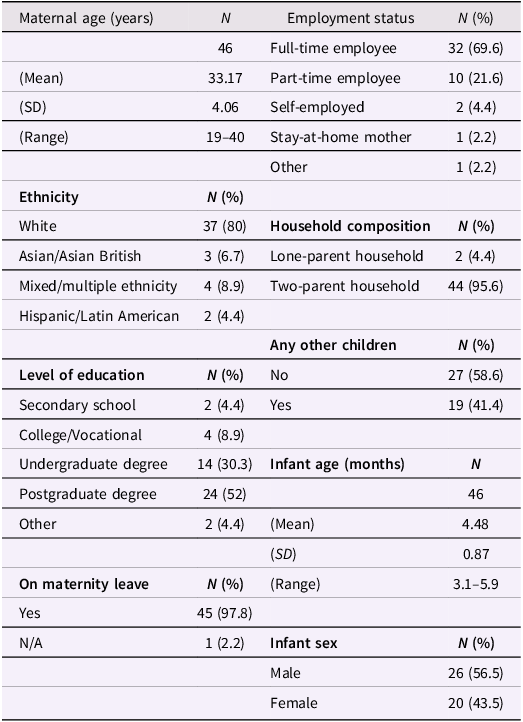
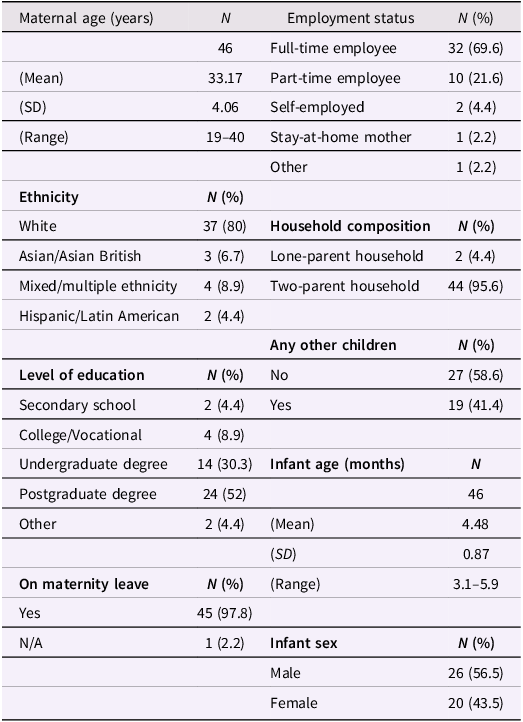
Overall, 51 participants responded to the recruitment advertisement. Five dyads’ videos were excluded from analysis; two due to a recording error, and three due to mothers interacting with their infant during the SF phase. The final sample consisted of 46 mother–infant dyads. For demographic data, see Table 1.
Demographic information for participants
Measures
Demographic questionnaire
An online survey link to collect demographic data was shared with participants 24 hr before attending the in-person session. Demographic data consisted of five questions concerning maternal demographics: age, ethnicity, education, employment status, and maternity leave status. Two further questions captured infant demographics: age and sex. Household composition assessed two questions: caregivers in residence (e.g., lone parent or couple household) and any other children.
Beliefs regarding smartphone use
Maternal beliefs regarding the acceptability of smartphone use in the presence of their infant were measured with a 5-item scale (Stockdale et al., Reference Stockdale, Porter, Coyne, Essig, Booth, Keenan-Kroff and Schvaneveldt2020). Participants were asked to rate how strongly they agreed with five statements about phone usage in the presence of their baby using the prompt “It is okay for me personally to use my phone” followed by the following scenarios; “When I take my child to the park,” “When my child is playing with toys,” “When feeding (breast or bottle feeding) my child,” “When my child is watching television,” and “When my child’s attention is occupied by something else”. The scale used a 5-point Likert scale from 1 (Strongly disagree), 2 (Disagree), 3 (Neither agree or disagree), 4 (Agree), to 5 (Strongly agree). All items were summed, and a higher score indicated greater acceptance of smartphone use in the presence of an infant. Internal consistency was found to be high (ω = 0.80, M = 18.83, SD = 3.49, range = 5–25).
Modified still-face paradigm
Mother–infant dyads participated in two modified still-face paradigms (SFP; Myruski et al., Reference Myruski, Gulyayeva, Birk, Pérez-Edgar, Buss and Dennis-Tiwary2018; Stockdale et al., Reference Stockdale, Porter, Coyne, Essig, Booth, Keenan-Kroff and Schvaneveldt2020). Similar to the traditional FFSF paradigm (Tronick et al., Reference Tronick, Als, Adamson, Wise and Brazelton1978), the infant was seated in a baby chair with the mother sitting across from her. The modified SFP comprised three separate phases: FP, wherein the mother was instructed to “play or be with your baby as you normally would” (duration: 2 min); modified SF; wherein the mother was instructed to pick up her phone when she heard a signal and either take part in an audio call conversation (condition 1) or a text message conversation (condition 2) with a member of the research team. In line with previous studies (Nazzari et al., Reference Nazzari, Zangrandi, Bottini, Salvato and Provenzi2025; Stockdale et al., Reference Stockdale, Porter, Coyne, Essig, Booth, Keenan-Kroff and Schvaneveldt2020), mothers were instructed to not interact with their child at all, including through touch or vocalization, whilst using the smartphone (duration: 2 min); and finally, the Reunion (RU; condition 1: RUcall; condition 2: RUtext) phase, wherein the mother was prompted to put down the phone and “play or be with your baby as you normally would” (duration: 2 min). Using a smartphone during the modified SF phase meant that instead of mothers making unresponsive eye contact as in the traditional FFSF, the SF phase more closely exemplified the type of maternal unresponsiveness that has been evidenced during episodes of technoference (Rozenblatt-Perkal et al., Reference Rozenblatt-Perkal, Davidovitch and Gueron-Sela2022; Stockdale et al., Reference Stockdale, Porter, Coyne, Essig, Booth, Keenan-Kroff and Schvaneveldt2020). A further modification to the traditional FFSF but closely aligning with Myruski et al.’s (Reference Myruski, Gulyayeva, Birk, Pérez-Edgar, Buss and Dennis-Tiwary2018) original modified SFP, provided mothers access to a small selection of age-appropriate toys, such as soft toys, picture books, blankets, and teething toys. Although developmentally most infants aged 3–6 months do not require toys for shared play with their caregivers, it was presumed that most parents would be likely to use toys in their general everyday play, so providing toys would increase the ecological validity of the experiment. While the toys were available for use, no instructions were given to the participants as to whether they should use the toys throughout the experiment, supporting the presumption that those who did reach for toys were likely to use them at home with their infant. Across the different conditions, 34 (73.9%) mothers chose to use a toy during the FP phase, 32 (69.6%) during RU(call), and 32 (69.6%) during RU(text).
The order of conditions was randomized and counterbalanced between all participants to control for order effects. Both conditions were carried out sequentially, however all participants were given as much time as they needed in between conditions to enable their infant to return to a regulated state of affect. During this time, parents were allowed to remove their child from the seat and soothe them freely. The duration of recovery time between both conditions ranged from 5–17.5 min (M = 8.35, SD = 2.6) across the participants. When the parent deemed their child to be returned to a baseline affective state, the experiment was continued. As there were no significant differences in synchronous negative or positive behaviors between the two FP phases, we believe that all infants were in fact returned to a baseline state of affect preceding the second condition. Unlike previous modified SFP paradigms where parents simulated phone use (e.g., Myruski et al., Reference Myruski, Gulyayeva, Birk, Pérez-Edgar, Buss and Dennis-Tiwary2018; Tidemann & Melinder., Reference Tidemann and Melinder2022), participants were asked to genuinely use their phones across both conditions to more fully replicate levels of cognitive absorption that may occur during these tasks. Participants used their own smartphones to take the call and reply to texts, using Whatsapp, a peer-to-peer encrypted messaging and video/audio calling app. This ensured that they felt comfortable using the device. Before starting, participants were asked to silence their phones so that no external notifications (e.g., incoming calls, messages, or push notifications) would interrupt them during the experiment. Two sets of standardized starter questions were used for both the audio phone call and the text messaging conversation (for full list of starter questions for each condition, see supplementary materials). After asking an initial question of the participant, the experimenter responded naturally to the participant’s replies, creating as genuine a conversation as possible. If the experimenter felt that the conversation was coming to an end, they would ask the next question on the list, incorporating this into the conversation as naturally as possible. These questions aimed to induce a genuine absorption in the task to create increased ecological validity. Instructions for ending the phase were given just before the 2-min mark, in order for participants to begin the RU phase at the correct time. The SFP was recorded using two wall mounted cameras, enabling profile views of the dyad as well as a frontal view of the infant’s face and body.
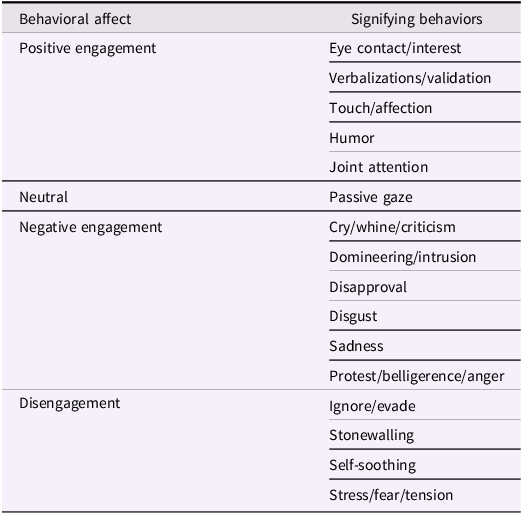
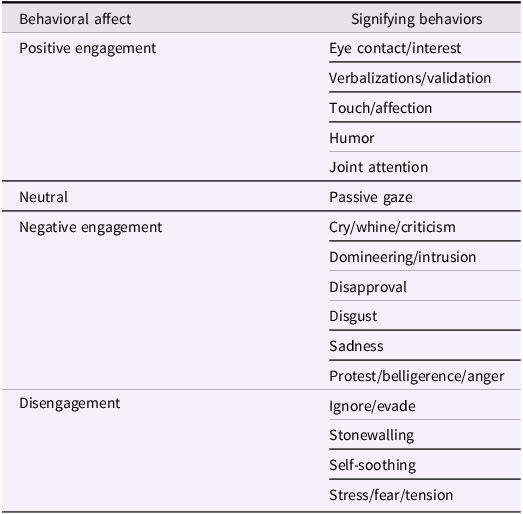
For data analysis, a dyadic behavioral coding scheme was modified from Hollenstein et al.’s (Reference Hollenstein, Granic, Stoolmiller and Snyder2004) study exploring synchronous affect after a stressful event in parent–child dyads. Both the infant and mother’s behaviors were coded in 3-s intervals during the initial FP phase (pre-stress elicitation), and both RU phases (RU(call) / RU(text); post-stress elicitation). Coding followed the same four categories as Hollenstein et al. (Reference Hollenstein, Granic, Stoolmiller and Snyder2004); Positive Engagement, Neutral, Negative Engagement, and Disengagement. Some modifications were made to the coding scheme, reported here and in the supplementary materials (as per SCOBe guidelines; Hillen et al., Reference Hillen, Hoeben, Kok, McHale, Sexton, van der Asdonk, van de Bongardt, Bowman, Brown, Branje, Chorney, Donker, Ejbye-Ernst, Geeraerts, Van der Giessen, Humphris, Larsen, Philpot, Portell and Noordman2024). In the current study, whining and sadness were observed to be behavioral strategies that infants used to attempt to engage with their mothers, rather than disengage from the interaction. Further, novel disengagement strategies (self-soothe and ignore/evade) were observed in infants and were added to the coding scheme. Using threats or demonstrating contempt were not observed in any of the dyads, and so was removed from the Negative Engagement category, however “demonstrating disapproval” was observed and was added. Defensiveness was not observed in any of the dyads and was removed from the Disengagement category. For all behavioral codes see Table 2, and for the full coding manual see the supplementary materials (as per Hillen et al., Reference Hillen, Hoeben, Kok, McHale, Sexton, van der Asdonk, van de Bongardt, Bowman, Brown, Branje, Chorney, Donker, Ejbye-Ernst, Geeraerts, Van der Giessen, Humphris, Larsen, Philpot, Portell and Noordman2024).
Behavioral coding signifiers (FP, RU(call), RU(text))
As the study focussed on dyadic behavioral outcomes, analysis was performed on the FP phase, as well as both reunion (RUcall; RUtext) phases for each dyad. As the SF phase does not produce a dyadic behavioral reaction due to maternal induced unresponsiveness, this phase was not deemed appropriate for outcome analysis. A second rater coded 10% of the videos to determine interrater reliability. Interrater reliability was calculated using two-way agreement intraclass correlation with an ICC score of 0.87, indicating robust interrater reliability.
Mother–infant interaction outcomes
Outcome variables of i) synchronous negative affect and ii) synchronous positive affect were derived. Synchronous negative affect was operationalized as the proportion of time that mother, and infant were simultaneously coded as exhibiting Negative Engagement or Disengagement behavioral strategies (as both individuals within the dyad may experience all of these behaviors as contributing to their sense of negative affect; Beebe, Reference Beebe2004). Synchronous positive affect was operationalized as the proportion of time that mother and infant were simultaneously coded as exhibiting Positive Engagement. Values for the proportion of time spent in both forms of synchronous affect ranged from 0 to 1. A score of 0 represented no time spent simultaneously in negative / positive affect, and a score of 1 represented the whole 2-min phase spent in synchronous affect. A higher number therefore indicated that the dyad spent a larger proportion of time synchronously in the respective behavioral affect.
Data analysis
Data cleaning
All survey data were cleaned and analyzed using R (version 2025.05.0). Outcome variables were first checked for normality. While the outcome variable, synchronous positive affect, was within an acceptable range, synchronous negative affect exhibited moderate right skewness (1.815). A square root transformation was applied to the data, reducing skewness to within an acceptable range (0.657). Sum to zero contrast coding was applied to the three experimental conditions to allow a more precise pairwise comparison of outcomes across conditions (Field et al., Reference Field, Miles and Field2012).
Data cleaning was also applied to the experimental paradigm recordings. For each dyad, videos were cut so that three videos per dyad were created. These comprised i) FP, ii) RU(call), iii) RU(text). For RU phases, videos started after the mother had finished using her smartphone. This ensured coders were blind to which condition was being observed. Video editing was carried out using DaVinci Resolve software. Videos were viewed and coded at x0.67 speed.
Statistical analysis
Data analysis used R packages “contrast” (O’Callaghan et al., Reference O’Callaghan, Kuhn, Weston, Wing, Forester and Thaler2022), “dplyr” (Wickham et al., Reference Wickham, François, Henry, Müller and Vaughan2023), “emmeans” (Lenth, Reference Lenth2025), “lme4” (Bates et al., Reference Bates, Maechler, Bolker and Walker2023), “lmerTest” (Kuznetsova et al., Reference Kuznetsova, Brockhoff and Christensen2020), and “moments” (Komsta & Novomestky, Reference Komsta and Novomestky2022). Descriptive statistics were reported, including mean and standard deviation (SD), as well as possible and observed ranges for the measured outcome variables.
A repeated measures design naturally violates the assumption of independence; therefore, due to the increased number of recruited participants, linear modeling was deemed appropriate to explore differences in the outcomes between the conditions. Both linear models (LMs) and linear mixed-effects models (LMMs) were fit to account for potential subject-level variability. As no significant differences were found between the two FP phases for either behavioral outcome (synchronous negative affect: t(45) = 0.11, p = .92; synchronous positive affect: t(45) = −0.07, p = .94) analysis was performed on the initial FP phase used as a baseline for synchronous affect, as well as both reunion (RUcall; RUtext) phases for each dyad. The order of conditions for each participant was included as a fixed effect in the model to account for counterbalancing. Due to the possible confounding effects of using toys (Myruski et al., Reference Myruski, Gulyayeva, Birk, Pérez-Edgar, Buss and Dennis-Tiwary2018), as well as potential developmental differences across the infant age range (Leach, Reference Leach and Leach2017), use of toys and infant age were both added as fixed effect covariates in the models. It should be noted that while increased age has been associated with fewer negative responses during the traditional FFSF paradigm (Melinder et al., Reference Melinder, Forbes, Tronick, Fikke and Gredebäck2010), no effects of age were found in either Myruski et al.’s (Reference Myruski, Gulyayeva, Birk, Pérez-Edgar, Buss and Dennis-Tiwary2018) or Tidemann and Melinder’s (Reference Tidemann and Melinder2022) studies using a modified SFP. This suggests that infant age might not confound results but nevertheless should be accounted for as a potential factor. Finally, maternal beliefs regarding the acceptance of using their phone in the presence of their infant was added as a covariate. Emerging evidence suggests that habitual patterns of smartphone use may influence how mothers respond to and recover from episodes of technoference, potentially making interactive repair less efficient or less successful in some dyads (e.g., Myruski et al., Reference Myruski, Gulyayeva, Birk, Pérez-Edgar, Buss and Dennis-Tiwary2018; Nazzari et al., Reference Nazzari, Zangrandi, Bottini, Salvato and Provenzi2025). In a previous study (Stockdale et al., Reference Stockdale, Porter, Coyne, Essig, Booth, Keenan-Kroff and Schvaneveldt2020), beliefs surrounding the acceptability of usage were found to be more predictive of infant behaviors during technoference than parental self-report of usage. Further, self-reporting use is often underestimated due to social desirability biases (Coyne et al., Reference Coyne, Voth and Woodruff2023), and so reporting beliefs around acceptability was deemed more appropriate in this instance. Post hoc Tukey tests were run to explore differences across all three condition levels. Likely due to the sample size, model comparison using AIC indicated that the LMs provided a better fit to the data. Therefore, the models were reduced, and results from the LMs are reported below. LMM results (see supplementary materials) show comparable, but slightly more conservative, patterns to the reported results (albeit with loss of significance for all covariates).
Results
Descriptive statistics
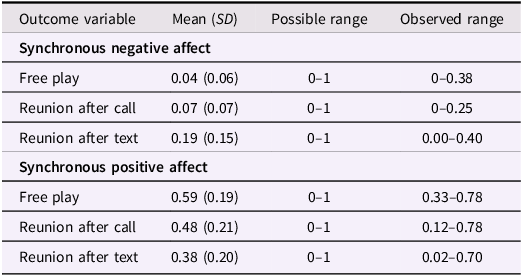
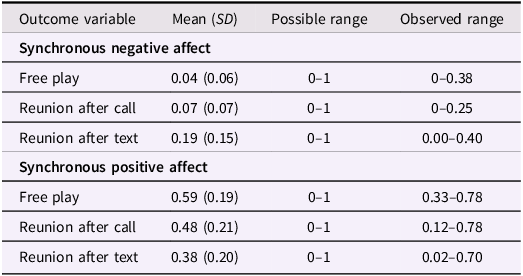
Descriptive statistics for measured outcomes are reported in Table 3.
Description of outcome variables
Additionally, while maternal and infant individual behaviors were not considered measurable outcomes in this study, individual behaviors during the SF phase are described here to aid in the interpretation of the dyadic outcomes. During the SF phase, it should be noted that mothers were instructed not to interact with their infants in any way if possible. During the phone call condition, nine out of the 46 participants (19.5%) did however, make eye contact with their child. The proportion of time these mothers spent in eye contact ranged from 0.02–0.20 of the phase (M = 0.09, SD = 0.07). Additionally, in the texting condition, only four out of 46 mothers (8.7%) made eye contact with their child. Again, this was for a very small proportion of the time, ranging from 0.02–0.10 of the phase (M = 0.09, SD = 0.07). For both conditions, this is a small proportion of mothers, who also spent a small proportion of time looking at their child, suggesting that the experimental conditions of the study generally led mothers to actively choose not to look at their infant while taking part in the SF phase, regardless of activity. It is likely, however, that in a real-world situation, mothers would engage in eye contact with their child, particularly when partaking in audio calls on their phone.
Infant affective behaviors during the disruption (SF) phases were also observed. The proportion of time that infants spent demonstrating negative affective behaviors, including both overt negative behaviors and disengagement behaviors, increased during the texting condition compared to the call condition (call; M = 0.55, SD = 0.20, texting; M = 0.76, SD = 0.16). A paired samples t-test suggests that this was a significant increase in negative affect during the texting condition compared to the call (t(45) = 6.64, p < .001). Conversely, the proportion of time that infants spent demonstrating positive affective behaviors was shown to decrease during the texting condition compared to the call condition: call; M = 0.33 SD = 0.18, texting; M = 0.08, SD = 0.07. Again, this reduction was statistically significant (t(45) = −8.83, p < .001).
Linear modeling
Outcome model 1 – synchronous negative affect
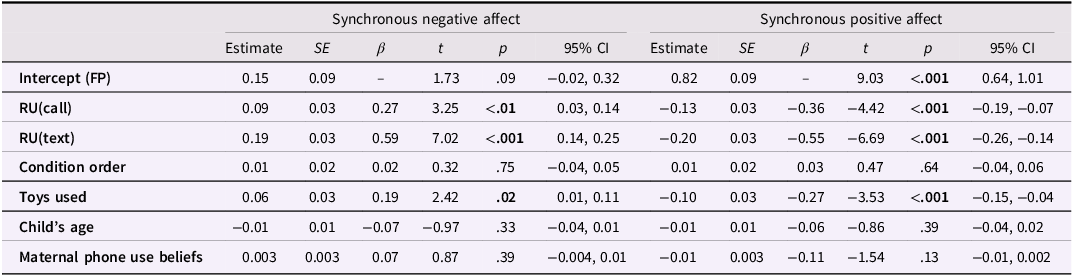
Table 4 reports the fixed effects predicted by each condition. The FP phase was modeled as the baseline intercept, and Tukey’s HSD pairwise comparison, adjusting for the use of toys, was utilized to explore statistical differences between all three conditions. Post hoc Tukey tests suggested that there was a significant increase of synchronous negative affect between the FP and RU(call) phases (t(131) = 3.26, p < .01, d = 0.68). A significant increase was also reported between the FP and RU(text) phases (t(131) = 7.03, p < .001, d = 1.47). Additionally, a significant increase was reported between the RU(call) and RU(text) conditions (t(131) = 3.77, p < .001, d = 0.79). Table 5 reports the Tukey HSD pairwise comparison results. There was no significant association between child’s age and synchronous negative affect or maternal phone use beliefs and synchronous negative affect across conditions, however engagement with toys was significantly associated with negative affect (b = 0.06, SE = 0.03, t = 2.42, p = .02), suggesting that dyads who used toys exhibited higher negative affect after controlling for experimental condition and child age. No significant association was found when adjusting for condition order.
Linear model (LM) analysis of the proportion of synchronous mother–infant affect predicted by condition
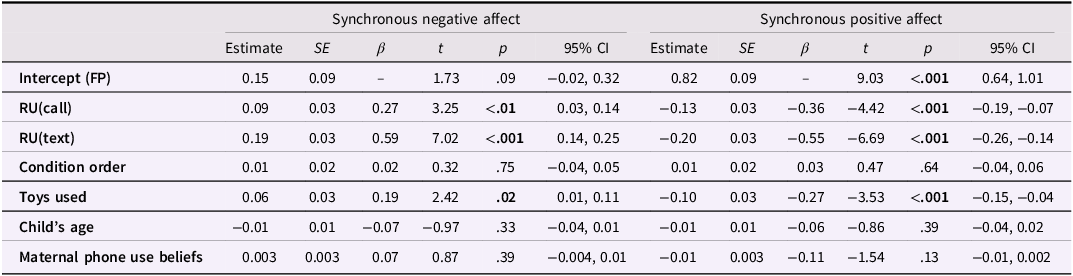
Note: β is standardized; p values in bold are significant; FP = free play phase; RU(call) = reunion after call; RU(text) = reunion after text.
Post hoc Tukey’s HSD pairwise comparisons across conditions

Note: p values in bold are significant; FP = free play phase; RU(call) = reunion after call; RU(text) = reunion after text.
Outcome model 2 – synchronous positive affect
Table 4 reports the fixed effects predicted by each condition. Post hoc Tukey tests, adjusting for the use of toys, suggested that there was a significant decrease of synchronous positive affect between the FP and RU(call) phases (t(131) = −4.42, p < .001, d = −0.92). A significant decrease was also reported between the FP and RU(text) phases (t(131) = −6.69, p < .001, d = −1.40). Synchronous positive affect during RU(text) was decreased compared to RU(call), however this decrease only approached significance (t(131) = −2.27, p = .06, d = −0.47). Table 5 reports the Tukey HSD pairwise comparison results. Neither child age nor maternal phone beliefs were significant predictors of synchronous positive affect across conditions, however engagement with toys was significantly associated with positive affect (b = −0.10, SE = 0.03, t = −3.53, p < .001), suggesting that dyads who used toys exhibited lower positive affect than those who did not, controlling for experimental condition and child age. No significant association was found when adjusting for condition order.
Discussion
The results of this study extend the existing literature on maternal smartphone use and mother–infant interactions. It is the first study to explore the impact of maternal smartphone use on synchronous co-regulatory behaviors within the mother–infant dyad, after an episode of technoference. It is also the first study to investigate differences between modes of smartphone use and potential differential impacts on mother–infant shared affect.
Pilot data from this study suggests that mother–infant dyads demonstrated a change in their behavioral affect following instances of technoference. Synchronous negative affect was observed to significantly increase after periods of technoference compared to baseline at FP. Accordingly, instances of synchronous positive affect were observed to be significantly reduced after technoference, compared to baseline at FP. As these behavioral changes are likely due to the dyad attempting to co-regulate after the period of disruption to their interaction, these results support Hypothesis 1 of the current study. Additionally, significant differences in synchronous behavioral affect were observed between different conditions. The results of the pilot study suggested that synchronous negative affect is likely to be significantly higher after texting compared to after a phone call, supporting Hypothesis 2 of the current study. Interestingly, synchronous positive affect was not found to be significantly lower after texting compared to after a phone call, although a medium effect size suggests that this result was approaching significance. These results demonstrate that an increase in negative behaviors might not be directly inversely linked to positive behaviors, and these behavioral strategies might in fact be employed separately from each other.
Both episodes of technoference appear to have been experienced by the dyad as interruptions to interaction, thus likely to increase infant’s distress (Rozenblatt-Perkal et al., Reference Rozenblatt-Perkal, Davidovitch and Gueron-Sela2022). As the mother reunites with the infant after receiving a phone call, she may notice the infant’s distress and attempt to engage in behavioral strategies to aid in emotion co-regulation. Tronick (Reference Tronick2003) suggested that during the SF phase of the traditional SFP, the mother’s unresponsiveness is confusing to the infant as there is a loss of meaning within the dyadic system. By engaging in synchronous affective behaviors during the RU phase, the mother may be creating a sense of meaning for the infant, to aid the infant further in understanding the negative affect that they are feeling (Jaffe et al., Reference Jaffe, Beebe, Feldstein, Crown, Jasnow, Rochat and Stern2001). Therefore, if the infant is demonstrating negative engagement behaviors such as crying or protest, this may provide an opportunity for the mother to coordinate to the infant’s negative behaviors in an attempt to “join the baby’s distress.”
While this may initially precipitate a significant increase in synchronous negative affect within the dyad, such behaviors may in fact have an adaptive function, validating the infant’s own response, and enabling the infant to co-regulate, with the mother’s assistance. The further significant increase of synchronous negative affect after the texting condition may be attributable to the observation that increased cognitive absorption (Lamberg & Muratori, Reference Lamberg and Muratori2012) in the smartphone led to increased infant negative affect, meaning that emotional co-regulation at reunion took longer to occur. Potentially, the mother may have needed to join with the baby’s distress for a longer period of time before the infant was able to regulate their emotion back to a stable baseline (Beebe, Reference Beebe2010).
One potential reason for the observed differences in negative and positive affect across conditions is that during the phone call, infants could still hear their mother’s voice. Vocal affect is an important feature of mother–infant co-regulation (Northrup & Iverson, Reference Northrup and Iverson2020), allowing infants to orient to their primary caregiver without physical contact. Unlike touch or gaze, vocal communication can be utilized by both mother and infant even during periods of disengagement to maintain a sense of non-physical connection (Beebe, Reference Beebe2010). When hearing the mother’s voice, even when it is not directed at the infant, they may still be able to maintain a level of co-regulation when the mother is taking a phone call, thereby diminishing the sense of distress.
During the text messaging condition, the effects of task switching may also play a salient role in the creation of an even more significantly higher amount of synchronous negative affect. Task switching, particularly after an episode of cognitive absorption, is often experienced as aversive (Vermeylen et al., Reference Vermeylen, Braem and Notebaert2019) creating heightened negative affect. As the text messaging condition is likely to increase the mother’s cognitive absorption, this may also lead the mother to feel greater task switching effects. In addition, as the mother’s cognitive absorption is increased towards the smartphone, the infant is likely to become even more distressed due to experiencing increased maternal unresponsiveness (Rozenblatt-Perkal et al., Reference Rozenblatt-Perkal, Davidovitch and Gueron-Sela2022), leading the mother to experience increased feelings of guilt. Such situational guilt, and particularly guilt surrounding smartphone use, has been associated with reduced feelings of satisfaction with motherhood (Wolfers et al., Reference Wolfers, Wendt, Becker and Utz2023). This in turn may increase the mother’s own negative affect, causing the mother to demonstrate more negative behavioral strategies, such as intrusive behaviors which not only match the rhythm of the infant’s distress but also the intensity and volume (Beebe, Reference Beebe2010). Such heightened distress in the mother may create over-arousal in the affective system between partners, leading the dyad to find it more difficult to co-regulate the distress that is felt by both mother and infant (Beebe, Reference Beebe2010). Additionally compounding these negative affective strategies may be the infant’s heightened reaction to the mother’s smartphone use. In developing relational processes of interaction, particularly after 3 months of age, Trevarthen & Aitken (Reference Trevarthen and Aitken2001) suggested that infants can actively choose how to demonstrate and regulate their affect in more salient ways. For example, “the infant can imitate, reply to, or ignore a partner, or show decisive avoidance” (Reference Trevarthen and Aitken2001, p14). If infants are choosing to use a larger proportion of disengagement cues through decisive avoidance to regulate their heightened distress, mothers may experience this as a rejection (Beebe, Reference Beebe2004). This sense of rejection may cause the mother to respond with heightened intrusive behaviors to create reconnection with her baby. Such interaction is often referred to as “chase-and-dodge” (Beebe, Reference Beebe2004) and is likely to further heighten the negative affect within the dyad. Chase-and-dodge activities can turn an adaptive regulatory function into a maladaptive experience for both baby and mother. It would be important for future research to ascertain whether the regulatory features of the synchronous behavior were still functioning as such, or if the behaviors of infant and mother had spilled over into distress for both actors within the dyad.
Linear modeling reported that use of toys had a significant impact on behavioral outcomes, suggesting that dyads who engaged in toy play had higher synchronous negative affect and lower synchronous positive affect across both perturbation conditions. Sjolseth et al. (Reference Sjolseth, Frosch, Tresch Owen and Redig2023) suggested that mothers who engage with their infants without toys share longer emotional experiences and demonstrate stronger emotional relationships with their infant. It may be that for those who chose to forego toys during the RU phases, mothers created more opportunities to attune to their infant by interacting solely with each other rather than with external objects. This supports Myruski et al. (Reference Myruski, Gulyayeva, Birk, Pérez-Edgar, Buss and Dennis-Tiwary2018), who also suggested that infants were less likely to engage with toys during the RU phase of the modified SFP as they were preoccupied instead with behavioral strategies designed to reengage with the mother. However, it should be considered that within this pilot study, the effect of the use of toys on both outcomes, although significant, was of small magnitude and may not represent a meaningful change in real-world environments.
The results of this study have broader implications for the development of infants’ psychopathology over the lifespan. As discussed, instances of heightened synchronous negative affect might be viewed as an adaptive model for co-regulation as the mother joins her baby in distress, interpreting the infant’s discomfort and providing meaning-making opportunities within the safety of the dyad (Beebe, Reference Beebe2010). It has been suggested that smartphones are no more distracting than other non-infant-directed activities, such as writing a shopping list or reading a book (Ewin et al., Reference Ewin, Reupert, McLean and Ewin2021). However, daily distractions caused by a smartphone are likely to occur much more frequently (Lederer et al., Reference Lederer, Artzi and Borodkin2021), and so these instances of heightened negative affect, both experienced by the infant during the period of technoference, and experienced by the dyad during reunion, will be increased, and as suggested when considering the texting condition, may ultimately become maladaptive examples of regulation (e.g., Beebe, Reference Beebe2010). As these small instances of technoference build up over time, both co- and self-regulation might be affected.
Such disruptions to co-regulation will have implications for the infant’s long-term mental health, which can be viewed from an intergenerational mental health perspective (MacBeth et al., Reference MacBeth, Christie, Golds, Morales, Raouna, Sawrikar and Gillespie-Smith2024). The infant’s experience of the mother’s unresponsiveness could potentially be likened to that of a baby whose mother is experiencing depression. Meta-analytic evidence shows that maternal perinatal depression is associated with lower infant self-regulation (Padrutt et al., Reference Padrutt, Berry, Schwartzman and Wilson2025), with lower responsiveness from the mother towards her infant often suggested as an underlying mechanism (Field, Reference Field2010). Recent findings from modified still-face paradigms also suggest that infants experience maternal unresponsiveness due to technoference in a similar way (Rozenblatt-Perkal et al., Reference Rozenblatt-Perkal, Davidovitch and Gueron-Sela2022). As lower emotion regulation skills are typically associated with psychopathology issues across the lifespan (Cicchetti et al., Reference Cicchetti, Ackerman and Izard1995), it is critical to understand the extent to which these habitual micro-instances of regulatory disruption may have on the infant. In particular, for younger infants aged 3–6 months who are entering the developmental stages associated with intersubjectivity, and developing dyadic processes of co-regulation, this seems especially pertinent to consider.
Limitations
We report a number of limitations that should be addressed for future research. First, recruitment for this study relied partly on targeted advertising through social media platforms (Facebook and Instagram). While every effort was taken to engage with diverse groups on these platforms, the internal use of advertising algorithms is likely to have created a biased and somewhat homogeneous sample. When platforms such as Facebook deliver advertisements, user profiles are analyzed to identify which users are more likely to engage with the content (Ali et al., Reference Ali, Sapiezynski, Bogen, Korolova, Mislove and Rieke2019). Once the platform has identified groups of users who engage with said content, users with similar demographics are likely to be targeted to see the advertisement. While this drives content engagement, it does nonetheless create subgroups of selected audiences (Ali et al., Reference Ali, Sapiezynski, Bogen, Korolova, Mislove and Rieke2019).
Second, the demographic of the sample comprised a large proportion of White women, with high levels of education, and almost entirely living in two-parent households, limiting generalizability to different household compositions, education levels, or cultural backgrounds. The sampling homogeneity may reflect increased social support at home, and the effect of paid maternity leave, creating a low-risk community sample with available time and resources to attend an in-person study. In the wider literature, particular demographic factors such as level of education and age have been implicated as critical to understanding smartphone use habits (Chan, Reference Chan2018; Kim et al., Reference Kim, Briley and Ocepak2015), and as such, recruiting mothers who represent a wide range within these demographic factors would be useful for future work.
Third, the study had limited ecological validity due to the chosen experimental paradigm. In the real world, caregivers may choose to use their phones for a number of reasons such as connecting with friends and family who are not in their immediate environment (Kildare & Middlemiss, Reference Kildare and Middlemiss2017), or conversely, disconnecting from an environment that they find to be stressful or boring (Radesky et al., Reference Radesky, Kistin, Eisenberg, Gross, Block, Zuckerman and Silverstein2016). The modified SFP used in this study was not able to recreate either of those situations, instead reflecting a particular social situation in which mothers feel it is necessary to receive a phone call or respond to incoming messages whilst playing with their infant. This may not account, for example, for times when the mother feels it necessary to disconnect from the infant to self-regulate, or for times when the mother feels that their infant does not need social engagement and interaction. Results may not be generalizable to other circumstances in which the mother uses her phone in the presence of the infant. Additionally, in real-world situations, mothers are more likely to maintain contact with their child, even when using the phone, through touch, vocalizations, and eye contact where possible, so more naturalistic studies should be designed to capture these nuances outside of the laboratory (Nazzari et al., Reference Nazzari, Zangrandi, Bottini, Salvato and Provenzi2025).
Finally, as a pilot study, the sample size was relatively small and a larger confirmatory study is required to enable more complex mixed modeling analyses.
Future research
As discussed, the most critical implication for future research suggests that a study designed to recruit a larger sample size is important to confirm the preliminary results seen here.
Additionally, due to the relatively homogeneous sample, this work should be furthered by recruiting mothers from a wider demographic that is more representative of the total population. In addition to a wider maternal demographic, it is also important to consider other, more diverse, caregiver populations. While historically, birthing mothers have been the primary caregiver to their infant, more contemporary family structures should also be considered, and as such, future research should explore the impact of smartphone use by fathers, kin carers, and same sex and non-birthing partners. When recruiting a larger sample with greater diversity, LMM models of analysis should be used to explore individual differences at the participant level and for greater generalization.
Further, designing observational experiments with greater external validity should also be considered. Multitasking with a smartphone while parenting is a complex activity that parents will regularly encounter and that is likely to cause parental distraction (Beamish et al., Reference Beamish, Fisher and Rowe2019). As parental smartphone use is a daily issue for almost every parent, understanding what this looks like in the real world should be considered.
Finally, while this pilot study reports differences between the behavioral affect patterns of mothers and infants after audio calls compared to texting, future research should aim to understand if these differences are due to longer periods of adaptive emotional co-regulation, or are in fact due to heightened levels of distress in both mother and infant, leading to a breakdown in co-regulation within the dyad. Additionally, as previous work has suggested that habitual smartphone use by parents may influence the adaptive behaviors of infants during episodes of technoference (Myruski et al., Reference Myruski, Gulyayeva, Birk, Pérez-Edgar, Buss and Dennis-Tiwary2018; Nazzari et al., Reference Nazzari, Zangrandi, Bottini, Salvato and Provenzi2025), this should be investigated further. Due to the unreliability of self-report measures, using objective measures, such as passive sensing of screentime and phone use should be incorporated into future study designs to explore this potentially important moderating factor.
Conclusion
While this study included directional hypotheses based on existing literature, the limited sample size and preliminary nature of the data collection position it as an exploratory study. Findings should be interpreted as indicative and hypothesis-generating, rather than conclusive. That being said, the results within this study demonstrate that mothers and infants spent more time in synchronous negative affect following a period of maternal texting, compared to following the mother talking on the phone. What the results of this study may suggest is that different modes of smartphone use may impact the dyadic regulatory system in different ways. Due to the greater cognitive absorption and potentially reduced levels of maternal responsiveness that text messaging may cause, infants may experience an even more heightened stress response when exposed to technoference in which their caregiver is texting compared to talking on the phone. This has direct implications for support and education, as mothers may find that using their phones to communicate using audio functions rather than texting has the potential to reduce maternal cognitive absorption in the device, as well as some of the negative affect in both infant and mother after the episode of technoference. Early identification of mothers who may need additional support, as well as early education on a population level about using smartphones with mindfulness and intentionality may therefore be critical in ensuring that smartphones have minimal impact on the regulatory processes of the mother–infant dyad.
Supplementary material
The supplementary material for this article can be found at https://doi.org/10.1017/S0954579426101461.
Data sharing and data availability
The data necessary to reproduce the analyses presented here are not publicly accessible. Data are available from the first author upon reasonable request.
The analytic code necessary to reproduce the analyses presented in this paper is publicly accessible. Code is available at the following URL: https://github.com/lisagolds/PhD-Thesis-data-scripts/blob/main/Chapter%206/R%20script%20(LMM%20analysis).R
The materials necessary to attempt to replicate the findings presented here are publicly accessible. Materials are available from the first author.
Acknowledgements
Thank you to Lan Luo and Yue Wang for their help in data collection for this study.
Funding statement
This research did not receive any specific grant from funding agencies in the public, commercial, or not-for-profit sectors.
Competing interests
The authors declare that they have no known competing financial interests or personal relationships that could have appeared to influence the work reported in this paper.
Ethical standards
Ethical approval for the study was granted by the University of Edinburgh Clinical Psychology Research Ethics Committee.
Pre-registration statement
As this manuscript formed part of a PhD thesis, the analyses presented here were not preregistered.



 Open access

