




1. Introduction
International intelligibility among World Englishes is indisputably pertinent. Second language contexts, such as Nigeria, often adopt the Received Pronunciation (RP) to achieve intelligibility and serve as the pedagogical and descriptive basis of the language (Carr & Honeybone, Reference Carr and Honeybone2007). However, studies on spoken Nigerian English (NE) have established that RP is unattainable by Nigerians, English language teachers inclusive (Akinjobi & Aina, Reference Akinjobi and Aina2014; Aina, Reference Aina2014; Adesanya, Reference Adesanya, Oladipupo, Akindele and Osisanwo2020a; Agboyinu, Reference Agboyinu2018; Aiyeola, Reference Aiyeola2021). Search for an ancillary model of Standard English pronunciation in Nigeria, therefore, becomes a necessity.
Based on existing literature, stress shift in NE is a result of speakers’ preference for forward or rightward stress in lexical and sentential units and not necessarily an effort to ensure eurhythmy as obtained in Standard British English (Kujore, Reference Kujore1985; Jowitt, Reference Jowitt1991; Sunday & Oyatokun, Reference Sunday and Oyatokun2016; Sunday & Oyemade, Reference Sunday and Oyemade2021). This variation between NE and Standard British English (SBE) has mainly been established adopting geographical origin/ethnicity and social variables such as education, occupation, age, gender, social class etc. which Labov (Reference Labov1966) establishes as means of stratifying English language (Soneye, Reference Soneye2007; Oladipupo & Akinjobi, Reference Oladipupo and Akinjobi2015; Johnson, Reference Johnson2017). However, exposure to native forms through Information and Communications Technology (ICT) seems yet to be adequately explored as a variable to delineate spoken English in Nigeria. This study, therefore, examines suffix-induced and variable word stress shift in the English speeches of educated Nigerian teenagers, who are of Yoruba ethnicity, based on their exposure to and use of technological facilities which grant them access to native English. Its aim is to determine if such facilities can serve as ancillary model for Nigerians to approximate Standard British English pronunciation.
2. Literature Review
The current state of literature on stress shift in Standard English and Nigerian English as well as submissions relating to the impact of Information and Communications Technology on English language pedagogy in Nigeria is presented in this section.
2.1 Standard English Stress Shift
The culminativity principle which operates on some languages such as English constrains their lexical units to have only one maximally prominent peak or syllable (primary stress). While the location of this stress in fixed stress (such as Finnish, Polish) is highly predictable, it is random in free stress languages such as English (Hayes, Reference Hayes1995). The position of stress may, however, change as a result of morphological processes (such as suffixation), grammatical word class and the type of rhythm foot of certain words, especially when such words are used in connected speech. This process is called stress shift (Gimson, Reference Gimson2008; Davenport & Hannahs, Reference Davenport and Hannahs2010).
Suffixes may influence the position of stress within a word. They are grouped into three categories: suffixes carrying primary stress themselves; those that do not affect stress placement and those that influence stress in the stem (Roach, Reference Roach2000; Skandera & Burleigh, Reference Skandera and Burleigh2005; Gimson, Reference Gimson2008). In disyllabic words, stress shift occurs as a result of grammatical class of English words. In this sense, context and content of stress change to inform meaning (O'Grady et al., Reference O'Grady, Archibald, Aronoff and Rees–Miller2017). For instance, some of these words keep the same general meaning but change their word class from noun to verb when the stress changes location e.g. ˈconflict/conˈflict while others change their meaning completely e.g. ˈentrance/enˈtrance. In the occurrence of stress shift, there is usually an accompanying reduction of the nucleus in the unstressed syllable (Akinjobi, Reference Akinjobi2006). However, while phonological accounts share the view that this shift is apparent in English lexical and phrasal categories, they differ in terms of the contexts in which it occurs.
First is the description of stress shift in terms of phrase-level stress placement which involves placing stress on an earlier syllable before its usual stress location owing to speakers’ preference to place the first stress of an intonational phrase as far as possible from the last accent (Bolinger, Reference Bolinger1989). Another description of stress of stress shift, considered more objective and descriptive, is the deployment of the metrical tree, the metrical grid or both. In the metrical accounts, stress shift results from the need to space stress apart in order to allow for intervening weak (W) syllables to alternate adjacent strong (S) ones for isochronous rhythm of the language. (Liberman & Prince, Reference Liberman and Prince1977; Hayes, Reference Hayes1995; Kager, Reference Kager and Goldsmith1999). Nonetheless their different approaches, both analyses agree that stress shift is one of the speech processes which ensure the eurhythmy of English language.
2.2 Stress Shift in Nigerian English
Stress shift in NE is not a response to morphological processes (such as affixation), grammatical word class or iambic foot reversal but rather a result of speakers’ inclination to ‘delay’ stress in lexical and phrasal categories, owing, partly, to the complexity of English stress system (Kujore, Reference Kujore1985; Jowitt, Reference Jowitt1991; Adetugbo, Reference Adetugbo, Dadzie and Awonusi2004). Akindele (Reference Akindele2012) observes a shift from the first syllable of disyllabic and trisyllabic words to the second syllable and, sometimes in trisyllabic words, the last syllable. Sunday (Reference Sunday2011) observes that stress assignment in educated NE speech lacks distinction between compound nouns and phrases. Sunday and Oyatokun (Reference Sunday and Oyatokun2016) identify high pitch (likened to the high tone of the indigenous languages) as sufficient cue to stress as Nigerians do not take cognizance of other stress cues (intensity and duration). Sunday and Oyemade (Reference Sunday and Oyemade2021) also provide evidence that NE productions do not reveal any distinction between stressed and unstressed syllables. Rather, stress is associated with a higher tone. From the foregoing, the shift of stress in NE only makes clear the distinctive stress pattern of NE and not related to any effort to ensure English eurhythmy. In fact, vowel reduction which often accompanies stress shift in Standard British English has been a major challenge for NE speakers (Akinjobi, Reference Akinjobi2006; Akindele, Reference Akindele2017; Adesanya, Reference Adesanya, Oladipupo, Akindele and Osisanwo2020a).
A factor to which the distinction between SBE and NE (stress) systems has been ascribed is the tonality of most Nigerian languages. Sunday and Oyemade (Reference Sunday and Oyemade2021), acknowledging the influence that tone in Nigerian languages wield on NE, aver that NE is neither a stress nor a tonal language as both features operate independently in Nigerian English. Their submission is based on the findings that NE has no stress distinctions between stressed and unstressed syllables and, yet, its tonality does not contribute to meaning differentiation in lexical units. Jowitt (Reference Jowitt, Oladipupo, Akindele and Osisanwo2020) further views the differences between both varieties in terms of the developmental stage that Popular Nigerian English connected speech system is still in.
2.3 Technology-based Non-enculturation Sources of Native English
In spite of claims of its obsoleteness, the RP remains a significant reference point/model for sustaining intelligibility among World Englishes and analysing English pronunciation around the world (Awonusi, Reference Awonusi, Oladipupo, Akindele and Osisanwo2020). RP-based analyses of spoken English in Nigeria have attested to the distinctiveness between SBE and NE, owing to, among other factors, the non-availability of native-speaker teachers as learners of English in Nigeria are being taught mostly by Nigerian teachers who themselves were taught by non-native speakers (Aina, Reference Aina2014). Meanwhile, studies which have examined the modelling capabilities of these teachers for English pronunciation in Nigeria have generally revealed their inability to serve as acceptable models. (Akinjobi & Aina; Reference Akinjobi and Aina2014; Agboyinu, Reference Agboyinu2018; Adesanya, Reference Adesanya, Oladipupo, Akindele and Osisanwo2020a; Aiyeola, Reference Aiyeola2021). Yet, physical exposure to native speakers suggested by Roach (Reference Roach2000) is an unfeasible reality for many Nigerians.
However, technological developments have influenced various facets of human lives. In relation to language use, various studies have opined its prospect for (spoken) English teaching and learning. The term non-enculturation sources of standard spoken English which stem from the advancement in information and communication technology (ICT) is originally a coinage of Akinjobi (Reference Akinjobi2015). She uses this coinage to encapsulate technological facilities/sources that could assist non-native speakers to access and approximate native English outside its native setting through virtual means. Such facilities include electronic media sources; internet-based speech drills; English dictionaries with audio aids; British and American films etc. In her opinion, such facilities have enhanced proximity between native and non-native speakers and can help Nigerians as well as other L2 speakers of English to approximate native forms.
Similar scholarly submissions relating to the impact of ICT developments on English language teaching and learning in Nigeria includes the works of Udoh and Egwuchukwu (Reference Udoh and Egwuchukwu2014), Akintunde and Angulu (Reference Akintunde and Angulu2015) Chitulu and Njemanze (Reference Chitulu and Njemanze2015), among others. However, these studies have only concentrated on its impact on written forms; its availability for and extent of utilisation in English teaching and learning and opining its general prospects for (spoken) English pedagogy. Only a few studies such as Adesanya (Reference Adesanya2020b) and Aiyeola (Reference Aiyeola2020a, Reference Aiyeola2020b) have empirically established its actual impact on word stress and vowel reduction. There is need for more empirical analyses on the influence of such technological utilities on English pronunciation in Nigeria.
3. Methodology
Educated Yoruba (Nigerian) teenagers were the target population. The participants, comprising 300 University of Ibadan teenage undergraduates (UIYTUs), were of Yoruba origin (Oyo [54], Ogun [45], Kwara [31], Lagos [44], Osun [49], Ondo [42] and Ekiti [35]) and were selected using purposive (criterion) sampling. Despite their various states of origin, their English and Yoruba speeches were not characterised by any dialectal variation. The participants were all teenagers who have not lived in countries where English is a native language but are exposed to Nigerian English as their first language. Hence, with regard to such variables as ethnicity, education, first language and age, they constitute a homogenous sociolinguistic group. The choice of this homogenous group is in a bid to avoid any extraneous factors, such as diverse mother tongue influences, that may invalidate the findings of the study. A Briton in his fifties who was born, raised and, at the time of the study, lived in London served as the baseline for assessing the research participants. A questionnaire was administered on the participants to ascertain their eligibility for the study and determine their level of exposure to electronic media sources; interactive computer games; online speech drills; telephone and web-based video conferencing with native speaker; social network sites; dictionaries with audio aids and British and American films.
The mean rating and standard deviation of responses to the questionnaire were 58.15 and 24.89 respectively. The SD was divided by 2 and the result, rounded off to the nearest whole number, was added to or subtracted from the mean to obtain the mid technology contact (TC) level (MTC = 58.15 ± 12.45). Hence, participants whose exposure were rated between 47 and 71 were categorised as the middle group. Those with 0-46 and 72-100 were categorised as low TC and high TC respectively. Number of participants for the LTC, the MTC and the HTC were 164, 71 and 65 respectively. A text infused with words to elicit participants’ ability to reassign stress as a result of suffixation and in variable words was read by participants into Speech Filing System (SFS/WASP version 1.54). Data were analysed using one-way analysis of variance at 0.05 significance level, metrical grid, and complemented with acoustic analysis.
4. Data Analysis
To achieve the aim of the study, participants’ ability to reassign stress was examined in words with stress-shifting suffixes and in variable words. The statistical, metrical and acoustic analyses of their productions are presented in subsections below.
4.1 Statistical analysis of Yoruba (Nigerian) Teenagers’ (UIYTUs) stress shift
For each of the categories, the frequencies and percentage of appropriate and inappropriate rendition of participants are first presented followed by analysis of variance.
4.1.1 Statistical Analysis of Suffixation-induced Stress Shift
Table 1 summarises the frequencies and percentages of realised and unrealised suffixation-induced stress shift in the speeches of UIYTUs.
Suffixation-induced stress shift in the speeches of UIYTUs

As shown in Table 1, the shift of stress from cli- in climate to -ma- in climatic was realised in the productions of 36% of the LTC, 80.3% of the MTC and 92.3% of the HTC. The NB's shift of stress from pho- to -to- in ˈphoto→phoˈtography was produced by 5.5% of the LTC. 12.7% of the MTC and 66.2% of the HTC. Of the 164 LTC only 24.4% shifted stress from per- to -fec- in ˈperfect→perˈfection. There were 50.7% and 87.7% appropriate stress shift for the MTC and the HTC respectively. The 1st→2nd syllable stress shift perceived in the native baseline's production of ˈproverb→proˈverbial was realised in the production of 37.2% of the LTC, 74.6% of the MTC and 90.8% of the HTC. Expected stress shift from tran- to -qui in ˈtranquil→tranˈquility was produced by 54.9% of the LTC, 83.1% of the participants with mid technology contact and 93.8% of the HTC. Percentage of appropriate stress shift resulting from suffixation as produced by UIYTUs is presented graphically in Figure 1 below:
Percentage of appropriate stress shift resulting from suffixation realised in the production of UIYTUs

The bar graph in Figure 1 shows that more cases of stress shift were realised in the speeches the participants with high technology contact than were found in the productions of UIYTUs with mid technology contact. Also, the percentages of stress shift realised in the productions of UIYTUs with mid technology contact for each of the lexical items were higher than those of UIYTUs with low technology contact.
Table 2 shows the result of ANOVA for stress shift in words with stress-shifting suffixes as produced by UIYTUs with low, mid and high technology contact. While there was 3.11 mean appropriate stress shift in the productions of the LTC, the MTC had a mean appropriate stress shift of 5.97 and the mean stress shift realised in the speeches of HTC was 8.65. Total mean of the 300 research participants was 4.99. The result shows that there is statistical significant difference in stress shift resulting from suffixation in the speeches of the different technology contact groups [F (2, 297) = 93.30; p < .05].
Analysis of variance for UIYTUs’ stress shift in words with stress-shifting suffixes
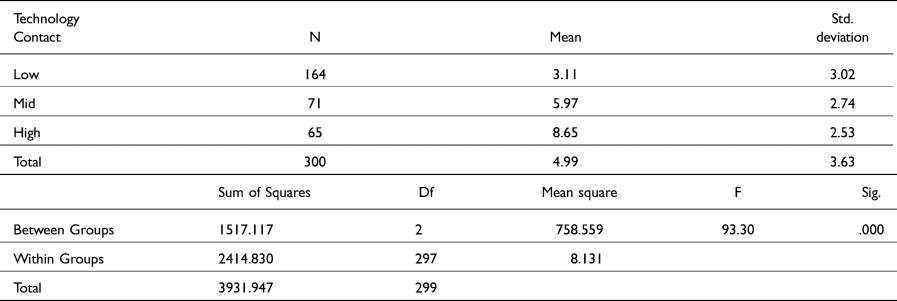
*significant at 0.05 level; df = 2, 297; critical F. =3.00
4.1.2 Statistical analysis of stress shift in variable words
Table 3 summarises the frequencies and percentages of realised and unrealised variable word stress shift in the speeches of UIYTUs.
Frequencies and percentages of UIYTUs’ stress shift in variable words
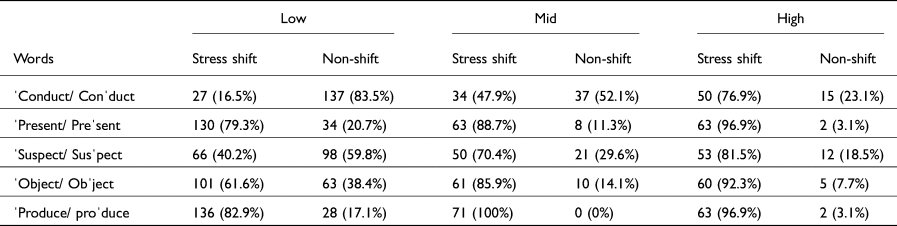
Table 3 shows UIYTUs’ ability to shift stress in words that can function both as nouns and verbs. Primary stress was shifted appropriately in ˈconduct/conˈduct by 16.5% of the LTC, 47.9% of the MTC and 76.9% of the HTC. The shift in ˈpresent/ preˈsent was perceived in the production of 79.3% of the LTC, 88.7% of the MTC and 96.9% of the HTC. The percentage of UIYTUs who shifted stress in ˈsuspect/ susˈpect are 40.2%, 70.4% and 81.5% of the LTC, the MTC and the HTC respectively. Among the LTC, 61.6% shifted stress appropriately in ˈobject/ obˈject. There were 85.9% and 92.3% appropriate stress shift perceived from MTC and HTC productions respectively. The expected stress shift in ˈproduce/ proˈduce was realised in the rendition of 82.9% of the LTC, all participants of the MTC and 96.9% of the HTC. Below is a graphical illustration of the analysis.
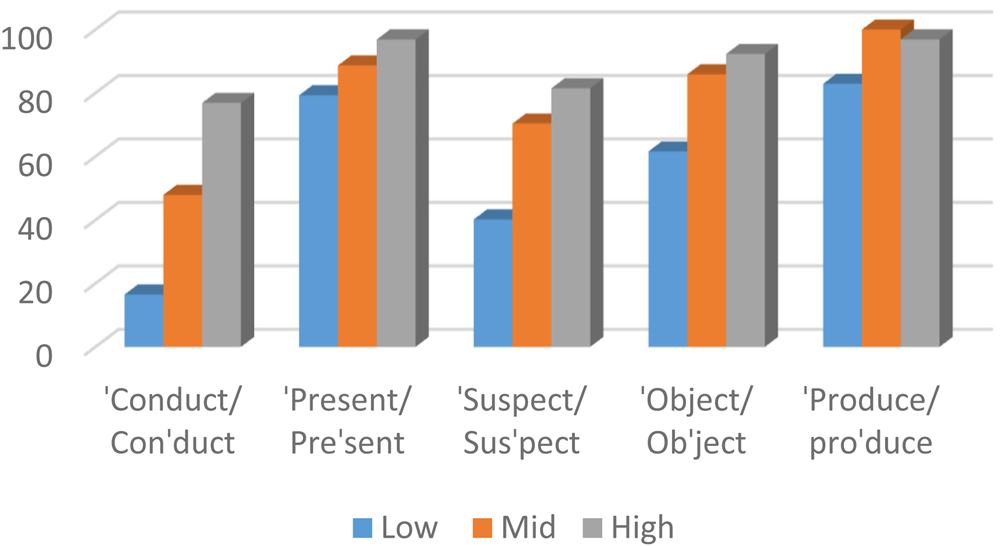
The bar chart in Figure 2 shows that higher percentages of stress shift were realised in UIYTUs’ production of variable words as the technology contact level progressed.
Percentage of stress shift realised in UIYTUs’ production of variable words
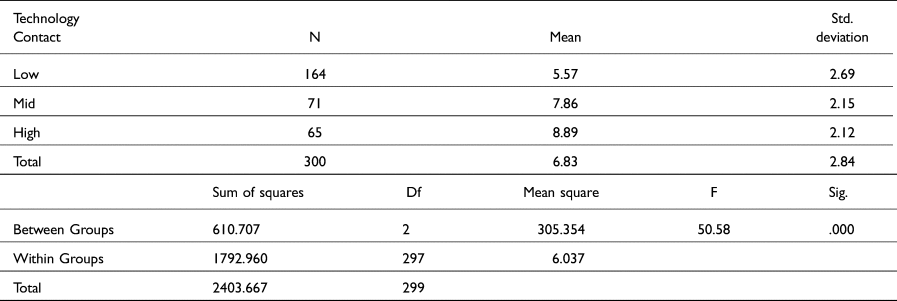
The result in Table 4 shows 2.35 mean variable word stress shift in the productions of LTC participants. The MTC participants had a mean stress shift of 7.86 and the mean stress shift realised in the speeches of HTC participants was 8.89. Mean performance of the 300 research participants was 6.83. Therefore, the difference in variable word stress shift among UIYTUs with varying degrees of technology exposure is statistically significant [F (2, 297) = 50.58; p < .05].
Analysis of variance for UIYTUs’ stress shift in variable words
*significant at 0.05 level; df = 2, 297; critical F. =3.00
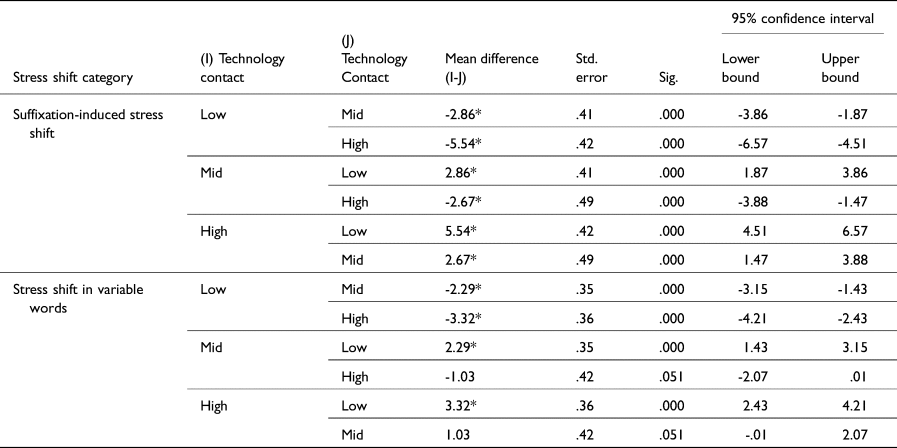
Multiple comparison between each pair of the TC levels for stress shift is presented in Table 5. The suffixation category reveals significant differences among the three levels of technology contact as the HTC performed significantly better than the MTC (MD = 2.67; p <.05) and the LTC (MD = 5.54; p <.05). Also, the MTC performed significantly better than the LTC (MD =2.86; p <.05). Stress shift in variable words exhibited statistical significant differences only between the HTC and the LTC (MD = 3.32; p <.05) and between the MTC and the LTC (MD = 2.29; p <.05). Although the HTC performed better than the MTC, the mean difference is not statistically significant (MD = 1.03; p <.05).
Multiple (between-group) comparison for UIYTUs’ stress shift
* The mean difference is significant at the 0.05 level.
4.2 Metrical analysis of UIYTUs’ stress shift
To further verify the rejection of the hypotheses in the statistical analysis section, selected lexical items were analysed using metrical grids. For each of the categories, predominant metrical patterns of selected words are presented below.
4.2.1 Metrical analysis of UIYTUs’ suffix-induced stress shift
Addition of suffixes to simple words is a morphological process capable of influencing stress placement within the words, depending on whether the suffix draws the stress on itself; leaves the stress pattern of the stem unaltered or shifts the stress to another syllable. The metrical analysis of UIYTUs’ ability to shift stress as induced by suffixation is presented in this section.
4.2.1.1 Native baseline and representative UIYTUs metrical grid for stress shift in photo→photography
The metrical grids below show how suffixation interact with word stress in the speeches of UIYTUs with various levels of technology contact. As presented in the grids, all the representative participants of the three categories of technology contact produced the SW structure as seen in the native baseline production for photo /ˈfəʊtəʊ/ or [ˈfɒto] (a Nigerian variant realised in the speeches of many of the teenagers), probably because the weaker node contains a vowel that is not prone to reduction. Their productions however differ with suffixation which prompts a forward shift of the primary stress from pho- to -to-, thereby reducing the strong vowel in the former to /ə/. Representative participants for the LTC and the MTC did not shift stress as expected. Their productions were rather characterised by sequence of stressed syllables where structures as SSWS, SSSS or SSSW were produced. The production of the HTC featured both expected stress shift and stress clashes as demonstrated in the productions of UIYTU 106 and UIYTU 191 respectively.


4.2.1.2 Native baseline and representative UIYTUs’ metrical grid for stress shift in perfect→perfection
As presented in the grids below, the productions of UIYTUs differ with the -ion stress-shifting suffix which prompts a forward shift of the primary stress from per- to -fec-, thereby reducing /ɜ:/ in per to /ə/. Again, the closest correspondence between the level of technology contact and ability to shift stress as required is found among the HTC, as demonstrated in the metrical grids of the two representative participants in this category. While some of the representative participants of the LTC and the MTC produced SW structure similar to the native baseline production for perfect, others produced SS pattern and realising the vowel in the initial syllable as [a]. In the same vein, the expected stress shift was realised in the productions of some of the participants in these categories represented by UIYTU 196 and UIYTU 232, while in others, represented by UIYTU 126 and UIYTU 116, stress was not shifted.
4.2.1.3 Native baseline and representative UIYTUs’ metrical grid for stress shift in variable words: Conduct (noun) and conduct (verb)
The metrical grids below present the noun/verb stress distinction for conduct. The stress pattern of the representative participants of the LTC and the MTC shows large variance from the native baseline SW (noun) and WS (verb) patterns. Whereas the vowel in the weak position, particularly of the verb, is reduced to /ə/ in the native baseline production, it predominantly remains stressed in the LTC and the MTC production of the words. All the representative participants of the LTC and the MTC had SS pattern for both noun and verb forms. While many of the HTC represented by UIYTU 102 produced SW pattern of conduct (noun) and WS pattern of the verb identical with that of the native baseline, many others represented by UIYTU 163 produced SS patterns thereby deviating from the standard form.
4.3 Dominant spectrographic patterns for UIYTUs’ stress shift
For the acoustic readings of stress shift, spectrograms of perfect/perfection and conduct (noun)/conduct (verb) as produced by a representative participant of each of the technology contact levels are compared with the spectrograms of the native baseline.
4.3.1 Dominant spectrographic patterns of perfect and perfection as produced by the native baseline and the UIYTUs
The spectrographic images of perfect and perfection as produced by the native baseline in comparison with a sample HTC spectrographic images of the same words as produced by UIYTU 245 are displayed in Figure 3. The pitch contour and waveform of the NB and the HTC show that per- was produced at a higher pitch and longer duration than -fect. The stress shift from per- to -fec- as observed in the NB spectrogram of perfection is also visible on the HTC image. The pitch and the duration readings of -fec(t)-, which was initially measured at 209Hz and 106ms respectively against the 265Hz and 141ms of per-, is measured at 244Hz and 299ms against the 221Hz and 189ms of per-, showing that the expected stress shift was realised.
Native baseline spectrograms of perfect and perfection compared with sample HTC spectrograms of perfect and perfection as produced by UIYTU 245

The MTC spectrogram of perfect (Figure 4) shows flatness rather than a modulation of pitch. Both syllables are produced at equivalent duration. The shift of stress in the NB image of perfection is not conspicuously realised in the MTC's. The pitch of -fec- (201Hz) is only slightly higher than that of per- (193Hz). The non-shift of the stress is more evident in the duration of both syllables as the former is measured at 250ms while the latter which is expected to be shorter is measured at 324ms.
Native baseline spectrograms of perfect and perfection compared with sample MTC spectrograms of perfect and perfection as produced by UIYTU 282

Figure 5 shows the native baseline spectrograms of perfect and perfection compared with a sample LTC spectrograms of perfect and perfection as produced by UIYTU 258. Unlike the NB rendition, the LTC production is flat and lacks the expected durational contrast.
Native baseline spectrograms of perfect and perfection compared with sample LTC spectrograms of perfect and perfection as produced by UIYTU 258

4.3.2 Dominant spectrographic patterns of ˈconduct (noun) and conˈduct (verb) as produced by the native baseline and the UIYTUs
The spectrographic images of ˈconduct and conˈduct as produced by the native baseline and a sample HTC spectrogram of the same words as produced by UIYTU 250 are displayed in Figure 6. The first syllable of ˈconduct in the NB image displays the highest prominence and is marked for the primary stress considering its pitch value of 268Hz and duration of 201ms against the 224Hz/146ms readings of the second syllable. In the verb form, the second syllable is marked for primary stress considering its respective pitch and duration of 252Hz and 436ms against the 208Hz and 242ms of the first syllable. In the sample HTC image, the first syllable of conduct (N) was produced at 251Hz and 177ms while the second was produced at 226Hz and in 124ms, thereby making the initial syllable the most prominent. The second syllable of conduct (V) is produced most prominently, given its pitch and duration readings of 264Hz and 240ms, compared with the 237Hz and 223ms of the first syllable.
Native baseline spectrograms of ˈconduct (noun) and conˈduct (verb) compared with sample HTC spectrograms of ˈconduct (noun) and conˈduct (verb) as produced by UIYTU 250

Figure 7 displays the sample MTC spectrograms of ˈconduct (noun) and conˈduct (verb) as produced by UIYTU 200 in comparison with the native baseline's, already analysed above. The distinctive rise in pitch of the stressed syllables of both words is not evident on the sample MTC images. The first syllable of conduct (N) in the MTC spectrogram was produced at 232Hz and 121ms while the second was produced at 218Hz and in 208ms. With this readings, it is difficult to ascribe prominence to any of the syllables as the first is higher in pitch than the second while the second is longer in duration than the first. Also, the pitch and duration readings of both syllables of conduct (V) do not show much difference between the pitch and duration of the first (209Hz/458ms) and those of the second (224Hz/447ms), hence the flatness of the pitch track.
Native baseline spectrograms of ˈconduct (noun) and conˈduct (verb) compared with sample MTC spectrograms of ˈconduct (noun) and conˈduct (verb) as produced by UIYTU 200

Figure 8 displays the sample LTC spectrograms of ˈconduct (noun) and conˈduct (verb) as produced by UIYTU 211 compared with the native baseline's. Unlike the pitch modulation and durational contrast between stressed and unstressed syllables of both words in the NB rendition already analysed above, the LTC pitch track lack the expected modulation. As observed in the spectrogram, the duration of the stressed syllables does not seem longer than that of the unstressed syllables.
Native baseline spectrograms of ˈconduct (noun) and conˈduct (verb) compared with sample LTC spectrograms of ˈconduct (noun) and conˈduct (verb) as produced by UIYTU 211

5. Findings
Differences in participants’ ability to shift stress as necessitated by suffixation [F(2, 297)=93.30;p<.05] and in variable words [F(2, 297)=71.47;p<.05] is statistically significant across the three categories. The metrical analysis revealed that participants across the three technology levels produced the SW structure of the disyllabic root. However, their ability to shift stress when suffixes are added and in variable words vary. While HTC metrical grids predominantly revealed stress reassignment in suffix-induced context, MTC and LTC grids, in varying degrees, reveal both stress shift and stress clash. But for a fair realisation of stress shift in the grids of the HTC, pitch shift characterises speeches of all TC levels in variable words, thus confirming Sunday and Oyatokun (Reference Sunday and Oyatokun2016) and Sunday and Oyemade (Reference Sunday and Oyemade2021). Vowel reduction which naturally follows stress shift resulting from suffixation (such as the ə in the initial syllable of perfection [pəˈfɛkʃən]) and, especially, in the verb forms of variable words (such as [kənˈdʌkt]) featured in some productions of the HTC participants while it was unrealised in others. Conversely, participants with low technology contact strengthened vowels in metrically weak positions such that [pafɛkʃɒn] and [kɒndɒkt] are predominantly realised, thereby confirming Akinjobi (Reference Akinjobi2006), Akindele (Reference Akindele, Oladipupo, Akindele and Osisanwo2020) and Emmanuel–Ogbe & Akinjobi (Reference Emmanuel–Ogbe, Akinjobi, Oladipupo, Akindele and Osisanwo2020). Participants with mid technology contact fluctuated between strengthening and weakening of such vowels. HTC spectrograms showed higher pitch and duration readings for post-shift primary syllables than their pre-shift counterparts. Pitch modulation is predominantly unrealised in LTC spectrograms. MTC fluctuate between pitch modulation and flatness. Vowel length is equivalent in MTC and LTC spectrograms.
6. Conclusion
This study empirically examined the influence of technological facilities which make native English accessible to L2 speakers on Yoruba (Nigerian) teenagers’ approximation to Standard British English stress shift. The three categories of participants for the study were unified by all other variables except their levels of exposure to and exploitation of technological facilities such as electronic media sources, interactive computer games, internet speech drills, dictionaries with audio aids and British and American films. Each category of participants demonstrated higher level of approximation to Standard English stress shift induced by suffixation and in variable words than their counterparts with lower technological exposure. This findings attest to Roach's (Reference Roach2000) claim that necessary social contact (or, in the context of this study, technological contact) with native speakers enhances foreign learners’ spoken form. Through empirical data, it also verifies the efficacy of technology-based non-enculturation sources recommended by Akinjobi (Reference Akinjobi2015) for approximating to Standard British English. These technological means of virtual access to native English are viable facilities that Nigerians as well as other L2 users of English can harness to enhance their spoken English. Professionals(-in-training) in any oral communication fields such as news casting, teaching, reporting, advertising, Nollywood etc. are advised to take advantage of the facilities to attain higher proficiency. The facilities are also highly recommended for teachers of oral English in Nigeria and in other L2 contexts to equip themselves with necessary spoken English skills in order to help their learners achieve maximum intelligibility.
 ABISOLA AIYEOLA is a resourceful, creative and self-motivated female academic who is enthusiastically committed to establishing the nexus between technology and language learning. She received her PhD in English from the Department of English, University of Ibadan, Nigeria and currently teaches English phonetics and phonology courses, English Language in Nigeria, Language and National Development, among others, at the Department of English, Elizade University, Nigeria. Using quantitative and qualitative methods of analysis, she has conducted researches pitched around modelling, sociolinguistics, language education, educational technology and social media Covid-19 discourse. Her research outputs are published in reputable local and international journals. Email: abisolafelicia@gmail.com


 Open access

