

When Argentina became the first nation to designate a significant percentage of parliamentary seats for women in 1993, it signaled the start of an explosive global trend: the use of gender quotas to increase women’s political inclusion (Hughes et al. Reference Hughes, Paxton, Clayton and Zetterberg2019). Consequently, quotas have become a popular strategy for promoting gender equality, appearing in more than 130 nations to date. As a widespread reform intended to fast-track women in politics, it is feasible that quotas would influence public attitudes toward women in politics positively, negatively, or even conditionally (Franceschet, Krook, and Piscopo Reference Franceschet, Krook and Piscopo2012, 13; Pitkin Reference Pitkin1967). Indeed, given their capacity to influence other forms of women’s representation, both descriptive (the number of women in legislatures) and substantive (the types of policies passed), it is likely that quotas also impact beliefs (Baldez Reference Baldez2006; Dahlerup and Freidenvall Reference Dahlerup and Freidenvall2005; Franceschet and Piscopo Reference Franceschet and Piscopo2008; Krook Reference Krook2006; Murray Reference Murray2010; Paxton, Hughes, and Painter Reference Paxton, Hughes and Painter2009; Xydias Reference Xydias2008).
Some evidence supports this claim. Experimental case studies of local quotas and villagers’ acceptance of female leaders, for instance, indicate positive effects (Beaman et al. Reference Beaman, Chattopadhyay, Duflo, Pande and Topalova2009). Cross-national studies in democratic, European, developing, and Muslim nations corroborate these findings (Allen and Cutts Reference Allen and Cutts2018; Benstead Reference Benstead2018; Fernández and Valiente Reference Fernández and Valiente2021; Kim Reference Kim2020). Although this provides some insight into the relationship between quotas and beliefs, in addition to being largely cross-sectional and/or small-N case studies, most studies measure quotas using a binary measure of adoption. Consequently, our understanding of how quotas shape beliefs remains incomplete in two ways. First, although some scholars are beginning to acknowledge the growing diversity of quota features and their impact on women’s representation (Dahlerup and Freidenvall Reference Dahlerup and Freidenvall2005; Jones Reference Jones2009; Paxton and Hughes Reference Paxton and Hughes2015; Schwindt-Bayer Reference Schwindt-Bayer2009), more work is needed to understand how these features influence attitudes across different types of quotas—particularly cross-nationally and over time (Hughes et al. Reference Hughes, Paxton, Clayton and Zetterberg2019). Second and consequently, the theoretical mechanisms underlying these features and their effects have yet to be systematically explored.
We build on current work by examining (1) quotas’ longitudinal, global effect on approval of women politicians and (2) how their diverse features and therefore strength, alongside country context, shape this relationship (Hughes et al. Reference Hughes, Paxton, Clayton and Zetterberg2019). In doing so, we engage existing hypotheses about how quotas might influence beliefs. On one hand, quotas may liberalize beliefs by legitimizing female politicians (Kittilson Reference Kittilson2005). Limited but important research supports this claim (Allen and Cutts Reference Allen and Cutts2018; Beaman et al. Reference Beaman, Chattopadhyay, Duflo, Pande and Topalova2009). Alternatively, concerns about nepotism or unfair advantages may yield negative or backlash effects (Baldez Reference Baldez2006; Clayton Reference Clayton2015). Both propositions have merit, and both can be true depending on the context. In fact, there is reason to suspect variation in quota influence.
Because quotas vary, it makes sense that different quotas would be received differently. For instance, quotas generating tangible changes in the legislature will likely elicit different reactions than those producing insignificant shifts, given the different mechanisms underlying attitude formation. Yet few make this distinction when studying attitudes. Quota effects could also be shaped by context. At the national level, studies suggest that quotas may be most effective in democracies (Allen and Cutts Reference Allen and Cutts2018; Bush Reference Bush2011). Individually, perhaps the most salient conditioning factor is gender, with many qualitative studies revealing backlash among male politicians in response to quotas (Franceschet and Piscopo Reference Franceschet and Piscopo2008; Lloren Reference Lloren2014) and enhanced effects among women who feel that quotas validate their political presence (Phillips Reference Phillips1995). Though some have examined these factors in subsamples or case studies, their global effect is unclear.
We build on current research to clarify which quota features influence beliefs, in which direction they do so, and what circumstances help or hinder these effects globally and over time. Using four waves of data (1994–2014) from the World Values Survey (WVS) in 87 nations, we examine how different national quotasFootnote 1 influence beliefs about women’s political suitability. We construct a theoretical framework classifying quotas as either weak or robust based on the strength of their features and, thus, the visibility they engender. This visibility, we argue, is the mechanism through which quotas shape beliefs. By linking each category to a corresponding level of visibility (weak quotas to low visibility; robust quotas to high visibility), we evaluate how different levels of women’s visibility in legislatures—as facilitated by different types of quotas—shape global attitudes toward women in politics in both significance and direction. Building on work exploring quota effects within different social subgroups (e.g., men versus women) and certain political environments (e.g., democracies), we additionally explore democracy and gender’s moderating effects among these quota categories to achieve a deeper understanding of how context influences attitude formation.
In doing so, we begin to demystify the black box through which quotas—an internationally recognized approach for improving women’s rights—shape global beliefs about women in politics while expanding upon existing work emphasizing visibility. In revealing which elements are more (or less) likely to positively transform public approval of women in politics, we shed new light on how quotas can best foster popular perceptions of women as both responsible and capable of holding high-status positions, in turn providing more avenues for women to engage in substantive societal changes.
We begin with a brief discussion of existing work on how quotas, and specifically the visibility they engender, shapes public attitudes. Drawing on this work, we introduce our approach to categorizing quotas, then theorize about how the visibility they produce might shape beliefs. Next, we present our data and methods, and we finish by discussing our findings and their implications.
Symbolic Representation, Visibility, and Quotas
After the 1995 United Nations (UN) Fourth World Conference on Women, where quotas were prioritized and featured as part of the Beijing Platform for Action, quotas rose exponentially across countries (Hughes, Krook, and Paxton Reference Hughes, Krook and Paxton2015). Studies exploring quotas’ effects grew accordingly. Initially, scholars focused on which factors increased women in the legislature, and which quotas were most successful at doing so (Baldez Reference Baldez2006; Kenworthy and Malami Reference Kenworthy and Malami1999; Kunovich and Paxton Reference Kunovich and Paxton2005; Matland Reference Matland1998). This approach was accompanied by, and extended to, other areas of study—for instance, the linkage between women’s descriptive and substantive representation (e.g., women’s issues and health policy) (Franceschet and Piscopo Reference Franceschet and Piscopo2008; Swiss, Fallon, and Burgos Reference Swiss, Fallon and Burgos2012), as well as broader trends in women’s political participation and endorsement of gender equality (Coffé and Bolzendahl Reference Coffé and Bolzendahl2010; Johnson, Hope, and Kayonga Reference Johnson, Hope and Kayonga2003; Kittilson and Schwindt-Bayer Reference Kittilson and Schwindt-Bayer2012).
The latter, more commonly known as women’s symbolic representation, or the “feelings and attitudes evoked by political symbols,” typically refers to either women’s political engagement or attitudes toward women in politics (Hinojosa and Kittilson Reference Hinojosa and Kittilson2020, 32; see also Franceschet, Krook, and Piscopo Reference Franceschet, Krook and Piscopo2012). Existing studies mostly focus on the former, highlighting the crucial role that women’s political presence plays in shaping political involvement (Campbell and Wolbrecht Reference Campbell and Wolbrecht2006; Hinojosa and Kittilson Reference Hinojosa and Kittilson2020; Liu Reference Liu2018; Liu and Banaszak Reference Liu and Banaszak2017). The underlying argument goes as follows: When women take up elected positions, they signal women’s political capacity and belongingness while challenging patriarchal notions about who can or should rule (Mansbridge Reference Mansbridge1999; Phillips Reference Phillips1995). Consequently, women feel greater identification with, and thus connection to, the political realm—leading to increased political participation, awareness, and involvement (Hinojosa and Kittilson Reference Hinojosa and Kittilson2020). Scholars have recently extended this logic to consider how women’s representation influences public attitudes (Alexander Reference Alexander2012; Johnson, Hope, and Kayonga Reference Johnson, Hope and Kayonga2003). If the broader population sees women as effective politicians in the public space, how might this shift attitudes toward women politicians generally? With this question, women’s collective visibility becomes a central mechanism for attitude change (Burns, Schlozman, and Verba Reference Burns, Schlozman and Verba2001; Campbell and Wolbrecht Reference Campbell and Wolbrecht2006; Dasgupta and Asgari Reference Dasgupta and Asgari2004).
According to the visible cue theory of representation, if changes to the proportion of women in the legislature are not noticeable or substantial, “heightened descriptive representation will fail to exert symbolic effects” (Hinojosa and Kittilson Reference Hinojosa and Kittilson2020, 38). This is in line with Kanter (Reference Kanter1977), who posits that there must be a critical mass within an organization to create change—in this case, a critical mass of women legislators. When the number of women legislators rises significantly, and citizens are aware of the increase, visibility has the potential to transform women’s symbolic representation in terms of political participation and attitudes toward women politicians. Campbell and Wolbrecht (Reference Campbell and Wolbrecht2006), for example, find that female politicians’ visibility in the news inspires political engagement among adolescent girls. Similarly, Desposato and Norrander (Reference Desposato and Norrander2009) find strong support that women’s descriptive representation, or visibility, increases women’s political engagement in 17 Latin American countries. Alexander (Reference Alexander2012) also finds a link between women’s increased representation and women’s endorsement of female politicians across 25 nations. Tan (Reference Tan2015) reports similar findings in Singapore. Thus, according to the visible cue theory and demonstrated in the examples given here, women’s noticeable and substantial visibility has the potential to convey women’s political suitability, which positively influences public attitudes (Allen and Cutts Reference Allen and Cutts2018).
One effective way to increase visibility is through quotas, which purposefully and publicly codify women’s political inclusion while symbolizing or cueing their political equality (Dahlerup and Freidenvall Reference Dahlerup and Freidenvall2010; Mansbridge Reference Mansbridge1999; Phillips Reference Phillips1995; Tripp Reference Tripp2003; Vincent Reference Vincent2004). Because quotas uniquely “jump-start” the political system, they have the capacity to transform legislative bodies and increase women’s visibility, precipitating changes in attitudes—unlike subtler, incremental changes to women’s representation (Beaman et al. Reference Beaman, Chattopadhyay, Duflo, Pande and Topalova2009; Clayton and Zetterberg Reference Clayton and Zetterberg2018; Dahlerup and Freidenvall Reference Dahlerup and Freidenvall2010; De Paola, Scoppa, and Lombardo Reference De Paola, Scoppa and Lombardo2010). In Rwanda, for example, respondents claimed that quotas—as a symbolic indication of government endorsement of women politicians—signified a broader cultural shift toward gender egalitarianism (Burnet Reference Burnet2011). Indeed, given the role that representation plays in conveying broader ideals (Pitkin Reference Pitkin1967) and states’ unmatched capacity to promote “state-sponsored feminism” via quotas (Kim Reference Kim2020; Nanivadekar Reference Nanivadekar2006:123), it makes sense that quotas would legitimize women in politics (Banaszak Reference Banaszak2006; Kittilson and Schwindt-Bayer Reference Kittilson and Schwindt-Bayer2010).
Despite quotas’ capacity to expedite women’s legislative presence, their influence on public attitudes toward female politicians themselves is not as well understood. Although scholars anticipate that quotas will “reshape attitudes, values, and ideas towards women’s roles in politics,” the magnitude and direction of these effects are not entirely clear (Kittilson Reference Kittilson2005, 643–44; see also Baldez Reference Baldez2006; Nanivadekar Reference Nanivadekar2006). On one hand, many studies report positive outcomes. For instance, in India, local quotas reduced constituent biases toward female leaders (Beaman et al. Reference Beaman, Chattopadhyay, Duflo, Pande and Topalova2009). Case studies of Rwanda and Italy report similar findings, which are surprisingly enduring, even when, as in Italy, quotas are retracted shortly after adoption (Burnet Reference Burnet2011; De Paola, Scoppa, and Lombardo Reference De Paola, Scoppa and Lombardo2010). Though limited, cross-national studies also demonstrate positive effects. For example, in an analysis of 48 democracies in 2005, quotas were associated with liberalized beliefs, particularly among women (Allen and Cutts Reference Allen and Cutts2018). Cross-sectional studies of European (Fernández and Valiente Reference Fernández and Valiente2021), developing (Kim Reference Kim2020), and Muslim nations (Benstead Reference Benstead2018) report similar outcomes.
Yet quotas may also reinforce negative stereotypes in response to unwelcome changes to the status quo, leading to backlash (Beaman et al. Reference Beaman, Chattopadhyay, Duflo, Pande and Topalova2009; Grey Reference Grey2002; Krook Reference Krook2015). Because quotas’ key criterion is being female, they may provoke sentiments that women politicians are unqualified, in turn undermining women’s broader political credibility (Clayton Reference Clayton2015; Franceschet and Piscopo Reference Franceschet and Piscopo2008).Footnote 2 For example, quota women are often dismissed as incompetent, the result of nepotism, or even locas (crazy) by their male peers, who respond by sidelining and antagonizing them—a behavior that may advance negative perceptions (Baldez Reference Baldez2006; Franceschet and Piscopo Reference Franceschet and Piscopo2008; Grey Reference Grey2002; Lloren Reference Lloren2014). Backlash effects have also been linked to country context, where women’s societal roles do not align with those of women politicians, as seen across Asia (Liu Reference Liu2018) and Eastern Europe (Fallon, Swiss, and Viterna Reference Fallon, Swiss and Viterna2012).
In sum, quotas’ overall effect on attitudes remains inconclusive. We attribute this, in part, to an incomplete consideration of how quotas, their features, their context of adoption, and—most centrally—the visibility they produce shape women’s symbolic representation via attitudes (Hughes et al. Reference Hughes, Paxton, Clayton and Zetterberg2019). As one study shows, quota attributes are decisive in determining the number of women elected to office (Rosen Reference Rosen2017). And yet, despite the importance of adopting the “‘right’ kind of quota law [under] the ‘right’ conditions” (Baldez Reference Baldez2006, 103), we know surprisingly little about how quotas’ features and the context in which they are enacted determine their effects.
Thus, although existing work sheds light on the complex and sometimes contradictory ways in which quotas influence attitudes, more work is needed to clarify how and under what circumstances women’s visibility via quotas advances or undermines women’s broader symbolic representation. As Franceschet and Piscopo (Reference Franceschet and Piscopo2008, 403) argue, “How women achieve office shapes perceptions about their capabilities.” Building on current work, we shed new light on how quotas influence attitudes cross-nationally and within different contexts. Because tangible changes to the political landscape brought on by quotas (such as shifts in public opinion) take time to manifest, quotas are best studied longitudinally, as a handful of studies demonstrate (Beaman et al. Reference Beaman, Chattopadhyay, Duflo, Pande and Topalova2009; Benstead Reference Benstead2018). Therefore, we expand on existing cross-sectional studies to evaluate changes over time. This approach advances current literature by systematically and theoretically evaluating how different levels of visibility—something fundamentally determined by quotas and their features—impact attitudes.
Quota Types, Features, and Strength
Although all quotas pursue similar aims, their characteristics vary. Most fundamentally, quotas exist as one of two types: candidate quotas (also known as legislative quotas), requiring some percentage of candidates or nominees be women, or reserved seats, designating a number or proportion of seats for women. Yet quotas do not differ by type alone; they also possess institutional features determining their strength and, thus, the visibility they generate. Therefore, we additionally classify quotas as either weak or robust, based on the presence and rigor of two key features: threshold size (i.e., the percentage of women to be elected or nominated) and enforcement mechanisms.
For instance, the breadth of a quota’s reach, or its de facto threshold (i.e., the percentage of seats that women can practically occupy),Footnote 3 can range anywhere from 5% to 50%. Perhaps unsurprisingly, higher thresholds are linked to greater advances in representation than lower thresholds (Paxton and Hughes Reference Paxton and Hughes2015; Paxton, Hughes, and Painter Reference Paxton, Hughes and Painter2009; Rosen Reference Rosen2017; Schwindt-Bayer Reference Schwindt-Bayer2009). A 10% target is a particularly crucial milestone. Whereas thresholds below 10% render inconsequential change, thresholds of at least 10% promote significant increases in women’s representation and should enable visibility (Hughes et al. Reference Hughes, Paxton, Clayton and Zetterberg2019; Paxton, Hughes, and Green Reference Paxton, Hughes and Green2006). Thus, we classify quotas with a minimum 10% de facto threshold as robust and those with de facto thresholds below 10% as weak.
We also consider enforcement mechanisms. Although some quotas include no enforcement protocols, reserved quotas, for example, can establish a legal procedure for filling seats (as opposed to leaving this process unspecified), while candidate quotas can include placement mandates and/or sanctions. These additions strengthen basic quotas by (1) clarifying standards and ensuring quotas’ fair and meaningful application and by (2) deterring insubordination (sanctions) and ensuring women appear in winnable positions on candidate lists (placement mandates). Additional enforcement mechanisms such as these have been linked to increased women’s representation (Hughes, Krook, and Paxton Reference Hughes, Krook and Paxton2015; Hughes et al. Reference Hughes, Paxton, Clayton and Zetterberg2019; Jones Reference Jones2004; Schwindt-Bayer Reference Schwindt-Bayer2009).
However, as Hughes et al. (Reference Hughes, Paxton, Clayton and Zetterberg2019) illustrate, not all candidate quota enforcement mechanisms possess equal strength. Whereas strong placement mandates meet or exceed the stated threshold, weak mandates fall short or only vaguely reference candidate ordering. Similarly, unlike strong sanctions that bar noncompliant parties from elections entirely, weak sanctions merely revoke funding or levy fines—thereby allowing well-funded parties to absorb monetary penalties and field their preferred (male) candidate anyway (Dahlerup and Freidenvall Reference Dahlerup and Freidenvall2005; Krook Reference Krook2009).
Thus, we further classify robust quotas as those that—in addition to possessing a minimum 10% de facto threshold—also include strong enforcement mechanisms. In comparison, weak quotas, in addition to missing the 10% threshold, possess weak, if any, enforcement mechanisms. Whereas robust quotas will likely increase women’s visibility, weak quotas will not. When differentiated by type, this yields four separate quota categories:Footnote 4 weak candidate, weak reserved, robust candidate, and robust reserved, the attributes of which are summarized in Figure 1. This classification allows us to systematically examine how visibility, as a mechanism of symbolic representation, impacts beliefs under different quotas. In the following section, we theorize about this process in greater depth.
Quota features by type and mechanism.

The Mechanism of Change: High versus Low Visibility
Until recently, the literature on quotas and attitudes largely focused on women’s symbolic outcomes, with little consideration for how those outcomes arise (i.e., the mechanisms that produce them). Building on existing studies and drawing on the visible cue theory of representation (Campbell and Wolbrecht Reference Campbell and Wolbrecht2006; Hinojosa and Kittilson Reference Hinojosa and Kittilson2020), we identify visibility as the key mechanism of attitude change under quotas. Indeed, the public cannot respond to a change it does not see (Hinojosa and Kittilson Reference Hinojosa and Kittilson2020). Thus, without the features and strength necessary to generate drastic and visible changes to the legislature, quotas should have no impact on beliefs. Unlike weak quotas, however, robust quotas should generate sufficient visibility. With a minimum 10% de facto threshold and strong enforcement mechanisms, robust quotas ensure high visibility—which forces the public to seriously reevaluate their beliefs in response. We hypothesize the following:
H 1 : Neither weak candidate quotas nor weak reserved quotas will significantly impact beliefs.
H 2 : Robust quotas will significantly impact beliefs.
Yet the direction of this outcome is unclear. Although quotas promote acceptance of female politicians, they do not guarantee increased approval, as studies of backlash illustrate (Franceschet and Piscopo Reference Franceschet and Piscopo2008; Liu Reference Liu2018). We expect that one determinant of whether the public accepts or rejects this narrative is the type of quota enacted. Building on similar work exploring differences in descriptive representation trajectories by quota type (Hughes, Krook, and Paxton Reference Hughes, Krook and Paxton2015), we anticipate that candidate quotas will be linked to approval, while reserved quotas will be linked to backlash. This, we argue, is due to differences in how each type generates visibility as a function of its design.
Candidate quotas produce visibility by providing female candidates the opportunity to run for office—a position for which they must then be elected. When the public sees women inhabiting political office in significant numbers, there is little reason to doubt their abilities. After all, if they were incompetent, they would not have won their seats. Extending this line of thought, high visibility generated by robust candidate quotas should convince the public of women’s capabilities. In contrast, because reserved quotas set aside seats for women, their election is a practical certainty—an achievement that perhaps the public sees as unearned. This sentiment, combined with high visibility, may diminish women’s already precarious credibility. By increasing the visibility of a group suspected of being undeserving, robust reserved quotas may exacerbate perceptions of unfair advantage to the point of backlash. Additionally, because quota women are more easily discerned within reserved versus candidate systems, public stigma against them can be more easily directed (Bauer Reference Bauer2008, Dahlerup and Freidenvall Reference Dahlerup and Freidenvall2010). Therefore, we hypothesize the following:
H 2a : Robust candidate quotas will be associated with approval of female legislators, whereas
H 2b : Robust reserved quotas will be associated with backlash.
In sum, we anticipate that although quotas producing low visibility (i.e., weak quotas) will be unimpactful, those strong enough to generate high visibility (i.e., robust quotas) will significantly influence beliefs. Additionally, whereas high visibility should lead to greater acceptance of women politicians under robust candidate quotas, it will precipitate backlash under robust reserved quotas. Figure 2 summarizes these relationships.
Proposed model of quota influence on attitudes.

The Context of Change
In addition to visibility, contextual factors, such as gender and democracy, are perhaps equally important in determining how quotas shape beliefs.
Gender
There is reason to suspect variation by gender. In addition to men’s backlash (Baldez Reference Baldez2006; Franceschet and Piscopo Reference Franceschet and Piscopo2008; Grey Reference Grey2002), women may also exhibit specific effects (Alexander Reference Alexander2012; Allen and Cutts Reference Allen and Cutts2018; Beaman et al. Reference Beaman, Chattopadhyay, Duflo, Pande and Topalova2009). The visibility that quotas produce and their messages of inclusion may especially inspire women, who, upon seeing someone who “looks like them” in politics, may adopt more progressive beliefs than men through a “vote of confidence” or “role model” effect (Allen and Cutts Reference Allen and Cutts2018; Burrell Reference Burrell1996; Phillips Reference Phillips1995; Wolbrecht and Cambell Reference Wolbrecht and Cambell2007). When this is the case, women’s responses to quotas should be exceptionally positive. Yet poor quota design can also generate unique female backlash, resulting in disengagement (Clayton Reference Clayton2015; Kerevel and Atkeson Reference Kerevel and Atkeson2017). If such recoiling also occurs for attitudes, quotas will elicit particularly negative quota reactions among women. Thus, we hypothesize,
H 3 : Quota impact on attitudes will depend on gender.
Democracy
Because quota impact “depends on how [quotas] interact with elements of the political environment” (Krook Reference Krook2009, 17), we also consider democracy as a moderator. Although one study examines the association between quotas and attitudes within democracies (Allen and Cutts Reference Allen and Cutts2018), more work is needed to understand how democracy and quotas interact.
Citizens of democracies may respond particularly favorably to quotas, which act as a “symbol of inclusion and democracy” by emphasizing equal access to political institutions for marginalized populations, like women (Krook Reference Krook2006, 34; see also Hassim Reference Hassim2002; Hinojosa and Kittilson Reference Hinojosa and Kittilson2020). A strong democratic framework with institutional checks on power may function similarly by preventing quota tampering, thus undercutting narratives about undeserving women (Franceschet and Piscopo Reference Franceschet and Piscopo2008; Kunovich and Paxton Reference Kunovich and Paxton2005; Murray Reference Murray2010). In fact, quotas and democracy are so interconnected that nations often pass quotas to enhance their democratic legitimacy (Bush Reference Bush2011; Schwindt-Bayer and Mishler Reference Schwindt-Bayer and Mishler2005).
Yet if quotas appear undemocratic (e.g., undermining free competition and equality, reducing transparency of candidate selection, providing special treatment) (Baldez Reference Baldez2006; Dahlerup Reference Dahlerup2006), they may exacerbate stigma within democracies (Bauer Reference Bauer2008; Clayton Reference Clayton2015; Franceschet and Piscopo Reference Franceschet and Piscopo2008). This corresponds with studies showing how authoritarian regimes use quotas to uphold patronage networks and boost their reputations rather than advance democracy, and the discouraging impact this has on perceptions of female legislators (Bush and Zetterberg Reference Bush and Zetterberg2021; Lloren Reference Lloren2014). Consequently, we expect the following:
H 4 : Quota impact on attitudes will vary by level of democracy.
Data and Methods
To test our hypotheses, we evaluate nationally representative, individual-level WVS data capturing global attitudes toward women in politics across four consecutive survey waves (3–6) (Inglehart et al. Reference Inglehart, Haerpfer, Moreno, Welzel, Kizilova, Diez-Medrano, Lagos, Norris, Ponarin and Puranen2014).Footnote 5 We analyze 252,668 individuals from 87 countries and 187 country-waves. Unlike other international surveys, the WVS offers the widest sample and temporal coverage (1994 and 2014) during a landmark period of quota expansion (Paxton, Hughes, and Painter Reference Paxton, Hughes and Painter2009). These data are therefore ideal for evaluating attitudes longitudinally and cross-nationally. Still, because we do not evaluate causal effects, results should be interpreted cautiously. Appendix 1 in the Supplementary Materials online lists all country-waves analyzed by quota presence.Footnote 6
Analytic Approach
To perform this analysis, we use multilevel mixed-effects logistic regression,Footnote 7 which simultaneously evaluates national- and individual-level variables over time while accounting for clustering, or similarities, between groups.Footnote 8 We estimate three-level mixed-effects models, wherein individuals (L1) are clustered within country-waves (L2), clustered within nations (L3). Survey wave dummies account for independent time effects. Sampling weights address selection probability. Earlier models including measures of quota duration (in years), quota duration squared, and dummies of various milestones (adopted within one, three, or five years) testing for dynamic, long-term variability, as well as nonlinear or compounding time effects, were insignificant.Footnote 9 This corroborates existing work highlighting quotas’ capacity to manifest lasting changes, even without long-term implementation (De Paola, Scoppa, and Lombardo Reference De Paola, Scoppa and Lombardo2010) and lays the foundation for future studies examining time effects in greater detail. We also include random intercepts at each level. Random slopes within cross-level interaction models account for cross-country differences in attitudes not explained by quotas (Heisig and Schaeffer Reference Heisig and Schaeffer2018). Appendices 2 and 3 present a correlation matrix and descriptive statistics.
Dependent Variable
We measure women’s symbolic representation using one question from the WVS asking whether respondents agree with this statement: “Men make better political leaders than women.” This measure was originally ordinal. However, because cross-national ordinal measures are highly susceptible to nonrandom cultural and contextual distortion (e.g., certain nations favor extremes, others avoid them) and often introduce unobserved bias into the analysis (Stegmueller Reference Stegmueller2011), we follow other cross-national WVS studies and dichotomize this measure (Kim Reference Kim2020; Pandian Reference Pandian2018). We code approval of women in politics (disagree, strongly disagree) as 1 and disapproval (agree, strongly agree) as 0. By emphasizing differences in overall direction (i.e., do respondents see women as fundamentally suitable or unsuitable for politics?) rather than intensity (e.g., strongly agree versus agree)—which is highly subjective and country specific—this approach best actualizes this study’s central goal: to investigate whether quotas advance or undermine women’s symbolic representation.
Still, unreported analysesFootnote 10 using multilevel ordered logistic regression are substantively similar for the main models and democracy interactions.Footnote 11 Although interesting, ordinal gender interactions are too nuanced to be adequately discussed here at length.Footnote 12 This article, which provides an initial, more generalized overview of cross-national quota effects by gender, provides the crucial foundation upon which future work examining more nuanced response categories can expand.
Country-Level Independent Variables
We construct our main independent variable, quotas, using QAROT—the first and only global, longitudinal dataset of gender quotas (Hughes et al. Reference Hughes, Paxton, Clayton and Zetterberg2017; Hughes et al. Reference Hughes, Paxton, Clayton and Zetterberg2019). This measure contains five categories: one for each quota (weak candidate, weak reserved, robust candidate, robust reserved) and one for nonadopters (ref = no quotas). This allows us to directly evaluate and compare the magnitude and significance of each quota. Weak quotas test the mechanism of low visibility, while robust quotas test high visibility.Footnote 13 Distinguishing by type allows us to further unpack how different combinations of quota type (candidate versus reserved) and strength (weak versus robust) shape beliefs.
Country- and Individual-Level Controls
We include several potentially confounding country-level variables. GDP per capita (World Bank, logged), women’s representation (QAROT, square root),Footnote 14 and democracy (Marshall, Gurr, and Jaggers Reference Marshall, Gurr and Jaggers2017) control for the liberalizing effects of development, women’s political empowerment, and liberal context on beliefs (Bergh Reference Bergh2007; Inglehart, Norris, and Welzel Reference Inglehart, Norris and Welzel2002, Inglehart and Norris Reference Inglehart and Norris2003).Footnote 15 Soviet (post-soviet =1, other = 0) accounts for public resistance to quotas in post-Soviet nations (Fallon, Swiss, and Viterna Reference Fallon, Swiss and Viterna2012; Tripp and Kang Reference Tripp and Kang2008). Preliminary models tested additional country-level controls, which were excluded because of insignificanceFootnote 16 or collinearity.Footnote 17
Individual-level controls account for other predictors of egalitarianism,Footnote 18 including education (no education = 1, primary school = 2, secondary school = 3, some college = 4, college degree = 5) (Bolzendahl and Myers Reference Bolzendahl and Myers2004) and being female (women = 1, men = 0) (Beaman et al. Reference Beaman, Chattopadhyay, Duflo, Pande and Topalova2009). Age (in years) and religion (Muslim = 1, Christian = 2, Orthodox = 3, else (ref) = 4) account for traditionalism among older (Pampel Reference Pampel2011) and religious people (Cole Reference Cole2003; Merdjanova Reference Merdjanova2021; Norris and Inglehart Reference Norris and Inglehart2002).
Interactions
Two sets of interactions account for social context. Interacting each measure (democracy, gender) with each quota category yields eight total interactionsFootnote 19 evaluating how democracy and gender impact the relationship between quotas and beliefs.
Results
Main Effects
Table 1 presents direct (Model 1) and interaction effects (Models 2 [democracy] and 3 [gender]) for each quota category. The first line presents the odds ratio; the second, the standard error.
Multilevel analysis of quota influence on attitudes toward women in politics

Notes: The first number represents the odds ratio; the second is the standard error.
** p < .01;
* p < .05;
+ p < .1.
Considering direct effects, Model 1 demonstrates differences by quota strength and type. Weak quotas, regardless of type, fail to reach significance. Confirming H 1 , these results support our central argument that quotas must generate significant visibility to influence public attitudes about women in politics. Significant coefficients (p < .01) for both types of robust quotas corroborate this theory and are consistent with H 2 . Exploring Model 1 further, we find that although quota strength determines whether beliefs change, quota type determines whether approval or backlash manifests. Under robust candidate quotas (versus no quotas), respondents are 38.6% more likely to approval of women in politics (p < .01). Yet robust reserved quotas are associated with a 46.8% reduction in approval (p < .01). Supporting H 2a and H 2b , these results additionally imply that how visibility occurs via robust quotas—whether through opportunities (candidate) or guarantees (reserved)—determines the direction in which beliefs sway. Together, these results provide strong evidence for visibility as the mechanism though which quotas influence beliefs and support calls to more carefully consider how differences in quota features and strength determine women’s representation.
Figure 3 plots the average marginal effects (AMEs) for quotas in Model 1. Estimates to the right of the vertical line (x = 0) indicate positive effects; estimates to the left indicate negative effects. This plot therefore visually summarizes the main takeaways from Model 1, which suggests that high (versus low) visibility via robust (versus weak) quotas is necessary to significantly impact beliefs; however, quota type determines the direction of influence.
Average marginal effects for quotas.

Interactions
Expanding on Model 1, Model 2 considers how quota effects vary by gender. Because interaction coefficients in nonlinear models often provide inaccurate assessments of their significance and even direction, we use AMEs to evaluate effects (Mize Reference Mize2019). Figure 4 visualizes these results, plotting AMEs for each quota category, disaggregated by gender.
Predicted probabilities for quotas by gender.
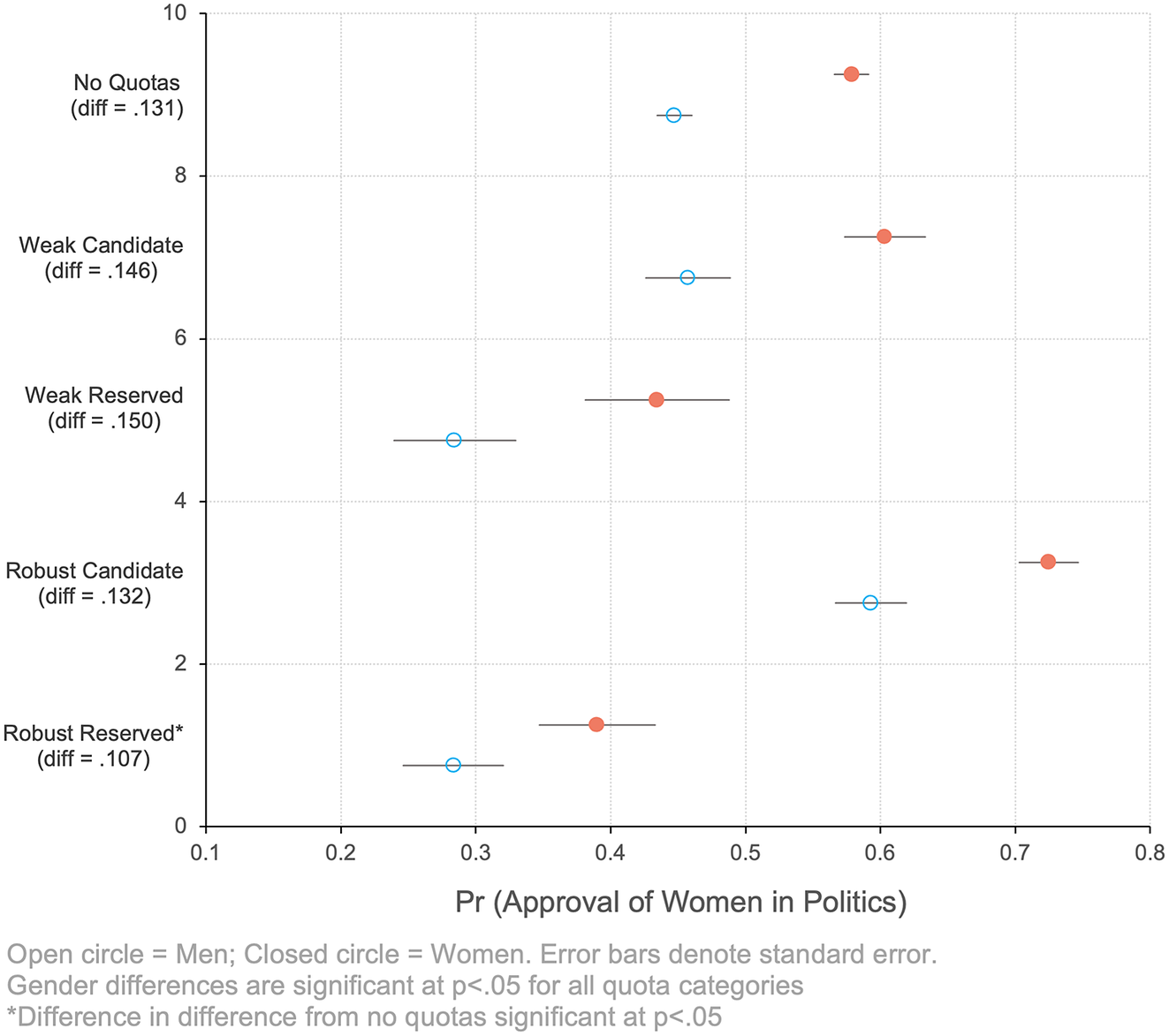
As the closed (versus open) points to the right imply, women are, on average, more likely to approve of women in politics than men across all categories. This is consistent with existing work. To test interaction effects, we use difference in difference calculations to determine whether the size of this gender gap varies under different quota conditions. Although these results are mostly null, robust reserved quotas do reach significance (p < .05) (i.e., the size of the gender gap under quotas versus no quotas is statistically equivalent for all quotas except robust reserved). Interestingly, gender differences here are smaller than for no quotas (0.107 versus 0.131)—indicating greater backlash among women (–18.9 percentage points) versus men (–16.4 percentage points). These results partially support H 3 . Although in most cases, quota effects do not vary by gender, robust reserved are linked to unique female backlash.
Model 3 further explores interaction effects, this time looking at democracy. Again, using second differences in AMEs to evaluate significance, we plot our findings in Figure 5, which graphs predicted probabilities in attitudes by democracy for significant effects.Footnote 20 Although no significant differences emerge for weak quotas of either type, beliefs are conditional on democracy for both types of robust quotas, thus providing partial support for H 4 .
Predicted probabilities by democracy level.
Circle indicates Robust Candidate; Square indicates Robust Reserved. 95% CI shown.

Compared to the slope of the solid no quotas line (which is slightly positive), the slope for robust candidate quotas (circle) is considerably steeper, whereas the slope for robust reserved quotas (square) is negative. However, significant differences only emerge among democracies (polity > 4 for robust candidate, > 0 for robust reserved). Unlike citizens of nondemocracies, citizens of relatively free societies appear particularly responsive to quotas. Yet like direct effects, the direction of response depends on type. Compared to a .527 probability of approval under no quotas, people in fully consolidated democracies (polity = 10) have an expected probability of .700 under robust candidate quotas and .153 under robust reserved—a 30% increase and 70% decrease, respectively. Thus, although democracy seems to provide an agreeable environment for liberal beliefs to flourish under robust candidate quotas, it also seems to foster backlash–especially under robust reserved quotas.
Across all models, significant controls are consistent with prior studies. Whereas democracy, women’s representation, education, and GDP are linked to higher approval, Soviet background, age, and being Muslim or Christian are associated with lower approval. Although being Orthodox is not significant, this may be due to low representation in the sample (approximately 10% of respondents). Scholars wishing to tease out these effects might further explore this relationship in Orthodox-specific contexts, thus contributing to ongoing work in this area (Merdjanova Reference Merdjanova2021).
Robustness Checks
Several robustness checks evaluate the rigor of our claims. Perhaps the biggest concern is that preexisting egalitarianism skews results.Footnote 21 Maybe quotas do not increase support for women, but rather, people where quotas exist are more egalitarian. Because agreement that “being a housewife is just as fulfilling as working for pay” implies endorsement of separate spheres ideology (i.e., the idea that women belong to the private household sphere because of innate differences in traits and preferences) and is highly correlated with traditionalism (van Damme and Pavlopoulos Reference van Damme and Pavlopoulos2022), we evaluate quota effects among respondents agreeing with this statement. Although other survey items may similarly and perhaps even more acutely capture traditionalism (e.g., “all women really want are kids”) (van Damme and Pavlopoulos Reference van Damme and Pavlopoulos2022), unfortunately, only this question appears in all four WVS waves. This measure therefore represents the best available proxy for traditionalism. If preexisting egalitarianism is driving results, quotas should have no effect on traditional individuals. However, direct effects remain consistent with Model 1, and predicted values indicate similar gender and democracy interactions (Appendices 4a–c),Footnote 22 suggesting that preexisting egalitarianism does not drive results. Even traditional individuals are responsive to quotas.
We similarly test a subsample of individuals expressing low political interest to ensure political engagement is not biasing results (Appendix 4d). Perhaps quota influence is limited to those more likely to notice or care about politics. However, original results substantively hold, suggesting that quotas influence even the politically disinterested.Footnote 23 Results substituting Freedom House rankings (1–7) into relevant models (Appendices 4–5) also substantively hold, suggesting robustness to democracy measure.Footnote 24 Finally, using the UN’s Gender Inequality Index (GII), we assess how controlling for women’s status impacts results and to evaluate endogeneity.Footnote 25 People in nations with low gender equality may be more amenable to quotas and women in politics. However, all resultsFootnote 26 hold and GII does not reach significance, indicating robustness to women’s status. Yet because GII and GDP are highly correlated (r = –.804), these findings should be interpreted cautiously.
Implications of Visible Quotas
This study has several key takeaways, both theoretical and methodological. Most fundamentally, it demonstrates that neither quotas nor their effects are equal. Rather, results suggest that quota type, features, and strength combine in complex and interesting ways to generate both public support for, and rejection of, women in politics.
Though potential explanations for these results abound, one conclusion we draw—like others before us—is that visibility matters (Burns, Schlozman, and Verba Reference Burns, Schlozman and Verba2001; Campbell and Wolbrecht Reference Campbell and Wolbrecht2006; Dasgupta and Asgari Reference Dasgupta and Asgari2004; Hinojosa and Kittilson Reference Hinojosa and Kittilson2020). Visibility through quotas is crucial for fostering both engagement and attitudes in relation to women’s broader symbolic representation. Differences between weak versus robust quotas illustrate this. Because weak quotas generate low visibility, their influence on beliefs is negligible. When women are highly visible via robust quotas, citizens are more likely to notice and respond to their cues. These findings offer strong support for the visible cue theory of representation and validate visibility—something generated by quotas possessing features which are sufficiently strong—as a key mechanism of attitude change (Hinojosa and Kittilson Reference Hinojosa and Kittilson2020).
Yet as differences among robust quotas imply, high visibility is not always well received. Rather, this is determined, in part, by how visibility occurs. This is consistent with existing work showing how inclusionary, power-sharing institutions (e.g., candidate quotas that incorporate women in the electoral process) may be more effective than exclusionary institutions which concentrate power within certain groups at the expense of others (e.g., reserved quotas that give women power at men’s expense) (Clayton Reference Clayton2015; Kittilson and Schwindt-Bayer Reference Kittilson and Schwindt-Bayer2010). For instance, in Lesotho, reserved quotas led to reduced women’s engagement—something Clayton (Reference Clayton2015, 334–35) attributes to the “stigma surrounding the beneficiaries of affirmative action.” Conversely, it seems that when robust candidate quotas generate visibility by enabling women to compete as equals against men, their symbolic representation improves. For instance, Atkeson (Reference Atkeson2003) finds that when women are both visible and competitive, engagement rises.
Together, our results provide a deeper understanding of how and why certain quotas impact attitudes while others do not and substantiate calls for increased attention to quotas’ design and their impact on representative outcomes (Hughes, Krook, and Paxton Reference Hughes, Krook and Paxton2015; Hughes et al. Reference Hughes, Paxton, Clayton and Zetterberg2019). Doing so begins to resolve tensions in the literature regarding the direction of quotas’ effects. Quotas are not categorically “good” or “bad” for egalitarianism; in addition to factors like country context (Benstead Reference Benstead2018; Fallon, Swiss, and Viterna Reference Fallon, Swiss and Viterna2012; Fernández and Valiente Reference Fernández and Valiente2021; Liu Reference Liu2018) and the internal actions of male elites (Baldez Reference Baldez2006; Franceschet and Piscopo Reference Franceschet and Piscopo2008; Grey Reference Grey2002; Lloren Reference Lloren2014), we show that certain quota features, types, and the visibility they generate also determine quota outcomes. We advise future studies evaluating attitudes to carefully consider not only whether quotas enable visibility, but also how they do so, and how the public will respond to it.
This is particularly true within certain contexts, such as democracy. Amid sufficient visibility (via robust quotas), citizens of democracies seem particularly sensitive to whether quotas reinforce (Bush Reference Bush2011; Hassim Reference Hassim2002; Hinojosa and Kittilson Reference Hinojosa and Kittilson2020; Krook Reference Krook2006) or contradict (Baldez Reference Baldez2006; Dahlerup Reference Dahlerup2006; Franceschet and Piscopo Reference Franceschet and Piscopo2008) democratic ideals. Perhaps in highly open societies where the lawmaking process is more transparent, citizens are particularly aware of and thus responsive to quota laws. Or perhaps democratic environments enable citizens to express their sentiments (particularly negative ones) about noticeable government policies such as quotas more freely.
Reason notwithstanding, clearly, when women’s increased visibility is the function of free and fair elections within democracies—a competition for which women are given a more equal opportunity to enter via quotas but could reasonably still lose, beliefs liberalize. We attribute this to the ideological consistencies between quotas and democracy (Bush Reference Bush2011). Perhaps more than average respondents, citizens of democracies expect changes to the composition of the legislature to result from fundamentally fair and impartial democratic processes—something only candidate quotas can do. When this expectation is not met under reserved quotas, it fosters dissonance between democratic norms. Apparently, democratic citizens are unwilling to enhance minorities’ institutional access at the expense of fair competition. When the beneficiaries of this inexcusable violation are both abundant and visible, disapproval rises. Still, because reserved quotas are uncommon in democracies, these effects must be further explored as quotas proliferate.
Although authoritarian regimes also use quotas to boost democratic legitimacy, they do so primarily in pursuit of international, not domestic approval, which may also explain the lack of significance within nondemocracies (Bush Reference Bush2011; Bush and Zetterberg Reference Bush and Zetterberg2021). Unlike their democratic counterparts, authoritarian leaders are relatively insulated from public scorn and therefore need not waste valuable resources implementing strong quotas generating meaningful change; they need only ensure a quota law exists (however weak) to avoid criticism on the global stage (Hafner-Burton and Tsutsui Reference Hafner-Burton and Tsutsui2005). Thus, quota-generated visibility may be less common within authoritarian regimes. Indeed, nations with weak quotas have a lower average polity score than those with robust (2.82 versus 4.59). Future studies can explore this further and build on existing work examining quotas and regime type (Allen and Cutts Reference Allen and Cutts2018; Bush and Zetterberg Reference Bush and Zetterberg2021; Tripp and Kang Reference Tripp and Kang2008). Overall, these findings reinforce the importance of political environment in shaping quota effects (Krook Reference Krook2009).
Finally, although in most cases, neither backlash nor approval is gender specific, exceptional women’s backlash under robust reserved quotas does occur. Just as women may disengage from politics in response to poor quota design or reserved systems (Clayton Reference Clayton2015), they may also reject female politicians, suggesting that women particularly disapprove of exclusionary quota measures (Clayton Reference Clayton2015; Kittilson and Schwindt-Bayer Reference Kittilson and Schwindt-Bayer2010). Thus, although role model effects are possible in some circumstances (Allen and Cutts Reference Allen and Cutts2018; Wolbrecht and Cambell Reference Wolbrecht and Cambell2007), they does not manifest globally. Rather, it seems that when quotas enable political handouts, women become disillusioned with women in politics at large. Or, perhaps because women see quotas as infantilizing (i.e., because women can/will not get elected the “normal” way, they require special help), they perceive women in reserved positions as an affront to feminist calls for the treatment of women as political equals, leading to backlash. This corresponds with responses from women in Lesotho who, rather than endorsing reserved quotas, believed that “women should stand on their own feet” to maintain their credibility (Clayton Reference Clayton2015, 358). Additionally, although men generally express lower approval than women, their lack of backlash suggests that nonelite men, unlike their politician counterparts (Baldez Reference Baldez2006; Franceschet and Piscopo Reference Franceschet and Piscopo2008; Grey Reference Grey2002), are amenable to women in politics following a nudge from candidate quotas producing sufficient visibility. It also suggests that quotas have the potential to increase egalitarianism even among typically resistant groups. Future work can build on these findings to investigate what factors help or hinder solidarity across and within genders.
Further Considerations and Conclusions
Representing a comprehensive cross-national, longitudinal analysis of quotas and attitudes toward women in politics across a diverse sample of nations, this study demonstrates quotas’ capacity to shape beliefs. Results show that only quotas producing high visibility are persuasive, and that the direction of persuasion depends on quota type. Additionally, whereas democracy exaggerates these effects, respondent gender has little impact.
These findings have several policy implications. Practitioners using quotas to improve representation should proceed cautiously and consider quotas’ underlying message and the visibility they produce. When in doubt, prioritize robust candidate quotas and avoid reserved quotas, particularly in democracies. Because weak quotas have no significant impact, promotion efforts should focus on neutralizing resistance to strong quota measures and ensure the necessary infrastructure exists to support meaningful enforcement. If the foregoing recommendations are followed, campaigns seeking to foster feminist solidarity among women or encourage men to buy in will be unnecessary.
Results also highlight important questions about which nations adopt which quota types, and why. Although quotas guaranteeing seats may elicit negative reactions, it may also be that lawmakers in countries with low regard for women deliberately opt for more drastic approaches, like reserved quotas, to reduce uncertainty. Indeed, average GII within nations with reserved versus candidate quotas (.324 versus .582)Footnote 27 suggests that although mechanisms explain the pathways through which attitudes form, quota type may affect and be affected by egalitarianism. Future research can address this by isolating quota nations by type and examining pre- and post-treatment attitudes, rather than comparing average group effects.
Additionally, although this paper makes many contributions, we cannot know the extent to which party quotas shaped the beliefs evaluated here. If, as studies suggest, party quotas do promote women’s political acceptance (Krook Reference Krook2009), national quotas’ positive effects will be underestimated, while negative effects will be overestimated. Thus, the presumed role of national quotas on opinions may be limited (Krook Reference Krook2013). Scholars evaluating national quotas should be cognizant of this limitation, and account for it whenever possible. Others looking to build on this study may be interested in exploring quotas’ causal cross-national effects. Extensions of this work might compare attitudes among quota adopters versus nonadopters at various thresholds or levels of visibility (Dahlerup Reference Dahlerup1988). Scholars may also wish to compare quotas with other high-visibility positions (e.g., head of state, party leader) to better understand how and why certain interventions are more (or less) effective. Finally, this article sets the foundation for examining quota effects in other areas of public opinion.
As this study makes apparent, the effects of quotas on women’s symbolic representation, much like quotas themselves, are highly diverse. Quotas possessing the necessary qualities to enable visibility are effective for changing beliefs—particularly in democracies and often regardless of gender. Yet we introduce here only one approach for considering quota diversity and its effects. Future studies must continue to explore how quotas’ complex structures impact women’s representation—whether descriptive, substantive, or symbolic.
Acknowledgements
We extend our gratitude to Pam Paxton for providing invaluable insight into the QAROT dataset and its potential uses during the earliest stages of this project; Jennifer Heerwig and Sarah Bush for providing feedback on early versions of this manuscript; Roshan Pandian for sharing his statistical acumen; and Sophia Boutilier and Laura Schimmöller for acting as crucial sounding boards during the revision process. We thank the three anonymous reviewers and the editor, Mona Lena Krook, for their incisive comments, which helped to greatly improve this manuscript.
Supplementary Materials
To view supplementary material for this article, please visit http://doi.org/10.1017/S1743923X23000089.


 Open access

