Introduction
The Georgian Middle Palaeolithic (South Caucasus) covers a long timespan, attested by the early Middle Palaeolithic site of Djruchula (260–140 ka; Meignen & Tushabramishvili Reference Meignen and Tushabramishvili2010; Mercier et al. Reference Mercier, Vallades, Meignen, Joron, Tushabramishvili, Adler and Bar-Yosef2010) and the late Middle Palaeolithic sites of Ortvale Klde (c. 47.5–44.2 ka cal BP, Adler et al. Reference Adler, Bar-Oz, Belfer-Cohen and Bar-Yosef2006; Cullen et al. Reference Cullen, Smith, Tushabramishvili, Mallol, Dee, Wilkinson and Adler2021) and Bondi Cave (c. 45 ka cal BP, Pleurdeau et al. Reference Pleurdeau2016). These sites demonstrate a wide variety of technological strategies; formerly grouped into four facies based on regional typological criteria (Tushabramishvili Reference Tushabramishvili1984), the greater techno-typological diversity and variability of lithic assemblages in the South Caucasus is becoming increasingly recognised (Pleurdeau et al. Reference Pleurdeau, Tushabramishvili, Nioradze, de Lumley and Lordkipanidze2007). To assess this diachronic diversity and variability, as well as technical changes over time, special attention is being given to Ormagi Ekhi.
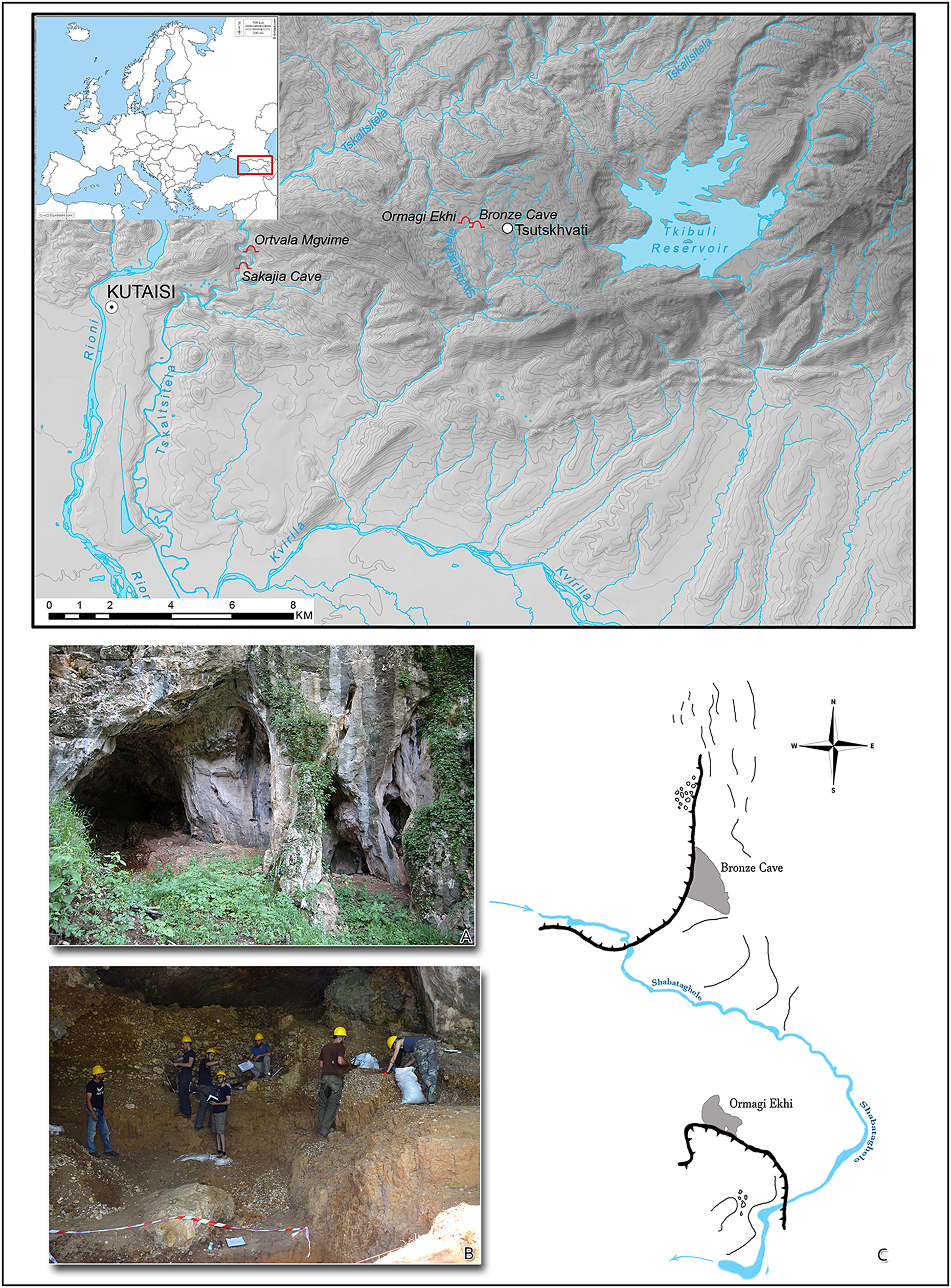
This cave, located in western Georgia, is part of the Tsutskhvati karst system (Figure 1). Excavations in 1970–1975 and 1998–1999 by Georgian scientific institutions were followed by further field seasons by a Georgian-Spanish team in 2002 and a Georgian-French team in 2017–2024. These investigations revealed recurrent hominin occupations.
Map showing the location of Ormagi Ekhi, with detail of archaeological work (A & B) and the simplified topographic map of the Tsutskhvati karst system (C) (figure by A. Mgeladze).

We present here our ongoing research (especially from stratigraphic layers XII, XIII and XVI, the only layers with sufficient archaeological material for in-depth analysis). New chronological data and techno-typological analyses point to substantial extra-regional influences, reshaping our vision of Middle Palaeolithic technological diversity in the region.
Stratigraphy and chronostratigraphy
The stratigraphy of the cave reaches a depth of more than 4.5m, with two main sedimentary units: an upper stony unit with alternate layers of granules and blocks (layers V–XII), and a lower silty unit (layers XIV–XVI).
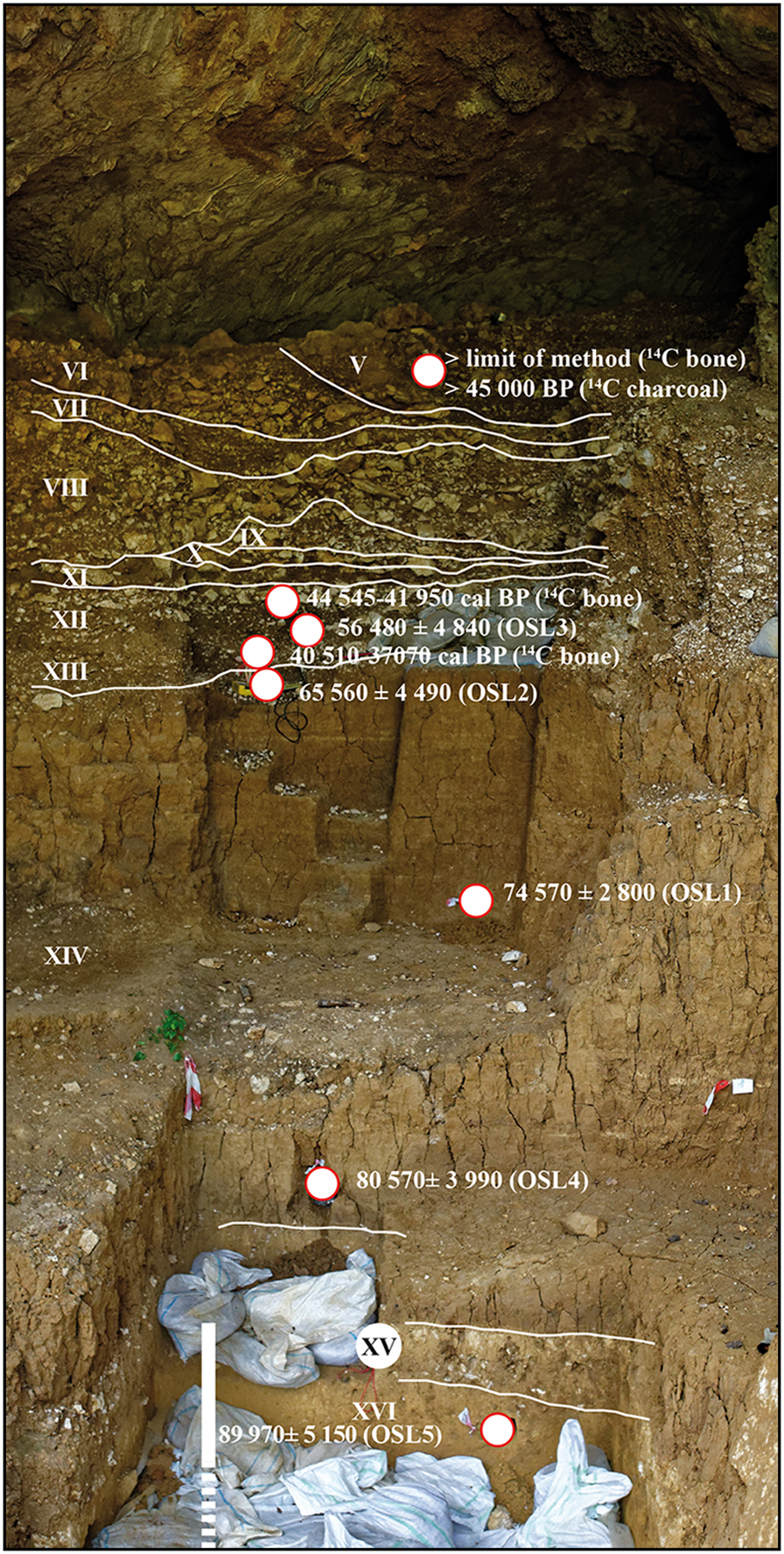
The collagen content (measured by Fourier Transform Infrared spectroscopy, Lebon et al. Reference Lebon, Reich, Gallet, Bellot-Gurlet and Zazzo2016) of three bones from the upper layers was sufficient for radiocarbon dating. These three samples, plus an additional charcoal sample, were prepared and dated at Laboratoire Archéologie et Archéométrie (Lyon) and the Laboratoire de Mesure du Carbone 14 (Saclay) with ARTEMIS accelerator, and the dates calibrated using OxCal 4.4, with IntCal20. Six silt samples (layers XII, XIV, XVI) were dated using optically stimulated luminescence (OSL) at the Re.S.Artes laboratory, Bordeaux (Figure 2).
Chronostratigraphy of Ormagi Ekhi (figure by S. Puaud).

The bones and charcoal date layers XII and XIII to more than 40 000 years cal BP, close to the methodological resolution limit for the radiocarbon method. Layer XII is dated by OSL to c. 50–60 ka., while occupations are older than 70 ka in layer XIV and c. 90 ka in layer XVI.
Archaeological assemblages
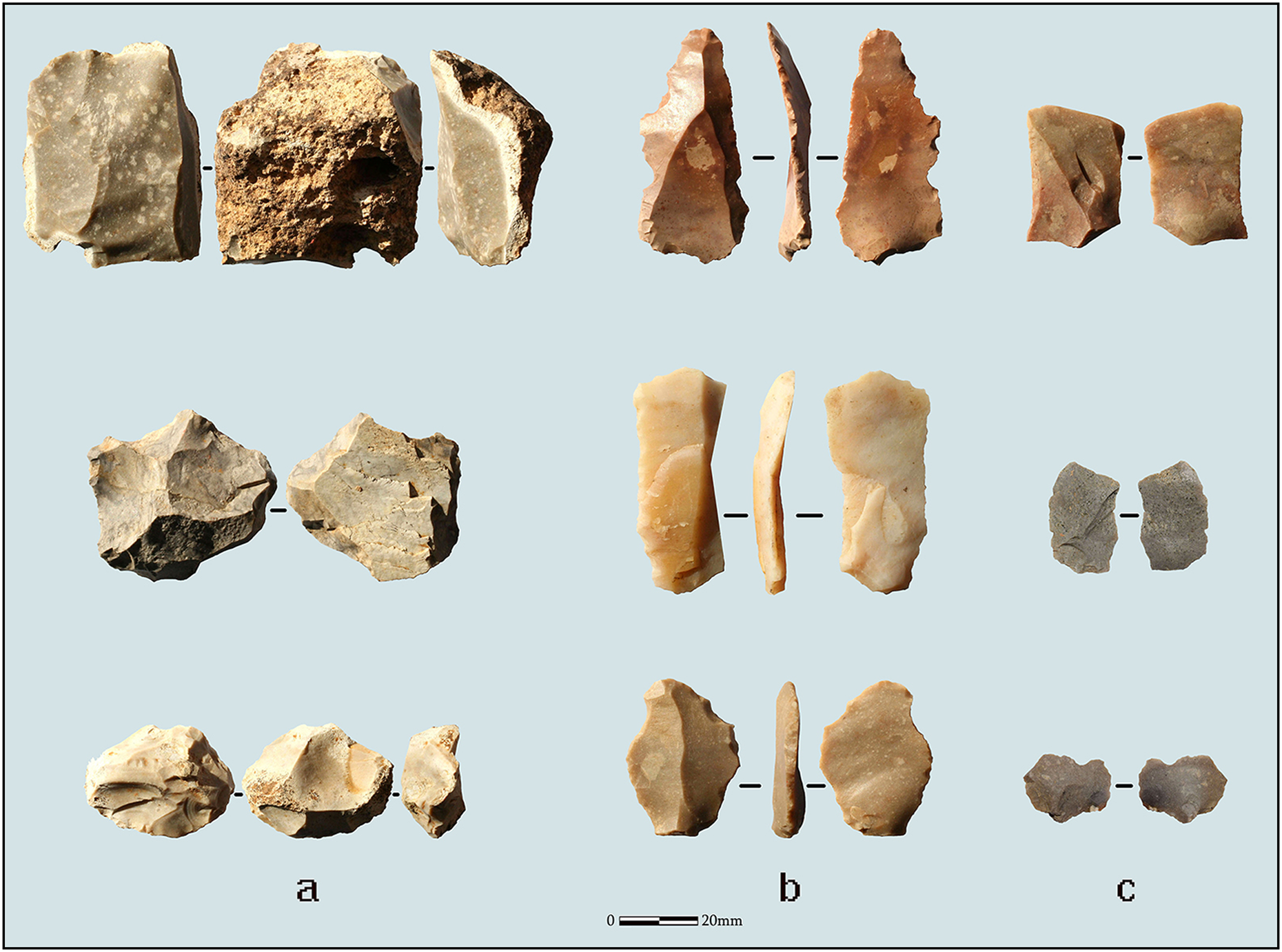
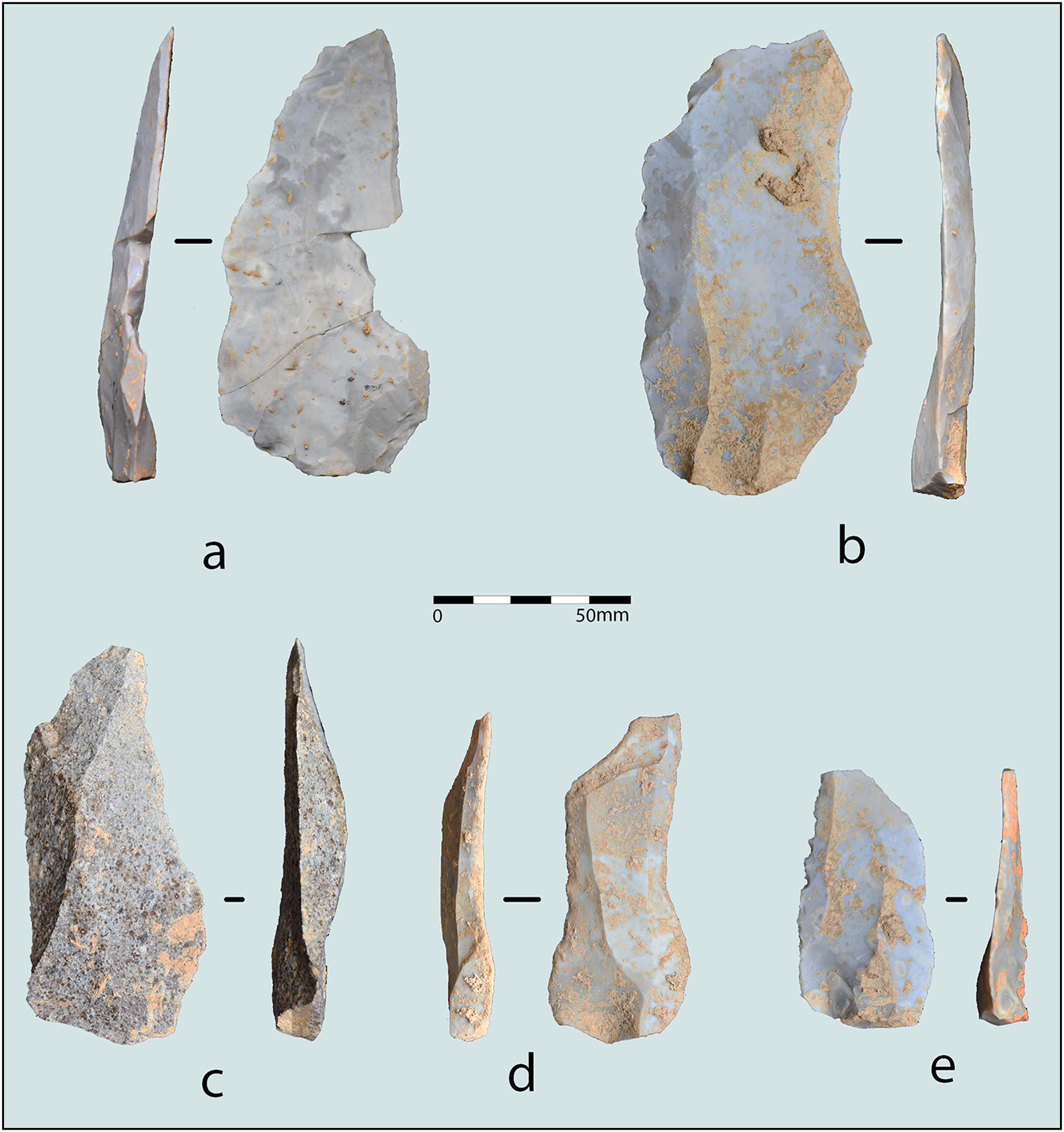
The lithic assemblage from layers XII (n = 29) and XIII (n = 291) comprises 57 fragments, 68 chips and debris and mainly small to medium-sized flint artefacts (from <30mm to 80mm long), including 81 wide (width>length) flakes, 26 elongated (length>width) flakes/blades, 16 points, 39 small flakes and 10 bladelets. The core technology consists of 13 unifacial and multifacial ‘flake cores’ with one or more striking platforms and debitage surfaces, and one or more series of removals. There are also three discoid, three Levallois and four lamino-lamellar cores (Figure 3). Most of the byproducts are not retouched. The few retouched tools include notches and denticulates, burins, points, flakes and blades (Figure 3). The lithic assemblage (cores, predetermined and maintenance flakes, byproducts, cortical pieces) attests to in situ production; butchery marks on associated bone fragments indicate possible in situ use. The lithic assemblage of the underlying layer XVI (n = 62, including fragments, chips and debris) is made on flint and quartzite-sandstone and can be organised into two categories. The first consists of 18 unretouched small (<30mm long) and medium-sized (30–80mm) flakes, pointed blades and points (30–80mm). The second consists of five large flakes/blades and pointed blades over 90mm long, including one retouched blade (Figure 4). Despite the absence of cores in the series, the production is mainly Levallois (unidirectional, bidirectional, centripetal). Differences between the lithic assemblages and the nature of raw materials from layers XII, XIII and XVI, which can all be attributed to the Middle Palaeolithic, could suggest either a shift in activities on site or the presence of distinct techno-cultural entities (late/early Middle Palaeolithic).
Lithics from layer XIII: a) bidirectional and discoidal cores; b) retouched tools; c) flakes (figure by A. Mgeladze).

Lithics from layer XVI: a) Levallois point; b & d) Levallois flakes; c & e) converging-edges flakes (figure by S. Bonilauri).

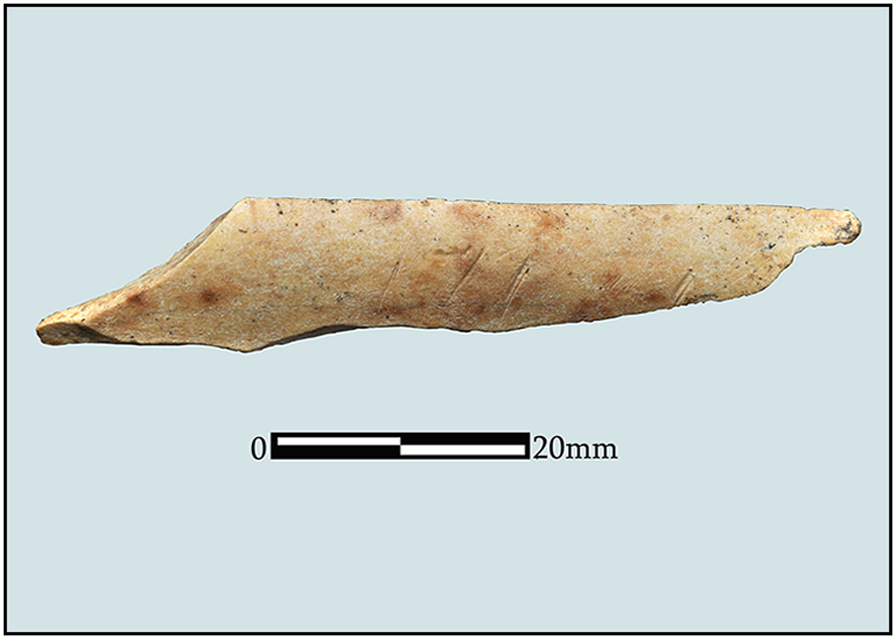
Cave bears are predominant in faunal assemblages throughout the sequence, particularly in layers XII, XV and XVI. Faunal remains are especially abundant in layer XIII (n = 5688), with 242 bones identifiable taxonomically at least to genus, and 111 anatomically (bone element) determined remains. Capra cf. caucasica (West Caucasian tur), Bison cf. priscus (steppe bison) and Cervus elephas (red deer) are the main prey species identified. Ormagi Ekhi was a hibernation site for cave bears but was not used as a den by other carnivores. Humans are solely responsible for the accumulation of ungulate bones, indicated by fractures on fresh bone, butchery marks and burnt bones (Figure 5).
Butchery marks on a fragment of long bone diaphysis from a medium-sized herbivore found in layer XIII (figure by S. Prat).

Implications for the Middle Palaeolithic in South Caucasus
Preliminary data from new fieldwork and analyses at Ormagi Ekhi reveal techno-typological diversity between layers XII and XIII—corresponding to Mousterian facies that may be related to the Tsutskhvati-type facies (e.g. Tushabramishvili Reference Tushabramishvili1984)—and layer XVI. Layer XVI (dated to c. 90 ka) is characterised by the production of a large-blade component. This layer shares common technological features with lithic assemblages attributed to the Djruchula-Koudaro group, and particularly with the Djruchula cave assemblages, dated to c. 250 ka (Meignen & Tushabramishvili Reference Meignen and Tushabramishvili2010; Mercier et al. Reference Mercier, Vallades, Meignen, Joron, Tushabramishvili, Adler and Bar-Yosef2010). The lithic assemblage from layer XVI also seems to share some common technological features with the Levantine early Middle Palaeolithic laminar industries (e.g. from Hayonim Cave E & Abou-Sif C–D), dated between 270 ka and 160 ka (Mercier et al. Reference Mercier, Vallades, Meignen, Joron, Tushabramishvili, Adler and Bar-Yosef2010), and assemblages from the Iranian Central Plateau (e.g. Qaleh Kurd Cave: QK1-3 ranging from 205±15 to 165±11 ka; Vahdati Nasab et al. Reference Vahdati Nasab2024). The discovery of a laminar component at Ormagi Ekhi highlights some affinities with the early Middle Palaeolithic of surrounding areas, suggesting relationships with groups to the south, associated with the persistence of local traditions (the Djruchula group for instance).
Initial results show that Ormagi Ekhi is a new key site for the long-term understanding of the occupation of the South Caucasus by hominin groups during the Middle Palaeolithic, highlighting potential links with southern outlying regions. Ongoing investigations will enhance these results.
Acknowledgements
We thank the General Director of the Georgian National Museum, C. Oberlin (ARAR laboratory), L. Byrne for English editing and all the members of the excavations team.
Funding statement
This work was supported by the Shota Rustaveli National Science Foundation of Georgia (SRNSFG#FR-21-17285) and by the Centre National de la Recherche Scientifique, France (PICS NEST and IRP WEST GEO).