


A gold rush in the Early Ptolemaic period
Egyptian gold has, historically, been highly sought after, especially in the Eastern Desert (Klemm & Klemm Reference Klemm and Klemm2013). First peaking during the New Kingdom (c. 1500–1000 BC), mining activity in the region saw another rise in the Hellenistic period (332–30 BC) (Faucher Reference Faucher, Brun, Faucher, Redon and Sidebotham2018). Almost 40 mines were opened under the Ptolemies (Redon Reference Redonin press), following Alexander the Great's conquest of Egypt in 332 BC (Figure 1). The new dynasty founded by Ptolemy I needed gold to fund military campaigns in the Mediterranean, prestige projects abroad and monumental buildings in Alexandria, reflecting its power and wealth.
Map of the Eastern Desert of Egypt showing the location of the Ptolemaic mines, with Samut North and Ghozza circled in red (figure by B. Redon).

Among the first mines to open was Samut North, excavated by the French team in 2014–2015 (Redon & Faucher Reference Redon and Faucher2020). The site revealed valuable insights into the ore-production process, though it was short-lived, lasting only four to five seasons (of six or nine months each) in the 310s BC. The mine was closely controlled, and part (if not all) of the workforce was housed in guarded dormitories.
Ghozza, a mining village in Egypt's Eastern Desert
More recent excavations began in 2020 at Ghozza, the northern-most Ptolemaic gold mine (Faucher et al. Reference Faucher2021; Crépy et al. Reference Crépy2023), revealing two major occupation phases, each likely spanning several years during the second half of the third century BC. Beyond this chronological distinction, several other differences from Samut North are also apparent.
First, Ghozza appears to have been organised as a village with residential blocks, streets, administrative buildings and baths (Figure 2), suggesting that the working and social environments were different from those at Samut North. Second, the mining techniques differ; while Samut North employed collective grinding methods, where workers ground quartz into powder in large mills (Redon & Faucher Reference Redon and Faucher2016, Reference Redon and Faucher2020: 38–46), Ghozza's workforce processed ore with hand grinding stones. Hundreds of ostraca (pottery sherds used as surfaces for writing) found at the site provide a record of daily activities, showing that some miners received wages. Together with the absence of any guarded buildings in the village, this suggests a more diverse and possibly free workforce, prompting questions about labour dynamics in this Ptolemaic mine. Even so, evidence of forced labour has also been uncovered at Ghozza.
Plan of Ghozza (figure by P. François, D. Laisney).

A shackled workforce
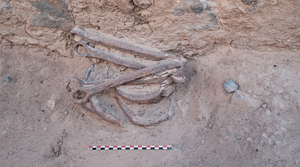
In January 2023, iron shackles were found in Sector 44, a large area on the eastern edge of the village (Figure 3). The group of buildings was primarily used for storage and food preparation, while a reserve of charcoal and a large amount of iron slag indicate that metal objects were made or repaired here. Perhaps related to these activities, two sets of shackles were discovered. The first, consisting of seven foot-rings and two articulated links, was neatly arranged in a pit cut into the floor of corridor 44.15 (Figure 4). The second set, including four links and two ring fragments, was scattered across the floor of room 44.11, alongside other iron objects.
General view of Sector 44 looking north (figure by M. Kačičnik, Institut français d'archéologie orientale).

Iron shackles on the floor of Room 44.15 (figure by B. Redon).

These shackles were not meant for restraining animals, as rope ties were typically used for that purpose in the Eastern Desert. Instead, they were designed for human use; when closed directly around a prisoner's ankles, these shackles could not have been removed without assistance (Figure 5). While they allowed the hands to remain free, walking with them would have been slow and exhausting, particularly given their weight.
A complete set of iron shackles from Room 44.15 (figure by M. Kačičnik, Institut français d'archéologie orientale).

This discovery is exceptional in many respects. First, it sheds light on the status of some workers at the Ghozza mine, aligning with ancient texts such as those of second-century BC writer Agatharchides (quoted by Diodorus Siculus, Library of History: 3.12.3; Oldfather Reference Oldfather1935), who vividly describes the harsh conditions endured by gold miners under the Ptolemies: “And those who have been condemned in this way—and they are of a great multitude and all have their feet bound—work at their tasks unceasingly both by day and throughout the entire night.” Although Agatharchides identifies the miners as prisoners of war and convicted criminals, it is possible that some were also slaves.
Second, the discovery provides archaeological evidence of shackles, an artefact rarely documented in Egypt, aside from Agatharchides’ text and a contemporaneous papyrus (P.Cair.Zen. 4.59782a, l. 69) mentioning ‘a pair of shackles’. Such finds are uncommon in the archaeological record more generally, especially in the context of mines, and the Ghozza shackles are among the oldest ever found in the Mediterranean, pre-dating the Late Iron Age and Roman-era shackles found in Europe (see for instance Thompson Reference Thompson1993; Duval et al. Reference Duval, Gasco, Rétif and Tzortzis2006; Duval Reference Duval2008). The Ghozza shackles closely resemble one of the few representations of a person with fettered feet in the Greek world (Figure 6).
Image of a shackled man on a kylix found in Naples, dated to 490–480 BC, diameter 195mm (National Museum of Antiquities, Leiden, inv. K 1894/9.15).

They also closely resemble shackles uncovered in the silver mines of Laurion, Greece, in the 1870s (Boucher Reference Boucher2017). This is not the first direct link between Greek and Ptolemaic mines: quartz-grinding mills at Samut North have striking parallels at Laurion (Redon & Faucher Reference Redon and Faucher2020: 46), suggesting that the technological knowledge used in Egyptian gold mines during the Hellenistic period was imported and set up by Greek and Macedonian engineers brought to Egypt by the Ptolemies. The Ghozza shackles further exemplify this cross-cultural exchange.
Conclusion
The discovery of shackles at Ghozza reveals that at least part of the workforce was composed of forced labour. The exact living conditions of these individuals remain unclear because their dwelling places have not yet been identified, indeed the village set-up seems to suggest that the population was free to move around in general. More than half of the village has been excavated so far, and excavations will continue in the hope of identifying any containment areas.
In the meantime, the discovery of the shackles at Ghozza serves as a reminder of the harsh realities faced by workers in the Ptolemaic gold mines. Beneath the grandeur of Egypt's wealth and the imposing mountains of the Eastern Desert lies a history of exploitation. The gold extracted from these mines helped finance the ambitions of Egypt's rulers, but it came at a significant human cost.
Acknowledgements
The author wishes to thank Maël Crépy, head of the mission, Paul François and Matjaž Kačičnik for the illustrations, and the Ministry of Tourism and Antiquity in Egypt and the inspectorate of the Red Sea.
Funding statement
The mission is funded by the Institut français d'archéologie orientale (Cairo), the Centre national de la recherche scientifique (HiSoMA, Lyon), the French Ministry of European and Foreign affairs, and the ‘Desert Networks’ project, funded by the European Research Council (ERC-2017-STG, Proposal number 759078).



