

This report seeks to clarify current stone tool typology by establishing criteria to differentiate chipped stone perforators from gravers. Augers, awls, becs, bodkins, borers, burins, drills, gimlets, gravers, perforators, piercers, and micro-piercers are all type names applied to specimens that imply their use in perforating, engraving, or drilling (Ahler and McMillan Reference Ahler, McMillan, Wood and McMillan1976:179; Ballin Reference Ballin2021:46; Bates at al. Reference Bates, Needham, Conneller, Milner, Pomstra and Little2022; Miller and Redmond Reference Miller and Redmond2016:165). As Tomášková (Reference Tomášková2005) observed, lack of consistency in the use of stone tool typology precludes systematic comparison of different assemblages and creates the impression of greater variability in the archaeological record than actually existed.
Although the functions of perforating and engraving differ, there are no widely accepted criteria for distinguishing perforators and gravers, two understudied tool types. Almost 50 years ago, Lynott (Reference Lynott1975:123) observed that what is called a perforator in Eurasia and Africa is typically referred to as a graver in the Americas, and this confusion still exists. Both perforators and gravers are characterized by a projection, either in the form of a distal tip or from removal of material along a lateral edge. The projection on gravers is often referred to as a spur or beak (Boen and Williams Reference Boen and Williams2022:16; Maika Reference Maika2012:4). Because the projection is the portion of the tool involved in perforating and engraving, we discuss the likely morphology of projections for performing these functions. We then examine specimens for use wear to determine whether there is concordance between the expected morphology of projections for perforating or engraving and the actual use of specimens.
The use of tools can be considered a separate question from that of typology (Andrefsky Reference Andrefsky1998; Odell Reference Odell1981). Modern ice picks and chisels may be used to perform functions other than those for which they were designed, yet we still refer to them as ice picks and chisels based on the morphology of their tips. However, the morphological difference between chipped stone perforators and gravers as tool types remains undefined. Previous use-wear studies of specimens with chipped stone projections have revealed multiple functions, including engraving with tools classified as perforators and perforation use wear on tools termed gravers (Bates et al. Reference Bates, Needham, Conneller, Milner, Pomstra and Little2022; Kay Reference Kay, Henry and Beaver2014; Kay and Solecki Reference Kay and Solecki2000; Nowak and Wolski Reference Nowak and Wolski2015; Sørensen Reference Sørensen, Sørensen and Buck Pedersen2017; Tomášková Reference Tomášková2005; Tomenchuk and Storck Reference Tomenchuk and Storck1997; Venditti et al. Reference Venditti, Lemorini, Bordigoni, Zampetti, Amore and Tagliacozzo2016). Use-wear studies of drills have revealed their frequent function as perforators, but drills typically have a rod-like distal tip that is diamond shaped or bi-convex in cross section, unlike the perforators and gravers in this study (Engelbrecht Reference Engelbrecht2023; Engelbrecht et al. Reference Engelbrecht, Hanrahan and Salisbury2023; Miller and Redmond Reference Miller and Redmond2016; Smallwood et al. Reference Smallwood, Pevny, Jennings and Morrow2020).
The Sample
Excavations at the Eaton site in western New York State yielded 116 chipped stone tools tentatively identified as perforators and gravers. In turning to the literature, we were unable to find a discussion of the difference between these two tool types. When we sought to compare these specimens with others from sites in the Northeast, we found that systematic data were lacking. These deficiencies in the archaeological database prompted the research presented here.
Eaton is a multicomponent site now owned by the Archaeological Conservancy (Figure 1). Its major component is an Iroquoian village dating to the mid-sixteenth century. A total of 257 2 m2 units were excavated by 17 summer archaeological field schools between 1975 and 2000. All soil was screened using quarter-inch hardware cloth, except for samples from features that were subject to flotation. Hundreds of chipped stone tools, including 81 drills and 115 drill fragments (Engelbrecht Reference Engelbrecht2023; Engelbrecht et al. Reference Engelbrecht, Hanrahan and Salisbury2023), and 335,433 pieces of lithic debris were recovered during these excavations. Most of the lithic tools and debris were of Onondaga chert.
Location of the Eaton site.
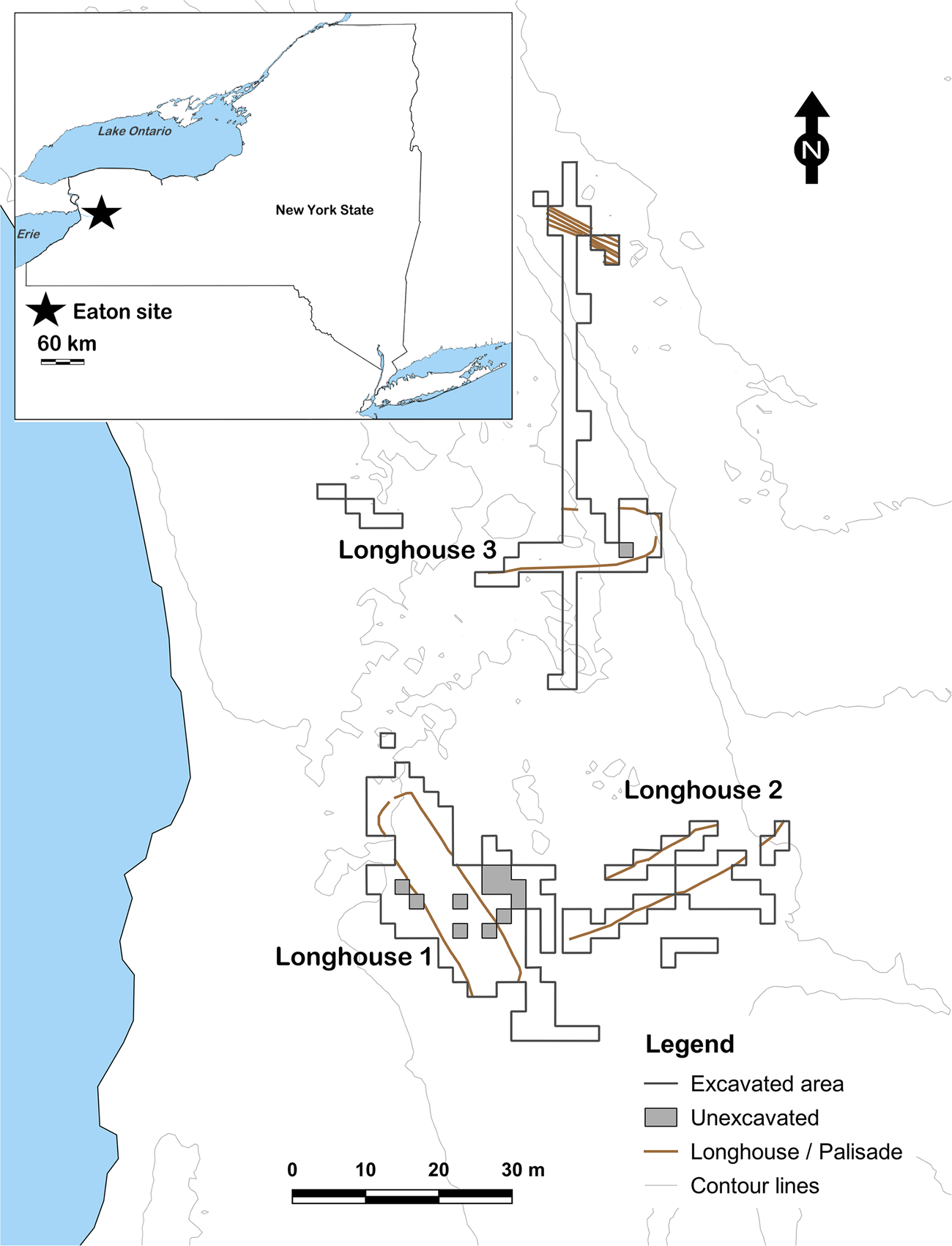
The site was plowed from the latter part of the nineteenth century through the mid-twentieth century, and most artifacts were recovered from the plow zone. Post molds delineate the major portions of three Iroquoian longhouses and a portion of a palisade. It is assumed that most stone tools with projections were used during the Iroquoian occupation because the bulk of diagnostic material is Iroquoian.
Of the 116 specimens in this study, 50 were unifacial flakes, six were unifacial blades, 45 were bifaces, and 15 were cores or core fragments. Thirty-three of the bifaces in the sample were damaged or whole projectile points or projectile point preforms that were reworked. Of the 116 specimens, 24 were also morphological scrapers, knives, or both. Five additional specimens that were likely perforators or gravers had a projection or tip snapped off and were not considered in this study. An Access table (available at https://core.tdar.org/dataset/497107/eaton-chipped-stone-perfortors-and-gravers) records the location of every specimen (unit, level, relationship to the longhouses) and various attributes, including maximum length, width, thickness, mass, cross-sectional shape, bit thickness, projection perimeter, and tip angle.
Projection Tip Morphology
The projections/tips in our sample were produced in a variety of ways, including unifacial or bifacial retouch on one or both margins or from a snap or break on one side. The projections on the unifacial specimens were created by the removal of one or two flakes. Chipped stone gravers are assumed to incise, slot, groove, or carve the surface of material, especially medium-hard to hard materials like wood, bone, antler, or stone (Ballin Reference Ballin2021:62; Boen and Williams Reference Boen and Williams2022; Morrow Reference Morrow2016). They need to be sturdy to withstand the pressure of being used on medium-hard to hard materials. Our expectation is that tools with a thick projection and a wide distal angle would be gravers. Perforators are defined functionally as tools used to create holes by pushing or twisting through soft to medium-hard material. Awls and needles made of bone, antler, or even thorns can also be used to perforate soft material. A sharp point is needed to perforate hides because they tend to stretch, rather than break (Hughes Reference Hughes1998:353). As Friis-Hansen (Reference Friis-Hansen1990:497) observes, the narrower the front angle of a projectile point, the more likely it is to penetrate a hide, and we would expect the same for perforators. We expect chipped stone perforators to have a thin projection with a sharp distal angle.
Quinn and colleagues (Reference Quinn, Andrefsky, Kuijt, Finlayson and Andrefsky2008) developed a sharpness index for el-Khiam projectile points from the Near East by dividing the tip into two right triangles and then using trigonometry to determine the distal angle. Taking a series of measurements from the tip, and then averaging them, gives an approximation of the front distal angle. However, projections in our study appear to be both narrower and shorter than those of el-Khiam points, making this methodology less suitable. We decided instead to use a goniometer to measure the angle. A common problem with goniometer measurements relates to the physical interaction between the goniometer, object, and individual (Yezzi-Woodley et al. Reference Yezzi-Woodley, Calder, Oliver, Cody, Huffstutler, Terwilliger, Melton, Tappen, Coil and Tostevin2020). We placed the specimen on top of the instrument, with the tip of the projection at the fulcrum and the stationary and moving arms of the goniometer aligned with the first 4 mm of the lateral edges of the tip. If the lateral edges of the projection were less than 4 mm, we measured the angle of the shorter projection. This ensured that the goniometer arms were on a flat surface. The distal tips were angular, so curvature was not a problem, and the sizes of the specimen and the instrument were compatible.
In addition to the distal angle, we wanted to consider the perimeter of the tip, which we see as relevant to the functions of perforating and engraving. We considered using the cross-sectional perimeter metric for the projection tip, rather than the midsection of a projectile point; we decided, however, that at this smaller scale a direct measurement was more accurate than one based on an idealized geometric form. The perimeter of the projection was measured 4 mm from its tip unless the projection was shorter, in which case we measured the circumference at the base of the tip. To do so, we wrapped dental floss around the specimen: the floss was found to be easier to use than thread, string, or dental tape. One end of the floss was first affixed to a piece of clear tape and then taped to the face of the specimen, with the end of the floss lining up with a lateral edge. While securing the tape with a finger, the specimen was twisted, resulting in the floss being wrapped around the specimen. The floss was pulled taut by its container. We then used manicure scissors to snip the floss along the lateral edge where it met its taped end and then took a linear measurement in millimeters of the segment of dental floss. The perimeter of each projection was measured twice with the same result. This procedure has the advantage of being fast, easy, inexpensive, and accurate.
Use Wear
We chose 30 specimens for use-wear analysis. To ensure a representative sample of projection tip angles and perimeters, we added the angle (degrees) and perimeter (mm) for each specimen and then chose specimens with the following sums: 23, 27, 32, 35, 37, 38, 40, 41, 42, 44, 45, 46, 47, 48, 49, 50, 51, 52, 53, 54, 56, 59, 61, 63, 65, 67, 69, 73, 76, 78. These represented the range of values, with 23 being a sharp-angled narrow projection and 78 being a wide-angled thick projection. To examine use wear, an AmScope trinocular microscope was fitted with WF 20/10× eyepieces, 2× objective lens, and 1.0×–4.5× zoom objective. Magnification varied between 40× and 180×. Thirteen specimens exhibited wear from perforation and 17 from engraving. However, all 30 specimens had wear suggesting multifunctional use: twisting/drilling, cutting, or scraping. Qualitative and quantitative aspects of the wear observed suggested a higher probability of either perforating or engraving. Recording of wear indicative of other functions—drilling, cutting, or scraping—was typically limited.
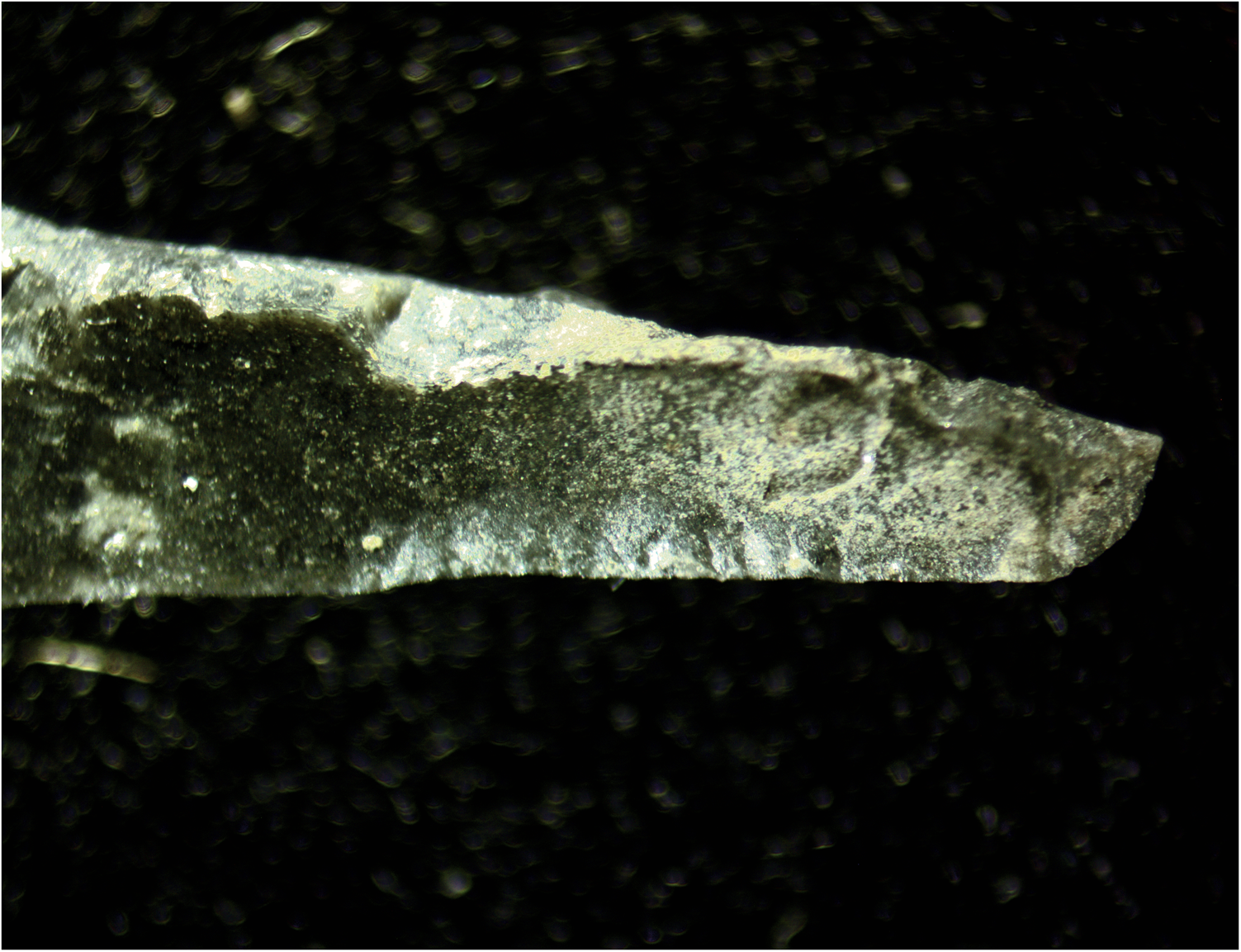
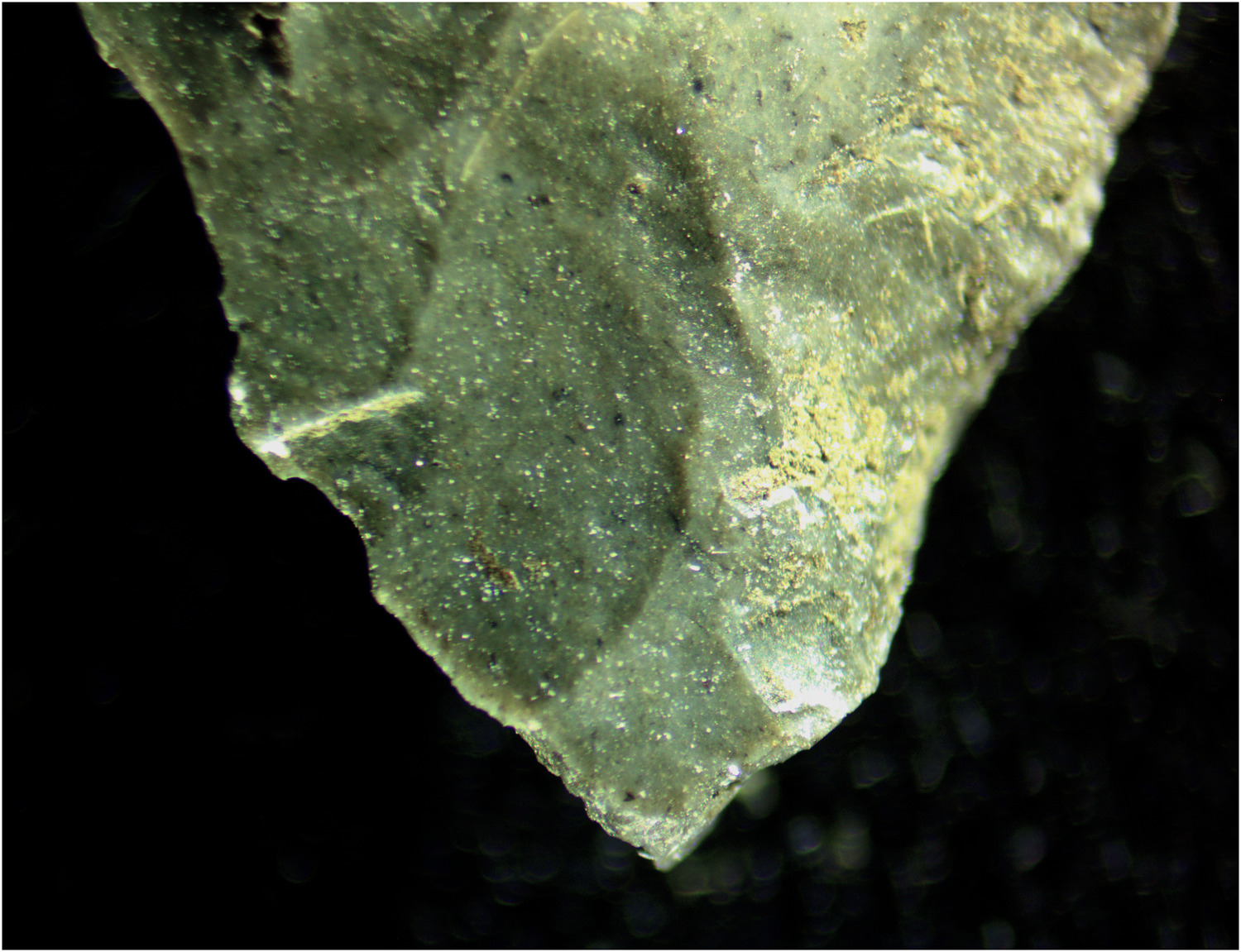
Specimens with perforation wear showed a higher incidence of edge serrations, whereas specimens with graver wear exhibited moderate to heavy micro-fracturing with continuous scalar scarring and more intense polish and edge rounding. In general, specimens with perforation wear showed less variable wear on the distal tip and less morphological change than gravers (Figures 2 and 3). Detailed use-wear descriptions of each specimen may be found on tDAR (https://core.tdar.org/collection/71221/eaton-chipped-stone-tool-use-wear).
Perforator #1609: Use wear includes edge seriation, minor edge rounding, and fracturing; 40× magnification. (Color online)
Graver #1565: Use wear includes moderate to heavy micro-fracturing along with scalar scarring, edge rounding, step fracturing, and distal edge crushing; 40× magnification. (Color online)
Results
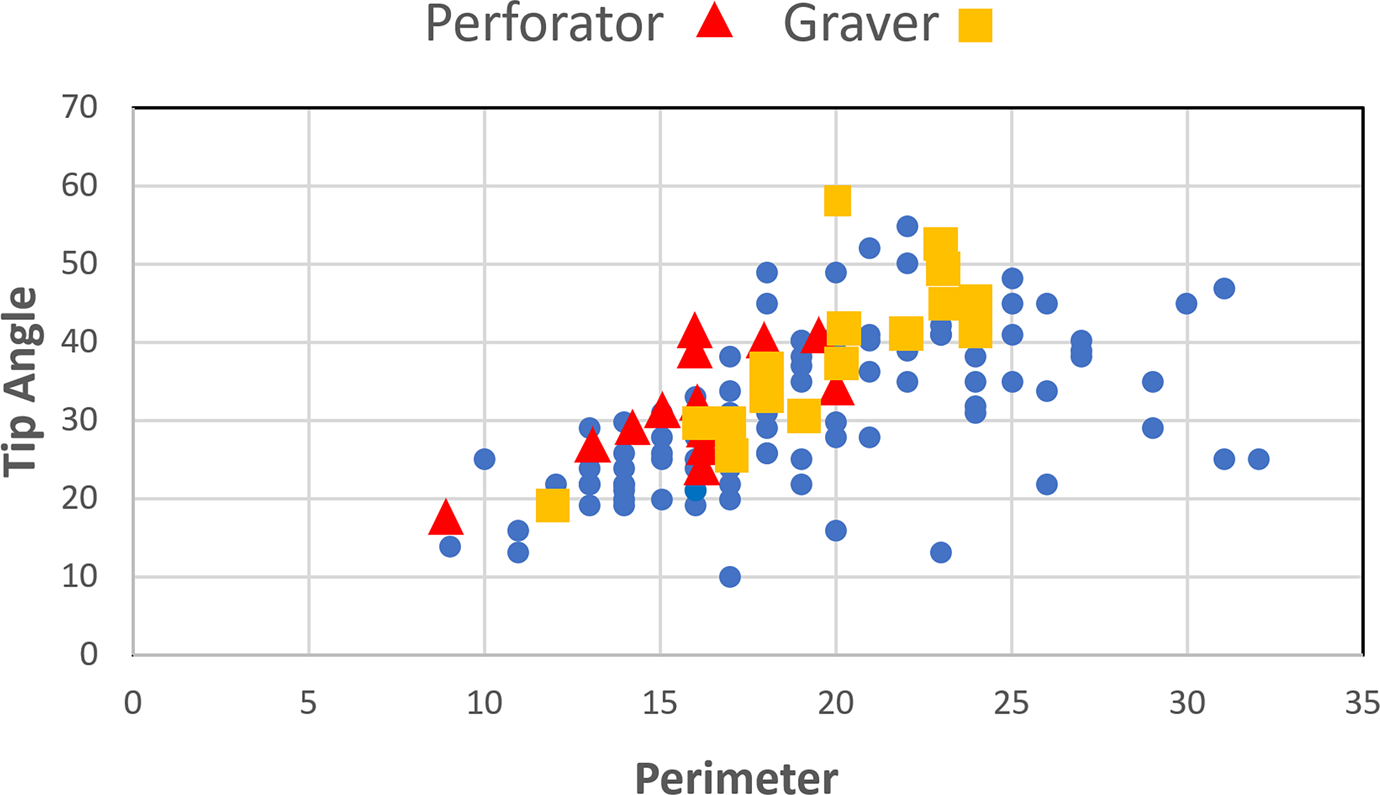
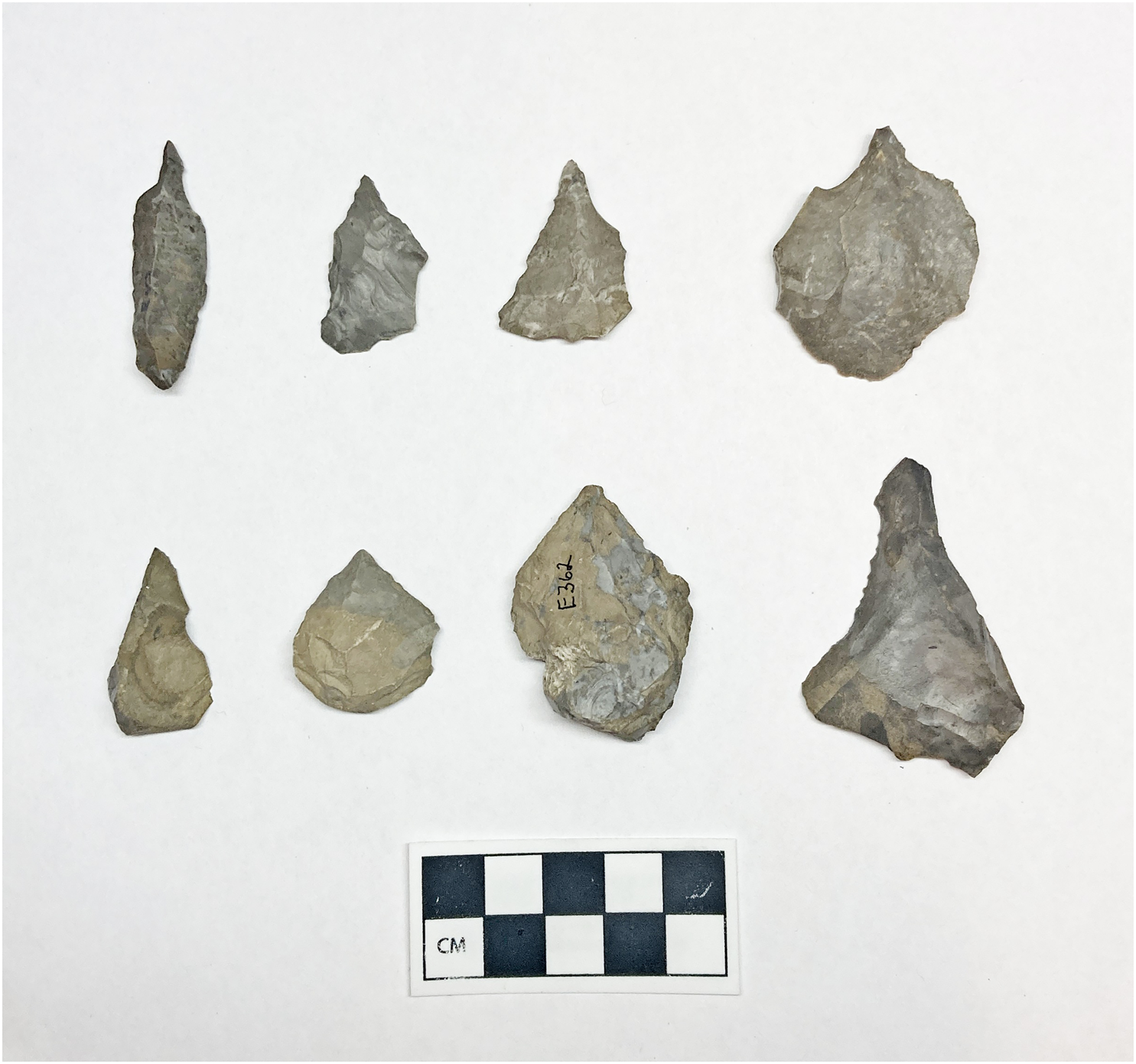
Figure 4 is a scatterplot, with the tip angle plotted on the y axis and the projection perimeter on the x axis. Specimens with perforator wear are marked with a triangle, those with graver wear are marked with a square, and specimens whose use wear we did not determine are marked with a circle. As expected, those with perforator wear had a small perimeter (20 mm or less) and a relatively sharp angle (40 degrees or less). However, specimens with graver wear did not conform to expectations: the dimensions of their projections overlapped with specimens with perforator wear. Specimens with perforator and graver wear are represented by roughly the same proportion of flakes, blades, bifaces, and core fragments. Figure 5 shows perforators and gravers with a range of distal angles and perimeters.
Projection tip angle plotted against perimeter. Specimens with perforator wear are represented by triangles, graver wear by squares, and specimens not studied for use wear are represented by circles. (Color online)
Top row: Specimens with perforation use wear (left to right; tool number): #1600, #1617, #1561, #1596; bottom row; specimens with graver use wear: #1386, #1587, #1013, #1053. (Color online)
Although these results preclude a clear-cut differentiation of perforators and gravers based on function, they do present a starting point for distinguishing these tools typologically. We propose that the term “perforator” be used for specimens with a projection perimeter of 20 mm or less and a projection angel of 40 degrees or less. We further propose that specimens with projections with wider angles and thicker projections be termed “gravers,” with the understanding that the function of graving is not limited to wide-angled thick projections. Using this typological distinction, specimens classified as gravers were unlikely to have functioned as perforators.
Summary and Conclusion
Chipped stone tools with projections are found worldwide and are given various type names, including perforator and graver. However, one researcher's graver is another researcher's perforator, leading to noncomparable databases. This use-wear study indicates that specimens with perforation use wear have projections that are both thin and sharp, whereas graver use wear occurs on projections of variable perimeters and tip angles. For typological purposes, we advocate that specimens exhibiting a distal angle of 40 degrees or less and a projection perimeter of 20 mm or less be classified as perforators, and those with greater dimensions be termed gravers. We recognize that placing specimens in lithic tool types obscures the variability between them and may lead to false assumptions concerning function. However, the use of a typology does not prevent the investigation of intra-type variation. This is a separate research goal from the comparisons of large assemblages for which the description of individual specimens is not practical. Currently, the failure of archaeologists to use a uniform lithic tool typology for perforators and gravers renders inferences on the use of these tools over broad areas or time periods little more than speculation.
Acknowledgments
The late John Holland examined many of the specimens in this study with the corresponding author. Roderick Salisbury is responsible for Figure 1, and Mark Warford and Marko Miletich translated the abstract into Spanish. We also wish to thank three anonymous reviewers for their suggestions.
Funding Statement
The Eaton site was excavated by 17 summer field schools from Buffalo State University, SUNY Buffalo, or from both institutions in joint sponsorship. We gratefully acknowledge the support of both institutions.
Data Availability Statement
The specimens that form the basis of this study are curated in the Anthropology Department at Buffalo State University.
Competing Interests
The authors declare none.


 Open access

