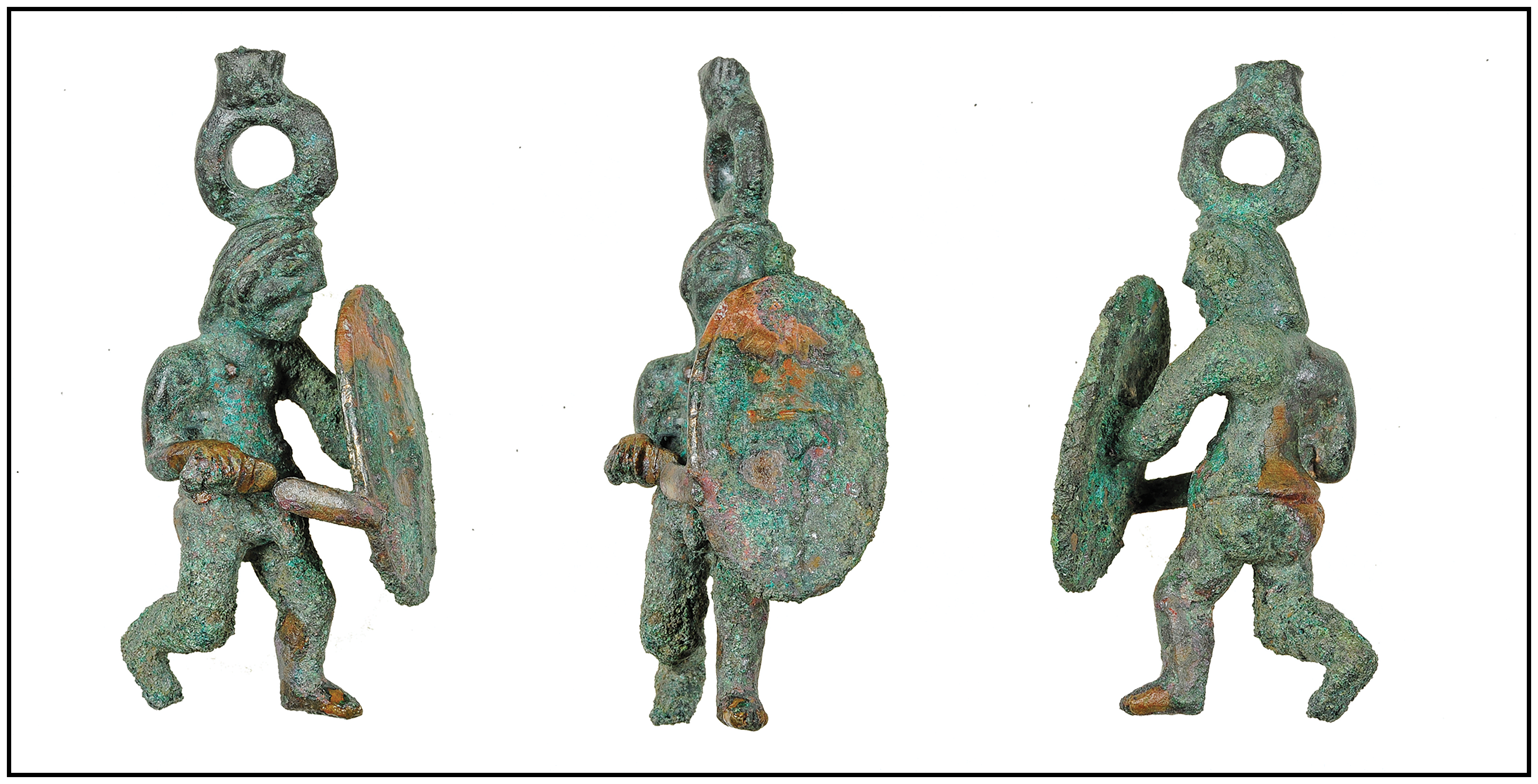
Armed conflict is a prominent theme in archaeological research, with the potential to add historical understanding to the fact that state-based armed conflict is (according to the World Economic Forum’s Global Risks Report 2025) now perceived to be the number-one risk facing the world. The image featured here is of a bronze warrior figurine, after conservation. It is 75mm high, weighs 55 grams and was made using the lost-wax casting process. It represents a figure holding a shield and sword. On its head is a ring, possibly used for suspension. It was recently recovered from a ditch dated to the third century BC at the Iron Age oppidum of Manching in Bavaria. This settlement site subsequently developed into a large, fortified political and economic centre north of the Alps. Associated cemeteries included graves containing weaponry. More recently, during the Second World War, the site was damaged by bombing raids on a nearby airfield. Evidently, throughout Manching’s history, armed conflict has played a prominent part in the lives and imaginations of its inhabitants. Photograph: Bayerisches Landesamt für Denkmalpflege.

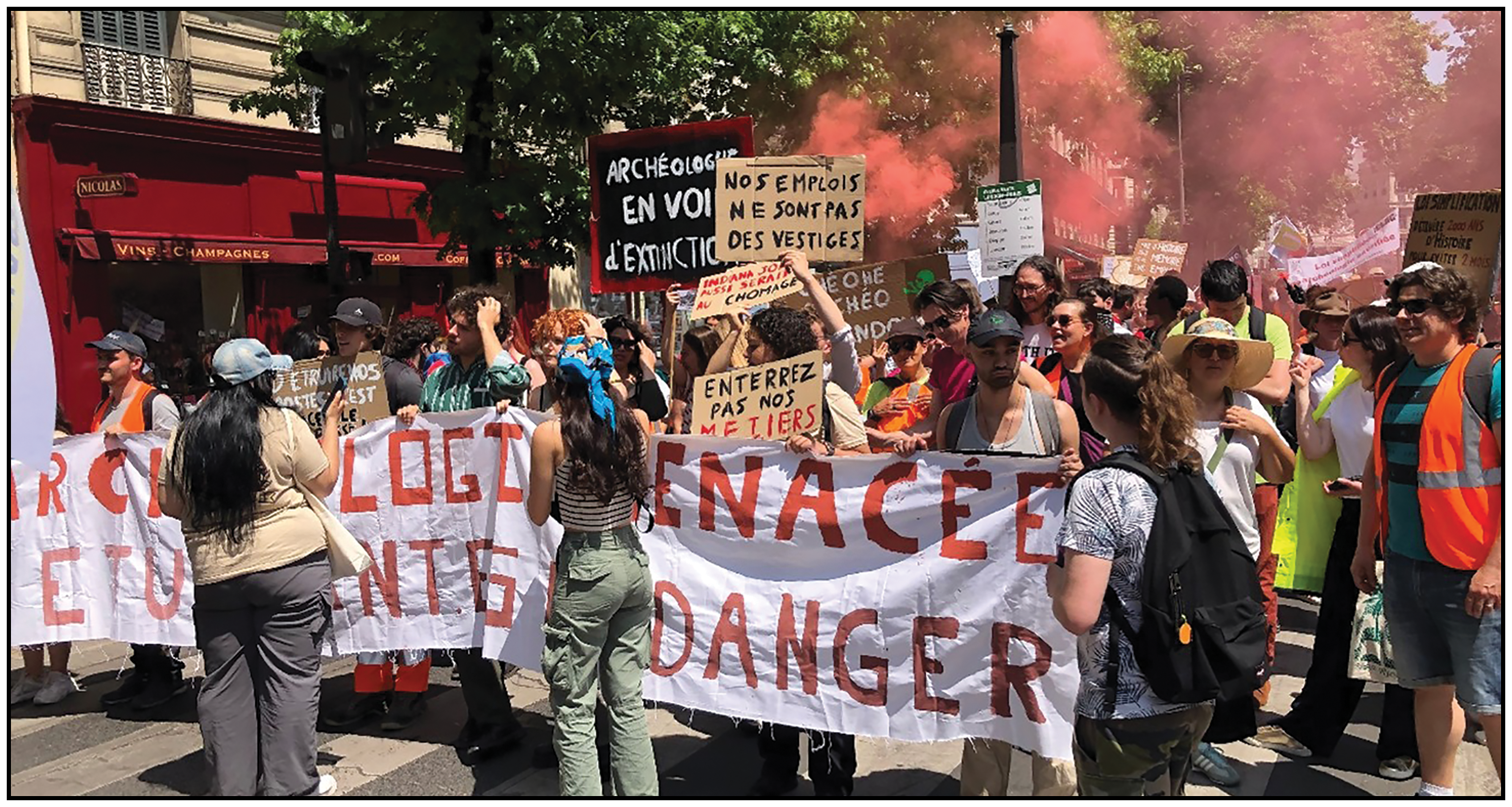
Economic downturn and confrontation are also perceived to be significant global risks. Nathan Schlanger, Professor of archaeology at École nationale des chartes in Paris, informs us that, in France, archaeologists face unprecedented reductions in budgets and personnel. These challenges have been compounded by the Government’s proposed exemption of designated ‘national priority’ building projects from any prior preventive archaeology measures. Besides flouting hard-earned heritage legislation, this ‘simplification’ risks sacrificing the cultural and scientific riches of the past to the short-term profits of the present. This proposal generated an unprecedented show of strength and unity from the archaeological community on 12 June 2025. The main demonstration in Paris attracted over 1300 archaeologists (according to police estimates)—nearly one-third of all French archaeologists, including employees from Inrap, local authorities, the Ministry of Culture, universities and the Centre national de la recherche scientifique (CNRS), as well as students and private operators. The very next day, the Government withdrew its proposal. Photograph: Nathan Schlanger.

The peer-review crisis
 Compared to the global crises we are currently facing (Frontispieces 1 & 2), the ‘peer-review crisis’ may rank as insignificant. Nevertheless, its symptoms are widely experienced by researchers, reviewers and the institutions that help sustain their work. For example, when it comes to securing research funding and publishing research results in academic journals or books, archaeologists, like other members of the international scientific community, are increasingly frustrated by longer turnaround times—from submission of manuscripts to first decision—caused by too many submissions and too few peer reviewers. And this is before reacting to any critical feedback they may receive, occasionally with accusations of reviewer or editor bias and error. At the same time, many of us are receiving a barrage of invitations to complete assessments of our colleagues’ work. Commentators have been arguing for over a decade that the established academic peer-review system—still widely regarded as a cornerstone of scientific integrity and publishingFootnote 1—is broken and in need of repair or replacement.Footnote 2 But precisely how to fix it is a matter of debate, spanning disciplines from information science to sociology.Footnote 3 Only a few archaeologists have so far contributed to this debate,Footnote 4 but more should, since different types of evaluation invariably suit different research communities.
The current practice of peer review can, arguably, be traced back to the sixteenth-century European Reformation, when, following an initial phase of book burning, the Anglican and Catholic churches instituted censors to review and approve books on theological matters for style and content prior to publication.Footnote 5 It is more widely accepted, however, that the origins of modern peer review lie in the new scientific societies and academies of seventeenth-century Europe, with precedence given to the Royal Society of London, whose Secretary, Henry Oldenburg, edited the Society’s Philosophical Transactions from 1665, gathering opinions from authoritative scientists on papers submitted for publication.Footnote 6 Nevertheless, research by Melinda Baldwin tracing the history of refereeing for scientific journals and funding bodies shows that, throughout the nineteenth century and into much of the twentieth, external referee reports were considered an optional part of journal editing or grant giving.Footnote 7 The idea that refereeing should be a requirement for scientific legitimacy arose first in the late 1960s and 1970s in the United States where, along with massive expansion of government funding for scientific research in a postwar and Cold War context, there was increasing pressure both from funders for science to be more accountable to the public and from scientists seeking to ensure their continued influence over funding decisions. (Baldwin also argues that, in establishing this requirement, the seeds of the current ‘crisis’ were sown.) Thereafter, and especially from the late twentieth century, expert ‘peer review’ (as it was increasingly called) became widely formalised as the only acceptable method of evaluating scientific quality and legitimacy. The scale of the peer-review system has since increased exponentially. Today, thankfully, most researchers still regard peer review as part of the professional ‘service’ they should provide for the benefit of their disciplines. But we cannot take their commitment for granted, particularly with at least four significant pressures threatening the sustainability of the established system.
First, there are too many manuscripts. With increasing numbers of researchers competing in our ‘publish or perish’ scientific milieu, the volume and rate of new submissions to peer-reviewed journals is accelerating. This is leading to editors issuing more numerous, quick ‘desk rejects’ and sending out more invitations to review papers. There can also be duplication in peer review, when papers rejected by one journal are sent to others to be reviewed again, occasionally by the same peers. Publishers, with an eye on revenue, have overseen a proliferation of academic journals, and have encouraged journals in high demand to publish more issues per annum. In parallel, they have facilitated the inclusion of large volumes of scientific data and supplementary material online, the details of which referees are also expected to consider.
Second, there are too few expert and willing reviewers. This was noted back in 2009 by David Killick and Paul Goldberg in relation to the boom in archaeological science in the USA, and in the same year by Karl Butzer, then editor of the Journal of Archaeological Science, particularly concerning the shortage of referees with expertise in evolving high-tech methods.Footnote 8 ‘Reviewer fatigue’ is also setting in. According to Publons’ ‘Global State of Peer Review Report’ for 2013–2017, 42 per cent of researchers declined review requests because they were too busy.Footnote 9 This figure is likely to have increased post-COVID, with many professionals reconsidering their work/life balance. Indeed, many potential reviewers not only decline but also ignore invitations or fail to complete reviews they have agreed to undertake. And new reviewers can be hard to enlist, partly because they are rarely trained in peer review and might therefore feel unqualified, but also because their host institutions may discourage them from taking on this kind of external service. Journal editors are consequently having to send out many more invitations and target a shrinking pool of experienced assessors.
Third, peer review is taking longer. Because of the first two tensions the evaluation of new and revised submissions is more drawn-out, with most journals taking months to send out first decisions on manuscripts, let alone final decisions. (Funders, likewise, have long turnaround times.) The pain of such delays is felt keenly by researchers, especially early career researchers who need publications to apply for funding, posts or promotions. Ultimately, this is leading to the slower initiation and dissemination of new research.
Fourth, peer-review quality is being jeopardised. With increasing pressures on their time, reviewers may be inclined to provide less thorough feedback (although many still go over-and-above the call of duty to help enhance colleagues’ work). Hard-pressed journal editors are also more liable to base their decisions on fewer reviews and to edit texts less closely. This can result in the publication of research containing weaknesses and errors that should have been corrected beforehand and that are increasingly ending in formal retractions.
Below, I take this discussion of the peer-review crisis further. I begin by considering the benefits and criticisms of peer review, with a particular focus on academic journal articles (instead of other forms of academic peer assessment ranging from book reviews or applications for funding or promotion through to student peer assessment, although these share many of the issues raised). Next, I take a closer look at Antiquity’s peer-review process. I then consider a variety of alternatives to the traditional peer-review system, before offering a few concluding thoughts. My own manuscript certainly benefitted from the feedback generously provided by my peers at Antiquity, the European Journal of Archaeology, the Journal of Archaeological Science and the Journal of Field Archaeology: Lindsey Elstub, Tara Ingman, Zena Kamash, Christina Luke, Efthymia Nikita, Abigail Teasdale and Marion Uckelmann.
Benefits
Before criticising it, let’s at least acknowledge some of the benefits of peer review for academic journals. For authors, receiving and responding to constructive critical feedback from colleagues generally improves the quality of their published articles. Individual researchers can also gain greater academic credit (as measured, for example, by their ‘h-index’ of scientific output and impact based on citations) by publishing in peer-reviewed outlets. Reviewers can be rewarded by being among the first to read about the latest research discoveries and emerging ideas in their fields of interest. They can also learn from the evaluation process how to improve their own writing and their responses to reviewers’ comments. Editors rely heavily on referees’ feedback on manuscripts—some of which inevitably lie outside their own areas of expertise—to take decisions on whether to accept them for publication or to request revisions. More broadly, the collective review process helps self-regulate and (re)shape the credibility, reputation and scope of scientific disciplines and their respective journals for the benefit of readers and the public that funds their research. It certifies what research can be trusted as an excellent contribution to the state-of-the-art, with reference to quality standards that determine, for example, how innovative, sound and significant a paper is. It can also expose and exclude bad science, such as instances of plagiarism, scientific fraud, pseudo-science and political propaganda. Peer review is, then, indispensable.
Criticisms
Researchers have, nonetheless, expressed multiple concerns, particularly regarding traditional systems of peer review. Key issues are bias and the related question of whether it is possible to remain impartial,Footnote 10 as well as review quality and compensation.
Social or ad hominem bias used to be rife when reviewers knew the identities of authors, and it still exists. It leads to differential evaluation of an author’s work because of their perceived social identity (gender, nationality), status (age, career stage, reputation), institutional affiliation and native language and because of existing (positive or negative) social relationships between reviewers and authors. It also results in a reinforcement of the power of dominant scientists, ideas and institutions at the expense of early career researchers, scientists from the Global South and researchers writing in a language that is not their mother tongue. The double-blind peer-review model (where authors’ and reviewers’ identities are concealed from each other) is claimed to decrease such bias. For example, a study by Laura Heath-Scott of peer review in the Journal of Field Archaeology has shown that a change from single-blind review (where authors’ identities are known by reviewers but not vice versa) to double-blind in 2014 shifted reviewer behaviour: the anonymisation of authors led to more nuanced critiques by reviewers and suggestion of revisions, instead of straight acceptance or rejectionFootnote 11. However, blinded reviewers may continue to guess the identity of authors, research groups and their institutions, especially in small and competitive fields. All this can lead authors to distrust reviewers and to therefore submit inappropriately long lists of reviewers not to be selected on the grounds of personal conflict, professional rivalry and so on. Interestingly, studies of biomedical publication have found that excluding reviewers can (statistically) significantly increase a manuscript’s chance of being accepted;Footnote 12 some journals have therefore restricted the number of reviewers that can be excluded in this way. A few authors have even submitted bogus details for recommended reviewers, who turned out to be the original authors or close colleagues reviewing their own work under pseudonyms.Footnote 13 (Warning: do not try this at home!)
Content-based bias involves partiality for or against a submission by virtue of its content (e.g. methods, theoretical orientation, results). It often includes ‘confirmation bias’ or ‘cognitive cronyism’, where reviewers evaluate more favourably the work of scholars who share, rather than challenge, their own beliefs and schools of thought. This process of boundary ‘gatekeeping’, particularly by senior scholars, can result in disciplinary conservatism and discrimination against innovative, high-risk and interdisciplinary research and against Indigenous ways of communicating knowledge and understanding. What’s more, when hidden behind a veil of anonymity, those established scholars are not held accountable. In light of this, Mitchel Allen, the highly experienced archaeology publisher and editor, argues that “publication decisions should usually, but can’t always, rely on peer review” and “the presentation and adoption of a radical new interpretation of the past has come from the willingness of a journal editor to buck the conventional wisdom that permeates the peer review process and take a chance on someone’s ideas that fall outside the mainstream”.Footnote 14 A related problem is ‘publication bias’, where a journal may favour research demonstrating positive outcomes rather than studies that don’t work.
Peer reviews can also be of inconsistent or poor quality. They are inevitably heterogeneous. So, different reviewers do not always understand and apply evaluative criteria of quality in the same ways, and some can be systematically harsher or more lenient. Some are more thorough than others. For example, the extent to which reviewers take time to undertake reproducibility checks to establish the scientific validity of results is variable. A few allow their emotions to come to the fore, although in my experience they are never “malicious, slanderous, insulting or gratuitously unkind”.Footnote 15 A very few may even ignore warnings against improper conduct, including failure to disclose conflicts of interest or limited competence, and misappropriation or breach of confidentiality of material provided for the purposes of peer review.Footnote 16 It is hardly surprising, then, that the peer-review process occasionally approves studies whose published results are later found to be fundamentally flawed, even deceptive or fraudulent. For example, an article published in PNAS by the late Richard Firestone and colleagues presenting their ‘Younger Dryas Impact Hypothesis’—which claims that an extraterrestrial impact event 12 900 years ago caused, among other things, the termination of the Clovis culture in North America—has subsequently been comprehensively refuted and used as a cautionary tale by other scientists for undertaking non-reproducible analyses and promoting a series of unsubstantiated speculations.Footnote 17
Another widespread complaint, voiced especially by untenured academics, is that large, commercial publishers are exploiting the goodwill and voluntary labour of reviewers, which they turn into profits. However, the question of whether peer reviewers should be paid remains an open one, to which I will return below.Footnote 18
Reviewing peer review in Antiquity
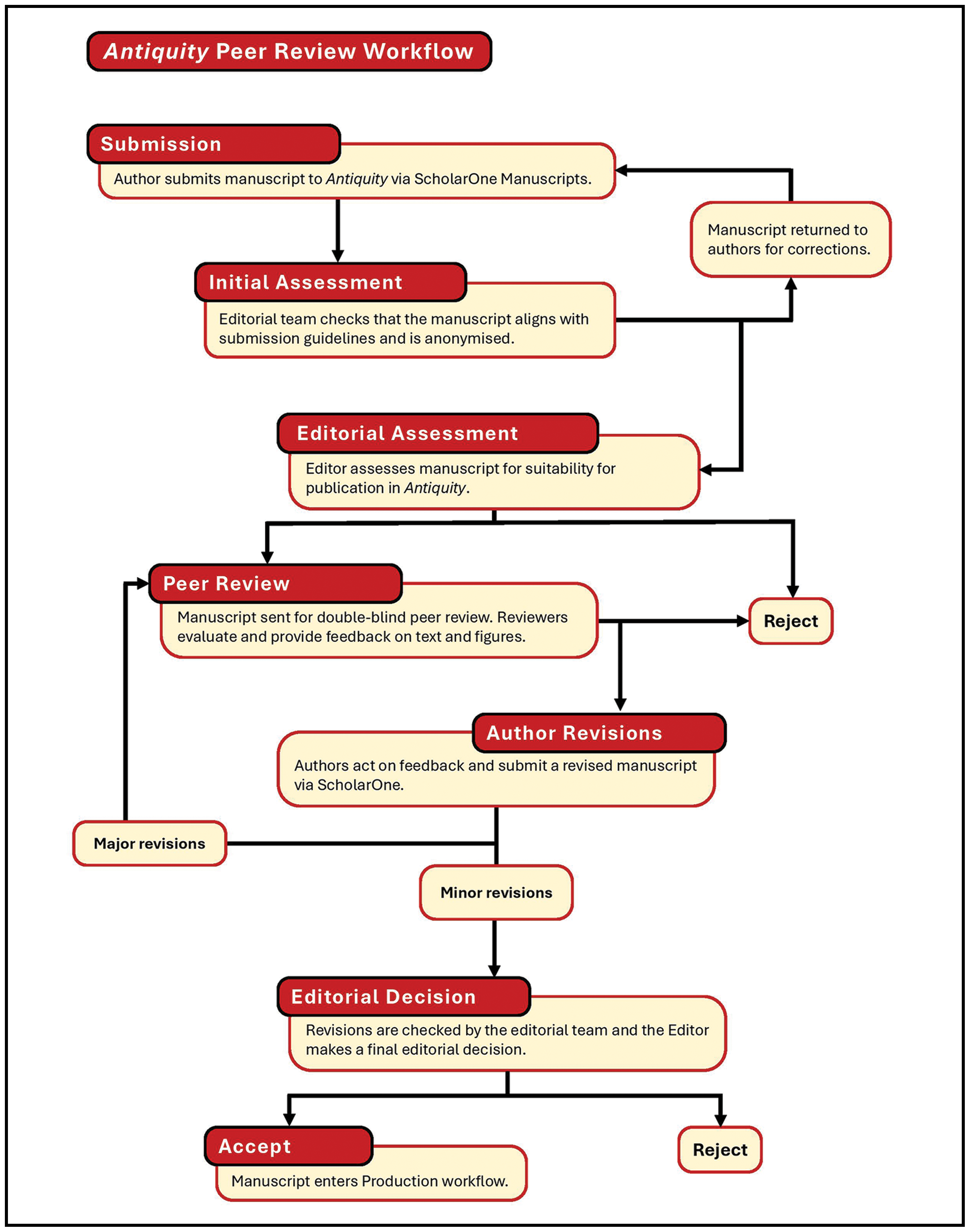
Traditional academic journals and publishers tend to avoid disclosing data on their peer review and decision-making, partly to avoid discouraging prospective authors. At Antiquity, we aim to demystify the process, especially when mentoring early career researchers from the Global South at our ‘Rewriting World Archaeology’ writing workshops. Since we follow a standard workflow (Figure 1), I will skim over processual details here. Instead, I shall focus briefly on describing and quantifying how the accepted research, method and Project Gallery articles published in this (December 2025) issue of Antiquity fared in our peer-review process. Data come from our ScholarOne Manuscripts submission-management platform.
Antiquity peer-review workflow. Image: The Antiquity Trust.

Following ‘internal’ evaluation of new submissions by our editorial team, we decline a proportion of manuscripts without peer review. These desk rejections are always accompanied by an explanation of our reasons, which can range from lack of ‘fit’ with the journal’s global archaeological scope and non-specialist readership to inadequate definition of research questions and aims, materials and methods. In 2024, 31.1 per cent of our 344 final decisions were rejected in this way (a figure that lies at the low end of the scale compared to Elsevier journals, which, back in 2015, reported desk rejecting between 30 and 50 per cent of submitted articles).Footnote 19
Using the double-blind procedure, we then solicit ‘external’ experts to comment on promising manuscripts. For manuscripts featured in this issue we sent out between three and 10 invitations per manuscript. A total of 151 invitations were issued, of which 58.9 per cent were either declined, not responded to or accepted but not completed; 61.6 per cent of invited males abstained from peer review in contrast to 50.0 per cent of invited females. We balance author recommendations of reviewers with our own choices, and we are constantly expanding our large pool of reviewers on a case-by-case basis, using a variety of online bibliographic searches to identify published experts in diverse fields. We also try to balance reviewers for each manuscript geographically, with a mix of regional and international specialists, and by gender, although a perfect balance is rarely attainable. For the original versions of the 27 articles now published in this issue, we received reports from 59 peer reviewers, of whom 23.0 per cent are based at institutions in the USA, 16.4 per cent in the UK, 37.6 per cent in other European nations and 23.0 per cent outside Europe and the USA (in Chile, China, Ghana, Israel, Russia and Türkiye). Of the reviewers, the female-to-male ratio is 0.40. This is comparable to the figure calculated by Emily Hanscam and Robert Witcher for Antiquity for 2015 (0.41) but lower than that for 2020 (0.55).Footnote 20 We do not pay peer reviewers, since Antiquity and our publisher, Cambridge University Press, are run as not-for-profit charities. We are not proscriptive as to what form reviews should take, because the kinds of submissions we receive to our ‘review of world archaeology’ are highly diverse, although we do welcome comments on how innovative, well-documented and clearly expressed each manuscript is. The review reports we receive are, then, highly variable, although we are happy to offer advice to inexperienced reviewers. On average, over the 12 months prior to 10 September 2025, reviewers took 15.8 days to complete and submit their reports.
We wait for a minimum of two reviewers’ reports before issuing a first decision, but we prefer three since the opinions of two can occasionally be polarised. In taking this decision, the editor weighs up the recommendations of the peer reviewers and considers other factors such as the scale of the changes required to bring a submission up to standard, different regional traditions of archaeological research and the potential of the research to appeal to our global readership. Over the 12 months prior to 10 September 2025, the average number of days from submission of a manuscript to first decision was 39.8 days. This figure is, however, skewed by (quick) desk rejects, and so for the articles published in this issue, that average rises to 73.9 days.
Authors then revise their manuscripts and provide a response to the feedback provided. Sound advice was given here by the late archaeologist Graham Connah: “Some authors might throw a tantrum, and others change as little as possible, but the wise author will weigh and consider with great care the things that have been said”.Footnote 21 Most of our authors do the latter, although the process can involve negotiation with the editor—it is not simply about compliance.
Manuscripts that have been subject to major revisions are then sent out for a second round of peer review. New reviewers must sometimes be brought in at this stage, since not all reviewers are suited, willing or able to consider a revised draft. This, and a multitude of other factors particular to each manuscript (including the scale of the requested revisions, author speed and the nature of their response to reviewers), can add significantly to timescales.
Armed with these details, we leave you to decide whether our peer-review and decision-making process is fair, fast and fit-for-purpose. Like other journals, we continue to adapt to the peer-review crisis at the same time as trying to enhance the experience of our authors and reviewers. We are also looking at alternatives.
Innovations
Peer review is widely supported by researchers, yet they also see room for improvement.Footnote 22 When it comes to academic journals, a variety of possibilities—ranging in impact from tinkering to more radical change—are currently being experimented with in response to the peer-review crisis.
Publishers are now offering inducements to hesitant reviewers. Many, for example, compensate referees by verifying their peer-review activities and editorial contributions and exporting the metrics to online platforms such as Clarivate’s ‘Web of Science Researcher Profiles’.Footnote 23 Some also offer reviewers free access to their content and discounts or waivers on Article Processing Charges (APCs) for their own submissions, having completed a certain number of reports. Paying reviewers, especially in return for rapid responses, has also been called for, but not everyone is tempted by the money. Publishers argue that this additional cost would have to be passed on to authors in the form of even more expensive APCs.
Some journal editors and publishers are proactively revising their peer-review strategies. They are, for example, widening their pools of peer reviewers to include the expertise of scholars in the Global South and early career researchers. ‘Community review’ by local experts, including members of Indigenous communities, has also been advocated in the heritage sector.Footnote 24 Publishing teams are providing reviewers with clearer and more structured advice, although plenty of guidelines already exist;Footnote 25 whether reviewers can spare more time to read them is another matter. Peer-review training is being incorporated into some doctoral training programmes (but not as a priority). Greater transparency of the peer-review process is also being provided by journals such as PLoS One, Footnote 26 which present peer reviewers’ reports (anonymised unless the reviewer wishes otherwise), author responses and editor decisions alongside final, published articles. Archaeologists Colleen Morgan and Judith Winters have also experimented along similar lines in a special issue of Internet Archaeology on ‘Critical blogging in archaeology’, by including open review (including reviews of a photo essay also performed with photographs and text), supplemented by a comments section for each page archived alongside each article. In their opinion, “open review encouraged civility, transparency of process and created meaningful connections and conversations between authors and reviewers”.Footnote 27 Some editors are also rejecting more submissions earlier on and limiting the number of ‘revise-and-resubmits’. Connected to this, however, is the possibility that the author(s) of a rejected manuscript might be enabled to carry the reviews they received from their last peer-reviewed submission to a different journal, whose editor could then decide on acceptance, rejection, revision or additional review.
Scientists are also acting, in the hope of making the review and publication process more open and swift. They have formed communities to review manuscripts posted on preprint servers (such as BioRxiv, OSF Preprints), which authors are then free to submit to a journal with the reviews alongside. There are variants on how this works in practice, particularly to secure sufficient reviews, guarantee their quality and timeliness and collaborate with established journals. For example, archaeometrist Alain Queffelec and an international group of collaborators advocate contributing to Peer Community In (PCI)—a non-profit organisation of researchers offering peer review and recommendation for preprints of scientific articles—and specifically PCI Archaeology, which was launched in 2020.Footnote 28 Another model, with a similar impetus but different workflow, is ‘post-publication peer review’.Footnote 29 Here, a variety of comments and reviews are posted by peers after manuscripts have been published. However, with the emphasis on speed, the quality of such publications and their reviews may suffer, potentially resulting in the public dissemination of poor science.
Inevitably, authors, reviewers, editors and publishers are experimenting with artificial intelligence (AI). For example, time-pressed experts are now employing ChatGPT and other AI tools to evaluate papers, to translate, edit and improve peer-review reports, and even to help write them.Footnote 30 Publishers and editors are also increasingly making use of software and AI-powered systems to speed up routine processes undertaken soon after papers are submitted, by checking the completeness of manuscripts, detecting bibliographic errors, plagiarism and image duplication, expediting desk rejects and identifying potential reviewers. Caution and human oversight are necessary, however, since AI is currently prone to making up information and because sharing authors’ manuscripts with online AI tools can violate confidentiality and copyright. New guidelines are therefore now required on what represents both best practice and misconduct when using AI in the peer-review process.
Concluding thoughts
Peer review is imperfect. This adds to the stress felt by authors in navigating the publication process. Yet, despite its limitations, it is hard to imagine how we would get along without peer review. Providing feedback on manuscripts submitted to academic journals, and on applications for grants and promotions, is an ethical obligation for researchers, and therefore also for their host institutions to support. If we want our research to be published in a peer-reviewed academic journal, then we should feel obliged to reciprocate by peer reviewing ourselves. Furthermore, we should take the time to communicate our expert knowledge and opinions on the work of our fellow researchers as objectively, critically and constructively as we would wish the fruits of our own labour to be treated. Of course, we all have limited time and must be selective in our responses to invitations. In the future, digital technologies may increasingly assist us in this laborious process. They cannot, however, replace the humanity, altruism and sensitivity that are among the hallmarks of excellent peer review.