


Introduction
In recent years, video-mediated communication has taken a more prominent position in the social lives of older adults, enabling them not only to maintain connections with their loved ones, regardless of geographical distance, but also to see and hear them instantly, as if they were close in time and space (Goodman-Deane et al. Reference Goodman-Deane, Mieczakowski, Johnson, Goldhaber and Clarkson2016; Wilson et al. Reference Wilson, Gates, Vijaykumar and Morgan2021). In alignment with a growing recognition of video calling’s potential to reduce perceived distance (Goodman-Deane et al. Reference Goodman-Deane, Mieczakowski, Johnson, Goldhaber and Clarkson2016), especially in the context of the pandemic, there has been a notable surge in the number of older adults using video-calling applications, including those above the age of 75, despite their lesser familiarity with the medium when compared with younger, more recently retired individuals (Houghtaling Reference Houghtaling2022; De Marez et al. Reference De Marez, Sevenhant, Denecker, Georges, Wuyts and Schuurman2023). Given that video-mediated communication allows for mediated face-to-face interactions without the need for physical presence, it may serve to protect this demographic subgroup from the potentially adverse consequences of another observable trend: the age-related decline in both outgoing and incoming visits, which may result in an elevated susceptibility to loneliness and social isolation (Delafontaine et al. Reference Delafontaine, Van Gasse and Mortelmans2023; Dickinson and Hill Reference Dickinson and Hill2007). However, video-mediated communication presents challenges in terms of usability and accessibility, which may prevent individuals aged 75 and above from fully capitalizing on video calling’s potential to bridge psychological distance (Zamir et al. Reference Zamir, Hennessy, Taylor and Jones2018; Moyle et al. Reference Moyle, Jones, Murfield and Liu2020; Van Dijk Reference Van Dijk2020) and reduce feelings of loneliness (Bonsaksen et al. Reference Bonsaksen, Thygesen, Leung, Ruffolo, Schoultz, Price and Østertun2021). It is therefore essential to identify the characteristics of video-mediated communication that act as either obstacles or facilitators to the ability of individuals over the age of 75 to feel close during informal interactions, as well as to gain insight into the specific circumstances or conditions that either impede or empower them in navigating the challenges encountered during video-mediated interactions, thus undermining or fostering a sense of proximity.
Owing to the age-related increase in the risk of functional and emotional losses, resulting in smaller network sizes and lower mobility levels, individuals aged 75 and above not only are more prone to loneliness and social isolation compared to older adults of younger ages (Luhmann and Hawkley Reference Luhmann and Hawkley2016; Delafontaine et al. Reference Delafontaine, Van Gasse and Mortelmans2023) but also may be more reliant on visits from family members and friends to counteract reduced opportunities for social interaction (Lloyd et al. Reference Lloyd, Calnan, Cameron, Seymour and Smith2014). Nonetheless, the same macro-processes that have created remote career opportunities for members of the younger generations, including migration, innovation and individualization, have contributed to increases in geographical distance between older adults and their younger family members and greater challenges for the latter in visiting their older relatives regularly (Dickinson and Hill Reference Dickinson and Hill2007; Mulder and van der Meer Reference Mulder and van der Meer2009). Video-mediated communication may assist individuals aged 75 and above in overcoming perceived distance to their close relatives by facilitating co-presence, defined by Kadylak et al. (Reference Kadylak, Makki, Francis, Cotten, Rikard and Sah2018) as the feeling of being together in a shared space, and by promoting a sense of immediacy, which can be described as the perception of being in direct contact with another person, resulting in a forgotten presence of the medium (Costa et al. Reference Costa, Esteve-Del-Valle and Hagedoorn2022). This is achieved through the use of natural language cues, which evoke feelings of warmth and intimacy (Goodman-Deane et al. Reference Goodman-Deane, Mieczakowski, Johnson, Goldhaber and Clarkson2016; Wilson et al. Reference Wilson, Gates, Vijaykumar and Morgan2021).
Notwithstanding video calling’s distance-reducing potential, specific properties of the video-calling medium may pose challenges for older adult users, which could compromise the quality of their video-mediated interactions and their ability to achieve co-presence and immediacy, hence undermining perceived proximity. On the one hand, older adults experience higher levels of tech anxiety and unfamiliarity and encounter a steeper learning curve when compared to younger age groups (Van Dijk Reference Van Dijk2020). On the other hand, owing to their increased susceptibility to visual, auditory and cognitive impairments, they tend to face more difficulties on average when processing information conveyed through video-mediated communication (Iancu and Iancu Reference Iancu and Iancu2020). It should be noted, however, that the current body of knowledge regarding the barriers and facilitators of video-calling use, as illustrated by the aforementioned findings, is largely based on studies that did not exclusively concentrate on individuals aged 75 and above. In studies that have considered older adults of advanced age, the research was conducted in nursing homes and other care facilities (Zamir et al. Reference Zamir, Hennessy, Taylor and Jones2018; Tsai et al. Reference Tsai, Cheng, Shieh and Chang2020) and focused on the use of video calls in patient–care-giver relationships (Husebø and Storm Reference Husebø and Storm2014), as well as in targeted interventions aimed at preventing and alleviating loneliness and social isolation (Airola et al. Reference Airola, Rasi and Outila2020; Choi et al. Reference Choi, Pepin, Marti, Stevens and Bruce2020; Mierzwicki et al. Reference Mierzwicki, Miller, Baney, Lash, Benton and Haller2024), frequently within the context of social restrictions imposed during the pandemic, or a combination of multiple of these settings (Kelly et al. Reference Kelly, Xing, Baker and Waycott2023). Therefore, the specific challenges and facilitators associated with the use of video calling among individuals aged 75 and above for the purpose of informal social interaction with family members and friends have been overlooked in previous research endeavours.
In light of the increasingly prominent role of video-mediated communication in the lives of individuals over the age of 75, it is paramount to acquire a comprehensive understanding of how these individuals perceive and position their video-mediated interactions within the broader realm of their informal interactional environments. Once the prerequisites for video calling to become a viable means of bridging perceived distances between individuals over the age of 75 and their interaction partners have been established, strategies can then be developed to ensure that these individuals can reap the full benefits of the opportunities for social interaction afforded by this mode of communication. This gives rise to the following research question: how do older adults aged 75 and over define the role of video-mediated communication in facilitating proximity and bridging distance within their close personal networks?
Theoretical background
This section provides a summary of previous theory and research on older adults’ video-calling use and how it relates to their social lives. The first part comprises a discussion of some concepts pertaining to the perception of proximity in virtual environments. The second part builds upon the concept of ageing in the context of digitalization and presents an integrated synthesis of existing knowledge on video-calling use among older adults.
Distance and sense of presence
This study examines which aspects of older adults’ video-calling experiences can facilitate a sense of presence and closeness in their informal encounters, irrespective of the physical location of their interaction partners. To achieve this objective, it is therefore essential to explore some concepts related to the perception of proximity in video-mediated encounters.
The notion of presence, especially social presence, lies at the centre of video-mediated experiences. Whereas sense of presence is the subjective ease with which other people or objects are imagined as being present or nearby in time and space (Liberman et al. Reference Liberman, Trope, Stephan, Kruglanksi and Higgins2007), social presence refers to the ‘psychological state in which virtual … social actors are experienced as actual social actors’ (Lee Reference Lee2006, 45), and consists of immediacy and co-presence (Zamir et al. Reference Zamir, Hennessy, Taylor and Jones2018). Immediacy pertains to the feeling of being in direct contact with another person, resulting in a forgotten presence of the medium (Costa et al. Reference Costa, Esteve-Del-Valle and Hagedoorn2022). Co-presence corresponds to the perception of ‘being together’ in a shared space (Kadylak et al. Reference Kadylak, Makki, Francis, Cotten, Rikard and Sah2018). The many visual, auditory and tactile conversational cues that video calling conveys allow for the potential to create social presence by evoking feelings of warmth and intimacy through perceptions of immediacy and co-presence (Goodman-Deane et al. Reference Goodman-Deane, Mieczakowski, Johnson, Goldhaber and Clarkson2016).
Ageing in times of digitalization and video-mediated communication
The sample used in this study consists of individuals who are at least 75 years old, have prior experience of video calling and reside in Flanders, which is the northern, predominantly Dutch-speaking region of Belgium. Consequently, this section draws extensively upon research findings from studies conducted with older adults in Belgium. In view of the international relevance of the topic, as evidenced by a substantial body of research from numerous countries in Europe and beyond, the following subparagraphs also incorporate research from outside Belgium. This includes studies undertaken in other European countries, the United States and Australia. Moreover, with the dual aim of contextualizing the presented findings within an international framework and enhancing overall transparency, studies are linked to their respective countries of origin.
To begin, the findings of Belgian research conducted by De Marez et al. (Reference De Marez, Sevenhant, Denecker, Georges, Wuyts and Schuurman2023) indicate that video-calling use is less common among older adults aged 75 and above than among older adults of younger ages, despite similar levels of social internet use between both age groups. One reason for this disparity is the unequal distribution of resources that drive differences in digital access, motivations and attitudes between the two age groups (Van Dijk Reference Van Dijk2020). For example, studies conducted in both the United Kingdom (Wilson et al. Reference Wilson, Gates, Vijaykumar and Morgan2021) and Belgium (De Marez et al. Reference De Marez, Sevenhant, Denecker, Georges, Wuyts and Schuurman2023), employing qualitative and quantitative methods, respectively, corroborate the assumption that individuals aged 75 and above have less confidence in digital technology and their ability to use it effectively, which leads them to believe that video-mediated technology is unsuitable for their age group (De Marez et al. Reference De Marez, Sevenhant, Denecker, Georges, Wuyts and Schuurman2023; Wilson et al. Reference Wilson, Gates, Vijaykumar and Morgan2021). Furthermore, specific aspects of video-calling experiences appear to be particularly discouraging for older adults in higher age groups. For instance, the findings presented by Moyle et al. (Reference Moyle, Jones, Murfield and Liu2020), based on mixed-methods research with Australian older adults, suggest that older adults aged 75 and over may be reluctant to utilize the medium owing to discomfort in relation to being seen. By contrast, building on arguments put forth by Van Dijk (Reference Van Dijk2020), it can be posited that the medium-related properties of video calling may be of lesser concern for those who have retired more recently, as they are more likely to have experienced greater exposure to video calling in the workplace and be more familiar with it.
Be that as it may, there has been a marked increase in the use of video calling among older adults, which is hardly surprising given that previous research suggests that video calls can help to overcome physical distance caused by mobility challenges and kin and peers living far away (Delello and McWhorter Reference Delello and McWhorter2017; Wilson et al. Reference Wilson, Gates, Vijaykumar and Morgan2021). Especially when social distancing measures were rigorously enforced during the peak of the pandemic, the potential of video calling to bridge psychological distance became fully apparent (Kelly et al. Reference Kelly, Xing, Baker and Waycott2023). Belgian findings align with the internationally observed surge in video-calling use among older adults but also demonstrate a steady decline in usage within this particular age segment after the pandemic’s apex (Vandendriessche and De Marez Reference Vandendriessche and De Marez2020; De Marez et al. Reference De Marez, Sevenhant, Denecker, Georges, Wuyts and Schuurman2023). Although video calling is deemed a useful tool for enabling immediacy and co-presence through natural language cues, such as tone of voice and body language, promoting feelings of closeness and warmth (Goodman-Deane et al. Reference Goodman-Deane, Mieczakowski, Johnson, Goldhaber and Clarkson2016), findings regarding the effectiveness of video calling in reducing loneliness among older adults are mixed (Noone et al. Reference Noone, McSharry, Smalle, Burns, Dwan, Devane and Morrissey2020; Hajek and König Reference Hajek and König2021; Naudé et al. Reference Naudé, Rigaud and Pino2022). As a result, researchers have repeatedly emphasized the necessity for further research in this area.
The results of cross-national survey research undertaken in Norway, the United Kingdom, the United States and Australia by Bonsaksen et al. (Reference Bonsaksen, Thygesen, Leung, Ruffolo, Schoultz, Price and Østertun2021), along with the findings of other studies referenced subsequently, indicate that video-mediated communication presents specific challenges for older adults over the age of 75, which negatively impact the quality of their video-mediated interactions and impede the capacity of the medium to foster a sense of closeness and alleviate feelings of loneliness. First, the oldest old are more likely to experience a combination of physical and cognitive impairments that collectively compromise the accessibility of video-calling applications (Zamir et al. Reference Zamir, Hennessy, Taylor and Jones2018). It should be noted, however, that this finding is derived from action-based research conducted in a sample of older adults, all of whom were recruited from care environments in the UK. Second, a qualitative case study in Sweden, which included the use of video-call mock-ups, interviews and observations, suggests that technological disturbances may elicit frustration, confusion and distress in older adults who experience cognitive decline. Nevertheless, as the sample under study was limited to older individuals with dementia, the applicability of the resulting findings to older adults without cognitive impairments remains uncertain (Boman et al. Reference Boman, Lundberg, Starkhammar and Nygård2014). Third, the mixed-methods study carried out by Schomakers and Ziefle (Reference Schomakers, Ziefle, Zhou and Salvendy2019) in Germany revealed that video-mediated communication raises privacy and security concerns, which in turn erode the trust placed in the medium and the sense of control older adults have over it. This may hinder their ability to attain immediacy and co-presence in their video-mediated interactions and to fully immerse themselves, particularly when accompanied by feelings of being watched. To obtain these results, the researchers made a comparison between older adults, on the one hand, and younger adults who are part of the so-called computer or internet generation, on the other hand, by contrasting their attitudes towards technology, their concerns about privacy and their subsequent adoption of technology (Schomakers and Ziefle Reference Schomakers, Ziefle, Zhou and Salvendy2019). Fourth, as proposed by the findings of researchers based in both the United States (Yuan et al. Reference Yuan, Hussain, Hales and Cotten2016) and Europe (i.e. the UK; Zamir et al. Reference Zamir, Hennessy, Taylor and Jones2018), older adults’ interaction partners may have insufficient time to engage socially during video calls, which may result in disappointment and eventual disengagement from video-calling software.
Method
Sample recruitment
The main study that this article draws upon included a sample of 615 interviews with people in Belgium who were at least 65 years old. This section outlines the data-gathering process undertaken as part of a methodology course for bachelor students in social sciences.
The preliminary phase of the research process commenced in September 2021 with the implementation of a pilot study. The participants in this study were at least 65 years of age and were selected from personal networks and from a Flemish nursing and care facility with which the first author had previously established connections. The respondents were invited to participate in open interviews, the content of which was informed by sensitizing concepts that had emerged from a comprehensive literature review. Throughout the pilot study, the research team engaged in a continual process of reflection, with the aim of refining the structure of subsequent interviews based on the experiences and findings of the first author during the preceding interviews. This iterative process involved the rephrasing, omission and addition of questions as needed, resulting in the formulation of a set of thematically structured interview guidelines, which contained the following topics: contact, visiting, loneliness, social activity and participation, technology, life adversity, support (i.e. emotional, social and instrumental), intimacy and conflict, meaning(fulness), society and ageing, and Covid-19. Furthermore, the researchers developed a brief background questionnaire that would allow for focused comparisons based on respondents’ underlying characteristics, including age and prior experience with digital technology (e.g. video calling), in later stages of the research process. Subsequently, the main data collection took place in November 2021. Following the distribution of the interview guidelines, bachelor students in social sciences were trained and instructed to conduct interviews with one male and one female respondent who met the age criteria, and to transcribe these interviews verbatim.
Involving students in the data-gathering process presents both advantages and disadvantages. Although the large number of interviewers yielded a heterogeneous sample of older adults, which could be further narrowed down using the background questionnaire, it is important to recognize that using student interviewers entails certain quality risks. These include the possibility of fraud and a lack of depth and richness in the data collected. Nevertheless, a series of measures were put in place to address these potential issues. First, the students received extensive guidance and support throughout the research process. Whereas the fourth author trained the students through a curricular course on qualitative research methods, the first author organized an extracurricular workshop on interviewing practices and sensitive subjects. Moreover, an educational assistant monitored the students’ progress at each stage of the assignment and evaluated their transcripts and methodological and ethical reflections, which were then shared with the first author for further examination. Second, additional quality and reliability checks were carried out. For instance, students were required to submit their recorded interviews so that the educational assistant could ascertain the congruence between the transcripts and the corresponding video and audio content. Finally, the decision to engage students in the present study was driven by the researchers’ conviction that involving students in research and maintaining complete transparency about the research objectives and their role in the process encourages them to invest in the task at hand, because the opportunity to play an indispensable role in ongoing academic research provides students with an immediate sense of purpose and appeals to their sense of responsibility.
Characteristics of the analytical sample
The present study is specifically concerned with the video-calling experiences of older adults who are at least 75 years old. Given that the initial data collection yielded a total of 615 interviews with older adults of various ages, both with and without prior video-calling experience, it was necessary to narrow down the preliminary sample by applying the selection criteria set out in the background questionnaire. First, interviews with respondents who were below the age of 75 were excluded from further analysis, which reduced the sample size to 317 interviews. Second, the mere inclusion of respondents who indicated that they had prior experience with video calling resulted in a final subsample of 108 interviews. Table 1 presents the descriptive statistics.
Descriptive statistics of the analytical sample (N = 108)

Note: ISCED = International Standard Classification of Education.
Both subsamples consist of fairly equal proportions of men and women, which indicates that video-calling use is more or less evenly distributed between both genders in people aged over 75. In this sample of older adults, the proportion of more educated individuals is higher than in the general population. This may be partly attributed to the sampling approach, which required university students in social sciences to solicit potential respondents from their personal networks and necessitated respondents to have prior experience with video calling. Many respondents lived in their own homes, partly owing to Belgian policies that prioritize in-home care and support for older adults and hence promote independent living. Table 2 presents the background characteristics of the respondents whose quotations are featured in the findings section. The rationale for including this additional information is to ensure that the selected excerpts can be properly contextualized within the broader socio-demographic and interactional frameworks in which the respondents are embedded.
Background characteristics of respondents
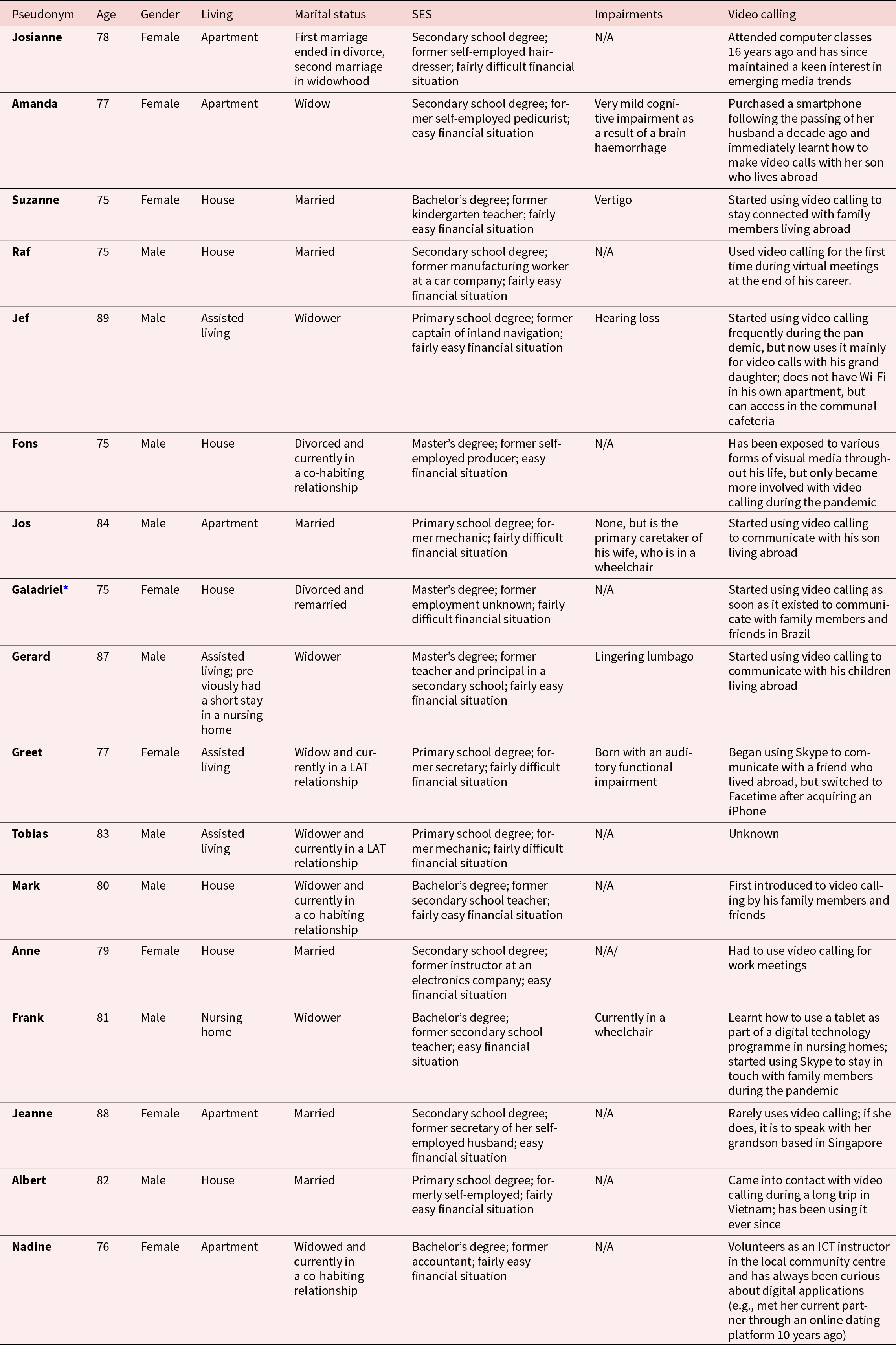
Notes: Living = type of living arrangement of the respondent in question; SES = socio-economic status, with level of education, former employment and currently perceived financial status as proxies; Impairments = self-assigned physical, psychiatric and cognitive functional impairments; Video calling = how did respondents come into contact with and/or start using video calling?
* Galadriel migrated from Brazil around two decades ago to reside with her Belgian partner.
Data analysis
A grounded theory analysis was conducted based on 108 interviews with people over the age of 75 who had prior experience with video calling. Both epistemological and ontological reasons guided the decision to use grounded theory as the principal research method. First, in line with the approach of Glaser and Strauss (Reference Glaser and Strauss1967), the primary objective of this study was to generate theory that is specific enough to engage policy makers with an interest in the topic, while at the same time being sufficiently generic to be applicable to and in myriad contexts. This is of particular importance given the rapid evolution of digital technology. Second, grounded theory has been developed in response to the mismatch between social theory and research and is especially relevant in the context of social science research. In view of the additional aim of countering the ongoing fragmentation of research and theory concerning older adults’ social relationships, grounded theory was deemed a suitable approach (Levinger Reference Levinger, Erber and Gilmour2013; Delafontaine et al. Reference Delafontaine, Van Gasse and Mortelmans2023). Third, this study explores the meanings that people aged 75 and over ascribe to and derive from video-mediated interactions (Charmaz Reference Charmaz2010). The research team adopted a pluralistic approach, drawing on diverse theoretical perspectives and methodological approaches within the framework of grounded theory to inform their own interpretation of the method. On the one hand, they sought to adhere to the scientific rigour emphasized by Glaser and Strauss (Reference Glaser and Strauss1967) when introducing their constant comparative method. On the other hand, they applied Corbin and Strauss’s (Reference Corbin and Strauss1990) systematic coding procedures with a dynamic flexibility, as proposed by adherents of constructivist approaches to grounded theory (e.g. Charmaz Reference Charmaz2010).
After the interviewers had videotaped and transcribed the interviews verbatim, the fourth author integrated the data from the interview transcripts and the background questionnaire into a single analytical file (see Table 1). Following the methodology employed in prior studies that rely on extensive qualitative data sets (Van Gasse and Mortelmans Reference Van Gasse and Mortelmans2020a, Reference Van Gasse and Mortelmans2020b), the data were pre-coded in NVivo based on the questionnaire. The assignment of pre-codes enabled the first author, who bore responsibility for subsequent data analysis, to rapidly access specific subsets of the transcripts at later stages, thus facilitating a focused open-coding procedure of the primary data. During the open-coding phase, the first author coded the transcripts line by line, appending memos to identify similarities and differences between the codes and link them to the study’s sensitizing concepts. During the axial-coding phase, they created memos to connect and combine the codes that had emerged in the open-coding phase, reorganized the initial coding list and developed theoretical concepts. During the final selective-coding phase, the theoretical foundation for the results and discussion sections was established. In drafting preliminary versions of this article, the first author drew upon memos written during this final stage and supplemented them with transcript excerpts that illustrate the interconnections among the ideas expressed. Although the interviews were transcribed in Dutch, the translated fragments are presented in English throughout the results section.
Ethical considerations
Besides obtaining approval from the Ethics Committee for Social Sciences and Humanities at the University of Antwerp (approval number SHW_18_72), several other measures were implemented to ensure ethical good practice in this study. First, the objective of the interview instructions and guidelines was to protect both the students and the research participants from any potential risk and harm throughout the research process. To begin with, students were not permitted to interview their own (extended) kin for two main reasons. On the one hand, prohibiting students from conducting interviews with close family members could help them feel more at ease and less reluctant to ask personal questions. On the other hand, conversing with a (near) stranger establishes a safe space in which respondents are more willing to share sensitive information that they might not disclose with family members. Moreover, the interview guidelines developed during the pilot study consisted of several introductory questions that were specifically designed to reassure the interviewees. Students’ participation in an extracurricular workshop on interviewing practices and handling sensitive issues allowed for additional preparation pertaining to unforeseen circumstances in which necessity knows no law (Guillemin and Gillam Reference Guillemin and Gillam2004). Second, to safeguard the anonymity and confidentiality of respondents, students added transcriptions and background characteristics as pseudonymized cases using case classifications in NVivo. These pseudonyms were used throughout the results section. Third, all participants gave their informed consent and had the option to withdraw from the research at any time. In addition, they were given the opportunity to read and correct their transcript afterwards.
Results
This section seeks to develop a more advanced understanding of how video calling relates to older adults’ perceptions of psychological distance and closeness in informal encounters. The first part of the analysis examines how older adults define video-mediated communication, thereby unveiling five key properties that they attribute to this type of communication. The second part presents a discussion of the three main roles that video-mediated communication plays in older adults’ lives. The third part explores the relationship between older adults’ evaluations of their video-mediated interactions and the broader interactional contexts in which they are embedded.
Properties of video-mediated communication
The ensuing paragraphs delineate the five defining properties of the video-calling medium, as repeatedly identified by the participants in this study. The first three are properties towards which the respondents had positive or neutral feelings. The last two evoked more negative emotions in our respondents; they often included fear in their answers when talking about these properties or described them as annoyances.
Seeing and being seen
First, video calling can be described as a medium that allows people to see each other while talking. In this regard, respondents often compared the medium to the telephone. Emphasizing the added visual dimension that video calling brings, they discussed the emergence of the telephone as a tool for auditory communication, which for the first time made it possible to connect across distances.
I have known a time when [video calling] didn’t exist. … Say twenty years ago. … [Now] you can see each other, see how others react, which is nice … but it also means that you can easily tell when they are no longer interested in the conversation [laughs]. I also prefer [regular calls to video calls] in the morning, I don’t like people to see me when I get straight out of bed. (Josianne, 78 years old)
They considered the visual aspect of this form of communication to be richer than the auditory, but also reported a degree of unease with another person seeing them. However, the ability to perceive other people’s facial expressions, gestures and mimicry adds value to this form of communication.
Distances disappear
The second property that respondents described is the perceived disappearance of distance. Even though this property could also be attributed to telephones, they referred to video calling as the tool that makes it easier to stay in touch with distant relatives. Many participants in the study have family members and friends who live abroad, and the video-call software allows them to maintain contact with them. The interviews gave no insight into why regular landlines cannot facilitate this, but suggest that video calling’s visual aspect significantly lowers the threshold to call foreign relatives and friends. Moreover, respondents identified a discrepancy in costs between regular phone calls and video calls, although none of them mentioned that video calls were completely free.
It’s not so difficult to keep in touch [with my son who lives in Australia]. When I really need him, we simply Facetime. … The only thing you have to take into account is the time difference, but you get used to that. In the past, it was quite different. [International] phone calls used to cost a lot of money … but now that’s no longer a problem. He isn’t really gone for me anymore. He used to be gone, but now …. (Amanda, 77 years old)
Furthermore, the distance-reducing property of video calling was observed to manifest in a second form. Some respondents reported experiencing physical impairments and considered the video-calling software a valuable means of facilitating communication with friends without the need for in-person visits.
A quick and available medium
Expanding on the property of disappearing distances, the software’s ease of use is associated not only with physical space but also with the threshold for reaching out to and meeting people. Respondents reported being just a few clicks away from their loved ones. Some even mentioned that they were in touch with certain family members more often during the Covid-19 pandemic because contact with them was no longer limited to physical visits at specific times of the day or week.
My granddaughter can’t come over very often. She’s frequently away on weekends. … However, video calling makes it easy to stay in touch with each other. … I like the fact that you can really see each other. My granddaughter easily shows me her surroundings when she’s somewhere: ‘Here, grandpa, this is my room’, she says then. (Jef, 89 years old)
Even after the peak of the pandemic, participants found it easier to stay in touch using video calls. This was especially true when it came to their grandchildren, who were often absent during weekend visits but more easily accessible during the week. In this regard, respondents frequently stressed the value of the first property, seeing and being seen, in providing insights into their grandchildren’s lives (e.g. children could exhibit their home-made drawings using the camera).
A medium with a technical burden
Alternatively, the respondents regularly mentioned the technical aspects of using the software. Some described the learning curve for video calling as instantaneous because they already used computers and video-mediated communication when they were still working, but others referred to a long, steep learning curve with which they needed help quite often in order to get the software up and running.
The software’s technical side also interferes with the respondents’ ability to focus on the call itself. Some found the software challenging to use because it did not provide them with sufficient cues that they could use to assess social situations.
You don’t see the person you are talking to. You see an image, but that’s not the same … in particular because it is not three-dimensional, and if it became three-dimensional once, it would still not be the same. … It is more like a talking postcard, if anything else. (Fons, 75 years old)
The impact of potential distractions stemming from technological interruptions and shortcomings on the transmission of non-verbal cues and the attainment of co-presence is closely linked to respondents’ digital literacy and their attitudes towards digital technology. Respondents who possess sufficient digital skills, substantial familiarity with digital media and a positive outlook on technology are better equipped to filter out redundant information, remain undisturbed by technical features of the medium and maintain their focus on the conversation at hand. However, merely holding a positive view of technology or having adequate digital literacy does not suffice. For instance, despite Fons’ extensive experience with visual media throughout his career, as shown in Table 2, he still finds himself bothered by the technical aspects of video calling owing to his generally pessimistic view of communication technology.
A fraud-vulnerable medium
The last property of the video-calling software that the participants observed is that it is fraud-sensitive. Many interviews demonstrated a latent fear of the danger of phishing that comes with new technology, but some respondents also expressed their explicit concerns that malevolent individuals would invade their privacy while engaging in video-mediated communication.
I have not experienced any disadvantages, but they exist. Recently, a man whom my friend got to know online and whom she already fell in love with asked her for 6,000 euros, and I advised her against sending it. … She hesitated for a while, but eventually she didn’t, although she was heartbroken for a month after that; they spoke to each other via video call about four to five times a day. (Josianne, 78 years old)
Whether respondents’ awareness of fraud-sensitivity disrupts the conversational flow of video-mediated interactions hinges on the extent to which they experience tech anxiety and, most importantly, their confidence in navigating potential privacy and data breach concerns successfully. The emotions elicited by video calling’s fraud-sensitivity depend on respondents’ attitudes towards and understanding of the internet and digital technology. Aspects driving the evaluation of video-mediated interactions, such as perceived safety, technological optimism and digital know-how, which are partly shaped by respondents’ past digital experiences, aid them in focusing on their interaction partners and the ongoing conversation. Conversely, the lack of one or more of these elements may trigger worry and concern, ultimately detracting them from their enjoyment of video-mediated interactions and hindering their ability to fully immerse themselves in the moment.
Roles of video-mediated communication
The older adults in this study assigned three distinct roles to video-mediated communication within their broader interactional contexts. First, interviewees mainly recognized that their close ones might be unable to engage in the desired amount of interaction, and subsequently regarded video-mediated communication as a means of achieving their desired level of contact whilst sacrificing minimal quality in their communication. Second, respondents viewed video-mediated communication as a means of enhancing the number of social contacts and fostering a diverse and well-formed interaction pattern. Third, they considered video-mediated communication a replacement for in-person interactions with their close ones. The following section illustrates that older adults may perceive video-mediated communication to fulfil a supplementing, a complementing or a substituting role, depending on how they position their video-mediated contacts relative to their in-person contacts.
Video-mediated communication as a supplement
The first narrative extracted from the interviews demonstrates video-mediated communication’s supplementing role. According to these interviewees, engaging in a video-mediated conversation with kin, peers and close ones mainly adds to their in-person encounters without reducing the quality of these interactions.
It’s a supplement. It doesn’t have a very large right to exist … although it’s a great addition and I am happy to participate. … I prefer to receive or visit people physically, but it’s not always possible. … When my great-grandchild became five, it was really nice to be able to see her from a distance. Her parents work very hard … and it’s not always easy to pick a date to meet them, but thanks to these tools, with pleasure. (Jos, 84 years old)
From this perspective, respondents typically showed a high level of understanding of and sensitivity towards their surroundings. They contended that their communication partners would not be able to visit them as much in real life. Therefore, they implied, or even asserted, that video-mediated communication allows them to maintain greater contact with their kin, peers and/or significant others who reside elsewhere, thereby enabling them to integrate them into their daily lives more easily.
I have friends here but also in Brazil, so I use various sorts of contact. … I’d like to meet people with coffee, tea, at home, or in a cosy restaurant … but I can’t expect that from all of my friends. If my Belgian friends would want to video call instead of meeting up, I wouldn’t do so, but for my Brazilian friends, it’s the only way to see each other. (Galadriel, 75 years old)
Although interviewees addressed increased opportunities for social interaction, they also stressed that the video-mediated reality rarely enhanced the quality of their interactions or their felt closeness in relational bonds. This suggests that video-mediated communication can mainly take a supplementing role when a close relationship has been established prior to the video-mediated contact.
Video-mediated communication as a complement
The second role that respondents attributed to video-mediated communication is that of a complement. According to them, video-mediated communication not only increases contact but also enhances the quality of social relationships with significant others, making it an integral aspect of their interactive actions. For this group of respondents, the video-mediated reality satisfies their need to build and nurture profound emotional connections with family members and loved ones, which would be impossible without access to this medium.
I only see her [his daughter living in Egypt] once or twice a year, so the only contact we have is by means of Skype. Still, I would call our Skype sessions rather intense. We do it almost every day. It really matters. She is not able to support me in a material way, but psychologically, we have – well, we often have a good talk with each other. (Gerard, 87 years old)
These respondents considered video-mediated contact a form of social interaction in its own right that helps them maintain their network and approach their social world as a combination of types of interaction in which in-person contact and video-mediated contact coexist and contribute to their overall interaction patterns. As Greet (77 years old) said,
I live alone, but I am not lonely. I get out to be around people, I can make phone calls or send them emails, engage in FaceTime with them. … If necessary, you can even knock on people’s doors’.
Greet, like many respondents who appreciate video calling’s complementary aspects, tends to cast her social world, as well as properties of video calling and other forms of digital communication, in a positive light. She holds a firm belief in the plethora of socializing options, whether online or offline. This conviction is rooted in her strong trust in neighbours and peers, her satisfaction with her current social circle and network position and her absence of concern about social isolation, which collectively create an environment conducive to fully realizing the potential of video calling in bridging psychological distance.
Video-mediated communication as a substitute
A third role of video-mediated communication is that it can act as a substitute for in-person communication. Respondents who ascribed this role to video calling perceived it as a replacement for in-person contact, resulting in negative affective responses. Older adults mainly reported a decline in the quality of contact, despite the number of their interactions remaining the same or even increasing. Additionally, they voiced concerns that virtual interactions may replace their in-person contacts sooner rather than later.
What bothers me is that you don’t see them as often. … I mean, it’s so easy. You receive a [video] call from your granddaughter, and she’s telling, ‘Hey, Grandpa! It’s been a while, how is everything?’ And we’re all happy to be called … but would they pass by? When do we really see them? For them, seeing Grandpa on the tiny screen is enough for three weeks, and that’s difficult. (Tobias, 83 years old)
Whereas the supplementing and complementing roles allow for a positive interpretation of video-mediated interactions, the substituting role does not. Respondents referred to unfulfilled social needs that were grounded in the perception that video calling simply did not evoke the same impressions or feelings as in-person contact, and they claimed that certain aspects of in-person contact could never be replicated by video calls. Mark (80 years old) commented,
Oh, I do not feel anything when I’m [video calling]. I just have to do it, or I want to do it so … I just do it. I do not have any feelings in particular when I do it’.
Similarly, Anne (79 years old) said, ‘It’s really cold. It’s an image. … You see an image. During [in-person interactions], you surely feel the warmth. [Video calling] is just television to me’.
When video calling serves as a substitute for in-person communication, older adults may deem specific features of the video-calling experience to compromise their sense of co-presence, the sense of being together with their online interaction partners ‘here and now’. They view this lack of co-presence as a barrier to the effectiveness and quality of video-mediated communication. Some interviewees articulated that video-mediated contact seemed more like a staged act than authentic interaction.
[Video calling is] more made up than real encounters. I do see that they are acting rather than being themselves, even if they are good friends. They are not like they’re used to. It’s like they want to act ‘right’ because they are being filmed. You know what I mean? Real-life contact is more natural. (Mark, 80 years old)
Respondents such as Mark, who view video calling as a substitute for in-person interactions, may struggle to appreciate the visual dimension it adds to regular calling. This difficulty stems from a lack of trust in their interaction partners and their authenticity, which leads them to focus on the aspects of video calling’s ‘seeing and being seen’ property that highlight its shortcomings compared to in-person interactions, rather than contributing to a forgotten presence of the medium. As a result, respondents may perceive video calling as deceitful, which can hinder their ability to experience warmth and closeness during video-mediated interactions.
Aspects driving the evaluation of video-mediated communication
The three roles that participants attributed to video-mediated communication suggest that older adults assign a particular value to this mode of communication. This section examines several aspects that drive the evaluation of video-mediated reality. These drivers can be categorized into four distinct dimensions: the emotional, relational, network and cognitive dimensions.
The emotional dimension
First, it is worth noting that older adults’ assessments of video-mediated interactions often stem from their emotional state and, more specifically, from isolation anxiety. A recurring theme in the interviews regarding the substituting role of video-mediated communication was the fear of exclusion and loss of contact. These concerns prevented individuals from fully embracing video-mediated experiences and undermined the sense of closeness and warmth they felt during these interactions, setting in motion a vicious cycle that drove a further wedge between them and their interaction partners.
Digital media have made our contacts more superficial. We just stay inside and don’t know our neighbours anymore. … In the past, people lived more as a community. … That had its good and its bad aspects, but nowadays people just live their own lives and … have less and less time for each other. … It is a sad reality that many people are living in loneliness, with no one to look out for them. … You don’t want to end up like that. (Frank, 81 years old)
In contrast, respondents who exhibited minimal isolation anxiety, such as Greet, held favourable views of their interactions in both online and offline settings and expressed less concern about video calling potentially endangering their in-person connections compared to those who fear social isolation. They described feeling well-connected to their social circle and environment and demonstrated confidence in their ability to seek support from and rely on their interaction partners during challenging times.
The relational dimension
The relational dimension involves individuals’ trust in their peers and close ones. Older adults who perceived video-mediated contact as a substitute for in-person contact experienced greater difficulties in trusting the aforementioned parties to respect their need for physical contact. They admitted to harbouring doubts about their interaction partners’ decision to opt for video calls instead of in-person visits, expressing suspicion about their underlying motives. Consequently, they described video-mediated interactions as insincere, deceitful or even threatening. Conversely, those who appreciated the complementing or supplementing values of video-mediated contact during their daily interactions displayed greater trust in their peers and close ones. These respondents articulated the view that their interaction partners had valid reasons for choosing video calls over in-person visits, acknowledging and respecting their choices. Moreover, they regarded their peers’ efforts to maintain communication via video calls as valuable and indicative of their commitment to the relationship.
The network dimension
The network dimension, or the perceived proximity of older adults with respect to other actors in their interactional networks, can also affect the interpretation of video-mediated communication. Three distinct types of perceived closeness have been identified. The first is geographical proximity, which refers to the physical distance between two network actors. The second, relational proximity, pertains to the emotional closeness between two individuals within a relational dyad. The third is generational proximity, which reflects age-related closeness. Further analysis revealed that the more distant interaction partners were perceived to be, the higher the value placed on video-mediated communication’s complementary and supplementary aspects.
If my grandson – he lives in Singapore – did not have a smartphone, I wouldn’t be able to see him or stay in touch since calling is very costly without Wi-Fi. I’ve had this experience before when my daughter lived in Rome and mobile phones were not yet invented. … As a parent, you just had to accept hearing each other less than you’d like. (Jeanne, 88 years old)
Geographical distance and generational distance were found to be more important than relational distance in determining the roles that older adults attributed to video calling. In general, older adults held more favourable views of video calling when communicating with grandchildren living abroad. In contrast, their views of video-mediated communication were less dependent on relational distance. Although respondents were generally more inclined to ascribe supplementing or complementing roles to video-mediated communication when dealing with friends and relatives to whom they were less emotionally attached, they did not necessarily consider it a substitute for in-person contact during interactions with close and intimate network actors. This may be because, regardless of whether the communication is mediated or not, people tend to perceive network actors as closer in time and space when they have already established a trustful and intimate bond prior to the conversation.
The cognitive dimension
The cognitive dimension includes technological optimism, which encompasses older adults’ technological know-how and their favourable outlook on digital media and its societal role. The interviews indicated that being tech-savvy alone does not guarantee a positive evaluation of video-mediated communication. Despite demonstrating considerable technological expertise, some participants nevertheless articulated concerns pertaining to the manner in which technology modifies social interactions. Similarly, a favourable disposition towards digital technology does not necessarily correspond with a positive evaluation of video calling. This is because, at least in the sample under examination, a positive outlook on technology was insufficient to ensure that older adults would be capable of operating the technology independently. Therefore, technological optimism can be considered a two-dimensional attribute that significantly shapes the interpretation of video-mediated communication: The presence of technological optimism possibly promotes a favourable appraisal of video-mediated communication, whereas its absence may cultivate a more negative evaluation of video communication as a substitute for in-person communication.
There lies a certain danger in continuously walking around with their cell phones … eventually seeing each other frequently indeed. However, the question is: what do they exactly see in those instances? They don’t see themselves, they don’t see others. … I don’t put any effort in [video-mediated contact]. … Physical contacts are timeless; modern human beings need them as badly [as our predecessors]. I actually think that these new types of technology undermine our [physical contacts]. (Fons, 75 years old)
Similar to his aforementioned emphasis on video calling’s two-dimensional nature and its fundamental distinctiveness from in-person contact, Fons once again conveyed a pessimistic outlook on digital technology in general and video calling in particular. These precognitions prompted him to evaluate the properties of video calling in a more negative light and regard it as a mere substitute for in-person interactions. Furthermore, Fons acknowledged the minimal effort he had invested in his video-mediated interactions. This minimal investment may have reinforced his unfavourable views, given that minimal input, attention and focus during video-mediated interactions have the potential to disrupt the conversational flow, thereby eroding co-presence and increasing psychological distance. Hence, his case serves as a poignant illustration that possessing technological know-how alone is insufficient to overcome general distrust of the medium and perceptions of unsafety.
Aspects arising from the intersection of dimensions
Building upon the observation that older adults form appraisals of video-mediated communication based on the interplay of dimensional components, three additional elements can be put forward: the perception of safety, the awareness of the self within the relational network and the in-person baseline of contacts.
The fifth aspect, the perception of safety, lies at the intersection of cognition and emotion. The older adults who participated in the present study demonstrated a high regard for their personal safety and exhibited a tendency to overlook positive (complementary or supplementary) qualities of the video-calling medium when faced with perceived safety risks. Technological know-how and trust in the medium, coupled with the perceived safety risks of physical contact, act as key determinants of this safety perception. Accordingly, respondents argued that video-mediated communication and in-person communication can be intrusive in different ways. Although in-person communication involves the act of opening up personal space to others, there is a clear delineation of boundaries. Video-mediated communication may be regarded as more invasive than in-person communication owing to the perceived possibility of being contacted at any time and its greater potential to breach boundaries, regardless of whether such transgressions are actual or perceived.
An advantage [of video calling] is that people can reach you and talk to you when you are not home. The disadvantage is that people know where to find you and can reach you anywhere. It’s an amazing benefit when you are doing business, but on other occasions it can be a nuisance. (Albert, 82 years old)
At the point where the network and emotional dimensions intersect, the sixth aspect to consider is the awareness of the self within the relational network. Interviewees who displayed behaviours related to isolation anxiety perceived themselves to be situated in the margins of their social networks, rendering them susceptible to feelings of isolation. In contrast, respondents who perceived themselves as a focal point within their relational networks have been observed to establish high expectations for their everyday interactions. A more nuanced understanding, in which older adults considered themselves an integral part of their social networks, while at the same time comprehending the complexities and demands of their interaction partners, facilitated recognition of the complementary and supplementary benefits of video-mediated communication.
For my cousins, I am the odd aunt. Maybe that goes a little far, but I appreciate them calling, to be honest, even though I know it might be just out of respect. I know what my position in the family is, and I value the attention I get from them while I might expect more from others. (Nadine, 76 years old)
The in-person baseline of contacts that older adults experience is the seventh aspect driving their evaluation of video-mediated communication and lies at the junction of the emotional, relational and network dimensions. Those who reported a quantitative lack of real-life contact were more likely to fear being left out, which suggests a relationship between the in-person baseline and isolation anxiety. Whereas the in-person baseline can be considered an objective gauge of one’s actual in-person contacts, isolation anxiety is the emotional component connected to people’s social and emotional needs and their responses when those needs are unmet.
Discussion
The findings presented in this article illuminate video-mediated communication’s complex position in the daily lives of older adults of advanced age. To elaborate further, the findings, derived from 108 interviews conducted with individuals aged between 75 and 99 years, indicate that these older adults have mixed interpretations and evaluations of the properties and impact of video-mediated interactions with their kin. They view video-mediated communication as a practical means to achieve visual contact in addition to phone calls, which only allow for audio communication. Furthermore, they describe it as an easy and cost-effective way to communicate over (sometimes vast) distances and a quick and always available means of contact with loved ones. However, they also mention some disadvantageous properties. Installing and using the software may pose challenges for older adults who are unfamiliar with technology; they require a learning curve to effectively interpret conversational cues during video-mediated interactions. Thus, video-mediated communication appears to provide a clear sense of presence (imagined closeness in time and space) and immediacy (the feeling of being in direct contact) but can only establish social co-presence if older adults have acquired the skills to interpret video-mediated cues correctly and to effectively alleviate privacy and security concerns.
The findings indicate that certain properties of video-mediated communication may effectively transform it into a practical, problem-solving tool and are beneficial in bridging geographical, relational and psychological distances between older adults over the age of 75 and their relatives. This is particularly valuable in light of the increased prevalence of health-related issues, reduced mobility and activity levels (Hawkley et al. Reference Hawkley, Buecker, Kaiser and Luhmann2020; Delafontaine et al. Reference Delafontaine, Van Gasse and Mortelmans2023) and the greater geographical distances to younger family members faced by this demographic (Dickinson and Hill Reference Dickinson and Hill2007). In this regard, the disappearance of distances is a crucial property. In ideal circumstances, video-mediated communication aids older adults in experiencing co-presence in their interactions with distant family members and friends, thereby complementing their daily lives (Zamir et al. Reference Zamir, Hennessy, Taylor and Jones2018). Previous research on the use of digital communication technology among older adults supports the hypothesis that, under certain favourable conditions, this type of technology may prove advantageous in enhancing the wellbeing of older adults and enriching their social lives, particularly among individuals over the age of 75. Drawing on a sample of 1,201 participants who were at least 50 years old and living in Hong Kong, Fang et al. (Reference Fang, Cak, Anna, Fh and Woo2018) compared the impact of digital communication technology on psychological wellbeing among three distinct age groups: individuals between the ages of 50 and 59, individuals between the ages of 60 and 74 and individuals aged 75 and over. They found that only for the latter group, more frequent use of digital technology was associated with better psychological wellbeing and more opportunities for social interaction with family members. However, these age-related gains in information and communication technology (ICT)-induced wellbeing were observed only among individuals over the age of 75 who were identified as ‘frail’ in terms of physical limitations and mortality. Moreover, the use of digital technology among older adults aged 75 and over was not associated with greater opportunities for social interaction with friends and neighbours. Nonetheless, these findings suggest that digital technology may be particularly helpful in compensating for the age-related losses and mitigating mobility-related obstacles faced by this specific subgroup of older adults aged over 75 (Fang et al. Reference Fang, Cak, Anna, Fh and Woo2018). In addition, the results imply that mediated communication’s effectiveness in boosting older adults’ opportunities for social interaction heavily depends on the emotional and social needs that their interaction partners in mediated communication fulfil (Bonsaksen et al. Reference Bonsaksen, Thygesen, Leung, Ruffolo, Schoultz, Price and Østertun2021; Fang et al. Reference Fang, Cak, Anna, Fh and Woo2018). Additional findings based on a mixed-methods study conducted in the UK by Hardill and Olphert (Reference Hardill and Olphert2012) indicate that older adults who experience spatial contraction owing to mobility challenges and kin living far away may benefit greatly from digital technology to overcome geographical distances if they are willing to invest the time and effort required to master the technology, often with the help of younger relatives, and hence succeed in fully integrating the communication technology in their everyday social lives. Nevertheless, it should be noted that these previous research endeavours predominantly pertain to the effects of digital technology use in general, and not so much to video-calling use specifically, on older adults’ wellbeing and social lives. Moreover, because these studies also included participants who did not use digital technology in their daily lives and were not confined to older adults of advanced age with prior experience with digital technology, they did not provide insights into how members of this specific demographic who regularly use digital technology to communicate with loved ones differ in their perceptions and interpretations of (video-)mediated technology that either enable them to benefit or hinder them from benefiting from such technologies for purposes of social interaction and connection.
Given the narrower scope of the present study, this article adds multiple layers to previous research conducted in the area. First, this study did not focus on the efficacy of digital technology use in general but was limited to the efficacy of video calling in bridging perceived distances between individuals aged over 75 and their interaction partners. Second, the study only included members of this age bracket who had prior experience with video calling. The resulting findings demonstrate that while not all older adults rely heavily on this medium, the perceived benefits of modern communication technology vary according to the roles older adults attribute to it. When older adults view video-mediated communication as a substitute for in-person contact, rather than a supplement or complement, it negatively affects the quality of their video-mediated interactions and their ability to achieve co-presence and a sense of immediacy during these interactions, hindering social co-presence and preventing the video-calling medium from effectively bridging psychological distance. Evaluation of the emotional, relational, network and cognitive dimensions provides further insights into the advantages and limitations of video-mediated communication, which shape the extent to which individuals over the age of 75 can fully benefit from the medium’s distance-reducing potential and perceive closeness during their video-mediated interactions as a result. Especially when perceived as a substitution for in-person contact, video-mediated communication instigates isolation anxiety and raises concerns that the need for physical, in-person contact will not be fulfilled, as Van Dijk (Reference Van Dijk2020) observed. Some older adults also expressed broader concerns about the increasing replacement of ‘real contact’ by technology-based communication. Nevertheless, given that social isolation and a lack of high-quality social interactions are significant contributors to loneliness and mental health issues among individuals aged 75 and above (Delafontaine et al. Reference Delafontaine, Van Gasse and Mortelmans2023), the implementation of video-mediated communication devices could prove vital in improving their quality of life, promoting mental health and reducing feelings of loneliness.
The findings presented corroborate those derived from previous studies on video-calling use in older adult populations. Based on qualitative in-depth interviews with UK-based individuals over the age of 65 who had access to and made regular use of social technology, including video-calling applications, Wilson et al. (Reference Wilson, Gates, Vijaykumar and Morgan2021) concluded that, only under certain conditions, these technologies assist older adults in maintaining meaningful relationships and staying connected to friends and family, but that, in other circumstances, these technologies may exacerbate loneliness and social withdrawal. Their findings further suggest that older adults are less likely to reap the benefits of social-technology use and fall prone to loneliness if they are less familiar with digital applications, worry about their privacy and security and perceive themselves to have little choice in the matter, expressing beliefs that mediated interactions are forced upon them by their social environment, or that offline social interactions are simply not an option for them. Alternatively, their results show that older adults are more likely to take full advantage of the connecting properties of social technology when using it to increase the frequency of communication with family and friends with whom they often engage in offline social interactions as well, to maintain contact when homebound owing to mobility issues or care-giving responsibilities, or to communicate with geographically distant kin, especially when the latter live abroad (Wilson et al. Reference Wilson, Gates, Vijaykumar and Morgan2021). Although Wilson et al. (Reference Wilson, Gates, Vijaykumar and Morgan2021)’s analysis of the visual aspects of social technology pertains to multiple forms of online visual communication, including the exchange of photographs, and goes beyond video-calling applications, their discussion also incorporates older adults’ positive and negative views of video calling’s visual dimension. Whereas older adults in their sample shared that video calling, by conveying crucial visual cues such as body language and facial expressions, provides opportunities for social interaction that are most similar to being together in person, other respondents expressed that video calling’s inherent visual properties made them self-conscious and worried about how they looked on screen (Wilson et al. Reference Wilson, Gates, Vijaykumar and Morgan2021).
Likewise, Moyle et al. (Reference Moyle, Jones, Murfield and Liu2020) identified both benefits and medium-specific obstacles of video-mediated communication in their mixed-methods study on the video-calling experiences of Australian nursing home residents. While video-mediated communication enabled the participants in their study to hear and see friends and family members that they would have been unable to hear and see otherwise owing to ill-health, respondents also indicated that, because of a lack of familiarity with the medium, video calling was difficult to use without the assistance of staff and family members. Moreover, they articulated concerns about privacy and security issues, as well as discomfort with the visual aspect of video-calling software that made them feel watched and controlled by their interaction partners (Moyle et al. Reference Moyle, Jones, Murfield and Liu2020). Nevertheless, it is important to note that, despite their relevance in highlighting the crucial role of contextual factors in shaping older adults’ perceptions and interpretations of video calling’s medium-specific properties, both studies failed to elucidate how these perceptions and interpretations of video calling’s properties are precisely shaped by specific attributes of the broader interactional contexts in which older adults are embedded, especially when it comes to individuals aged above 75. While providing a deeper understanding of how medium-specific properties of several types of social technology and older adults’ broader circumstances drive their assessments of these technologies, Wilson et al. (Reference Wilson, Gates, Vijaykumar and Morgan2021), besides solely considering the visual properties of video calling, paid minimal attention to how specific aspects of their respondents’ circumstances affect the myriad ways in which they position video-mediated interactions within their social lives as a whole. Moyle et al. (Reference Moyle, Jones, Murfield and Liu2020), on the other hand, did explicitly examine video-calling experiences among individuals over the age of 75, but the results of their action-based mixed-methods research drew on a sample of only six individuals residing in a long-term-care facility.
Given the aforementioned considerations, we concur with Goodman-Deane et al. (Reference Goodman-Deane, Mieczakowski, Johnson, Goldhaber and Clarkson2016) that video-mediated communication possesses properties that have the potential to diminish perceived distance from loved ones but also recognize the importance of the contextual factors and the specific attributes associated with the circumstances of individuals aged 75 and above, as opposed to those of older adults of younger ages, in shaping their interpretations of video-mediated communication (Van Dijk Reference Van Dijk2020). Research undertaken previously in Norway, the United Kingdom, the United States and Australia during the Covid-19 pandemic by Bonsaksen et al. (Reference Bonsaksen, Thygesen, Leung, Ruffolo, Schoultz, Price and Østertun2021), mentioned before, has already drawn attention to the age-related diversity in video-calling use and in the medium’s effectiveness in mitigating loneliness, underscoring the importance of also considering age-related differences in video-calling experiences within the overall older adult population. Their findings indicate that older adults below the age of 70 are more likely to benefit from video-mediated communication by using it in ways that serve their needs for connecting with close ones, as evidenced by lower levels of loneliness and a higher quality of life, than older adults of at least 70 years old. The absence of a significant protective effect of video-mediated technology among participants of the latter age group was argued to be attributable to their potential disregard for the value of the video-calling medium, as well as their tendency to use it rather passively, for instance by waiting for family members to video call them instead of initiating video-mediated contact themselves (Bonsaksen et al. Reference Bonsaksen, Thygesen, Leung, Ruffolo, Schoultz, Price and Østertun2021). While Bonsaksen et al. (Reference Bonsaksen, Thygesen, Leung, Ruffolo, Schoultz, Price and Østertun2021) provide convincing explanations for the apparent lack of significant associations between the use of video-mediated technology and wellbeing among individuals over the age of 70 who participated in their survey, their analysis lacks a comprehensive examination of the underlying mechanisms that empower or impede individuals of advanced ages in successfully navigating medium-related challenges and in overcoming perceived distance during video-mediated interactions.
This article contributes to the extant body of knowledge by elaborating in greater detail on the specific challenges that individuals aged 75 and over encounter during their video-mediated interactions, as well as identifying the prerequisite conditions that empower them to navigate these challenges effectively. The findings of the present study have demonstrated that older adults appreciate video-mediated communication solely when they perceive distance between themselves and their network partners or when it is accompanied by a solid base of in-person contact. Furthermore, ideally, older adults possess sufficient digital proficiency and familiarity with video calling to competently mitigate certain shortcomings of the medium, including technological disruptions and privacy and safety concerns. Only in those instances, participants in our study attributed a complementing or supplementing role to video-mediated communication. Consequently, it is important to consider both the benefits and the drawbacks of video-mediated communication devices in mental health interventions. Although certain situations, such as the Covid-19 pandemic, have brought attention to the usefulness of this technology, older adults may perceive it as a deceptive replacement for in-person interactions, which could, in turn, trigger isolation anxiety (Yuan et al. Reference Yuan, Hussain, Hales and Cotten2016; Berenguer et al. Reference Berenguer, Goncalves, Hosio, Ferreira, Anagnostopoulos and Kostakos2017). The impact of contextual factors on how older adults position video-mediated communication within the broader context of their social lives sheds light on why research on the effectiveness of video calling in reducing loneliness among older adults has yielded inconclusive results (Noone et al. Reference Noone, McSharry, Smalle, Burns, Dwan, Devane and Morrissey2020; Naudé et al. Reference Naudé, Rigaud and Pino2022). Further research is required to gain a more comprehensive understanding of the relationship between video calling and feelings of loneliness (Hajek and König Reference Hajek and König2021), particularly among older adults of advanced age (Bonsaksen et al. Reference Bonsaksen, Thygesen, Leung, Ruffolo, Schoultz, Price and Østertun2021).
Given that this article has repeatedly highlighted the significant role of contextual factors in shaping how individuals aged over 75 interpret video calling’s medium-related properties, and perceive distance or closeness in their video-mediated interactions as a result, it should be emphasized that our research has been conducted in Flanders, the northern, predominantly Dutch-speaking region of Belgium. Despite comparable outcomes of macro-processes, policies and demographic trends across Europe, compelling older adults to adopt and use digital technology, particularly in the post-pandemic era, such as increased geographical distances from their relatives (Mulder and van der Meer Reference Mulder and van der Meer2009; Gruijthuijsen et al. Reference Gruijthuijsen, Nweke, Vanneste, Schrenk, Popovich, Zeile, Elisei, Beyer and Ryser2022) and the digitalization of public services (Victor et al. Reference Victor, Scambler and Bond2008; Van Dijk Reference Van Dijk2020), substantial variations persist within Europe regarding the manner in which older adults use these technologies and the extent to which they integrate them into their daily social lives. Belgium’s cultural, linguistic and ideological heterogeneity, reflected in the complex structure of its federal state, renders it a noteworthy case study for examining the dynamics among micro-, meso- and macro-level factors that shape the adoption and use of digital technology. Such a case study may offer international scholars a valuable opportunity to deepen their comprehension of the interplay among global processes of digitalization, the European Union’s targets and objectives for successful digital transformation in its Member States (European Commission 2022b, 2024a), the (sub)national policies developed to achieve these objectives (Government of Flanders 2019; FPS Economy Belgium 2023) and the socio-economic and cultural-historical specificity of the regions in which these digital policies are implemented (European Commission 2022a, 2024b). The subsequent subparagraphs will provide a concise discussion on digital-technology use among Belgian (older adult) citizens, with particular consideration of the distinct contexts of the subnational regions in which they reside. This will serve to illustrate the importance of incorporating country-level characteristics and developments into research endeavours concerning digital technology in Europe and other Westernized nations.
Cross-country comparisons demonstrate that Belgium performs better than most other European countries in terms of the intensity and frequency of use of several types of digital application among its older adult citizens, as well as their level of digital proficiency (König et al. Reference König, Seifert and Doh2018; Sala et al. Reference Sala, Gaia and Cerati2022; Eurostat 2024a; Eurostat 2024b; Eurostat 2024c). Despite room for improvement in the domain of connectivity infrastructure, Belgium is positioned well above the European average in the area of digital public services. Regarding the maturity of its e-health system, which facilitates nationwide access to electronic health records, Belgium has been found to outperform all of its fellow European Member States (European Commission 2024b). However, whether Belgian citizens decide to adopt and use these essential digital services is, to a certain extent, contingent on the subnational regions in which they reside. A recent survey conducted by Brotcorne et al. (Reference Brotcorne, Ponnet, Dedonder and Anrijs2024) indicates that the proportion of e-services users is substantially lower in Wallonia than in both Flanders and Brussels (i.e. 69 per cent in the former region as opposed to 81 per cent in the latter two). Flanders, the setting for the present study, has demonstrated notable superiority over other regions in Belgium in European rankings pertaining to digital public services. In 2023, the availability of digital public services for citizens in Belgium as a whole was 82.3 per cent, while in Flanders this figure was 89 per cent (European Commission 2024b). Consequently, Flanders occupies the sixth position within the European Union with respect to the provision of its digital public services (van der Linden et al. Reference Van der Linden, Dogger and Boerdijk2024).
The uneven distribution of e-services usage and adoption across subnational borders can be attributed to several factors. First, delays in fixed network upgrades in Wallonia following the recent acquisition of the primary Walloon cable operator, and the slower pace of 5G deployment in Brussels and Wallonia owing to regional disparities in radiation emission norms and issued licences, especially in Wallonia, have put Flanders in an advantageous position regarding digital connectivity and the ease of access to digital technology (European Commission 2022a, 2024b). Second, given the generally more favourable attitudes of Flemish citizens towards e-banking, e-health and e-government services compared to their southern neighbours, it is probable that the lower proportions of e-services users observed in Wallonia do not necessarily stem from the slower internet speeds and smaller service coverage on average, but rather reflect regional differences in attitudes and preferences towards digital essential services (Brotcorne et al. Reference Brotcorne, Ponnet, Dedonder and Anrijs2024). Third, Flanders has implemented numerous policies designed to encourage as many of its citizens as possible to go radically digital. By gradually dismantling physical offices that facilitate in-person services, replacing them with digital applications specialized in e-services, and financially incentivizing online purchases of public services, Flanders might place greater pressure on its older adult citizens to adopt and use these digital applications compared to its southern neighbours (Government of Flanders 2019; Pirhonen et al. Reference Pirhonen, Lolich, Tuominen, Jolanki and Timonen2020). In light of the regional differences previously delineated, it is imperative to acknowledge the potential influence of the Flemish context, within which the present study was conducted, on the views of its participants. Therefore, a certain degree of caution should be exercised when transferring the findings of this study to research, policy and practice in other regions, both within and beyond Belgium.
The present study also has several limitations that need to be addressed. Although the involvement of students in the data-gathering process was instrumental in obtaining a diverse and sizeable sample of interviews with older adults, thereby enabling a thorough investigation of video-calling experiences of individuals over the age of 75, it is important to consider the potential implications of this strategy on the quality and reliability of the data acquired. First, despite the implementation of several measures to reduce quality risks, such as fraud and lack of depth, there is no guarantee that interviews of inferior quality were not included. However, the vast amount of data collected enabled the main researcher to carefully select interviews based on their quality and richness.
Second, pairing students with older adults posed additional challenges. On the one hand, students experienced difficulties comprehending the various dialects spoken during the interviews. This may have hindered their ability to pick up on certain expressions, potentially interfering with the natural flow of conversation. On the other hand, it is possible that students had a priori assumptions about older adults that could have affected how the interviews were conducted. Nonetheless, in analysing the data, the main researcher predominantly encountered open-minded interviews in which older and younger individuals complemented each other in endearing and synergistic ways.
Lastly, given the rapid pace of technological change, research on digital technology such as video calling can quickly become obsolete. Consequently, the perspectives and challenges discussed in this article may alter significantly as soon as novel advancements in in-person communication, be it in the form of new devices or updates, enter the market. Alternatively, the difficulties that people aged over 75 face today may differ from the difficulties that the same age group will face a decade from now. Although this younger cohort may be more familiar with video calling as a medium, which would enable them to assess video-mediated cues and handle related technical problems and anxiety more proficiently, this does not ensure that they will not face difficulties when navigating novel communication technologies. Ongoing research into the barriers and opportunities that prevent or enable different age groups to make the most of new communication tools and software is therefore urgently needed.
Conclusion
This article focused on how adults over the age of 75 perceive the role of video-mediated communication in bridging spatial and psychological distance to members of their close networks. The findings revealed the complex and multifaceted role of video-mediated communication in the everyday lives of the age group in question. The study identified five properties of the video-calling medium and three potential roles of video-mediated interactions. Furthermore, the results indicated that the interplay of seven attributes across four distinct dimensions is crucial in determining how older adults evaluate video-mediated communication.
In conclusion, video-mediated communication can be beneficial for the mental health of older adults if utilized effectively. Given its capacity to foster perceptions of proximity and diminish psychological distance, this medium can assist in addressing the needs of individuals aged 75 and above who are separated from their close relatives owing to geographical and physical distance. Nonetheless, the positive aspects of video-mediated communication can be undermined by privacy and safety concerns and fear of substitution of in-person contact, which the older adults participating in this study consistently highlighted. In instances of substitution, older adults are left with what respondent Fons described as ‘the talking postcard’ and keep craving the warmth and more natural aspects of real-life contact.
Acknowledgements
First, the authors would like to express their sincere gratitude to the research participants, to the bachelor students in social sciences who conducted the interviews as part of a methodology course, and to Olivier Chandesais, the educational assistant who monitored the students at every stage of the data-gathering process. Second, the authors wish to extend their gratitude to the two anonymous reviewers and the (associate) editor(s) for their invaluable contributions and unwavering commitment to this manuscript throughout multiple revision cycles. It is to their credit that the quality of the manuscript improved substantially over time and that the resulting article aligns more closely with the scope and international readership of Ageing & Society.
Financial support
The present study was made possible through funding from Research Foundation Flanders (FWO) as part of the following Strategic Basic Research (SBO) projects: Family Solidarity 2.0 (grant number S002719N) and Digital Ageing (grant number S005221N).
Competing interests
The authors have no competing interests to declare.
Ethical standards
This study was approved by the Ethics Committee for Social Sciences and Humanities at the University of Antwerp (approval number SHW_18_72).


 Open access

