





Introduction
The scientific and medical community are increasingly recognizing both sex and gender as important determinants of health (Tannenbaum et al., Reference Tannenbaum, Ellis, Eyssel, Zou and Schiebinger2019). Briefly, sex is a biological variable determined by chromosomes, anatomy and hormones and typically classifies individuals as male, female or intersex. Most animal species and some plant species have biological sex, though not all (Johnson et al., Reference Johnson, Greaves and Repta2007). Gender, on the other hand, is a social construct defined by the roles, norms, behaviours and presentations typically viewed as ‘masculine’ or ‘feminine’ by a society. Gender encompasses an individual level in terms of how a person identifies themselves and the roles they occupy (gender identity and gender roles), as well as an interpersonal level in terms of how individuals interact with each other based on gender (gender relations), and a population level in terms of how a society is structured to enforce expectations and norms for men and women (institutionalized gender) (Johnson et al., Reference Johnson, Greaves and Repta2007). Definitions can therefore vary considerably by culture, and gender falls along a much wider spectrum than sex, though often is used to classify individuals as men/boys, women/girls or non-binary. As such, this term is typically only relevant to humans, for which a more in-depth understanding of culture and social norms is possible.
Both sex and gender impact an individual’s general lived experience in a myriad of ways, including risk and outcomes of communicable and noncommunicable disease, accidental injury, mental health or personal safety. In terms of factors relevant to parasitological research, sex hormones are known to impact host immunity (Taneja, Reference Taneja2018), resulting in differences between males and females in both prevalence and severity of a broad range of parasitic infections (Córdoba-Aguilar and Munguía-Steyer, Reference Córdoba-Aguilar and Munguía-Steyer2013; Schmid-Hempel, Reference Schmid-Hempel2021; Sellau et al., Reference Sellau, Hansen, Gálvez, Linnemann, Honecker and Lotter2024). Sex-related biological variables may also influence a host’s response to pharmaceutical interventions (Spoletini et al., Reference Spoletini, Vitale, Malorni, Rosano and Regitz-Zagrosek2012; Madla et al., Reference Madla, Gavins, Merchant, Orlu, Murdan and Basit2021). For parasites which have biological sex, sex may also influence their infectivity or virulence (Boissier et al., Reference Boissier, Morand and Moné1999) or resistance to drugs (Delves Michael et al., Reference Delves Michael, Ruecker, Straschil, Lelièvre, Marques, López-Barragán María, Herreros and Sinden Robert2013; Koopman et al., Reference Koopman, Houlder, Janse, Casacuberta-Partal, Lamers, Sijtsma, de Dood, Hilt, Ozir-Fazalalikhan, Kuiper, Roozen, de Bes-roeleveld, Kruize, Wammes, Smits, van Lieshout, van Dam, van Amerongen-westra, Meij, Corstjens, Jochems, van Diepen, Yazdanbakhsh, Hokke and Roestenberg2023).
Gender, on the other hand, may play a role in an individual’s likelihood of exposure to an infectious disease agent, or their ability to treat infection, due to differences in roles and norms which impact an individual’s behaviour. For example, employment in healthcare or service as well as domestic and caregiving responsibilities, which tend to be dominated by women, may make women more likely to be exposed to some infectious diseases or parasites (Sevilimedu et al., Reference Sevilimedu, Pressley, Snook, Hogges, Politis, Sexton, Duke, Smith, Swander, Baker, Gambhir and Fung2016; Heise et al., Reference Heise, Greene, Opper, Stavropoulou, Harper, Nascimento, Zewdie, Darmstadt, Greene, Hawkes, Heise, Henry, Heymann, Klugman, Levine, Raj and Rao Gupta2019; Lewandowski et al., Reference Lewandowski, Katarzyna and Magda2021), while outdoor or agricultural work may make men more likely to be exposed to others (Tolhurst et al., Reference Tolhurst, De Koning, Price, Kemp, Theobald and Squire2002; Heise et al., Reference Heise, Greene, Opper, Stavropoulou, Harper, Nascimento, Zewdie, Darmstadt, Greene, Hawkes, Heise, Henry, Heymann, Klugman, Levine, Raj and Rao Gupta2019). It has also been documented that men exhibit more risk-seeking behaviours and are less likely to adopt precautions around infection prevention such as handwashing, use of personal protective equipment, and others (Heise et al., Reference Heise, Greene, Opper, Stavropoulou, Harper, Nascimento, Zewdie, Darmstadt, Greene, Hawkes, Heise, Henry, Heymann, Klugman, Levine, Raj and Rao Gupta2019; Urbán et al., Reference Urbán, Paksi, Miklósi, Saunders and Demetrovics2021; Dias Sara et al., Reference Dias Sara, Brouwer Matthijs and van de Beek2022; Yan et al., Reference Yan, Howden, Mahar, Glidden, Garland and Oberoi2022). Once infected, women are often more proactive in health-seeking behaviour than men (Pinkhasov et al., Reference Pinkhasov, Wong, Kashanian, Lee, Samadi, Pinkhasov and Shabsigh2010; Thompson et al., Reference Thompson, Anisimowicz, Miedema, Hogg, Wodchis and Aubrey-Bassler2016), which may improve their outcomes by receiving treatment earlier, though this may not be the case in settings where women have less agency over seeking medical treatment, or experience greater shame or stigma around infections (Tolhurst et al., Reference Tolhurst, De Koning, Price, Kemp, Theobald and Squire2002; Heise et al., Reference Heise, Greene, Opper, Stavropoulou, Harper, Nascimento, Zewdie, Darmstadt, Greene, Hawkes, Heise, Henry, Heymann, Klugman, Levine, Raj and Rao Gupta2019). It has also been documented in some cases that women have poorer access to healthcare than men (Wagner et al., Reference Wagner, Graves, Fan, Walker, Zhang and Ross-Degnan2013; Heise et al., Reference Heise, Greene, Opper, Stavropoulou, Harper, Nascimento, Zewdie, Darmstadt, Greene, Hawkes, Heise, Henry, Heymann, Klugman, Levine, Raj and Rao Gupta2019; Tadiri et al., Reference Tadiri, Gisinger, Kautzky-Willer, Kublickiene, Herrero, Norris, Raparelli and Pilote2021a) and that due to unconscious bias medical providers often take women’s complaints less seriously than those of men, or have only been trained to recognize diseases in men, meaning women may be less likely to receive diagnoses or treatment (Govender and Penn-Kekana, Reference Govender and Penn-Kekana2008; Heise et al., Reference Heise, Greene, Opper, Stavropoulou, Harper, Nascimento, Zewdie, Darmstadt, Greene, Hawkes, Heise, Henry, Heymann, Klugman, Levine, Raj and Rao Gupta2019; Meidert et al., Reference Meidert, Dönnges, Bucher, Wieber and Gerber-Grote2023). For non-binary and other gender-diverse individuals, there is very little information about how gender and sex intersect to shape their risks and outcomes of infectious diseases, as most studies have used a binary definition of gender and these individuals are underrepresented in research. These complexities are why it is important to deepen our understanding of how gender-related and other social variables influence infection risk and outcomes when studying any parasite.
Parasites of the genital tract particularly highlight how both sex and gender interact to shape the risks and outcomes of an infectious disease. For example, Schistosomiasis haematobium, which causes urogenital schistosomiasis, infects both males and females and significantly contributes to the burden of disease in the tropics, particularly sub-Saharan Africa. Risk of contracting the disease may differ between men and women or boys and girls due to gender norms around contact with water. For example, in some cultures girls are more likely to be prevented from playing outside, particularly swimming or bathing, decreasing their risk of exposure compared to boys who participate in many activities including swimming, washing animals and fishing, which prolongs their contact with water (Senghor et al., Reference Senghor, Diallo, Sylla, Doucouré, Ndiath, Gaayeb, Djuikwo-Teukeng, Bâ and Sokhna2014). Similarly, women may be more likely to be responsible for household duties rather than fishing or farming, which are considered more masculine occupations, thus increasing the risk of exposure for men (Ayabina et al., Reference Ayabina, Clark, Bayley, Lamberton, Toor and Hollingsworth2021). However in areas without running water, the need to collect water as part of household duties may increase the risk for women (Senghor et al., Reference Senghor, Diallo, Sylla, Doucouré, Ndiath, Gaayeb, Djuikwo-Teukeng, Bâ and Sokhna2014). Pathology and symptoms differ by sex because this parasite infect the genitals. Infections lead to lesions caused by S. haematobium ova which are not excreted, and have been observed primarily in the seminal vesicles, prostate, testes and bladder in males, and causing haemospermia and haematuria (Kayuni et al., Reference Kayuni, Lampiao, Makaula, Juziwelo, Lacourse, Reinhard-Rupp, Leutscher and Stothard2019). In females, granuloma due to schistosome ova infections are often seen on the cervix, fallopian tubes and vagina, and other symptoms include itchiness, pain and abnormal vaginal discharge (Kjetland et al., Reference Kjetland, Kurewa, Ndhlovu, Midzi, Gwanzura, Mason, Gomo, Sandvik, Mduluza, Friis and Gundersen2008). It has additionally been shown that females infected with genital schistosomiasis may increase their risk of contracting HIV and other infections (Kjetland et al., Reference Kjetland, Leutscher and Ndhlovu2012), including other parasites of the genital tract, such as Trichomonas vaginalis (Aribodor et al., Reference Aribodor, Azugo, Jacob, Ngenegbo, Onwusulu, Obika, Obikwelu and Nebe2024). Delaying care can lead to more severe symptoms including infertility and bladder cancer (Kjetland et al., Reference Kjetland, Leutscher and Ndhlovu2012; Santos et al., Reference Santos, Santos, Gouveia, Bernardo, Lopes, Rinaldi, Brindley and Costa2021). Gender may also influence whether an individual seeks treatment due to attitudes and stigmas about the genitals. For example, girls were less likely to self-report infections with schistosomiasis, despite showing similar prevalence through microscopy to boys (Clements et al., Reference Clements, Barnett, Nyandindi, Lwambo, Kihamia and Blair2008). On the other hand, haemosperia in males may be overlooked as some cultures see this as a sign of maturity, rather than a symptom of infection (Kayuni et al., Reference Kayuni, Lampiao, Makaula, Juziwelo, Lacourse, Reinhard-Rupp, Leutscher and Stothard2019; Ayabina et al., Reference Ayabina, Clark, Bayley, Lamberton, Toor and Hollingsworth2021). Women may also live with infection for a long time without seeking care due to shame and similarities of symptoms to sexually transmitted infections (Kjetland et al., Reference Kjetland, Kurewa, Ndhlovu, Midzi, Gwanzura, Mason, Gomo, Sandvik, Mduluza, Friis and Gundersen2008, Reference Kjetland, Leutscher and Ndhlovu2012), and some people misunderstanding it as an STI (Mazigo et al., Reference Mazigo, Samson, Lambert, Kosia, Ngoma, Murphy and Matungwa2021). Low awareness of female genital schistosomiasis in some endemic communities may also prevent women from accessing appropriate care through misdiagnosis (Mazigo et al., Reference Mazigo, Samson, Lambert, Kosia, Ngoma, Murphy and Matungwa2021). Clearly, parasites of the genital tract exemplify why a sex and gender-based approach and an awareness and sensitivity to these factors is necessary for understanding and treating infectious diseases.
Many large funding bodies also now require applicants to specifically incorporate both the sex and gender dimension into their research (European Commission Decision, 2024). However, many if not most grant application calls include this requirement without providing the above definitions or much guidance for applicants on how to appropriately incorporate this dimension in their projects, or for evaluators to assess whether it has been accurately considered, with a notable exception being the Canadian Institute for Health Research (Canadian Institutes of Health Research, Reference Research2019). There is also little oversight or standardization in how this dimension is incorporated into studies or manuscripts, often resulting in confusion among researchers over this terminology, particularly around the definition of term ‘gender’ as distinct from sex (Tadiri et al., Reference Tadiri, Raparelli, Abrahamowicz, Kautzy-Willer, Kublickiene, Herrero, Norris and Pilote2021b). Due to the increasing recognition of the importance of incorporating the gender dimension into parasitological research, and this topic’s relevance to the current Parasitology special issue on parasites of the genital tract, a review of how the gender dimension has been incorporated into research in Parasitology thus far is timely. The purpose of this commentary is to provide an overview of where parasitologists, particularly those publishing in Parasitology, are in terms of incorporating the gender dimension into their research, and to provide further clarity to parasitologists on best practice moving forward.
Materials and methods
To determine how gender has been incorporated into parasitological research thus far, the entire online archives of the journal Parasitology were searched using a full-text search for the term ‘gender’ on 21 Mar 2025. A total of 355 entries were found using the term ‘gender’ within the full text (Figure 1). The citation information for all of them were downloaded into EndNote21. From there, 10 were identified as cover/front/back pages of the journal or ads and were removed from the EndNote Library. A total of 174 instances of duplicate citations were found using the ‘find duplicates’ feature and only one copy was kept, resulting in 258 retained citations which were exported to a csv. Full-text articles of these manuscripts using the ‘find full text’ function were then downloaded for scanning. For the rare cases where the find ‘full text function’ was unable to retrieve the article, the article was manually downloaded using the DOI and associated with the citation.
Flow chart of literature search and inclusion/exclusion of entries.

Full-text articles were searched for the instance of the word ‘gender’, as well as the type of article. Of the 258 retained citations, 68 were excluded as upon scanning they were found to not actually include the term ‘gender’ anywhere in the manuscript, rather this term was used only in the titles of references. Literature reviews and meta-analyses (15 total) were also excluded, as it would not be possible to determine whether all the papers that they included were correctly using the term, or whether the authors themselves were using it interchangeably with sex. The one case study yielded by the search was also excluded, as the sex and gender dimension would not be relevant to an n of 1.
The remaining 174 manuscripts were read for analysis. The parasite and host in the study were noted, as well as whether the term ‘sex’ was also used, and whether the term ‘gender’ was used to refer to the parasite or the host. Full texts were searched for the instances of the words ‘gender’, ‘sex’ and the contexts were read to determine whether the authors were referring to social variables (gender), or biological ones (sex), or if both terms were being used interchangeably. It was also noted whether sex/gender was actually incorporated in the analysis and results, either through reporting sex disaggregated results or through including sex/gender-related variables in multivariate models, and whether sex and/or gender differences were found.
Results
In general, the term ‘gender’ has been used in Parasitology since 1990, and its use has trended upwards over the past 35 years. This may correlate with an overall increase in publishing, but potentially also an increase in the recognition of the need to incorporate this dimension into research. However, a closer look reveals a confusion about how to correctly incorporate this dimension. Of the 174 original research articles that mention the term ‘gender’ in the full-text, 106 also used the term ‘sex’, in most cases interchangeably and incorrectly.
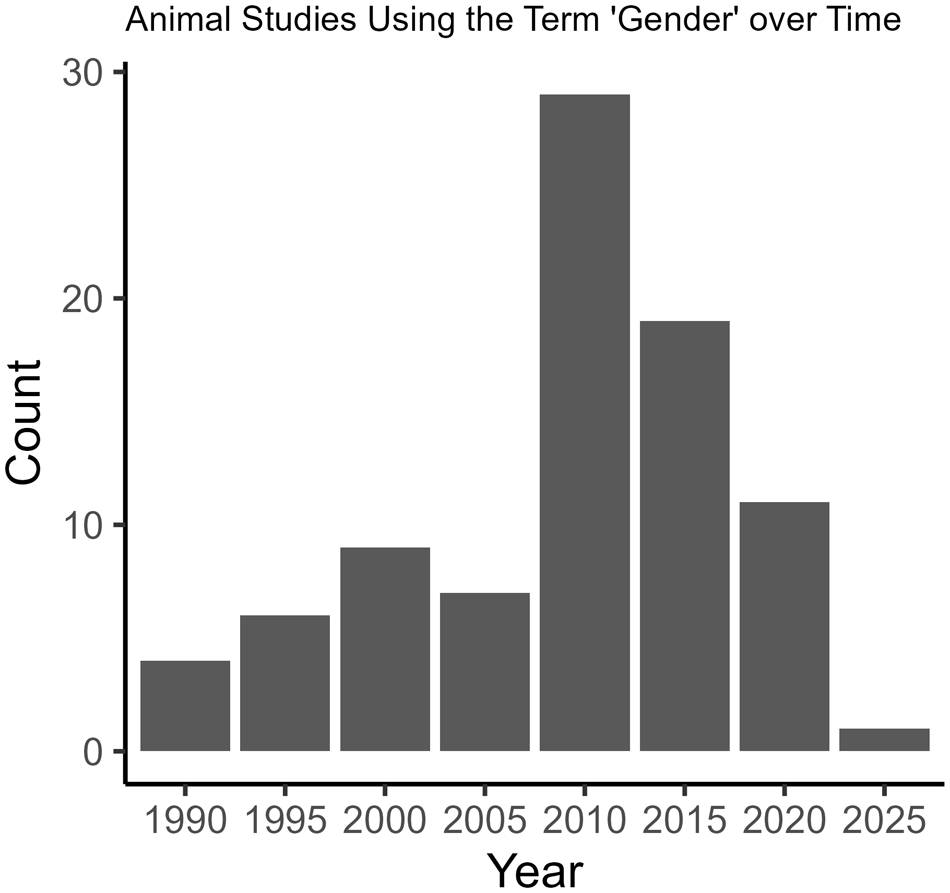
Most glaringly, 86 articles (49.4 %) were inappropriately using the term ‘gender’ to refer to the sex of an animal host, with an additional 13 (7.5 %) using the term to refer to the sex of a parasite in an in vitro study. In all, 32.6% of animal studies (28 out of 86) consistently only used the incorrect term ‘gender’ throughout, while the remaining 67.4% used both ‘gender’ and ‘sex’ interchangeably. Furthermore, 26.7% (23 out of 86) of these animal studies which used the term ‘gender’ (although they meant ‘sex’) failed to actually include sex in their analysis and results or to report sex disaggregated data beyond descriptive statistics of their study population. Of the 63 animal studies which did include sex in their analysis and report the results, 52.4% (33 out of 63) found a significant difference between males and females or an impact of sex on their response variables of interest, indicating the importance of always considering this variable. The remaining 30 specifically reported that no significant impact of sex or differences between males and females was found, according to best practice. Additionally, it does appear that incorrectly using the term ‘gender’ to refer to animals has been slowly trending downwards after a spike in 2010 (Figure 2). While not possible to ascertain with these data, this result could potentially reflect an increase in scientists correctly beginning to use both sexes of animals and look for sex differences between them in parasitological research (although getting the terminology wrong) and slowly shifting to correct terminology.
Bar plot of use of the term ‘gender’ to incorrectly refer to the sex of an animal (host or parasite) in Parasitology.

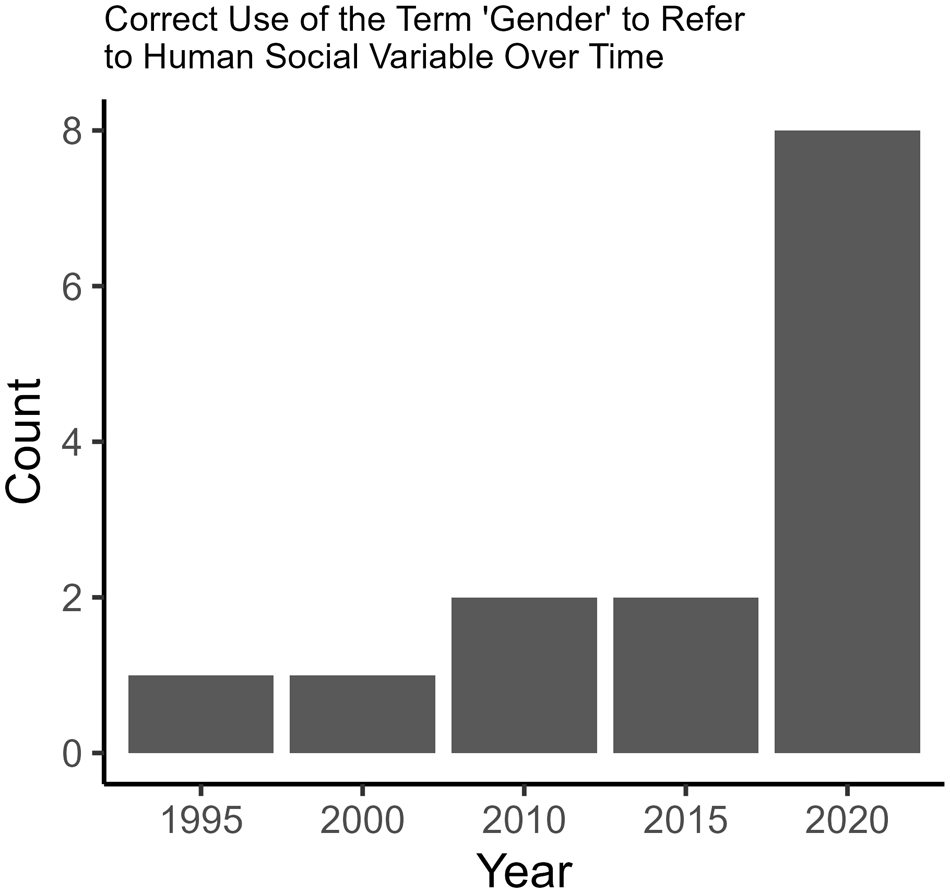
The remaining 70 studies used the term ‘gender’ to refer to humans, for which both a sex and a gender dimension are relevant. Of the human studies, 75.7% (53 out of 70) actually included sex and/or gender in their analysis and results, with the rest either only using the term in their introduction or in descriptive statistics of their study population. Attempts at inclusions of a gender dimension through reporting sex disaggregated data or including sex/gender in analysis appears to slowly increase, most consistently over the past ten years. Of these papers, 50.9% (27 out of 53) found statistically significant differences between men/males and women/females in their study, indicating the importance of including the sex and gender dimensions into analysis of human studies. However, only 20.0% of human studies (14 out of 70) were actually using the term ‘gender’ correctly to refer to social variables either explicitly collected for analysis or to explain observed differences between men and women in their results through social pathways like workplace exposure, among others discussed in the paper, with 28.6% these (4 out of 14) finding gender to be a significant factor in their results. The rest either referred explicitly to biological differences such as sex hormones or immunity, or provided no further explanation for observed differences, meaning that the gender dimension was not adequately addressed, although sex was. Correct use of the term gender has sharply increased over the past five years (Figure 3), with only five papers published before 2020 correctly using the term.
Bar plot of use of the term ‘gender’ to correctly refer to social variables of humans in Parasitology.

Discussion
Reviewing all Parasitology articles in which the authors mention ‘gender’ reveals an increasing effort to incorporate the gender dimension into parasitological research, but also shows that confusion around best practice exists, particularly around the definitions of sex and gender. Most studies (58 of 86; 73.2% of animal studies and 53 of 70; 75.7% of human studies) in Parasitology incorporate sex into their research design through balanced sex ratios of study populations and, in most cases, report whether or not differences in males and females were observed (although there is still room for improvement). However, gender as a human social variable was very rarely properly accounted for in studies (14 papers out of the 174 which use the term; 8.0%) (Figure 4). Notably, more than half (27 of 53; 50.9% of human studies and 33 of 63; 52.4% of animal studies) of manuscripts that attempted to incorporate a sex or gender dimension into their analysis did find a significant difference between males and females, indicating the importance of sex and/or gender as determinants of health. However, most of the human studies (the only ones for which gender would be relevant) did not go further in determining whether observed differences were due to biological sex or to gender-related social factors. It is evident that many scientists are unclear on the definitions and believe that ‘sex’ and ‘gender’ are terms that can be used interchangeably. The rest of this discussion provides further clarification and guidance for how to correctly incorporate the sex and gender dimension into parasitological research based on these issues.
Ways in which the term gender was used in 174 articles in Parasitology since 1990. A large percentage incorrectly used it to refer to the sex of an animal (red, Orange and chartreuse), and a further percentage used it to refer to biological differences by sex in humans (green, turquoise and light blue). only a small percentage correctly used it to refer to social differences between men and women (dark blue, purple and pink). whether sex and/or gender-based analysis and results were incorporated into the study (representing adequate incorporation of these dimensions into the study), as well as whether significant differences were found is also displayed.

Sex, as previously mentioned, is a purely biological variable, and applies to all species that have a biological sex. Therefore, for most animal hosts and some parasites, sex should be considered in research design. An argument can be made for not incorporating sex if sex has already been found to not be a significant factor in the host–parasite system, if the host or parasite does not have biological sex or if sex may not be relevant for some other reason. However, sex must still be considered in the research question and project design phase, so that the argument for not incorporating sex is clearly articulated. To incorporate sex into research design, it is first important to include equal numbers of male and female subjects when possible (or as close to it as possible), and if not to explain why it was not possible or relevant (Tannenbaum et al., Reference Tannenbaum, Ellis, Eyssel, Zou and Schiebinger2019). Differences in baseline and response between males and females should then be incorporated into analysis, either by including sex as a variable and interaction term with other independent variables of interest in multivariate models or through analysing results for males and females separately and reporting sex disaggregated data (Tannenbaum et al., Reference Tannenbaum, Ellis, Eyssel, Zou and Schiebinger2019). If no differences are found, results can be analysed together for greater statistical power, but it should be explicit in the methods and results that no difference between the sexes was found. Otherwise, differences in baseline and/or outcomes should be reported. Most, though not all papers analysed here do this for hosts and in many cases also the parasites or vectors of their study, albeit mistakenly using the term ‘gender’ to describe sex. Of course, this review only focused on papers using the term ‘gender’ and therefore excludes all studies which correctly only used the term sex and incorporated the sex dimension into animal research. It is therefore possible that an even higher number of Parasitology studies are accurately incorporating the sex dimension into human and animal research. For research not involving human subjects, this is all that needs to be done, though researchers may also be interested in exploring the exact mechanisms through which sex influences outcomes through collecting additional data on gene expression, hormone levels, among others to consider sex on a spectrum.
Correct incorporation of the gender dimension, which should be considered for all human studies, requires greater effort, as it is a complex social variable. When a difference is found between men and women, it should be carefully considered whether that difference is likely to be due to biological (sex) or social (gender) factors. To adequately incorporate gender into human studies, researchers should first consider how and which gender-related social variables may be relevant to their study population and parasite of interest. Variables such as level of education, employment status, employment in specific sectors, caregiving roles and access to healthcare are a few typical gender-related factors which may influence exposure to parasites or treatment, but researchers should carefully consider the specifics of their parasites’ transmission pathway and the culture of their study population when designing their research project and analysis (Tadiri et al., Reference Tadiri, Raparelli, Abrahamowicz, Kautzy-Willer, Kublickiene, Herrero, Norris and Pilote2021b). Additionally, gender identity should be collected as a separate variable from biological sex, with a diverse range of options. The inclusion of gender-diverse individuals is highly important for studies moving forward, as these groups are underrepresented in studies and there is little information about how sex and gender may intersect to impact their health. Relevant social variables should then be collected alongside the others of interest and included in analysis and investigated to determine their influence on baseline and exposure. If multiple gender-related social variables are collected, they can be reduced to a composite score (Tadiri et al., Reference Tadiri, Raparelli, Abrahamowicz, Kautzy-Willer, Kublickiene, Herrero, Norris and Pilote2021b) to increase statistical power, and then the score can be incorporated into multivariate models. Very few studies analysed here (14 out of 70 human studies) considered social differences between men and women as the likely explanation for differences observed in infection prevalence or parasite load, and most of those only incorporated it into the discussion, rather than directly measuring those social variables. However, an encouraging positive trend through time was observed in correct use of the term and consideration of gender-related factors in parasitological studies.
An initial review of Parasitology archives reveals that there is progress, but much more work to be done to appropriately incorporate the gender dimension into parasitological research. Sex has been increasingly incorporated into both human and animal studies, with the majority of the reviewed papers doing so. While this figure excludes all papers that accurately only used the term ‘sex’ to describe animal studies or biological differences, it also excludes all studies for which sex and gender were never considered or incorporated, though likely should have been. Historically, this has been the case for most medical and scientific research (Regitz-Zagrosek, Reference Regitz-Zagrosek2012; Gahagan et al., Reference Gahagan, Gray and Whynacht2015; Madla et al., Reference Madla, Gavins, Merchant, Orlu, Murdan and Basit2021). In Parasitology, use of the term ‘gender’ has increased over the past decades, indicating the increased recognition of the importance of sex and/or gender in parasitological studies. Moreover, correct use of the term increased sharply over the past five years, indicating the growing recognition of gender-related social variables as important determinants of human health, though this dimension has still only been incorporated in the binary to compare results between men and women. Moving forward, parasitologists should incorporate sex into the design and analysis of all studies where the host and/or parasite have a biological sex and refer to it using the correct terminology. Those studying parasites of humans should also include gender by explicitly incorporating relevant gender-related social variables into their study design and analysis and should work to include gender-diverse individuals in order to consider gender on a broader spectrum. These efforts will improve our scientific approach and deepen our understanding of host-parasite interactions and infectious disease epidemiology.
This special issue aims to highlight, and begin to fill, these gaps in the literature by focusing on how both biological and social factors shape the epidemiology of parasitic infections of the urogenital tract, as well as the long-term outcomes for patients. Using a sex and gender-based approach, these studies will contribute to knowledge about how both biological and social factors contribute to the risk of acquiring and experience in living with these neglected diseases.
Acknowledgements
I would like to thank John Dalton for feedback on this manuscript.
Author contributions
CPT designed and collected and analysed the data for this review and wrote the manuscript.
Financial support
This research received no specific grant from any funding agency, commercial or not-for-profit sectors.
Competing interests
I declare that there are no conflicts of interest.
Ethical standards
Not applicable.



 Open access

