




Introduction
DJing and dance music culture can feel both welcoming and unwelcoming to Disabled people. Big crowds and noisy environments may overwhelm neurodivergent people, who can sometimes struggle to read social cues and are often hypersensitive to intensely stimulating sensory input. People with impaired mobility can feel unsafe in big crowds, and some forms of dancing may not be accessible. At the same time, Disabled people may find acceptance in the inclusive culture of some dance music spaces, especially in queer scenes, with which they share a history of marginalisation, pathologization, and othering. What then are the experiences of Disabled DJs in dance music? How do they navigate the complex physical, social, and cultural environments in which they practise? And what are the key characteristics of this culture that make it accessible or inaccessible to them?
Our goal in this study is to address these research questions in a way that centres the understudied experiences of Disabled people in dance music. We focus on Disabled DJs, rather than clubbers or dance music audiences, because DJs straddle a middle ground between actively performing, facilitating, and participating in dance music experiences through their practice. The tension between being a performer and a participant highlights complex experiences where being Disabled emerges as both an asset and a barrier to cultural practice.
Our study takes a participatory approach, integrating the voices and agencies of Disabled people at almost every stage of the research process.Footnote 1 Two Disabled DJs participated as co-researchers to interview seven DJs (including the two co-researchers themselves) about their practices and experiences. The co-researchers and participants drew from a range of genres in their DJ practice, including house, techno, hardcore, and drum and bass, in mostly club, festival, and bar settings. No Deaf or visually impaired DJs participated, and thus our focus is limited to the experiences of neurodivergent and mobility-inflected participants. All participants were asked to submit media diaries of their experiences, which subsequently informed the questions asked during individual qualitative interviews with participant and co-researchers, recordings and transcripts of which the co-researchers then helped to analyse. Together, we have also written this article about our research in Plain English to ensure its accessibility to all participants, as well as to Drake Music’s target communities more broadly. Disabled participants thus played an active role in shaping the scholarship. The result is not just a piece of scholarly work that does justice to the lived experiences of Disabled DJs, but also a step towards a new, more community-embedded approach to music research.
Through our analysis we have identified four main themes that describe Disabled DJs’ experiences as they navigate points of access and exclusion to the physical, social, and cultural landscape of dance music culture: i) being Disabled in the club; ii) Disabled DJing and caring for the crowd; iii) masking disability and DJ authenticity; and iv) Disabled dancing. Due to the nature of our participants’ disabilities, the themes foreground DJs’ experiences of neurodivergence and mobility-inflection. Before we describe each theme in detail, we contextualise them by reviewing previous literature from dance music scholarship and music and disability research to identify overlapping questions and concerns. Our discussion will thus be informed by research on musical embodiment via movement and tactile modalities, expectations of normative dance music aesthetics and practice, the fluidity of social interactions on the dance floor, models of Disabled hearing, neurodivergent practices of stimming and masking in music scenes, and journalistic writing on the relationship between neurodivergence and electronic music. The first three sections of our literature review cover these intersecting fields of music and disability research that inform our study. The fourth section points to the need for a multidisciplinary study of Disabled dance music and DJ experience and reviews the research questions.
We claim that while the physical and social environments of dance floors can be inaccessible to and othering of Disabled people, there are some elements of dance music culture that offer opportunities for showcasing and unmasking Disabled ways of being, and that DJing offers Disabled people a role within dance music culture that not only gives them access to the social and emotional connections that happen on the dance floor, but also the power to shape those connections safely and enjoyably. Beyond simply challenging stereotypes of social and emotional incompetence among Disabled (and especially neurodivergent) people, DJing emerges as a practice in which being Disabled can also be advantageous. However, normative expectations towards what ‘authentic’ DJing looks like perpetuate feelings of otherness and exclusion among Disabled DJs and tensions are felt especially around the role of dancing, which on the one hand is central to dance music culture but on the other hand is not always accessible to Disabled people. Together, these claims challenge a number of key assumptions in dance music scholarship and disability research, including the essentialism of dance and movement and the social deficits of neurodivergence. Furthermore, it adds to the growing critique of overly utopian views of dance music culture, by showing the perpetuating barriers that Disabled DJs experience when engaging with and working in dance music.
DJing
DJing is a performance practice that involves the skilful manipulation of two or more sound recordings, either vinyl, CDs, or digital files, to mix and blend different musical patterns together and to transition between songs, often for dancing audiences. The standard DJ set-up has gradually expanded to include other portable technologies, such as laptops, sequencers, and MIDI controllers (Wiltsher Reference Wiltsher2016; Butler Reference Butler2014). There has been a prevailing misconception that DJs ‘just play tracks’, akin to a jukebox or Spotify playlist (Montano Reference Montano2010). But beyond the undeniable importance of putting together a good set, the skills of DJs are highly multifaceted. Mark Butler distinguishes between seven musical ‘technologies’ that DJs apply in their practice: repeating, cycling, going, grooving, riding, transitioning, and flowing (Butler Reference Butler2014). These are all techniques that use the affordances of the materials that are being manipulated (loops, records, turntables) and the DJ’s own musical knowledge to curate emotionally stimulating experiences for dancing or listening audiences. Good DJs are tuned to their crowd, adapting their sets to the emotional atmosphere of the dancefloor, not just responding but also anticipating which tracks will hit the right vibe and elevate the experiences of the audience. As such, improvisation is key to DJing.
While the standard DJ set-up is changing along with digital innovations, there is still a relatively rigid perception of what an authentic DJ should do and what they should look like. While DJs were initially confined to the back of the room, rarely a point of focus for dancers on the floor, they are now frequently positioned on an elevated stage, most commonly in front of the dancefloor. This positioning implies that the DJ should be seen and appreciated as a stage performer, and as a result, a DJ ‘aesthetic’ has developed, with certain fashion and behaviour expected. This aesthetic is clearer for certain genres; techno, in particular, is associated with black clothing, while mainstream EDM DJs frequently exhibit vigorous gesturing and performative manipulation of the decks.
Audience expectations about the appearance and behaviour of DJs are clearly gendered, with the default being male coded. Tami Gadir’s research has shown that women who DJ are often expected to dress and act ‘sexy’, especially in mainstream EDM (Gadir Reference Gadir2023; Farrugia Reference Farruggia2012). But drawing attention to their sexual desirability can also perpetuate the discrimination of women as less competent at DJing, relying more on looks than skills. Gadir also highlights that certain sounds, such as vocal lines, are perceived as more feminine in dance music (Gadir Reference Gadir2023). The association between voice and the feminine is prevalent not just in dance music, but in popular music more broadly (Frith Reference Frith1996; Middleton Reference Middleton1990). The voice represents the body and emotional feeling – characteristics that have traditionally been imbued as feminine (Dunn & Jones Reference Dunn and Jones1994). In dance music, female and gender-non-conforming DJs must navigate the sometimes conflicting behavioural and aesthetic expectations that the practice and the culture dictate. These expectations are further exasperated towards ageing women in dance music culture, due to its association with youth (O’Grady & Madill Reference O’Grady and Madill2019). Together, the expectations towards DJ appearance, behaviour, age, and gender expression create normalizing perceptions of DJ authenticity, which can complicate or block participation from DJs with divergent ways of practicing and expressing themselves.
Dance music
Beyond a narrow focus on DJ practice, scholarship on dance music culture has been addressed from many perspectives (Lawrence Reference Lawrence2004; Goodman Reference Goodman2012; Thornton Reference Thornton1995; Gilber & Pearson Reference Gilbert and Pearson2002; Garcia-Mispireta Reference Garcia-Mispireta2023). Active engagement with dance music culture will involve some combination of most, if not always all, of four key elements: the social, the affective, the musical, and the embodied. In this section, we give a brief overview of these elements, focusing on themes that are particularly relevant to a disability perspective.
Dance music is, of course, for dancing, and for many DJs, the single most important job is to get people moving on the dancefloor. Dance music scholarship has given the body a central role, not just in explaining how people respond to the music, but also how they hear and understand it (Goodman Reference Goodman2012; Witek Reference Witek, Herbert, Clark and Clarke2019). Dance music can be considered groove-oriented, where groove is understood as a fundamentally embodied experience, including (but not limited to) eliciting a pleasurable desire to move (Danielsen Reference Danielsen2006; Roholt Reference Roholt2007). In groove research, body movement is seen as a required component without which the music is incomplete (Witek Reference Witek2017). This essentialism of dancing has been crucial to developing the embodied epistemologies and phenomenologies of dance music and groove scholarship (Bolden Reference Bolden2013; Witek Reference Witek2017; Danielsen Reference Danielsen2006). The music is heard and understood in a kinaesthetic sense, where the body is the site for affordances of musical meaning and knowledge. When DJs and audiences move to the music, this can be taken as a sign of success, that the track is working and the set is going well.
However, dance music is not just embodied through overt movement and dance. Luis Manuel Garcia-Mispireta draws attention to how the texture of electronic dance music production gives the music tactile and haptic qualities (Garcia Reference Garcia2016). On most dance club sound systems, high-amplitude bass frequencies and sharp attack envelopes give beats impact, which can be physically felt in the body via vibrotactile receptors. Furthermore, sounds with a distinctly ‘fleshy’ quality are often used in dance music, such as samples of handclaps. Other techniques, such as granular synthesis, can give dance music a texture that can be associated with the experience of touch. Garcia-Mispireta’s argument is that these tactile and haptic qualities of the music afford a kind of embodiment that links touch, sonic experience, and social connectedness on the dancefloor. However, they can also offer non-movement and non-dance-oriented alternatives to embodying the music.
It is hard to deny the social dimension of dance music. This is music for clubs, raves, festivals, and house parties. Moving the body in time not just with the music but also with the movements of surrounding friends and strangers can give rise to intensely pleasurable and meaningful experiences. Facilitated by interpersonal synchrony, these experiences are shared across the dancefloor, leading to feelings of strong interpersonal connection and social bonding (Witek Reference Witek, Herbert, Clark and Clarke2019; Garcia-Mispireta Reference Garcia-Mispireta2023). This is not to say that fans of dance music do not listen at home, while commuting, or in other situations where they may be alone. But the connections that happen on dancefloors are crucial to the feeling of belonging that fans of dance music seek, and are fundamental to the status of dance music as a subculture (Thornton Reference Thornton1995).
More generally, dance clubs are venues for socialising with peers (Malbon Reference Malbon1999). During the heyday of club culture in the 90s and 2000s, many night clubs would have a ‘chill-out’ room, where people could take a break from the intensity of the dancefloor and have a quieter conversation. Conversing away from the sound system is now often confined to the smoking area, as chill-out rooms have been taken out to allow for bigger dance floors and more audiences. Some venues allow entry beyond their capacity, and as a result, dance floors and other facilities can get extremely crowded. In the UK, overcrowding is exacerbated by the club and nightlife industry crisis, with over 300 clubs closing since the COVID-19 pandemic, likely due to a combination of rising cost of rent and operations, reductions in audiences’ disposable income, and a change in lifestyle and leisure behaviour (Barnes Reference Barnes2017; Woodham & Hemmati, Reference Woodham and Hemmati2025). When clubs are struggling financially, an easy way to boost returns is to let more people into the club. But increasing crowds, especially in confined spaces like clubs, can raise significant safety concerns, and navigating crowded nightlife spaces can pose access barriers.
When dancing in a crowded dance club, you are surrounded not just by people you know, but also by strangers. It is not uncommon for active members of dance music culture to go ‘clubbing solo’, with the expectation that meeting and talking to new people is welcome. The social bonding that happens in dance music venues includes people who have never met before, many of whom would not normally socialise together. While connections to strangers can be fleeting—lasting perhaps only for the few moments one dances face to face with them on the dancefloor, or as long as one stands with them in the line for the bar or the toilets—they are central to the feeling of togetherness that dance music culture values.
Luis Manuel Garcia-Mispireta emphasises this ambiguity of social connection in dance music culture, coining the term liquidarity to describe its characteristics. Related to, yet meaningfully distinct from solidarity, liquidarity is ‘a state of fluid cohesion that generates a sense of inclusion uncoupled from identity or kinship’ (Garcia-Mispireta Reference Garcia-Mispireta2023, p. 97). It is a ‘fluid togetherness that manages to hold the shape of a heterogeneous and unconnected crowd’ (ibid, p. 91). Vagueness is central to the functioning of liquidarity. There is little explicit talk of belonging, and no clear guidance on how to navigate the social interactions on dancefloors. As such, participating in and practicing liquidarity on the dance floor is a skill that may or may not come effortlessly to different people. The rules of engagement are tacit, smoothing out any differences or conflicts that might be apparent if explicitly stated. While liquidarity is necessary to produce a togetherness that can include heterogeneous people such as those participating in dance music culture, it can also mask that heterogeneity in a way that neutralises any critique of power imbalances or exclusion. As Garcia-Mispireta states, ‘to blur differences is also to hinder the detection and recognition of asymmetries that stem from difference; and so, what allows a crowd of strangers to come together can also be what allows it to ignore- and thus perpetuate-its own inequities’ (ibid, p. 123).
While dance music culture is not immune to power asymmetries and inequality, many of its scenes explicitly and overtly foreground values of inclusivity, diversity, and acceptance. The first scene emerged among marginalised communities, specifically queer people of colour in New York City in the 1970s (Fikentscher Reference Fikentscher2000; Lawrence Reference Lawrence2004). Even as dance music scenes became more globalised and commercialised, and as a result more white and straight, the values of acceptance and inclusion have stuck and become key to its ‘brand’, as exemplified by the ‘Peace, Love, Unity, Respect’ (PLUR) mantra of the 90s rave scene. Recently, and despite the closing of commercial club venues, a resurgence in grass-roots queer nightlife collectives and venues has reaffirmed the values of inclusivity and diversity in dance music culture (Garcia-Mispireta Reference Garcia-Mispireta2024). However, marginalised groups of people are still being systematically excluded from dance music spaces, and Disabled people form a significant part of those groups.
Music and disability
Disabled people are perpetually and systematically excluded from cultural participation, and dance music and nightlife are no exception. Recently, Disability Studies has emphasised the cultural, social, and political experience of being Disabled, following on from more established critical theories, such as those of gender, sexuality, and race (Howe et al. Reference Howe, Jensen-Moulton, Lerner, Straus, Howe, Jensen-Moulton, Lerner and Straus2015). It questions our assumptions about what it is to have a normal body and a normal mind, and largely embraces the social model of disability, where people are considered Disabled not by their impairments but by barriers they encounter in their environments (Davis Reference Davis2002). In contrast to the medical model, where disability is a pathological condition to be treated and fixed, the social model puts the onus on society to better accommodate Disabled people. The social model also supports the relatively recent redefinition of certain mental disabilities as neurodivergence, rather than intellectual impairments. The term is usually used as an umbrella to describe conditions that in the medical field are referred to as Autism Spectrum Disorder (ASD), Attention Deficit Hyperactivity Disorder (ADHD), Dyslexia, Obsessive Compulsive Disorder (OCD), Bipolar Disorder, and many other mental health and learning disabilities. By referring to these as neurodivergent, the focus shifts towards differences in the brain that can afford both strengths and challenges in engaging with the world, and away from the stigmatising dysfunction of the brain that requires treatment.
Joseph Straus analyses how different people with different minds and bodies hear music, with a focus on expressions of ‘disablist hearing’ (Straus Reference Straus2011). ‘Hearing’ is here to be understood as more than the function of the ear, but as our primary way of engaging with music, including listening, performing, and gaining meaning from music. Similarly, ‘disablist hearing’ represents ways of hearing beyond just the ‘hearing impaired’ to include the multitude of ways in which people with any form of disability engage with music. He rejects the notion that certain kinds of hearing are superior to others: especially what he calls ‘prodigious’ hearing, which relies on music-theoretical training (what musicologists do), and ‘normal’ or ‘generalised’ hearing (what music cognition researchers tend to pursue). In related work on the acoustic ecology of tinnitus by Marie Thompson, this is referred to as ‘normate aurality’ (Thompson Reference Thompson2024, p. 45). These types of hearing act as normalising forces in music analysis and research, making other types of hearing appear deviating or non-normal. Disablist hearing is defined as ‘the ways in which people with disabilities listen to music, specifically to the ways in which the experience of inhabiting an extraordinary body can inflect the perception and cognition of music’ (Straus Reference Straus2011, p. 158). Straus distinguishes between different expressions of disablist hearing. Autistic hearing is the cognitive style of some neurodivergent people, including detail focus, special interest, absolute pitch possession, and idiosyncratic associations. Deaf hearing relies significantly on vibrotactile sensation, and Blind hearing on non-notated or Braille-notated mediation. Mobility-inflected hearing is defined by the embodied feeling of the way one moves through the world, whether via the jerky motion of walking or the smooth glide of wheels. Each of these ways of hearing music reflects the unique capacities that a given disability affords. In this way, disablist ways of engaging with musical practices are not diminished or impaired, but simply different in a non-hierarchical way. Straus’ analysis showcases those differences and what they enable, rather than what they prevent. Straus also highlights the ways in which all bodies rely on the structures of our environments to engage with and understand music, questioning the notion that only Disabled people rely on assistive technologies in musical experience and performance. There is no strict separation between Disabled and Non-Disabled hearing, but rather, musical hearing is a spectrum of embodied distribution and environmental access.
The recognition of disablist hearing has led some Disabled scholars to explore how their musical preferences are related to their way of hearing music. Prior to the present research, there has been no academic study of disablist hearing among DJs (although see below for journalistic research on related topics). However, Metal Studies has produced a collection of essays on metal’s relationship to disability (Shadrack & Kahn-Harris Reference Shadrack and Kahn-Harris2024). While there are considerable differences between the aesthetics and practices of dance music and heavy metal, there are also undeniable similarities, including the importance of timbral-textural qualities (cf. Garcia Reference Garcia2016; Fessenden Reference Fessenden, Shadrack and Kahn-Harris2024) and the impetus on body movement (cf. Witek Reference Witek, Herbert, Clark and Clarke2019; Hudson Reference Hudson2022). In one of the book’s essays, Jon Fessenden updates Straus’ theory of disablist hearing with new evidence on how autistic people perceive the world, and explores how and why metal aesthetics appeal to autistic hearing (Fessenden Reference Fessenden, Shadrack and Kahn-Harris2024). He claims autism is conducive to the appreciation of the spectral and melodic structures of metal music. Its distorted chords and fast, repetitive rhythms promote textural over teleological hearing, which appeals to the tactile sensations that can stimulate autistic people. The repetitive and simple metric structure of metal can give a sense of perpetual forward motion, further adding to the pleasant stimulation.
The headbanging that metal fans often engage in at concerts can be understood as a culturally accepted form of ‘stimming’ – a self-regulatory autistic behaviour defined as ‘repetitive, usually rhythmic behaviour that [is] commonly expressed through body-movements’ (Kapp et al. Reference Kapp, Stewart, Crane, Elliott, Elphick, Pellicano and Russel2019, p. 1785). Disabled metal fan Vik Squires claims that stimming lends itself well to music that is associated with dancing, moving, and vocalising (Squires Reference Squires, Shadrack and Kahn-Harris2024). Instead of a pathological behaviour that needs to be suppressed, stimming should be seen as a form of communication and participation that emerges from the hypersensitivity that many autistic people experience. Thus, ‘stimming in the pit’ can be a way for autistic people to unmask at gigs (ibid). Masking refers to the tendency for people to suppress and hide their natural neurodivergent behaviours and responses (Evans et al. Reference Evans, Krumrei-Mancuso and Rouse2023). Unmasking is thus to resist this suppression and express neurodivergence unrestrictedly. For autistic metal fans, stimming at gigs can offer a safe context in which to practise unmasking. As we will show below, stimming also offers similar opportunities to unmask for neurodivergent people participating in dance music culture.
Disability, DJing, and dance music
While there is little scholarly writing about Disabled people in dance music,Footnote 2 there is some discussion about it in the popular media, especially in publications dedicated to DJing and electronic music, such as DJ Mag and Mixmag. The focus here has been largely on neurodiversity. Some journalists have noticed an unusually large proportion of neurodivergent people among those who make and enjoy electronic dance music (Heath Reference Heath2022), supported in part by a small-scale questionnaire study showing that 58% of participants considered themselves neurodivergent, with 38% diagnosed (AFEM 2022).
Harold Heath interviewed several neurodivergent DJs about electronic dance music, DJing, and club culture (Heath Reference Heath2023). The interviews showed that, for some producers, the hyperfocus associated with autism and ADHD can be handy during the composing and mixing stages of production, leading easily to creative states of flow. The intensity of the dance club can be both positively stimulating and socially overwhelming for neurodivergent people. An autistic DJ may capitalise on their hyperfocus and specialised interest when working a crowd. Their ability to draw idiosyncratic connections can lead to creative track choices that drive dance floors in a particularly responsive way, allowing neurodivergent DJs to project and share their feelings with the crowd. Similar to metal, there seems to be a broad agreement that there is something about dance music that not only appeals to neurodivergent listeners but also lends itself to showcasing neurodivergent characteristics in a positive way. Applying Straus’ term of disablist hearing, we might consider dance music and DJing conducive to neurodivergent hearing (Straus Reference Straus2011).
However, while neurodivergence can be a strength when DJing, it also presents challenges, especially when it intersects with other marginalised identities. Yewande Adeniran (aka Ifeoluwa) is a Black, non-binary, and autistic DJ from London who describes their journey through the crowd, via the venue staff, and towards the DJ booth as a sensorily and socially overwhelming experience that can trigger meltdowns (Adeniran, Reference Adeniran2023). ‘Ironically, my triggers for a panic attack – flashing lights, unventilated spaces and large groups of strangers – are some of the trademark characteristics of a typical club’ (ibid). But once they get behind the decks, DJing and engaging with dance music can be intensely pleasurable and calming.
Heath’s interviews and Adeniran’s account offer insightful journalistic impressions into the multifaceted experiences of Disabled DJs. We continue to highlight both strengths and challenges in the current study, adopting the social model of disability, a non-hierarchical understanding of difference, and a disablist approach to engaging with music. We also expand beyond neurodivergent disability to include DJs whose experiences are imbued with physical and mobility differences. In order to give voice to the people at the centre of this research, we deployed a participatory research approach, combined with qualitative media diaries and semi-structured interviews. This approach is described in detail in the next section. Our research questions, first stated in the introduction, were intentionally broad in order to allow participants to steer the research in directions that were meaningful to them:
-
• What are the experiences of Disabled DJs engaging in dance music culture?
-
• How do Disabled DJs navigate the complex physical, social, and cultural environments in which they practice?
-
• What are the elements of dance music culture that make it accessible or inaccessible to Disabled DJs?
Methods
Approach
Participatory research is a framework used in social science to integrate the people with the most at stake in the research into the research process. It calls for members of the community that is being studied to actively take part in all aspects of doing the research, and to design the research with that community in mind, letting them contribute to or drive the direction and design of the investigations (Aldridge Reference Aldridge2015). In this way, the research is done ‘with’ instead of ‘on’ people and is grounded in the lived experiences of the community. Researchers are encouraged to make clear the level of participation, whether the community is involved in merely consultatory or advisory capacity (low-level participation), or whether they take a more active and leading role, doing research tasks (high-level participation) (Rix et al. Reference Rix, Garcia Carrizosa, Seale, Sheehy and Hayhoe2020). A key limitation to participatory research is the number of community members that can practically be included in a project, both as co-researchers and as participants. Furthermore, co-production can be challenging if tensions emerge between the practices and visions of different co-researchers. Witek and Garcia-Mispireta (forthcoming, Reference Witek, Garcia-Mispireta, Gadir, Kong-Perring, Strong and Raine2026) reflect on participatory research methods in queer nightlife industries, including the current project, highlighting tensions between the priorities, timeframes, and practices of professionalised and subcultural partners (e.g. commercial industries versus grass-roots collectives).
Tensions can be reduced by reflecting on any power imbalances between participants, and this reflection is central when teams are made up of a mix of academics and community members. The goal is to strive for equity in the team and to work together to learn about the topic of choice. As such, it can sometimes be difficult to clearly distinguish between the contributions of participants and researchers, as people can sometimes fall into both categories. Our team came together in a way that reflects the funding of academic music research in the UK. Maria Witek, a Non-Disabled non-DJ academic with expertise in dance music research and musical embodiment, conceived of the project and reached out to Drake Music, an English charity for Disabled musicians and music technology, who became official partners on the project. The project was funded by the UK Research and Innovation, Arts and Humanities Research Council.Footnote 3 With the help of Drake Music, two co-researchers were recruited who consider themselves Disabled DJs – Caro Cooke and Gemma Nash. Cooke is a DJ, producer, and arts practitioner with combined autism and ADHD. Nash was a sound artist and former DJ with Cerebral Palsy.Footnote 4 The final member of the team is Lisa Heywood, a freelance arts administrator working on an artist development programme for Disabled musicians at Drake Music. Heywood acted as the project manager. The team collaborated on several stages of the research process, including setting the research questions, deciding on the methods, gathering and analysing research data, sharing the findings with the community, and writing the paper. We consider this a high level of participation.
Participants
In addition to the two co-researchers, six Disabled DJs were recruited through the networks of Drake Music, with one eventually dropping out. We invited anyone who considered themselves Disabled and a DJ to take part, not focusing on any particular kind of disability. Combining the two co-researchers and these additional participants resulted in a total N = 7. This relatively small sample size aligns with the practices of both the participatory method and the qualitative interview approach applied (IPA, see below), favouring depth over breadth and limiting the potential for clashing visions. Of the seven participants, two were men, four were women, and one was non-binary. There were three queer participants and two were people of colour. All participants and co-researchers gave informed consent before taking part in the study. To give further agency to the participants, they were given the opportunity to waive anonymity and give informed consent to use imagery and/or real names when describing their experiences.
Paradigm
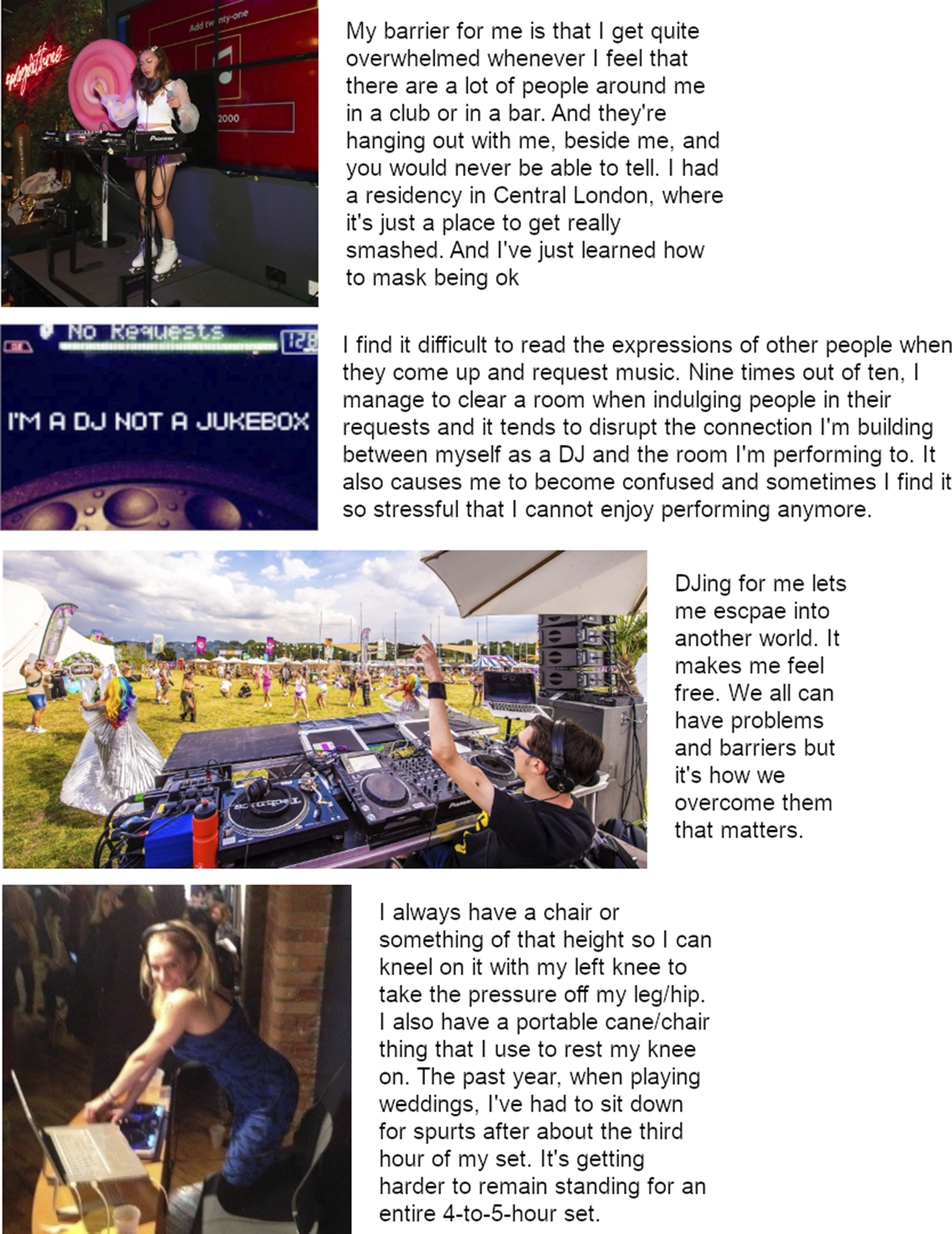
To give steering to participants on the focus of the research, they were first asked to submit media diaries. Media diaries are a development of photo diaries, a widely used participatory method where participants are asked to take photos of objects, people, and environments in their community that they feel represent a significant part of their experience (Chowdry et al. Reference Chowdry, Nganda, Piotrowski, Ozano, Dean and Tancred2021). Due to the diverse disabilities among our participants, we expanded this to include other forms of documentation, such as screenshots, video, audio, and text. Participants were encouraged to use whatever media was accessible to them. They were given two weeks to document their DJ practice, capturing both current and past experiences in response to a series of questions regarding their inspirations, their entry routes to DJing, their DJ set-ups, and their experiences of DJing. They were encouraged to write or audio-record brief descriptions of any video or photo content, and were required to obtain written or verbal consent from any identifiable third persons, unless they were a public figure or the media was taken from a publicly available source (e.g. the internet). Participants also gave written consent to share any media that identified themselves. Figure 1 presents some images and descriptions gathered through the diaries. We do not present a full analysis of the media diaries here, and instead focus on the follow-up interviews, which are described in the next section.
Examples of media diary entries, documenting Disabled DJs’ experiences. Image description: The first image is a photo of a woman with dark hair, wearing roller skates and holding a microphone, standing alone behind a DJ deck stand. The second image is a picture of parts of a digital DJ deck, including the digital screen that normally names the track that is being played. The name of the track is ‘No Requests’ and another caption has been added across the image, stating ‘I’m a DJ not a Jukebox’. The third image is a photo of a man with dark hair, wearing a black t-shirt and sunglasses, sitting behind the DJ decks at an outdoor dance music event, gesturing to the dancing crowd in front of him. The last image is a blurry photo of a woman with blond hair wearing a blue dress, standing behind a table with turntables and a laptop, while resting one leg on a chair. Each image is accompanied by a quote from the participant’s media diaries.

Figure 1. Long description
Top-left panel: Photo of a woman with dark hair, roller skates, and a microphone, standing alone behind a DJ deck stand in a dimly lit venue. To the right, her diary quote describes feeling overwhelmed by crowds and masking discomfort while DJing in clubs. Top-right panel: Close-up photo of a digital DJ deck screen displaying the track name ‘No Requests’ with overlaid text ‘I'M A DJ NOT A JUKEBOX’. The adjacent quote discusses difficulty reading expressions during song requests, the stress of disrupted connection with the audience, and how this can diminish enjoyment of performing. Bottom-left panel: Photo of a man with dark hair, black t-shirt, and sunglasses, seated behind DJ decks at an outdoor dance music event, gesturing toward a dancing crowd. His quote explains how DJing provides an escape and a sense of freedom, emphasizing overcoming barriers. Bottom-right panel: Blurry photo of a woman with blond hair in a blue dress, standing behind a table with turntables and a laptop, resting one leg on a chair. Her quote details using a chair or cane to relieve pressure on her leg/hip during long sets, and the increasing difficulty of standing for extended periods.
The media data was used to inform follow-up questions to the participants, which were asked during semi-structured interviews. The interviews were designed and analysed according to Interpretative Phenomenological Analysis (IPA) – an approach suitable for the investigation of lived subjective experience and which encourages the exploration of complex and ambiguous concepts (Smith et al. Reference Smith, Murray and Chamberlain1999; Smith & Osborn Reference Smith, Osborn and Breakwell2004). Witek trained the co-researchers in the method, and the interviews were conducted by all researchers, except Heywood. The two co-researchers were also interviewed as participants. Interviews lasted approximately one hour, and were all conducted and recorded via Zoom except one, which was conducted in person.
Witek transcribed the interviews, and together, the team identified themes across the transcripts, using principles from IPA. In the following section, we focus on a selected number of themes relating specifically to social, embodied, affective, and musical experiences. Other themes, e.g. regarding experiences of software and hardware, are reported elsewhere (Witek et al. Reference Witek, Cooke and Heywood2026).
The study was approved by the University of Birmingham’s ethical review committee. To give voice and agency to the participants, they were offered to waive anonymity. All participants gave written consent to waive anonymity, hence we refer to them by their names in the analysis of themes below.
Being Disabled in the club and accessing dance music culture
Our participants expressed a wide range of experiences of social interactions in club spaces. Many desired a space that could offer a break from the intensity of the crowds and interpersonal interactions with others on the dance floor. For Sha Supangan, a.k.a. SO SHA, a neurodivergent DJ based in the Philippines and the UK, the intensity of the social interactions in clubs included her own friends who were there to see her perform:
Sha: When I performed in London, almost half the crowd were my guests, and my anxiety was so intense that I could barely speak. I felt like saying, ‘please don’t talk to me!’ I don’t enjoy being touched either, and everyone kept suggesting drinks, but I just couldn’t interact. I felt like I needed to be away from people altogether. It was exhausting, and there wasn’t even a quiet space to retreat to. It definitely affects me differently.
For Sha, the lack of a quiet space away from the crowds could exacerbate both her social and performance anxiety. However, sometimes a quiet room can be too excluding, as it takes the person out of the club experience. Many of the Disabled DJs in the study talked about coming to clubs for the music and navigating the desire to be close to the speakers yet away from the crowds. Caro Cooke, a.k.a. Caroline the DJ, a non-binary neurodivergent DJ based in London (and a co-researcher and co-author of this paper), explained:
Caro: I want to dance on my own. I don’t want anybody to come near me. I want to, physically, if I’m listening to a DJ on the dance floor, I want to dance and I want to respond because I’m enjoying the music, and that’s what’s making me feel good. I don’t want to be dancing in a circle with people. I don’t want somebody to come and drag me into the centre. I can’t do that! And so I get very, like, I want to be in the corner and I don’t want anybody to come anywhere near me. But I’ll go along with it if I feel like I have to, but I will literally inside be like ‘I absolutely hate this! I can’t think of anything worse’.
In the absence of social awareness of neurodiverse needs for social interaction, Caro describes a trade-off where masking social discomfort can lead to further mental distress.
All the participants, regardless of their impairment, responded that they disliked being in big crowds. However, some referred to DJing as offering a safe space or comfortable role within dance clubs. For Gemma Nash, a sound artist and former DJ with Cerebral palsy from Manchester (and the second co-researcher and co-author of this paper), being a DJ gave access to the social bonding that dance music culture offers, but away from the crowd:
Gemma: I get a feeling of being in a flow state and really I enjoy creating a set that is going down well with the audience. It gives me a lot of pleasure and joy and I feel like I’m more in connection with people. So there’s a connection element as well, because I’m not really a natural dancer, should we say, so it’s a way of connecting to the people, I think.
Gemma’s disability affected her mobility, which could make crowds difficult to navigate. She felt more secure in her wheelchair, but being seated could make her feel like she was standing out, separating her from the others. But when she was DJing, the designation to the DJ booth created a physical barrier that could help break a social one, supporting her to connect to the crowd through the music she played rather than through normative dancing. For Adam Conroy, a.k.a. One For The People, a neurodivergent DJ from Manchester, the DJ booth offered safety within the intense social environment of the club:
Adam: Part of the reason why I started DJing is because I loved being out and loved the club and I loved the energy and I loved the music. But I didn’t like being in the thick of it too much because I used to worry about what I had to say to people, especially if I wasn’t drinking. Whereas once I started DJing, some people would say ‘oh you DJ because you want to be at the front’. But I did it because there was like a safety barrier between me and the people, which is called the decks, and so I get to share this really fantastic environment and experience with people, but like in a little safety box!
These reflections suggest that DJing allows some Disabled people to actively participate while also avoiding the crowd. The physical designation of the DJ to the booth aligns with Heath’s reflections on his combination of neurodivergent conditions, allowing ‘the sociable ADHD part of me to be part of the party while allowing my autism to be a little separate from it too’ (Heath Reference Heath2023). We show that the safety of the DJ booth can also give DJs who experience mobility barriers a way to actively yet safely participate in the social bonding that happens in clubs. DJing thus gives access to dance music culture in a way that allows them to feel in control of their engagement with that culture.
This feeling of control that DJing affords may be especially important due to the liquidarity of social interactions that Garcia-Mispireta identifies on the dancefloor, making it a place where the rules of engagement are fluid, ambiguous, and unspoken (Garcia-Mispireta Reference Garcia-Mispireta2023). Disabled DJs’ experiences may not always intersect with the unspoken cohesion of a fluid interaction or experience in club spaces. To some neurodivergent people, liquidarity may be difficult to navigate, especially if they struggle to pick up on other people’s implicit social cues. The smoothness of liquidarity may also feel alienating to mobility-inflected people, especially if their movements and speech are notably different from the majority on the dance floor. Although many dance music spaces are perceived as diverse and inclusive, there remains an unspoken expectation to facilitate the liquidarity within the club environment. As Garcia-Mispireta notes, liquidarity can mask some inequalities that exist between people in the crowd (ibid), but here we argue that it can also be a barrier for some Disabled people.
Disabled DJing and caring for the crowd
A number of our participants, in particular those who identified as neurodivergent, reported that DJing offered access to certain feelings that they rarely experienced in their everyday lives. The power that DJs assert over a dancefloor – controlling the socio-affective atmosphere – offered respite from the feelings of powerlessness and lack of social connectedness that cognitive and affective impairments can sometimes exacerbate. For Sha, DJing gives her a voice in a subculture in which she felt voiceless for much of her life:
Sha: [I feel] centred, euphoric. Buzzing, but in control? I feel some semblance of control. I feel that I am where I belong. I feel like I belong. I feel like I’m, not that I’m necessarily a star, but it’s more like I’m with you, and we’re in this together. I feel connected, and I feel like I’m being heard, I’m seen, I’m not hidden. And these are things that I’ve felt a lot growing up. Hidden, unseen, unheard, ignored, misunderstood. And it’s such a thrill. I would bring the whole thing [the music] down, and now you have to listen to my voice, haha! I use my powers, I feel powerful. I felt powerless for a lot of my life, powerless with myself, just to mobilise myself, even to do things I love. So as soon as I’m on the decks, that’s how I feel, powerful, in control, seen, heard, like ‘I got this’. And a lot of times in the past, I didn’t really feel like that.
Some of the DJs expressed pride in their ability to ‘read’ a dancefloor – a key DJ skill that involves observing how the crowd responds to the music and choosing tracks based on what they expect will maximise their social and emotional enjoyment. Caro explained that they exert a great amount of care for the people they play to:
Caro: Before I was diagnosed, I just thought that I had this weird, crazy, magic ability to be able to read people really well. Sometimes not, but often I’m good at being able to get to the bottom of what people’s needs are. So when I’m in a live setting, my ability to be able to be on the dance floor, read somebody, and then be like ‘I think they’re gonna like this song’ or ‘this crowd is gonna like this song’, I’ll then play it, and if they respond positively to it, I’m like ‘yes’, and I basically start becoming like a donkey with a carrot, and just like chasing that, and just being like ‘more of it! I’m doing this right! Let’s give them more!’
Caro sees their neurodivergence as an asset when DJing, as it makes them more attuned to the vibe of the night, and that attunement can become addictive, pushing them to play more and more to the crowd. Adam described a similar care for the crowd and linked it directly to the hypersensitivity of his neurodivergence:
Adam: Sometimes you might struggle to read one person, being neurodivergent. But I think feeling a room, being over-sensitive to how a room is feeling is something that’s based out of our neurodiversity in a strong way, because I think we really care and we really want things to feel right and feel the way it should. I feel like there’s a good way for us to express ourselves within that environment that might be a bit more difficult for us in other ways.
Adam’s care for the crowd is driven not by what we might call a ‘neurotypical’ strategy of interpreting individuals’ emotions one on one, but rather by his obsession with how the people on the dancefloor are feeling as a whole. This obsession can be grounded in a feeling of anxiety or fear of failure to succeed:
Adam: I’m sure you’ve heard of rejection sensitive dysphoria. There is a risk of it going too far the other way. So you think the room’s not good enough. But at the same time, I think that intensity of getting the atmosphere and the feeling right as a neurodivergent person, there’s a level of understanding of that which I think neurotypical people may not quite be able to obtain. Not that they can’t achieve it, but they don’t obsess over it the way I do. And I think it’s the obsession and the care of wanting the room to feel right and be right that makes me great at doing it.
Even if driven by fear or anxiety, the hypersensitivity to social ambience that neurodivergent people often experience is seen here as a strength rather than an impairment, as it pushes the DJ to drive the crowd even further. This strength was linked in Heath’s interviews with the neurodivergent characteristics of special interest and enhanced memory for and ability to catalogue music, enabling ADHD and autistic DJs to create sets that are fine-tuned to the crowd (Heath Reference Heath2023). Together, then, Heath’s and our participants’ reflections suggest that DJing is a practice in which disablist, specifically neurodivergent, hearing offers an advantage (Fessenden 2023; Straus Reference Straus2011). The hypersensitivity, hyperfocus, and ability to draw idiosyncratic connections may promote a way of listening to music and curating sets that are deeply tuned to audiences. We propose that, in DJing, neurodivergence can facilitate rather than frustrate emotional connection with the crowd.
The increased care for the social and emotional welfare of a crowd stands in opposition to the stereotypical and stigmatising understanding of neurodivergent people as lacking empathy and social competency. Recent research suggests there is a high proportion of hyperempaths among autistic people (Kimber et al. Reference Kimber, Verrier and Connolly2024). This hyperempathy can lead to increased concern with the emotional and social wellbeing of other people, as we see here with the neurodivergent DJs in our study. However, to the person exerting it, hyperempathy can be experienced as overwhelming and even distressing, as it requires a high amount of emotional labour (ibid). To the neurodivergent DJs in this study, this was often reflected in a need for extended recovery time after a gig.
While crowd-reading was seen as a strength among the neurodivergent participants in this study, this is not a universal experience among neurodivergent DJs, just as hyperempathy is not a universal autistic trait (ibid). Adeniran states that reading crowds is a challenge for them, but that their affective power over the dance floor comes not from the sense of empathy and shared emotion that other DJs pursue, but instead from a more inward facing state that can be projected onto the crowd, via the music, inviting the dancers to join them on their personal emotional journey (Adeniran Reference Adeniran2023). We might consider Adeniran’s experience as an expression not of crowd empathy but of crowd sympathy, a form of shared experience where there is an acknowledgment of the emotions projected, but not necessarily a taking-on of those emotions. Regardless of the level of emotional attunement, it’s clear that the hypersensitivity of neurodivergent DJs affects their relationship to the crowd, helping to create an engaging emotional atmosphere.
This emotional connection with the crowd can also be difficult for neurodivergent DJs to extract themselves from. On the one hand, DJing can offer a route to feelings of intense euphoria and experiences of flow, but that flow can also tip over into hyperfixation, as Caro describes:
Caro: [When I’m] in a flow state, then I could be [DJing] for a really long time, and forget and neglect everything else around me that I need to do, like feeling hungry, or needing to go to the toilet. Those things, I don’t feel them anymore. It just shuts off, and I’m like in the zone. This can also have an impact on my emotional wellbeing. I’ve had to learn that that’s not a helpful way, because it can affect my creativity or my output. There are times when I don’t feel [flow in a positive way], and I feel really burnt out and shut off. Like I literally can’t hear the music, I can’t get any sort of emotive experience out of it. They [the audience] might be dancing, but I’m forgetting that I’m in a room with other people there, and I’m just completely focused in.
The mixed experience of flow was also expressed by Adam, who felt that flow could quickly shift from liberating to trapping:
Adam: It’s like everything is pulled in at you, and you feel trapped and anxious. And you feel like everyone’s looking at you. The freedom of the joy when it’s positive but then that trapped-ness is just… as much as it’s the best feeling in the world, that can be the worst feeling in the world as well.
Flow is widely understood as an extraordinary psychological state of complete immersion and attention during an activity, often accompanied by a loss of sense of time, space, and self (Czikszentmihalyi Reference Czikszentmihalyi1990). Performance researchers often depict flow as a desirable state during performance, where the pleasure of performing is rewarding in and of itself (Antonini Phillippe et al. Reference Antonini Philippe, Kosirnik, Ortuño and Biasutti2022; Tan & Sin Reference Tan and Sin2021). The hyperfocus and time blindness associated with neurodivergence may make neurodivergent musicians highly susceptible to flow experiences, making flow another example of a musical experience where neurodivergent hearing may be a strength (Heasman et al. Reference Heasman, Williams, Charura, Hamilton, Milton and Murray2024). However, for some of the neurodivergent DJs in our study, the hyperfixation that comes with flow is only enjoyable in moderation, because it can lead to a feeling of overdrive that can ultimately be disruptive to the performance and reduce connection with the crowd. This is supported by research with autistic people reporting a difficulty exiting flow (ibid). Some of the DJs in this study shared this inability to decouple from the physical and mental state of flow, even when that flow was no longer a positive experience.
Masking disability and DJ authenticity
When experiences were positive, our participants described DJing as offering respite from feeling othered. Sha describes DJing as being an outlet for her neurodivergence:
Sha: Because I fidget a lot, or I need to be stimulated or something, I’m always mildly uncomfortable. But when I’m DJing, I feel at ease. I’m comfortable, I’m free, my body feels like it’s not constricted or limited. I can do that and you’re not going ‘why is she doing that arm movement, weird!’ And like, ‘I’m performing, bitch’, whatever! I feel like I’m always trying to ‘shhhhh’ [shush myself]. But when I’m performing, I can be weird and zany, and my body feels free.
The performative act of DJing relieves Sha’s need to suppress her neurodivergent behaviour. Several of the DJs also stated that while the presence of alcohol and drugs often make dance music spaces feel unsafe for them, being around inebriated people could also make them feel less conspicuous.
Maren: People think I’m weird for sure. They think I’m weird and my laugh is weird and I talk too much and I talk too fast. And sometimes people think I’m on drugs, when I’m not. I’m just super high energy and talk really fast.
Several of the neurodivergent participants mentioned that they felt comfortable stimming in a dance club setting. For Sha, there was a blurring between dancing and stimming in the club:
Sha: I think movement is part of it. Like my fingers are doing their own thing. My head, it’s almost being moved by the music, naturally. It’s like stimming, I guess. It’s like a thing that you have to do. It’s even harder to not do it than doing it.
Due to the similarity between stimming and dancing, and the sense of propulsion that these two behaviours share, DJs can safely stim on the dance floor or in the DJ booth without standing out. Not unlike metal shows (Squires Reference Squires, Shadrack and Kahn-Harris2024), dance clubs can offer a safe space in which neurodivergent people can practise unmasking their neurodivergent behaviour. Masking can become psychologically and emotionally burdening, leading some to depression, anxiety, and burnout (Evans et al. Reference Evans, Krumrei-Mancuso and Rouse2023). Thus, opportunities to unmask can not only offer neurodivergent DJs relief from this burden but also allow them to express themselves in a way that feels more authentic, without standing out as different. As noted by Squires, stimming is a way for neurodivergent people to participate and respond to music in an active and natural way (Squires Reference Squires, Shadrack and Kahn-Harris2024).
However, stimming may not be appropriate in every situation in the club. Adeniran points out that the acceptance of stimming depends on what they are doing in the moment that the urge to stim comes on – if they are talking to the promoter, stimming can feel othering and can lead to further stigmatising and social anxiety (Adeniran Reference Adeniran2023). There are therefore some constraints on the unmasking that neurodivergent DJs can practise in dance music culture. Furthermore, DJing can also mask symptoms of disability. Two participants described that when they DJ, the joy and flow of performing can sometimes override the experience and discomfort of muscle spasms, which normally result from their disability. This masking can also contribute to feeling, if only momentarily, Non-Disabled. Thus, there is no simple relationship between masking and othering of Disabled DJs. For some, and in certain circumstances, masking can be liberating, while for others and at other times, it is letting go of the mask that can feel freeing.
While DJing can mask disability in some contexts, the participants in the study also expressed feelings of shame when their practices diverged from a stereotypical expression of a DJ. Maren Hancock, a.k.a. Betti Forde, is a Canadian neurodivergent DJ with a physical condition that affects her ability to stand for extended periods of time. But DJs are not normally expected to sit while they are playing:
Maren: I went to a gig in Toronto, and the DJ was just playing background music, it was just cocktail hour. It wasn’t a dance floor, but they were sitting down, and I remember thinking ‘oh, that looks whack. They shouldn’t sit down’. But now, like all I want to do is sit down when I DJ, because I’m Disabled. So I think I have an internalised ableism or whatever. I just worry that the crowd will look at me and just think I’m not trying or I don’t care because I’m sitting down, because they’re used to seeing DJs standing and [gesturing vigorously]. It’s what we expect from a DJ.
Sitting while DJing emerged as a key point of tension for Disabled DJs, since the industry standard of DJ performance is to stand, if not actively move and dance behind the decks. Conforming to this standard was not always possible for our participants, and could come with significant physical health trade-offs. The fear of being perceived as lazy or uncommitted to the performance could affect Disabled DJs’ sense of confidence and acceptance in the DJ community.
The lack of acceptance as a Disabled DJ could also be felt in responses to the deployment of idiosyncratic DJ practices. Sha is known to both sing and roller-skate while she is DJing, and she sees her performance style as an expression of her neurodivergence. At the same time, these activities are considered extraordinary to the standards of DJing:
Sha: I think my singing and improvising… Before I was ashamed, because DJing is [in low voice] “all about the music, man!” I hate it when DJs are like that. I was embarrassed about my sets because I like to talk a lot! I feel like I need to speak. But now I just say it when I present myself, like yeah, I’m an interactive DJ.
For Sha, her idiosyncratic practice could sometimes lead to feelings of embarrassment, as it steps outside of ‘authentic’ ways of DJing. While improvisation is an important tool within standardised modes of DJing, as Butler suggests (Butler Reference Butler2014), only certain kinds of improvisation are accepted, and singing over the music and roller-skating through the crowd are not normally included. However, for some Disabled DJs, unusual practices can be key to getting into the flow of DJing, another of Butler’s DJ technologies (ibid). In other words, there can be a conflict between access to DJ technologies for Disabled people and the perceived authenticity of DJ practice and aesthetics.
The perceived inappropriateness of certain practices during DJing, such as singing, can create a double exclusion of DJs, based both on their disability and their gender. As Gadir argues, female and femme-presenting DJs are often expected to conform to societal gender roles (Gadir Reference Gadir2023). But adopting female-coded expressions can lead to further discrimination of a DJ, as they are perceived as less competent. This is compounded by the perception of certain kinds of DJ technologies, such as hardware and software, as ‘masculine in essence’ (ibid, p. 125), while other musical technologies, such as singing, being associated with the feminine. When a DJ’s disability intersects with expressions that are culturally coded as female, their performance skills can be questioned both by virtue of their disability and their gender, compounding the scepticism for their talent. Gemma felt this acutely when engaging with venue staff, who would often ignore her during set-up and address technical and practical conversation to her personal assistant who was there to provide disability support, instead of her:
Gemma: I always found that if I had a male PA supporting me, that was a bit of a double whammy, because they weren’t expecting a woman DJ, and then they got a Disabled woman DJ.
Several of the DJs in this study reported being ignored in favour of their PAs or support workers during gigs. But the explicit disregard for Disabled DJs’ competence was especially apparent when the DJ was female and the PA or support worker was male. Thus, when disability intersects with gender, DJs’ agency in both their own practice and in dance music culture as a whole is blocked even further.
Disabled dancing
Participants’ feelings about dancing while performing ranged from being deemed impossible, unimportant, to essential to the practice of DJing. For some, dancing can interfere with flow in DJing, while for others, it is key to accessing that flow. Furthermore, while dancing can be a physical response to the enjoyment of DJing, it may also come at the cost of temporarily reduced mobility, increased pain, or a reduction in energy levels after the event.
Gemma: When I’m really enjoying DJing, I think it’s a bit of a pain reliever. It can both feel like a pain killer, but also, I did get repetitive strain injury from overusing the computer a bit too much, so again, it’s a happy medium. If it’s enjoyable, I’m forgetting all my troubles, whether they’re physical or emotional, but then remembering to take breaks.
Djing can take a physical toll on the body, and while the pain and discomfort can be masked during the performance, many Disabled DJs report a rebound of symptoms afterwards, requiring significant time for recovery. Pacing and managing energy and engagement emerged as an important strategy for sustaining Disabled DJs’ practice.
When it came to the audience, feelings about dancing could be quite complex:
Gemma: I don’t personally dance when I DJ because coordinating dancing and DJing at the same time would just be a bit impossible. I mean, I probably jig about a bit. But it’s important to see other people dancing. It’s sort of a weird one really because I’ve DJed for a number disability related gigs, and you don’t want to DJ to a bunch of wheelchair users and then sort of say that because no one is dancing in the traditional sense of the word [you’re disappointed], but on the other hand it is quite nice seeing people dancing.
For Gemma, a wheelchair-using DJ, there was a tension between accepting the central role that dancing plays in dance music culture and DJ performance and recognising the lack of access to dancing in a standardised way for some Disabled people. She acknowledged the potential ableism of wanting her audience to be dancing to her sets. Also for Jake Smith, a DJ from Cheshire who uses a wheelchair and has Cerebral Palsy, a dancing audience was taken as sign of success, but he recognised that the relationship between dance and engagement was not fixed.
Jake: Yeah it gives me a bit, when all the people get involved, but just because they’re not dancing doesn’t mean they’re not enjoying it.
With movement and dance being seen as an indispensable part of dance music, the assertion that dancing is not necessary may seem controversial. However, music can be embodied in covert ways, through imagined movement, or through interoceptive or proprioceptive sensations. The haptic and tactile qualities of dance music noted by Garcia-Mispireta might offer alternative routes to embodiment of dance music for people to whom dancing might not be accessible (Garcia Reference Garcia2016). Furthermore, the vibrotactile qualities of dance music may afford embodiment for neurodivergent people for whom textural sensations are pleasantly stimulating (Fessenden Reference Fessenden, Shadrack and Kahn-Harris2024). Finally, Disabled people might in fact be dancing in clubs, but it may not be noticed or recognised as dancing by the standards of the culture. In particular, the intersection of stimming and Disabled dancing risks being ignored as a meaningful mode of neurodivergent participation in music (Squires Reference Squires, Shadrack and Kahn-Harris2024).
Some participants found that there could be social pressures to engage in normative dancing:
Gemma: I’m not very coordinated, I mean having Cerebral Palsy, but I also get tired. So I tend to dance a bit and then sit down, and I think sometimes people don’t really get that, they’re like ‘come on, dance!’ I really hate it when someone’s persistently trying to drag me out to dance cause like I don’t want to dance to this tune. I don’t mind this tune, but it’s not one that I would automatically get up and dance to, you know.
The importance that dance music culture places on normative styles of dancing can feel excluding of people who do not or cannot dance in standard ways. Indeed, it may break the liquidarity in the club that Garcia-Mispireta argues is crucial to the unspoken cohesion and shared experience that dance music culture values (Garcia-Mispireta Reference Garcia-Mispireta2023). Based on participants’ reported experiences of emotions and flow states, it is clear that Disabled DJs can access rich, sensory experiences in dance music, but that these experiences are not always externalised through a physical response like dancing. As a result, our study questions the essentialism of dancing in dance music culture, and in particular, highlights the potential access barriers that this essentialism poses to Disabled people.
Conclusion
In this paper, we report on qualitative and participatory research in which Disabled DJs describe their experiences navigating dance music culture. By involving Disabled DJs in the research process, we highlight aspects of these experiences that are the most meaningful to the people with the most at stake. We analyse these experiences in relation to dance music scholarship and the social model of disability, showing that being Disabled affords a complex array of both advantages and barriers when engaging with dance music. The physical and social environments of dance floors can be inaccessible to and othering of Disabled people, who often struggle to navigate big crowds. However, some elements of dance music offer opportunities for unmasking of Disabled ways of being, such as stimming. Furthermore, occupying the DJ booth and controlling the music and the crowd is a way to not only access dance music culture and connect with the crowd in safe way, but also gives Disabled people an active role in that culture and power in shaping its social and emotional wellbeing. Neurodivergent DJs take pride in their care for the dancefloor, countering the stereotype that neurodivergent people are socially inept. This marks a key conclusion of this paper – that neurodivergent hearing – in the Strausian sense (Straus Reference Straus2011) – can be an asset to DJing. Its characteristics of hyperfocus, susceptibility to flow, and hypersensitivity to social atmosphere can drive DJs’ crowd-reading abilities, leading to performances that are intensely attuned to their audiences’ social and emotional states.
However, notions of DJ authenticity and normativity about performance practice and physical appearance can perpetuate Disabled DJs’ experiences of exclusion, especially when these intersect with gendered behaviours and expressions. Disabled DJs’ relationships with dancing reveals a tension between the centrality of dancing in dance music culture and the inaccessibility and othering of dancing as a Disabled person. To complement disablist hearing (Straus Reference Straus2011), we propose that disablist dancing questions the essentialism of the embodied assumptions of dance practices, and centres engagements with music where those embodiments diverge from cultural norms. By diversifying our understanding of dancing and celebrating the advantages that neurodivergent DJing affords, popular music studies can help dismantle some of the barriers to DJing and dance music and support it in becoming the diverse and inclusive culture that it strives to be.
Acknowledgements
During the review and revision of this paper, one of the co-researchers and co-authors, Gemma Nash, passed away. We dedicate this paper to her memory. We thank Drake Music and all the participants for their participation in the project, Dr. Patrick Valiquet and Dr. Luis Manuel Garcia-Mispireta for helping with revising the paper and the two anonymous reviewers for their comments and suggestions. The study was funded by the UK Research and Innovation, Arts and Humanities Council, project number AH/W000954/1.

 Open access

