

This essay seeks to limn the vulnerabilities of partnering in competitive ballroom dancing. It argues that for racialized and gendered subjects who fall beyond dancesport’s normative range of aesthetic legibility, lead and follow becomes an especially fraught—yet potentially reparative—mode of relation. It brings sustained ethnographic focus to the Asian American amateur dancesport community in New York City, which not only represents a growing presence in a predominantly white industry, but unsettles its racially charged conventions of skill, prestige, beauty, and belonging. From this position, it maps a field of vulnerable relations: between Asian American amateurs and the dancesport industry, in which they remain largely marginal and illegible figures, but also between Asian American male leads and female follows. Building on partner dance scholarship that complicates assumptions about lead and follow as a one-way flow of power, it treats the embodied mechanics of dancesport partnering as a dialogic practice of mutual vulnerability, in which both dancers effectively lead and follow each other. It also attends to the aesthetic, pedagogical, and social rules that put pressure on competitive couples—demanding resilience, even detachment, at the expense of that mutual vulnerability. In parsing what is contradictory, even compromising, about Asian American dancesport practice, this essay theorizes lead and follow as a mode of relation that involves opening ourselves up, and remaining open, to risk—but also, to the possibility of exquisite moments that can only be co-created.
Having been part of the Asian American amateur dancesport community in New York City for over ten years, I examine this lively subculture as one still tethered to the industry’s conventions, yet invested in producing alternative visions and practices. While Asian American participation in ballroom is often assumed to be an assimilating maneuver, I suggest that this community is well-positioned to critique the norms of an industry in which our racial status facilitates certain allowances as well as limitations. Certainly, there are far more Asian American competitors than Black or Latinx ones—an imbalance that reflects the ongoing inaccessibility of dancesport to the very groups whose movement vernaculars were appropriated for its creation. In drawing attention to the experiences of Asian American dancers, which—despite our growing presence in the industry—remain largely unstudied, I treat the lived and embodied position from which we engage in this dance form as premised on conditional inclusion into some of whiteness’s material privileges, if not its phenomenological comforts. To consider the ways Asian American dancers are disciplined into performing lead and follow is to ask, after Sara Ahmed, what “enable[s] some bodies to flow into space” and not others (Reference Ahmed2010, 12). In theorizing Asian American dancesport practice as a network of vulnerable relations, I attend to the risks and constraints these dancers must manage from their position.
For those engaged in this practice, such risks and constraints can manifest in painfully compromising ways. In the interviews I conducted from 2017 to 2024 with Asian American dancers, female follows continually voiced the need they felt to perform “strength” and cultivate “confidence” in the face of Orientalist remarks from coaches, the exigencies of the partner search, and—perhaps most unsettling—the callous dismissals or threats of disposability they received from their own long-term dance partners. Even more striking was my own partner’s admission that he often struggled to feel like a “good partner” and a “good competitor” at the same time. Like other leads I spoke with, Will recounted being pushed by coaches to “be more of an asshole”: project an assertive energy on the floor, and only care for the follow “as much as you have to” (interview with author Reference Tong2022). While coaches ostensibly limit the scope of this order—“‘Not in life, just for the dancing’”—it can hardly be surprising, as another lead observed, that men “struggle with not letting that overflow into the rest of the partnership” (Ajay Phatak, interview with author Reference Phatak2022). This decree to look competitive sits in tension with another, equally vital aspect of dancesport partnering: the mutual vulnerability dancers must cultivate in order to move together and make spontaneous choices on the floor. That tension is further amplified, I argue, by the differing demands of gendered racialization: for Asian American men to distance themselves from effeminizing tropes, and Asian American women to perform resilience and flexibility. As both a theorist and a competitor, these deeply personal lines of inquiry led me to the anchoring questions of this essay: How does the lead-follow relation discipline us into dancesport’s aesthetic sensibility—the full embodiment of which, for Asian American amateurs, might already be a futile endeavor? How can attending to our shared and diverging experiences of that disciplining process enable us to not only critique its limitations, but enact more ethical ways of being together?
In what follows, I first offer an overview of the Asian American amateur dancesport culture in New York City. By dint of several intersecting factors that shape our participation—profession, race, age, and education—the dancers of this study fall on the margins of the industry proper. While many of them strive for competitive success at the industry level, and feel some pressure to conform to its conventions, they also remain invested in their amateur community, which they see as an alternative space. In our conversations, they advanced numerous critiques of the subtle, yet insidious ways that ballroom dancing bodies are racialized and rewarded (or not) accordingly, which in turn sustain dancesport’s investment in the white, heterosexual couple. I then examine these dancers’ accounts of training and competition, considering how the demands of competitive legibility and prestige shape their experiences of finding and nurturing long-term partnerships. Building on scholarship that attends to the nuances of the lead-follow relation, I propose a theoretical approach—derived from fieldwork and practice—that turns on vulnerability rather than focusing, as much of this scholarship does, on the question of follows’ agency. Vulnerability defines the conditions faced and the choices made by marginalized dancers in an industry based on external evaluation—but also, the embodied mechanics of partnered movement itself. At the intersection of the two, vulnerability suffuses the joyful and arduous work of sustaining competitive partnerships. My theorizing of vulnerability in dancesport thus encompasses, and is animated by, questions of power, pleasure, risk, and intimacy. Overall, this essay engages with and advances partner dance studies, as well as Asian American feminist theory, to examine the ways dancers productively confront their own social and bodily vulnerabilities. Using the perspectives of Asian American amateurs as a critical entry point, it ultimately gestures towards more ethical futures for dancesport culture, theorizing embodied relation as a means of negotiating and contesting the terms of white supremacist spaces.
Asian American Amateurs in the U.S. Dancesport Industry
While Asian Americans remain peripheral to the U.S. imaginary of ballroom dancing, our growing presence on the dance floor itself—a space where hegemonic relations are both reproduced and disrupted—challenges this status. After the tragic 2023 mass shooting at majority-Chinese Star Ballroom Dance Studio in Monterey Park, California, one local instructor told The New York Times, “In this country, it would be the Asian American communities that have kept ballroom dancing alive” (Hubler et al. Reference Hubler, Knoll and Albeck-Ripka2023). However, Asian Americans remain understudied in ballroom scholarship, which has largely treated them as peripheral, lumped them in with white dancers, or suggested that their participation is merely an assimilatory move.Footnote 1 I draw here on more nuanced readings of this phenomenon by Asian American dance scholars. For instance, SanSan Kwan’s re-examination of the World War II–era Chop Suey Circuit—in which Asian American couples performed ballroom dances for primarily white audiences—resists prevailing assumptions that such dancers strove to “produc[e] themselves as earnest mimics of ‘real’ Americans” (Reference Kwan2011, 129). Kwan’s analysis builds on scholarship that interrogates the notion of ballroom as a “white” dance form. The origins of modern ballroom dancing, as historians have ably documented, lie in the uneasy commingling of European partner dance traditions with Black and Latin American movement vernaculars. It was a “partnership between commodification and racialization,” as Danielle Robinson argues in her account of the “refinement” of ragtime dancing, “that contributed to the creation of contemporary social dance practices” (Reference Robinson2015, 180). In the 1910s, Robinson adds, this process “involved the removal of ragtime’s blackness in part because ‘black’ was not yet marketable in American culture,” and thus threatening to “the idealization of American national identity as ‘white’” (189). The upright posture, extended dance hold, precise footwork, and spectacular choreography that define modern-day dancesport, Juliet McMains similarly notes, are emblematic of this so-called refinement. Dancesport’s five “Latin” dances, McMains argues, “rely extensively on Western stereotypes of Latinness for their emotional and aesthetic appeal,” even as the creators of the style jettisoned certain technical elements and an emphasis on improvisation characteristic of Latin American partner dance forms (Reference McMains2006, 112). Despite efforts to obscure these complex genealogies and present ballroom dancing as Euro-American, such specters continue to haunt the form—with thorny implications for Asian American dancers, who are often figured as dancing to assimilate into whiteness.
However, as Kwan reminds us, the very notion of Asian American ballroom dancing as mere mimicry fails to account for the form’s histories. Take one critic’s description of a Chop Suey Circuit act as a “‘speedy imitation of American jitterbugs’” by two Asian American dancers, for instance; given that the jitterbug was itself “a white appropriation of the African American lindy hop,” this critic’s description inadvertently underscores “the fragility of such a border and, in fact, of the ambiguity of Americanness as whiteness” (Reference Kwan2011, 129). In short, ballroom does not enable Asian American dancers to claim an uncomplicated proximity to whiteness; rather, it is one mode of performance through which we have negotiated our liminal position in U.S. racial formation.Footnote 2 George Uba’s article “From Signifying to Performance: International Ballroom Dance and the Choreographies of Transnationalism”—the only scholarly work to focus on twenty-first century Asian American ballroom dancers to date—similarly urges us to treat the dance form as a “field of unstable signifiers,” one potentially “unsettled through the impact of a critical mass of Asian Pacific ballroom dancers” (Reference Uba2007, 142).
This essay builds on Kwan’s and Uba’s insights to argue that Asian American dancesport cultures—while certainly not unattuned to the demands and rewards of assimilation—can also function as sites of critique and intervention. Indeed, one such critical mass exists within New York City’s amateur scene—yet its members often express ambivalence about their numbers and competitive accomplishments. During the 2022 Big Apple Dancesport Challenge, a competition hosted annually by the Columbia University Ballroom Dance Club, Yang Chen, the master of ceremonies, would observe to the room that all six leads in the Championship Standard final—the most competitive event of the night—were Asian American. Four of the six follows were also Asian American, and all but one of these dancers resides in New York City. But the politics of representation are complex here—more so than the keen applause Yang’s pronouncement received might suggest. “It inspired a lot of great pride in me,” said Patrick, who placed sixth in the final with his partner Ying. Aware that ballroom remains a “heavily white-dominated space,” he had always hoped that “we could be invading this space, taking it over in a good way.” But with several Black school friends in the audience that night, he “couldn’t help but also think in that moment about how they might be perceiving this all–Asian American lead final, because maybe the doors have been opened for us now, but not for other people” (interview with author Reference Lin2022). Responding to these reflections, Yimeng dryly summarized how our competitive aspirations might be read: “Ah, here we are, being white. You know? Like, here we are doing the thing again, where we’re really good at things, and then we just take over white spaces.” (That both Patrick and Yimeng used language that alludes to yellow peril—Asian American dancers “invading” and “taking over”—also reflects latent anxieties among industry professionals that I later elaborate on.) Like these dancers, then, I do not treat Asian American representation as a panacea; rather, I argue that while our practice operates within, and to some degree sustains, the values of a predominately white industry, it still implicates and produces—to quote erin Khuê Ninh—“something more interesting than a misplaced possessive investment in whiteness” (Reference Ninh2021, 17).
The liminality of these dancers’ position is compounded by their amateur status. They largely identify as “post-collegiate,” having started their training on university clubs. Many of these organizations were founded in the 1980s and 1990s; Yang—then a law student at New York University—would draft the constitution for its club, which remains active today, in 1988 (interview with author Reference Chen2022). While most are now in their twenties or thirties, they remain connected to the collegiate community, serving as teachers, mentors, and event organizers in addition to training and competing. New York City being home to one of the largest populations of ballroom dancers in the U.S., including many reputable coaches, it is perhaps unsurprising that its post-collegiate community includes so many dancers who not only participate in the collegiate circuit, but also strive to become competitive at the industry level. These are amateur dancers, who maintain professions outside of the industry that support their training expenses. None of my informants majored in dance, and few plan on teaching and competing full-time—in industry parlance, “going pro.” Still, their level of devotion confounds conventional perceptions of adult dancing as unskilled or low-stakes. When I started each interview by asking my informant what they do “outside of” dance, this language proved ill-equipped to capture the ways dance organizes and animates their day-to-day: “Outside of ballroom, I—well, ballroom is my life, so there is no outside of ballroom,” as one put it. “‘Hobby’ feels too casual,” said another. “I feel like dancing is essentially all I want to do” (B. Li, interview with author Reference Li2019). These dancers are near-daily inhabitants of their local studios, take private lessons, and travel to camps; they devote additional time to cross-training in modalities like Pilates and Gyrotonic; they remain dedicated to dance through periods of injury, partnership break-ups, and competitive plateaus. Their commitment reflects Julia Bryan-Wilson and Benjamin Piekut’s portrait of the amateur: “If leisure is supposed to be the antithesis of work, with little sense of obligation, then amateurs have chosen a marginal form of it. They are serious about their leisure pursuits, devoting time, money, and energy to them. They persist in their practice through disappointment and tension, and their breaking-points lie far beyond those in the field of popular leisure” (Reference Bryan-Wilson and Piekut2020, 9).
As serious young adult amateurs, these dancers awkwardly elude legibility, falling outside the two categories to which the majority of Asian American ballroom dancers belong. The first are senior recreational dancers, who gather in largely mono-ethnic spaces to dance socially, as Uba describes in his 2007 article. The second are affluent “pro-am” enthusiasts, who are also typically older. Unlike the amateur dancers I address, who train with professional coaches and compete with amateur partners, pro-am dancers compete with their professional coaches. Dancing in this division requires significant disposable income, as an “am” not only pays for frequent private lessons, but also the costs of registration, travel, and housing for competitions. In the U.S., where dancesport garners little institutional recognition or funding, pro-am is a key source of income for many individual professionals and the industry as a whole. Outside of senior dancers, my informant Noelle noted, the “vast majority” of Asian American competitors are concentrated in the pro-am division. Pro-am amateurs are overwhelmingly female, and Asian American women, in particular, can be clocked by industry professionals as potential students. As former pro-am competitor Arlene observed, “There’s this idea that I see an Asian face and that’s a cash cow for me.” A third, significantly smaller group of Asian American dancers in the industry are those who came up through its youth division, achieving recognition through winning national and international titles, or those who carved out entrepreneurial niches. The latter includes Michael Chen, one of the industry’s most sought-after designers, and Wayne Eng, the CEO of Dance Vision Foundation and the owner of multiple prestigious competitions, including the U.S. professional championships. While still rarities within a predominately white field, these figures are fully embedded within its social networks and profit imperatives.
In contrast, post-collegiate amateurs enter this world sideways, having started dancing as members of university clubs that remain largely divorced from the broader ballroom industry. Many of these student-run organizations were formed in the late 1980s and 1990s as club sports, and receive funding from their universities’ physical education departments. Their members learned to dance in community-oriented spaces that approach training as a collective endeavor, using a combination of university funding and semesterly dues to provide weekly group classes, cover the costs of attending competitions, and maintain costumes shared by team members. Student leaders and local alumni provide the labor required to run these teams, which typically boast 50 to 100 members on their rosters; volunteer committees plan the competitions hosted annually by each team, which draw up to 1,000 dancers from across the country. While dancers who have graduated and work full-time support their own training expenses, this collegiate ethos can still be felt among alumni. Amateur dancesport in New York City is far from an exclusively Asian American domain, but the questions I pose and explore through this site are grounded in the experiences of the Asian American dancers who not only comprise a critical mass within it, but shoulder a significant portion of its stewardship. In 2019, two Asian American dancers, Nicole Barron Torres and Steve Torres, founded Five Borough Ballroom as a catch-all social network for post-collegiate dancers in the area. In its closed Facebook group description, 5BB defines itself as a space for “amateurs and alumni” devoted to “community-powered ballroom dance.” Less an official body than a loose, non-exclusive coalition, it provides a platform for local dancers to organize events and cultivate relationships that advance the community’s values.
Among these activities, 5BB hosts a monthly social dance event called Borough Ball; unlike other socials in the city, it is specifically oriented towards collegiate and post-collegiate amateurs, requiring attendees to sign a set of collectively designed guidelines for safety and consent, and regularly donating profits to local competitions or fundraisers for progressive causes. From 2019 to 2023, the organization co-sponsored Dance for Pride, an annual event series promoting queer partner dance created by collegiate ballroom magazine Waltz Tango Foxtrot. 5BB also offers workshops and camps for amateur dancers, promoting access to professional coaching at discounted rates. Beyond these organized efforts, post-collegiate amateur culture functions through informal relations of collaboration and exchange. When I asked one dancer who graduated from New York University how being part of the community had shaped her competitive experiences, she responded, “It’s the generosity.” The dancers she met through this network had sold or rented her costumes at affordable prices, shared information from their own private lessons, and made it possible for her to participate when ballroom would have otherwise remained financially inaccessible (Eolian Liu, interview with author Reference Liu2022). In particular, the community practice of mentorship, or unmonetized knowledge sharing, is so illegible within the industry’s profit-driven schema that, at the studios that 5BB members frequent, those who take a few minutes to help out a friend might find themselves getting called out by management for not having paid a teaching fee.
Yet valorizing such customs risks romanticizing and decontextualizing this amateur culture, at the expense of grasping its complex imbrication in the neoliberal values and relations of the industry at large. Dancers often did just that in our interviews, suggesting that our relationship to the “dancing itself” is purer and more authentic than those of others—a perspective I seek to complicate. One dancer, Jonathan, described the amateur community as “the best of the ballroom world,” because “the people are there for the love of dance and nothing else.” The pride that suffuses such accounts, I think, is not entirely unwarranted; it not only marks the ways this community advances a more progressive agenda than the industry at large, but also resists the marginalization of adult amateurs within it. These dancers are their own breed of amateur—too young to be seniors, too serious to be recreational, and too unknown to be located among the handful of non-white industry success stories. While most have lucrative enough day jobs to support the expenses of training and competing, few have the means to participate in the pro-am division, whose affluent competitors more or less sustain the industry’s operations. These Asian American dancers thus elude legibility; as Noelle put it, “I feel like an island.” After “graduating” from the collegiate circuit and starting to compete at the industry level, the professionals with whom she was interacting often did not “know how to categorize” her. This, she suggested, can make it difficult to be “taken seriously” by coaches and judges. Indeed, as one team’s coach said to their most promising couple upon graduation, “You don’t want to be known as a collegiate dancer” (Nancy Wei, interview with author 2017). To champion the post-collegiate community and its practices, then, can be a form of critique in itself, contesting the narrow terms on which competitors participate in—or remain estranged from—the industry’s social and economic networks.
The notion of amateurism as a pure or authentic pursuit, however, needs be problematized. In particular, the narrativization of amateur practice as driven by love—in Latin, amare—often serves to obscure the material conditions that support its workings. Indeed, for these post-collegiate amateurs, it is precisely their socioeconomic status that enables their participation. That a critical mass of Asian American collegiate and post-collegiate dancers exists at all signals their ability to not only attend elite four-year universities, but join dance teams with semesterly dues. For alumni no longer directly supported by collegiate teams, their jobs outside of the industry provide the means to pay for private lessons, competition fees, and studio memberships. Moreover, most of their professions fall within the disciplines that sociologists Jennifer Lee and Min Zhou frame as normative markers of second-generation Asian American success: “Medicine, law, engineering, or science” (Reference Lee and Zhou2015, 6). This is the position from which these dancers enter the ballroom industry, one facilitated in no small part by their socioeconomic status (but also, as I discuss in the next section, limited by their racial difference). I thus concur with Bryan-Wilson and Piekut when they warn us to “resist the tempting lure of only celebrating the amateur” (Reference Bryan-Wilson and Piekut2020, 20). Bryan-Wilson and Piekut also, however, locate valuable insight in amateurs as “people whose aesthetic sensibilities might not have been formed primarily” within the institutions they entered later in life (14). My investment in this site does not stem from the size of its Asian American critical mass, nor the competitive achievements its members can claim, and my aim is not to prove its overtly subversive value. Rather, I am interested in how these dancers cultivate critiques of and alternatives to the industry proper even as they also—by their own admission—strive to look, and feel, like they belong within it.
Aesthetic Legibility and Asian American Non-Belonging
While comprising a plurality of the post-collegiate population in New York City, Asian American dancers make up a much smaller—and thus noticeable, yet often overlooked—minority within the industry’s ranks. This vexed (in)visibility heightens the stakes for aesthetic presentation and social networking, which in turn shape one’s competitive prospects in that arena. As post-collegiate dancer Nancy put it, starting to compete at the industry level requires more effort on these fronts: “spend[ing] a lot of money to look a certain way—makeup, hair, dress” and attending as many competitions as possible “to get your face seen” (interview with author Reference Wei2023). The imperative to “get seen” is enforced by the structure of ballroom competitions, in which multiple couples—as many as fourteen—share the floor for a full “round” of four to five dances. Because each dance only lasts a minute and a half, judges often have mere seconds to evaluate a couple and determine whether to recall them to the next round or how to place them in a group of six finalists. Couples are effectively fighting for visibility, and as such, their decisions regarding choreography, costuming, and style carry significant strategic weight. In order to get seen and advance through the industry’s ranks, they must simultaneously perform adherence to competitive convention and showcase what is singular and eye-catching about their partnership. Aesthetic legibility in dancesport thus encompasses some range by default, as each couples strives to offer a unique “product,” yet the dominance of certain qualities cannot be overstated. “There’s no way around it—ballroom has a look,” Nicole told me in our interview. “Tall and white and blond” (interview with author Reference Torres2022). Laying the groundwork for my discussion of lead and follow’s embodied dynamics, then, this section does what disability dance scholar Bailey Anderson calls “the complex and careful work of naming aesthetic values,” which enables us to “see how beauty, desire, and normalcy are constructed across space and time” in a given discipline (Reference Anderson2020, 70-71). I foreground Asian American dancers’ critiques of the aesthetic sensibility shared by most judges and coaches, highlighting the pedagogical methods through which dancing bodies—even those of unruly amateurs—are disciplined into participation, and those who deviate from dancesport’s tenets deemed illegible or inferior. In particular, I attend to competitive strategy framed as neoliberal self-curation, with judges and coaches walking the line between upholding a hegemonic “look” and urging dancers to find what is “authentic” to each of them.
For the dancers I address, who already enter this dynamic and contentious arena with few advantages, the stakes of aesthetic labor are especially high—more so than for white dancers, who automatically pass the “eye test.” Among my informants, such casually deployed terms denote a shared understanding that whiteness is key to looking like a proper ballroom dancer. When asked to describe the body of the ideal ballroom lead, Will rattled off this litany: “Six feet tall,” “muscular but not big,” “military straight back.” He concluded with, “White, obviously. They just look like they know how to dance” (interview with author Reference Tong2024). In gaming jargon, a buff refers to any change or element that enhances a player’s power, even if only temporarily; Asian American amateurs jokingly lament that they will never get a “white buff,” the advantage of visual conformity with the rest of the floor. As one dancer observed, some non-white competitors intentionally seek out partners of European descent—“with a certain look, hair color, or even last name”—in order to “be taken more seriously.” The buff is both exacting and ineffable in its effects; even adult amateurs may get it if, to quote Will, they are white and “approximately the right shape” (interview with author 2024). Indeed, at one training camp, two of our white post-collegiate friends were told by a coach that they had “good coloring” as a couple. “He was trying to be encouraging and say that we were a good match,” one of them would recount diplomatically, “but he did say that.” If a white buff exists, so does a corresponding debuff. For Asian Americans who choose to compete together, it can be “more difficult to climb,” said one dancer in such a partnership. Their coaches, while supportive, still “pointed it out” to them: “You guys know…and we’re like, yeah. We know.” Nicole concurred: “It’s an immediate visual disadvantage. You see us, and you’re like, Oh, I don’t know if they can dance, I’m going to look over there. But then we start moving, and you’re like, Okay, well, they’re not terrible. But I feel like it’s one of those things that no judge is ever going to admit. You can’t prove it, but at the same time, I feel like it’s hard to not notice.”
As these accounts suggest, industry dancers often sublimate race into vague euphemisms, skirting their discriminatory implications and effects. Asian Americans, in particular, must contend with racist tropes that cast their dancing as technically competent, but boring. As Jonathan observed, dancers from Asia—a population into which Asian Americans are often unceremoniously absorbed—are stereotyped as robots who “drill the technique to a point where it’s so good, but it’s like they didn’t do anything with it.” Having “heard a lot of that sentiment,” he added, “there is always that side note in the back of my mind—like, okay, this is how Asians can be perceived when they’re dancing” (interview with author Reference Liu2022). During the same camp, one coach, recounting his first time judging in Japan, confided to the roomful of dancers in complete sincerity that he had been worried about all the couples “looking the same” to him. Another judge invoked the Western fear of the Asiatic horde in a lecture on how to navigate the dance floor, which Nancy quoted in our interview: “He made a very unnecessary comment like, You turn around and there’s a Japanese couple right there, and you have to dodge them—implying that they’re bad. And he kept repeating Japanese, Japanese, over and over in that lecture. And you can hear other people, the mostly European group of people watching him, just laugh” (interview with author Reference Wei2023). Even the collegiate sphere, with its critical mass of Asian American dancers, is not immune from such sentiments. Yet another dancer recalled the time an industry acquaintance attended a collegiate competition for the first time, saw who was on the floor, and remarked—in less than complimentary tones—“It looks like the Asian Open in here…” Certainly, this dancer added, the finals of industry competitions “tend to be majority white,” a status quo that does not “warrant a special remark as if it’s an amusing or strange thing.” Taken together, such accounts reveal how the othering of Asian American dancers often manifests not as straightforward exclusion—after all, we were in the room to hear these things—but contingent and wary inclusion.
While the “good coloring” comment certainly underscores the aesthetic superiority of whiteness in dancesport, it is equally important that this comment was accompanied by the coach’s assessment of the new couple as a “good match.” When watching unpaired dancers try out together, onlookers will frequently remark on whether or not the two “look like a couple.” A promising couple might come from similar schools of training, move with the same sense of attack and ease, or be similar enough in height and build to dance together without strain. This signals a general desire in the industry to see dancers paired who complement each other; their movement styles and physical features should align or contrast in some eye-catching way. Over the three years of our partnership so far, Will and I have found that, with his athletic build and our eight-inch height difference, we quickly get dubbed a “man-woman couple” by almost every coach we work with. As such, we are encouraged to play up our contrast through sensual gestures or dramatic level changes. Our choreography has come to include many figures like the telerondé pictured below, a theatrical element which the follow hooks one leg around the lead’s body and curls against their torso. Couples who are closer in stature, like Nicole and Steve, are—rather imprecisely—labeled “androgynous” by coaches who encourage them to hone synchronicity. While a “man-woman” couple might dance a side-by-side sequence differently from each other—with the follow employing more expressive arm styling, or softening her posture while the lead maintains his verticality—an “androgynous” couple might choose to showcase symmetry by adopting similar lines and angles.
a) My partner Will and I dance a telerondé. Photo credit: Eric Lam. b) Nicole and Steve show off their synchronicity. Photo credit: Michael Porter.

While the embodied dynamics of lead and follow are more complex than these labels imply, that dancesport assigns different aesthetic responsibilities to each role is indisputable. Will made this point in our interview by citing the industry truism, “The man determines how many rounds you dance and the woman determines your placement in the final.” While this is an imperfect expression, he added, it denotes a prevailing division of labor: the lead provides a strong vertical posture and frame, which indicates the couple’s baseline skill level, while the follow elaborates on that baseline, performing the virtuosic shapes and extensions that define their persona as a couple (interview with author 2024). Costuming reflects this division of labor as well. Leads wear muted shades and straight lines reminiscent of men’s business formal, while follows are expected to display texture and contrast with their multicolored, elaborately rhinestoned dresses. Because leads’ options are so restricted in comparison, follows’ costuming carries the responsibility of enhancing the unique “look” of each partnership. Women also shoulder the aesthetic and financial burden of further refining that look through hair and makeup. While men’s hair simply requires a clean fade held in place by hairspray, women’s hair reaches the level of sculpture, and requires hour-long appointments with professional stylists that can cost up to $130. At collegiate competitions, women often style their hair themselves or with the help of a friend, but at industry competitions, Nancy said, “people will judge you” for not going to a professional: “It definitely makes a difference between one or two placements or marks, so if you care about the results, then you would definitely care about any edge you can get” (interview with author Reference Wei2023). Nicole similarly described aesthetic presentation as a means of showing the judges that “you’re well put-together, this is not your first comp, you know the expectations of what it takes to be here.”
The competitor’s dilemma, then, is this: to stand out, you first have to fit in. Ironically, this aesthetic labor is often articulated in terms of individuality and authenticity. A few months into working together, one of our coaches tasked Will and I with identifying three words that capture who we are on the floor. Whether we wanted our dancing to come off romantic or sensual, delicate or punchy, playful or intimidating, all of our choices—across choreography, styling, and costume—should serve to maintain brand integrity. At a camp the year before, a celebrated former champion (who, in fact, coaches our coaches) had dedicated her workshop to discussing such strategic considerations, which make one’s dancing an effective “product.” As yet another coach and judge would put it in a lesson, “It doesn’t matter so much if I personally like your product, as long as I can tell what it is you’re selling.” While this emphasis on clarity of artistic intent may not be problematic in itself, judging panels in dancesport undeniably reward a relatively narrow range of products. “Dancers don’t take risks in making themselves look different,” Jonathan observed. “The entire system kind of incentivizes, okay, just do what gets marked.” Moreover, its parameters are informed by racial perception. This neoliberal bent towards self-branding and persona thus dovetails insidiously with the homogenization of Asian diasporic dancers, making competitive legibility and belonging an even more elusive goal. During a lesson with one of the few Asian American coaches in the industry, my partner and I were startled when he paused mid-sentence and said, “So I have an Asian thing”—referencing his half-Asian background—“and you guys, you’re just full Asian.” We have to let the light find our faces, the gestures be expansive, he added, because for us, judges are primed to read shyness in a downcast gaze or clean technique as an absence of artistry; what might come off charismatic on one dancing body makes another seem boring and inscrutable. Given these conditions, it is especially challenging for Asian American amateurs with no prior foothold in the industry to challenge its pedagogical and aesthetic conventions.
In attending to these processes of disciplining ballroom dancing bodies, however, I want to make sense of our desire to succeed here as, to quote Ninh again, “something more interesting than a misplaced possessive investment in whiteness” (2021, 17). Much of this sense-making, I suggest, occurs in the embodied and social negotiations of the lead-follow relation. Ballroom, by default, is never an individual endeavor: “You’re very accountable to another person,” Will said, adding that many adult dancers are drawn to ballroom “more than anything else because of the partner aspect—we want to dance with another person, really feel connected and present with them, and like we’re creating something together. In that way it’s satisfying, and the opposite of lonely” (interview with author 2022). For racialized and gendered subjects on the margins of aesthetic legibility for the form, this embodied practice of mutual vulnerability offers an especially fraught—yet potentially reparative—mode of relation. Lead and follow lies at the heart of ballroom’s competitive conventions, and Asian American dancers’ articulations of this dynamic enable us to attend to its complex pleasures, risks, and limitations.
Embodied Vulnerability in the Lead-Follow Relation
To the untrained eye, as Julia Ericksen observes, ballroom is “a world that seems traditionally gendered, where appearance is all important, and where men lead and women follow” (Reference Ericksen2011, 14). Scholar-practitioners like Ericksen are thus hard-pressed to reconcile ballroom’s antiquated image with its enduring popularity: “Why, I wondered, do successful women choose this world as the place to spend their precious leisure time? Why do they want to spend time and money visiting a world in which they would likely not want to live?” (14) In her work on the sexual politics of ballroom dancing, Vicki Harman introduces this quandary in nearly identical terms: “Why do women (including myself) who are committed to gender equality also enjoy this form of dance? Is it a position that is sustainable upon closer examination? […] Why would educated women want to visit, through dance, worlds in which they would not want to live?” (Reference Harman2019, 7) This ethical dilemma is exacerbated for Asian American women, whose bodies are already seen as compliant and sexually available objects. Uba thus articulates the problematic image of the Asian female follow: “Like the feminized body of the colonized nation, the woman passively awaits the male imperative” (Reference Uba2007, 150). B, one of the dancers I interviewed, recalled the surprise and skepticism of their non-dance friends who assumed following is a passive endeavor: “They’re like, You don’t seem like the type of person who would just let someone move you, or listen to what other people want you to do.” B pushed back against such assumptions: “I’m still making decisions for myself, and I’m still being assertive, and telling my partners when something is wrong or when something works well. I still feel like me. But I think there’s definitely an overall perception, where it’s like, the follows are powerless, or especially that Asian women are powerless” (interview with author Reference Li2019).
Like B, scholar-practitioners have ably complicated reductive perceptions of the lead-follow relation. In her ethnography of adult amateur dancers in an Illinois studio, Joanna Bosse suggests that while ballroom facilitates a feeling of transcending social categories “in the thrill of the dance moment” (Reference Bosse2015, 8), it ultimately remains “a contradictory experience in which social norms for gendered identities are both upheld and transgressed,” and in which dancers learn “to move, literally, within and between these expectations” (77). McMains’s study of U.S. dancesport as a “Glamour machine” (Reference McMains2006, 1) critiques the problematic norms it upholds, but also attends to the complexities of gendered performance in this arena “despite the relatively narrow representation of femininity on the dance floor.” McMains suggests that many follows experience a sense of affirmation or empowerment in “their own relationship to the feminine, particularly if the complexity of their own lives seems to exceed the boundaries of its traditional representation” (29). Feminist scholar-practitioners have thus opened space to discuss the social and experiential nuances of dancesport partnering, especially as it implicates broader questions of gendered identity and aspiration. These eloquent theorizations of the lead-follow relation often share a preoccupation with the politics of agency—specifically, how following might compromise women’s, folding them back into heteronormative structures of desiring and desirability even (or especially) as the dancing itself facilitates a sense of pleasure or freedom. McMains thus defines the lead-follow dynamic in dancesport: “The male leader initiates movement and the female follower reacts, mirroring and recreating the active-passive binary traditionally associated with male and female behaviors” (30-31). There are elements of this role that “empower” the follow, she concedes; follows are “never as passive as the rhetoric implies.” Still, she argues, leading remains “a more powerful position” (30). In his study of social dancing, David Kaminsky similarly notes that lead and follow “is not and has never been absolute in the sense that one partner’s movements are always led by the other” (Reference Kaminsky2020, 132). However, for Kaminsky, this dynamic ultimately “deploys a trick of bourgeois patriarchy, offering the woman a privileged place in the world in exchange for her relinquishment of agency” (10). Within the largely improvisational practice of social dancing, “to lead well is to embody the limits of a follower’s menu of choices, to one or only a few at a time, without disturbing their sense of agency. That restriction, when imposed with proper subtlety, intensifies the follower’s pleasure in conformity” (17). This, Kaminsky argues, is “experience[d] as agency” (17)—implying that any sense of autonomy the follow experiences is, in fact, illusory and compliant with patriarchal norms.
Elaborating on the embodied mechanics of lead and follow in dancesport, this section builds on such scholarly conversations to map a complex dynamic of mutual sensitivity and improvisational decision-making. I do concur with McMains that while lead and follow “are equally important and may be equally difficult, they are not the same” (Reference McMains2006, 30-31). Indeed, the aesthetic demands of each role index complementary sets of gendered expectations, which place female follows in a position that is often more physically, financially, and interpersonally vulnerable. I thus also echo Kaminsky’s cautionary note that the lead-follow dynamic is “not necessarily less troubling for its complexity” (Reference Kaminsky2020, 152). Like these scholar-practitioners, my intention is not to simply take at face value the sense of pleasure and empowerment that dancers often articulate as key to their experiences. Where this essay diverges most from existing scholarship, then, is in its attention to the specific pressures of gendered racialization on Asian American dancers. The follows I interviewed were all too aware of the ways Asian femininity is constructed; they frequently voiced anxiety about reinforcing such tropes through their participation. However, through their reflections on the joyful, contradictory, and intimately compromising aspects of our practice, they would ultimately advocate not for abandoning, but finding ways through, these embodied and social dilemmas. As such, while I agree with Kaminsky that lead and follow is “not necessarily less troubling for its complexity” (152), I do strive to, after Donna Haraway, stay with the trouble (Reference Haraway2016).
In theorizing the embodied vulnerability that lead and follow entails, I first turn to the improvisational dimension of dancesport, which is often overlooked due to the form’s competitive and spectatorial structure. Kaminsky suggests that social dancing might actually involve less freedom, at least for the follow, than dancesport: “The more a dance allows for improvisation, the greater the need for the leader to control the follower’s” (115). In dancesport, Kaminsky states, both partners are beholden to their choreographed routines; as such, the form is paradoxically “so restrictive as to obviate the need for a leader’s decision-making in the moment,” thus making the partners closer to equals (162). This does not entirely capture the nuances of dancesport partnering, however, which also requires moment-by-moment improvisation. Performing live in competition requires a dancer to attend, all at once, to themselves, their partner, the room, and the music. Three of these factors are out of our control; we cannot dictate our partner’s instincts and desires, the speed and trajectory of the other couples on the floor, or the songs selected by the competition DJ. Sharing the space requires dancers to practice “floorcraft,” revising their routines on the fly to accommodate varying floor sizes and avoid collisions with other couples without breaking the moment of the dance. The lack of a proscenium stage in dancesport competitions makes the immediacy of this decision-making especially vulnerable. As Sharon Savoy, who trained in both ballet and ballroom, reflects in her memoir, “On an elevated platform […] one can bare his or her soul and still have a veneer of protection. Dancing on a large floor that is level with your audience is up close and personal, raw and exposing” (Reference Savoy2014, 68). With the judges and audience placed right up against the floor, any minor fumble can be seen and scrutinized.
Moreover, because partners cannot confer out loud when making these decisions, they must be both deeply attuned to each other and stable on their own feet, ready to redirect at any moment. As one dancer, Danica, described this paradox, it takes years to hone the strength and sensitivity needed to “feel really grounded” and thus “more free” (interview with author Reference Chan2018). Maintaining our sovereignty while managing these variables leaves couples open to the risk of failure and miscommunication—but also, the potential for exquisite moments. As such, despite its choreographic emphasis, I argue that dancesport partnering also embodies Danielle Goldman’s claim that “improvisation does not reflect or exemplify the understanding of freedom as a desired endpoint devoid of constraint” (Reference Goldman2010, 3). Rather, this mode of partnering draws our awareness to the constantly shifting field of constraints—defined by race, class, gender, sexuality, time, and artistic convention—that inform the ways we move. Navigating these constraints requires critical and kinesthetic awareness; as Goldman suggests, it “involves literally giving shape to oneself by deciding how to move in relation to an unsteady landscape.” Importantly, she adds, “to engage oneself in this manner, with a sense of confidence and possibility, is a powerful way to inhabit one’s body and to interact with the world” (5). Goldman’s insights resonate with the complex rewards that dancesport affords—the greatest being not a false sense of escapism from social norms but, I suggest, a means of actively and critically inhabiting them.
With the understanding that dancesport is not so choreographed that lead-follow becomes obsolete, we can better attend to the nuances of this relation, and how the weight connection it entails requires vulnerability from both partners. To be sure, this mode of partnering evolves with skill and experience. Many of the dancers I interviewed were hailed as “girls and boys” or “ladies and gentlemen” by their first teachers. In newcomer classes, Nancy recalled, men were exhorted to stand up tall and dictate the steps; women, to “turn off their brains” and “just follow” (interview with author Reference Wei2017). However, as dancers advance in skill, this conception of lead and follow is rendered insufficient by the demands of increasingly complex and rhythmically dense choreography. Quality of weight connection between partners thus becomes a primary goal. As Arlene described dancesport partnering, to move with weight connection is to have “three centers going on in a couple—each person with their own, and the shared center.” To an untrained eye, she noted, it can look like “it’s just arms moving people around,” the lead placing the follow where he wants her. While arm and hand-holds do help dancers communicate, the ways they manage their own centers are far more important to sustaining weight connection. This form of partnering, Yimeng noted, enables two people to “create a bigger movement than you could do by yourself.” Moreover, while the terms “lead” and “follow” imply a one-sided conversation, it is not that the lead acts and the follow reacts; rather, as Jonathan put it, the lead indicates, the follow acts, and the lead reacts to facilitate each connected weight change. Further complicating this sequence, one of our coaches would say that both partners, in fact, are always leading—dancing their own bodies to affect something in the partnership. By extension, then, both partners are always following—attuned to the other person’s weight and touch and momentum.
The nuances of this relation can be observed in how couples hone their musicality. Because DJs play different songs for each round, every dance should be different, even if the choreography remains largely unchanged. These subtle improvisations inform “the texture or the flavor of how you move,” as one dancer put it. For instance, if a couple dances the same figure twice but on different counts—a downbeat and an offbeat—the two versions “should not look the same.” To maximize the potential for synchronicity between movement and music, couples intentionally “phrase” their routines so their strongest elements fall on downbeats or hit when the chorus will; however, they are also prepared to abandon this meticulous phrasing at any moment. This is not only because a certain song might call for different choices, but also because, as this dancer added, “you often have to redirect, floorcraft, and then you get off-phrase. So all the work you put into phrasing your routine, it’s not always going to be that way—unless you never get interrupted once in your routine at a comp, which never happens.” To prepare for competitions, Will and I practice our routines to as many variations of music as we can—waltzes with light piano arrangements or deep, resonant strings and soaring vocals. While dancing, we take turns counting out loud, inflecting our speech to match the rhythms we each want to bring out. Over three years of dancing together, such exercises have refined our intuitive understanding of how the other person hears and experiences music; now, in competitions, we often respond to each other’s improvisations without speaking or even thinking about it.
a) Sasha extends her shape while waiting for another couple (whose hands can be seen) to vacate their space. Photo credit: Dalton McIntire. b) Will and I mirror each other in a choreographic sequence where I am “ahead of the movement.” Photo credit: Dalton McIntire.

Importantly, then, leads must listen as much as follows for both partners to express themselves and craft a signature style. If a follow is “skilled enough,” Arlene said, they can communicate a musical choice to their partner by delaying their own weight changes—following as a well-timed refusal to follow. In such moments, she added, “You don’t give up control, but you need to hang back and be receptive.” Jonathan’s partner Sasha performs this nuanced mode of refusal in the photograph on the left. “We got stuck because someone was in the way,” Jonathan recalled of this moment at the national amateur championships. “So she just…kept shaping.” Here, Sasha’s quick thinking turned a near-collision into an opportunity to showcase her strength and flexibility, as well as Jonathan’s responsiveness to her desired action. Such playful maneuvers are crucial to maintaining a lively elasticity between partners. As our coach likes to say, we do not dance to force anything to happen, but to create opportunities for something to happen; when moving with another person—especially to an unchosen song on an unpredictable floor—nothing can be forced. This complex balance also applies in ostensibly prearranged moments. Advanced ballroom choreography often contains sequences where the follow is, in common parlance, “ahead of the movement,” as I am in the image on the right. When partners are dancing separately and the follow is facing away from the lead, they are responsible for directing not only themselves, but the partnership as a whole. Moreover, as Yimeng observed, follows can—and often should—dictate the couple’s timing even when they are physically touching. While beginners are taught that the partner with “more mass” is in charge of moving the other, this rule fails to cover a full range of scenarios in which that division of labor is simply ineffective. Yimeng recalled one lesson in which a coach urged his partner to take charge of a transition in their routine: “He waits for you,” the coach told them. “Lead and follow is not real. She is leading this move.”
Vulnerability animates this dynamic not because one dancer lacks agency, but because both are engaged in the moment-by-moment process of partnering. This is the kind of connection towards which ballroom dancers strive: one enlivened, not blunted, by the parameters of music, space, and partner. As Kwan writes of other dyadic dance forms, lead and follow thus makes “visibly and viscerally manifest the effortfulness of collaboration, the satisfaction in moments of unison, and also the exquisite persistence of our unique, sovereign selves” (Reference Kwan2021, 14). However, the tension between unison and sovereignty—like the tension between legibility and self-expression—requires attention as well. As Asian American dancers share weight and engage in vulnerable relation, they also struggle to meet the often contradictory demands of competition. This puts significant pressure on the lead-follow relation—so much that, at times, the care and sensitivity theorized here can feel more aspirational than actualized.
Saying Yes and the “Strong Follow”
Following is saying yes to an either-or question. I found this sentence while reviewing fieldnotes from my first year of dancing with Will—just another night in the studio, where we spend hours engaged in the joyful and onerous work of moving while attached to another person. I find myself struggling, then and now, to synthesize the seemingly contradictory instructions I often receive as a follow. I would ask our coaches to clarify: between one figure to the next, do I keep my weight over my own feet or feed it towards our shared center? During competitions, do I hit the musical accents I hear or strive to harmonize with his interpretation? Do I maintain my space or surrender to our momentum? Yes, yes, and yes again. Here, I want to think through the complexities of what follows say yes to, both on and off the floor, as well as the risks of this openness. Because Asian American women’s bodies are already imagined as “hospitable thresholds,” as Vivian L. Huang argues, we must contend with the “Western ethical imperative to say yes” (Reference Huang2022, 53). As a gendered and racialized imperative, then, saying yes opens the possibility of miscommunication and conflict, even hurt and abuse. Following, as one dancer described it, asks us to be “vulnerable with your body in a way that is expected, yet requires a lot of trust” (Hope Chang, interview with author Reference Chang2017)—a condition that, as these follows’ accounts make clear, is not always maintained within competitive partnerships. Yet, as Huang compellingly argues, we need not necessarily “vacate or concede the pleasures of giving or saying yes” (Reference Huang2022, 53-54). Dancesport relations are shaped by such complex negotiations of vulnerability and risk. In what follows, I attend to these negotiations, as well as the tensions that arise between different strains of vulnerability for Asian American follows.
In visual and embodied terms, the heteronormativity of dancesport drives what we might call an aesthetics of vulnerability. Like the telerondé, many choreographic highlights feature the lead providing a stable base on top of which the follow shapes their body into extravagant, eye-catching lines. In these photos, two post-collegiate couples ably perform a division of aesthetic labor that places the follow, in McMains’s phrase, at “the center of visual attention” (Reference McMains2006, 30). Nicole, on the left, hooks her leg around her partner’s hip as her head and upper body wrap against his chest; Holly, on the right, is swept across the floor in a 180-degree layout, her free arm trailing behind. Both women wear elaborately rhinestoned dresses that conform to their torsos and flare out into silky skirts, cut high on the sides to emphasize their leg lines. The beauty and competitive appeal of these gestures seem to lie in the malleability of their bodies, creating the illusion of the follow being ably manipulated by the lead. In reality, partners collaborate to design such expressive moments. Still photos cannot tell the full story of how they unfold in real time: Nicole’s leg swinging up with control, her back working to support the curl of her body; Holly’s sternum remaining active to keep her center engaged, even as it looks like her partner is lifting her entirely. While these gestures require mutual strength and support, however, they do create different physical experiences. For the follow, these moves require compromising one’s line of sight or temporarily entrusting most of one’s weight to the lead. These are thus physically vulnerable maneuvers. As one woman noted, follows are typically at greater risk of injury on the floor; an elbow to the head, for instance, is not uncommon when coming out of a layout or backbend. “That’s just the nature of follow’s moves,” she said. “Our faces are just out there.”
To perform these figures, follows must embrace some degree of vulnerability and reliance on their partners. Photo credit: Kevin Shi (Photo 3a) and Dalton McIntire (Photo 3b).

Following does require putting oneself “out there”—subject not only to physical risks, but also to the challenges of forming and sustaining competitive partnerships. While a dancer of any gender or role might struggle to find a partner with whom they are compatible in height, movement style, and goals, it is especially difficult for female follows. Dancesport’s long-standing hostility towards queer pairings has exacerbated a gender imbalance endemic to all levels and divisions: there are more women than men, and thus more follows than leads. Even as same-gender couples become increasingly common at collegiate competitions, it went unspoken among my informants that women with aspirations beyond that circuit need to find male partners. This imbalance creates a sense of scarcity for female follows, while male leads are all but guaranteed—to quote Winnie—a “revolving door” of potential partners. Noelle told me, “As a woman in this industry, I felt disposable.” Her former partner held this “over [her] head” when they fought: “There’s a line of other follows waiting down the block to try out with me,” he would say to her.
If the embodied mechanics of lead and follow require care and sensitivity from both partners, the conditions of the industry demand disproportionate vigilance from women, particularly women of color. “There’s kind of a mixed effect of being both Asian and a woman,” Noelle said, in an industry that is not only “extremely patriarchal,” but one in which “overtly Orientalist” attitudes remain “entrenched.” One such effect is the frequency with which “yellow fever”—a popular euphemism for fetishistic desire of Asian women by non-Asian men—is a factor in why men join ballroom or how they choose potential partners. As another follow recalled, it was “kind of scary” to realize that an apparently benign interaction with a new lead—in which she, as an established community member, had made an effort to be friendly and encouraging—had actually been a calculated move on his part to “pick [her] up.” A third woman had been asked out by her partner after dancing together for one week; he did the same with each of his partners before and after her, all of them Asian American. Yet another woman was invited to practice at a secluded studio near her new partner’s place out of town. That night, he invited himself into her guest bedroom, unprompted. She locked her door at night for the rest of her stay.
Coaches occasionally intervene in these situations, but more often urge female follows to cultivate strength and confidence in order to manage their situations—or consider themselves “lucky” to be partnered at all. In some cases, coaches can be “even worse” than their students, one woman said. One of her male coaches had exacerbated her partner’s misogynistic behavior with his own, making unsolicited comments about her appearance during lessons and sending her video essays about “dismantling feminism.” She spoke positively of a female coach she described as a “strong woman” who had also endured “abusive” partnerships. This female coach gave her “good advice about how to set my boundaries,” even stepping in on occasion when they were all at the studio together. In these one-off encounters, the female coach was able to leverage her superior competitive pedigree to put the male coach “in his place.” Reflecting on these social dynamics, this woman added, “I’ve seen a lot of strong follows who do really well just by speaking up, but it’s kind of sad that it has to happen.” When support is not forthcoming, it is too easy for follows to leave altogether: “I almost quit ballroom at that point,” she admitted. Another dancer, whose partner had crossed boundaries early in their acquaintance, ultimately decided to “continue in this while protecting myself.” Having experienced an acrimonious split with a previous partner, she was determined to get back on the competition floor. “A lot of follows, I feel, have just sort of disappeared from the New York scene” because they could not find partners, she said. She never told her new partner how unsettled she had been by his behavior because she “didn’t know what the future was going to be” if he took offense. Not trusting his ability to set aside “whatever masculine perspective of the world” he held, she made this her MO: “Build yourself up stronger, so you’re not as affected.” “I was desperate to have a partner,” she said, “and this desire lets leads get away with a lot.”
“Be More of an Asshole”: Leading and Asian American Masculinity
If follows contend with scarcity by performing resilience, leads are granted certain permissions. Multiple leads recalled coaches telling them to be more of an asshole: “I’ve been told that by so many people,” Ajay said (interview with author Reference Phatak2022). Yimeng, likewise (interview with author Reference Xu2022): “My coach always used to tell me I need to be much more of an asshole when I compete.” And Will: “I’ve lost track of the number of male coaches that have said, You kind of need to be an asshole sometimes” (interview with author Reference Xu2022). This is primarily an “appearance thing,” as Yimeng put it—a way of organizing the body that projects an assertive energy. However, its effects radiate across the partnership as a whole. The phrase itself invites—indeed, exhorts—the lead to “dance more selfishly” and, in Will’s words, only care for his partner “as much as he has to” (interview with author Reference Xu2022). If the follow won’t follow the way you want? During a competition, when the stakes are high, Yimeng said, “you bulldoze over her.” Fail to adopt this approach, coaches warn, and you come off “too accommodating, like you don’t belong on the floor.” To be more of an asshole, as Will put it, is thus to embody the look that determines, in no small part, “what wins or works in our world” (interview with author Reference Xu2022). The issue here is not simply rhetorical—though the language is problematic in itself—but rather, Ajay added, with “seeing leads who are assholes succeed competitively because of the confidence that comes with it,” the hegemonically masculine ease with which such dancers take up space on the floor. “It can be hard to emulate the confidence without emulating the toxicity” (personal correspondence with author Reference Phatak2025). This is not a racially specific instruction—yet, as Yimeng added, “I do wonder if it’s because we’re Asian that they always tell us that. They just think we’re too nice, you know?” With judges more likely to write them off as unmanly model minorities, Asian American leads feel extra pressure to act the part.
The “asshole” mindset is not all-encompassing, however, and ballroom does allow for more capacious performances of masculinity. As Ericksen argues, “becoming a male dancer is a ‘particular kind of project’ involving the integration of seemingly contradictory identifications,” including “elements of masculinity more acceptable in the dance world than outside it” (151). Compared to the single-gender team sports he used to play, Will reflected, “A quiet gentlemanliness is much more rewarded in ballroom than in a lot of other spheres. A more expressive masculinity is rewarded, a considerate masculinity is rewarded. But—you know—to different degrees” (interview with author 2022). I was struck by the display of these complex dynamics in one photograph taken during a Championship-level event at a collegiate competition in 2017. Having just collided mid-dance, two couples pause to check on each other. Both leads have dropped their dance frames, Donovan holding Daria’s hand to his chest, Yimeng cradling the side of Danica’s head where she was bumped. It is a muted, almost tender moment, and it showcases something of the nuanced, yet competitive masculinity that Will describes. The leads appear solicitous of their partners; while Danica smiles and reaches out, palm softly open—as if to say, no harm done—the men seem to hold the women away from each other, and are ready to shield them from further oncoming traffic. This interlude performs a deeply heteronormative division of labor: leads setting and maintaining boundaries, follows smoothing over rough edges. Such subtle shades can be risky for Asian American leads, who must balance dancesport’s contradictory demands to appear arrogant and gentlemanly, expressive and understated.
Under these pressures, vulnerability gives way to resilience; being a good partner may well come to feel like a competitive liability. Ironically, these conflicts emerge more in high-level partnerships—that is, at the point where dancers depart from the simplistic conceptions of lead and follow they were taught as beginners, and follows are asked to become equally active and responsive. As Will said, “I would imagine a lot of leads feel vulnerable about that”—being asked to relinquish their attachments to the role of powerhouse and provider. Adopting this new paradigm can be especially challenging for adult amateurs, he noted, because we had fewer formative years of training and are thus “asked to fast-track” such conceptual shifts. “Imagine going from learning how to add two numbers to learning calculus in three dimensions over the course of five or six years”—and not just having to “keep up” with, but “fully embody and implement,” a far more sophisticated method of partnering. For Asian American men, Will speculated, this process of dismantling and reconstructing one’s knowledge can surface a lot of fear and insecurity: “The messaging was, this is your job. I have to do this or the partnership isn’t going to succeed” (interview with author 2024).
“Strong Follows” and Neoliberal Non-Solutions
Attending to both sides of the partnership, it feels entirely unsurprising that follows are urged to practice resilience in response to the ways leads are authorized to act. Here, I want to further complicate the notion of the strong follow. As Savoy wrote of her experiences as a follow, “The single most important characteristic is the ability to adapt” (Reference Savoy2014, 90). This perspective is emblematic of an older generation of dancers who frequently mobilize such sentiments in their teaching. During a rehearsal in which her partner launched into one of his characteristic tirades at her, Savoy would turn to her mother—whose reaction she could “feel without her uttering a single word”—and mouth, “I can handle it” (39). Follows understand that calling out bad behavior entails the risk of further conflict. As such, B noted, they are far more likely to protect their partners’ feelings rather than their own: “If you’re the first person” who refuses to follow something that was poorly led, for instance, “leads can get angry! They’re like, why aren’t you following it?” To follow honestly and strive to break this “cyclical problem,” B added, “requires a lot of vulnerability from a follow’s side” (interview with author Reference Li2022).
“Strong follow” also carries another meaning, though; the phrase indexes recent moves within the community to change the ways we talk about and teach these roles. Over the course of my fieldwork, post-collegiate dancers have increasingly come to reject what Winnie called “old-school” pedagogy in favor of more progressive approaches, emphasizing the proactive aspects of following (interview with author Reference Chan2022). Importantly, such calls to reframe following as active have risen in tandem with efforts to queer the form by same-gender couples, as well as female and nonbinary leads. These alternatives to heteronormative partnership are linked in their desire to imagine and embody a more radical dancesport practice; they are vital moves in an industry where female follows can be treated as disposable, and nonbinary identities dismissed altogether. However, as scholars like McMains and Kaminsky have noted, there is risk in giving analytical primacy to an “active” versus “passive” binary. Moreover, as these dancers themselves also insist, the vulnerability of lead and follow does not lie in the passivity of the follow and dominance of the lead; rather, it is in the moment-by-moment exchange of weight, the constant renegotiation of boundaries, and the active co-creation of movement that both become implicated in vulnerable relation. In this sense, then, rhetorical maneuvers that declare the follow an active or empowered figure merely describe the way this dance form has always already functioned. Indeed, Winnie summarized her coach’s teachings along precisely those lines: “It’s supposed to be very active. A follow needs to be doing her job” (interview with author Reference Chan2022). The leads I interviewed agreed: “I don’t think there was ever a passive follow who was good,” Yimeng said. Jonathan concurred, adding, “If you look at all the world champions, none of the follows were passive.” The recent shift in rhetoric, he suggested, is simply a matter of our language for lead and follow “becoming more accurate.” While the intentional resignification of following as active is certainly valuable, it may also obscure aspects of women’s experiences in the industry that are not addressed by simply proclaiming them empowered. Indeed, women are often asked to “undertake intensive work on the self” in ways that masquerade as agency. Shani Orgad and Rosalind Gill theorize this form of affective labor in their work on the neoliberal “cult” of female confidence (Reference Orgad and Gill2022, 6). The figure of the strong follow, as well as the recent discursive shift towards “active” following, reflect what Orgad and Gill deem the post-feminist “reconstruction” of women’s issues in “purely individual terms that stress choice, empowerment, and competition” (8).
The experiences of Asian American follows reveal the vulnerabilities that remain even when following is reconceptualized as an active position. There is a particular irony to this for those who have been racialized as vulnerable only in a pejorative sense: delicate, submissive, sexually available, and always already victims. That we are enjoined to cultivate resilience for the sake of our partnerships points to a complex terrain of racial and gendered subjectification. As Ninh observes, the trope of Asian women’s passivity, while still relevant, cannot fully account for constructions of Asian American femininity in our neoliberal age: “The racial gendering of Asian women has taken on new tones. […] They are cast as neither ‘lotus blossom’ nor ‘dragon lady,’” but “‘as individuals who are more focused on their careers than on their families, contradicting older stereotypes that portray Asian American women as domestic and submissive’” (Reference Ninh, Fujiwara and Roshanravan2018, 74-75). Certainly, these older stereotypes remain active, and sometimes to devastating effect. However, we must also attend to the ongoing reconfigurations of racialized femininity that shape the lives and aspirations of the Asian American women in this dance culture. Far from fragile and confined to the domestic sphere, these women are assumed to be resilient, able to handle unforgiving conditions. Reflecting on our own conflicts, Will identified a pattern he shared with other Asian American leads of pushing negative emotions onto their partners. “There’s a kind of taking for granted,” he said, and paused. “I hate this—I hate thinking about this and speaking about it out loud, because it kind of makes me confront my own assumptions about it.” Asian Americans, he suggested, “are socialized to accept an extraordinary amount of suffering and abuse, especially from the people we love. It’s not even from, it’s especially from” (interview with author 2024). His insights square with Ninh’s contention that “the tolls of structural racism and the dehumanizations of capital manifest in the everyday lives of Asian American families” as “intimate harm” (Reference Ninh2014, 168). This phenomenon deserves a fuller accounting; most prescient here, though, is Ninh’s claim that these structural pressures manifest with especial viciousness for Asian American women, who are scripted as “the consummately obliging solution to social anxieties, workforce shortfalls, familial losses, communal dreams” (Reference Ninh, Fujiwara and Roshanravan2018, 77). In this sense, she suggests, we make excellent neoliberal subjects.
Non-solutions, then, are these strategies dancers offer one another—be more of an asshole, build yourself up stronger—in lieu of actually addressing the institution’s harmful and exclusionary status quo. Dancers should not have to make themselves invulnerable to thrive in this space; indeed, many were drawn to partner dancing because it promises more entangled and intimate forms of relation. As Arlene put it, rebranding following as active or urging women to switch to leading reinforces a “societal valorization of proactiveness” as a “white, masculine property.” “Just what is wrong with being receptive is beyond me,” she said. “Isn’t being able to do both being a whole human?” Anne, who confessed that she “hates” leading, would add, “But I also hate that I hate it. And I hate that it’s often perceived as the legitimate way for followers to flesh out their knowledge, as if we are unwhole in our knowledge without it” (personal correspondence with author Reference Nakano2023). Both women’s allusions to wholeness refuse to disavow the complexities of what lead and follow involves: receptiveness and independence, surrender and sovereignty.
Remaining in Vulnerable Relation
When first returning to dance after the Covid-19 pandemic, this thing we did together felt infinitely more precious, but perilous as well. We were, after all, entering a world profoundly altered by loss and social distancing, yet in some ways as resistant to change as ever. Apprehension would prickle in the corners of my mind as I rode the subway and skirted the mayhem of midtown Manhattan to reach the studio—floorcrafting, as we often joke about the agility one needs to navigate New York City. On any given day, we had not needed to doom-scroll long for news of the latest assault or spat-out insult to reach us. For the dancers I work with—especially the follows—this surge in anti-Asian violence sharpened their attention to their surroundings, as well as the ways their bodies might court unwanted attention. That sensitivity, however, was not unique to the pandemic. Since middle school, one woman—an intimidatingly tall and statuesque dancer—would tell me, she had “trained up this aura” she assumed whenever she was alone: “You cannot bother me, and I will not hear you, and I will just walk straight through you.” Similarly reflecting on the precarities of moving through public space, Hope said, “As a woman who wants to be strong, it’s very difficult for me to admit sometimes that it is okay for me to realize that I am not safe.” Any effort to track vulnerability in Asian American dancers’ experiences, then, must take into account that this is not the only space in which we have experienced violent desire or harm. What moved me most in these interviews, though, was the way these dancers insisted on remaining in vulnerable relation. “When I first started dancing, I was a terrible follow,” Arlene said. But she persisted in learning that role, rather than switching to leading, “because following is about learning how to trust, and it was something I was really lacking.” Hope had joined our university’s ballroom team after leaving an abusive relationship: “I’d opened myself up to someone vulnerably, and I was kind of beaten down for it.” For her, it was only “after I got over the fact that I’m scared to follow my partner’s lead,” and learned to relate differently to this fear, that “following became such a beautiful thing.”
Like anyone writing in the afterlife of the pandemic, I cannot help but think about—will perhaps forever be attuned to—what Lauren Berlant terms “the overcloseness of the world and how we live it” (Reference Berlant2022, X). While social distancing contracted our range of movement and enforced space between us, it simultaneously drew our awareness to the ways we were always already in contact. Lead and follow embodies what Berlant evocatively terms the “inconvenience drive”: that strange, insistent pull we feel towards being with others, even though they might do us harm—or, at least, induce endless “aversion, adjustment, minor resistance, and exhaustion” in us (6). Inconvenience, which Berlant defines as “more than ‘being affected’ and sometimes less than ‘being entangled’” (2), is indispensable to partnering. Two dancers engaged in this mode of relation are far more than incidentally touching, yet less than absolutely reliant on each other, and never passive. Lead and follow enables us to express ourselves within and through constraint, producing more textured rhythms than one could alone. Within the atomizing imperatives of the industry and neoliberal life at large, this mode of embodied engagement—one that mobilizes our mutual inconvenience and vulnerability—remains the linchpin of dancesport orthodoxy, but also offers a potent means of critique and intervention. I understand remaining in vulnerable relation as a method for negotiating our overcloseness, employed by Asian American dancers learning to move together in a white supremacist world. To stay with its troubles is to take seriously the desires these dancers articulate—for exquisite moments that can only be co-created, intimacies that allow us to maintain our sense of self—and ask how they might be actualized in more feminist, anti-racist, and ethical forms.

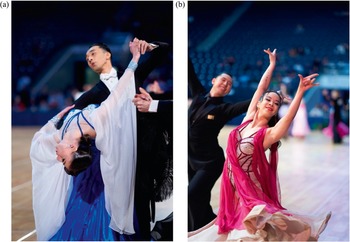


 Open access

