


Introduction
The markhor Capra falconeri is a wild goat occurring in Pakistan, India, Tajikistan, Afghanistan, Turkmenistan and Uzbekistan. It is categorized as Endangered on the IUCN Red List (Valdez, Reference Valdez2008) based on criterion C1 because, at the time of the last global assessment, there were < 2,500 mature individuals, with an estimated continuing decline of 20% over two generations (generation length defined as 7 years). Since 1992 the species has been listed under Appendix I of CITES, which permits trade only in exceptional circumstances.
Heptner's or Tajik markhor C. falconeri heptneri occurs on the Kugitang Range in south-east Turkmenistan and south Uzbekistan (Weinberg et al., Reference Weinberg, Fedosenko, Arabuli, Myslenkov, Romashin, Voloshina, Zeleznov and Shackleton1997a,Reference Weinberg, Valdez and Fedosenkob), and it was recently confirmed to exist in small numbers in north-east Afghanistan along the border with Tajikistan (Moheb & Mostafawi, Reference Moheb and Mostafawi2011, Reference Moheb and Mostafawi2012). Its current distribution in south Tajikistan extends from the Kushvariston range in the south-west, continuing along the eastern slope of the Hazratishoh range and the eastern slope of the south-western edge of the Darvaz range towards Zighar village in the north-east.
To preserve the markhor in Tajikistan a strictly protected area of almost 20,000 ha, the Dashtijum Strict Reserve (Zapovednik in Russian), was set up in 1973, as well as the 53,000 ha Dashtijum Reserve (Zakaznik in Russian), a reserve with regulated natural resource use. Zapovedniks provide the highest degree of formal protection, meeting IUCN category Ia criteria (Dudley, Reference Dudley2008). Zakazniks are protected areas that meet category IV, or more frequently category VI, criteria. However, enforcement of the protection regime of the Strict Reserve is weak, and specific rules for protection of markhor and their habitat in the Reserve are poorly known and not implemented. Fuelwood cutting, unregulated grazing, and poaching are abundant (authors, pers. obs., 2008–2012). Markhor is included in the Red Book of Tajikistan (Abdusalyamov, Reference Abdusalyamov1988), and hunting of the species is currently prohibited in the country, although it is prevalent. According to the most recent published data, there were an estimated < 700 Heptner's markhor in its entire range and < 350 animals in Tajikistan (Weinberg et al., Reference Weinberg, Fedosenko, Arabuli, Myslenkov, Romashin, Voloshina, Zeleznov and Shackleton1997a).
Here we describe a survey conducted during February–April 2012 across the current range of the markhor in Tajikistan and discuss the conservation implications of our results. In particular we examine the role of local communities in the conservation of the markhor and the development of community-based trophy hunting as an incentive for the species’ conservation, and associated challenges.
Study area
The known markhor distribution range in Tajikistan includes the south-western edge of the Darvaz mountain range, the mid part and the southern edge of the Hazratishoh range and the mountains east of Parvor village. The altitude ranges from 600 m in the south-west at the Pyanj River, which forms the boundary between Tajikistan and Afghanistan, to 4,573 m at Kuhifrush peak in the north.
The vegetation (Authors Collective, 2000) in the lower parts of the area consists of open woodland and shrub communities with pistachio Pistacia vera, redbud Cercis griffithii and other shrubs, among them pomegranate Punica granatum and almond Amygdalus bucharica, Artemisia and umbelliferous plants (Prangos pabularia, Ferula spp.). With increasing altitude, juniper (Juniperus seravschanica, Juniperus semiglobosa) occurs in scattered stands, mixed with shrubs of maple (Acer regelii, Acer turkestanicum), rose Rosa kokanica, honeysuckle Lonicera nummulariifolia and Cotoneaster spp.. Markhor rarely use the high mountain zone above the tree line (2,400–2,800 m).
The habitat of markhor overlaps with that of ibex Capra sibirica and urial Ovis vignei bochariensis. Markhor are a potential prey of the snow leopard Panthera uncia, lynx Lynx lynx isabellinus, brown bear Ursus arctos isabellinus, wolf Canis lupus, jackal Canis aureus and golden eagle Aquila chrysaetos.
Most of the people in these areas are agro-pastoralists and own small numbers of livestock. Under the Soviet Union many farmers were resettled but later reoccupied their lands. This history may be one of the reasons for intra- and intercommunity conflicts over pasture and natural resource use.
In terms of responsibility for natural resource management and land use, the areas surveyed include the Dashtijum Strict Reserve, supervised by the State Agency of Natural Protected Areas, forest enterprises, the Leskhozes, belonging to the State Agency for Forestry and Hunting, partly assigned as Reserve, and lands of the State land reserve. Significant areas of the Leskhoz and State land reserve are under long-term lease by peasant farmers. Wildlife management in parts of the area is assigned to two family-based (Morkhur and M-Sayod) and one community-based conservancies (Muhofiz). A conservancy is understood here as a non-governmental organization dedicated to the conservation of wildlife and its habitats and the area it manages.
Methods
We surveyed the area based on accessibility of survey points with good overview and known areas of likely concentration of markhor. The surveyed locations across the range covered c. 36,000 ha (Fig. 1), equivalent to 30% of the total range area of c. 118,000 ha. Heavy snow precluded surveying of some areas. Because of remaining land mines and presence of armed Afghan intruders, we surveyed only parts of the Dashtijum Strict Reserve.
Strictly protected areas and conservancies in Tajikistan, and kernel density estimates of markhor Capra falconeri heptneri in the areas surveyed.

We surveyed when snow was still covering vegetation at higher elevations but vegetation was becoming visible on lower slopes, attracting concentrations of markhor. Three or four teams of 3–6 surveyors carried out the surveys during 22 February–8 March and 10–17 April 2012 (heavy snowfall and lack of access to some areas caused a break of 4 weeks in March). Use of spotting scopes (20–60×) allowed detection and age and sex classification of markhor, at distances of up to 3 km, depending on light conditions, habitat and behaviour. We recorded each point where we searched for markhor, using a GPS (global positioning system) and a topographic map. Teams estimated the distance from the observer to the point at which the animals were first detected, using a range-finder and/or topographic maps. For each group observed, the azimuth from the observation point was determined using the electronic compass of the GPS. Based on the azimuth, distance and characteristic topographic features, we marked the approximate locations of the observed groups on the map. Total number, sex and age classes of all individuals within each group were recorded. We classified markhor as females, yearlings (i.e. 12–24 months old), young of the previous birth season, subadult males (2–3 years old) and adult males (⩾ 4 years old). For adult males we noted those of an estimated age ⩾ 8 years as of ‘trophy age’. Age of males was estimated by horn size and pelage. On the basis of location, group size and composition and recognizable animals, we considered whether observations were duplicates of previously recorded animal groups. Following entry of data in a geographical information system we again checked for possible duplicate observations. All potential duplicate observations were excluded from the total count. We determined the surveyed areas by a viewshed analysis, based on a 50-m digital elevation model (DEM) and corrected the viewshed manually where the resolution of the DEM produced incorrect results. We calculated the kernel density (cell size 120 m, search radius 2,000 m) of the markhor population density for visualizing the species’ distribution.
On two occasions we used the double-observer approach to estimate detection probability. As recommended by Suryawanshi et al. (Reference Suryawanshi, Bhatnagar and Mishra2012), observations were made by two survey teams at an interval of ⩾ 60 minutes. We assigned each observed group of markhor as detected by the first team, by the second team or by both teams. We analysed these data with DOBSERV (USGS, undated).
Results
Across the surveyed range 1,018 markhor were counted, with a mean density of 2.84 km−2 (Fig. 1). The highest concentrations were in the conservancies managed by M-Sayod (8.56 km−2) and Morkhur (13 km−2). We counted a total of 185 unique herds, composed of 1–30 markhor, with a mean herd size of 5.178 ± SD 4.680. The sex and age composition is presented in Fig. 2. Among the adult males 48 were considered to be probably ⩾ 8 years old (4.7% of the total recorded). Most markhor were in groups of mixed sex and age, and some small groups consisted only of males (Table 1).
Sex and age composition of the 978 markhor observed during the 2012 survey (not including 40 individuals that could not be categorized); percentage of the total is indicated after each bar.

Group composition of Heptner's markhor Capra falconeri heptneri in the surveyed areas in Tajikistan (Fig. 1).

* In 34 of these groups subadult males were also present
During the double-observer exercise we recorded 39 markhor groups with 196 animals. The resulting detection probability for these markhor groups was 0.57, the estimated number of markhor groups was 69 (95% CI 51–114), and the estimated abundance was 345 animals (95% CI 255–571).
Markhor were observed at elevations of 650–2,300 m, typically resting or feeding on south, south-west and south-east facing slopes, clear of snow, with preferred vegetation types classified as shrubland, woodland or forest (76% of the observed individuals). We frequently observed markhor standing with their front legs on the branches of redbud, feeding on its branches and leaves (Plate 1).
Markhor Capra falconeri heptneri feeding on redbud Cercis griffithii. Photograph: T. Rosen Michel.

During the survey we observed other wildlife, including a group of five male ibex, and 40 urial. We found tracks of a snow leopard in the west of Dashtijum Strict Reserve and made two sightings of a snow leopard in the M-Sayod conservancy.
Discussion
Our survey of the markhor population in Tajikistan has yielded numbers that are amongst the highest estimates across the entire range of this subspecies (Table 2). The survey's incomplete coverage of markhor habitats and the results of the double-observer exercise suggest that an unknown number of markhor remained undetected. We did not apply the results of the double-observer exercise to estimate the total population size because of the limited application of the method and the possibility that sightings of markhor groups by the first team reduced the likelihood of detection by the second team, thus violating the assumption that observations by the two teams were independent. The second teams observed 71–100% of the herds detected by the first teams. Nevertheless, the calculated detection probability of P = 0.57 is below the values of P = 0.74–0.82 reported for other mountain ungulates (Suryawanshi et al., Reference Suryawanshi, Bhatnagar and Mishra2012).
Estimated population sizes of Heptner's markhor in those countries and areas of its range for which data are available.

Little information was previously available on the distribution and population size of markhor in Tajikistan. Between 1960 and 1970 there was an estimated total of no more than 1,000 markhor in Tajikistan, with a viable population remaining only in the Kushvariston and Hazratishoh mountains (Zhirnov, Reference Zhirnov1977). Ishunin (Reference Ishunin1972) referred to the presence of markhor in the Babatag range, along the border between Tajikistan and Uzbekistan, and in the Hazratishoh range. The Red Book of Tajikistan assessed the number of markhor to be < 1,000 in two areas (the Hazratishoh and Darvaz ranges, and the Sanglak and Sarsarak ranges), 700 of which are in the Dashtijum Strict Reserve (Abdusalyamov, Reference Abdusalyamov1988). No recent reliable information is available to indicate that markhor still exist in the Babatag and southern parts of the Vaksh range (including the Sanglak and Sarsarak ranges). Weinberg et al. (Reference Weinberg, Fedosenko, Arabuli, Myslenkov, Romashin, Voloshina, Zeleznov and Shackleton1997a) mentioned that possibly < 350 markhor remain in Tajikistan, all of which were found in the Hazratishoh and Darvaz ranges.
Comparisons of survey data for 2008–2012 (Committee for Environmental Protection, 2012) are only partly possible as surveys took place during different seasons and in particular areas, and observation conditions were not always the same. However, the data presented in Table 3 suggest that in most areas population numbers have increased or are at least stable. There appear to have been increases in the areas managed by the M-Sayod and Morkhur conservancies. The manager of Morkhur noted that he believed there were only 23 markhor in the conservancy area in 2003 (Michel, Reference Michel2010). The increase in the number of markhor in the M-Sayod area has caused a dispersion of markhor into adjacent areas. This dispersion and the protection by the community-based conservancy Muhofiz have resulted in an increase of markhor in the section of the Darvaz range south of M-Sayod, from four in 2008 to 101 in our survey. Observations north of Zighar indicate that markhor could extend their distribution area to the north if protection and habitat preservation are ensured. Reports of poaching incidents combined with information from local sources suggest that the trend in Dashtijum Strict Reserve is less positive (Michel, Reference Michel2010). However, our limited survey of Dashtijum Strict Reserve was insufficient to assess fully the population size and trend in this area.
Numbers of Heptner's markhor recorded during earlier surveys and our 2012 survey in parts of the study area in Tajikistan (Fig. 1).
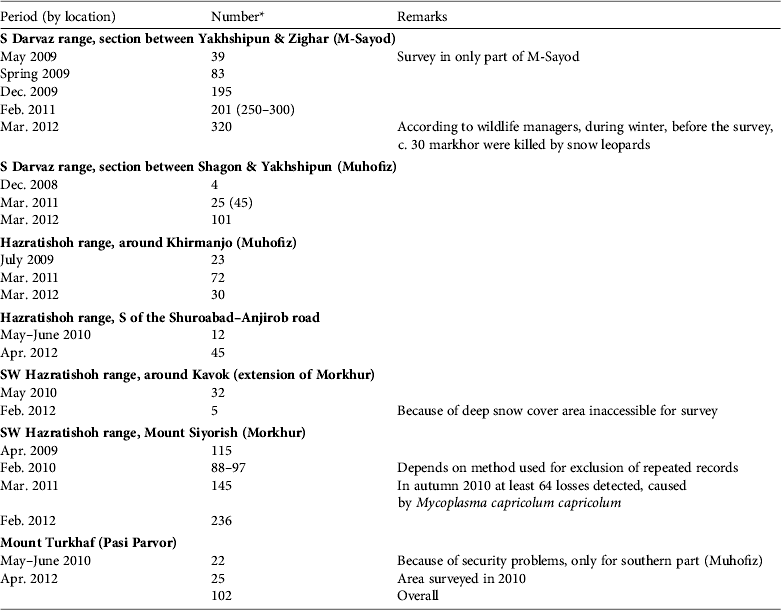
* The numbers in parentheses were provided by rangers of the organizations managing the areas.
The sex and age structure of the population appears to be well balanced. The young : female ratio of 0.97 (possibly higher as yearlings might have been incorrectly determined as female) indicates high rates of reproduction and survival of kids. The low proportion of yearlings per female (0.2) is probably not an indicator of low recruitment but rather a result of the difficulty of determining this age class during the time of the survey, when the yearlings were already c. 20 months old. The male : female ratio of 0.94, or 0.58 if taking into account only adult males of ⩾ 4 years (1.74 female per adult male), suggests that illegal hunting targeting adult males is not significant. In the M-Sayod area the percentage of adult males (22%), and especially those of trophy age (9%), is higher than the mean for the entire surveyed area (19 and 4.7%, respectively) and higher than in any other area (14–20 and 3%, respectively). This could be a result of the longer period of protection from poaching in the M-Sayod area.
There are, however, ongoing threats to the markhor, including poaching, habitat degradation, competition with livestock and disease transmission. In June 2009 Tajik border guards and rangers of the Morkhur conservancy and Dashtijum Strict Reserve found a camp of Afghan poachers with > 100 markhor skins and c. 40 urial skins (Michel, Reference Michel2010). During the 2012 surveys, Afghans were present in Dashtijum Strict Reserve and its surroundings. Reportedly, poachers also originate from villages within the markhor range and from neighbouring districts, and border guards may be involved in shooting markhor occasionally. Cutting of firewood by border guards and local people causes degradation of key markhor habitat. Grazing of sheep and goats puts them in competition for forage with markhor and increases the risk of disease transmission to markhor. In 2010, in the Morkhur conservancy, a pneumonia outbreak killed at least 64 markhor. Mycoplasma capricolum capricolum was the sole infectious agent detected and cross-species transmission from domestic goats was suggested (Ostrowski et al., Reference Ostrowski, Thiaucourt, Amirbekov, Mahmadshoev, Manso-Silván and Dupuy2012a). Ten percent of domestic goats sampled in 2011 in the markhor range were positive for antibodies against Mycoplasma capricolum capripneumoniae, the causative agent of contagious caprinae pleuropneumonia (Ostrowski et al., Reference Ostrowski, Yacub and Zahler2012b).
Despite these ongoing threats, the conservancy approach to conserving the markhor has achieved considerable success, with populations of markhor remaining stable or increasing in the areas managed by the conservancies. This approach began in the 1990s when a local hunter, convinced by a hunting tourist, decided to stop poaching markhor. In 2004 he formally established a conservancy, managed by a small enterprise (M-Sayod). Inspired by this example two other local organizations, the small enterprise called Morkhur and, in 2009, an NGO of local hunters called Muhofiz, were established. These conservancies have been protecting the markhor with the expectation they will eventually be able to sustainably use the species. This approach remains the most effective, as protected areas have not been effective in protecting the markhor given the limited enforcement capacity and the poor security situation (Baldus & Michel, Reference Baldus, Michel, Abensperg-Traun, Roe and O'Criodain2011).
The status of markhor in Tajikistan is now such that well-managed sustainable use could ensure conservation of the species and bring significant benefits to the livelihoods of local people. Successful community-based markhor hunting conservancies in Pakistan, such as the Torghar Conservation Project and the Skoyo–Krabathang–Basingo conservancy, where 80% of the hunting fees are invested in the participating communities (Shackleton, Reference Shackleton2001; Woodford et al., Reference Woodford, Frisina and Awan2004; Frisina & Tareen, Reference Frisina, Tareen, Dickson, Hutton and Adams2009), provide models for how similar schemes could be established in Tajikistan.
No general formula exists for determining a sustainable trophy hunting quota. Take-off rate should take into consideration population size as well as the number of trophy-age males. For trophy hunting markhor in Pakistan, Johnson (Reference Johnson and Freese1997) assumed as sustainable a take-off of 1–2% of the population within any particular area. The Markhor Conservation Management Plans list as a requirement for one hunt a minimum of 50 markhor, of which at least four are of trophy size, recorded in two consecutive surveys (SKB & BK Conservation Committees, 1999).
We suggest the following requirements, following Wegge (Reference Wegge and Shackleton1997), for defining the allowable take-off in a trophy hunting programme in Tajikistan: (1) if in an assigned conservancy during two consecutive surveys at least 100 markhor with a minimum of five trophy-age males have been recorded, permits could be issued; (2) the number of permits should not exceed 1% of the population size and 20% of the males of at least 8 years of age recorded during the most recent survey; (3) the size and age of animals taken, and hunting effort and success rate, should be recorded and if the trend shows any decline in age, trophy size and/or hunting success the criteria would have to be adapted. Surveys should be made by area managers together with independent experts and no extrapolations should be made to unsurveyed areas (Safarov, Reference Safarov2011).
Applying these criteria to the results of our 2012 survey and taking into consideration data from previous local surveys, a suggested quota of five markhor could be divided as follows: three permits for M-Sayod (1% of 320 and 20% of 27); one permit to Muhofiz (1% of 142, 20% of 8); and one permit to Morkhur (1% of 236, 20% of 8). The number of markhor recorded outside the conservancies is not considered in the calculation of the quota.
However, there are some obstacles that need to be addressed. First, individual claims over local wildlife management rights can lead to a fragmentation of management units. These claims need to be reconciled to assign management areas of sufficient size and appropriate configuration covering the year-round habitats of subpopulations.
Second, conflicts arose between one conservancy and the Leskhoz management about the weak enforcement of forest use rules and lease of land to individual peasant farms by the Leskhoz, and about the use of the area for hunting and tourism by the conservancy.
Third, one of the conservancies is organized as a local NGO, consisting of hunters from different villages. Given the existence of conflict over access and use among different members, and non-members, from the local villages, it will be critical to involve more members with high social standing within the community and to design a benefit-sharing arrangement that is fair and inclusive.
Fourth, the two family-run conservancies have been bearing the burden of managing the species without any financial return. It is important that these conservancies become economically viable and that a percentage of the revenues is invested in community development.
Fifth, Tajikistan suffers from corruption and lack of transparency (UNECE, 2012): in the corruption perceptions index 2012 it ranks 157 out of 176 countries, with a score of 22 out of 100 (Transparency International, 2012). This is evident in how difficult it is to track how some of the revenues from the sale of Pamir argali Ovis ammon polii hunting permits are being spent (Wildlife Conservation Society, 2012). For a markhor trophy hunting programme to be successful the participating communities will need to receive significant financial benefits for socio-economic development and funds will need to be spent as earmarked and in a transparent manner.
Sixth, Tajikistan is not yet party to CITES. Technically, CITES import and export permits could be issued for a markhor trophy regardless but it could be politically difficult, unless there is a CITES Resolution such as 10.15 (Rev. CoP14) on ‘Establishment of quotas for markhor hunting trophies’, which establishes a quota of 12 trophies for export from Pakistan.
Failure to address these challenges could compromise the successes achieved so far in conserving Heptner's markhor in Tajikistan. It is therefore of critical importance to continue supporting the conservancies in their efforts to address the threats to the markhor whilst simultaneously developing the legal framework to accommodate legal and sustainable use of markhor and a transparent and equitable benefit-sharing mechanism. Once such a framework is developed, the sustainability of the conservation of markhor will be ensured through the commitment of local people to protect the markhor from poaching and to reduce potentially harmful land-use practices.
Acknowledgements
We would like to thank the following survey participants: Zayniddin Amirov, Nuzar Oshurmamadov and Komil Saidov of the Academy of Sciences of Tajikistan; Fozil Asoev, State Agency for Natural Protected Areas and Tohir Kurbanov of the Committee on Environmental Protection; Davlatali Sharipov, State Agency for Forestry and Hunting; and the rangers of the conservancies and the Dashtijum Strict Reserve. We would also like to thank the German International Cooperation GIZ, the Committee on Environmental Protection under the Government of Tajikistan and its State Agency for Natural Protected Areas for supporting the work. We thank two anonymous reviewers and Rich Harris for advice on the application of the double-observer method.
Biographical sketches
Stefan Michel is a biologist and member of the IUCN Species Survival Commission Caprinae Specialist Group, focusing on the conservation of caprinae in Tajikistan through the development of community-based hunting management, improvement of the legal framework and establishment of systematic population monitoring. Tatjana Rosen Michel is a conservation scientist and lawyer leading PANTHERA's snow leopard programme in Tajikistan. Abdusattor Saidov is Director of the Institute for Zoology and Parasitology of the Academy of Sciences of Tajikistan. He has carried out conservation-oriented research on the country's mammals for more than 25 years. Khalil Karimov is a student of wildlife management and has participated in project work on conservation and sustainable use of mountain ungulates in Tajikistan. Munavvar Alidodov works in a GIZ project on sustainable wildlife management in Tajikistan. Ismoil Kholmatov is a scientific collaborator of the Department of Zoology of the Tajik National University.



