


Carolyn “Carl” McElhinney was a rambunctious child. Perhaps he was a troubled one. He threw stones at cows. He hit dogs with sticks. At age five, some said, he burned down his father’s barn—an allegation his family would later deny. On September 27, 1896, he became something worse: a child that contemporaries called a “baby murderer.”Footnote 1
On that Sunday morning, Carl’s recently widowed mother and several other family members left their house on West Main Street in Dalton, a village of just over six hundred souls in northeastern Ohio. They walked to the United Presbyterian Church, a short distance away, leaving seven-year-old Carl with his baby sister and his mother’s boarder, fourteen-year-old Tommy Kidd. One of Carl’s elder sisters returned home a little over an hour later to confront a gruesome sight—blood spattered on the ceiling of the sitting room, shot scattered across the floor, walls pockmarked, and a mirror in an adjacent room shattered. A double-barreled shotgun stood in its usual place, with one of its two chambers loaded. Tommy was dead, slumped in a chair. Carl and eighteen-month-old Maggie were nowhere to be found.Footnote 2
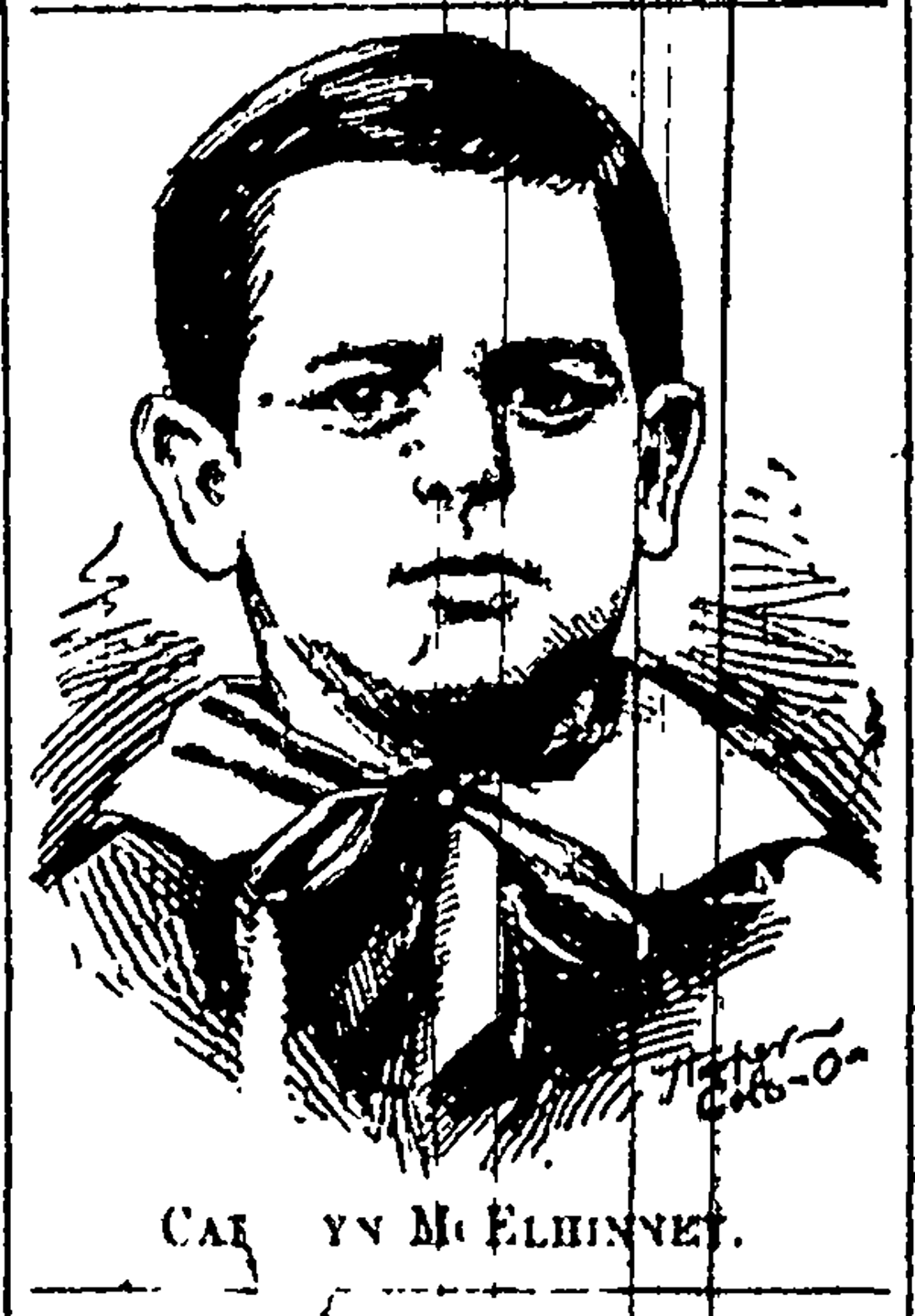
They were soon discovered playing at a home nearby. Carl first denied knowing anything about Tommy’s death. Persistent questioning by a trio of local authorities—the mayor, county coroner, and town marshal—led him to confess his part, though the information extracted from a frightened seven-year-old was not especially consistent. According to one account, the two boys had quarreled, and Carl had retaliated by shooting his playmate. According to another, the shooting was an accident, the result of “playing rabbit.” A third report suggested Carl had merely intended to frighten Tommy. “I didn’t know that the gun would shoot unless it had caps on it,” he told his mother.Footnote 3 (Figure 1)
Carl McElhinney described as a “Seven-Year-Old Murderer,” Indianapolis Journal, October 1, 1896. Public domain.

Carl McElhinney captures the dilemmas that newspaper reporters, local authorities, medical experts, and ordinary citizens confronted as they wrestled with the problem of children who killed. How could you distinguish an accident from a “well-defined motive to do an injury?”Footnote 4 At what ages did children understand the consequences of their actions? When were they old enough to grasp the finality of death? Could murderous tendencies be nipped in the bud? Were homicidal impulses inherited, the result of deficient parenting, or the fault of a corrupt environment? Were baby murderers mentally ill, morally deficient, or just plain evil? Did the law sufficiently deter perpetrators and protect potential victims?
These dilemmas are still with us. But they acquired special resonance in the late nineteenth century, a time that preceded the establishment of separate juvenile justice systems but one in which the right to what the historians Susan Pearson and Michael Grossberg term a “protected childhood” had gained increasing (but by no means universal) acceptance.Footnote 5 The Gilded Age, then, offers a particularly rich vantage point from which to view how various popular definitions of childhood intersected and clashed with medical understandings and legal procedures. It also offers us a window into competing impulses which are also still with us—to protect children, to reform them, but also to punish them.
***
In nineteenth-century parlance, a baby murderer could mean an abortionist, the unscrupulous proprietor of a “baby farm,” or, more obviously, any adult who murdered a child.Footnote 6 By the 1870s, however, the term increasingly described a youngster, almost always a boy, who caused the death of someone else, his victim usually another child. Newspapers seized on the phrase for its sensational appeal and semantic possibilities: “babies” were both perpetrators and victims. Nearly fifty such “perpetrators” made the papers in the years between 1869 and 1900, to be sure a tiny, tiny portion of the nation’s juvenile population.Footnote 7 Their significance resides not in their numbers but in what they reveal about attitudes toward crime, punishment, and childhood. At the same time, we cannot forget the human tragedies behind the sensational headlines and lurid prose. Baby murderers were media creations, but they were also real children. Black children, predictably, were overrepresented within this journalistic universe, part of a long history of their criminalization.Footnote 8 That said, baby murderers included children from solidly middle-class families as well as those from impoverished households, rural and small-town kids as well as urban children, and children from all parts of the nation. Wherever they lived, the expansion of wire services ensured their stories circulated far and wide.Footnote 9 (Figure 2)
The “FIVE O’CLOCK LATEST!” from the June 11, 1895, issue of the Biddeford Daily Journal, in Biddeford, Maine—an example of one of many late nineteenth-century newspaper headlines featuring baby murderers. Public domain.

The details, though in many instances embellished, were disturbing. Armed with a bent piece of iron, five-year-old Bud Harris of Columbia, South Carolina, crept into the house of his next-door neighbor and “perforat[ed]” the skull of her infant child. Six hundred miles to the north, in Philadelphia, William Sewell Jackson, age three, killed a lodger’s two-month-old with a red-hot fire poker. In Indianapolis, three-year-old Clarence Siler set his infant sister’s clothing alight. In Akron, Ohio, Howard Rempes, age six, got hold of his father’s “loaded, 22 caliber revolver,” pointed it at his four-year-old friend, and said, “Artie, I am going to shoot you.” Angered when a two-year-old acquaintance refused to speak to him, Gilbert Bowsher of Monticello, Indiana, age four, retaliated by hitting her with a stone.Footnote 10
Though their numbers paled in comparison to the ranks of other young delinquents who populated the pages of late nineteenth-century newspapers—baby firebugs, infant burglars, and baby pickpockets—baby murderers confirmed moralists’ worst fears: something was terribly wrong with the nation’s youngest citizens. “We have … boys under ten years of age whose little hands are red with the dripping blood of human victims of their precocious depravity,” the July 4, 1875, issue of the Leavenworth, Kansas, Daily Commercial complained—a development its editor believed threatened “the perpetuity of our republican form of government.” Two years later, the San Francisco Examiner lamented “the bloody adventures of our infant outlaws.” “To What are We Tending?” asked the Philadelphia North American, in June 1895, as it bemoaned the “murderous violence indulged by boys of tender years.”Footnote 11
The shadow of Jesse Pomeroy, the nation’s most notorious juvenile criminal, hovered over these conversations. In 1874, at age fourteen, Pomeroy viciously killed a ten-year-old girl and four-year-old boy in South Boston. Narrowly escaping the death penalty, he was sentenced to life imprisonment. Although at least one baby murderer made the news before Pomeroy became a media sensation, his horrific acts set the stage for a moral panic about younger perpetrators.Footnote 12 Some accounts invoked Pomeroy explicitly, years or even decades later. Carl McElhinney, at least one newspaper reported, “seems a Pomeroy counterpart.” Four-year-old Cicely Lewis, of Port Jefferson, Long Island, was “a girl Jesse Pomeroy;” Clarence Siler was “a youthful Jesse Pomeroy.”Footnote 13 This description made sense in the language of the time. Pomeroy was a boy murderer, a label that generally, though not exclusively, described children in their teens. “Baby murderer” was a journalistic term, not a legal one, and its parameters were anything but precise. In an era when chronological age was gaining increasing importance reporters mostly applied it to children too young—or just barely old enough—to be prosecuted.Footnote 14 (Figure 3)
“Boy murderer” Jesse Pomeroy. At age fourteen, in 1874, Pomeroy killed a ten-year-old girl and four-year-old boy in South Boston. Pomeroy’s vicious acts helped to trigger journalistic and popular interest in younger perpetrators. Philip Farley, Criminals of America (New York, 1876), 79. Public Domain.

It is not that very young children did not kill other children before the 1870s.Footnote 15 But in the latter half of the nineteenth century and to some extent into the twentieth, newspapers used “baby murderer” to both sensationalize and rhetorically criminalize childhood tragedies. “Can this be termed murder?” the Carthage, North Carolina Blade asked in the case of two “youthful murderers,” ages four and five. “The law says not, yet the fact[s] leave … the impression that they knew the enormity of their crime and feared the consequences of it.”Footnote 16
***
The circumstances in which babies became murderers varied. Some killed siblings or other relatives. One spring day in 1885, Cicely Lewis’s mother, a laundress, left their modest Long Island home to go out to work, reminding six-year-old Henry and four-year-old Cicely (sometimes called Lizzie) to “take good care” of their six-month old sister. Henry thought Cicely was joking when she said, “Let’s kill baby, will we?” He learned otherwise when she began attacking the infant with her father’s fish knife.Footnote 17
Several papers suggested Cicely, one of a tiny number of baby murderesses who made the late-nineteenth-century news, had inherited her mother’s supposed insanity, an illness to which medical experts believed Black people especially susceptible. None of the more than one hundred articles describing a “youthful carver,” “a little girl’s crime,” or an “insane child’s bloody work” made the connection explicit. Not one, however, failed to mention her race.Footnote 18
Other accounts claimed Cicely was jealous of her baby sister. If so, her actions offered a particularly spectacular instance of sibling rivalry, a concept that was just beginning to gain traction, although the term itself was not coined until the late 1920s. Advice writers warned parents not to show excessive favoritism to new arrivals. As Babyhood magazine explained, mothers would do well to remember that a big sister or brother held “in … their dimpled fists the well-being, the very life” of their younger sibling.Footnote 19
Cicely Lewis’s heartbreaking story suggests another motive (if we can call it that) that drove baby murderers: some were children tasked with caring for other children. Child labor conjures up visions of children toiling in factories, cotton fields, and tenement sweatshops. We do not always view babysitting in same light, even less so when the job involves caring for younger relatives. Yet it was work, labor that children sometimes resented.Footnote 20 Child caregivers might take that resentment out on their young charges, hitting, pinching, dropping, teasing, or neglecting them. Or, in very rare instances, worse. “Tired of nursing,” one nine-year-old agreed to kill her infant stepsibling in exchange for five cents. Tasked with minding his eleven-month-old nephew and angered because his uncle had subjected him to “a severe flogging,” seven-year-old Richard Smith of Bartlett, Tennessee, picked up a shotgun and fired it at the baby.Footnote 21
Grinding poverty forced parents to make difficult choices that endangered their children. Working-class fathers and mothers, especially widows and widowers, expected young children to look after even younger siblings. The problem was especially acute for Black families, few of whom could get by on the wages of a single earner. At the same time, their stories provided white readers with confirmation of Black children’s supposedly natural criminality.Footnote 22
***
If some “murders” committed by young children happened during work, others happened during play—and of course the two activities were far from mutually exclusive. Despite thousands of pages devoted to the solemn duties of motherhood, nineteenth-century parents of all classes generally exercised only minimal supervision, especially where boys were concerned.Footnote 23 Left to their own devices, kids sometimes resorted to violence, pushing, shoving, punching, and hitting other children. Or worse. Then, as now, play often resulted in arguments and hurt feelings. Sometimes disagreements could be fatal—as when four-year-old Dudley Kimball, a resident of Boston’s still-fashionable South End, shot and killed his six-year-old neighbor, when the latter refused to share his candy. Tired of playing with his five-year-old cousin, eight-year-old Johnny Hexamer of Malvern, Ohio, warned he would shoot him if he did not leave. In State Line, Mississippi, Edmund Boykin, the five-year-old son of a prominent physician, shot his older brothers, one of them fatally, when they refused him a turn with their air gun.Footnote 24 (Figures 4 and 5)
“Summer Vacation.” Our Dumb Animals, published by the Massachusetts Society for the Prevention of Cruelty Against Animals, reprinted this idealized version of children’s play from the Children’s Visitor. Our Dumb Animals, July 1898, 21. Public Domain.

An image of boys fighting from a popular children’s book published on both sides of the Atlantic and reprinted several times since the 1840s. “It grieves me to tell of anything so disgraceful,” the author explains. Julia Corner, Sketches of Little Boys (McLoughlin Brothers, c. 1863–1870), 45, 49. Courtesy, American Antiquarian Society, Worcester, Massachusetts.

Baby murderers wielded a variety of weapons: rocks, bricks, knives, sticks, fire pokers, and, in one case, a scrap of metal that had no specific purpose. Not quite half of them used guns. In circumstances that sound sadly familiar to modern ears, some children thwarted their parents’ attempts to keep firearms safely hidden. Left at home while his parents ran an errand, six-year-old Howard Rempes of Akron retrieved “his father’s loaded, 22 caliber revolver, the hiding place of which he evidently knows.” Dudley Kimball’s mother placed her husband’s Smith and Wesson “on a shelf beyond his reach, as was supposed.” In other cases, loaded guns were readily accessible. Johnny Hexamer grabbed “a shotgun standing near by” and took deadly aim at his tiresome cousin. It took Edmund Boykin only minutes to retrieve the “small shotgun” with which he shot his siblings.Footnote 25
These instances suggest that even very young children knew a fair amount about guns and how to use them. Even faulty knowledge demonstrated familiarity with the workings of firearms. Richard Smith said he only wanted to “pop a cap” to frighten his infant niece or nephew. “Why mama, I didn’t know that the gun would shoot unless it had caps on it,” Carl McElhinney reportedly claimed.Footnote 26
Rural boys knew about guns—or at least enough about them to endanger themselves and others—because they learned to hunt at an early age. How early is difficult to tell, given the ambiguous meanings of “boy,” a term applied in equal measure to three-year-olds and twenty-year-olds. In January 1892, a Springfield, Missouri, eight-year-old “went hunting … and brought down three squirrels and a quail.” The St. Joseph Herald did not approve. “A boy of that age,” an anonymous reporter wrote, “armed with a shotgun usually brings down another boy.” And, indeed, stories that featured preteen hunters often had tragic endings. In central Pennsylvania, a “young boy” squirrel hunter, age unknown, died when his gun discharged, hitting him in the stomach. An eight-year-old Kansan accidentally shot himself while ‘“punching a rabbit out of a hole.”Footnote 27 (Figure 6)
“A lad with a gun,” from popular illustrator Frank Bellew’s humorous alphabet book, A Bad Boy’s First Reader (G. W. Carleton and Co., 1881), 7. Courtesy, Baldwin Library Collection of Historical Children’s Literature, University of Florida, Gainesville, Florida.

Still, even if no one turned them loose with rifles or shotguns, young children tagged along with fathers and older brothers or watched them closely, learning by example. Carl McElhinney “knew how to load … [a shotgun], having seen others do it.” In towns and cities, elders wittingly or unwittingly demonstrated the use of handguns. Five-year-old Hiram Leidy pointed a revolver “at his younger brother as he had seen his father point it at a dog.” As one newspaper observed of four-year-old Dudley Kimball, “some older person … must have committed the egregious folly of teaching the child how to cock the pistol and pull the trigger, or it may have learned these things from the use of a toy gun injudiciously given to it as a plaything.”Footnote 28
Even toy guns, designed to shoot blank cartridges, could be dangerous. Joseph Mullery, age nine, of Brooklyn accidently shot himself with a toy pistol; the wound became infected, and he died of tetanus. Mullery was far from the only child to perish from a festering wound inflicted by a toy. Such incidents were sufficiently common that some localities attempted, not wholly successfully, to ban toy guns, especially around the Fourth of July, when they competed with firecrackers for children’s attention. “Fourth of July and Lockjaw” read a Chicago Tribune headline. Terming the “deadly toy pistol” a “Yankee weapon of unlimited powers of destruction,” the Wheeling, West Virginia, Sunday Register claimed the toy gun had eclipsed “the ‘unloaded gun’” as “the most deadly engine of destruction in America.”Footnote 29
***
Children who died from accidents far outnumbered those “deliberately” killed by their peers. Accidents of many sorts claimed the lives of children. Kids tumbled from trees, fell into wells, and overturned pots of boiling water. They dashed in front of streetcars, carriages, and trains. They confused poison with candy. They played with fire.Footnote 30 And they shot themselves or others, sometimes with toy pistols that fired blanks, other times with the real thing. Some mistook a gun for a toy; others, as the Sunday Register implied, picked up a gun they did not realize was loaded.Footnote 31 Still the line between an accident and a deliberate act was a fuzzy one, and the meaning of “accident” often less than clear.Footnote 32 The legal decision was up to the coroner, but enterprising journalists did not always agree with official verdicts. Reporters could not decide, for instance, whether the death of Roderick Boykin was the work of an “infant desperado” or a “sad and deplorable accident.”Footnote 33
While boys—given longstanding associations between guns and masculinity—were the major perpetrators of both accidental shootings and supposedly deliberate acts, girls, too, occasionally pulled the trigger. Gun-toting girls, however, almost never committed murder.Footnote 34 Maggie Tobin, the eleven-year-old protagonist of a “tenement house tragedy,” was typical. In what one newspaper termed a “shocking accident,” another, a “distressing accident,” the eleven-year-old Philadelphian shot and killed her six-year-old sister while “playing soldier” with her teenage brother’s revolver. There was little legal or cultural debate regarding the nature of Maggie’s act; a coroner’s jury speedily returned a verdict of accidental death. That Maggie was an “innocent murderess,” as the Philadelphia Times dubbed her, and hers “clearly a case of accidental shooting” suggests how gender (and race) shaped the ways journalists and local authorities defined accidents, holding a girl, even one a full six years older than Edmund Boykin, less than responsible for her actions. While it would be foolhardy to draw definitive conclusions given the wildly lopsided ratio of “murders” to “accidents,” it is worth noting that girls accounted for only three of the fifty or so children newspapers called baby murderers. It is also worth noting that two of them were Black.Footnote 35
Maggie tearfully—and most likely truthfully—insisted that she “didn’t mean to do it.”Footnote 36 Yet even when children intended to inflict pain—such as when Cicely Lewis said “Let’s kill baby”—it is unlikely the youngest of them understood the consequences. Death was a frequent visitor to nineteenth-century households. In an era when a fifth did not live to see their first birthdays and another fifth died before age five, the death of a sibling was not uncommon. Neither was the death of a parent. Death was not just an absence but a physical presence. Families laid out bodies in parlors; they attended open casket funerals; they hired photographers to take postmortem pictures by which to remember the dead. While some parents shielded the very young from these experiences, it seems safe to say that children of the late nineteenth century had a more intimate acquaintance with death than do their twenty-first-century counterparts.Footnote 37
Perhaps for this very reason, nineteenth-century children’s literature romanticized death, assuring young readers that the dearly departed were heaven-bound. “How beautiful will brother be, When God shall give him wings, Above this dying world to flee, And live with heavenly things!” read a poem published in The Child’s World. Pretend death, whether the game involved cowboys, cops and robbers, make-believe military battles, or characters from fiction and fairy tales, figured prominently in children’s play. As a young girl in the 1890s, New England novelist Mary Ellen Chase liked to imagine she was “covered with leaves like the Babes in the Wood” or “Little Nell lying dead while her canary still stirred in its cage.”Footnote 38
While nine-year-old Mary Ellen understood the difference between reality and fantasy, younger kids might not. One early twentieth-century psychoanalyst argued that very young children saw death as “a temporary standstill of the life-functions,” an observation that mirrors more recent research that many young children consider death reversible.Footnote 39 Evidence suggests this was true for Gilded Age children as well. “Don’t put my little brother into that hole,” a child of three screamed at a sibling’s burial. “She won’t speak to me!” a fictional toddler cried when brought to see his little sister for the last time.Footnote 40 A Florida three-year-old who killed his infant sibling was discovered “rocking [the dead child] in his arms.” A Chicago mother discovered her five-year-old son “running about the room and laughing,” shortly after shooting his younger brother, apparently “unconscious of what he had done.”Footnote 41
***
Legally, almost none of the cases involving so-called baby murderers amounted to murder. Most states followed the common law, which held children younger than seven incapable of distinguishing right from wrong and therefore not culpable for committing a crime. Most of the children described in newspaper headlines as baby murderers committed cultural crimes, not legal crimes. Titles such as “Youngest Murderer on Record,” “Four Year Old Murderer,” and “A Two-Year-Old’s Crime” sold papers. But they also hinted at a gap between legal meaning and social beliefs.Footnote 42
The stock phrases with which news accounts typically closed—“little can be done”; “too young to be held responsible”; “out of the reach of the law”— were statements of fact, the predictable denouements of cases that could not be prosecuted. Yet they also were laments. They expressed hope that a misguided child could be set straight, the community protected, or both. At times they expressed a desire for punishment. Recall the words of the Carthage, North Carolina, Blade in its story about the four- and five-year-old killers. “Can this be termed murder? The law says not, yet the fact[s] leave … the impression that they knew the enormity of their crime and feared the consequences of it.”Footnote 43
Given the limits of the law, what could be done? In some instances, most often in cases that involved working-class children, local authorities and child saving organizations intervened by removing young offenders from their families and placing them in orphanages or asking judges to sentence them to reform schools if they met the minimum age requirements. Only rarely did baby murderers stand trial, even if they met the common law standard, and even more rarely were they convicted. As far as I can tell, most continued to live among the very people they once had terrorized. Whether they lived down their reputations we cannot know.
***
This brings us to Carl McElhinney, “the seven-year-old murderer.” His story, situated on the murky boundaries between work and play, intention and accident, knowledge and ignorance, evil and innocence, reveals a good deal about the debates a baby murderer might provoke, and the creative ways a community might navigate legal—and cultural—obstacles.
Carl’s transgression could not be easily explained by familiar references to race or class. His father was a prominent citizen of his small Ohio town. A farmer and coal mine operator—who at one time employed over four hundred workers—David McElhinney was also a Union veteran, stalwart member of the Grand Army of the Republic, town councilman, and singer in Dalton’s United Presbyterian choir.Footnote 44 The McElhinneys, like many families, had fallen on hard times by the 1890s. Things went from bad to worse; in December 1895, David, no longer a mine owner, but a miner, was paralyzed in a workplace accident. He died eight months later, leaving behind a wife and ten children, six of them still at home, only one of the latter gainfully employed.Footnote 45 Given her straightened circumstances it is not surprising that Frances McElhinney agreed to host fourteen-year-old Tommy Kidd “under pay for board and care” when a family emergency called his mother to Cleveland.Footnote 46
Two aspects of Carl’s case were especially troubling. Tommy was disabled, using a wheelchair. And unlike the perpetrators of many accidents, Carl did not pick up a loaded gun that a careless adult left within reach. Quite the contrary. A neighbor who had recently borrowed the weapon made a point of returning it unloaded; Carl had to go to some trouble to render it operational. After fetching the gun from his mother’s bedroom on the first floor, he went upstairs to find shotgun shells. These he loaded into empty chambers. It was this chain of events that led the Wooster Republican to describe his act as “one of the most fiendish and deliberate in the history of the county or state.” The county coroner agreed. Carl, his verdict concluded, “deliberately loaded a double-barreled shot gun for the purpose of shooting said invalid Thomas Kidd.”Footnote 47
Tasked with explaining Carl’s terrible deed, observers offered various and competing theories. Some emphasized previous misbehavior, a familiar ritual in which adults constructed a criminal history to explain a child’s shocking act. In the words of the Cleveland Plain Dealer, Carl was “the bully of the neighborhood,” the terror of the whole community,” a boy “universally feared as a maker of petty disturbances.” Several papers reported his supposed history of barn-burning, evidence, one physician claimed, of “a tendency to criminality.” Others hinted at a history of cruelty to animals. Dalton’s mayor recounted an alarming incident: Carl had nearly “brained” a neighboring child.Footnote 48
Even so, various experts puzzled over whether he was culpable, revealing a sort of vernacular criminology in action. “Is the boy morally responsible?” the Wayne County Democrat asked. A visiting reporter from Cincinnati thought he was. “Little McElhinney,” he declared, “shows the tact of an adult criminal.”Footnote 49 A phrenologist and a physiognomist also decided in favor of Carl’s culpability, by determining he “was not, and is not, mentally deranged.” Whether these “two eminent physicians” personally examined him is not known. The one doctor who knew the boy, the McElhinney family physician, insisted Tommy’s death was an accident.Footnote 50
Some believed Carl’s criminality was inherited—an opinion that potentially absolved him of responsibility but increased the danger he posed to the good people of Dalton. The Plain Dealer published a “contour” of his head, presumably sketched by the phrenologist. The illustration appeared without explanatory text; evidently the paper expected informed readers to draw their own conclusions. When the Plain Dealer asked, “Is Crime Hereditary?” a Dr. H. R. Bittern, one of the supposedly eminent physicians who pronounced Carl sane, answered in the affirmative. Emphasizing Carl’s “abnormal development of criminality,” “delight in the inhuman” and “the intense horror” necessary “to please … [his] peculiar appetite,” Bittern bypassed the usual Jesse Pomeroy comparisons in favor of an infamous “multimurderer” hanged only months before. Even H. H. Holmes, who recently had confessed to killing twenty-seven victims, “did not show his tendencies before maturity,” Bittern claimed.Footnote 51 (Figure 7)
“Contour of the Head of Carl M’Elhinney,” Cleveland Plain Dealer, October 4, 1896. Public domain.

And yet the “theory” Bittern presented drew heavily on Pomeroy lore. He deftly combined two hypotheses popularly applied to the fourteen-year-old boy murderer. Some explained Pomeroy’s crimes by invoking the theory of maternal impressions, the idea that a pregnant women’s experiences or emotions marked the child she carried. Newspapers circulated the lurid claim that Ruth Pomeroy, while pregnant with Jesse, visited her husband’s butcher shop to delight in the spectacle of animals being slaughtered. The rumor turned out to be false; Pomeroy’s father had never even worked as a butcher. Of course, that did not stop the story from circulating. Others held unwholesome literature responsible for creating a boy who became a “monster.” Pomeroy was an avid reader of dime Westerns; his favorites involved “narratives of bloody tragedies among the Indians.” For moralists who feared the impact of dime novels on the nation’s youth, there was no better example of the dangers sensational fiction posed. It was only a short step, Pomeroy’s horrific career suggested, from reading about bloody tragedies to enacting them.Footnote 52
From these two competing schools of thought Bittern fashioned a creative synthesis: Frances McElhinney, he contended, read “flashy novels” while pregnant with Carl. “Morning, noon and evening her mind was preoccupied with imaginative crimes of the most bloody sort” so much “that her mind was miserably contorted weeks before and at the birth of her child.” How Bittern acquired this information is unclear—perhaps he simply made it up. It seems unlikely that “one of the best educated women in the town of Dalton” and the “best Sunday school teacher that attends the United Presbyterian church” spent her eleventh pregnancy reading trashy crime fiction. Bittern’s theory of criminality via maternal impressions, whatever its evidentiary basis, led him to “doubt that even a severe schooling in one of our severest reformatory institutions would better … [Carl’s] condition.” However, he concluded, “By all means, he should be sent to one.”Footnote 53
The county coroner suggested, to the contrary, that youthful offenders were made, not born. He, too, blamed Frances McElhinney, not for what she did while pregnant, but for what she had failed to do once her child was born. “Had this murderous youth been blessed with home training by those whose duty it was to guide his footsteps away from his little crimes,” his verdict concluded, “this murder might not have occurred.” Frances was not the only guilty party, his choice of words suggests. Those who neglected to bless young Carl with “home training” presumably included the late David McElhinney as well. Folded into an official determination of cause of death was a moral judgment—and a stunning indictment of one of Dalton’s first families.Footnote 54
E. B. Eshelman, the editor of the Wayne County Democrat, agreed that “moral responsibility rests with the parents,” but was “loathe to believe” Carl was “as bad as pictured or any different than the average seven year old boy.” Indeed, the Democrat literally pictured the young defendant. While the portrait that previously appeared in the Plain Dealer showed a scowling “seven-year-old boy murderer,” the Democrat borrowed the “authentic picture” published by the Plain Dealer’s rival, the Cleveland Press. This “only correct picture” lent visual credence to Eshelman’s claim that Carl did not look like a “little monster.” Nor was he one. Average seven-year-old boys, Eshelman explained, threw buckeyes at their friends, hit dogs with sticks, and hurled stones at birds, cows, and barns. Anyone foolish enough to believe “the average 7-year-old child is sprouting wings,” he suggested, should try “liv[ing] a year or two alongside” a schoolhouse.Footnote 55 Seventy-two-year-old Eshelman, known as “Old Figgers,” evoked a vision of boyhood that challenged the sentimental and, as he would have seen it, sissified behavior organizations like the Society for Prevention of Cruelty Against Animals encouraged. Nor did Eshelman, “a member of no church … but a most sincere Christian,” seem to embrace the organized manly recreations advocated by acolytes of muscular Christianity. Instead, his vision was both old and new—it harkened back to an imagined rough and tumble past and also anticipated what would come to be called the strenuous life.Footnote 56 (Figures 8, 9, and 10)
A sketch of Carl McElhinney printed in the Cleveland Plain Dealer, October 1, 1896. Public domain.

“The Only Correct Picture” of Carl McElhinney, Cleveland Press, October 5, 1896. Public domain.

The Wayne County (Ohio) Democrat, October 7, 1896, likely borrowed this image from the Cleveland Press’s “only correct picture.” Public domain.

Public opinion was divided. Few Daltonians seem to have endorsed the Cincinnati Times Star’s musings on capital punishment (“Are the ends of the criminal code subserved so long as such monsters live? Is society protected?”), but some considered Carl “a moral monster who should end his days in prison.” Others believed Tommy Kidd’s death a tragic accident. Still, many parents did “not care to have their little ones associate” with the young offender. Enough locals protested Frances McElhinney’s decision to send Carl to school in the immediate aftermath of the tragedy—she “did not think it was right to keep the boy from getting an education”—that the mayor felt compelled to intervene.Footnote 57
As medical experts, newspaper reporters, and ordinary citizens rendered various opinions on Carl’s character, culpability, and redeemability, local authorities were struggling with procedure. Bittern’s recommendation notwithstanding, the state’s reform school did not accept children younger than eight. But Carl was not too young to be prosecuted—a key reason his case remained in the public eye. According to both the common law and Ohio’s criminal code, a child between the ages of seven and fourteen could be held accountable, if it could be proved he understood the difference between right and wrong and that “he acted with malice and evil intention.”Footnote 58 Carl was barely seven—to be precise, he had turned seven only twenty-three days before he shot Tommy Kidd. Nevertheless, the county prosecutor entered a charge of second-degree murder (intentional, but not premeditated, killing), a charge that avoided the possibility of a death penalty.Footnote 59
After a preliminary hearing in the Dalton town hall, the mayor bound the case over to the county grand jury. Six weeks later, the jurors announced their decision, finding Carl McElhinney “innocent of the charge preferred against him by reason of his youth, being thus incapable of comprehending the nature of the charge preferred.” They also found him “without proper parental care on account of the recent death of his father,” and recommended his admission to the Soldiers’ and Sailors Orphans Home in Xenia, some two hundred miles away. Extolling the institution’s “education and influences,” they saw the orphanage as the best next thing to a reform school. Frances McElhinney did not resist. Although she bristled at criticism of her parenting, the Orphans Home seems to have been at least partly her idea.Footnote 60
Still, the decision was not solely up to Frances McElhinney or even to the grand jury. The jurors only did what their friends and neighbors asked them to do. More than a month before they rendered their verdict, various Ohio newspapers were reporting that Wayne County residents were mounting an effort to place Carl in the orphans home. Those local citizens who believed him guilty of premeditated murder and those who believed Tommy Kidd’s death a terrible accident agreed on one thing: they wanted Carl sent away. Some hoped to protect the safety of their own children; others argued it was for Carl’s benefit to send him to “some institution where his young mind can be properly trained and where he would not be constantly reminded of his deed.”Footnote 61
More broadly, the disposition of the case failed to resolve troublesome questions about the nature of child criminals and the nature of childhood itself. By 1896 the phrases newspapers invoked to describe children like Carl—“terror of the whole community,” “terror of the neighborhood”— had become clichés, trotted out whenever news of a baby criminal surfaced. Yet as Eshelman observed and various historians have noted, violence was woven into the everyday fabric of boys’—and, often, girls’—lives.Footnote 62 If the average seven-year-old abused animals and hit his playmates did that mean that all such children could become murderers? Where did boyhood end and monstrosity begin? Sending Carl to a distant orphanage dodged the question. Still, the solution satisfied both those residents who feared the presence of a “morally insane child” and those who thought the boy needed a fresh start.
It did not satisfy everyone. “The youthful murderer of Wayne County goes scott [sic] free,” the Bucyrus, Ohio, Telegraph-Forum complained. Nor did it satisfy the Orphans Home, which had other plans. “The gentlemen composing the grand jury of Wayne county … apparently do not understand much of this institution,” its newspaper, the Home Weekly, observed. Children could not be “committed” to the home; they had to apply. Carl’s prospects were not promising. “Our trustees are not likely to pass over nearly 600 applications now on file to receive an applicant with such a record as Carl McElhinny [sic], whose influence among his associates would naturally be very bad, to say nothing of the danger caused by his presence.”Footnote 63
There is, of course, much we cannot know. We can only imagine the grief—and anger—of Tommy Kidd’s family, their sorrow compounded by the death of their patriarch less than two months later. We can only imagine the McElhinneys’ own grief and their anxiety over Carl’s fate. We can only imagine the local gossip, the whispers, the stares, the shame, and embarrassment that Frances McElhinney felt when she complained that newspaper coverage reflected poorly on her family’s “good name.” We can only speculate about the ongoing relationship between the two families, who continued to live next door to each other for three more years.Footnote 64 And we can never know what Carl was thinking—and feeling—when he loaded shells into his eldest brother’s shotgun. Perhaps, even at his most truthful, he could not have explained it himself.
One thing we do know: Carl did not get off scot-free. Only a week after the Wayne County grand jury rendered its presumably impotent decision, he contracted diphtheria, a disease responsible for some ten to fourteen percent of nineteenth-century childhood deaths. He died only two days after falling ill.Footnote 65
The words of the Wayne County Democrat may sound callous to us, but I think they meant to be kind. “Death,” it concluded, “ended [Carl’s] troubles.”Footnote 66
Acknowledgments
My thanks to Brianna DeValk, Connie Goddard, and Ann Vlock for their comments on an earlier version of this essay. I also owe thanks to Brianne Barrett and Nathan Fiske, American Antiquarian Society, Amber R. Coffman, Wayne County (Ohio) Public Library, Fiona Hartley-Kroeger, Baldwin Library of Historical Children’s Literature, University of Florida, Gina Piastuck, Historic Documents Library, Suffolk County (New York) Clerk’s Office, and Cyndi Shull, Wayne County (Ohio) Microfilmed Records. A fellowship from Indiana University’s College Arts and Humanities Institute supported the research and writing of this piece as did funds from the Robert F. Byrnes Professorship.



 Open access

