




1 Introduction
This article investigates some functions of the determinative sum(e) in Old, Middle and Early Modern English. It traces, quantifies and models the diachronic development of sum(e) as a prehead element from a constructional perspective. Our contribution especially focuses on the demise of the so-called ‘individualizing’ usage with singular nouns (1) and traces the incipient stages of sum(e) as an indefinite near-article with plural and mass nouns (2).
(1) & sum wif hatte Uenus, seo wæs Ioues dohtor …
‘and there was a woman called Venus, who was Jupiter's daughter’ (Dictionary of Old English Web Corpus [DOEC] 2009, WHom 12 [0026 (77)])
(2) … þat he schuld sende summe prestes to þis lond …
‘… that he should send some priests to this land …’ (PPCME, CMCAPCHR, 54.655)
We will argue that the use of sum(e) with singular nouns became marginalized because of constructional competition with the numeral ān. In Old English (OE), the two forms were both occasionally used to mark indefiniteness before singular nouns, but ultimately ān became the default marker of indefiniteness ousting sum(e). We will also show that Middle English (ME) sum(e) started to grammaticalize into an indefinite near-article for plural and mass nouns in late Middle English, following the previously established indefinite singular article a/an.
Originally lacking an indefinite article category, English developed one in the wake of the complete systemic reorganization of definiteness and indefiniteness marking during late Old English and Middle English (Christophersen Reference Christophersen1939; Rissanen Reference Rissanen1967; Traugott Reference Traugott and Hogg1992; Sommerer Reference Sommerer2018). Overt (in)definiteness marking became obligatory for referential NPs during the late OE period, which corresponds to the emergence of an abstract NP-construction with a determination slot requiring to be filled. In the singular, OE demonstrative se (‘that’) and the numeral ān (‘one’) were recruited as default markers of (in)definiteness, grammaticalizing into today's the and a/an. In the plural, the also established itself to mark definiteness. Indefinite ān, on the other hand, remained restricted to singular nouns and did not branch out into the plural. It is our view that sum(e) started to grammaticalize before plural and mass nouns to fill the gaps left by ān, while at the same time relinquishing its OE individualizing function with singular count nouns to ān.
In terms of its theoretical approach, this article subscribes to a usage-based, cognitive, Construction Grammar model (e.g. Goldberg Reference Goldberg2006, Reference Goldberg2019; Hilpert Reference Hilpert2014; Diessel Reference Diessel, Dąbrowska and Divjak2015, Reference Diessel2019; Ellis, Römer & O'Donnell Reference Ellis, Römer and O'Donnell2016), which postulates that linguistic knowledge is stored in the form of constructions (i.e. form–function pairings) and in which ‘grammaticalization’ is reconceptualized as ‘grammatical constructionalization’ (e.g. Traugott & Trousdale Reference Traugott and Trousdale2013; Trousdale Reference Trousdale2014; Sommerer Reference Sommerer2018). In such a model, language change is conceived as the reconfiguration of the ‘constructicon’ (i.e. network reconfiguration via node emergence and node-external reconfiguration of links between constructions). It is primarily cognitive factors (frequency, processing efficiency, analogical thinking, ability to schematize and abstract …) and the influence of related constructions which are responsible for the constructionalization of [sum(e)]ART. To our knowledge, this article is the first to model the grammaticalization of sum(e) within this framework.
Empirically, this article relies on the quantitative and qualitative analysis of texts from the Penn–Helsinki Parsed Corpus of Middle English (PPCME Reference Kroch and Taylor2000) and the Penn–Helsinki Parsed Corpus of Early Modern English (PPCEME Reference Kroch, Santorini and Delfs2004). The open statistical software environment R (R Core Team 2018) was used to extract the data and to calculate correlation coefficients and measures of statistical significance in univariate analyses. To address questions involving more than one predictor variable, we constructed a multivariate logistic regression model (Baayen Reference Baayen2008; Gries Reference Gries2009; Levshina Reference Levshina2015). One main finding from these analyses is that the usage of sum(e) as an indefiniteness marker for plural nouns increased drastically from the later ME period onwards, particularly in informal text genres. Moreover, from the earliest periods onwards, there is a strong preference for this function to occur with complex NPs with pre- and post-head modification, which seem to have acted as bridging contexts.
The remainder of this article is structured as follows: section 2 provides an overview of the various functions of sum(e). First, we discuss its functions in Present-day English to introduce essential terminology used throughout the article. After that, we consider the etymological roots of sum(e) and its Old and Middle English uses. In section 3, we present the results from the empirical corpus study. The findings are then interpreted through a constructional lens in section 4. Section 5 concludes the article.
2 Changing functions of some
The functional inventory of some has not remained constant in the history of English. Various OE uses (Mustanoja Reference Mustanoja1960; Mitchell Reference Mitchell1985) have become rare or obsolete, while new ones have emerged over time. Before we present the historical functions of sum(e), we briefly turn to functions of some in Present-day English.
2.1 Versatility of some in Present-day English
In the comprehensive grammars of English, some has been classified as an independent indefinite pronoun heading its own NP (3) or as determinative which occurs in the pre-head of the NP (4) (Quirk et al. Reference Quirk, Greenbaum, Leech and Svartvik1985: 255; Huddleston & Pullum Reference Huddleston and Pullum2002: 92). Some is also found in the partitive [some of DET+CN] construction with the preposition of (5) and in compound forms like somebody, someone (Huddleston & Pullum Reference Huddleston and Pullum2002: 100).
(3) If there is pizza left, I'd like to get some.
(4) Some people like pineapple on their pizza.
(5) Some of my friends have season tickets for the opera.
In its function as a dependent determiner, some is an ‘existential determinative’ (Payne & Huddleston Reference Payne and Huddleston2002: 380), which is located in the determination zone before any modifiers.Footnote 1 Some often functions as a quantifier. In English, quantification can be expressed by a range of lexical items such as always, rarely, numerous. Mostly, however, it is expressed by a small set of quantifiers, e.g. some, all, several, none. One can distinguish between existential quantification and universal quantification. Universal quantification, which is typically expressed by all (e.g. All students were tired), refers to a complete set of entities. Existential quantification, which indicates a quantity or number greater than zero, is most often expressed by some. According to Jespersen (Reference Jespersen1949: 49), the quantifier some expresses an unspecified quantity, amount or number of persons and things. Biber et al. (Reference Biber, Johansson, Leech, Conrad and Finegan1999: 275–8) are more specific, stating that some usually specifies a moderate quantity. It generally refers to a number not less than two. In examples (6) and (7), some has a quantifier function.
(6) Some candidates misunderstood the question.
(7) Some people don't know how to love.
The examples indicate the existence of a quantity or number of candidates and people. This number has a certain property or behaves in a certain way (e.g. misunderstanding the question). We are concerned with a subset of people belonging to an implied larger set, which is why in all cases one could easily substitute some by not all, in the sense of not all people misunderstood the question and not all people don't know how to love. This function of some has been called ‘(basic) proportional’ (Payne & Huddleston Reference Payne and Huddleston2002: 381) ‘partitive’ (Israel Reference Israel2000: 173) and ‘selective’ (Halliday & Matthiessen Reference Halliday and Matthiessen2014: 366–9). Sahlin calls this function ‘an indefinite assertive limiting quantifier’ (Reference Sahlin1979: 14–16).
Some is not always used to express moderate quantity but can also be used to express considerable quantity in the sense of many (8)–(9):
(8) It was some years before she saw him again.
(9) We discussed the problem at some length.
In addition, some can also have other functions that need to be distinguished from those above. Especially in combination with singular nouns, it can express non-specificity, vagueness or speaker attitude (10)–(13) (Biber et al. Reference Biber, Johansson, Leech, Conrad and Finegan1999: 278; Israel Reference Israel2000: 170; Payne & Huddleston Reference Payne and Huddleston2002: 380f.).
(10) Some day I will win the lottery.
(11) Some idiot must have left the fridge open!
(12) When I arrived, some student was waiting outside the door.
(13) Some 18 percent of managing directors secured pay increases of over 20 percent.
The usage in (11) has been called ‘exclamatory use’Footnote 2 (Payne & Huddleston Reference Payne and Huddleston2002: 381) due to the prosodic emphasis that some receives in such cases. In (13) some is used as an approximating adverb before numerals.
Finally, and most importantly for our purposes, some can take yet another function that is rather different. It may be used in a non-proportional, non-selective, non-partitive way (14)–(17).
(14) I need to buy some apples.
(15) We need some milk.
(16) I see some cars driving along the road.
(17) There were some children in the park.
The above examples are different from the partitive/quantifier usage of some described earlier. Here, some lacks the proportional aspect: there is no ‘not all’ implicature. Several scholars have classified this kind of some as an indefinite ‘near-article’, selecting plural and mass heads (e.g. Sahlin Reference Sahlin1979; Chesterman Reference Chesterman and Jucker1993; Jacobsson Reference Jacobsson2002). For example, Sahin calls this function ‘indefinite assertive article’ (Sahin Reference Sahlin1979: 14; see also Israel Reference Israel2000; Jacobsson Reference Jacobsson2002). In this function, some is usually reduced to /s(ǝ)m/. The reduced phonology reflects the general pattern of quantitative and qualitative vowel reduction (and eventual elision) in function words due to lack of stress (Selkirk Reference Selkirk, Morgan and Demuth1996; Bybee Reference Bybee2001: 74; Kingston Reference Kingston and de Lacy2007: 419–22). Its non-specific, individualizing interpretation shows significant resemblance to the indefinite a/an (e.g. in clauses introduced by there is/are). In this function, some often serves to introduce a new entity in discourse and designates the existence of a given nominal type (Israel Reference Israel2000: 172).Footnote 3
Although the above classification of functions might not do justice to every semantic nuance associated with various uses of some, it suffices as a backdrop for our diachronic investigation. We agree with previous accounts that in cases like (14)–(17) some functions as an indefinite near-article which selects plural and non-count heads. In this article we are particularly interested in the diachronic development of this function. It should be noted, however, that an analysis which grants some a status similar to the canonical articles the and a/an can been criticized. One of the reasons for skepticism is that some is much more restricted in its distribution than the and a/an. In Present-day English, indefinite plural NPs are not necessarily marked by any overt determinative (18)–(19). Frequently, the NP consists of only the nominal occurring as a ‘bare’ noun.
(18) I see cars driving along the road.
(19) There were children in the park.
Additionally, some cannot be used in ascriptive and predicative complements, as in (20c) and (21b).
(20)
(a) As a doctor, she should know better.
(b) As doctors, they should know better.
(c) *As some doctors, they should know better.
(21)
(a) This liquid is acid.
(b) *This liquid is some acid.
Also, some cannot be used in generic constructions without changing the meaning. Thus, insertion of some automatically triggers a quantifier reading (22).
(22)
(a) Lions are ferocious beasts.
(b) Some lions are ferocious beasts.
However, we contend that the fact that the near-article use of some is barred in the cited examples is not a sufficient argument against its potential article status. We argue that an element deserves to be classified as an article based on its behavior in referential NPs, not based on a complete distributional congruency with canonical representatives of the article class. Arguably, a similarly uneven situation obtained at historical stages of English, when the had already been firmly established as an article in definite contexts while the indefinite determiner a/an was still trailing behind (Sommerer Reference Sommerer2018). One may speculate that although some may not be compatible with non-referential or generic uses yet (as this represents the last step in the grammaticalization cline), it may be assigned these functions in the future.Footnote 4 All the cases (20)–(22) above are non-referential or generic.Footnote 5
We admit, however, that it also true that some does not have to be used obligatorily in the same way as the definite article the or the indefinite article a/an. As can be seen in table 1, the marking of definiteness is obligatory in Present-day English with count and mass noun heads. In contrast, indefiniteness is not obligatorily marked with plural and mass noun heads. It only has to be marked with count heads in the singular. For this reason, we argue that the unstressed, non-partitive PDE some functions as an indefinite near-article for referential plural and non-count nouns. It does not deserve full article status (yet), as we define a full article as an element which ‘is a syntactically fixed default slotfiller used to exclusively and obligatorily mark (in)definiteness’ (Sommerer Reference Sommerer2018: 72).
(In)definiteness marking in Present-day English

2.2 Sum(e) in Old and Middle English
Etymologically, PDE some goes back to PGmc. *sumas from the PIE root *sem- ‘one, as one’ (cf. Skt. samah ‘even, level, similar, identical’) (OED).Footnote 6 OE and ME sum(e) could express a number of different meanings and had several syntactic functions (Wülfing Reference Wülfing1901 [1894]; Heltveit Reference Heltveit1977; Mitchell Reference Mitchell1985: 152). Like in Present-day English, it could be used either as an independent pronoun or as a pre-head dependent. In the latter function, OE sum(e) was consistently declined as strongFootnote 7 and used both in the singular and plural. Several of the OE functions have survived but some others have become obsolete.
2.2.1 Independent pronoun usage in Old and Middle English
For completeness, we briefly mention the use of sum(e) as an independent pronoun. OE and ME sum(e) is often used in contrasting constructions [some…, some/other …] as in (23).
(23) Sume hi beoton, sume hi ofslogon.
‘Some they beat, some they killed.’ (DOEC 2009, Mk (WSCp) [0461 (12.5)])
Pronominal sum(e) clearly has a partitive function. It denotes a certain part of something, a portion: an indefinite or unspecified but not large number of people (24).
(24) & þær ofslogon manige Walas & sume on fleame bedrifon, on þone wudu
‘and (they) killed many Welsh there and drove some to flight into the wood’ (DOEC, ChronE, [0094 (477.1)])
In example (25), OE sum(e) is used in combination with a partitive genitive plural. Sum(e) in this construction can precede or follow the genitive construction.
(25) Þara manna sum wæs, …, bescoren preost, sum wes læwde, sum wæs wifmon.
‘One of these people (lit. men) was … a tonsured priest, one was a layman, one was a woman.’ (DOEC, Bede 5 [0265 (13.428.1)])
This construction still existed in Middle English but was increasingly substituted by the some of X construction.Footnote 8 As the independent usage of sum(e) is not the focus of this article, examples like (23)–(25) will not be investigated any further.
2.2.2 Dependent determiner usage in Old and Middle English
In Old and Middle English, sum(e) was also used dependently as a determiner with singular and plural noun heads and had several functions. One frequent usage was the partitive quantifier function (26) that has survived into Present-day English (see section 2.1).
(26) þæt ælc gesceaft bið healdon locen wið hire gecynde, …, buton monnum & sumum englum.
‘that every creature is kept within bounds with its kind, […] except human beings and some angels.’ (DOEC, Bo [0678 (25.57.5)])
(27) Summe iuglurs beoð þt ne cunne seruin of nan oðer gleo, buten makien cheres
‘There are some jesters who can provide no other entertainment but to make faces’
(PPCME, CMANCRIW-1,II.157.2131)
Sum(e)’s general indefinite reading sometimes indicated an approximate amount or estimate, similar to an adverb with the sense ‘about, nearly, approximately’ (28), again a use that is still relatively common today (see section 2.1).Footnote 9
(28) þa hæfde he sume hundred scipa; þa wæron hi sume ten gear on þam gewinne
‘then he had about a hundred ships; then they were at war for about ten years.’ (DOEC, Bo [1487 (38.115.17)])
In addition, sum(e) could combine with singular nouns in a way very similar to the ‘individualizing’ use of OE ān ‘one’, which would later go on to grammaticalize into the PDE indefinite article a/an (29)–(30).
(29) Þa wæs sum consul … Boetius wæs gehaten.
‘There was some/one/a consul … called Boethius.’ (DOEC, Bo [0006 (1.7.11)])
(30) Sum iungling him fyligde mid anre scytan bewæfed …
‘Some/one/a young man followed him clothed in a piece of cloth …’ (DOEC, Mk (WSCp) [0588 (14.51)])
In the earlier literature on the topic, one finds an animated discussion concerning the question whether sum(e) can be regarded as an indefinite article for singular head nouns (Ropers Reference Ropers1918; Süsskand Reference Süsskand1935; Rissanen Reference Rissanen1967). For example, Mustanoja (Reference Mustanoja1960: 211) remarks that ‘in OE and early ME the dependent use of sum is often practically the same as that of the indefinite article’.Footnote 10 Sum and ān are regularly used to individualize and single out an individual among several of the same kind (31)–(32).
(31) æt Finchamstæde an mere blod weoll
‘at Finchampstead a pool welled up blood’ (DOEC, ChronE [1550 (1098.5)])
(32) Ðær wearð Alexander þurhscoten mid anre flan …
‘There Alexander was pierced by an arrow …’ (DOEC, Or 3 [0247 (9.73.18)])
However, both ān and sum(e) were extremely rare in this function. In the vast majority of cases, indefiniteness was not marked overtly by any determinative in Old English (see Sommerer Reference Sommerer2018: 227 for frequency and distribution of ān in Old English). For example, indefiniteness marking was very rare in predicate NPs (33)–(34).
(33) He cuæð: ða ic hæfde ðone weall ðurhðyrelod, ða geseah ic duru
‘He said: When I had pierced through the wall, I saw a door’ (DOEC, CP [0723 (21.155.3)])
(34) Gif hwa slea his ðone nehstan mid stane oððe mid fyste …
‘If anyone beats his neighbour with a stone or a fist’ (DOEC, LawAfEl [0027 (16)])
Similarly, overt marking of indefiniteness was the exception in NPs denoting the result of an action expressed by a transitive verb (35).
(35) & þa gewrohte he weall mid turfum
‘and then he built a wall with turf’ (DOEC, ChronE [0051 (189.1)])
Following our definition, which only regards an item as an article if its use is obligatory (see section 2.1), and considering the sporadic use of sum(e) and ān in Old English, we conclude that the two cannot be classified as full articles at that stage. At best, they functioned as near-articles. This near-article function of sum(e) with singular nouns continued for some time into Middle English (36)–(37).
(36) þenne hie beð ofþurst cumeð to sum welle
‘when she is thirsty, (she) comes to a well’ (PPCME, CMTRINIT, 199.2758)
(37) vse wel this remedye, that whether thou slepe or wake, thy mynde be euere vpon sum sentence of holy writ or vpon som seyntes lyf …
‘use this remedy well, so that whether you sleep or are awake, your mind is always focused on a sentence from the Bible or on a saint's life’ (PPCME, CMAELR4, 12.328)
Ultimately, however, the singular near-article function was marginalized in Middle English compared to Old English due to the fact that ān supplanted sum(e) in this context. According to Mustanoja (Reference Mustanoja1960: 262), ān became more and more frequent as a determinative (i.e. the ratio of ān versus som(e) being 10:1). It remains to be seen whether the empirical analysis in section 3 can corroborate this assessment.
Finally, in addition to the functions of sum(e) discussed so far, there is evidence for another function appearing in Middle English: near-article usage before plural noun heads (38)–(39).
(38) ‘Lat us spyrre som tydynges,’ seyde Percyvale …
‘‘Let us make some inquiries,’ said Percival …’ (PPCME, CMMALORY, 652.4362)
(39) He receyued a letter fro þe kyng of Grete Britayn, … þat he schuld sende summe prestes to þis lond to baptize him and his puple.
‘He received a letter from the king of Britain, … that he should send some priests to this land to baptize him and his people.’ (PPCME, CMCAPCHR, 54.655)
Here, sum(e) is not used in a partitive way. Its meaning in som tydynges is not some but not all, but rather it is the non-specific, initiatory meaning, used to establish a new plural noun type in discourse: an unspecific, higher-than-one number of tydynges. One also finds this near-article usage of sum(e) before mass nouns (40), where it denotes an unspecified amount (rather than unspecified number) of something.
(40) take a boke and rede, or do som labour with thyn hondes
‘take a book and read, or do some work with your hands’ (PPCME, CMAELR4, 6.158)
Given the delayed appearance of the near-article function as part of the functional repertoire of sum(e), and considering that it is found in plural and mass noun contexts, just like the partitive quantifier function, it is reasonable to assume that the near-article developed out of the partitive quantifier. This is parallel to the development of the indefinite article a/an from the numeral ān: in both cases, the primary meaning of quantifying N turned into the more basic and grammatical meaning of establishing the existence of N.
To conclude, sum(e) had a variety of functions in historical stages of English. One key function was that of a non-partitive indefiniteness marker for singular nouns alongside ān (33)–(34), which is prominent in the Old English period. In addition, there was the near-article function before mass and plural nouns (38)–(40), emerging in Middle English. The latter contrasts with the use of sum(e) as a quantifier with a partitive reading (26)–(27), from which the near-article function is diachronically derived.
So far, no empirical study has investigated the development of these functions from Middle English onwards using a quantitative methodology. It is our aim to fill this empirical gap by investigating when the OE individualizing usage with singular count nouns fell out of use as well as when and under what circumstances the near-article function with mass and plural nouns emerged. In section 4 we will describe the former as a case of constructional competition between two viable candidates for the grammatical role of singular indefiniteness marking, sum(e) versus ān, which was decided in favor of ān. The case of near-article emergence with mass and plural nouns, on the other hand, is hypothesized to have followed a constructionalization route via some interesting bridging contexts.
3 Empirical analysis
The functions and developments presented in the previous section generate a number of expectations towards linguistic corpus data for the periods between Old and Present-day English. In the following, some of these predictions will be discussed, alongside appropriate quantitative measures to determine to what extent they are supported by the surviving textual material.
3.1 Data and method
The data for the empirical investigation were supplied by two structurally parallel historical corpora: the Penn–Helsinki Parsed Corpus of Middle English (PPCME 2000) and the Penn–Helsinki Parsed Corpus of Early Modern English (PPCEME 2004).Footnote 11 Together they cover almost 600 years of historical English (1150 to 1720), including more than 500 text samples, which in total amount to almost 3 million words. In addition to part-of-speech tagging, the corpora are also syntactically parsed, which allows searches for syntactic constituents such as phrase and clause types as well as syntactic function.
We used the open statistical software environment R (R Core Team 2018) to extract linguistic strings. In a first step, this meant extracting all NPs from the complete dataset. We further narrowed down the scope of our investigation to NPs functioning either as subjects or objects, to the exclusion of adverbials and other NP types. We did this to factor out the potential skewing effect of NPs that typically display a high amount of idiomaticity, such as adverbial adjuncts (e.g. some days, some year, …). NPs with proper nouns and pronouns as their head were also discarded. From this base dataset – which comprises NPs that have a common noun (CN) as their head – we then extracted subsets including sum(e) which will be discussed individually in the following sections. We used R to calculate binary logistic regression models for both univariate and multivariate analyses (see Baayen Reference Baayen2008; Gries Reference Gries2009; Levshina Reference Levshina2015).
3.2 Determinative some with singular nouns, in contrast to indefinite a(n) and bare nouns
First, we were interested in the diachronic development of sum(e) as an indefiniteness marker with singular nouns. To approach this question, we extracted NPs where singular common nouns were preceded by either sum(e) or the individualizing determinative a(n). Note that the results exclude cases where ān functions as the numeral one. The numeral function and the article function are kept apart by two different POS-tags in the Penn–Helsinki corpora. Additionally, we extracted all singular NPs lacking any determinative before the nominal head (i.e. ‘bare NPs’). Our queries allowed for up to one non-complex adjectival pre-modifier before the nominal head. Thus, the following strings were extracted: [sum(e)+(ADJ)+CNsg], [a(n)+(ADJ)+CNsg] and [(ADJ)+CNsg]. This means that the results do not include NPs with several adjectives in the pre-head. In that sense we have not analyzed all of the NPs which are determined by ān or sum(e), but we consider this limited set to be a good start. No restrictions were placed on the post-head, which means that the singular CN head may be followed by a post-head element (any complementation pattern).
Figure 1 and the results from the binary logistic regression analysesFootnote 12 (Appendix tables A1–A3) reveal that the usage of sum(e) as a determinative (S) undergoes less dramatic and less monotonic (albeit significant) changes compared to the usage of a(n), which increases dramatically (A). In contrast, the frequency of bare NPs (N) decreases. This is in line with previous accounts which state that ān as an indefinite article increased dramatically in the ME period (Mustanoja Reference Mustanoja1960; Rissannen Reference Rissanen1967).
Diachronic development of determinative sum(e) (S) with singular nouns, compared to indefinite a(n) (A) and bare nouns (N). N = 25,457 (sample sizes for individual sub-periods given in graph). Brackets denote 95 percent confidence intervals (Wilson with continuity correction).

At this stage in our analysis, sum(e) is included in all its singular functions (i.e. sum(e) as an individualizing article but also as a vagueness marker or quantifier with mass nouns). Moreover, the corpora are not lemmatized, and mass nouns (e.g. water, love, honor) are simply tagged as singular nouns. Thus, the results above also include NPs with mass noun heads, which were never eligible for determination with a/an.Footnote 13 The corpus is also not tagged for type of reference. This means that not only referential but also non-referential NPs are included (especially in the case of bare NPs). In a project on the shifting strategies of indefiniteness marking, it would have been preferable to use only referential NPs as a base line, but identifying them would have gone beyond the scope of this article.
These limitations result in a relatively large amount of ‘statistical noise’ in our dataset (which was to some extent reduced in our later investigations; see section 3.3). Nonetheless, if our hypothesis that ān ousted sum(e) as a competitor for indefiniteness marking in singular count nouns as early as late Old English is correct, this should be reflected in noticeably different diachronic trajectories of the two determinatives in relation to the unmarked competitor in the Middle English and Early Modern English period. This hypothesis is rather unambiguously borne out by the data. Figure 1 makes it clear that the two real competitors for the function in question are a(n) and the bare noun variant, which is reflected in the almost symmetrical patterns of increase and decrease over time: where a(n) soars, decisively and significantly, the share of singular bare nouns falls at an almost identical rate.Footnote 14 As was shown in section 2.2, indefiniteness was not marked obligatorily in Old English. No indefinite article existed yet and, in the vast majority of cases, singular (and plural) nominals could occur bare if the context was indefinite. However, this changed in time so that a(n) and bare nouns reached a more or less stable distributional state in Early Modern English, with both accounting for roughly half of the dataset. This can be interpreted as a paradigmatized division of labor: a(n) has become an obligatory indefiniteness marker for singular count nouns in referential NPs, and the bare noun option has become standard for non-referential or mass nouns. The third competitor sum(e) drops out of the competition early on, despite the fact that ān and sum(e) both start out from very low rates in the earliest Middle English sources.
Thus, while it is possible, and congruent with our data, that ān and sum(e) were still competing for the same constructional space in Old English, later diachronic data makes it evident that a(n) rapidly emerged as the winner from this incipient competition, possibly due to its small (but significant) advantage in terms of frequency in the earliest records.
3.3 Determinative some with singular count versus mass nouns
As the results in figure 1 include not only singular count nouns but also mass noun examples, we next consider the relation between singular count and mass noun heads in more detail. In order to circumvent the limitations discussed above, we reduced our sample to occurrences of the form [sum(e) + (ADJ) + CNsg] and manually coded the individual examples for the count/mass distinction. Where the distinction was ambiguous, the mass reading was chosen. Figure 2 depicts the relative proportion of mass nouns in contrast to count nouns in the singular. We expected the share of sum(e) + CNmass to increase over time, assuming that sum(e) loses its OE indefinite marking function for singular count nouns, thereby becoming available as an indefiniteness marker for mass nouns (as well as plural nouns, which are discussed in section 3.4). In other words, we expected a scenario where sum(e) specializes its article-like use to go with mass nouns, in a similar way that a(n) has specialized its use with count nouns. This prediction finds some support in the data, but the development is not as clear as in the case of a(n). Inspecting the error bars in figure 2 reveals a large degree of overlap between the values for individual corpus periods due to the small number of occurrences of some with singular nouns overall (N = 309; see figure 2 for sample sizes of individual periods). Notably, at all times the use of sum(e) with count nouns appears to remain more frequent than its use with mass nouns. Time does emerge as a significant predictor in the binary logistic regression model, but only relatively late and with a modest effect. We thus conclude that while the general trend of determinative sum(e) with mass nouns points upwards, the evidence falls short of providing conclusive evidence that sum(e) became strongly associated with mass nouns during the time when a(n) became tied to count nouns, or at least any such development does not manifest itself clearly in the textual record.
Diachronic development of determinative sum(e) with singular mass vs. count nouns. N = 309 (sample sizes for individual sub-periods given in graph). Brackets denote 95 percent confidence intervals (Wilson with continuity correction).

In other words, the quantitative evidence does not allow us to conclude that the frame [sum(e) + (ADJ) + CNsg] underwent any sweeping changes during the time under investigation, neither for count nor mass nouns, but rather that frequencies remained rather stable at a very low rate throughout. This however, does not mean that sum(e) continued to function as a second article-like element alongside a(n) throughout the ME period. A closer look at individual examples suggests that what survives is the vagueness/approximation/evaluative function rather than the article-like use.Footnote 15
3.4 Determinative some with plural count nouns
Having dealt with the occurrences of some before singular noun heads, we continue by investigating the use of sum(e) with plural nouns. For this, we extracted all hits for [sum(e) + (ADJ) + CNpl]. Instead of attempting a ‘global’ analysis as in section 3.2, we proceeded on a slightly different route to establish when the near-article function in the plural became productive. We analyzed the retrieved examples (N = 262) with sum(e) in qualitative terms, coding them for partitive or near-article use in each individual example. An example was interpreted as partitive when either the semantics of the noun (e.g. some members; PPCEME, VICARY-E1-P1, 19.108) or the context of the passage (e.g. as some pastures breed larger sheep, so do some Rivers […] breed larger Trouts; PPCEME, WALTON-E3-P1, 228.149) implied a partitive reading. Wherever a near-article reading was plausible, the example was coded as such. A few cases where no clear decision could be reached were discarded. Initial results are shown in figure 3, the results from the regression analysis can be found in the Appendix (table A5).
Diachronic development of partitive vs. near-article sum(e) with plural nouns. N = 262 (sample sizes for individual sub-periods given in graph). Brackets denote 95 percent confidence intervals (Wilson with continuity correction).

There is a strong and statistically significant increase of near-article use in the data. While near-article readings account for only a fraction of the retrieved examples at the beginning of the Middle English period, they increase rapidly in Early Modern English, concluding the investigation period at a level of around two thirds of all plural occurrences. On the face of it, this trend nicely aligns with our assumption that sum(e) in plural contexts has over time developed a non-partitive use that is in many ways parallel to the indefinite article a(n) in the singular.
However, there are factors that confound this seemingly clear picture of diachronic increase, which are linked to the heterogeneity of the textual material. In addition to time, the rates of near-article and partitive usage may also depend on register. Since grammaticalization processes typically originate in informal language use, we hypothesize that more informal text types exhibit a higher proportion of near-article usage than more formal text types. At the same time, we recognize that the texts in the two Penn–Helsinki corpora are distributed highly unevenly in this regard. This is due to the limited spread of literacy in medieval times, as well as to the vagaries of textual transmission, which have disadvantaged private, unpublished writings throughout history. Thus, the early periods of PPCME largely consist of texts of a very formal style, such as religious treatises and homilies. More informal and speech-based text types, including private letters, diaries or trial proceedings, only appear in Late Middle and Early Modern English.
To establish, first, whether the assumed correlation between near-article usage and level of formality holds true, and second, whether the observed diachronic increase in the near-article function is real or merely an artifact of the skewed distribution of texts in the corpora, we decided to include formality as an additional predictor. We assigned one of two formality values, ‘formal’ and ‘informal’, to the texts in the corpora.Footnote 16
As a third predictor variable, we coded presence or absence of modification in the NP. The rationale underlying this variable is that we expect NPs with pre- or post-modification to have intrinsically partitive semantics. In specifying the noun, a modifier reduces the set of possible referents denoted by the noun to a smaller sub-set sharing the features expressed by the modifier. It is conceivable that the grammaticalization process was even initiated in modified NPs, where sum(e) is redundant as a carrier of partitive meaning, thus lending itself to reinterpretation as an indefiniteness marker.
The addition of two more predictors necessitated the construction of a multivariate statistical model in order to control for the influence of each predictor variable on any observed correlation between the other predictors and the output. We therefore built a binary logistic regression model, in which the probability of near-article use serves as the output (dependent) variable (ARTICLE), while PERIOD (nominal scale, with Helmert contrasts), level of FORMALITY (nominal scale) and presence or absence of MODIFICATION (nominal scale) serve as predictor (independent) variables. Since the likelihood of near-article usage in a particular token may also depend on the individual text (or its writer), we included TEXT as a random effect (Baayen Reference Baayen2008: 241–84).Footnote 17
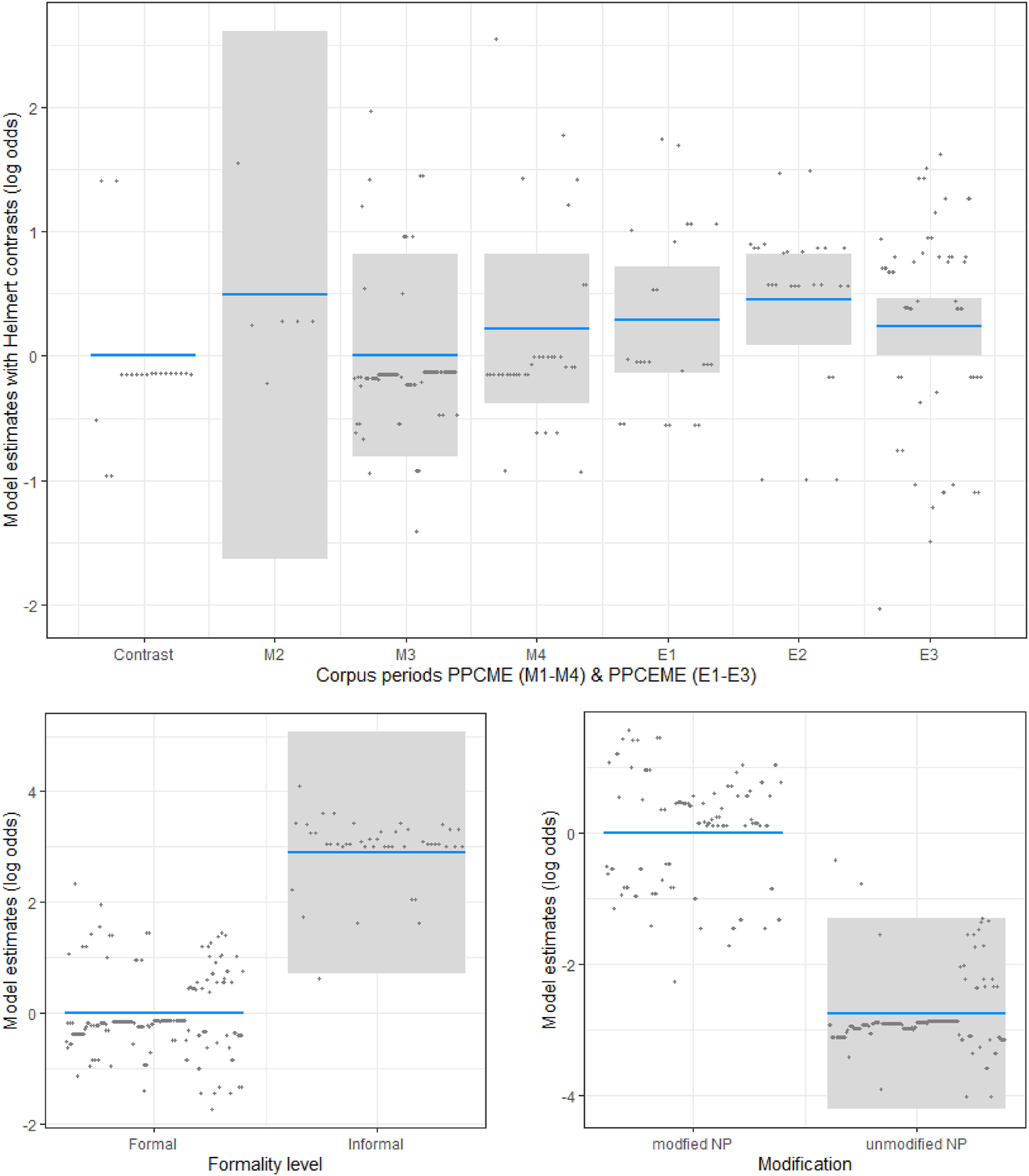
On closer inspection of the model statistics (table 2), all three predictors turn out to be significant (PERIOD: p < 0.05; FORMALITY: p < 0.01; MODIFICATION: p < 0.001), meaning they all have a statistically relevant impact on the rate of near-article use in contrast to partitive use. No statistically relevant interactions among the predictors were detected.Footnote 18 The direction of the impact is visualized in figure 4, where each panel represents one of the predictor variables. The upper panel shows that the near-article function increases significantly over time even when formality level and modification are controlled, thereby confirming that the observed trend cannot simply be reduced to an imbalance of text types in the corpora. This particular model uses Helmert contrasts for the predictor TIME, so that each level (i.e. corpus period) is compared to the mean of all previous levels, rather than to one reference level that is kept constant. Thus, the exact value of the contrast level changes the further one moves through the graph from left to right on the x-axis. Helmert contrasts are particularly useful for the analysis of diachronic aspects of linguistic variation, especially when the temporal intervals represent unequal amounts of time, as is the case for the periods in the Penn–Helsinki corpora.Footnote 19 The y-axis in this graph represents log odds ratios, a (log-transformed) measure of how much more likely it is to encounter the near-article function in a specific corpus period compared to the contrast level. Thus, the log odds estimate for the corpus period E2 (0.45) corresponds to a 57 percent increase of the near-article function in that corpus period compared to the mean of all previous periods. The lower left panel indicates that informal text types have a much higher likelihood to include near-article uses of sum(e) than formal ones. Finally, in the lower right panel we see that modified NPs are much more likely to appear with near-article sum(e) than with partitive sum(e).
Diachronic development of partitive vs. near-article sum(e) with plural nouns. N = 262. Grey areas around the estimates denote 95 percent confidence intervals (profile likelihood).
Multivariate binary logistic regression model (significance codes: 0.001 ‘***’/0.01 ‘**’/0.05 ‘*’)

In sum, the multivariate logistic regression model supports our hypothesis that determinative sum(e) underwent a process of grammaticalization in the Middle and Early Modern English periods, leading to the emergence of a novel, article-like use with plural NPs. The fact that our analysis also finds corroborating evidence for our more fine-grained predictions concerning the association of near-article sum(e) with informal language and modified NPs represents particularly compelling evidence in this respect.
4 A constructional sketch
4.1 Diachronic Construction Grammar (DCxG)
In the past fifteen years, several versions of Construction Grammar have been growing fast as cognitive-functional approaches to language (see e.g. Croft Reference Croft2001; Tomasello Reference Tomasello2003; Croft & Cruse Reference Croft and Cruse2004; Goldberg Reference Goldberg2006, Reference Goldberg2019; Trousdale & Gisborne Reference Trousdale and Gisborne2008; Hoffmann & Trousdale Reference Hoffmann and Trousdale2011, Reference Hoffmann and Trousdale2013; Steels Reference Steels2011; Boas Reference Boas2013; Boogaart, Colleman & Rutten Reference Boogaart, Colleman and Rutten2014; Hilpert Reference Hilpert2014; Diessel Reference Diessel, Dąbrowska and Divjak2015, Reference Diessel2019; Ellis, Römer & O'Donnell Reference Ellis, Römer and O'Donnell2016). Although these models differ substantially from one another, most of them share several basic tenets, some of which we discuss briefly at this point.
Linguistic knowledge is assumed to be usage-based and all linguistic generalizations are derived from the user's experience with language (actual usage events). Syntactic structure emerges through repetition, categorization and conventionalization rather than resulting from an innate matrix (e.g. Bybee Reference Bybee2010; Diessel Reference Diessel2019).
Language consists of constructions; i.e. of conventionalized form-meaning pairings in the sense introduced by de Saussure (Goldberg Reference Goldberg2006: 3). A construction is a symbolic sign, which links a formal side to a particular meaning/function via a symbolic correspondence link (Croft & Cruse Reference Croft and Cruse2004: 258). Linguistic knowledge about the formal, phonological and orthographic structure of a construction is paired with semantic and discourse pragmatic knowledge that the speaker has acquired about the meaning, function and use of this conventionalized string (e.g. [the end]Cx in figure 5).
[the end]Cx construction

Regarding their formal shape, constructions can be atomic and substantive (e.g. lexical items like [car], [drive], [love], or function words like [the], [who]) or atomic and schematic (e.g. an abstract category like [DEM] ‘demonstrative’ or [CN] ‘common noun’). Constructions can also be complex. In that case they are either fully specified (e.g. fixed phrases like [ladies and gentleman]NP), semi-specified with substantive and schematic parts (e.g. [a hell of a CN]NP, [a + CNsing]NPindef), or completely schematic (e.g. NP grounded by a definite determiner [DETdef + CN]NPdef). Semantically they can be fully compositional and transparent (e.g. [next year]) or non-compositional and non-transparent, figurative (e.g. [SAW tensed logs]). In other words, complex constructions can have sequential structure with positions that are either fixed and lexically filled or open; their meaning can be semi- or fully idiomatic or completely compositional (Croft & Cruise Reference Croft and Cruse2004: 255; Diessel Reference Diessel, Dąbrowska and Divjak2015: 312; Smirnova & Sommerer Reference Smirnova and Sommererforthcoming).
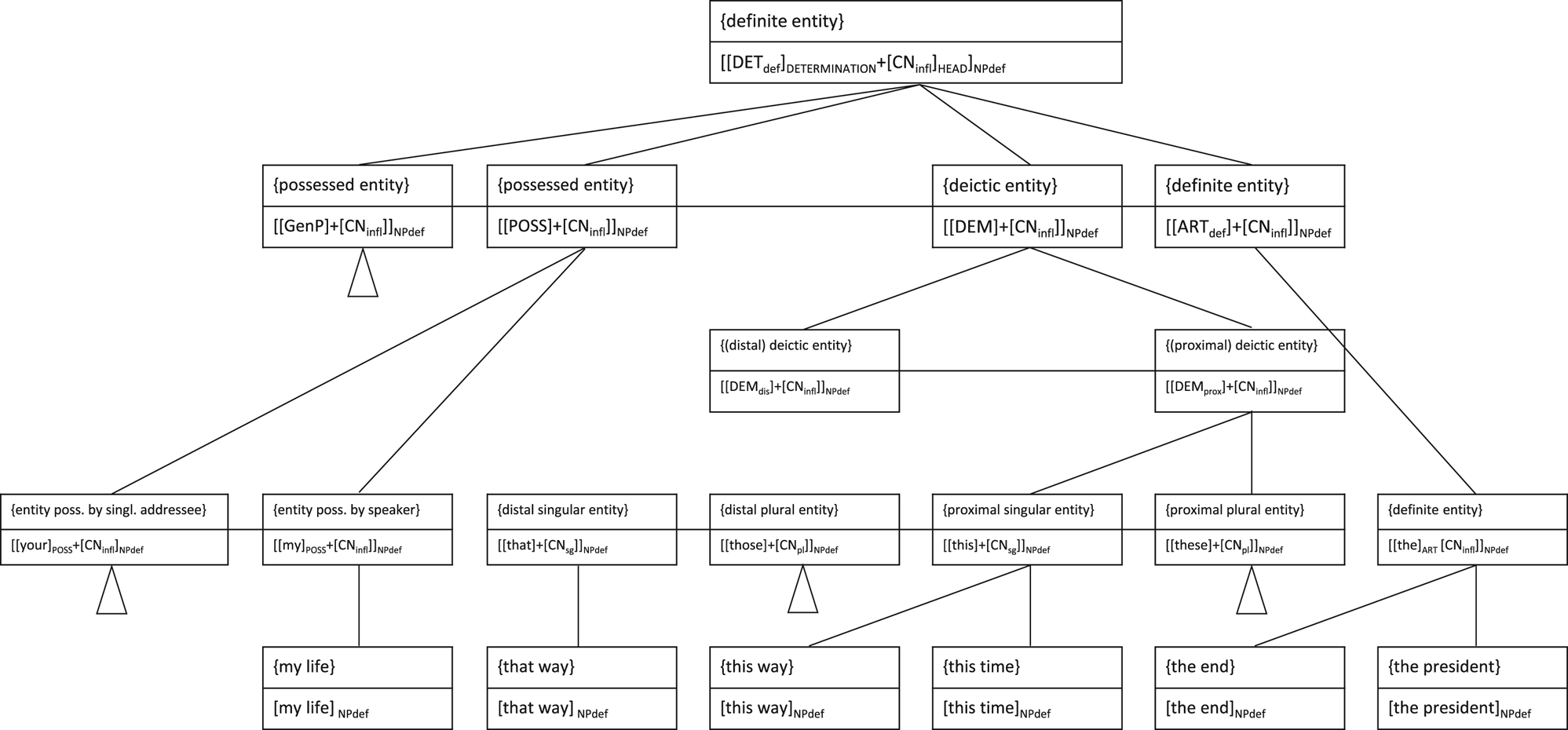
‘Rules’ in the traditional generative sense have been replaced by schemas (i.e. grammatical templates which have evolved over concrete tokens) (Croft & Cruse Reference Croft and Cruse2004; Diessel Reference Diessel, Dąbrowska and Divjak2015; Tomasello Reference Tomasello2003; Hoffmann & Trousdale Reference Hoffmann and Trousdale2013). Langacker (Reference Langacker2008: 23) defines schemas as ‘abstract templates obtained by reinforcing the commonality inherent in a set of instances. Since grammatical rules are patterns in the formation of symbolically complex expressions, they are themselves symbolically complex as well as schematic’. One of the most attractive ideas of Construction Grammar is that we can assign procedural meaning to abstract syntactic templates, independent of the meaning of the words being used in them (Boas Reference Boas2013: 236) (see figure 6).Footnote 20
Partial network sketch of definite NPs with common noun head in English
Finally, all the constructions of a language form the ‘constructicon’: ‘a structured inventory, which can be represented by multiple inheritance networks’ (Croft & Cruse Reference Croft and Cruse2004: 262–5). Constructions are considered as nodes which are organized in taxonomic and meronymic networks of constructional families (Barðdal & Gildea Reference Barðdal and Gildea2015: 23). Linguistic knowledge is represented in two-dimensional networks where lower level constructions are said to inherit features from higher-level constructions through vertical links. Vertical links are instance or inheritance links. If two constructional nodes are connected vertically, the lower node is a more specified version of the higher node and inherits general information from it. Complex abstract schematic constructions can exert influence on more substantive constructions and vice versa. Moreover, horizontal links between constructions on the same level of abstraction exist. Horizontal links express all kinds of paradigmatic relationships between constructions on the same level (for a more detailed account of vertical and horizontal connections and what they express, see Diessel Reference Diessel, Dąbrowska and Divjak2015, Reference Diessel2019; Smirnova & Sommerer Reference Smirnova and Sommererforthcoming).
In figure 6,Footnote 21 a partial network sketch of definite NP constructions in Present-day English exemplifies the structure of a network. In the mid positions of this network, there are semi-specified schemas like [[this]DEM + [CNsg]]NPdef and [[the]ART + [CNinfl]]NPdef. Influenced by the functional and formal similarity of these strings, it is assumed that the speaker has also abstracted several higher levels, where one finds completely abstract schemas like [[DEM] + [CNinfl]]NPdef or [[POSS] + [CNinfl]]NPdef. On the lowest level, one finds fully specified constructions like [this time] or [this way], [the end] or [my life]. These qualify as separate nodes due to their high frequency and specific discourse pragmatic usage. A speaker's network ‘can grow “upwards” via schematization, “outwards” via extension and “downwards” as more detailed instances are added’ (Evans & Green Reference Evans and Green2006: 546). Crucially, the formal and functional fate of linguistic forms and constructions is influenced – among other things – by related constructions in the network. This brings us to language change.
4.2 Constructional competition and network reconfiguration
Usage-based cognitive Construction Grammar also aims to incorporate a diachronic/variationist perspective (e.g. Israel Reference Israel and Goldberg1996; Bergs & Diewald Reference Bergs and Diewald2008; Hilpert Reference Hilpert2013, Reference Hilpert2018; Traugott & Trousdale Reference Traugott and Trousdale2013; Trousdale Reference Trousdale2014; Coussé, Andersson & Olofsson Reference Coussé, Andersson and Olofsson2018; Sommerer Reference Sommerer2018; Van Goethem, Norde, Coussé & Vanderbauwhede Reference Van Goethem, Norde, Coussé and Vanderbauwhede2018; Zehentner Reference Zehentner2019; Smirnova & Sommerer Reference Smirnova and Sommererforthcoming). In current versions of DCxG, all types of linguistic change are being reconceptualized as ‘network changes’. It has been suggested that the network can change:
(i) via node creation and node loss (‘constructionalization’ and ‘constructional death’),
(ii) via node-internal changes (‘constructional change’), and
(iii) via node-external changes, i.e. constructional network reconfiguration (Hilpert Reference Hilpert2018; Smirnova & Sommerer Reference Smirnova and Sommererforthcoming)
Diachronically, ‘constructionalization’ (i.e. the emergence and entrenchment of a new form-meaning pairing) but also the potential marginalization or death of a construction can, among other things, be influenced by discourse-pragmatic needs (functionally driven), by form-driven frequency effects and/or cognitive preferences like processing efficiency or analogical reasoning skills (e.g. Fischer Reference Fischer2007; Hoffmann & Trousdale Reference Hoffmann and Trousdale2011; Sommerer Reference Sommerer2012, Reference Sommerer, Barðdal, Smirnova, Sommerer and Gildea2015; De Smet Reference De Smet2013).
The network does not only change when new nodes are added but also when node-external links between constructions are rearranged. Hilpert (Reference Hilpert2018) calls those ‘connectivity changes’ in which the network undergoes some rewiring. Links between existing constructions may fade and disappear or new links may emerge (Torrent Reference Torrent2015; Lorenz Reference Lorenzforthcoming).
Grammaticalization is reconceptualized as a special case of ‘grammatical constructionalization’ (e.g. Trousdale Reference Trousdale2014; Coussé, Andersson & Olofsson, Reference Coussé, Andersson and Olofsson2018). A new form-meaning pairing constructionalizes which is semantically less heavy and more procedural than the one of the source construction (Trousdale Reference Trousdale2014: 113).
Finally, an important concept is that of ‘constructional competition’ (e.g. Zehentner Reference Zehentner2019; Sommerer Reference Sommererforthcoming), i.e. two constructions compete until one ousts the other:
[I]n many cases, the old form drops out of use and the new form goes on to become the canonical, or even the only, way to code the distinction in question. (Barðdal & Gildea Reference Barðdal, Smirnova, Sommerer and Gildea2015: 38)
Of course, it is also possible that two forms reach an equilibrium and coexist, if the constructions find respective niches (see also Fonteyn & Heyvaert Reference Fonteyn and Heyvaert2018; Zehentner & Traugott Reference Zehentner and Traugottforthcoming). Investigating the various (changing) functions of sum(e) in Middle English offers an excellent opportunity to show in more detail what is meant by such general statements.
4.2.1 Demise of the individualizing usage with singular count nouns
It was shown earlier in this article that in Old English sum(e) and ān were infrequently used in front of singular nouns to ‘individualize’ (in contrast to their relatively frequent usage as a quantifier or numeral). However, after a phase of functional coexistence in Old English, sum(e) was ousted from this function by the numeral ān. We argue that the observable development is a result of constructional competition, which unfolded in the following way: in West Germanic and early Old English, definiteness and indefiniteness were not marked obligatorily. In referential NPs, the common noun did not need to combine with a determinative (i.e. a grounding element in the sense of Langacker (Reference Langacker2008)). Broadly speaking, this means that referential NPs were constructed in exactly the same way as non-referential NPs: I see abbot in the cloisters (referential) versus He was elected abbot (non-referential). However, many CNs in definite and indefinite contexts often collocate with definite or indefinite determinatives (demonstratives, possessives, numerals, quantifiers) which indirectly express (in)definiteness next to other semantic content (e.g. possession, spatial deixis, number etc.). Still, any marking of definiteness or indefiniteness happens ‘parasitically’ and is optional (see table 3).
Shifting strategies of (in)definiteness marking in English

This stage of non-marking puts a heavy decoding pressure on the listener. Often nothing in the input overtly helps the listener to decode the referential status of the message. The speaker/listener has to guess from context whether the noun phrase is referential or non-referential or whether the referent is conceptually definite or indefinite. That is why we argue that at one point in time the speakers/listeners – influenced by frequency and analogy effects – change their marking strategy. As a first step, the marking of definite contexts becomes obligatory in all referential cases between early and late Old English. Speakers adopt a new default strategy to mark singular, plural count and mass nouns obligatorily. One reason to ground the referent by an overt element and to code intertextual (anaphoric) relations overtly is that it is cognitively and communicatively efficient for the listener (Hawkins Reference Hawkins2004).Footnote 22
In constructional terms, this new obligatory and overt marking strategy corresponds to the emergence of an abstract definite NP schema with a determination slot that has to be filled: [[DETdef,infl]DETERMINATION + [CNinfl]HEAD]NPdef ↔ {definite entity}. The existence of this construction leads to the recruitment of the OE demonstrative se as an obligatory default marker of definiteness, triggering its grammaticalization into the definite article the (Sommerer Reference Sommerer, Barðdal, Smirnova, Sommerer and Gildea2015; Reference Sommerer2018). What can be observed is a case of grammatical constructionalization, where a new node constructionalizes [se infl]ART ↔ {definiteness marker} that is more ‘grammatical’ than its source node: [se infl]DEM ↔ {marker of situational or intertextual deixis}.
Late Old English sources also reveal that at that point, indefiniteness marking is not yet obligatory. What helps speakers to interpret a message is the following opposition: definiteness is marked overtly; indefiniteness is indicated by leaving the determination slot empty (see table 3). This is the stage at which OE sum but also OE ān are sometimes used in an individualizing, non-partitive function.
However, around early Middle English the textual sources suggest that speakers shifted to the overt marking of indefiniteness in singular NPs as well. Influenced by the already emerged definite template, an indefinite abstract schema develops:
 $$[[{\rm DE}{\rm T}_{{\rm indef},{\rm infl}}]_{{\rm DETERMINATION}} + [{\rm C}{\rm N}_{{\rm count},{\rm sg},{\rm infl}}]_{{\rm HEAD}}]_{{\rm NPindef}}$$
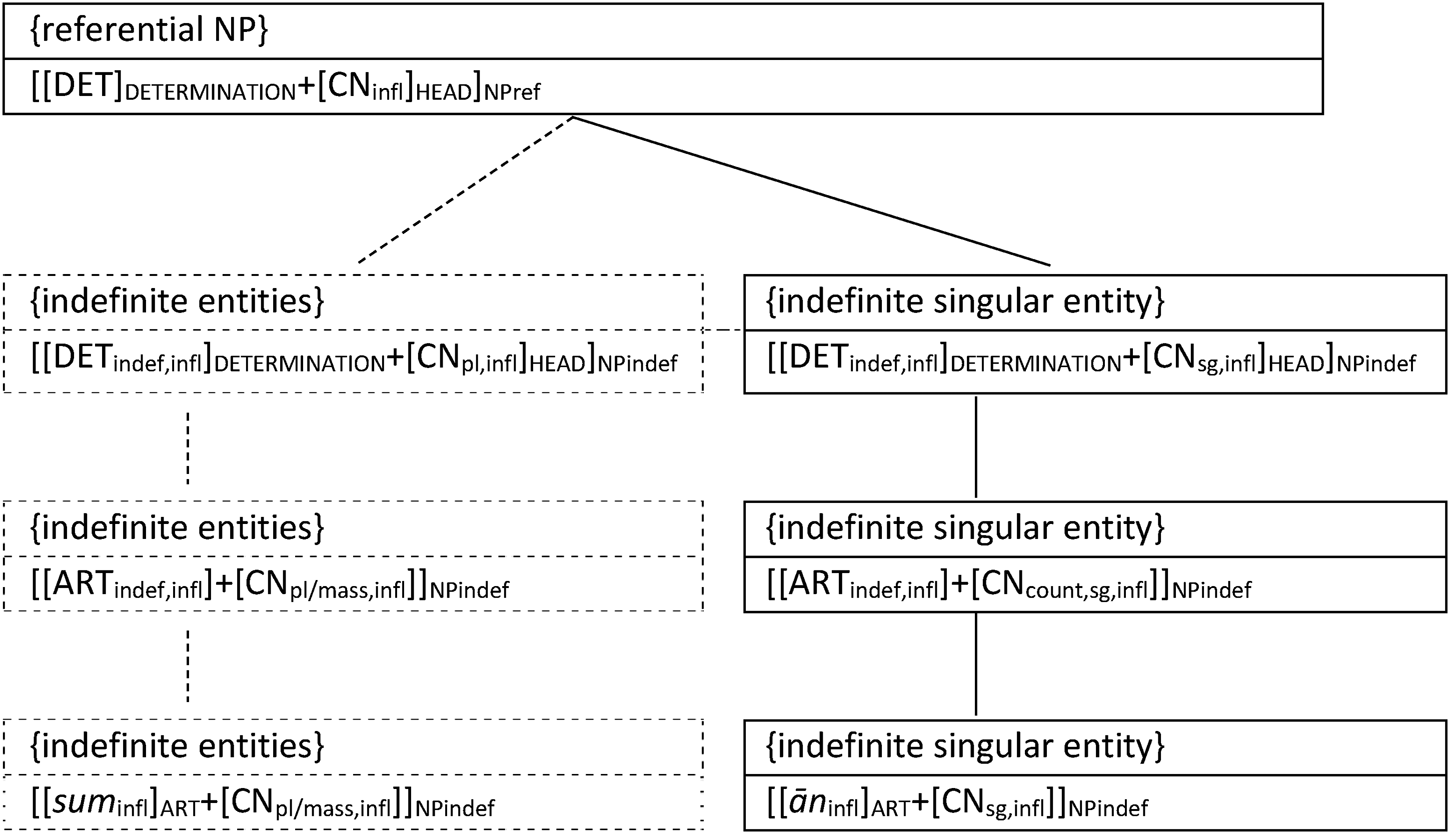
Again this schematic template formalizes a new coding strategy; a newly entrenched procedural routine, which is to mark indefinite contexts overtly as well. The semantically bleached numeral ān is recruited as the default slot filler to be used in NPs with a singular noun head. [ān]NUM > [ān]ARTindef. Figure 7 shows this step of network reconfiguration.
Emergence of abstract indefinite CNPs schema and indefinite article in early ME (Sommerer Reference Sommerer2018: 286)Footnote 23

The speakers analogically extend the definite template to the indefinite realm. We again assume that speakers introduce overt marking of indefiniteness because it helps them distinguish between referential and non-referential NPs, increases processing efficiency and is communicatively more efficient (again see Sommerer Reference Sommerer2018).
It would have been possible for OE sum(e) to be recruited for the job of a default indefiniteness marker for singular CNs as well, but ultimately ān is preferred. One reason why ān might have been preferred is that it was simply more frequent as a pre-head dependent from the beginning (see figure 1). This is why at this point, sum(e) sheds its function as an individualizing element and speakers no longer produce examples like sum wif hatte Uenus ‘there was a woman called Venus’ (DOEC, WHom 12 [0026 (77)]). Two forms share the same function for some time but at one point one form takes over completely. This, however, does not mean that sum(e) loses its partitive use or its other functions. It continues to be used as a vagueness/approximation marker and a quantifier.
4.2.2 Emergence of new indefinite plural article node
Our empirical analysis also reveals that by the mid fourteenth century, speakers mark indefiniteness with singular nouns very consistently but interestingly not yet with plural and mass nouns. However, after 1530 and especially in Early Modern English the non-partitive function of sum(e) in front of plural and mass nouns increases significantly, eventually outpacing the original partitive reading in those contexts. Here, we argue that as a next step a new abstract template for plural and mass nouns develops – [[ARTindef,infl]+[CNpl/mass,infl]]NPindef – and a sum(e) node constructionalizes as an indefinite near-article for plural and mass nouns, alongside the indefinite article a(n) for singular count nouns (see figure 8). In more traditional parlance, ME sum(e) starts to grammaticalize into an indefinite near-article: e.g. [suminfl]QUANT > [suminfl]ART.
Network reorganization in indefinite CNPs in late ME/EME
As we have argued throughout, we classify this sum(e) as ‘near-article’ because it is not obligatory, so that even in PDE it is still grammatical to leave the determination slot empty (e.g. Cars are driving on the road). In indefinite NPs with plural and mass nouns, the nominal can still occur as a bare noun: [[CNpl/mass,infl]]NPindef ↔ {indefinite entities}.
The empirical analysis in section 3.4 also suggests that sum(e) takes up its new function in some contexts earlier than in others. For example, it was shown that it spreads earlier in informal texts. This can be accounted for in a constructional model by adding discourse-pragmatic knowledge to the node:

At the same time, the data also showed that, when sum(e) starts to spread with plural CNs, it is used primarily in constructions with pre- and or post-head modification. This can be expressed by the postulation of more fine-grained templates, which function as bridging contexts. Obviously, the modifier restriction is given up soon and sum(e) extends to the non-modified cases.
 $$\big [ {{\lsqb {sum_{{\rm infl}}} \rsqb }_{{\rm ART}} + {\rm}} [ {\rm ADJ} ] \;+\; { {\rm}} [{\rm C}{\rm N}_{{\rm pl/mass,infl}}] \big ]_{{\rm NPindef}}$$
 $$\big[ {{\lsqb {sum_{{\rm infl}}} \rsqb }_{{\rm ART}} + {\rm} (} \right[{\rm ADJ}\left] {){\rm} + {\rm}} \right[{\rm C}{\rm N}_{{\rm pl/mass,infl}}\left] {{\rm} + {\rm}} \right[{\rm Complement}/{\rm Modifier}]\big]_{{\rm NPindef}}$$
 $$\big[ {{\lsqb {sum_{{\rm infl}}} \rsqb }_{{\rm ART}} + {\rm}} [{\rm C}{\rm N}_{{\rm pl/mass,infl}}]\big]_{{\rm NPindef}}$$
Seen from a different angle, it also seems possible to argue that some in its non-partitive, article-like function ‘completes’ the article paradigm of English. Whereas for definite NPs, the article the is used not only for singular but also for plural/mass heads, we have a division-of-labor situation for the indefinite contexts. A(n) is used for singular contexts, some for plural and mass contexts. The addition of some as an overt element which can function as a marker of indefinite contexts completes the English article paradigm (see table 1, reproduced here as table 4 for the reader's convenience).
(In)definiteness marking in Present-day English

English has thereby reached a stage in which referential contexts can be marked overtly by a specific element. Here, we would like to make two important remarks: obviously, at all historical stages where we have claimed that (in)definiteness marking has become obligatory, one can find examples of definite and indefinite constructions which do not take an article. Some groups of nouns resist the overt marking process longer than others (e.g. unique nouns, etc.).
At the same time there are several cases in Present-day English where article usage has been extended to the non-referential or generic domain (e.g. She plays the piano; A lion is a dangerous animal). This means that the development depicted in table 3 is not as clear-cut as it seems. However, we are concerned with the majority strategy and conceptualize constructions deviating from it as semi-specified or fully specified constructions on the lowest levels of the network, which block inheritance from above.
5 Conclusion
In this article, we analyzed the development of ME sum(e) from a constructional point of view using a quantitative methodology. It was shown that the usage of sum(e) with singular nouns drops in Middle English as a reaction to the recruitment of the OE numeral ān as the indefinite article (i.e. constructional competition). The indefinite, near-article function in plural CNPs only develops and starts to spread in late Middle English (mid fourteenth century) (i.e. constructionalization). This happens first in informal texts and in certain complex constructions. Sum(e) became an indefinite near-article for plural and mass nouns due to a shifting strategy of definiteness marking in English: from covert to overt and obligatory marking of referential definite and indefinite NPs. Originally lacking an indefinite article category, English only developed one as a result of the complete systemic reorganization of (in)definiteness marking in late OE and ME.
Appendix


 Open access

