



Frailty has recently been found to directly impact the healthy lifespan of an older individual and acts as a precursor to the need for care(Reference Fukutomi, Kimura and Wada1,Reference Chen, Liu and Woo2) . Frailty can lead to a decline in various physical and physiological declines that can easily lead to health disadvantages, such as weight loss, fatigue, reduced walking speed, decreased grip strength and reduced physical activity(Reference Fukutomi, Kimura and Wada1,Reference Chen, Liu and Woo2) . Similarly, oral frailty is a multifaceted condition with widespread implications for overall health and well-being in the elderly because it implies deterioration of oral tissues, immune response and microbial balance, leading to an increased susceptibility to oral diseases and conditions(Reference Fukutomi, Kimura and Wada1–Reference Iwasaki, Motokawa and Watanabe4). Addressing oral frailty through preventive measures, early detection and appropriate interventions is essential to promote healthy ageing and improve the quality of life of the elderly(Reference Fukutomi, Kimura and Wada1–Reference Iwasaki, Motokawa and Watanabe4). Proactive interventions for oral frailty, characterised by a decline in oral function (e.g. poor oral hygiene, dry mouth, reduced tongue-lip mobility, decreased bite force, low tongue pressure, impaired chewing function and weakened swallowing function), should aim to prevent transition to specialised treatment(Reference Watanabe, Kurotani and Yoshida3,Reference Iwasaki, Motokawa and Watanabe4) . In particular, poor oral hygiene and dry mouth are not only associated with poor oral mucosal immunity but have also been reported to be related to nutritional status(Reference Lin, Yang and Wen5,Reference Kotronia, Brown and Papacosta6) , and this could likely be attributed to dysregulation of inflammatory and antimicrobial responses associated with down-regulation of regulatory receptors on the mucosal surfaces. Furthermore, evidence also suggests that age-related fluctuations in biological low-molecular-weight compounds can lead to the development of periodontitis and other oral diseases through various underlying molecular mechanisms(Reference Ebersole, Kirakodu and Novak7,Reference Ebersole and Gonzalez8) . Oral frailty can be addressed through preventive measures, early detection and appropriate interventions as they mainly focus on oral immunological defence mechanisms and their role in maintaining oral health and its resilience(Reference Shinkai, Toba and Saito9,Reference Krisanaprakornkit, Kimball and Weinberg10) . Therefore, oral immunity, traditionally evaluated using established markers such as IgA and, more recently, oral peptides such as β-defensins, plays an important role in disease status(Reference Shinkai, Toba and Saito9,Reference Krisanaprakornkit, Kimball and Weinberg10) . Although numerous studies have demonstrated the effects of drugs, certain food items and fluctuations in antigen (e.g. bacteria and viruses) levels on mucosal immunity, very few have examined the effects of ageing to date(Reference Krisanaprakornkit, Kimball and Weinberg10,Reference Tobin and Zhang11) .
Oral immunity factors such as β-defensins (DEFB) are typically produced by the gingival tissues and play an important role in innate immunity(Reference Polesello, Zupin and Di Lenarda12,Reference Hancock, Haney and Gill13) . They include subtype 1 (DEFB1), which are constitutively expressed, and subtype 2 (DEFB2) which are induced under certain conditions such as infections or inflammation only(Reference Polesello, Zupin and Di Lenarda12–Reference Akira, Uematsu and Takeuchi14). However, no studies to date have examined variations in DEFB expression and secretion levels in the oral cavity in response to ageing. Defensins are typically induced through pathways that are similar to inflammatory cascades (including toll-like receptors, myeloid differentiation factor 88 and tumour necrosis factor receptor-associated factor 6), with mechanisms regulating transcription levels through DNA and histone modifications also playing a role. However, there is limited evidence on the effects of ageing on these processes(Reference Akira, Uematsu and Takeuchi14–Reference Palazzo, Balsari and Rossini16).
Curcumin (CUR) is a polyphenolic compound that has been shown to have anti-inflammatory effects in mice with inflammatory bowel disease, and also immune-regulatory effects in response to drug-induced inflammation in humans(Reference Yue, Liu and Li17–Reference Moghadamtousi, Kadir and Hassandarvish22). It increases the expression of antimicrobial peptides stimulated by blood cell components, thus activating innate immunity(Reference Akone, Ntie-Kang and Stuhldreier21); induces epigenetic gene regulation by inhibiting DNA methyltransferases(Reference Moghadamtousi, Kadir and Hassandarvish22); and exhibits antiaging effects by acting as an antioxidant or Sirtuin modulator(Reference Shinkai, Toba and Saito9,Reference Akone, Ntie-Kang and Stuhldreier21,Reference Karaman Mayack, Sippl and Ntie-Kang23) . However, despite stimulating various immune responses, polyphenolic compounds such as CUR exhibit poor water solubility and very low absorption rates in the gastrointestinal tract(Reference Panche, Diwan and Chandra24). Therefore, their efficacy as nutritional supplements is often limited by their low biological availability, as demonstrated by numerous in vitro and in vivo studies(Reference Guo, Rosoha and Lowry19,Reference Cheng, Hsu and Lin25,Reference Marczylo, Steward and Gescher26) . However, oral administration of CUR has been shown to affect the gastrointestinal mucosal surfaces through toll-like receptors and similar pathways, regardless of the absorption levels(Reference Boozari, Butler and Sahebkar27). Therefore, we hypothesised that CUR absorption would result in immunomodulatory effects in the gastrointestinal tract.
Although a direct effect of CUR on oral ulcers has not yet been demonstrated(Reference De Quadros De Bortolli, Klein and Teixeira28), an improvement in the oral environment through the regulation of oral flora and promotion of the body’s defence mechanisms is expected upon its administration. Therefore, the current study examined changes in DEFB and related cascades in response to ageing and evaluated the effects of CUR on the oral immunity of older mice, with the aim of establishing convenient salivary markers that can inform pre-disease strategies targeted at extending healthy lifespan through dietary habits.
Experimental methods
Chemicals
CUR was purchased from Wako Pure Chemical Industries, Ltd. All other reagents were used at the highest grade available and without further purification.
Animals
The study sample included thirty male mice (C57BL/6J; weight: 19–40 g; age: 7 or 70 weeks) that were obtained from Jackson Laboratory, Hokkaido, Japan. For the young age group, time of sexual maturity was selected as the criterion. This age range represents a stage in the mice’s life cycle where they have reached sexual maturity but are still considered young adults(Reference Flurkey, Currer, Harrison, Fox, Davisson, Quimby, Barthold, Newcomer and Smith29). In contrast, the criterion for the old age group was based on a specific age in weeks. This age corresponds to a point in the mice’s lifespan where changes associated with ageing can be reliably detected across various biomarkers in almost all animals(Reference Flurkey, Currer, Harrison, Fox, Davisson, Quimby, Barthold, Newcomer and Smith29). For experiments involving older animals, the sample size was set according to older mice, referring to The Mouse Phenome Database (https://phenome.jax.org/), to consider the environment, feed and health conditions at the time of rearing. The mice were housed in plastic cages under standard laboratory conditions, including a constant temperature of 23°C ± 2°C and a 12:12-h light–dark cycle, and ad libitum access to water and food (standard rodent chow diet) was provided. The cage measured 235 × 353 × 160 mm (width × depth × height), the flooring was Shepherd’s® Specialty Blend™ (Shepherd Specialty Papers, Inc.) and there were five animals/cage. The experimental animal protocol was approved by the Committee of the Laboratory Animal Center (No. 2022-011), and all procedures were carried out in accordance with the Guiding Principles for the Care and Use of Experimental Animals at Hokkaido University of Science. CUR (dose: 3·0 mg/kg body) was dissolved in 0·5 % methylcellulose-400 and 1 ml/kg was administrated orally using a micropipette. To ensure uniformity in body weight, the animals were randomly divided into the young control (YC; age: 7 weeks; n 10); old control (OC; age: 70 weeks; n 9) and CUR (CUR; age: 70 weeks; n 10) groups (online Supplementary Fig. S1). An acclimation period of 1 week was considered in all animal experiments. Herein, 7-week-old mice were acclimatised for 1 week and 70-week-old mice for 70 weeks after purchase at 60 weeks. One 70-week-old mouse died during the acclimatisation period; therefore, the sample size at the start of treatment was n 9 in OC. The dose of CUR was set in a way that it did not exceed the acceptable daily intake of CUR established by the WHO(Reference Nair and Jacob30). The animals were anesthetised after administration of food reagents for 5 d. A mixture of pharmaceutical-grade medetomidine hydrochloride (Domitor®; NIPPON Zenyaku Kogyo Co., Ltd.); midazolam hydrochloride (Dormicum®; Astellas Pharma Inc.) and butorphanol tartrate (Vetorphale®; Meiji Seika Pharma Co., Ltd.) was created using concentrations of 0·75 mg/kg, 4·0 mg/kg and 5·0 mg/kg, respectively. These drugs were diluted in sterile saline and administered using an intraperitoneal injection. After euthanasia, the submandibular and parotid glands were sampled, stored at −80°C and appropriately processed prior to analysis.
Saliva collection and measurement
Following intraperitoneal administration of 1 mg/kg of pilocarpine-HCl (Sampiro 1 %; Santen Pharmaceutical Co., Ltd.) after anaesthesia(Reference Nakagawa, To and Saruta31), the saliva samples were collected strictly from the oral cavity using a micropipette continuously for 10 min. Thereafter, the samples were immediately placed on ice, centrifuged at 10 000 × g for 2 min at 4°C and subsequently stored at −80°C until analyses were performed. The DEFB1/2 levels were then detected using Enzyme-Linked Immuno Sorbent Assay (ELISA), whereas bicinchoninic acid assay was used to determine the protein concentration.
ELISA
DEFB secretion was determined using β-defensin 1 and β-defensin 2 ELISA kits (MyBioSource) as per the manufacturer’s instructions. No changes were made to the procedure; however, the saliva samples were diluted 50-fold in phosphate-buffered saline and assayed thereafter.
Western blotting
The control and treated tissue lysates (10 µg protein/lane) were separated using 4 %–20 % sodium dodecyl sulfate–polyacrylamide gel electrophoresis (Bio-Rad Laboratories Inc., Hercules). The separated proteins were transferred to a polyvinylidene difluoride membrane (Bio-Rad Laboratories Inc.) and analysed using Western Blotting with anti-DEFB1, anti-DEFB2 and anti-cystic fibrosis transmembrane conductance regulator (CFTR) (1:500) antibodies (Santa Cruz Biotechnology). The membrane was blocked for 1 h using 5 % EzBlock Chemi (ATTO) and then incubated for 15–18 h using the appropriate primary antibodies at 4°C. The blots were washed with Tween-20 (Bio-Rad Laboratories Inc.) containing PBS and incubated with appropriate secondary antibodies for 1 h at 22°C–25°C. The protein bands were visualised using enhanced chemiluminescence Western Blot detection reagents (Bio-Rad Laboratories Inc.)(Reference Taylor and Posch32).
Real-time quantitative PCR
Total RNA was extracted from the tissues using the ISOGEN II reagent (NIPPON Gene Co. Ltd.). Thereafter, single-stranded cDNA was prepared from 1 µg total RNA using ReverTra Ace (Toyobo), and reverse transcription-quantitative polymerase chain reactions were performed using the QuantStudio™5 real-time PCR system (Applied Biosystems) with KAPA SYBR™ FAST (NIPPON Genetics Co. Ltd.) as per the manufacturer’s protocol. Online Supplementary Table 1 shows the sequences of the specific primers used.
Data analysis
All statistical analyses were performed using the statistical software package Excel (Bell Curve for Excel v.3·20). Data were presented as mean ± standard deviation and were analysed for statistical significance using ANOVA followed by Tukey’s test to compare means of two or more groups and Welch’s t test for between two groups. P values < 0·05 or < 0·01 were considered statistically significant.
Results
The effects of curcumin on age-related changes in saliva volume and protein content
The OC group exhibited a significant decrease in salivary volume per minute and salivary protein content compared with the YC group (P < 0·01; Fig. 1(a) and (b)). However, administration of CUR in the OC group significantly increased these parameters, suggesting that it exerted a restorative effect on the salivary secretory capacity (P < 0·01; Fig. 1(a) and (b)).
The effects of CUR on age-related changes in salivary volume and protein content. The bar graphs show the mean values and standard deviations observed after > 2 independent experiments (n 7–10). * and ** indicate statistical significance at a level of P < 0·05 and P < 0·01, respectively. The results are presented as follows: (a) Saliva secretion level (μl/min), (b) protein levels in saliva (μg/min), (c) expression of CFTR protein by Western blotting. CFTR, cystic fibrosis transmembrane conductance regulator; CUR, curcumin; DEFB, beta-defensin; OC, old control; YC, young control.

The CFTR, responsible for the regulation of pH and salt concentration in the oral mucosa, exhibited significantly decreased expression in the submandibular glands of the OC group compared with the YC group. However, restoration of this decreased expression was observed in the CUR group (Fig. 1(c)).
Effects of curcumin on DEFB1/2 secretion and expression in old mice
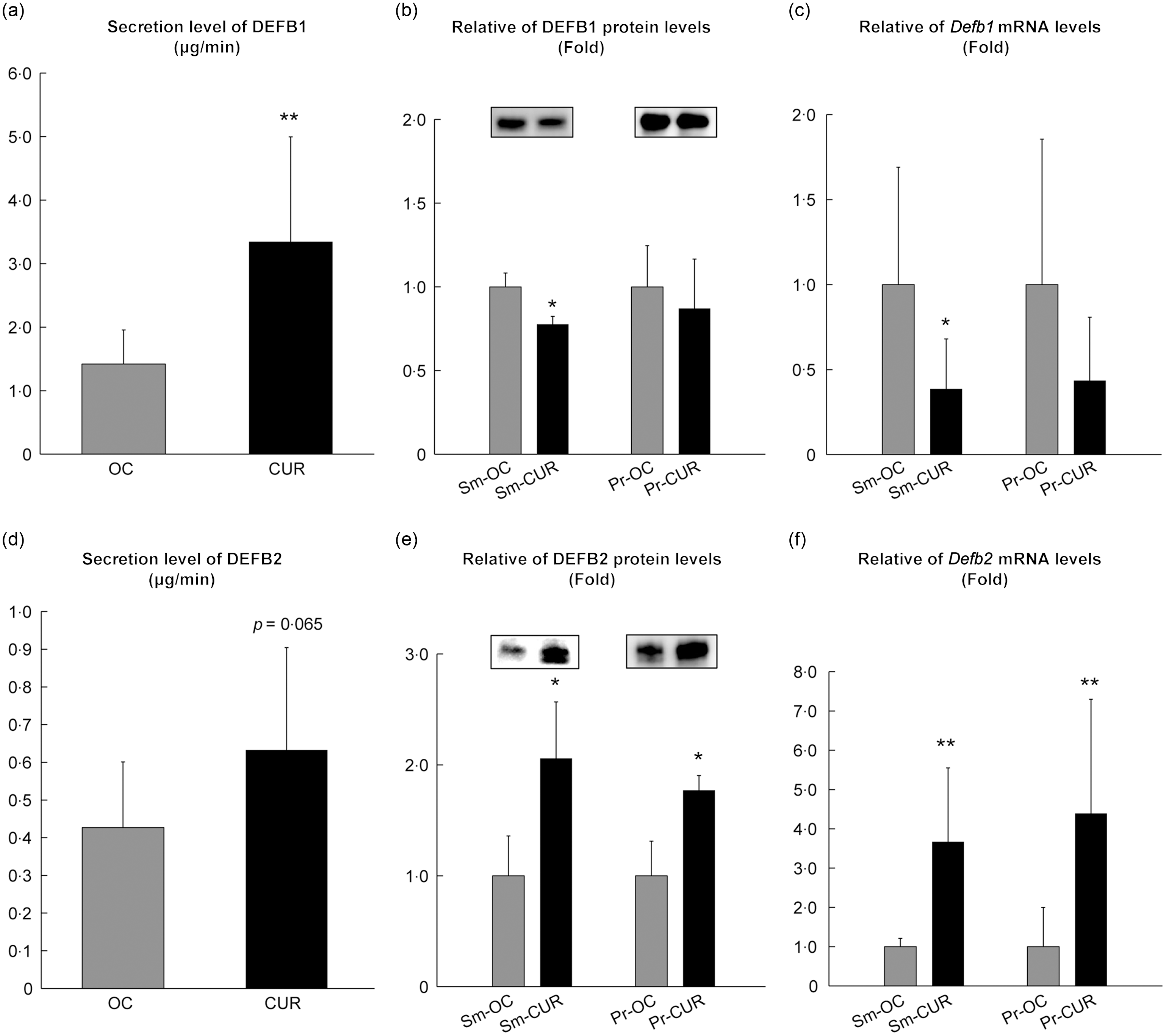
Examination of the effects of CUR on DEFB1/2 in the OC group showed a significant increase in DEFB1 secretion levels in the saliva (P value < 0·05; Fig. 2(a)) and a significant decrease in the protein and gene expression levels of DEFB1 in submandibular gland tissues (P < 0·05; Fig. 2(b) and (c)). Furthermore, CUR also increased DEFB2 secretion in the saliva (P = 0·065; Fig. 2(d)) and protein (P < 0·05; Fig. 2(e)) and gene (P < 0·01; Fig. 2(f)) expression levels in the submandibular and parotid glands. These findings confirm that CUR induces transcription and translation of DEFB2 in the salivary glands.
Effects of CUR on DEFB1/2 secretion and expression in old mice. The bar graphs show the mean values and standard deviations observed after > 2 independent experiments (n 7–10). * and ** indicate statistical significance at a level of P < 0·05 and P < 0·01, respectively. The results are presented as follows: (a) DEFB1 secretion level (μg/min), (b) relative to DEFB1 protein levels (Fold), (c) Relative to Defb1 mRNA levels (Fold), (d) DEFB2 secretion level (μg/min), (e) relative to DEFB2 protein levels (Fold), (f) relative to Defb2 mRNA levels (Fold). CUR, curcumin; DEFB, beta-defensin; OC, old control; Pr, parotid glands; Sm, submandibular.
The effects of curcumin on age-related changes in immunomodulatory capacity
Changes in intracellular signalling, epigenetically related genes, and cytokines were examined to enable elucidation of the mechanisms underlying the differential effects on constitutively and indelibly expressed DEFB1 and DEFB2. Intracellular signalling variations were assessed by measuring the myeloid differentiation factor 88 (Myd88) and tumour necrosis receptor-associated factor 6 (Traf6), while epigenetic gene regulation was confirmed by measuring WD40 repeat protein 5 (Wdr5). The results showed a significant reduction in gene levels (P < 0·01; Fig. 3(a)), indicating age-related effects. Furthermore, CUR significantly decreased Myd88, Traf6 and Wdr5 levels in the submandibular glands of the OC group (P < 0·01; Fig. 3(b)–(d)).
The effects of CUR on age-related changes in immunomodulatory capacity. The bar graphs show the mean values and standard deviations observed after > 2 independent experiments (n 7–10). * and ** indicate statistical significance at a level of P < 0·05 and P < 0·01, respectively. The results are presented as follows: (a) mRNA variation in the old control group relative to the young control group (Fold), (b) relative to Myd88 mRNA levels (Fold), (c) relative to Traf6 mRNA levels (Fold), (d) relative to Wdr5 mRNA levels (Fold), (e) relative to Tnfα mRNA levels (Fold), (f) relative to IL-1β mRNA levels (Fold). CUR, curcumin; IL-1β, IL-1beta; Myd88, myeloid differentiation factor 88; OC, old control; Tnfα, TNF alpha; Traf6, tumour necrosis factor receptor-associated factor 6; Wdr5, WD40 repeat protein 5; YC, young control.

Furthermore, examination of variations in cytokines including tumour necrosis factor-α (Tnfα) and interleukin 1β (IL-1β), which exhibit similar cascades or DEFB2-inducing abilities in the submandibular gland, showed a significant decrease in expression levels as a result of ageing. CUR administration further decreased IL-1β gene expression (P < 0·05; Fig. 3(e) and (f)) and restored Tnfα gene expression. However, the final Tnfα levels observed did not exceed that of the control groups, indicating an immune stimulus that was not inflammatory in nature.
Discussion
The current study identified age-related changes in oral immunity and examined the effects of CUR administration and its underlying mechanisms. In oral immunity, we focused on DEFB1/2, which is related to innate immunity, from tissue expression to secretion, as an indicator. Reports stating the effects of CUR on immune responses were used to determine the CUR dosage(Reference Shin, See and Jung33–Reference Tayyem, Heath and Al-Delaimy35). In mice, 100 mg/kg body weight of turmeric extract can suppress ovalbumin-induced anaphylaxis, and even 3 mg/kg body weight of CUR, converted from the fact that CUR contains approximately 3 % in the turmeric extract, affected immunity(Reference Shin, See and Jung33). This suggests that the biological activity is sufficient even at acceptable daily intake doses. In particular, the effect of CUR on Th2 cells was discussed in the corresponding report; however, the effect on innate immunity, such as DEFB1/2, was not fully investigated(Reference Shin, See and Jung33); therefore, this study was conducted with CUR dose of 3 mg/kg body weight administered orally.
In this study, CUR restored the reductions in saliva volume/min and salivary protein content observed in the OC group. Decreased saliva volume may lead to decreased oral function, exacerbating frailty, further exacerbating oral health problems, and increasing susceptibility to dental caries, gingivitis, oral mucosal lesions and taste changes(Reference Watanabe, Kurotani and Yoshida3,Reference Iwasaki, Motokawa and Watanabe4) . This may result in weight loss and malnourishment due to decreased food intake(Reference Iwasaki, Motokawa and Watanabe4). Saliva volume is reduced in patients with hyponutrition, suggesting that saliva volume may play a role in the vicious cycle(Reference Lin, Yang and Wen5,Reference Kotronia, Brown and Papacosta6,Reference Xu, Laguna and Sarkar36) . Therefore, from an oral hygiene perspective, supporting the frailty of the elderly by adequate saliva secretion may not only enhance the mechanical function of digestion and absorption but also help mitigate potential adverse effects(Reference Iwasaki, Motokawa and Watanabe4–Reference Kotronia, Brown and Papacosta6,Reference Xu, Laguna and Sarkar36) . Saliva secretion can be divided into two categories: that controlled by the autonomic nervous system and that secreted during processes, such as mastication(Reference Feron37). The former is present in a certain amount in the oral cavity and is involved in the control of sensory stimuli such as taste, and the saliva measured in this study falls into this category(Reference Feron37). Therefore, amount of saliva can determine age-related abnormalities, leading to a decrease in food intake and progression of frailty, mainly weight loss, due to the loss of enjoyment of taste. However, the restoration of autonomic nervous system-controlled saliva by pilocarpine stimulation by CUR in this study indicates that it can improve taste abnormalities, suggesting the possibility of nutritional intervention for frailty. Moreover, proteins in saliva, which control taste perception, are altered by tasty foods(Reference Martin, Gutierrez and Torregrossa38), and this study confirms that the amount of immune substances present was also altered by CUR, making food-based oral hygiene interventions for oral frailty a realistic possibility. Because this study was conducted in animals, results commonly observed in humans (such as oral lesions and weight loss) were not obtained. This is a limitation while assessing the association between oral frailty and frailty in terms of food intake, dietary goals, and number of taste receptors, which may be hampered by differences in biological species differences between (laboratory animals and humans)(Reference Watanabe, Kurotani and Yoshida3,Reference Iwasaki, Motokawa and Watanabe4,Reference Xu, Laguna and Sarkar36) . Therefore, as discussed in detail below, further nutritional interventions may be warranted to investigate the effects of ageing and CUR on the regulators and biomarkers of salivary components. Previous studies suggested that immune senescence associated with ageing predominantly affected adaptive immunity rather than innate immunity(Reference Sato, Kato and Sekai39). Furthermore, examination of the gene expression ratios in various organs through analysis of data from the Human Protein Atlas Project (v.21.1; https://www.proteinatlas.org/) showed higher expression levels in the salivary glands, suggesting that DEFB played a significant role in oral immunity (online Supplementary Fig. S2)(Reference Karlsson, Zhang and Méar40). Therefore, the investigation of age-related alterations in innate immunity, which serves as the initial defence mechanism against antigens, is imperative, to demonstrate the utility of DEFB as a short-term oral immune indicator. The current study examined changes in oral immune function due to ageing by focusing on the quality and quantity of saliva produced.
Notable changes in salivary salt concentration and pH due to ageing have been reported previously(Reference Nagler and Hershkovich41), with studies examining the pathophysiology of cystic fibrosis demonstrating that increased salt concentration on the mucosal surface and decreased pH led to a reduction in antimicrobial peptide activity(Reference Abou Alaiwa, Reznikov and Gansemer42). Furthermore, age-related changes in salivary glands, including a decrease in acinar cells, fibrosis and lymphocyte infiltration, have been shown to decrease salivary secretion(Reference Scott43). In the current study, CUR treatment was seen to restore the age-related decrease in CFTR protein expression in the submandibular glands, and this was accompanied by recovery of the salivary flow rate and protein concentration. Although both the submandibular and sublingual glands were examined in the current study, CFTR protein expression recovery was not observed in the former, and this discrepancy could likely be attributed to the fact that the sublingual glands became the predominant source of proteins during saliva collection using pilocarpine(Reference Kiyama44). Considering the pivotal role of CFTR protein expression in salivary composition, particularly with regard to maintenance of the antimicrobial activity of DEFB proteins, it can be inferred that qualitative changes in salivary components contributed to this process.
Although CUR restored the DEFB1 secretion levels to a certain extent, the overall levels were still relatively low in the salivary gland tissue, potentially due to morphological changes associated with ageing that prevented complete recovery(Reference Scott, Flower and Burns45). Therefore, evaluation of age-related changes in natural immunity requires examination of variations in DEFB2, which is known to be indelibly expressed and is reflective of immune reactivity. The sublingual gland is highly responsive to immune stimulation, suggesting that the polyphenols may act as ligands and activate the immune system(Reference Tobin and Zhang11,Reference Ogle46) . Additionally, polyphenols exhibit poor translocation into the cells when existing as aglycones(Reference Panche, Diwan and Chandra24). In the current study, the CUR was suspended as an aglycone before administration, suggesting that the observed effects originated from extracellular immune stimulation.
Polyphenols have been shown to modulate immune responses via host defence peptides in various organs and tissues(Reference Tobin and Zhang11), and the mechanisms involved include activation of the MAPK pathway, induction of sphingosine-1-phosphate, inhibition of KEAP1 leading to induction of NRF2, epigenetic gene regulation and metabolic regulation of gut microbiota(Reference Tobin and Zhang11). The current study found that CUR activated the main immunity and inflammatory factors such as MyD88 without inducing inflammation, indicating partial immune stimulation. In addition, they decreased IL-1β, which induced multiple cytokine networks and selectively increased TNFα, which was secondarily induced. These findings were consistent with previous studies that reported DEFB2 induction by TNFα (Reference Tsutsumi-Ishii and Nagaoka47), demonstrating restoration of the expression of both genes within the salivary gland. Furthermore, while CUR showed different results compared with its anti-inflammatory effects assessed by TNFα as an indicator in mice, interestingly, the inflammatory state in older individuals, who are at risk for chronic inflammation, appears to operate through a mechanism distinct from that of pathological or drug-induced inflammation(Reference Yue, Liu and Li17,Reference Epstein, Sanderson and MacDonald18,Reference Rosignoli da Conceição, Dias and Michelin Santana Pereira48) . CUR has also been reported to act on G-protein-coupled receptors, suggesting a cascade that is distinct from immune stimulation by immunological ligands(Reference Harada, Arahori and Okuyama49,Reference Harada, Okuyama and Teraoka50) . Evaluation of histone methylation showed inhibition of Wdr5 gene expression and, consequently, acetylation which controlled the observed transcriptional levels(Reference Kishimoto, Uno and Okabe51).
Although previous studies have used DNA methyltransferase and histone deacetylase enzymes as indicators of epigenetic gene control with polyphenols(Reference Akone, Ntie-Kang and Stuhldreier21), the effects of Wdr5 were previously unknown. The variations in the effects of CUR could likely be attributed to DNA and histone modifications that regulate the selective recovery of cytokines and result in differential effects of DEFB1 and DEFB2 on the same chromosome. However, the current study was limited by its inability to directly observe methylation/acetylation of histones or methylation at the DNA level. Future studies should aim to examine methylation status in the promoter regions of genes that exhibited altered expression in the current study (e.g. DEFB1 and DEFB2) or examine the symmetrically varied results of IL-1β and TNFα to gain a deeper understanding of epigenetic gene control in the older.
The findings of this study can inform clinical practice by potentially serving as a marker for immune-related diseases. For example, oral flares and fluctuations in the oral environment due to infections require monitoring, similar to autoimmune diseases. The use of saliva samples gained popularity during the novel corona virus infectious disease, emerged in 2019 (COVID-19) pandemic, and this was accompanied by rapid advancements in measurement techniques for viral antigens. However, there are a limited number of markers available for the elucidation of mechanisms underlying the development of autoimmune oral disorders associated with COVID-19(Reference Fitzpatrick, Alramadhan and Islam52), and future studies should aim to identify inflammatory markers and examine the possible outcomes of epigenetic gene regulation to facilitate establishment of diagnostic reference values for salivary markers in humans. At the very least, tracking oral health status using salivary molecular markers such as DEFB2 has the potential to facilitate early detection of oral frailty in the general population, even in the absence of medical expertise. This, in turn, could promote self-care practices, including the incorporation of specific food ingredients, to sustain overall health(Reference Shinkai, Toba and Saito9,Reference Morley53,Reference Diaz-Toro, Petermann-Rocha and Parra-Soto54) .
In conclusion, the findings of this study showed that salivary secretion declined with age, and the changes in the quality and quantity of saliva may be directly linked to infection control. Moreover, CUR administration in older mice showed suppression of inflammatory signals, epigenetic regulation through suppression of histone methylation and partial induction of inflammatory cytokines in the salivary gland tissues. Increased secretion and expression of DEFB2 helped strengthen the protective response to foreign antigens in older individuals who are susceptible to infection, suggesting that it may be used as a biomarker to monitor the oral environment. These findings confirm the hypothesis that CUR exerts significant effects on the gastrointestinal tract, regardless of absorption. To link the significance of DEFB variation to health effects, attention must be paid to variation in oral bacteria; however, this was not possible in this study. Alternatively, while it has been reported that orthodontic acrylic additives containing CUR have antimicrobial activity against S. mutans and C. albicans biofilms(Reference Pourhajibagher, Noroozian and Ahmad Akhoundi55), it is also consistent with the antimicrobial spectrum of DEFB(Reference Weinberg, Krisanaprakornkit and Dale56), which indicates that this action is mediated by DEFB. Therefore, it is expected that this is DEFB-mediated action. The significance can also be considered from the potential host effects of antimicrobial peptides. We have previously demonstrated the direct host effects of an antimicrobial peptide, α-defensin5, on CFTR in the intestinal tract and the utility of polyphenols in cancer therapy(Reference Uemura, Takahashi-Suzuki and Kita57–Reference Yasuda, Kubota and Okamoto59). Further studies to better elucidate the potential host effects of DEFB are required in future. Medical interventions are typically associated with higher risks in older individuals who have lower tolerance to treatment measures. Therefore, the findings of the current study, which showed that innate immunity can be regulated through food components, can prevent progression of disease and provide insight into appropriate dietary habits during the treatment period. CUR is expected to help prevent frailty in the older population by improving the oral environment and partially restoring the age-related decrease in innate immune responses.
Acknowledgements
We thank Enago (www.enago.jp) for editing the language of the manuscript.
This work was supported by the URAKAMI FOUNDATION (awarded to Natsuko Suzuki) (grant numbers R04208).
I. U.: Conceptualisation, formal analysis, investigation, writing – original draft, writing – review and editing, and visualisation; N. T-S.: conceptualisation, investigation, supervision, writing original draft, writing – review and editing, funding acquisition; A. S.: investigation; S. Y.: investigation; A. N.: investigation, writing – review and editing; T. S.: supervision, writing – review and editing.
The authors declare no conflicts of interest.
Supplementary material
For supplementary material/s referred to in this article, please visit https://doi.org/10.1017/S0007114524000801



