


Introduction
The jaguar Panthera onca is categorized as Near Threatened on the IUCN Red List (IUCN, 2011) and is typically associated with tropical forests, ecosystems characterized by their high primary productivity (Seymour, Reference Seymour1989; Crawshaw & Quigley, Reference Crawshaw and Quigley1991). This large felid has a wide distribution, however, indicating a high plasticity in its tolerance of environmental variation that permits it to exist in marginal habitats. This is the case of the northernmost reproductive population of jaguars, in Mexico (Brown & López González, Reference Brown and López González2001), where the species' habitat is dominated by arid conditions (Brown, Reference Brown1994) but where non-native prey (i.e. livestock) are widely available. This northern population of the jaguar is of particular interest because it may be a unique gene pool adapted to extreme environmental conditions. Nevertheless, despite its conservation importance, this population has been little studied (e.g. Rosas-Rosas et al., Reference Rosas-Rosas, Bender and Valdez2008). The region is considered a long–term jaguar conservation unit (Sanderson et al., Reference Sanderson, Redford, Kitchenette, Medellin, Rabinowitz and Robinson2002; Rabinowitz & Zeller, Reference Rabinowitz and Zeller2010).
The most commonly used method to estimate abundance and density of jaguars is by camera trapping, which facilitates individual identification (Wallace et al., Reference Wallace, Gomez, Ayala and Espinoza2003; Silver et al., Reference Silver, Ostro and Marsh2004). Most such studies span 2–3 months and consider populations to be closed (Wallace et al., Reference Wallace, Gomez, Ayala and Espinoza2003; Silver et al., Reference Silver, Ostro and Marsh2004; Cavalcanti & Gese, Reference Cavalcanti and Gese2009); i.e. it is assumed there are no births or deaths during the sampling period. Considering that populations can suffer losses or additions within short periods of time it is important to expand research methods so that temporal variations can be examined but such changes are not considered in closed population analysis (Mohd Azlan & Sharma, Reference Mohd Azlan and Sharma2003; Heilbrun et al., Reference Heilbrun, Silvy, Peterson and Tewes2006). Open population models are an alternative and make the following assumptions: (1) each animal in the population has the same probability of being captured sometime during the sampling period provided it is alive during the sampling, (2) each animal in the population has the same probability of survival from time i to time i+1, and (3) individual markings (physical characteristics) are not missing and individuals cannot be misidentified (Pollock et al., Reference Pollock, Nichols, Brownie and Hines1990; Morrison et al., Reference Morrison, Block, Dale Strickland, Collier and Peterson2008).
Our objective in this study was to determine jaguar density from camera-trap data, using an open population model. Because of the arid conditions of the study site we assumed that the estimated densities of jaguars would be lower than densities reported for jaguar populations in more productive areas.
Study area
The study was carried out in the east-central region of the state of Sonora, Mexico, in a private protected natural area, the Northern Jaguar Reserve, and 10 adjoining cattle ranches (Fig. 1). The study site covers an area of c. 330 km2 and, because of its isolated location, is an area without high human impacts. Vegetation is a heterogeneous mosaic of mostly xerophilous and Sinaloan thorn scrub, tropical deciduous forest, and riparian vegetation with palms, holm oaks and natural grasslands. Dominant plant species are Lysiloma watsonii, Prosopis velutina, Vachelia campechana (=Acacia cochliacantha), Jatropha cordata, Sabal uresana, Brahea brandegeei, Senegalia occidentalis (=Acacia occidentalis), Havardia mexicana, Salix bonplandiana, Baccharis salicifolia and Ambrosia ambrosioides. This vegetation is interspersed within large areas of non-native grassland (dominated by buffel grass Penisetum ciliare; Brown, Reference Brown1994). Mean annual precipitation is <400 mm, distributed throughout the year and with winter rains accounting for 18% of the annual total. Mean annual temperature varies from 16°C in winter to 30°C in summer, with extreme temperatures from −7 to 43°C (Brown, Reference Brown1994; García & CONABIO, Reference García1998). The adjoining cattle ranches signed an agreement in 2006 to not hunt wildlife and we therefore consider the Reserve and cattle ranches as a single area.
Locations of camera traps in the Northern Jaguar Reserve and neighbouring ranches. The rectangle on the inset shows the location of the main map in Sonora, north-west Mexico.

Methods
Fieldwork
The number of camera traps used varied from 25 to 111. We used three camera trap models: Camtrakker 35 mm (Camtrakker, Watkinsville, USA), Wildview (Wildview, Grand Praire, USA) and Cuddeback (Non Typical Inc., Green Bay, USA). Most camera traps were placed in pairs, to facilitate identification of individual jaguars using photographs of both flanks (Karanth & Nichols, Reference Karanth and Nichols2000), along game trails, streams and narrow canyons. To avoid bias in individual detection no attractant was used. Camera traps were placed according to the web-trap design proposed by Anderson et al. (Reference Anderson, Burnham and White1983), with modifications as described by Gutiérrez-González (Reference Gutiérrez-González2008). We carried out monthly sampling from February 2009 to May 2010. Each month was considered a sampling session, with 16 sessions in total.
Data analysis
Each photograph of a jaguar was associated with an individual. Those photographs in which the individual could not be identified were discarded from the analysis. A capture history was developed using the data for each sampling period, considering each individual photograph as a capture and a new photograph of the same individual as a recapture (Di Bitetti et al., Reference Di Bitetti, Paviolo and De Angelo2006). Capture history was analysed with CloseTest v. 3 (Stanley & Richards, Reference Stanley and Richards1999) to determine if the population was open or closed. CloseTest compares assumptions between open population models (losses and recruitments in the population) against closed population models (no additions or losses to the population). The capture record was then analysed according to the Jolly-Seber model using JOLLY (Pollock et al., Reference Pollock, Nichols, Brownie and Hines1990), which can estimate parameters related to abundance such as population growth, recruitment and abundance. Density in each sampling period and mean density over the whole sampling period was calculated from estimates of abundance obtained from JOLLY divided by the sampled area (Karanth et al., Reference Karanth, Chundawat, Nichols and Kumar2004; Silver, Reference Silver2004). JOLLY provides a series of χ2 comparisons between capture and survival probabilities and determines the best estimators for these parameters.
The sampled area was calculated taking as a basis the male jaguar home range with the highest number of records since 2006 to date (authors, unpubl. data), using the estimate of the mean maximum distance moved (MMDM; Silver, Reference Silver2004). MMDM was estimated as the mean of the sum of all distances between two capture sites (camera locations)(Karanth & Nichols, Reference Karanth and Nichols1998). We used the mean obtained as a radius to calculate a circular buffer around each camera location. All buffer areas for each camera location were summed for each sampling period to give an estimate of the sampling area by period (Karanth et al., Reference Karanth, Chundawat, Nichols and Kumar2004; Silver, Reference Silver2004).
To test if jaguar density in general is related to productivity we used a linear regression model with jaguar density from this and 20 other studies (in Mexico, Belize, Costa Rica, Brazil and Bolivia) as the dependent variable and annual precipitation as the independent variable. We assumed that productivity is proportional to precipitation.
Results
The mean area covered by camera traps plus the buffer area was 684.6±SE 162.3 km2. Variations in the size of the sampling area were caused by the loss or acquisition of cameras. During the 16 months of sampling a total of 7,718 trap nights were accumulated, with 63 photographs of jaguars, from which 10 individuals were identified (four males, three females and three individuals for which sex could not be determined; Plate 1, Table 1).
Examples of photo identification of individual jaguars Panthera onca using camera-trap photographs. Images A and B are of individual JM-11 and images C and D of individual JNI-10 (Table 1).

Capture history of the 10 jaguars Panthera onca identified in the Northern Jaguar Reserve and adjoining ranches in Sonora, México (Fig. 1), in 16 monthly sampling periods from February 2009 to May 2010. An entry of 1 indicates capture of the individual.

All assumptions of the open population model appeared to be met. According to CloseTest the capture history fits the open population model (χ2=23.9, df=11, P=0.013). There were no additions of individuals (P=1) but there were losses (P=0.013). The data did not fit a linear model (r 2=0.05, P=0.38), supporting the rejection of the use of a closed population model (Heilbrun et al., Reference Heilbrun, Silvy, Peterson and Tewes2006).
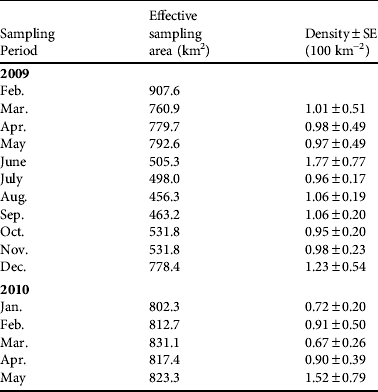
The best model explaining the capture record included a constant survival rate (φ=0.94) and a constant capture probability (P=0.23) throughout the sampling period (P=0.82). Mean jaguar density was estimated to be 1.05±SE 0.4 per 100 km2. Variation in estimates per sampling period is shown in Table 2.
Estimated effective sampling area calculated using the mean maximum distance moved (see text for details), and mean density±SE of the jaguar population in the 16 monthly sampling periods.
The linear regression confirms that jaguar density is positively related to precipitation (Fig. 2) and therefore presumably to productivity. In general, higher densities of jaguars have been reported from areas with higher precipitation.
Linear regression model (r2=0.40, P=0.001) showing the relationship between jaguar Panthera onca density, using published data (●) and data from this study (♦) (Table 3), and total annual precipitation.

Discussion
As far as we are aware this is the first study to calculate densities of an open jaguar population using data from camera trapping. The only other long-term jaguar study that considered an open population focused on the social interaction between jaguars over 10 years of monitoring, and used radio telemetry (Cavalcanti & Gese, Reference Cavalcanti and Gese2009). Camera trapping has been widely used for calculations of density in closed populations of various species. We consider that its application can be extended for prolonged periods, especially for those species that require long-term management and extensive monitoring strategies for their conservation, such as jaguars.
Our survey met the three main assumptions of open population models (Pollock et al., Reference Pollock, Nichols, Brownie and Hines1990; Morrison et al., Reference Morrison, Block, Dale Strickland, Collier and Peterson2008): (1) We used an homogenous method for camera location that assumes all animals have the same capture probability and we did not use any attractants (Yasuda, Reference Yasuda2004). (2) Statistical results for the best model (constant capture and survival probabilities) showed that all jaguars had a constant survival probability throughout all 16 survey sessions. (3) All jaguars could be identified in photographs by their unique marks. We therefore suggest that open population models can be a reliable way to analyse data from >6 months of camera-trap sampling (O'Brien, Reference O'Brien, O'Connell, Nichols and Karanth2011). Most closed population analyses use sampling blocks of 2–3 months to fit the assumption that the population is closed but this kind of blocking can be arbitrary. Our alternative analysis includes all sampling periods without arbitrary blocking.
In short-term studies using closed populations models it is possible for individuals to be captured only once, leading to biased estimations of abundance or closure testing. In our study four individuals were captured only once; two of them are females that we captured later as part of long-term monitoring (Gutiérrez-González & López-González, Reference Gutiérrez-González and López-González2011). The other two were captured in the outer limits of the study area and therefore may be transients at our study site. The use of open population models allows researchers to include individuals captured only once without bias in model selection and without violating the model's assumptions.
In all studies of density it is important to consider each record individually to understand capture history and correctly determine whether to use open or closed population models (O'Brien, Reference O'Brien, O'Connell, Nichols and Karanth2011). When most of the captures are within the limits of the study area we suggest the use of spatial mark–recapture models, as described by Partanen & Penttinen (Reference Partanen and Penttinen2007).
As there is a lack of previous camera-trap studies of jaguars using open population models, comparison of our results with other studies is tentative. The density of jaguars estimated in our study is lower than that reported elsewhere (Table 3), even for studies in Mexico. However, we found a positive relationship between jaguar density and precipitation in general (Fig. 2), suggesting an effect of productivity on carrying capacity.
Jaguar density estimated in 21 studies in five countries, with annual total precipitation of the study sites, arranged in order of increasing density.

The density of jaguars at our study site was relatively unchanged between months. However, the estimated densities in June 2009 and May 2010 were almost two-fold higher and coincided with the driest months of the study period. As the Northern Jaguar Reserve and some of the neighbouring ranches provide an area with permanent water it is possible that jaguars concentrated in this area, where natural prey is greater. In the months with higher precipitation water availability may not be a limiting factor for jaguar dispersion. Despite the different management regimes of the reserve and cattle ranches the constant survival probabilities confirm that management on cattle ranches, with the wildlife protection agreement, and the exclusion of cattle from the Reserve had a positive impact on jaguars in the whole study area. However, although the agreements signed with neighbouring landowners have resulted in an increase in records of jaguars and their prey it is important to continue the long-term monitoring.
The low density of jaguars in our study cannot be attributed to a single factor even though there is an apparent relationship between jaguar density and precipitation. Livestock rearing is the most common farming activity in northern Mexico and we believe that the historical effects of livestock on vegetation structure and water availability may have altered the availability of forage and the abundance of jaguar prey. Nevertheless our analysis has demonstrated an overall high probability of jaguar survival that, together with 10 years of jaguar monitoring (Gutiérrez-González & López-González, Reference Gutiérrez-González and López-González2011), suggests jaguars are able to survive in this arid region.
The site of this research is a priority area for jaguar conservation and study (Sanderson et al., Reference Sanderson, Redford, Kitchenette, Medellin, Rabinowitz and Robinson2002). The main objectives of the management of the Northern Jaguar Reserve are to reduce the impact of cattle and restore jaguar habitat, with strategies focused on water retention, removal of invasive grass, reforestation and environmental education. Livestock have been gradually excluded since 2003 and, combined with the protection provided under the agreements with the surrounding ranches, the area is now a suitable place for long-term studies of the jaguar. It is important to continue research in this area to determine if the present management strategy can continue to maintain, and increase, jaguar populations in these arid lands of North America.
Acknowledgements
We would like to thank Naturalia A.C., Northern Jaguar Project Inc., Universidad Autónoma de Querétaro, The Denver Zoo, Defenders of Wildlife, Disney Worldwide Conservation Fund, Robert & Michelle Friend Foundation, Jeniam Foundation, J.M. Kaplan Fund, J.W. Kieckhefer Foundation, Wendy P. McCaw Foundation, Margaret T. Morris Foundation, Neotropical Migratory Bird Conservation Act, David & Lucile Packard Foundation, Patagonia, Shared Earth Foundation, Wilburforce Foundation and all the organizations and people who granted funds for this project. We are grateful to all the researchers and other people who over 10 years helped us monitor jaguars in the Northern Jaguar Reserve. We thank two anonymous reviewers for their comments and Dr Robert W. Jones for reviewing and editing the English.
Biographical sketches
Carmina E. Gutiérrez-González works on the conservation biology of carnivores using a combination of landscape ecology, geographical information systems and field work. She has also been involved in projects on rodents and carnivore communities. Miguel A. Gómez-Ramírez has been involved in projects on rodents, bears and jaguars, as well as faunal inventories and studies of mammal communities. Carlos A. López-González focuses on carnivore ecology. His main interests are predator–prey interactions, vertebrate community ecology and the behaviour and conservation of large mammalian carnivores, with an emphasis on the Mexico–US borderlands.



