


Introduction
Until the late twentieth century, evidence for the Linear Pottery Culture (LBK) on the western side of the river Oder was rarely found at Uckermark in Germany; it was known from just a handful of surface sites (Cziesla Reference Cziesla2008). Recently, however, intensive fieldwork in an area of about 60 × 60km, centred on the town of Prenzlau, has revealed a dense cluster of 119 findspots with LBK ceramics (Figure 1).
To date, 119 sites have been discovered with LBK sherds west of the river Oder, around the town of Prenzlau in the centre (figure by author).

Much of this research has been driven by the construction of wind turbines and their associated wiring. For the past two decades, the company Wurzel Archäologie und Umwelttechnik GmbH has investigated sites that total more than 1.5 million square metres. Only six sites (Figure 1 nos. 12, 27, 30, 40, 63 & 64) yielded Linear Pottery that dates to 5250–4900 cal BC (Table 1 & Figure 2). The sites are typical of the small footprints of LBK occupation in much of the lowland zone.
Radiocarbon dates between c. 5250 and 4900 cal BC from sites with LBK sherds from Uckermark (see Figure 2).

Graph of radiocarbon dates from sites in Uckermark, for dating see Table 1 (calibration using the OxCal program with calibrated dates quoted at 95.4% ranges probability) (figure by author).

Results
The Klockow site (Figure 1 no. 30) yielded only a single feature in an access road and no further Linear Pottery materials were found in the 3.8ha that were excavated at this location. Wallmow (Figure 1 no. 27), Dreesch (Figure 1 no. 63) and Rosow (Figure 1 no. 12) each had a limited number of waste pits (<10) with Linear Pottery materials in tight clusters, suggesting more intensive occupations, although no linear arrangements of postholes are visible, which would indicate a dwelling/structure. Rosow has yielded from cattle bones a radiocarbon date of 4923 ± 122 cal BC (Table 1) and nearby lithic artefacts were found, including a typical trapeze, some blades with oblique end-retouching and a set of long, needle-like borers (Figure 3).
Needle-like borer from the site Rosow: a) line drawing; b) photograph (figure by author).

The remaining two sites—Dauerthal (Figure 1 no. 40) and Bietikow (Figure 1 no. 64)—are particularly informative. At Dauerthal, two pit complexes lie about 70m apart with no features/finds in between. In and around feature 14 (dating to 5170 ± 125 cal BC/5075 ± 133 cal BC; see Table 1)—a discolouration about 6.5m long × 4m wide × 0.75m deep—eight postholes have led to its reconstruction as a sunken-floor building with a forecourt (Figure 4).
Illustration of a reconstruction of the sunken-floor-building, constructed from eight postholes, at Dauerthal (figure by author).

In the backfill of this feature, we found bones of sheep/goat, pig and a minimum of 10 small cattle (analysis by Professor Norbert Benecke, Berlin University pers. comm.). However, the body parts of the cattle survived disproportionately; their crania, vertebrae, ribs and hind limbs are missing, while their mandibles remained, which suggests that the elements that provided the most meat—the hind limbs and ribs—were removed and used elsewhere. A flint drill, two trapezes and 24 scrapers in this feature suggest that hide preparation took place here, bones have typical cut-marks.
The Linear Pottery ceramics from Dauerthal have typical decorative patterns that suggest they originated in Polish regions, primarily at Pyrzyce-Land and Kuyavia, about 250km east of the Oder river (e.g. Pyzel Reference Pyzel2006; Czerniak & Pyzel Reference Czerniak and Pyzel2011).
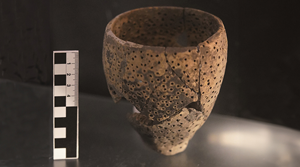
In feature 20 at Bietikow, an unusually well-preserved sieve vessel was found (Figure 5). It is a funnel about 120mm high and 105mm in diameter at its larger opening and 35–40mm across at its smaller oval opening (for more examples see: Bogucki Reference Bogucki1984). This Bietikow sieve is the most complete and best preserved from the LBK.
An unusually well-preserved baseless sieve funnel from Bietikow (figure by author).

Ceramic sieves in the Uckermark region have also been found at Zollchow, Blindow, Falkenwalde and Rosow (Figure 1 nos. 12, 43, 62 & 105). The relative frequency of ceramic sieves in the Uckermark region is comparable to that found in concentrations of LBK settlement elsewhere in the lowlands, at Pyrzyce-Land and especially Kuyavia along the lower Vistula. Ceramic sieves from Kuyavia have yielded evidence of bovine milk lipids that have been interpreted as evidence for cheese production (Salque et al. Reference Salque, Bogucki, Pyzel, Sobkowiak-Tabaka, Grygiel, Szmyt and Evershed2013).
Feature 50 at Bietikow is an ovoid pit (3.85 × 2.35m) about 0.45m deep with a posthole at each of its narrow ends. In addition, a pit about 0.9 × 0.85m with a stone pavement with fire-marks on its eastern side is interpreted as a cooking feature because it is too deep for a fireplace for heating. This feature is interpreted as a two-post semi-subterranean dwelling (see drone photo and illustration Figure 6). More than 120 Linear Pottery sherds were found in the fill of this feature, displaying Šarka-style ornamentation with pitch on its surface.
Above) aerial photograph of feature 50 at Bietikow—a two-posthole pit shelter with protruding cooking pit; below) illustration of a reconstruction of the shelter with a cooking pit in front (figures by author).

Other LBK sites in Uckermark—29 sites from the 119 findspots (Figure 1)—have also yielded pit complexes with large quantities of artefacts in their fills, but no linear rows of postholes. Therefore, at present, there is no evidence of large longhouses, despite the assertion that they are seen as universal features of LBK settlements. Yet the number of LBK sites in Uckermark points toward an intensive landscape use over a maximum of about 500 years of occupation (Table 1), despite the absence of evidence for longhouses and crop cultivation (Jahns & Wolters Reference Jahns, Wolters, Schier, Orschiedt, Stäuble and Liebermann2021). Sunken-floor buildings, probably used temporarily or seasonally, were more suited for the practice of mobile stockherding based on domesticated cattle, with the sieve vessels indicating milk processing and cheese production. Eventually, longhouses might be found in the hilly region west of Szczecin (Figure 1, 1–4), or east of the Oder river, as recently suggested by the discovery of a single longhouse at the site Nowe Objezierze (Czerniak et al. Reference Czerniak, Święta-Musznicka, Pędziszewska, Goslar and Matuszewska2023: fig. 7). It appears that the stockherders might have spent winters in these. Thus, the settlement and subsistence systems of the LBK at its northern periphery are different from that seen in its core areas, and here the cattle-breeding seems to be focused on the production of dairy products.
Acknowledgements
I am grateful to Peter Bogucki (Princeton, USA) for his help with an early version of this article and I thank two anonymous peer reviewers for their support.



