





1. Introduction
Because of the great temporal resolution that characterizes them, electroencephalographic (EEG) signals have been often analyzed to gain insights into the brain processes which are carried out during language processing tasks. In more detail, investigations on language processing have been performed considering event-related potentials (ERPs) since the early 1980s (Kutas & Hillyard, Reference Kutas and Hillyard1980; Kutas & Federmeier, Reference Kutas and Federmeier2000; Bambini, Reference Bambini, Östman & and Verschueren2012). ERPs are voltage changes of the electrical activity of the brain and can be induced by sensory or cognitive events (Luck & Kappenman, Reference Luck and Kappenman2011). Two ERP signatures, N400 and P600, have been found to strongly interact with the brain response to linguistic inputs. Specifically, N400 is a negative component peaking between 300 and 500 ms after stimulus onset, and its elicitation has been associated with difficulties in lexical–semantic retrieval (Kutas & Federmeier, Reference Kutas and Federmeier2000; Lau et al., Reference Lau, Phillips and Poeppel2008), semantic integration/unification mechanisms (Hagoort & van Berkum, Reference Hagoort and van Berkum2007), the processing of more or less expected information structural patterns (Cowles et al., Reference Cowles, Kluender, Kutas and Polinsky2007; Wang & Schumacher, Reference Wang and Schumacher2013; Masia et al., Reference Masia, Canal, Ricci, Lombardi Vallauri and Bambini2017), and the decoding of non-literal meanings (Kutas & Federmeier, Reference Kutas and Federmeier2011; Weiland et al., Reference Weiland, Bambini and Schumacher2014). P600, a component peaking between 500 and 800 ms, was originally observed in parsing difficulties caused by syntactic violations or garden path sentences (Osterhout & Holcomb, Reference Osterhout and Holcomb1992; Hagoort et al., Reference Hagoort, Brown and Groothusen1993; Kaan & Swaab, Reference Kaan and Swaab2003), yet its functional role has also been associated with mechanisms of context update (Burkhardt, Reference Burkhardt2006; Hoeks et al., Reference Hoeks, Brouwer, Holtgraves and Holtgraves2014) and new information decoding (Burkhardt, Reference Burkhardt2007; Domaneschi et al., Reference Domaneschi, Canal, Masia, Lombardi Vallauri and Bambini2018).
The present paper aims at assessing the contribution of ERPs in exploring how the brain deals with a special type of language interface, namely the one between the information structure and the word class level of a sentence. Notably, variations in the brain response in terms of evoked potentials will be investigated in cases where more or less expected combinations between word classes (mainly noun and verb) and distinct patterns of information structure (i.e., Topic–Focus articulations) are processed.
The paper is organized as follows. In Section 2 a working definition of information structure units is provided, and their relation to noun and verb classes in language use is canvassed. Section 3 reports an overview of the existing literature both on the processing of the information structures of different utterances and on the mental representation of the noun–verb distinction. Building on Section 2, the prediction that there should be some sort of ‘processing preference’ for topical nouns over focal nouns, and for focal verbs over topical verbs, is formulated in Section 4. Section 5 describes the experimental design adopted to test our predictions on the neurophysiological response to distinct patterns of associations between noun and verb categories and information structure units. Results from ERP measurements are then discussed in Section 6, and conclusions are drawn in Section 7.
2. Theoretical views: Information Structure and word classes
Since its very discovery as an independent level of utterance organization (related to but not subsumed by semantics or syntax), Information Structure was defined in terms of predicativity. The founding remarks by the Second Prague School, starting at the second half of the twentieth century (Daneš, Reference Daneš1964, Reference Daneš1967, Reference Daneš1974; Firbas, Reference Firbas1966, Reference Firbas1987), led to the naming of theme and rheme as the fundamental units of what was then called an utterance’s Functional Sentence Perspective, with the first seen as ‘what the utterance is about’, and the second as ‘what the utterance actually tells (about the Theme)’. Even etymologically, and absolutely not by chance, the theme is conceived as typically encoding reference to some object or entity, while the Rheme is the predication, the part of the utterance encoding what is actually said.
Halliday (Reference Halliday1985) introduces Thematic Structure as a feature of the clause. In accordance with the Prague School terminology, he defines the Theme as “the element which serves as the point of departure of the message” expressed by the clause, “that with which the clause is concerned”. The Rheme, conversely, is defined as “the remainder of the message, the part in which the Theme is developed”. A similar definition suggests a strong affinity between the Theme and nominal constituents on the one side, and between the Rheme and verbal or in general predicative constituents on the other. Halliday himself remarks that “a Predicator is rarely thematic”. In sum, Theme and Rheme seem to present themselves (by definition, and in actual utterances) as two complementary parts of any message encoded by a clause, which is made of an entity (“what the message is about”, the Theme) and a predication (“what is told”, the Rheme), exactly as the clause is made – syntactically – of a nominal and a verbal part. What is thematic has the nature of an entity; what is rhematic is that of a process.
Currently, the terms Theme and Rheme have been replaced in most of the literature by Topic and Focus, respectively, but the concepts remain essentially the same. Emanuela Cresti’s path-breaking work (Cresti & Moneglia, Reference Cresti, Moneglia, Moneglia and Panunzi2010) has shown that Topics have their typical (mainly ascending–descending) ‘Topic-contours’, while Focuses are produced under the various contours which describe the utterances’ illocutions. In an assertion, the Topic will be prosodically produced as a Topic, and the Focus will carry an assertive contour. In a question, the Topic will again have its Topic contour, but the Focus will carry an interrogative (ascending) contour. The same for an illocutionary act of command, protest, and so on. In other words, prosody crucially shows that while the Topic of the utterance only encodes the entity to which the illocutionary act will apply, the Focus is responsible for the illocution, that is, for the particular kind of predication encoded by the utterance.
Among others, Cresti and Moneglia (Reference Cresti, Moneglia, Moneglia and Panunzi2010) have shown, based on huge amounts of data belonging to corpora of spontaneous speech, that an information unit carrying the function of a Topic can actually be made of any kind of syntactic constituent, and the same holds for a Focus. Therefore, Information Structure is largely independent of syntax. Consider, for example, the following sentences:

The clauses contained in the ‘B’ utterances in (1) and (2) are actually different, despite their apparent syntactic identity. In fact, in (1) the utterance is about John, and it predicates that he went to China. Hence, John is the Topic of the message, and went to China is the Focus. In (2), conversely, the utterance is about going to China, and it predicates that it is John who did it. In other words, went to China is the Topic of the message, and John is the Focus. Now, the case represented by (2) is possible and even frequent, but (1) is the default case. It is more expected and straightforward for nominal constituents to realize the nomination of entities, and for verbal constituents to realize the predication of the message. In the examples above, this can be seen from the fact that language is organized to express the first case by means of the unmarked, default construction, while the second case requires marked, contrastive prosody.
In more detail, it has been shown from vast corpora of spontaneous speech that nominals are more frequently associated with Topics, while verbal constituents more frequently realize Focuses. For example, Mittmann (Reference Mittmann2012) has shown that in the C-ORAL-BRASIL Brazilian Portuguese corpus, nominal Topics are more than twice as frequent as verbal Topics, while the ratio found by Cavalcante (Reference Cavalcante2015) in a vast American English corpus was 7:1. These figures are extracted from Mittman’s and Cavalcante’s data by considering utterances whose information structure does not involve more than one clause. They do not consider those cases where, in a complex sentence, the Topic of the utterance can be an entire clause, possibly including both nominal and verbal constituents.
Cresti and Moneglia (Reference Cresti, Moneglia, Moneglia and Panunzi2010) report that, in a representative corpus of Italian spontaneous speech, Topic units are filled nearly 60% by noun phrases and nearly 40% by other constituents, including adverbial phrases, adjectival phrases, prepositional phrases, and subordinate as well as main clauses. By the same token, Focus units (called ‘Comment; in their terminology) are filled nearly 62% by verb phrases and nearly 38% by adverbial phrases, adjectival phrases, prepositional phrases, and noun phrases.
These observations lead us to formulate the prediction that the associations between the syntactic categories of Noun and Verb and the information categories of Topic and Focus, though in principle free, may not be completely independent, but oriented. More precisely, the processing of nominal Topics and verbal Focuses should be cognitively less costly in terms of the required brain processing, being the most frequent and more ‘homogeneous’ option: nouns are already made for denoting entities and verbs are already made for predicating about entities. In contrast, the processing of verbal Topics and nominal Focuses should be cognitively more costly, being the less frequent and less ‘homogeneous’ option. Verbs must change their primary function in order for them to denote an entity, and nouns must change their primary function if they are to express a predication.
It is worth remarking that, in principle, different processing efforts could be simply due to the fact that infrequent structures may generate a more ‘surprising’ response. Still, it can be observed that, although Focal Nouns and Topical Verbs have lower frequencies as compared to Topical Nouns and Focal Verbs, nonetheless none of them is rare. As a consequence, a ‘surprising’ response should be highly unlikely for both of them. What makes them really different is the relative nature of their components, in that nouns, being non-predicative, have more semantic/pragmatic affinity to Topical information status, while verbs, being predicative, have more semantic/pragmatic affinity to Focal information status. This difference in semantic/pragmatic ‘homogeneity’ may well cause different effort, thus being the best candidate to explain possible brain processing effects.
The aim of the present paper is to verify the plausibility of such predictions, analyzing the cognitive effort when processing sentences with different kinds of associations between the syntactic categories of Noun and Verb and the information categories of Topic and Focus. Specifically, EEG signals, giving information on the electrical activity of the brain, are exploited to perform such an analysis. EEG ERPs, that is, time- and phase-locked brain responses measured as the direct result of specific cognitive events, are used as descriptors of the brain workload in the scenarios considered.
3. Literature overview
The literature regarding noun and verb processing is covered in Section 3.1, while experimental findings on Information Structure processing are outlined in Section 3.2.
3.1. Noun and verb processing
Brain response to nouns and verbs has been the object of several neurophysiological investigations over the last two decades (Damasio & Tranel, Reference Damasio and Tranel1993; Pulvermüller et al., Reference Pulvermüller, Lutzenberger and Preissl1999; Cappa & Perani, Reference Cappa and Perani2003). Both fMRI and ERP studies report fairly consistent topographic specializations of these two word classes in the human brain, with nouns mainly activating visual cortical regions, and verbs chiefly involving pre-frontal and frontal motor regions (Cappa & Perani, Reference Cappa and Perani2003). Different processing patterns, though, have appeared less consistent and less robust in other works in which grammatical class detection produced a more remarkable response only when extended sentence contexts were adopted in experimental stimuli (Levelt et al., Reference Levelt, Roelofs and Meyer1999). ERP measurements have also proved useful in unraveling how word class processing taps into the construal of other levels of analysis, and earlier and more recent studies in this respect have revealed that semantic and grammatical distinctions between nouns and verbs are bound to emerge even earlier than the canonical N400 time interval (Neville et al., Reference Neville, Nicol, Barss, Forster and Garrett1991; Zhao et al., Reference Zhao, Dang and Zhang2016). For example, Tan and Molfese (Reference Tan and Molfese2009) noticed that preschoolers’ responses to spoken nouns and verbs, either matching or non-matching action or object names presented in a scene, produced P100 and N220 signatures over frontal electrode sites, which suggested a discrimination effort between syntactic classes for both matching and mismatching conditions. In other experiments, verbs have been reported to impose more taxing processing due to their greater morphological and semantic complexity, since they designate events which necessarily involve other participants (Baker, Reference Baker2003). These findings, however, appear less systematic when it comes to ambiguous verbs and nouns such as the English cut, kiss, head, etc., which can function either as verbs or nouns depending on their context of occurrence. Indeed, using English words of this kind, Federmeier et al. (Reference Federmeier, Segal, Lombrozo and Kutas2000) conducted an ERP study to assess the extent to which manipulation of prior contextual information made the processing of nouns and verbs more or less costly. Notably, presenting short texts with ambiguous nouns and verbs alternatively embedded in verb-predicting and noun-predicting contexts, the authors noticed that more prominent N400 deflections were elicited by both nouns and verbs in less expected contexts (i.e., nouns embedded in verb-predicting contexts and verbs embedded in noun-predicting contexts). They thus concluded that, rather than correlating with neatly delimited patterns of neural activation, word class distinctions “emerge in real-time from an interaction of semantic and syntactic properties at both the single-word and the discourse level”. It should be noted that the interplay between word classes and discourse structure – with particular regard to the information structure level – has been less extensively investigated within the neurophysiological purview. The present paper intends to contribute to this line of research by further developing Federmeier et al.’s premises on the role played by discourse in facilitating word class differentiation.
3.2. Information structure processing
Most of what we know about information structure processing comes from behavioral and EEG studies (Birch & Rayner, Reference Birch and Rayner1997; Hruska & Alter, Reference Hruska, Alter and Steube2004; Sturt et al., Reference Sturt, Sanford, Stewart and Dawydiak2004; Schumacher & Hung, Reference Schumacher and Hung2012, among others). In the behavioral domain, the psychological processes underlying the mental encoding of topical vs. focal information have mainly been investigated through reading times and eye-movement measures, which yielded overall greater processing demands elicited by focused information, as opposed to topical information (Birch & Rayner, Reference Birch and Rayner1997). Possibly due to the adoption of more extensively contextualized stimuli, subsequent neurolinguistic experiments revealed quite deflecting processing trends of information units, in that increasing costs were not only observed in association with information statuses per se, but also – and even more conspicuously – as conditional upon more or less expected syntactic realizations (Burmester et al., Reference Burmester, Spalek and Wartenburger2014), phonological profiles (Cowles et al., Reference Cowles, Kluender, Kutas and Polinsky2007; Baumann & Schumacher, Reference Baumann and Schumacher2012), and activation degrees in discourse (Wang & Schumacher, Reference Wang and Schumacher2013). In these accounts, Topics conveying new information (Wang & Schumacher, Reference Wang and Schumacher2013) or realized by object dislocation strategies (Burmester et al., Reference Burmester, Spalek and Wartenburger2014) are reported to cost more than Topics carrying given information and realized by syntactic subjects. These and other findings on the whole converge on the involvement of both N400 and P600 responses which, as discussed in the mainstream literature, respectively reflect mismatch detection at both the semantic and the discourse level (Kutas & Federmeier, Reference Kutas and Federmeier2000; Masia et al., Reference Masia, Canal, Ricci, Lombardi Vallauri and Bambini2017; Domaneschi et al., Reference Domaneschi, Canal, Masia, Lombardi Vallauri and Bambini2018), as well as difficulties in context updating (Burkhardt, Reference Burkhardt2007). Phonological, syntactic, or context-dependency features inconsistently matching with information statuses generally elicited greater N400 responses, sometimes accompanied by subsequent positive deflections. In a recent study, Bañón and Martin (Reference Bañón and Martin2019), tested the brain response to it-clefts, either with dislocated given or new information. While the former condition would be more expected, the latter is less common and was therefore predicted to increase the cost required to process the sentence. Indeed, the authors found that the less expected condition yielded more prominent N400 amplitudes with even greater P600 effects.
So, much of what is at play in information structure processing is profoundly contingent on the level of expectations interlocutors entertain on the distribution information received in an utterance, and on the types of interactions it displays with other levels of sentence representation. In the present paper, the level of expectations we propose to look into concerns the relation between Topic and Focus units and the syntactic classes of noun and verb in a sentence.
4. Predictions
Capitalizing on the assumptions and the findings discussed above, we expect differences between Topic–Noun/Focus–Verb and Topic–Verb/Focus–Noun combinations to emerge in modulations in the N400 signature. A stronger negative response is expected to be elicited by less homogeneous information structure / word class matchings, represented by topical verbs and focused nouns in our experimental design. An N400 response would be consonant with previous accounts on the expectation-related nature of this component (Kutas & Federmeier, Reference Kutas and Federmeier2011; Bambini et al., Reference Bambini, Bertini, Schaeken, Stella and Di Russo2016) and particularly with unmet predictions on information packaging strategies (Cowles et al., Reference Cowles, Kluender, Kutas and Polinsky2007). In the experimental paradigm used, no given–new opposition (Chafe, Reference Chafe and Li1976) has been measured for the critical information, so we should not expect potential P600 effects to be driven by the activation status parameter.
5. Methods
The experimental tests performed are described below. Specifically, the experimental design adopted is outlined in Section 5.1, the administered stimuli in Section 5.2, the collected data in Section 5.3, and the data processing performed in Section 5.4.
5.1. Experimental design
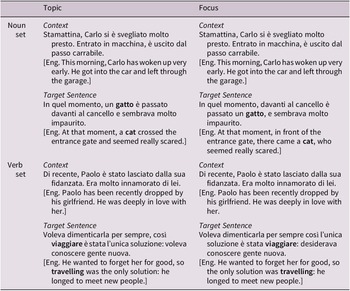
In order to collect a proper number of brain responses to all the interesting combinations between information structure and word class (noun and verb), a set of 60 pairs of texts, each composed of three-sentence passages, namely a two-sentence context followed by a target sentence, was created. The critical region in the target sentence contains a noun or a verb realized either as Topic or as Focus. To avoid potential overlapping with other discourse phenomena, mainly indefinite phrases were considered for the noun set, since definite noun phrases would have been interpreted as triggering a presupposition, thus blurring topicalization and focalization effects. As for the verb set, mainly infinitives were used, since they can be flexibly moved from Topic to Focus position without remarkable infelicity effects (at least in Italian, the same would hardly obtain with fully inflected verbs).
As can be seen from the examples in Table 1, texts have been arranged in pairs, so that the same two-sentence context can be followed by two different target sentences, with a noun (or a verb) in either Focus or Topic condition.Footnote 1 To test the predictions outlined in Section 4, the design has been constructed so as to assess the interaction between the two main independent variables of the study, i.e., Type (Noun, Focus) and Condition (Topic, Verb), and how such interaction is reflected in the ERP measurements.
Examples of the experimental stimuli (target nouns and verbs are bold-typed)

5.2. Stimuli
To isolate the effects of information packaging and word class variation from those related to the discourse availability (givenness vs. newness; Chafe, Reference Chafe and Li1976) of contents, which strongly modulates sentence processing (Basar-Eroglu et al., Reference Basar-Eroglu, Basar, Demiralp and Schürmann1992; Burkhardt, Reference Burkhardt2006), we have chosen to keep all regions of interest equally new. Therefore, the critical nouns or verbs, in Topic or in Focus condition, always convey novel information. Differently from other studies, such as those by Baumann and Schumacher (Reference Baumann and Schumacher2012), La Rocca et al. (Reference La Rocca, Masia, Maiorana, Lombardi Vallauri and Campisi2016), and Hruska and Alter (Reference Hruska, Alter and Steube2004), where expectations on information structure processing have been measured relative to the degree of activation of the contents carried by topical or focal units, in this study we are mainly interested in brain responses to topicalizations and focalizations as realized by different word classes, which, to us, makes the unvaried information status parameter even more compelling.
The position of the target word has been carefully determined for both the Condition and the Type factors. Particularly, for the Topic condition, the average position of critical nouns in the target sentence is 5 (SD = 1), whereas for verbs it is 4.5 (SD = 1.7). In the Focus condition, the position of nouns is approximately fixed at 10 (SD = 1.8), while for verbs it is 9 (SD = 2.3). Overall, the distribution of critical nouns and verbs is fairly homogeneous within and between the Topic and Focus conditions, meaning that the effects of Topic vs. Focus packaging should not be distorted by unsystematic positional oscillations of the target words. As a result, the syntactic encoding of critical words as Topic or Focus, at least in terms of sentential position, is expected to be more comparable between the Noun and the Verb set. Also, the mean length of the target sentences did not significantly differ between the Noun and Verb sets, nor did the overall frequency of the critical (ERP anchorage) words in common language uses, as the resulting mean frequency values show (Noun = 25.85; Verb = 20.83). Furthermore, in compliance with standard normalizing measures in experiments utilizing context–target pairs as stimuli, the naturalness of all texts has been judged on a 5-point Likert scale by another group of subjects in an offline questionnaire. A two-way ANOVA on the collected responses showed no significant interaction (F(1,35) = 1.2; p = 0.6) between the Type (Noun, Verb) and Condition (Topic, Focus) parameters. This suggests that any effect to be foreseen at the electrophysiological level should not be put down to unnatural or implausible features of the stimuli.
The stimuli employed were submitted as audio tracks. Since they were recorded and presented at normal speech rate, the timing between the offset of a region of interest and the beginning of the next word could be quite short. Specifically, the inter-word means and standard deviations for each combination of Type and Condition are {mean = 151ms, SD = 49ms} for Noun/Topic, {mean = 166ms, SD = 62ms} for Verb/Topic, {mean = 182ms, SD = 121ms} for Noun/Focus, {mean = 209ms, SD = 105ms} for Verb/Focus. The aforementioned inter-word intervals are quite similar for all the considered Type × Condition combinations, with differences due to the natural way the considered Types and Conditions are verbally performed to pack information within sentences. Moreover, an ANOVA test could not find any significant effect regarding possible (information structure) × (word class) interactions on the collected timing values (p = 0.71).
It is worth observing that, having used stimuli with such inter-word timings to reproduce natural conditions, the EEG responses to consecutive words could overlap, making it hard to record clean and artifact-free potentials, and affecting the feasibility of detecting differences in the behaviors observed for distinct combinations of Type and Condition. This is especially valid for comparisons of noun and verb usages in Topic, due to the typically shorter subsequent silence period with respect to Focus conditions. Nevertheless, as will be shown in Section 6.2, significant effects on the cognitive cost of processing more or less expected combinations of information structure and word class have been indeed found in the tests performed, testifying that the stimuli employed have been properly designed to highlight significant interaction effects. In particular, as will be seen, although the average length of the inter-word interval after a Focus is (quite naturally) longer than after a Topic, the effects were found both for Topic/Verb and for Focus/Noun, suggesting that the effect is due to the cognitive factors proposed in the paper, rather than to minor vs. major overlapping of EEG signals.
5.3. Data collection
Thirty-five students (7 men, mean age = 22.8, SD = 3.5) from Roma Tre University took part in the experiment. All subjects were right-handed (mean laterality = 0.81, SD = 0.16; cf. Oldfield, Reference Oldfield1971), native Italian speakers, with normal or corrected-to-normal vision. None of them reported a history of neurological or psychiatric disorders. Informed consent was obtained from all subjects prior to each experimental session.
During the experiment, participants sat in a dimly lit, sound-attenuated room. Subjects were asked to look at a fixation cross in the center of a computer screen while listening to the stimuli provided.
The 60 pairs of texts were arranged into two randomized lists according to a Latin Square design, so that each participant was presented with only one occurrence of the two-sentence context whose target sentence contained either a noun or a verb in Topic or in Focus condition. Both lists also contained a further 30 fillers, randomly interspersed between the experimental trials, with no marked topicalizing or focalizing constructions.
In order to make sure that the investigated Type × Condition interactions had no significant effect on the comprehensibility of the designed texts, all experimental stimuli were accompanied by two verification questions presented visually on the computer screen. After reading each question, subjects had to press a TRUE/FALSE button on the keyboard.
During the presentation of the stimuli, EEG signals of the participants were acquired using a 19-channels system GALILEO Be Light Amplifier, with an original sampling rate of Sr = 256 Hz. The electrodes were placed on the scalp according to the 10-20 standard montage, and the electrical impedance was kept under 10 kΩ using conductive gel at the beginning of each acquisition. The EEG measures are referenced to the AFz position, and represented as potentials v(c)[t] between the c-th electrode and the reference electrode, with c = 1, …, C = 19. EEG recordings have been time-locked to the presentation of the target words, represented by the head noun of the indefinite phrase for the noun set (see Table 1), and by the infinitive verb for the Verb set. The synchronization signal obtained was used to lock the raw EEG traces to the occurrence of the words of interest.
5.4. Data processing
A spatial common average referencing (CAR) filter (McFarland et al., Reference McFarland, McCane, David and Wolpaw1997) was first applied to the data acquired in order to improve their signal-to-noise ratio (SNR), and make them as independent as possible from the employed reference, by subtracting from each raw EEG signal v(c)[t], c = 1…, C, the mean voltage sensed over the entire scalp. The signals obtained were then band-pass filtered in order to retain spectral components in the range [0.5 − 40] Hz, containing the main EEG rhythms of interest for the present study. Subsequently, EEG signals were segmented into epochs time-locked to the words under analysis, considering time intervals lasting from TpreS = 50 ms before the stimulus end, to TpostS = 1000 ms after it. The result of the aforementioned process was a set of NT = 60 epochs vn(c)[t], n = 1, …, NT, for each participant. After the application of independent component analysis (ICA), artifacts were automatically labeled and removed (Pion-Tonachini et al., Reference Pion-Tonachini, Makeig and Kreutz-Delgado2017). The post-stimulus signals were then normalized with respect to the pre-stimulus baselines, obtaining the set of epochs $ \overset{\sim }{v} $
n(c)[t], n = 1, …, NT and c = 1, …, C from which ERP descriptors were derived as described below.
$ \overset{\sim }{v} $
n(c)[t], n = 1, …, NT and c = 1, …, C from which ERP descriptors were derived as described below.
5.4.1. Event-Related Potentials
For each user and for each possible combination of Type × Condition, the selected samples were averaged in order to generate a single ERP signal. In more detail, as laid out in Section 4, we focused our analysis on the behavior of the N400 and P600 components, isolated considering time windows starting TN400Start = 300 ms and TP600Start = 500 ms after the stimulus end, respectively, and lasting 200 ms. Within this time lapse, three distinct features were extracted and taken into account as indicators of the cost of processing the different sentences, namely the mean and the peak value within the considered time windows, and the latency of the obtained ERP peaks. Such characteristics, evaluated separately for each of the C considered channels, are employed in the statistical analysis outlined in Section 6.
6. Results
The results obtained are reported here, together with a discussion on the observed ERPs in response to different patterns of associations between information units and the two word classes considered in the present study.
In order to verify the hypotheses stated in Section 4, several statistical testing procedures were carried out. In more detail, Section 6.1 first reports the results obtained from norming questionnaires performed in order to address whether the usage of different Type × Condition combinations may affect the understandability of the experimental texts. Sections 6.2 and 6.3 respectively illustrate the outcomes from the tests performed on the ERP samples to evaluate the effects of different Type × Condition interactions on brain processing. The results gathered are then discussed in Section 6.4.
6.1. Understandability analysis
A preliminary analysis of the subjects’ responses to verification questions yielded an overall accuracy of 95% (SD = 0.07) which suggests that all texts had been carefully read by the subjects. A two-way ANOVA crossing Condition (Topic, Focus) and Type (Noun, Verb) with verification accuracy displayed no significant interactions (F < 1), indicating that neither the topical/focus packaging level nor the word class level interfered with the comprehension of the texts and that all stimuli had been understood equally well. Another two-way ANOVA was performed on the interaction between the two factors for the subjects’ response times to verification questions, again showing no statistically significant result (F(1,35) = 0.19; p = 0.7), implying that subjects took more or less the same amount of time to answer verification questions, irrespective of the Condition or Type manipulations carried out in the target sentences. Text complexity was also evaluated by measuring the length of the submitted texts, designed with a mean range between 33.3 and 36 (SD = 5) words. A two-way ANOVA run on the Condition × Type interaction showed no significant result (F(1,56) = 3.6, p = 0.06), suggesting that on the whole all texts displayed the same length, and that overall the length parameter did not affect the brain response to the experimental passages listened to by the subjects. In other works, text complexity has also been gauged by calculating readability indexes (see Gulpease index for Italian written texts in Piemontese, Reference Piemontese1996) which, given the auditory presentation modality of our stimuli, we have preferred to not consider for the present study.
6.2. ERP results
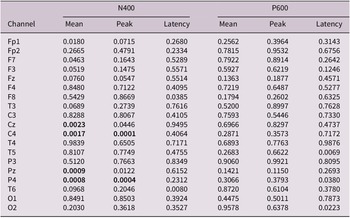
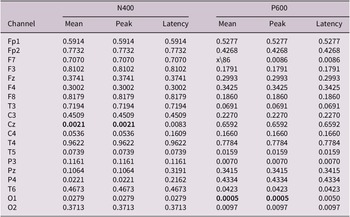
The ERP features mentioned in Section 5.4.1, that is, mean, peak, and latency, were considered as dependent variables in two-way Type (Noun, Verb) × Condition (Topic, Focus) ANOVA tests, performed to evaluate the existence of an interaction between the considered categories of information structure and the two-word classes. The p-values obtained when considering both N400 and P600 ERPs are reported in Table 2. Values reported in bold display significant interactions, having considered a level of significance at 0.05, and a Bonferroni correction depending on the number of employed channels, i.e., 19, for each ERP. As expected, the N400 signature emerged as the most prominent characteristic to reveal the interaction between the employed information structure and the considered word classes, with significant results observed in centro-parietal areas. The mean value over the N400 interval is the descriptor providing the most relevant information.
p-values obtained performing two-way Type (Noun, Verb) × Condition (Topic, Focus) ANOVA tests on features derived from N400 and P600 descriptors. Values in bold highlight the existence of significant interaction between information structure and word classes.

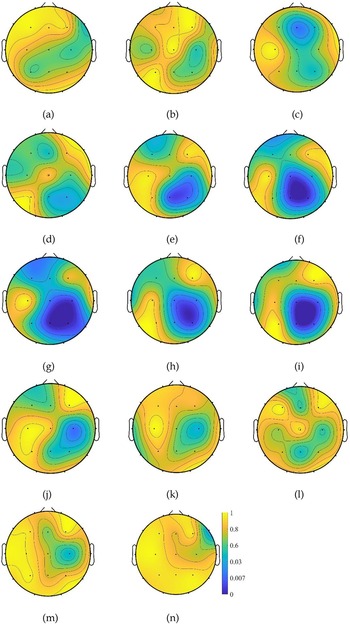
To provide a visual representation of the results obtained, the brain regions where significant interactions emerged from the analysis of the mean of the N400 ERPs are reported in Figure 1, which includes both the location of the most relevant channels, and a topographic map of the p-values obtained using interpolation on a fine cartesian grid. Further, Figure 2 reports a set of topographic maps to describe the temporal behavior of the p-values computed through ANOVA tests conducted on consecutive time windows, each lasting 50 ms. Significant values start to appear in the centro-parietal area for time intervals coherent with N400 responses.
Regions with significant Type × Condition interaction, according to two-way ANOVA tests performed on the mean value of the N400 ERPs. (a): channels with significant effects; (b): interpolated topographic map with p-values.

Interpolated topographic maps with p-values from ANOVA tests on the Type × Condition interaction, computed on the mean values recorded in different consecutive time windows. (a): 0-50ms; (b) 50-100 ms; (c) 100-150 ms; (d) 150-200 ms; (e) 200-250 ms; (f) 250-300 ms; (g) 300-350 ms; (h) 350-400 ms; (i) 400-450 ms; (j) 450-500 ms; (k) 500-550 ms; (l) 550-600ms; (m) 600-650 ms; (n) 650-700 ms.

It is worth specifying that, since the number of electrodes employed for our EEG acquisitions is quite limited, in the statistical tests performed we opted to rely on the Bonferroni correction to handle the family-wise error rate (FWER) in our multiple-comparison scenario, instead of resorting to non-parametric statistical tests such as Threshold-Free Cluster Enhancement (TFCE) analysis (Smith & Nichols, Reference Smith and Nichols2009), which could benefit from high-density montages to improve the computed statistics. Actually, we found significant effects even following the parametric testing approach, which is typically much more conservative than non-parametric alternatives.
In order to gain further insights on the effects of using different combinations of Type and Condition categories, several statistical t-tests were also performed, each evaluating the effects on N400 and P600 of adopting different word class Types in a specific Condition of information structure.
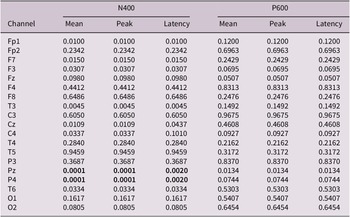
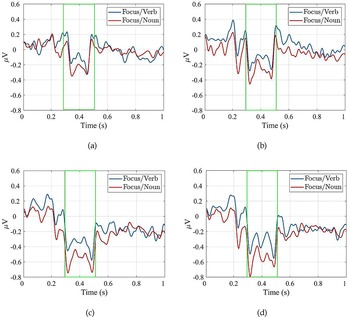
In more detail, the p-values obtained when considering the processing of nouns and verbs occurring in Focus condition are given in Table 3, with significant differences reported in bold, for the same significance level and the same correction as adopted in the ANOVA tests. In order to give a visual representation of the observed behaviors, ERPs referred to Focus conditions are reported for selected channels in Figure 3, where it is shown that the processing of focused nouns produces greater N400 deflections than the decoding of focused verbs. The reported results confirm what had already been observed with the ANOVA tests, showing that the most significant differences are linked to the mean and peak values of the N400.
p-values obtained performing t-tests on features derived from N400 and P600 descriptors, for ERPs recorded as responses to the adoption of different word class types (nouns or verbs) in Focus condition

Grand average ERPs for the Focus Noun vs. Focus Verb comparison. (a): Cz; (b) C4; (c): Pz; (d): P4

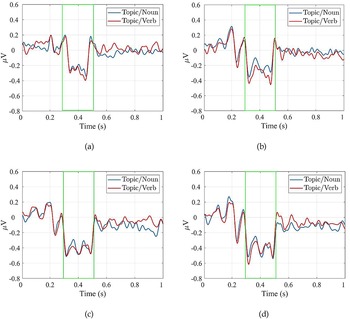
The results related to the ERP responses to nominal and verbal Topics are shown in Table 4. A comparative analysis highlights that the Focus condition induces most of the effects on cognitive processing. ERPs extracted from responses recorded in correspondence to nominal and verbal Topics are provided in Figure 4.
p-values obtained performing t-tests on features derived from N400 and P600 descriptors, for ERPs recorded as responses to the adoption of different word class types (nouns or verbs) in Topic condition

Grand average ERPs for the Topic Noun vs. Topic Verb comparison. (a): Cz; (b) C4; (c): Pz; (d): P4

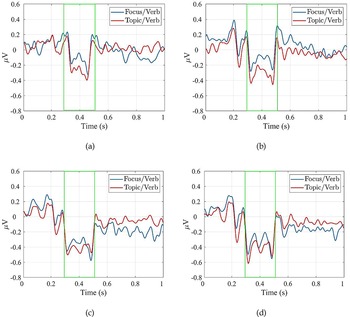
Similarly, statistics regarding the same class type but different conditions were performed. Specifically, the p-values obtained when taking into account verbs occurring in both Focus and Topic conditions are reported in Table 5. Again, the results show that the differences can be observed in the mean and peak values of the N400 time window. Table 6 instead reports the results related to the ERP responses to nominal Topics and Foci. The analysis performed considering the processing of nouns resulted in statistically significant effects in the mean and the peak amplitudes of the N400 responses, mainly in parietal brain areas.
p-values obtained performing t-tests on features derived from N400 and P600 descriptors, for ERPs recorded as responses to the adoption of the same word class type (verb) in Focus and Topic conditions

p-values obtained performing t-tests on features derived from N400 and P600 descriptors, for ERPs recorded as responses to the adoption of the same word class type (noun) in Focus and Topic conditions.

The visual representation of the reported comparisons, which take into account the same word class but different packaging conditions, are reported in Figure 5 and Figure 6. In more detail, Figure 5 shows examples of the grand average ERPs related to the electrodes displaying more prominent N400 responses in the comparisons between verbal Topics and verbal Foci, while Figure 6 depicts the comparisons between grand average ERP responses to nominal Topics and nominal Foci.
Grand average ERPs for the Focus Verb vs. Topic Verb comparison. (a): Cz; (b) C4; (c): Pz; (d): P4

Grand average ERPs for the Focus Noun vs. Topic Noun comparison. (a): Cz; (b) C4; (c): Pz; (d): P4

6.3. Discussion
The results obtained from the ERP analysis confirm the expectations about the N400 component, and, notably, those associated with the processing of less expected information structural patterns (Cowles et al., Reference Cowles, Kluender, Kutas and Polinsky2007; Wang & Schumacher, Reference Wang and Schumacher2013; Masia et al., Reference Masia, Canal, Ricci, Lombardi Vallauri and Bambini2017). In our study, the less expected patterns are represented by the Focus-Noun and Topic-Verb conditions.
As shown in both the grand averages and the statistical measures, the N400 effects observed in centro-parietal regions are mainly prominent when considering two comparisons, that is, in response to focused nouns compared to focused verbs (Table 3, Figure 3), and for focused nouns as opposed to topical nouns (Table 6, Figure 6). As already hinted at, this trend appears to go quite remarkably in the direction of an expectation-based processing of information structure, and particularly towards a realization of information units that is on the whole consistent with both the functions Topic and Focus generally perform in an utterance and with the cognitive contribution associated with the mental encoding of different word classes. More particularly, since Focus has an essentially predicative nature, it is safe to assume that its most expected association is with verbs or, more generally, with predicative segments of sentences. Instead, its association with the nominal category, although anyway frequent in spoken discourse – especially when it comes to narrow focalizations – is functionally less homogeneous, due to the fact that nouns (even those characterized by an eventive meaning such as construction, demonstration, raising, etc.) are less predicative in nature. Also, since focused constituents are expected to ‘say something’ about topical entities, what is said about these entities in non-marked syntactic orders is more likely to coincide with verbal and, more generally, predicative syntactic units, and the Topic with nominal syntactic units. Decoding a nominal syntactic unit in focal packaging thus requires dealing with a mismatching combination between a part of speech and its presentation in terms of discourse status which, in the case of focused nouns, entails assigning the function of ‘predicating something about the Topic’ to a syntactic unit which is not predicative itself.
A further aspect to underline is that in the Topic condition (cf. Table 4, Figure 4), the difference registered between verb and noun is not as strong as that noticed in the Focus condition. A possible and plausible explanation for this result is that, contrary to Focus, information packaged as Topic is generally presented as communicatively less salient and therefore as somewhat taken for granted on the processing level (Birch & Rayner Reference Birch and Rayner1997; Sturt et al Reference Sturt, Sanford, Stewart and Dawydiak2004, among others). As a consequence, a less expected matching between word class and information packaging strategy may be expected to come with a weaker cognitive impact in topical than in focal realization.
Regarding word class types, the stronger negativity observed for topical verbs as compared to verbs in Focus – although less prominent than that observed for nouns in topical vs. focal packaging – is indicative of a counter-expectation effect elicited by assigning topical packaging – which is more typical of nominal, time-stable lexical categories – to more predicative syntactic units. The slightly less prominent N400 deflections registered for this condition, compared to focal verbs, reflects an increasing processing demand owing to the central brain area’s dealing with a less homogeneous information packaging – word class matching – and therefore with the effort required to ‘solve’ a discursive mismatch caused by mentally representing predicative content (i.e., a verb) as a unit to say something about. This thus involves an overall restructuring of the linguistic context with a subsequent revision of expectations on the communicative dynamism of the ongoing discourse.
As already hinted at in the foregoing, differences between focal and topical packaging are more robust in the noun condition than in the verb condition, the costs imposed by focal nouns being considerably greater than those associated with the processing of topical nouns. On balance, our data seem to extend to information structure processing the results on expectation-based processing of word classes suggested by Federmeier et al. (Reference Federmeier, McLennan, De Ochoa and Kutas2002), on which this study also capitalized, who found modulations in the N400 signature during the online processing of English nouns and verbs in more or less predictable syntactic positions or discourse functions. In our research we sought to demonstrate that, besides interactions with the prosodic level (Hruska & Alter, Reference Hruska, Alter and Steube2004; Cowles et al., Reference Cowles, Kluender, Kutas and Polinsky2007) and with degrees of activation of information in the receiver’s short-term memory (La Rocca et al., Reference La Rocca, Masia, Maiorana, Lombardi Vallauri and Campisi2016; Masia et al., Reference Masia, Canal, Ricci, Lombardi Vallauri and Bambini2017), the processing of information structure is also sensitive to expectations associated with the word class being selected by the speaker to package some information as Topic or Focus of the sentence.
Other electrophysiological studies on unexpected information packaging criteria (Masia et al., Reference Masia, Canal, Ricci, Lombardi Vallauri and Bambini2017) reported N400 effects in response to novel information packaged as presupposition, as compared to the same item of information packaged as assertion, which confirm the connection of this component with less expected strategies of information packaging. These trends were interpreted as stemming from costs of discourse linking mechanisms (Masia et al., Reference Masia, Canal, Ricci, Lombardi Vallauri and Bambini2017), that is difficulties in linking some information to the foregoing discourse.
In our study, costlier cognitive operations were elicited by focal nouns, meaning that the mental operations required to perform a predication (i.e., focusing) by means of a noun are more taxing than those required to perform it by means of a verb. The fairly strong N400 effect observed in response to focal nouns, compared to focal verbs (cf. Table 3, Figure 3), can therefore be explained as reflecting a cognitive overload required to mentally construe a nominal type of information in Focus function (which is typically associated with predicates and, more particularly, with verbs). For the Topic condition, this scenario appears reversed, though with less significant values, in that topical verbs seem to be correlated with greater amplitudes in the N400 component, as compared to topical nouns. In other words, the negative deflections elicited by topical verbs is suggestive of costlier processing operations due to mentally representing eventive meanings in a packaging which is more typical of nominal categories.
All in all, the results gleaned do not point to significant trends in the P600 signature. To some extent, this outcome was not to be expected due to the fact that P600 more often correlates with updating efforts when some new information is being processed (Schumacher, Reference Schumacher2006; Domaneschi et al., Reference Domaneschi, Canal, Masia, Lombardi Vallauri and Bambini2018) or when parsing difficulties are experienced by the receiver (Gouvea et al., Reference Gouvea, Phillips, Kazanina and Poeppel2010). However, in our experimental design, all regions of interest in the target sentences conveyed new information, which means that no additional updating costs were required to the subjects. Also, the four experimental conditions were not opposed for factors related to the syntactic complexity or syntactic anomalies of the stimuli. These factors thus possibly made the elicitation of a P600 effect less likely.
To sum up, our results can be said to disconfirm previous data on the major processing demands imposed by verbs, as compared to nouns. The trends observed in the present study rather substantiate Federmeier et al.’s (Reference Kutas and Federmeier2000) view that word class processing is contingent on their discourse profile and that verbs can be costlier than nouns, or vice versa, only to the extent that their discourse status – and, notably, their information structural status – is less or more compliant with the receiver’s expectations on the current representation of the discourse contents.
6.4. Shortcomings and future developments
Although the data gathered in this study are all in all encouraging in the attempt to foster experimental research hypotheses on the interplay between information structure and word classes, the present study is not altogether free from some methodological limitations. One issue concerns the ecological validity of the stimuli which, with a view to achieving a more effective experimental design, have been artificially constructed by the experimenters, as mostly happens. The norming questionnaires, aimed at assessing the naturalness of the stimuli for native speakers of Italian, have thus provided compelling positive information on the structural soundness and overall perspicuity of the critical items administered as audio tracks. Attempts at obtaining the same relevance of the experimental design to the analyzed linguistic features, but with more ecological stimuli, are an interesting, difficult challenge, and an open path for further research.
Secondly, we have not conducted a prosodic analysis (in terms of presence vs. absence of pitch accent contours) to substantiate the Topic/Focus status of the critical regions. Notwithstanding that this procedure has sometimes been complied with in previous studies (Schumacher & Baumann, Reference Schumacher and Baumann2010; Baumann & Schumacher, Reference Baumann and Schumacher2012, among others), we opted for constructional criteria which did not emphasize only the prosodic profile of the critical region but also the overall contribution of the discourse context to the informational status of linguistic units. In fact, as also demonstrated in studies on the phonological correlates of Topic and Focus (e.g., Frascarelli & Hinterhölzl, Reference Frascarelli, Hinterhölzl, Schwabe and Winkler2007), intonational prominence may also mark topical constituents based on their discourse role, which is why prosody, without the foregoing linguistic context, risks being a too partial information structural cue.
A further development of the study would also benefit from gauging the influence of Topic/Focus packaging on the processing of parts of speech other than nouns and verbs. For example, it would be interesting to investigate the electrophysiological response (if any) to sentences with topical vs. focal adjectives such as Sono belli i gatti di Andrea ‘Beautiful are Andrea’s cats’ vs. I gatti di Andrea sono belli ‘Andrea’s cats are beautiful’.
7. Conclusions
In this study, the interplay of an utterance’s information structure and the word-class level has been investigated by looking into their brain correlates through ERP measurements. Data showed that the processing of informational hierarchies is indeed sensitive to the word class selected to realize the Topic or the Focus unit of the sentence. More particularly, a fairly strong N400 effect has been observed in response to nouns encoded as Focus as opposed to both focused verbs and topical nouns. These findings are in line with two main predictions set forth for the present research: (a) the cost associated with information structure processing follows discourse-driven expectations also with respect to the word-class level, and (b), as put forth by Federmeier et al. (Reference Federmeier, McLennan, De Ochoa and Kutas2002), the cognitive cost of mentally representing verbal and nominal classes is not only conditional on the evaluation of category-related features (i.e., that verbs are semantically and structurally more complex than nouns), but also follows an expectation-driven path; that is, it responds to the receiver’s anticipation of the information packaging properties that a word is expected to exhibit based on the discursive function it is called upon to perform.
Acknowledgments
The experiment has been devised and set up by the five authors together; ELV is responsible for Section 2; VM is responsible for Sections 1, 3, 5.2, 6.1; ELV and VM together wrote Sections 4, 5.1, 6.3, and 6.4; EP, EM, and PC are responsible for Section 5.3; EP and EM are responsible for Sections 5.4 and 6.2; Section 7 has been jointly written by the five authors.
Funding statement
None.





 Open access

