




THEATRE reviewing is an important sector of theatre criticism and theatre industry in the UK. While reviewers ‘shape economic and intellectual marketplaces’ through their writing, Irving Wardle notices that the history of theatre criticism demonstrates ‘its persistent blindness to fresh experience’.Footnote 1 This limitation remains relevant in contemporary British theatre criticism, where global majority productions frequently receive reductive or incomplete evaluations.Footnote 2 One example is HOME X, a digital theatre collaboration between artists in London and Hong Kong and a work closely connected with migrant communities in the UK. However, despite HOME X’s deep engagement with Chinese literary heritage, British reviews prioritize its technological aspects while neglecting its cultural specificity. This raises concerns about cultural erasure in theatre criticism.
This article thus examines the reception of HOME X within postcolonial and intercultural theoretical frameworks, arguing that its critical neglect reflects Gayatri Chakravorty Spivak’s ‘epistemic violence’ and the limits of western epistemology in engaging global majority theatre. Spivak exemplifies epistemic violence as ‘the remotely orchestrated, far-flung, and heterogeneous project to constitute the colonial subject as Other’.Footnote 3 ‘This project,’ she suggests, ‘is also the asymmetrical obliteration of the trace of that Other in its precarious Subject-ivity.’Footnote 4 It is my contention that although the technological innovation of HOME X is undoubtedly worth reviewing, British theatre criticism’s failure to acknowledge HOME X’s cultural references perpetuates critical disengagement and deeper epistemic violence, as these reviews simplify the meaning of the piece and obliterate the subjectivity of global majority creators. These reviews thus lead to a further consideration of the extent to which existing British theatre criticism can cause a system of exclusion to non-British theatre works produced in the UK.
I further engage with Ric Knowles’s theory of ‘new interculturalism’, which emphasizes the power dynamics within intercultural theatre production and reception. Knowles critiques earlier models of interculturalism for often privileging western perspectives. He suggests instead that theatre criticism must shift towards recognizing ‘intercultural flows/encounters from the perspective of non-Western and/or minority or subaltern stakeholders’, or, in his own words, ‘the visceral stitching together from below’.Footnote 5 This article applies Knowles’s framework to demonstrate how HOME X as an intercultural collaboration demands a critical approach that moves beyond a Eurocentric technological fascination and reflects its own subjectivity.
This article foregrounds its author’s first-hand experience of the production as an audience member, and further draws on an interview with its director An-Ting Chang as a representative of the creative team, revealing perspectives of ‘previously paradigmatic “Others”’ within the western context.Footnote 6 It also consults the concept design from the 3D designer Donald Shek. It is worth mentioning that the present author was born and grew up in mainland China, while Chang comes from Taiwan, and Shek’s design is influenced by his Hong Kong family heritage. These cultural backgrounds generally belong to the umbrella term ‘Chinese culture’. Meanwhile, each has their own cultural specificity closely connected with local cultures and personal diasporic experiences. This feature is enhanced by interviewees from HOME X, who come from different regions, ranging from Ukraine to Iraq and the Philippines, but all of whom now live in Britain and share their memories of home in this production. The hybridity of HOME X is consistent with new interculturalism’s aim that we should not ‘assume two, and only two, identifiable cultures encountering one another for the purposes of the performance project’.Footnote 7 Rather, hybridity of participants can ‘disrupt and reshape rather than confirm binaries of us/them, self/Other, here/there, and East/West, as experienced by individuals and groups in both artistic and social settings’.Footnote 8 By including Chang and Shek’s personal perspectives, this article shows how interculturalism suggests ‘a conceptual, processual, embodied lived condition driven by one’s own multiple affiliations to cultures, nations, and faiths’.Footnote 9 It thus foregrounds ‘culture’ as a ‘process of materially situated becoming for individuals and collectives (whether theatre ensembles, audiences, or publics) that remains always in motion and that can be viewed from an infinite number of angles and perspectives’, revealing the limited perspectives of existing reviews and the urgency for new approaches.Footnote 10
For international readers, this article locates a detailed context for HOME X within relevant Chinese texts. Ironically, such a complementary approach is consistent with ‘a pervasive double standard within the theatre community which expects the work of white artists to be universally understood while the work of IBPOC artists is relegated to “niche” level and so requires translation’, a problem this article addresses.Footnote 11
HOME X: An Intercultural Digital Performance
HOME X is co-produced by Kakilang, a London-based East and Southeast Asian (ESEA) arts organization, and Don’t Believe In Style, a Hong Kong-based company combining technology with creative arts. Originally commissioned by the British Council Hong Kong, it premiered at The Pit, Barbican, London, in February 2023. The production employs virtual reality (VR), 3D gaming, and real-time motion capture to explore migration, identity, and home. These technologies allow the two performers to appear in separate locations while ‘meeting’ in a shared virtual space. They also enable live audiences to witness these interactions through a 270-degree projection, while online audiences can navigate the virtual space on their own devices.Footnote 12
Set in a virtual world, the production follows two human characters, Jack (performed by Si Rawlinson in London) and Yang (楊, performed by Suen Nam in Hong Kong), as they are sent to a natural yet mythical space inhabited by tree spirits. Through their interactions, Jack and Yang reshape the landscape, replacing nature with urban development to rebuild their home. However, this leads to the destruction of the world’s biggest tree and, ultimately, the collapse of the virtual world. Later, Jack, Yang, and the tree spirits witness recorded video stories in which migrants to the UK share memories of their birthplaces and reflections on life in a new country.Footnote 13 These interviews constantly link the UK and other places, now and in the past, questioning and confirming ‘our roots, our sense of home, and their relationship with our existence’.Footnote 14
In addition to Rawlinson and Suen, Mia Foo (at The Pit, London) and soprano Colette Wing Wing Lam (in Hong Kong) also contribute to the production. Foo controls a tree spirit wandering the virtual world. The camera tracking her avatar offers live audience members a guided view of the digital landscape. Lam sings in Cantonese, with her live image projected and integrated into the virtual environment.
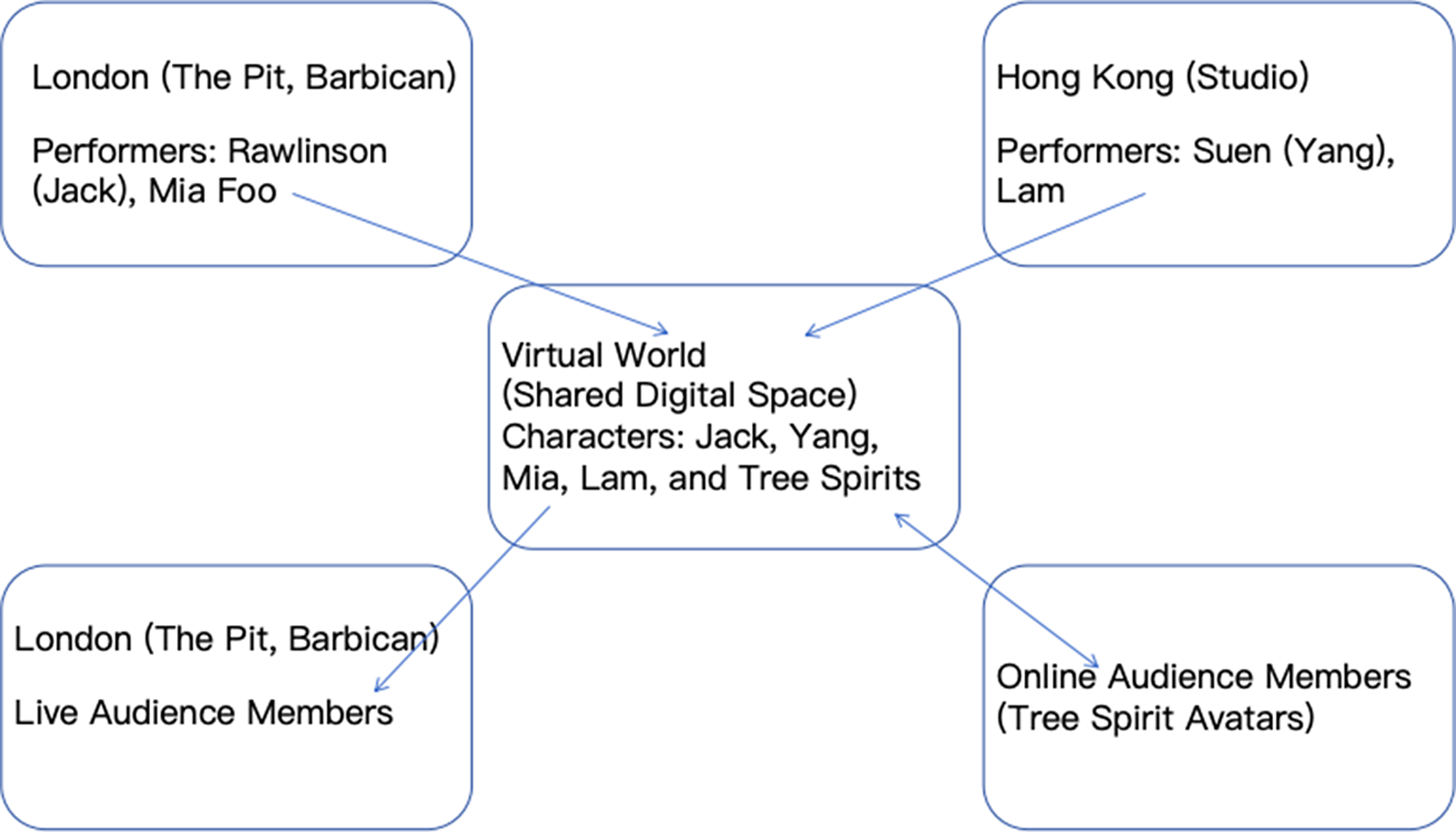
While the actors perform, online audience members actively explore the virtual world themselves. Before the performance begins, they open a pre-downloaded application and enter as pink avatars representing tree spirits. They interact through gestures such as planting trees and picking fruit, thereby shaping the environment. During the performance, they can see the digitized performers co-existing with them in the virtual space. They are also encouraged to engage with one another by sending reactions via interface buttons labelled ‘hearts’ and ‘beam lights’. These responses are projected onto the screen at The Pit, allowing live audience members to see both Rawlinson’s physical performance and the evolving virtual world (Figure 1).
Performance structure of HOME X. Created by the author.

Reviewing Reviews: Critical Reception and Epistemic Violence
British theatre reviews of HOME X predominantly focus on its digital technologies, emphasizing visual effects and interactivity over thematic and cultural depth. While critics have praised the production’s ‘visual artistry’ and ‘extraordinary beauty’, few have considered how technology interacts with Chinese cultural references and function as narrative devices rather than mere technical innovations.Footnote 15 For example, The Reviews Hub even calls it ‘a daring technical experiment’,Footnote 16 though Kakilang is hardly the first company to integrate gaming or VR into live performance. Moreover, the production’s beauty stems not only from technology but also from its aesthetic perspective, which is shaped by Chinese literature, an aspect absent from reviews.
Even when critics address the idea of home, the central theme of this production, few recognize the fact that HOME X reflects not only the experiences of its interviewees but also those of its creators. Kashmini Shah, for example, praises the recorded testimonies from migrants as ‘wonderfully insightful, showing honest and raw opinions and emotions from those with a range of backgrounds’,Footnote 17 while at the same time overlooking how HOME X expresses the creative team’s own understanding of home and their worldview.
This problem is accompanied by an oversimplified approach to ‘Asia’ in reviews. I consulted reviews of HOME X from The Stage, The Reviews Hub, Broadway World, and various personal blogs. Across these sources, reviewers largely prioritize technology, slightly address thematic dimensions of home and colonialism, but pay little attention to cultural dimensions. For example, Tom Wicker’s review in The Stage includes only a single sentence referencing Asia, describing how its ‘touring production is created by Kakilang (formerly Chinese Arts Now) and focuses on the stories of South East and East Asian diasporic communities’.Footnote 18 The rest of this review describes the mechanics of the cross-border performance, concluding that it ‘mimics a computer game, but there is no point-scoring’.Footnote 19
Other reviews demonstrate a similar pattern by reducing ESEA cultural references into one or two brief and generic sentences, failing to specify cultural elements and their contribution to the production’s meaning-making. However, this omission cannot be blamed on HOME X itself. Rather, as the following analysis shows, this production explicitly incorporates non-English languages, visual design inspired by Chinese mythology, and human–nature conflicts reflected by contemporary Chinese novels – none of which is acknowledged in reviews.
The lack of cultural reference might stem from practical constraints, such as ‘the relative brevity of the British theatre reviews’, which ‘inevitably encourages rather brisk and summary judgements’, or tight deadlines that limit deeper reflection.Footnote 20 As a result, reviewers tend to focus on what impresses them most – namely the technologies. However, if this is the sole reason for such omission, we might expect a similar lack of cultural analysis in reviews of other digital theatre works.
This is not the case, for example, with the Royal Shakespeare Company’s digital work A Midsummer Night’s Dream, produced in 2021. This production also uses motion capture and gaming interfaces to construct a virtual world, and invites the online audience to interact.Footnote 21 It suffices to say that the two productions are comparable in their use of technology. However, their critical reception diverges notably. The reviewer of A Midsummer Night’s Dream directly associates the virtual forest with Shakespeare’s original text, ‘a bank where the wild thyme blows / Where oxlips and the nodding violet grows’.Footnote 22 By contrast, HOME X’s reviews rely on vague references to ESEA culture and overlook its own literary roots, which, as the following section will show, are drawn from Chinese literature. None of HOME X’s reviewers demonstrate the same degree of textual sensitivity or familiarity as seen in the reviews of A Midsummer Night’s Dream.
A more direct indication of Chinese cultural impact on HOME X lies in its producing company, Kakilang. While most reviewers mention the company’s name (which means ‘one of us’ in the Hokkien dialect) and its close relationship with ESEA communities, none engages with its institutional significance. To do so would reveal that HOME X could not be reduced to a purely technical experiment or narrowly Chinese production. Instead, as produced by Kakilang, the work is positioned within a broader ESEA framework and articulated through multilingual, diasporic, and transnational collaboration. By neglecting this context, reviews erase both the company’s role in community-building and the wider cultural intervention that HOME X enacts.
The divergence in sensitivity is highly relevant to reviewers’ personal experiences. According to Marvin Carlson, people can understand new works ‘only because we recognize within them elements that have been recycled from other structures of experience that we have experienced earlier’.Footnote 23 From this perspective, the lack of attention to HOME X’s cultural context may suggest the lack of familiarity with relevant experience, as well as the lack of diverse critics. Consequently, HOME X’s cultural specificity becomes invisible or unrecognized in reviewers’ critical framework.
This argument should not be read as suggesting that only people whose experiences relevant to those productions are eligible to review them. On the contrary, divergent perspectives can be even more valuable when reviewers are also familiar with the cultural references of the piece. As Arifa Akbar notes, ‘people should always be free to write outside their identity, walk around and imagine themselves in other shoes’.Footnote 24 For example, Shah regards HOME X’s ‘magical non-capitalistic world’ as a reminiscence of ‘the Nintendo games which prioritize small and sustainable living’.Footnote 25 While this reading is valid, the same virtual world can also be linked to Tao Yuanming’s classical Chinese fable, which pre-dates Nintendo by centuries and reflects an enduring Chinese fascination with an imagined Utopia. Recognizing both influences would reveal interesting connections within East Asian countries.
Moreover, an emphasis on technology at the expense of cultural context indicates a tendency of ‘imposing’. That is, to apply what reviewers have already known to the performance they may not fully engage with. ‘Rather than interrogate the limits of their understanding,’ as Signy Lynch and Michelle MacArthur conclude, ‘they rely on what they do know.’Footnote 26 Faced with unfamiliar Chinese literary references, reviewers tend to focus on the technological aspects they find more accessible. This neglect ‘demonstrates how critics let their expectations and lack of competence in certain areas cloud their ability to engage with the works in front of them’.Footnote 27 Franco Milazzo, for example, criticizes the lack of ‘theatrical execution’ in HOME X by comparison with other immersive theatre works such as Le Bal de Paris and The Gunpowder Plot. Footnote 28 Yet Milazzo’s 670-word review does not even attempt to engage with the philosophical or literary layers of HOME X. The focus on technology thus overshadows and diminishes the work’s complexity.
This narrow critical lens is reinforced by a structural tendency shaped by reviewers’ similar backgrounds, which has been identified in Britain. In 2007, Nicholas Hytner’s controversial critique of ‘dead white men’ raised heated discussions on misogyny embedded in existing theatrical criticism.Footnote 29 Hytner notes that despite efforts to appear open, ‘readers of their [reviewers’] papers inevitably hear predominantly the same voice, and all their papers employ voices from the same tradition’, due to reviewers’ similar backgrounds.Footnote 30 Today, the same structural homogeneity shapes the reception of HOME X. Its critical ignorance is not necessarily a deliberate act of exclusion but rather a symptom of broader systemic patterns in British theatre criticism that marginalize global majority perspectives. As the final stage of a theatre performance’s life cycle in front of the public, the lack of global majority critics perpetuates epistemic violence in this industry by consolidating similar voices.
The ‘same voice’ in theatre reviews as a form of epistemic violence can cause long-term negative impacts on global majority theatre practice, perception, and research. Wardle suggests that ‘the critic is a divided man, writing simultaneously for today’s theatregoer and tomorrow’s theatre historian’.Footnote 31 If the history of HOME X is thus written solely through the lens of today’s reviews, its cultural heritage would be largely erased from the history, especially the interaction between technology and cultural reference.
In Michel Foucault’s terms, these reviews, as a discourse, contribute to the generation of knowledge regarding ESEA intercultural theatre in Britain, while ‘secretly … contain[ing] the power to say something other than what it actually says’.Footnote 32 Elizabeth Méndez Berry and Chi-hui Yang argue that ‘culture is a battleground where some narratives win and others lose’: ‘At a time when inequality and white supremacy are soaring, collective opinion is born at monuments, museums, screens, and stages – well before it’s confirmed at the ballot box.’Footnote 33 Reviews overlooking Chinese cultural references risk perpetuating white supremacy through indicating to its readers which aspects of ESEA theatre are deemed worthy of attention. By foregrounding Chinese literature in HOME X and emphasizing ‘a plurality of meanings’, this article can counteract the singular perspective of existing critiques that can influence audience reception of Kakilang’s future works, shape the ESEA theatre market in the UK, and determine how today’s productions are remembered in the historical record.Footnote 34
Literary Foundations: Chinese Texts in HOME X
The stunning visual and audio effects of HOME X, widely recognized in reviews, are inseparable from its Chinese literature foundation. HOME X weaves together classical and contemporary Chinese texts, including mythology, poetry, fable, and fiction. While this article refers these texts to a broadly ‘Chinese literary heritage’, it acknowledges the complexity of this term, which spans temporal, geographical, and political traditions across Chinese-speaking cultures. Here, however, all texts are written in Chinese and originate in China.
By incorporating these literary traditions, HOME X affirms its creators’ cultural roots and challenges dominant theatrical frameworks that marginalize non-western text. This section argues that in HOME X, Chinese-language literature is not simply displayed, but utilized to ‘negotiate and translate’ within the ‘materialist histories of colonialism, global capital, migration, and conflict’.Footnote 35 Through these texts, HOME X constructs what Homi Bhabha calls a ‘third space’, where people ‘are now free to negotiate and translate their cultural identities in a discontinuous intertextual temporality of cultural difference’.Footnote 36 Such intertextuality also reveals ‘the continuing renegotiation of cultural values and the reconstitution of individual and community identities and subject positions’.Footnote 37 The absence of cultural references in reviews thus largely undermines the depth of the idea of home that HOME X intends to convey.
The use of Chinese language tied to China’s historical and socio-political contexts suggests the challenges in translation not only linguistically but also thematically. On the other hand, such difficulty offers opportunities for digital tools to reimagine Chinese traditional storytelling rather than solely serve as an aesthetic novelty. For example, HOME X draws on the mythological creature Penghou (彭侯) when designing avatars; turns the poem ‘Guan Cang Hai’ (‘觀滄海’) [‘The Sea’] into a Cantonese song; transforms the fable ‘Taohuayuan Ji’ (‘桃花源記’) [‘The Peach Blossom Spring’] into an interactive experience for online audience; and adapts the concept of ‘the king of trees’ from Ah Cheng’s modern novella ‘Shu Wang’ (‘樹王’) [‘The King of Trees’] as both a key component of the landscape and a central metaphor.Footnote 38 This integration makes Chinese texts more accessible to non-Chinese audience. It also shows that literature can depart from the creative team’s own cultural roots and personal memories, and converge on the global stage where new meanings are collaboratively created.
The following subsections examine the interactions between key Chinese literary influences and HOME X’s visual and audio design and themes. Together, they reveal how Chinese texts are woven into this digital work and telling the stories beyond Chinese traditions.
Mythology in the digital world
Chinese mythology largely shapes HOME X’s visual design and narrative world. It is blended with interactive elements to include online audience members in the live performance. The avatars controlled by online audience members (namely tree spirits with branch-like features) are, according to Chang, inspired by Penghou (彭侯), a mythological figure recorded in Soushen Ji (搜神記) [In Search of the Supernatural], a fourth-century ce Chinese compilation of stories about gods, ghosts, and supernatural phenomena. In HOME X, this figure is reimagined with accentuated tree features (Figure 2). Online audience members are invited to select a name for their avatars from a name pool. Many names, such as Fusang (扶桑) and Mantuoluozi (曼陀罗子), are written in Chinese and come from Bencao Gangmu (本草綱目) [Compendium of Materia Medica], a sixteenth-century collection of Chinese medicine and natural history compiled by Li Shizhen.
Avatar design from HOME X. Designed by Donald Shek. Image provided by An-Ting Chang. Courtesy of the artist and director.
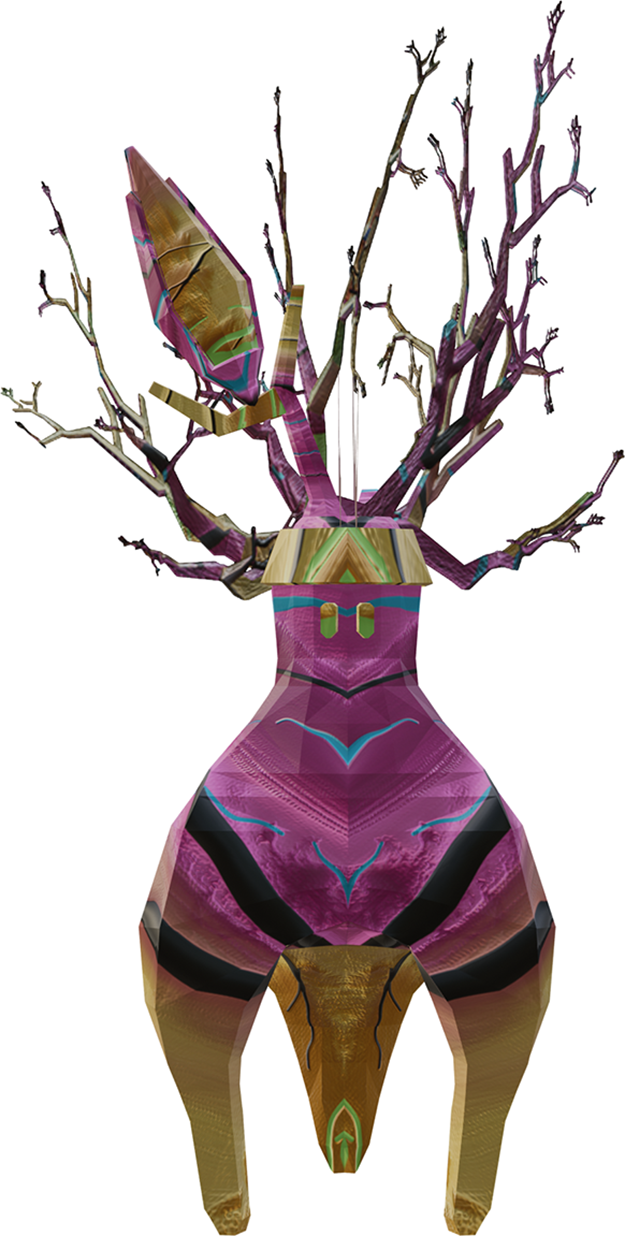
Online audience members thus experience the game as avatar and self. The avatar serves as a digital mask that ‘signifies a double existence, for he is at once himself, and someone else’.Footnote 39 The new temporary identity suspends social categories and unifies diverse audience members through a shared identity as tree spirits. More importantly, this de-/re-identification indicates a non-hierarchical relationship among avatars. By transforming all into tree spirits, gender, ethnicity, or physical conditions that can socially marginalize some people while prioritizing others no longer have significance. This utopian possibility echoes the Daoist idea, reflected in HOME X, that all creatures are equally embraced by nature, framing ‘home’ as the shared earth, a place where people, regardless of their social identities, co-exist.
Meanwhile, the mythological feature of HOME X is amplified through the visual design of the landscape. For example, the virtual world is covered with auspicious clouds (Figure 3). Beneath them stand buildings with a plaque inscribed ‘Tin Hau Temple’ (‘天后古廟’) in traditional Chinese characters. The Tin Hau Temple is ‘dedicated to the worship of Tin Hau (Goddess of the Sea)’.Footnote 40 According to Shek, this building, along with the giant tree as the centre of this production, is inspired by the temple located in Yuen Long, Hong Kong.Footnote 41 This temple is now ‘not just a place of worship but a cultural and entertainment space that brings together old and new communities’, closely associated with the complex migration status of Hong Kong where people from the north of China and other ESEA countries gather, turning Hong Kong into their new home.Footnote 42 As the physical temple fosters an autonomous migrant community in Hong Kong, avatars in HOME X create a virtual home through collective activity. By omitting these mythological elements, reviews overlook how HOME X reinterprets and recontextualizes Chinese traditions for contemporary audience members and community-building in digital theatre.
Traditional auspicious cloud pattern. Public domain image, courtesy of Wikimedia Commons, <https://commons.wikimedia.org/wiki/File:MET_RT665.jpg>.

Fable and the search for Utopia
The audience experience of HOME X, in which characters enter a hidden idyllic world, closely parallels ‘The Peach Blossom Spring’, a fable written by Tao Yuanming (also known as Tao Qian, or T‘ao Ch‘ien). This tale depicts a fisherman who accidentally enters an isolated village named ‘Peach Blossom Spring’ where residents live in self-sufficiency and remain oblivious to the outside world. When he leaves and later attempts to return, the entrance to the village has disappeared.
HOME X resembles this story by positioning the online audience as both ‘the fisherman’ and ‘the residents’. Like the fisherman, they are temporarily immersed in an alternate reality, only to recognize its fragility when the virtual landscape collapses. Like the residents, they embody tree spirits who plant trees and collect fruits, demonstrating their reliance on nature. Both communities highlight the autonomy of ordinary people and an apolitical inclination.
This fable also resonates with the western idea of Utopia. Through a London–Hong Kong collaboration, HOME X highlights this connection, showing that in both the UK and China, the imaginative projection of a better life is embedded in centuries of storytelling. According to Gregory Claeys and Lyman Tower Sargent, the ‘earliest utopian works are myths of a golden age or race in the past and earthly paradises like Eden’.Footnote 43 They note that the ‘word utopia or outopia was derived from Greek and means “no (or not) place” (u or ou, no, not; topos, place)’.Footnote 44 Similarly, in Chinese literature and everyday speech, ‘The Peach Blossom Spring’ has become a synonym for an ideal no-place. In HOME X, while the landscape recalls both traditions, its residents are drawn from diverse backgrounds. It thus embodies ‘an ideal no-place’ within a global and virtual context.
Furthermore, the online audience’s virtual journey mirrors the fisherman’s discovery of the Peach Blossom Spring: an entry through a narrow passage into a realm of nature and tranquillity. Tao writes how, after walking through a cave, the fisherman reaches ‘a broad and level plain where well-built houses were surrounded by rich fields and pretty ponds’.Footnote 45 This process is digitalized in online audience members’ gameplay: after walking across the river valley alone, they arrive at an expansive plain populated by other tree spirits. In this way, even if the original text is unintelligible to non-Chinese speakers, it is theatricalized for the wider audience through a specific way of interacting with the virtual world.
Cantonese poetry as resistance
Beyond its visual design, HOME X integrates Chinese languages, particularly Cantonese, into its acoustic design. It features live Cantonese opera-style singing, incorporating classical Chinese poetry such as ‘Guan Cang Hai’ by Cao Cao and ‘Siyan Zeng Xiong Xiucai Rujun Shi Qi Shiba’ (‘四言贈兄秀才入軍詩其十八’) [‘Tetrasyllabic Poems Presented to My Elder Brother the Cultivated Talent on His Entry into the Army, the Eighteenth’] by Ji Kang. Although written in the third century ce, these poems still resonate today through new interpretations. However, no British theatre review has acknowledged the significance of this linguistic and cultural choice. Some omit the singing or mention it only in passing, such as introducing Lam by saying she ‘sings soprano in Hong Kong’. Others attribute the production’s soundscape primarily to ‘an atmospheric electronic score [by Chang] with the power to calm’, and describe HOME X as ‘the perfect ASMR experience in a time where we could do with calm’, rather than recognizing Lam’s performance as a core aesthetic and political strategy.Footnote 46
Performing in Cantonese asserts cultural specificity and resists the hegemony of English, almost a lingua franca, as well as the epistemic violence, in intercultural theatre. Jacqueline Lo and Helen Gilbert argue that by imposing imperial languages on non-western people, ‘the system of values inherent in a language’ is internalized in the social, economic, and political discourse of non-western areas.Footnote 47 Similar imposition exists in British theatre dominated by English. As Rustom Bharucha notes, ‘One unfortunate aspect of interculturalism is its seeming disregard for, if not transcendence of, the linguistic specificities of nation-states.’Footnote 48 In HOME X, the deliberate use of Cantonese counters this tendency, affirming the production’s Hong Kong and diasporic influences.
Moreover, given the previous colonial history between Britain and Hong Kong, Cantonese performance in London particularly reclaims the subjectivity of Hong Kong and its people, including members of the HOME X creative team. The wide application of English in Hong Kong is itself a legacy of imperial imposition, as noted by Lo and Gilbert. By contrast, by using Cantonese, HOME X directly subverts the linguistic hierarchy, replacing the dominance of English with the local authority embodied in Cantonese.
Thematically, the poems foreground the human–nature connection. In ‘Guan Cang Hai’, Cao describes the vistas from the peak of Jieshi Mountain, containing a variety of natural elements such as ‘sea’, ‘grass’, ‘wind’, and ‘milky way’, paralleling his political ambition with the grandeur of the landscape. Ji Kang in the poem ‘Siyan’ urges people to‘see the world from afar and return to a pure, natural state’ (‘流俗難悟/逐物不還’) and compares life to ‘a floating guest, temporary and fleeting’ (‘與彼共之/予何所惜’).Footnote 49 Both poets suggest that life is transient yet the universe is eternal, a view mirrored in HOME X’s tree spirits, whose survival depends on nature, and in its ending where natural forces overwhelm human activities.
Additionally, the inclusion of ‘End Poem’, originally written in English by Julian Gough for the video game Minecraft, adds another layer of intertextuality. Performed in Cantonese in HOME X, the poem’s themes of the universe and love resonate with both classical Chinese traditional cosmology and the production’s exploration of virtual worlds. This linguistic and cultural hybridity challenges fixed notions of linguistic authenticity as well as confirms the hybrid cultural experience of individuals living in English and Cantonese cultures simultaneously.
For Cantonese-speaking audiences, the poems foster intimacy, with Lam’s tender but firm voice amplifying the cathartic power of nature in the text. Live-streaming technology further enhances this connection, allowing Lam, online, and in-person audiences to experience a shared co-presence despite geographical distance, thus reinforcing community among Cantonese speakers. By contrast, for non-Cantonese-speaking audience members, the unfamiliar language may produce a sense of estrangement, delineating the boundaries between one’s own culture and that of the Other. It is worth mentioning that English-speaking audience members could have understood Gough’s ‘End Poem’ in its original language, but the Cantonese language withholds that access. This reverses the more common dynamic that non-English speakers are excluded by the linguistic dominance of English. Consequently, HOME X reconfigures the politics of linguistic inclusion and exclusion in the intercultural theatre space.
The modern novel and nature as home
In terms of its worldview, HOME X draws inspiration from contemporary Chinese literature, particularly the novella ‘The King of Trees’, as introduced by director Chang.Footnote 50 To some extent, HOME X not only adapts the plot of this novella but also internalizes the philosophy of ‘The King of Trees’.
‘The King of Trees’ was written by Chinese novelist Ah Cheng in the 1980s. This fiction is deeply affected by Ah Cheng’s personal experience as an urban youth sent to rural areas during the Cultural Revolution. As Gang Yue notes of this period, ‘Destruction of the old to build the new is a central tenet in the Maoist theory of socio-historical transformation.’Footnote 51 Impacted by this political movement, ‘The King of Trees’ focuses on a remote farm in Southwestern China, where young people are sent for labouring work, including the slashing and burning of ‘useless’ trees in the tropical rain forests. By doing so, more space is created for ‘growing “useful” and lucrative crops’.Footnote 52 However, in this region, trees are regarded as divine tree spirits, with the strongest one being the king of trees. Conflict arises between this reverence for nature and the political drive toward environmental exploitation. When the youths are determined to chop down the tree spirits and the king of trees, Knotty Xiao, an experienced and retired soldier, warns them that people doing so will be sentenced to die by nature. Eventually, the youths chop down the king of trees, leading to both the tree’s fall and Xiao’s illness and death.
HOME X echoes this narrative and uses the destruction of the tree as a metaphor for uprooting cultural and ecological foundations. The act of ‘cutting our roots’ and its aftermath symbolize human exploitation of nature. For Chang, ‘Nature is absolutely our first home’, but the act of cutting down trees suggests that human beings are increasingly disconnected from their origins.Footnote 53 In this regard, the reference to ‘The King of Trees’ thus transcends the association between home and a specific region but extends to the planet itself, advocating a reciprocal relationship between humanity and nature.
More interestingly, on the one hand, the divinity of nature is unquestionable: the exploitation of nature will result in catastrophe. However, Ah Cheng never explicitly explains why. As the narrator of ‘The King of Trees’ comments, ‘I began to feel that these mountains were like the convolutions of the human brain – we didn’t know what they were thinking.’Footnote 54 The inscrutability of nature is enhanced by Knotty Xiao’s warning, which does not explain why the king of trees must not be chopped down. Similarly, HOME X offers no reason for why the collapse of the largest tree would end the world. This silence echoes a Daoist perspective in which nature follows its own course, beyond human comprehension. As Laozi (also written as Laotse) writes, ‘Nature is unkind: / It treats the creation like sacrificial straw-dogs’ (‘天地不仁, 以万物为刍狗’).Footnote 55 In both Ah Cheng’s rural village and HOME X’s virtual world, nature treats all beings equally without prioritizing humanity. This recalls the design of pink tree avatars and non-hierarchical interactions among online audience members, highlighting how the nature–human relationship is in fact repeatedly emphasized throughout HOME X.
Conclusions: Towards an Intercultural Theatre Criticism
Chinese literature deeply affects HOME X’s visual and audio design, audience experience, and worldview. Far from a story of migrants, this work utilizes Chinese literature to construct another layer of storytelling about the relationship between human beings and nature. However, the explicit and implicit cues to this narrative are repeatedly overlooked by reviewers. Meanwhile, HOME X is not purely fictional but fuses its creators’ personal reflections – in other words, their own voices created by their multicultural experiences – with literature and technology. Neglecting these cultural references effaces the creative team’s agency and perspectives. Hence, in conclusion, this article proposes rethinking intercultural theatre criticism.
Firstly, it is urgent to create more opportunities for more diverse critics in Britain. Examining the technological aspect of a theatre production is safe and reasonable, but what differentiates the RSC’s A Midsummer Night’s Dream from Kakilang’s HOME X is the distinct way each applies original texts to digital theatre. Critics familiar with these texts are more likely to seize the interconnections between theatre productions and their cultural references, and further to understand the work from the creators’ standpoint. The proposed diversity also resists ‘an Orientalist tendency of the Western world to speak on behalf of non-White people and their experiences’.Footnote 56
Secondly, theatre criticism could adopt a more self-reflexive, even risky, approach by openly acknowledging the limits of understanding. No review can be omniscient, but critics can reflect on moments of opacity instead of eliding them. For example, reviewers who did not understand the Cantonese songs in HOME X might have engaged with their inaccessibility rather than ignoring it. Focusing on what remains unintelligible can itself produce insights, especially for non-global majority reviewers. As Spivak reminds us, ‘To confront them [the heterogeneous Other] is not to represent (vertreten) them but to learn to represent (darstellen) ourselves.’Footnote 57 Here Spivak identifies two types of representation: the former refers to ‘speaking for’, while the later refers to ‘re-presentation’.Footnote 58 Her distinction underscores the awareness of one’s own positionality and agency that this article values.
Finally, the divergence between reviews of HOME X and this analysis highlights the unacknowledged growing diversity of contemporary audience members, especially the Asian audience, in British theatre ecology. The increasing presence of the global majority participants, spectators, and storytellers is gradually reshaping audience expectations and the UK theatre industry. Accordingly, British theatre reviews are no longer written solely by ‘dead white men’. Even what is opaque to a critic may provide insights for certain readers, fostering new dialogues between production, reviewer, and reader. Now is the time to seriously consider the perspectives of the global majority and to recognize how their participation as artist, audience, and critic will shape the future of theatre history.


 Open access



