

Introduction
In the field of political science, the gender gap in electoral decision-making in the United States has been widely discussed since the 1980s, identifying the pattern of women overall being more supportive of Democrats than Republicans compared to men voters (Box-Steffensmeier, De Boef, and Lin Reference Box-Steffensmeier, De Boef and Lin2004; Norrander Reference Norrander1999; Ondercin Reference Ondercin2017). Adopting the concept of intersectionality as an analytic framework in this study, however, we aim to illuminate the heterogeneity among women voters. The results provide an empirical basis for our argument that women voters are constrained in different ways in their partisan vote choice due to their intersectional sociohistorical location of gender and race within patriarchy and white supremacy and its institutionalization in the United States political system. Although the term “intersectionality” was first introduced in the late 1970s by women-of-color feminist scholars (Collins Reference Collins2000; Combahee River Collective 1977; Crenshaw Reference Crenshaw1989; Hancock Reference Hancock2016; Jordan-Zachery Reference Jordan-Zachery2007), there has been a dearth of empirical political science research to conceptualize and test intersections between gender and race in partisan candidate choice.
In this study, we investigate whether and how one’s intersectional status in gender and racial hierarchy conditioned their vote choice in the 2020 presidential election. Thus, we assume that one’s positionality is constructed based on their status as women and as a function of racial and ethnic categorization as white, Black, Latina, or Asian American. Although it is generally observed that women voters in the US electorate are more inclined than men voters to support Democratic Party candidates, a key motivating question is why were some women voters attracted to the GOP despite Donald Trump’s sexist rhetoric? Given that sexism is not an analogous form of oppression across different racial women groups (Collins Reference Collins2000), we view that a race component significantly disunited women in their voting decisions, with a higher proportion of white women compared to women of color responding positively to Trump’s claims. In this way, the context of the 2020 election might be distinctive for different racial women groups in line with their positionality of gender and race under overlapping structures of the US patriarchy and racial hierarchy.
Due to the concern about low statistical power driven by small subsamples, it has been conventional to analyze women of color together as a group in previous empirical research. However, we assert that assuming this group is a cohesive political force may obscure important heterogeneity even among women-of-color voters. Since the legacy of slavery in US society is paramount, the political experience of African Americans has been especially different in nature from other racial/ethnic minorities (Kim Reference Kim1999; Reference Kim2018; Reference Kim2023), and the distinctive political behaviors of African Americans from other racial minorities are well documented (e.g., Dawson Reference Dawson1994; Gay and Tate Reference Gay and Tate1998; Huddy and Carey Reference Huddy and Careyma2009; Kinder and Sanders Reference Kinder and Sanders1996). Accordingly, we utilize a unique data collection that includes large national samples of racial/ethnic minority populations, the 2020 Collaborative Multiracial Post-election Survey (CMPS), to unpack heterogeneity among women of color and also in comparison to white women. Our study is a project to demarginalize women of color in politics.
In sum, through the lens of intersectionality, we aim to upend the long-standing assumption about women voters as a homogeneous group and make the political experiences of women of color more visible. To do so, we use the 2020 US presidential election as a case study and demonstrate the dynamics of gender and race in American voters’ electoral decision-making. For this purpose, we pay particular attention to the role of attitudes about gender (i.e., “hostile sexism”) and race (i.e., “racial resentment”) on vote choice in the 2020 election in addition to standard explanatory measures, such as demographic and socioeconomic factors as well as party identification. Our analyses demonstrate that an intersectionality framework helps to decenter normativity — of the typical “whitewashing” of women voters — and, as such, allows analysts to better grapple with both the differences between women and men as well as among women voters (Crenshaw Reference Crenshaw1989).
Heterogeneity among Women Voters
The conventional wisdom about women voters in the US electorate is that they are more likely than men voters to favor Democratic Party candidates. The gender gap in the elections has been widely reported since the 1980s (Box-Steffensmeier, De Boef, and Lin Reference Box-Steffensmeier, De Boef and Lin2004; Norrander Reference Norrander1999; Ondercin Reference Ondercin2017). The 2020 presidential election can also be characterized by the gender gap since approximately 55% of women voters voted for Joe Biden, whereas support among men was around 48% for the Democratic Party candidate (Pew Research Center Reference Center2021).
A growing number of recent studies have attempted to alter the focus from traditional studies of the gender gap, where the behavior of women voters is set in contrast to men, and instead reveal the heterogeneity among women voters (e.g., Cassese and Barnes Reference Cassese and Barnes2018; Frasure-Yokley Reference Frasure-Yokley2018; Junn Reference Junn2017; Junn and Masuoka Reference Junn and Masuoka2020; Phillips Reference Phillips2018; Tien Reference Tien2017). Paying attention to the 2016 presidential election, these prior studies identify the distinctive patterns of white women voters from women of color — a majority of white women were willing to vote in support of Trump in the 2016 election, whereas women of color overwhelmingly voted for Clinton. Building on the literature, we also view women voters as a much more heterogeneous political group than previously suggested. In the 2020 presidential election, whereas women of color, and particularly Black women voters, strongly supported Biden, white women voted in support of Trump by a majority (about 53% according to Pew Research Center Reference Center2021). Additionally, given the fact that white women’s support for the Republican party has been a long-standing pattern since the 1950s (Junn and Masuoka Reference Junn and Masuoka2020; Junn and Masuoka Reference Junn and Masuoka2024), this “whitewashing” is the result of viewing women as a monolith and pays insufficient attention to the intersection of race and gender in partisan vote choice.
Instead, women voters present different electoral patterns of partisan candidate choice in line with their racial identity. To illuminate the variation and the reasons for it, we begin by focusing on the interlocking nature of racism and sexism in US society and culture. Even though women are in placement below men in the patriarchal system, white women are more privileged than women of color via their whiteness in the racial hierarchy (Lien and Filler Reference Lien and Filler2022; Masuoka and Junn Reference Masuoka and Junn2013). Also, the intersectional experiences that women of color often face is “greater than the sum of racism and sexism” (Crenshaw Reference Crenshaw1989). An emblematic example of the intersectional experience in kind is women of color being excluded from the political and cultural revolutions in the 1960s and 1970s because they are neither men nor white women (Combahee River Collective 1977; Crenshaw Reference Crenshaw1989). Thus, overwhelming support for candidates of the Democratic Party among women of color should be understood as their collective expressions to fight against racial and gender inequality in the US (Junn and Masuoka Reference Junn and Masuoka2024). Especially given the fact that the Republican Party today continues to take conservative positions about gender and racial issues, women of color in the two-party system are more constrained in their partisan candidate choice. In contrast, white women, who are “second in sex to men” but “first in race to minorities” (Junn Reference Junn2017), have more leeway to cast ballots by their preference, compared to women of color.
Further, we do not assume women of color as politically uniform. Given the ramifications of slavery and the dehumanization of Blacks throughout US history, African Americans are placed at the bottom of the US racial hierarchy, where whites are at the top and other racial/ethnic groups are somewhere in between (Masuoka and Junn Reference Masuoka and Junn2013). Additionally, since race has been the most overarching factor in their survival as well as determining their life opportunities, African Americans generally show strong group-level cohesion in making their political decision (e.g., Dawson Reference Dawson1994; Huddy and Carey Reference Huddy and Careyma2009; Kinders and Sanders Reference Kinder and Sanders1996). For Black women, racial identity may be as or more powerful a factor in shaping their political attitudes and behaviors as their gender identity (Gate and Tate Reference Gay and Tate1998). Moreover, Black women tend to report higher racial consciousness even in a comparison with other racial/ethnic minorities (Carey and Lizotte Reference Carey and Lizotte2023; Matos, Greene, and Sanbonmatsu Reference Matos, Greene and Sanbonmatsu2023). Accordingly, our intersectional approach aims to reveal the heterogeneity between and among women voters — from Black women voters to Latina and Asian American women, as well as from white women voters to women of color.
Figure 1 highlights the percentage of the 2020 CMPS respondents by subsamples who answered each identity presented in the table as the most important among their multiple identities.Footnote 1 , Footnote 2 Above all, it is striking that approximately half of Black women (47.0%) value their racial identity the most, whereas in comparison, only about 15.0% of them answered that their gender identity is the most important. Among Latina respondents and Asian American women, in contrast, racial identity scores slightly higher than gender identity (Latina women: racial 23.7%, gender 21.4%; Asian American women: racial 26.4%, gender 21.0%).
Percent answering the following identity is the most important among multiple identities.

Among white women respondents, however, only about 7.0% of them answered that their racial identity is the most important for them among their multiple identities. Although this result may seem counterintuitive at first glance, it makes sense, especially given the fact that “whiteness” has been considered the cultural standard or norm in US society (Jardina Reference Jardina2019; Weller and Junn Reference Weller and Junn2018). Thus, although it may be natural for many women of color to acknowledge their location in the US racial hierarchy and to stick to their racial identity, white women do not need to do so, as whiteness is a norm as well as default. Instead, the largest group of white women respondents (about 33.9%) value their “American” identity most, and the second-largest group (25.3%) values their gender identity most.
Our analyses thus far with the 2020 CMPS data lend support to the idea that women voters are a much more heterogenous political force than typically considered. Based on these analyses as well as what has been revealed in the existing literature, we anticipate heterogeneous voting patterns in the 2020 presidential election across different women voters. Why did some women voters cast their ballot for Donald Trump despite his sexist and racist rhetoric, whereas women voters in general are viewed as supporters for the Democratic Party? Adopting intersectionality as our analytic tool, we argue that it is because the context of the election varies for each racial women group. Specifically, with particular attention to the role of attitudes about race and gender on one’s vote choice in the 2020 presidential election, we will demonstrate the dynamics of gender and race in the US election.
Research Design
We use the 2020 CMPS to test our hypotheses. Considering that the main purpose of this study is to demarginalize political experiences of women of color, the 2020 CMPS is especially useful as it provides high-quality national survey data with large racial/ethnic minority samples from which generalizations can be made to the broader population in question (Frasure-Yokley et al. Reference Frasure-Yokley, Wong, Vargas and Barreto2020). Most political science research studying gender or racial gaps in voting patterns has relied on mostly white samples. Accordingly, political scientists have yet to fully analyze how gender and race interact in partisan candidate choice. This analysis will provide new insights into the differences both between and among women voters. For this purpose, we first analyze all voters in the 2020 CMPS who completed the survey about their vote choice in the 2020 presidential election (n = 15,843) and also conduct additional analyses with subsamples disaggregated by gender and race. Of all respondents included in our samples, the size of women samples is 8,936, and each separated by major racial and ethnic group among women samples is 2,360 (Black), 2,072 (Latina), 1,844 (Asian American), and 1,983 (white).Footnote 3
The dependent variable of interest is one’s vote choice in the 2020 presidential election, and it is coded as 1 if a respondent answered she/he voted for Trump in the 2020 election; otherwise, it is 0. Thus, we analyze the significance of a host of factors that contribute to Trump support in the 2020 election, including the impact of one’s attitudes about race and gender. To measure attitudes about gender, we utilize the Ambivalent Sexism Inventory (ASI) items included in the 2020 CMPS. The ASI was developed by Glick and Fiske (Reference Glick and Fiske1997) and comprises two subscales measuring hostile and benevolent sexism. According to Glick and Fiske, gender hierarchy is distinctive from other power structures in that it assumes not only men’s dominance over women but also the interdependence of two sexes based on traditional gender roles in a patriarchal society. Thus, they argue that sexism is fundamentally ambivalent since it involves both hostile and benevolent components. Frasure’s 2018 analysis of the 2016 election data utilized this broader ASI scale and focused on differences between white women and women of color overall. In our analysis of the 2020 election data, we show similar findings for white women and disaggregated results among Black, Latina, and Asian American women voters.
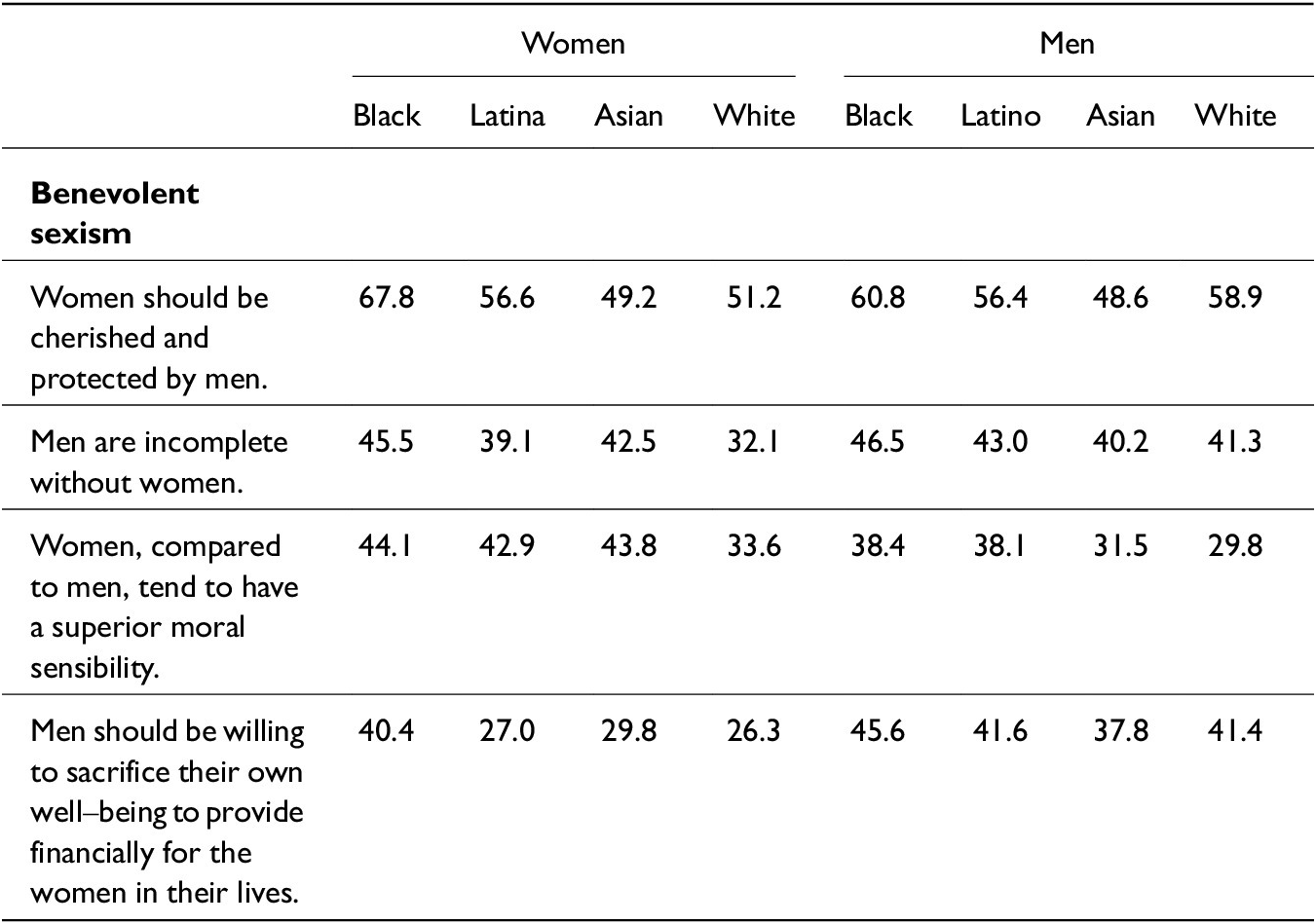
The 2020 CMPS includes four hostile and four benevolent sexism items, and we focus only on hostile sexism items in our main analyses. This is because we are skeptical that responses from benevolent sexism accurately reflect different levels of sexist beliefs across racial groups.Footnote 4 Since benevolent sexism items were designed to assess one’s inclination toward “protective paternalism,” “complementary gender differentiation (traditional gender roles),” and “heterosexual intimacy” (Glick and Fiske Reference Glick and Fiske1997), respondents may construe the items differently based on their understanding on the interdependence of two sexes, which may be influenced by their racial/ethnic culture.Footnote 5 Moreover, hostile sexism has been demonstrated to be a more significant predictor of one’s voting behaviors than benevolent sexism since the 2016 presidential election (e.g., Spencer Reference Spencer2021), and many studies report a high correlation between hostile sexism and voting choice in recent elections (e.g., Cassese and Holman Reference Cassese and Holman2019; Schaffner Reference Schaffner2022; Schaffner, MacWilliams, and Nteta Reference Schaffner, MacWilliams and Nteta2018).
Table 1 reports four hostile sexism items used in our analyses as well as the percentage of the respondents by gender and race who answered that they somewhat or strongly agree with each hostile sexism item. Our results indicate that men are more likely than women to agree on hostile sexism items regardless of their race/ethnic group. However, men report relatively high within variance in each hostile sexism item by subgroups, whereas there is little variation among women.Footnote 6 Although racial gaps among women are relatively small, white women are the most likely to agree with the item that states “most women interpret innocent remarks as acts being sexist,” whereas they are the least likely to agree with the item that states “once a woman gets a man to commit to her, she usually tries to put him on a tight leash.”Footnote 7
Percent agreement (somewhat or strong) to each hostile sexism item by gender and race

Note. All estimates are adjusted using survey weights.
In addition, we utilize four racial resentment scale items included in the 2020 CMPS. Given that racial resentment scale measures attitudes toward Blacks, the scale is especially useful for our study to disentangle the distinctive political experiences of Black women from other racial/ethnic minorities. Recent research by Kam and Burge highlights the intergroup variation among Americans based in race and ethnicity in how they understand the meaning of the racial resentment measures (Kam and Burge Reference Kam and Burge2018; Reference Kam and Burge2019). The racial resentment scale is correlated with one’s voting behaviors in terms of preference for Republican Party candidates especially among whites, and the relationship became stronger for this group of voters with the appearance of an African American candidate (e.g., Kam and Kinder Reference Kam and Kinder2012; Tesler Reference Tesler2012).
Table 2 presents the four racial resentment items used in our analyses as well as the percentage of the respondents by gender and race who answered that they somewhat or strongly agree with each racial resentment item (some items were recoded to indicate that the higher the score is, the more conservative attitude it is.) According to the table, white men report higher scores than women on the racial resentment scale regardless of their race/ethnicity. In contrast, Black men report the lowest levels of racial resentment among men and show lower racial resentment compared to Latina and Asian American women voters. Within each gender group, white respondents consistently report the highest racial resentment scores across all items, whereas Blacks score the lowest.Footnote 8
Percent agreement (somewhat or strong) on racial resentment scale item by gender and race

Note. All estimates are adjusted using survey weights.
In our main analyses in the next section, both scales of hostile sexism and racial resentment scale item are recoded on a five-point scale from 0 (the least conservative) to 1 (the most conservative) with intervals of 0.25. Afterward, the responses for each item were summed and divided by the number of items to provide a 0–1 scale for an easier interpretation (reference Frasure-Yokley Reference Frasure-Yokley2018).Footnote 9 The Cronbach α of the four hostile sexism items included in CMPS 2020 is 0.825 (high internal consistency), whereas that of the racial resentment scale items is 0.828 (high internal consistency).
Findings
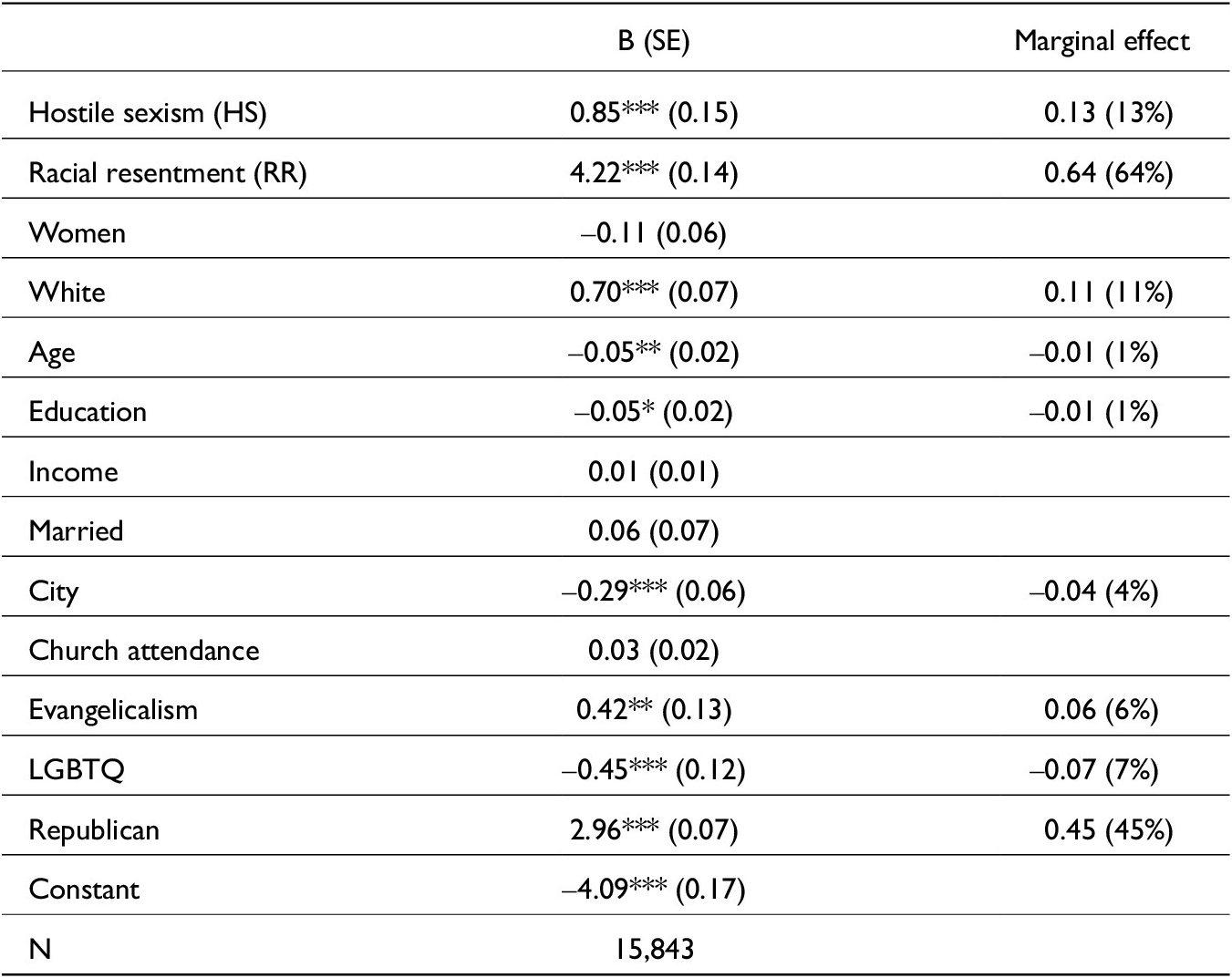
Our first model (Table 3) identifies relevant factors contributing to Trump support in the 2020 presidential election for the full sample of CMPS respondents. Logistic regression is used as our dependent variable is binary (1 = Trump support/0 = otherwise). For an easier interpretation, we also present the marginal effects for those factors that reach statistical significance in addition to coefficients. According to the results, attitudes related to race and gender significantly affect one’s electoral decision-making in the 2020 presidential election (p < 0.001). A marginal effect of hostile sexism and the racial resentment scale on Trump support is approximately 13% and 64% on average, respectively, when other variables are held at their means. Note that party identification is also controlled in the model.
Logit model predicting impact of hostile sexism and racial resentment on Trump support (full sample)
Standard errors in parentheses (***p < 0.001, **p < 0.01, *p < 0.05).
Notes: All estimates are adjusted using survey weights. Dependent variables: 1 = Trump/0 = otherwise.
Since the 2016 election, analysts have paid particular attention to attitudes related to sexism and racism as predictors of one’s vote choice, and political scientists have empirically revealed a significant relationship between these attitudes and Trump support in the 2016 presidential election (e.g., Cassese and Barnes Reference Cassese and Barnes2018; Frasure-Yokley Reference Frasure-Yokley2018; Godbole, Malvar, and Valian Reference Godbole, Malvar and Valian2019; Schaffner Reference Schaffner2022; Schaffner, MacWilliams, and Nteta Reference Schaffner, MacWilliams and Nteta2018; Valentino, Wayne, and Oceno Reference Valentino, Wayne and Oceno2018). Our analyses also confirm a similar pattern in the 2020 election, such that the higher people score on hostile sexism and the racial resentment scale, the more likely they voted for Trump. Additionally, respondents who are white, younger, less educated, rural residents, evangelicals, non-LGBTQ, and Republicans were more likely to vote for Trump in the 2020 election than their counterparts.
Next, we disaggregated the 2020 CMPS by gender and race to investigate the heterogeneity among different women voters. Thus, our second set of models (Table 4) reports how the significance of different factors varies in each of the four major race/ethnicity women voters, including Blacks, Asian Americans, Latinas,Footnote 10 and whites. Above all, the results show that women of color are more constrained in their vote choice than white women. Black, Latina, and Asian American women — despite being internally diverse within their own racial and ethnic groups — were nevertheless more constrained in being able to support Trump, the Republican Party nominee. In contrast, white women have much greater agency, and, for example, the explanatory power of the model is stronger for this group of voters who can choose between the Republican Party and the Democratic Party, because voting for the former does not pose an existential threat in terms of anti-egalitarian policies against women and people of color.
Logit model predicting impact of hostile sexism and racial resentment on Trump support (women samples)

Standard errors in parentheses (***p < 0.001, **p < 0.01, *p < 0.05).
Notes: All estimates are adjusted using survey weights. Dependent variables: 1 = Trump/0 = otherwise.
Among Black women voters, other than party identification (p < 0.001) and the racial resentment scale (p < 0.001), none of the demographic/socioeconomic variables divided this group internally when they decided for whom to vote. This also aligns with the fact that more than 90% of Black women voted for Biden in the 2020 presidential election (Pew Research Center Reference Center2021). However, Latina and Asian American women as voters were also quite constrained in their vote choice, especially compared to white women, but less so than for African American women voters.
For white women, greater variation across different factors, such as the racial resentment scale (p < 0.001), age (p < 0.01), income (p < 0.05), evangelicalism (p < 0.01), and party identification (p < 0.001), appears to explain their voting patterns.Footnote 11 In contrast, statistical significance of many features disappears in the analyses of Latina and Asian American women. Besides Republican identity (p < 0.001), hostile sexism (p < 0.001) and the racial resentment scale (p < 0.001) only significantly affected their vote choice among Latina women, whereas region (p < 0.01) also mattered among Asian American women in addition to their Republican identity (p < 0.001), hostile sexism (p < 0.01), and the racial resentment scale (p < 0.001).
More importantly, the role of hostile sexism and racial resentment on Trump support is significantly conditioned by one’s gender and race. Hostile sexism significantly affects support for Trump among Latina and Asian American women, with the marginal effects of approximately 26% among Latina women and 22% among Asian American women, but this effect lacks statistical significance for Black and white women. Figure 2 illustrates this trend: the slope of the hostile sexism line is steeper for Latina and Asian American women, milder for white women, and almost flat for Black women. Similarly, although racial resentment significantly predicts Trump support across all groups, Figure 3 demonstrates that the slope of the racial resentment line, with regard to Trump support, differs considerably depending on race/ethnicity. The marginal effect of racial resentment on Trump support in the 2020 election was the highest among white women (approximately 96%), followed by Asian American women (66%), Latina women (42%), and Black women (27%).
Impact of HS on Trump support.

Impact of RR on Trump support.

Upon closer investigation of group differences in the effects of hostile sexism on Trump support, Figure 4 highlights heterogeneous patterns, particularly among women-of-color voters. Regarding the influence of hostile sexism on Trump support, group differences analysis reveals statistically significant differences from Black women voters to Latina (p < 0.05) and Asian American women (p < 0.07), whereas other comparisons lack statistical significance. The findings suggest that Latina and Asian American women are estimated to have significantly higher odds of supporting Trump due to their distinctive attitudes toward hostile sexism compared to Black women voters (Appendix F/Table 1 for more details).
Group differences: Impact of HS on Trump support.
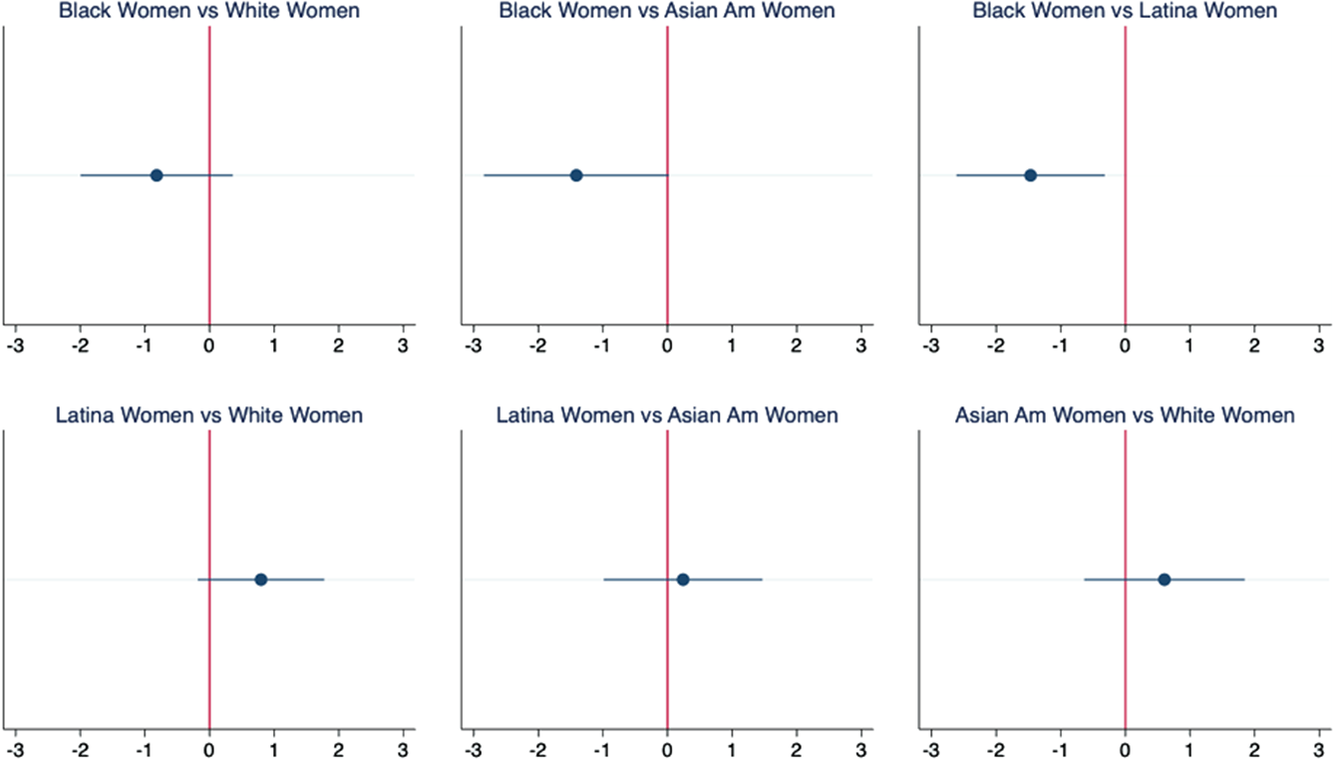
Figure 5 presents the group differences in terms of the racial resentment scale, confirming heterogeneous patterns among women-of-color voters as well as between white women voters and women of color. The analysis indicates statistically significant differences from Black women voters to white (p < 0.05) and Asian American women (p < 0.05) as well as from Latina women voters to white (p < 0.01) and Asian American women (p < 0.05). In other words, white women and Asian American women are estimated to have significantly higher odds of supporting Trump, influenced by their racist attitudes, compared to Black and Latina women, respectively (Appendix F/Table 2 for more details).
Group differences: Impact of RR on Trump support.

In summary, women voters in the 2020 presidential election varied in considering gender and racial inequality when deciding whom to vote for in line with their intersectional positionality of gender and race. Our findings suggest that among white women, racial resentment significantly increased the likelihood of voting for Trump, whereas hostile sexism did not have a significant effect. Specifically, the marginal effect of racial resentment scale on Trump support among white women was approximately 96% when other variables were held constant. Moreover, the group differences analysis confirms that white women were more influenced by racial resentment in their support for Trump compared to Black and Latina women. In other words, white women’s support for Trump in the 2020 election can be explained by their positionality as “second in sex to men” but “first in race to minorities” (Junn Reference Junn2017).
Our findings also uncover heterogeneous patterns even among women of color. Some Latina and Asian American women voted for Trump in part due to their attitudes toward sexism and racism, whereas Black women appeared to be the most constrained in their voting decisions, rejecting the negative politics of sexism and racism together. Among Latina and Asian American women, higher levels of hostile sexism significantly increased the likelihood of voting for Trump in the 2020 election, whereas the influence of hostile sexism on Trump support was limited among Black women. The group differences analysis also confirms the heterogeneity between Black women voters and Latina and Asian American women, indicating that Latina and Asian American women are more influenced by attitudes aligned with hostile sexism in their support of Trump compared to Black women. Additionally, although racial resentment remains significant across different subgroups, the analysis shows Asian American women are more influenced by racial resentment in their support of Trump compared to Black and Latina women. Therefore, our results demonstrate the intersectional dynamics of gender and race among women voters, implying that racial advantages and disadvantages are relative across contexts.
Implications and Discussion
Attitudes related to sexism and racism and their impact on partisan candidate choice have recently been highlighted by political scientists (e.g., Cassese and Barnes Reference Cassese and Barnes2018; Frasure-Yokley Reference Frasure-Yokley2018; Godbole, Malvar, and Valian Reference Godbole, Malvar and Valian2019; Schaffner Reference Schaffner2022; Schaffner, MacWilliams, and Nteta Reference Schaffner, MacWilliams and Nteta2018; Valentino, Wayne, and Oceno Reference Valentino, Wayne and Oceno2018). Our analyses of the 2020 CMPS data confirm that racial and gender attitudes are significantly correlated with one’s vote choice in the 2020 presidential election. However, we find that the extent to which these attitudes matter in one’s voting decision varies considerably across different women voters. In particular, our analyses show that white women’s support for Trump in the 2020 election was largely driven by their racial attitudes, rather than attitudes consistent with hostile sexism. However, some Latina and Asian American women voted in support of Trump because of their distinctive attitudes related to both gender and race. Lastly, for Black women, the role of these attitudes in their vote choice is limited and indicates the highest level of constraint in partisan candidate choice among all US women voters. Black female voters are stalwart Democratic voters, and little can persuade them to support Republican Party candidates and Trump in particular.
Although political scientists have widely discussed the gender gap among the US electorate (e.g., Norrander Reference Norrander1999; Box-Steffensmeier, De Boef, and Lin Reference Box-Steffensmeier, De Boef and Lin2004; Ondercin Reference Ondercin2017), scant attention has been paid to the intersection of race and gender in one’s vote choice. Adopting the concept of intersectionality as a conceptual framework illuminates distinctive political experiences between and within different women voters. With a particular focus on the role of gender and racial attitudes in the 2020 presidential election, we demonstrate with these data empirically that partisan candidate choice is conditioned by gender and race within the overlapping structures of patriarchy and racial hierarchy. Moreover, our analyses also demonstrate that women of color are more constrained in their vote choice, whereas white women have more leeway to cast their ballots and, in so doing, consider many factors. In particular, Black women voters show strong group-level cohesion in voting decision despite their various situations within a group.
Thus, our study contributes to decentering what is often unspoken but implicit normalization of voters being male and white by unpacking the heterogeneity across different women voters. Methodologically, we do so by using the 2020 CMPS that includes large national samples of racial/ethnic minority populations and analyzing it with disaggregated samples by gender and race. Since voting behavior research has in the past so heavily relied on white majority samples, it has been natural to analyze women together as a group due to the concern about relatively small samples and resulting low statistical power. As a result, Black, Latina, and Asian American women voters have been “whitewashed” after being crowded out by the much larger proportion of white women in the female electorate. Our analysis shows that US women voters are far from politically uniform and that race and ethnicity are a key and defining feature of partisan candidate choice in American elections. Overlooking the intersection of race and gender in American elections comes at the expense of fulsome explanations about women voters, as well as accurate predictions of what the future holds for the electoral fortunes of candidates for political office.
Competing interest
The authors have no competing interests to declare.
Acknowledgements
An earlier version of this manuscript was presented at the Southern California Political Behavior Conference, Riverside, CA, 2023, and at the annual meeting of the American Political Science Association (APSA), Los Angeles, CA, 2023. Thanks to the panelists for their helpful feedback.
Appendices
Appendix A
Percent vote choice by gender and race

Source: 2020 Collaborative Multiracial Post-election Survey (CMPS).
Note: All estimates are adjusted using survey weights.
Appendix B
Mean of ambivalent sexism inventory (ASI) items by gender and race

Source: 2020 Collaborative Multiracial Post-election Survey (CMPS).
Notes: Scale is recoded in a 0-1 scale for an easier interpretation. Accordingly, those who score above 0.50 are considered to hold more conservative views, while those below 0.50 are less conservative. All estimates are adjusted using survey weights
Mean of racial resentment scale items by gender and race

Source: 2020 Collaborative Multiracial Post-election Survey (CMPS).
Notes: Scale is recoded in a 0–1 scale for an easier interpretation. Accordingly, those who score above 0.50 are considered to hold more conservative views, whereas those below 0.50 are less conservative. All estimates are adjusted using survey weights.
Appendix C
Percent agreement (somewhat or strong) to each benevolent sexism item by gender and race
Source: 2020 Collaborative Multiracial Post-election Survey (CMPS).
Note: All estimates are adjusted using survey weights.
Appendix D
Logit model predicting impact of gender/racial/American identity on Trump support (full sample)

Source: 2020 Collaborative Multiracial Post-election survey (CMPS), dependent variables: 1 = Trump/0 = otherwise).
Notes: Standard errors in parentheses (***p < 0.001, **p < 0.01, *p < 0.05). All estimates are adjusted using survey weights.
Logit model predicting impact of gender/racial/American identity on Trump support (women samples)

Source: 2020 Collaborative Multiracial Post-election survey (CMPS), dependent variables: 1 = Trump/0 = otherwise).
Notes: Standard errors in parentheses (***p < 0.001, **p < 0.01, *p < 0.05). All estimates are adjusted using survey weights.
Appendix E
Logit model predicting impact of hostile sexism and racial resentment on Trump support by Latina groups

Source: 2020 Collaborative Multiracial Post-election survey (CMPS), dependent variables: 1 = Trump/0 = otherwise).
Notes: Standard errors in parentheses (***p < 0.001, **p < 0.01, *p < 0.05). All estimates are adjusted using survey weights.
Appendix F
Group differences (Logit): Impact of hostile sexism on Trump support by race-gender group (table version of Figure 4)

Standard errors in parentheses (***p < 0.001, **p < 0.01, *p < 0.05, +p < 0.07).
Notes: All estimates are adjusted using survey weights. Dependent variables: 1 = Trump/0 = otherwise. Racial resentment, age, education, income, marriage, region, church attendance, evangelicalism, LGBTQ identity, and party identification are controlled in the model.
Group differences (Logit): Impact of racial resentment on Trump support by race-gender group (table version of Figure 5)

Standard errors in parentheses (***p < 0.001, **p < 0.01, *p < 0.05, +p < 0.07).
Notes: All estimates are adjusted using survey weights. Dependent variables: 1 = Trump/0 = otherwise. Hostile sexism, age, education, income, marriage, region, church attendance, evangelicalism, LGBTQ identity, and party identification are controlled in the model.


 Open access

