


Introduction
Large mammalian carnivores experienced significant range reductions worldwide in the second half of the 20th century (Gittleman & Gompper, Reference Gittleman and Gompper2001; Pyare et al., Reference Pyare, Cain, Moody, Schwartz and Berger2004; Treves, Reference Treves2009). In efforts to reverse these trends a common tool is the reintroduction of species into their former range (Gittleman & Gompper, Reference Gittleman and Gompper2001). The debate regarding any reintroduction effort usually centres on two main concerns: (1) is there sufficient habitat/food to support the introduced species, and (2) is the public's attitude favourable towards the species' return (Nilsen et al., Reference Nilsen, Milner-Gulland, Schofield, Mysterud, Stenseth and Coulson2007)? Although public acceptance of a carnivore's return is important to the success of a reintroduction effort, assessing the adequacy of an area to support the species is the first step. Without sufficient habitat and food resources even the most publicly supported reintroduction effort will fail.
An assessment of the habitat and food resources of an area for the reintroduction of a large carnivore requires a landscape-scale analysis of its habitat, information on how the species will use the landscape, details of its food requirements and an assessment of prey resources. One such species for which this detailed analysis is needed is the American cougar Puma concolor. Over its current range in western North and South America the cougar is categorized as Least Concern on the IUCN Red List (Caso et al., Reference Caso, Lopez-Gonzalez, Payan, Eizirik, de Oliveira and Leite-Pitman2008). However, the eastern subspecies P. concolor cougar, which was part of the pre-European fauna of the north-eastern USA, was extirpated from the region in the late 1800s (Young & Goldman, Reference Young and Goldman1946). Until 2011 this subspecies was listed as endangered under the Endangered Species Act but has recently been listed as extinct by the US Fish and Wildlife Service. There have been discussions concerning the possible reintroduction of P. concolor into the region from western populations but one of the main arguments against this is that there is inadequate habitat in the densely human-populated eastern forest to support cougars (Brocke, Reference Brocke1981). However, there are several large (> 3,000 km2) relatively undisturbed areas in the north-eastern landscape. Much of the debate concerning the reintroduction of P. concolor centres on whether these and similar areas are large enough and wild enough to support viable populations of the species. One area being considered is Adirondack State Park in northern New York. Because of its vast size (> 24,000 km2) and relatively pristine state (> 45% is publicly owned land classified as wilderness/wild forest), this Park is a potential relocation site. If cougars could survive in the Park their return to other areas in the region could also be feasible.
In the 1980s Brocke (Reference Brocke1981) evaluated Adirondack State Park with regard to its potential to maintain cougars. He identified a hypothetically suitable area of 7,500 km2 within the Park that contained low road and human densities. Brocke estimated that this area could support a population of c. 116 cougars (1.5 cougars per 100 km2). However, because of the high human and road densities in the Park compared to then existing studies in the western USA (Hornocker, Reference Hornocker1970; Seidensticker et al., Reference Seidensticker, Hornocker, Wiles and Messick1973; Lindzey et al., Reference Lindzey, Ackerman, Barnhurst and Hemker1988) Brocke (Reference Brocke1981) concluded that human-induced mortality would cause a population of 100 cougars to become extinct within 10 years. His recommendation (Brocke, Reference Brocke1981) was that ‘Reintroduction of cougars in Adirondack State Park is currently not advisable in light of the data presented in this report’. This recommendation was probably influenced by the fact that, until the early 1970s, cougars were hunted without control (Dawn, Reference Dawn2002). Today, however, cougars are game species in most western states and there is strict control over the number of animals killed (Dawn, Reference Dawn2002). Nevertheless, Brocke's report is still cited as one of the reasons that reintroduction of cougars into the Park, and the north-east in general, is unjustified (Bolgiano & Roberts, Reference Bolgiano and Roberts2005). Although Brocke's work was based on the knowledge available about cougars at the time, the research of Hornocker (Reference Hornocker1970) and Seidensticker et al. (Reference Seidensticker, Hornocker, Wiles and Messick1973) was not taken into account and research in southern Utah by Lindzey et al. (Reference Lindzey, Ackerman, Barnhurst and Hemker1988) would not be published for another few years. Since that time our knowledge and understanding of cougar behaviour and ecology has greatly expanded (Hornocker & Negri, Reference Hornocker and Negri2010).
The aim of this research is therefore to reanalyse the suitability of Adirondack State Park to support cougars. My objectives are to: (1) determine the validity of Brocke's assumptions, primarily by examining the literature that has been published since 1981, (2) conduct a landscape-level analysis of the habitat and physical features of the Park and estimate the number of cougars that could potentially exist there, (3) evaluate the prey base to determine whether it is sufficient to support the estimated number of cougars, and (4) compare characteristics of the Park to other areas that currently support cougars or have been proposed as possible relocation sites.
My analysis of the Park and comparisons with other areas should help to determine the feasibility of the Park to support a cougar population. The conclusions drawn will be helpful not only in the debate regarding whether cougars should be reintroduced into the Park but also in discussions about other suitable reintroduction areas in the eastern USA. The analytical methods presented here could also be applied to the conservation of other large mammalian carnivores.
Study area
Adirondack State Park is located in northern New York and was established by legislative decree in 1885. Within the designated area c. 45% of the land (c. 11,000 km2) is state owned (Fig. 1a). The rest of the land is a mixture of large private forested areas, hamlets and towns, and individual houses/buildings located primarily along the roads. The human population density in the Park is 5.3 km–2, varying from 1.2 persons km–2 in Hamilton County to 12.7 persons km–2 in Fulton County (Table 1). The total road density is estimated to be 0.59 km km–2 (for calculations see Methods). An estimated 7–10 million people visit the Park annually but the areas visited are distributed unevenly, with most people visiting popular areas such as Lake Placid. Although there are several paved high-traffic roads through the Park, including an interstate section, 88.8% of the roads are low traffic or unpaved (Fig. 1b).
(a) Outline of Adirondack State Park, indicating the extent of state-owned land and resource management lands; county boundaries are also indicated. (b) Distribution of the various types of roads in the Park; the main roads are paved and carry most of the Park's traffic. (c) Distribution of lands excluded from possible cougar use assuming 300- and 500-m buffers around buildings in the Park. (d) Vegetation composition of the land available for use by cougars; the 300-m buffer is included as a reference to where towns and buildings are located. (e) Location of Adirondack State Park in the state of New York in the north-eastern United States.

Area of, and density of, people, buildings and roads in Adirondack State Park (Fig. 1) and the various political units within its boundaries.

1 Area of the counties within Park boundaries. All areas are approximate.
2 Unpaved/paved/high-speed roadways. The only high-speed highway (length 144 km) is in Essex and Warren Counties.
3 There were no data available to estimate human density for state or managed lands
Vegetation cover is primarily second-growth deciduous and evergreen forest. The dominant deciduous trees are sugar maple Acer saccharum, American beech Fagus grandifolia and yellow birch Betula allaghaniensis (Hurst & Porter, Reference Hurst and Porter2008). The dominant evergreen species include red spruce Picea rubens, black spruce Picea mariana and eastern hemlock Tsuga canadensis (Glennon & Porter, Reference Glennon and Porter2007). Approximately 5.7% of the Park surface is water. The predominant mammal species are white-tailed deer Odocoileus virginianus, moose Alces alces, coyote Canis latrans, bobcat Lynx rufus, raccoon Procyon lotor and snowshoe hare Lepus americanus.
Methods
Delineating suitable areas
To estimate the amount of habitat potentially available to cougars in Adirondack State Park I identified various features where cougars could not or should not live, such as roads, towns and rivers. I estimated the area associated with each feature, as explained below, and subtracted those areas from the total area of the Park.
A main assumption of the earlier analysis was that cougars needed wilderness or wild areas with low human and road densities to survive (Brocke, Reference Brocke1981). Based on current data for cougars living in areas with human and road densities equal to or higher than those in the Park (Dickson et al., Reference Dickson, Jenness and Beier2005; Beier et al., Reference Beier, Riley, Sauvajot, Gehrt, Riley and Cypher2010; Kertson, Reference Kertson2010; Maletzke, Reference Maletzke2010; Stoner, Reference Stoner2011), I relaxed this assumption substantially. Data indicate that cougars are reluctant to cross paved roads but not dirt roads (Dickson et al., Reference Dickson, Jenness and Beier2005). Accordingly, I assumed that the presence of dirt roads would not affect cougars directly and so did not exclude them from my calculations of areas suitable for cougars. To exclude paved roads, I buffered each road by 200 m on each side and subtracted this area from the total area of the Park. I calculated the density (km km–2) of paved and dirt roads of different units (e.g. counties, public land) of the Park for comparison with other areas. I obtained the length of paved and dirt roads in the Park and its various political subunits from the United States Geological Survey National Map Seamless Server (2002) shapefiles. Road density for each type of road (e.g. paved or dirt) was defined as the sum of all road lengths of that type within a unit of interest divided by that unit's area.
Cougars are known to live near, and often come within sight of, houses in rural areas and enter suburban areas on the edge of towns and cities (Beier & Barrett, Reference Beier and Barrett1993; Beier et al., Reference Beier, Riley, Sauvajot, Gehrt, Riley and Cypher2010; Kertson, Reference Kertson2010; Maletzke, Reference Maletzke2010; Stoner, Reference Stoner2011). However, normally they do not spend much time near houses or buildings and human tolerance for such incursions is relatively low. Consequently, I encompassed each town and hamlet with a circle of radius 1,000 m. Beyond these circles I buffered all houses and buildings with two levels or zones of intolerance, using circles of radius 300 and 500 m. The minimum buffer width was chosen based on the premise that, in forested habitat, cougars could pass within 300 m of an occupied building without detection. The second width was selected based on cougars' low use of areas < 500 m from human structures (Beier et al., Reference Beier, Riley, Sauvajot, Gehrt, Riley and Cypher2010; Kertson, Reference Kertson2010; Maletzke, Reference Maletzke2010).
To exclude these areas of human use I digitized town and house locations from county raster images for 2009 available from the United States Department of Agriculture (USDA) Geospatial Data Gateway (2009). The image resolution was 60 cm and within ArcMap v. 9.3 (ESRI, Redlands, USA) individual buildings were clearly visible. The images were from early spring when deciduous trees lacked leaves, facilitating detection of buildings. Buildings and towns were buffered with the ArcMap buffering tool. I could not distinguish between permanent and seasonal use or between residential and business buildings.
Once towns and buildings were buffered I overlaid the two sizes of buffer layers on the outline of the Park and then subtracted the total buffered areas from the total area of the Park. I obtained a layer for lakes and rivers from a shapefile available from the Shared Adirondack State Park Geographic Information CD-ROM (2001) and, as with towns and buildings, I subtracted these features from the overall surface of the Park. The final map provides estimates of the maximum areas that cougars could use without coming into contact with human habitation at the two buffer distances of 300 and 500 m. I used this map to calculate possible maximum population sizes of cougars in the Park. Using data from NLCD (2001), obtained through the USDA Geospatial Data Gateway, I then overlaid the final map of usable areas on the NLCD habitat and topographic layers to determine the characteristics of the areas available to cougars.
Because little was known of how cougars used the region historically Brocke (Reference Brocke1981) assumed that in the summer cougars could use all of the area designated to be highly suitable. In a similar manner I assumed that in the summer cougars could use all possible habitat in these areas. Thus I used the size of the maximum areas cougars could use in the summer under the two buffer sizes when calculating the size of the cougar population in the Park.
Calculating potential numbers of cougars
To estimate potential ranges of adult cougar population sizes I multiplied the two maximum areas, based on the 300- and 500-m buffers, by the densities of 1.0 and 2.0 resident cougars per 100 km2 to represent low and high cougar densities respectively (Logan & Sweanor, Reference Logan and Sweanor2001; Laundré et al., Reference Laundré, Hernández and Clark2007). These calculations provided the range of population size possible in the Park under each of the two buffer size scenarios.
Brocke (Reference Brocke1981) reported white-tailed deer densities in the Park of 3.3–5.6 km–2, which are similar to the 4.9–6.8 deer km–2 reported for the area by Mathews & Porter (Reference Mathews and Porter1993). How these densities were estimated is not explained and so, to provide a conservative estimate, I used Brocke's densities in my calculations. I multiplied his minimum and maximum densities by the maximum areas to obtain a range of two possible white-tailed deer population sizes for each area. To estimate the number of fawns born each year for the two maximum areas I used a 1 : 2.6 buck : doe ratio (Mathews & Porter, Reference Mathews and Porter1993) to calculate the number of does. I then multiplied the number of does by a mean 0.80 pregnancy rate and the resulting number by a mean birth rate of 1.2 fawns per doe (DelGiudice et al., Reference DelGiudice, Lenarz and Carstensen Powell2007) to give estimates of the number of fawns born annually for the two population sizes per maximum area.
To estimate the per-capita predation rates (number of deer killed per cougar-year) for cougars I used data from two recent studies to represent minimum and maximum per-capita predation rates of 30 (Laundré, Reference Laundré2008) and 40 deer per cougar-year (Knopff et al., Reference Knopff, Knopff, Kortello and Boyce2010). For each maximum area I multiplied the two adult cougar population estimates by these two per-capita predation rates to obtain a total of four estimates of the total number of deer killed per year. Cougar ungulate prey includes 43% young of the year (Knopff et al., Reference Knopff, Knopff, Kortello and Boyce2010). Thus I multiplied the four estimates of total deer killed per year by 0.43 and 0.57 to estimate the total young of the year and adult animals killed respectively. For young of the year and adults separately I divided the four mortality estimates of each by the respective total number of fawns and adult deer for the two population estimates. This provided eight estimates each of cougar-specific mortality rates for young of the year and adult deer for different combinations of deer (two) and cougar densities (two) and per-capita predation rates (two) separately for each of the two maximum areas.
I used these mortality rates for adults and fawns to evaluate the potential impact cougars could have on deer in the Park. Although cougars elsewhere are known to prey on other species that are found in the Park, such as moose or snowshoe hares (Knopff et al., Reference Knopff, Knopff, Kortello and Boyce2010), this is mostly incidental and I did not include such predation in my calculations.
Results
The density of buildings beyond the municipal areas for the whole Adirondack State Park was 2.1 km–2. Within counties building densities were 0.9–8.4 km–2 (Table 1). Oneida County had the highest density of buildings but the smallest amount of land within the Park (67 km2). The density of buildings within state-owned land was 0.05 buildings km–2. Within resource management lands, used primarily for timber production, the density of houses was 0.82 km–2. In the remaining land-use classes, except for towns and hamlets, the density of buildings was 8.3 km–2. The total road density in the Park is 0.59 km km–2 and road densities vary among the counties (Table 1; Fig. 1b). The paved road density in the Park is 0.07 km km–2.
There were 20,350 km2 of land beyond the 300-m buffer and 17,658 km2 beyond the 500-m buffer (Fig. 1c, Table 2). Total road density for the 300- and 500-m buffers was 0.33 and 0.24 km km−1, respectively. For both areas road densities consisted mainly of unpaved roads (Table 2). Building density was, by definition, 0.0 and because of that permanent human use of these areas was also considered to be 0.0. The two defined areas included water bodies, paved roads and small (< 200 km2) isolated parcels that cougars could not use. These areas were subtracted from the totals to give estimates of the amount of usable cougar habitat (Table 2).
Total maximum areas within Adirondack State Park (Fig. 1) after the removal of lands within 300-m and 500-m buffers around houses and the 1,000-m buffer around towns, the amount of usable cougar Puma concolor habitat (which is the total maximum area minus the amount of area occupied by lakes, rivers, and roads plus the small, < 200 km2, areas surrounded by the buffered towns and houses), and the density of unpaved and paved roads and high speed highway.
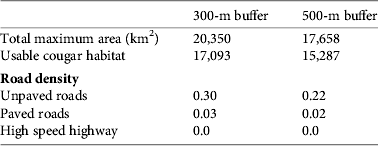
The maximum areas include the mountainous regions towards the centre of the Park and the lower flatter lands to the east (Fig. 1c). The habitat throughout the maximum areas is a mixture of evergreen and deciduous forest, with evergreen forests dominating the more mountainous areas and deciduous forest with wooded wetlands dominating the lower elevations to the west (Fig. 1c). Open grass and shrub habitat accounts for c. 14% of the two maximum areas.
Estimation of potential cougar numbers
In the 17,093 km2 of the 300-m buffer the estimated number of cougars at densities of 1.0 and 2.0 per 100 km2 was 171 and 342, respectively, the estimated number of deer at densities of 3.3 and 5.6 km–2 was 56,407 and 95,721, respectively, and fawn production of these deer populations was estimated to be 39,096 and 66,346 per year, respectively (Table 3). At the two per-capita predation rates the number of adult deer killed would be 2,923–7,794 and the number of fawns killed would be 2,204–5,880 (Table 3). Corresponding estimates for the 500-m buffer are also given in Table 3. Because I used the same density estimates of cougars and deer for both buffer sizes the proportional relationships among cougar and deer numbers and the number of deer killed, and thus mortality rates, was the same for both scenarios (Table 4). Cougar-specific mortality rates would range from 3.1–13.8% for adult deer and 3.3–15.0% for fawns (Table 4).
Calculations of the potential number of cougars, adult deer, and deer fawns born annually, at low and high densities, for the maximum available areas after subtraction of 300- and 500-m buffers around houses and buildings (see text for details), and similarly deer and fawn mortality at low and high rates of predation by cougars, in Adirondack State Park (Fig. 1).

* Based on a doe : buck ratio of 2.6 : 1, pregnancy rate of 0.80 and a birth rate of 1.2 fawns per female
Calculated mortality rates (%) of adult deer and fawns at low and high cougar and deer densities and low and high cougar predation rates in Adirondack State Park (Fig. 1). Because I used the same cougar and deer densities, the number of cougars, deer, and deer killed changed proportionally between the 300-m and 500-m buffer scenarios, resulting in equal mortality rates for the two scenarios.

Comparisons with other areas
The Black Hills of South Dakota are similar to Adirondack State Park in that much of the area is mountainous, with some peaks in both areas reaching c. 1,200 m. Both areas are heavily forested, are a mixture of public and private land and have similar human and deer densities (Table 5). However, the Black Hills have a higher road density (Rumble et al., Reference Rumble, Kenkobi and Gamo2005) and cover a much smaller area than Adirondack State Park (Table 5). Cougars recolonized the Black Hills late in the 20th century and currently there is an estimated population of 130–140 adult cougars (SDGFP, 2010), which is a density of 1.5–1.7 cougars per 100 km2 (my calculations). Collisions with vehicles account for the death of c. 4.5 cougars per year, mostly young dispersing males, but this level of mortality does not seem to affect the population. Based on the Black Hills example, Adirondack State Park would seem to be suitable for occupation by cougars.
Comparison of Adirondack State Park with areas with established cougar habitat (Black Hills and southern Florida) and predicted suitable cougar habitat (southern Georgia and western Arkansas).

1 Unpaved/paved roadways
2 Rumble et al. (Reference Rumble, Kenkobi and Gamo2005)
3 Calculated from Terrall et al. (Reference Terrall, Monteith, Grovenburg, Burris, Hien and Swanson2005)
4 Thatcher et al. (Reference Thatcher, van Manen and Clark2003)
5 Estimates from three high-potential sites for Florida panther reintroduction (Thatcher et al., Reference Thatcher, van Manen and Clark2003, Reference Thatcher, Van Manen and Clark2006)
The second comparison is with southern Florida, where the only remnant southern panther Puma concolor coryii population occurs in an area of c. 12,600 km2 (Land et al., Reference Land, Shindle, Kawula, Benson, Lotz and Onorato2008). Like Adirondack State Park, the southern Florida area is a mixture of public (77%) and private land (23%) and has similar road and deer densities (Table 5) but it is smaller. The panther population of this area is estimated to be 100–120 adults producing at least 20–40 kittens annually. This panther population is surrounded by high levels of human development, including the Miami–Fort Lauderdale metropolitan area. Because of the high annual panther production and the closed nature of the population an estimated 14–20 panthers, mostly young dispersers, are killed annually on highways (Florida Fish and Wildlife Conservation Commission, 2011).
The third comparison involves 11 sites in south-eastern USA that have been evaluated as potential reintroduction sites for the Florida panther (Thatcher et al., Reference Thatcher, van Manen and Clark2003, Reference Thatcher, Van Manen and Clark2006). Of these 11 sites three were ranked as having high and six as moderate potential for reintroduction releases. The effective sizes of the habitat areas (similar to the maximum areas used in this study) for the three high potential sites are all substantially smaller than that of Adirondack State Park (Table 5). The total road densities are all higher and human population densities are 4.0–9.6 km–2 in the three sites compared with 5.3 km–2 in Adirondack State Park (Table 5). The deer densities for two of the sites are similar to those in the Park (Table 5).
Discussion
Brocke's (Reference Brocke1981) report on the feasibility of cougars living in Adirondack State Park was based on the knowledge of cougar biology at the time. One overriding assumption was that cougars are animals of wild areas. It is likely that this assumption arose because it was only in the more remote areas of the west where cougars were able to survive persecution by humans, which continued up to the 1970s. Based on this assumption Brocke identified the most remote regions in the Park, a relatively small area of 7,500 km2, as suitable for cougars. Most western states now have well-controlled hunting seasons for the cougar and studies have demonstrated that the original assumption about where cougars can live can be relaxed (Beier & Barrett, Reference Beier and Barrett1993; Laundré, Reference Laundré2008; Thompson, Reference Thompson2009; Beier et al., Reference Beier, Riley, Sauvajot, Gehrt, Riley and Cypher2010; Kertson, Reference Kertson2010; Maletzke, Reference Maletzke2010; Stoner, Reference Stoner2011). Based on these studies I redefined the criteria for suitable cougar habitat.
Under these redefined criteria the estimated area that cougars could inhabit increased to 16,000–19,000 km2. Figs 1a & c show that most of this area is state-owned land and private land managed for forest products. Although there are 7–10 million visitors to the Park annually the total number of visitors per km2 (283–404) is similar to that of Yellowstone Park (2.2 million visitors; 245 persons km–2). As in Yellowstone the distribution of visitors to Adirondack State Park is concentrated in high-interest areas, leaving the state-owned and privately managed lands relatively undisturbed. Although there is some danger of cougars being killed on paved roads in the Park, the low density of these highways suggests that road-related mortality would be low. Within most of the areas where cougars could roam they could therefore move across large tracts of land, encounter few people and only have to cross dirt roads.
Both my study and that of Brocke (Reference Brocke1981) indicate there would be sufficient deer for the cougar population that it is estimated Adirondack State Park could support. Both studies conclude that the impact of cougars on deer numbers in the Park would be minimal. Regardless of the number of cougars, only under the worst-case scenario of high cougar but low deer density would cougars take > 10% of the adult deer population. Even with this scenario fawn production would still outpace deer mortality rates of 15% from predation by cougars. Thus there is no indication that cougars would adversely affect deer populations in the Park.
A comparison of Adirondack State Park with other areas supports the conclusion that the Park could support a population of 150–350 cougars. These animals would be able to move freely about the Park without substantial contact with humans. There would be some mortality from road-related causes and removal of animals either legally or illegally but the population would probably be self-sustaining. Other areas in the north-eastern USA provide similar habitat and a population in Adirondack could potentially expand beyond the Park to establish populations across a broad geographical range, adding to the long-term viability of the species.
In conclusion, the analyses presented here support the proposition that Adirondack State Park has sufficient habitat and food resources to support a viable cougar population. These analyses also provide a method to evaluate the adequacy of an area for large mammalian carnivores. Although estimating the amount of potential habitat available is important, the estimation of the potential population size that could be supported and the adequacy of the prey base are of particular importance. By use of up-to-date information on the biology and ecology of the species of interest, especially regarding habitat and food requirements, conclusions can be drawn about the feasibility of reintroducing a carnivore species into a particular area.
Although the results of such an analysis for a large mammalian carnivore can be favourable for reintroduction it does not necessarily follow that the social environment is suitable. Common social issues raised about the return of cougars and other large carnivores include concerns (1) from sportsmen (e.g. whether the return of a carnivore will negatively affect hunting opportunities for ungulate prey), (2) from livestock owners regarding depredation by large carnivores, and (3) about public safety (e.g. what risks these species pose to human life). For the successful reintroduction of cougars or any large carnivore each of these concerns has to be addressed. In the case of cougars the high level of public concern regarding these issues is not supported by scientific data. Most studies have demonstrated that cougars do not have significant impacts on ungulate populations (Ballard et al., Reference Ballard, Lutz, Keegan, Carpenter and deVos2001; Laundré et al., Reference Laundré, Hernández and Clark2006), are not a significant threat to livestock (Mazzolli et al., Reference Mazzolli, Graipel and Dunstone2002; Bueno-Cabrera et al., Reference Bueno-Cabrera, Hernández-Garcia, Laundré, Contreras-Hernández and Shaw2005; Palmer et al., Reference Palmer, Conover and Frey2010), and that the threat to humans from cougars is relatively low (Beier, Reference Beier1991). In addition, established protocols to deal with situations involving cougars have been developed (Cougar Management Guidelines Working Group, 2005). If we address these issues in light of existing data rather than emotional rhetoric, there is a high probability that cougars could be successfully reintroduced to Adirondack State Park and other suitable areas in the eastern USA. What is now required is the will to bring them back.
Acknowledgements
This study was undertaken while the author was an adjunct professor at the State University of New York at Oswego (SUNY Oswego), USA. I thank SUNY Oswego for the logistic and financial support to conduct the geographical information system analyses. I also thank the many dedicated cougar biologists who over the years have provided the data on the behaviour and ecology of cougars that have made this analysis possible.
Biographical sketch
John Laundré's research interests include the ecology, behaviour and conservation of cougars and other large predators. He has studied cougars for more than 20 years in their current range in the western USA and Mexico. He is interested in using this knowledge of cougars to study the possible restoration of cougar populations to their former range in the eastern USA.



