


- AA
arachidonic acid
- COX
cyclooxygenase
- DMARD
disease-modifying anti-rheumatic drugs
- LOX
lipoxygenase
- LTB
leukotriene B
- NSAID
non-steroidal anti-inflammatory drugs
- RA
rheumatoid arthritis
- RCT
randomised controlled trials
Efficacy: different outcome measures and the evidence
The main reason that patients with rheumatoid arthritis (RA) seek medical treatment is for alleviation of pain and discomfort. Meta- and mega-analysis of ten double-blind, placebo-controlled trials showed that fish oil supplying 2·9– >6 g long-chain n-3 fatty acids daily for 3 months was associated with decreased number of tender joints and duration of morning stiffness in patients with RA of 10–11 years' duration(Reference Fortin, Lew and Liang1, Reference James and Cleland2). It was concluded that there was little difference in the magnitude of effect between 2·9 and 7·1 g/d long-chain n-3 fats(Reference Kremer, Lawrence and Petrillo3).
Another symptomatic outcome measure is overall pain experience, which is measured most commonly in clinical trials by use of a visual linear analogue scale or categorical scales. A meta-analysis of fish oil trials that measured inflammatory joint pain, mainly with RA patients, reported a beneficial effect of fish oil on patient-reported joint pain intensity, number of painful or tender joints, duration of morning stiffness and non-steroidal anti-inflammatory drug (NSAID) use(Reference Goldberg and Katz4). However, another meta-analysis that examined the effect of fish oil on pain scores in RA reported that ‘There were no significant effects in twelve studies’(Reference MacLean, Mojica and Morton5). However, this latter meta-analysis did not take account of the influence and management of NSAID or disease-modifying anti-rheumatic drugs (DMARD) in nine of those trials (Table 1).
Influence of non-steroidal anti-inflammatory drugs (NSAID) on outcomes in studies with fish oil in patients with rheumatoid arthritis (RA)

DMARD, disease-modifying anti-rheumatic drugs.
The meta-analysis that concluded that fish oil had no effect on pain did not consider that the extent of patient-determined NSAID use can be considered a measure of pain(Reference MacLean, Mojica and Morton5). It is clear that fish oil had an NSAID sparing effect in the four trials designed to examine that issue(Reference Kremer, Lawrence and Petrillo3, Reference Kremer, Lawrence and Petrillo6–Reference Lau, Morley and Belch8). In another trial where need to change drug use was a withdrawal criterion, there were ≥6 times the number of trial participants withdrawn in the placebo group compared with the fish-oil groups, an indication of lesser pain/discomfort in the fish oil groups(Reference Kremer, Lawrence and Jubiz9). Of the remainder of the 12 studies cited, one did not measure pain(Reference Lau, McLaren and Belch10), one did not use fish oil(Reference Nordstrom, Honkanen and Nasu11) and the other did show a decrease in pain scores(Reference Nielsen, Faarvang and Thomsen12).
There was no effect of fish oil on disease activity as measured by erythrocyte sedimentation rate(Reference MacLean, Mojica and Morton5).
Efficacy of fish oil in RA includes collateral benefits that extend beyond symptomatic effects. RA is associated with an approximate 2-fold increased standardised mortality ratio and the excess mortality is due mainly to cardiovascular deaths(Reference Van Doornum, McColl and Wicks13). Acute and unrecognised myocardial infarction are 3–6-fold increased in RA and sudden cardiac death is approximately 2-fold increased(Reference Maradit-Kremers, Crowson and Nicola14). The increased cardiovascular risk is not explained by traditional (i.e. Framingham) risk factors, and it has been postulated that chronic systemic inflammation is a contributor, perhaps via altered endothelial function(Reference Van Doornum, McColl and Wicks13). The magnitude of this issue had led to management of cardiovascular risk being recommended as an integral component of RA treatment(Reference John, Kitas and Toms15). Additional to the disease-associated increased cardiovascular risk is that further added by NSAID use. A comprehensive review suggests slightly increased cardiovascular risk with non-selective NSAID, with possibly naproxen being the safest and diclofenac conferring increased risk similar to that of the cyclooxygenase (COX)-2 selective drug, celecoxib(Reference Farkouh and Greenberg16). It is well established that fish oil decreases cardiovascular risk due to the protective effect of fish and fish oil on coronary mortality(Reference Mozaffarian17), including sudden cardiac death(Reference Albert, Campos and Stampfer18, 19). The latter is concordant with the anti-arrhythmic effects of n-3 fatty acids, including fish oil(Reference McLennan, Bridle and Abeywardena20–Reference Schrepf, Limmert and Claus Weber24). A protective effect seems evident at doses of long-chain n-3 fats >250 mg(Reference Mozaffarian17), much lower than those needed for symptomatic effects in RA. Fish oil may reduce cardiovascular mortality in RA via direct myocardial actions and possibly via anti-thrombotic actions, evidence for which has been reported in an RA clinic setting with fish oil(Reference Cleland, Caughey and James25). In addition, there is a further possible protective effect due to the NSAID sparing effect of fish oil in RA(Reference Skoldstam, Borjesson and Kjallman6–Reference Lau, Morley and Belch8). The potential for this latter effect is underlined by comparison of the use of NSAID by 77% of patients with established RA in a large US and Canada database with 22% NSAID use in our early arthritis patients taking fish oil(Reference Cleland, Caughey and James25, Reference Fries, Murtagh and Bennett26). The latter also had an improved blood lipid profile(Reference Cleland, Caughey and James25).
Consideration of what constitutes ‘efficacy’ of fish oil should be sufficiently broad to encompass all that will benefit an RA patient. This extends beyond symptomatic relief.
Potential mechanisms for anti-inflammatory effects of fish oil
The pro-inflammatory lipids, PGE2 and leukotriene B(LTB)4, are products of the n-6 PUFA, arachidonic acid (AA). This is prevalent in cell membranes, in part due to the high intake of n-6 relative to n-3 fats. AA is released from membrane phospholipids in response to inflammatory stimuli, whereupon the free AA is a substrate for COX and 5-lipoxygenase (5-LOX) with the production of PGE2 and LTB4, respectively. PGE2 synthesised peripherally by COX-1 and COX-2 results in swelling(Reference Smith, Zhang and Koboldt27), and PGE2 produced in the central nervous system by constitutive/inducible COX-2 and inducible PGE synthase results in hyperalgesia(Reference Hori, Oka and Hosoi28–Reference Guay, Bateman and Gordon30). LTB4 is a chemoattractant and activator of neutrophils, which are essential for inflammatory arthritis expression in animal models(Reference Chen, Lam and Kanaoka31) and which are the most prominent leucocyte type in rheumatoid synovial fluid.
Fish oil contains the n-3 fatty acids EPA and DHA. These are homologues of AA (Fig. 1). AA has 20 C and four double bonds with the double bond proximal to the methyl terminus being in the n-6 position. This is designated 20:4n-6. EPA is 20:5n-3 and DHA is 22:6n-3. EPA and DHA are effective competitive inhibitors of AA metabolism by COX, having K i values of approximately 2 μm, which is similar to that of ibuprofen(Reference Lands32) (Fig. 2). EPA could be potentially metabolised by COX to the n-3 eicosanoid, PGE3. However, EPA is a poor COX substrate and little, if any PGE3, is formed by leucocytes(Reference Hawkes, James and Cleland33). EPA is a good substrate for 5-LOX and both LTB5 and LTB4 are synthesised in relation to the amounts of EPA/AA substrates(Reference Cleland, James and Gibson34). However, LTB5 has little pro-inflammatory activity on neutrophils relative to LTB4(Reference Goldman, Pickett and Goetzl35). Thus, the overall effect of EPA is production of a less inflammatory mix of eicosanoids compared with those derived from AA.
Basis for n-3 and n-6 fatty acid designation.

Possible metabolic pathways for anti-inflammatory effects of the long-chain n-3 fatty acids, EPA and DHA. Cyt P450, cytochrome P450; LTB4, leukotriene B4; LOX, lipoxygenase; COX, cyclooxygenase.

Fish oil also has been shown capable of inhibiting the peptide mediators of inflammation, TNFα and IL-1β (Fig. 2). Fish oil suppressed ex vivo monocyte TNFα and IL-1β production in healthy volunteers at 2·4 to 4·7 g/d long-chain n-3 fats(Reference Meydani, Endres and Woods36–Reference Caughey, Mantzioris and Gibson38) and in patients with RA at 2·9–5·9 g/d long-chain n-3 fats(Reference Kremer, Lawrence and Jubiz9). However, a review of studies of this phenomenon shows considerable variation in outcome(Reference Sijben and Calder39). Some of this variation may be due to genetic factors because the extent of suppression of TNFα appears to be a function of the basal level of synthesis and a polymorphism in the TNFα gene(Reference Grimble, Howell and O'Reilly40). It is possible that other variability in the effect of dietary fish oil on cytokine synthesis is due to the large inter-individual variation in blood levels of EPA arising from a fixed oral dose of EPA (Fig. 3). This source of variation is rarely considered and may be larger in the community than that shown in Fig. 3 where healthy trial participants received intensive dietary advice and were provided with monounsaturated cooking oil, spread and salad dressing, all with the aim of achieving a uniform dietary background(Reference James, Ursin and Cleland41).
Change in plasma phospholipid EPA arising from the ingestion of purified EPA at doses of 0·75 g/d for 0–3 weeks and 1·5 g/d for 3–6 weeks in healthy volunteers. Each line represents one subject. Mean data were reported previously(Reference James, Ursin and Cleland41).

In addition to suppression of lipid and peptide inflammatory mediator production, EPA and DHA are substrates for a class of anti-inflammatory lipids which are proposed as being promoters of inflammation resolution (Fig. 2). The discovery and elucidation of these compounds has led to the suggestion that chronic inflammation is a failure of resolution(Reference Serhan, Chiang and Van Dyke42). DHA can be metabolised by 15-LOX or aspirin-treated COX-2 to 17(S)- and 17(R)-hydroxy derivatives, respectively, and these are metabolised by 5-LOX to resolvin D1 and aspirin-triggered resolvin D1, respectively(Reference Sun, Oh and Uddin43). Likewise, EPA can be metabolised to a tri-hydroxy derivative, resolvin E1, via 5-LOX and aspirin-treated COX-2 or perhaps cytochrome P450 enzymes(Reference Serhan, Chiang and Van Dyke42, Reference Serhan, Hong and Gronert44, Reference Arita, Bianchini and Aliberti45). These resolvins suppress dermal inflammation, murine peritonitis and colitis, and a receptor that mediates resolvin E1 activity has been identified(Reference Sun, Oh and Uddin43, Reference Arita, Bianchini and Aliberti45, Reference Ishida, Yoshida and Arita46). It is proposed that the cellular interactions that occur between neutrophils and endothelium or cells within an inflammatory focus with the development of an inflammatory reaction serve to up-regulate 15-LOX which, combined with neutrophil 5-LOX, generate resolvins that lead to resolution of inflammation(Reference Serhan, Chiang and Van Dyke42). The production of lipids with pro-resolution properties is not limited to EPA and DHA. AA is a substrate for the production of tri-hydroxy derivatives known as lipoxins or aspirin-triggered lipoxins via 5-LOX and 15-LOX or aspirin-treated COX-2(Reference Serhan, Chiang and Van Dyke42). The lipoxins and resolvins have overlapping activities and it is not clear whether there are distinct roles, e.g. produced in different tissues or different leucocyte targets or act at different times after the initiation of inflammation, or whether there is simple redundancy.
Clinical trial design for rheumatoid arthritis studies: past and future
Clinical trials of fish oil in RA have been conducted as double-blind, randomised, placebo-controlled trials(Reference Kremer, Lawrence and Petrillo3, Reference Skoldstam, Borjesson and Kjallman6, Reference Lau, Morley and Belch8, Reference Kremer, Lawrence and Jubiz9, Reference Nielsen, Faarvang and Thomsen12, Reference Kremer, Bigauoette and Michalek47–Reference Geusens, Wouters and Nijs54). This is a standard design for examination of the effects of agents, mainly drugs, in clinical medicine. In these trials, fish-oil was examined as an addition to other medications already being taken by the patients at baseline. The medications were a combination of NSAID and DMARD that were mainly methotrexate, hydroxychloroquine, D-penicillamine and gold. In general, the need to change DMARD dose during the trials due to disease activity or drug toxicity was a trial withdrawal criterion(Reference Skoldstam, Borjesson and Kjallman6, Reference Kremer, Lawrence and Jubiz9, Reference Nielsen, Faarvang and Thomsen12, Reference Tulleken, Limburg and Muskiet48–Reference Volker, Fitzgerald and Major50, Reference Kjeldsen-Kragh, Lund and Riise53). The need for this is understandable within that type of design, which could not evaluate the effects of fish oil against a changing drug background. Thus, the medical need to change medications during the trial was seen as a problem. However, the need for drug changes can be informative. In one of the studies where DMARD change or need for steroids was a withdrawal criterion, the number withdrawn for this reason was reported and analysed with significantly more withdrawals in the placebo group compared with the fish-oil group(Reference Kremer, Lawrence and Jubiz9). In one study where patients with longstanding RA took fish oil supplying 2·6 g/d long-chain n-3 fats, medication adjustment was allowed and was reported as an outcome measure; 47% of those in the fish oil group had their medication decreased compared with 15% in the placebo group, a statistically significant difference(Reference Geusens, Wouters and Nijs54). In the remaining studies, it was stated that DMARD and NSAID were continued, presumably without change but with no further information given(Reference Kremer, Bigauoette and Michalek47, Reference Kremer, Jubiz and Michalek51, Reference Cleland, French and Betts52).
These trials mainly spanned the period 1985–1995 with one being conducted in 2000. Modern rheumatology practice has changed since that era, which generally concentrated only on relief of symptoms. While that is critically important for each patient, it tended to ignore the underlying disease process that determines long-term patient outcomes. Serial monotherapy with DMARD was common and this gave a remission rate of <20%(Reference Wolfe and Hawley55). It is now recognised that combination DMARD therapy can achieve greater disease suppression and this may delay the progression of joint damage(Reference O'Dell, Leff and Paulsen56, Reference Egsmose, Lund and Borg57). It is also accepted that outcomes are better if there is intervention during a ‘window of opportunity’ in early disease when joint damage is still absent or minimal(Reference Cush58). This knowledge has framed modern RA treatment, which has implications for future clinical trial design.
With the aim for remission rather than ‘merely’ symptom relief, there is a frequent need to change medication in response to disease activity or drug intolerance or toxicity. While a changing medication background against which fish oil is tested makes analysis difficult, not allowing medication changes is a distortion that dissociates the trial results from applicability to standard rheumatology practice. While this was a feature of previous fish oil in RA trials, it is not unique to them. It is also a condition for trials with ‘biological agent’ therapies(Reference Maini, Breedveld and Kalden59–Reference Weinblatt, Keystone and Furst61) and we have pointed out the ethical problem of avoiding the drug complexities by deliberately under-treating trial participants in RA(Reference James and Cleland62). These citations provide examples of randomised controlled trials (RCT) in RA where the conduct does not reflect ‘real life’ clinical practice because treatments should be adjusted in response to disease activity.
To address this deficiency, we have established a structured approach to the treatment of early RA that uses triple DMARD therapy from the outset, but with rules-based dose adjustments of DMARD and additions of leflunomide and anti-TNF agents if needed. The rules are responsive to signs of disease activity and drug intolerance or toxicity. The approach is directed by an explicit set of algorithms that we have published(Reference Proudman, Keen and Stamp63) and this results in a systematised series of allowable drug changes (Fig. 4).
Allowed drug changes that result from the treatment algorithm described(Reference Proudman, Keen and Stamp63). Allowed dosing escalations can be made every 3–6 weeks according to disease activity and toxicity. Disease-modifying anti-rheumatic drug (DMARD): HCQ, hydroxychloroquine; SSZ, sulfasalazine; MTX, methotrexate; LEF, leflunomide; Anti-TNF, anti-TNF biological agent therapy; CsA, cyclosporine A; Azt, azathioprine. —— If active disease, drug doses escalated as shown. - - - - If remission/low disease activity, drug doses maintained. aOral MTX is used unless intolerable gastro-intestinal side effects, in which case subcutaneous (sc) MTX is used. If the max oral dose (25 mg) is reached, 25 mg sc MTX is used if dose adjustment is still needed. bIf there is still active disease after the DMARD HCQ, SSZ, MTX have reached their max allowed doses, leflunomide (LEF) is added. If active disease is still present, then an anti-TNF agent (usually adalimumab) is added. N.B. Addition of LEF at 30 weeks and anti-TNF at 36 weeks is illustrative only. The requirement and timing are determined by disease activity.

We are conducting an RCT of fish oil in early RA in this treatment framework. Patients will have different drug trajectories toward remission or disease control. However, because the drug regimen is systematised and involves a pre-determined hierarchy of responses to persistent disease activity and drug intolerance or toxicity, variations in drug use can be employed as measures of disease activity, as modified by tolerance/toxicity considerations, rather than being discarded due to withdrawal.
The drug-based outcome measures that will be used for analysis of the effects of fish oil will include (a) the proportion of participants progressing from triple DMARD therapy to leflunomide at 12 months and (b) the number of DMARD ‘step-ups’ and ‘step-downs’ as well as an ‘area under the curve’ for individual drugs ingested. The progression to leflunomide is a salient event because it represents a failure of triple DMARD therapy at the maximum allowable or tolerable doses, and it is a transition from treatments costing AUD100–200 to approximately AUD3000 per patient per year, after which are biological agents costing >AUD20 000 per patient per year. The number of step-ups and step-downs may detect a suppressive effect of fish oil on disease activity or an effect on tolerance to DMARD. An area under the curve for drugs ingested, while not equivalent to area under the curve of blood levels, is a reflection of total exposure to each drug over a certain period.
Our RCT of fish oil in early RA is still in a 3-year follow-up phase and results are not available. However, because our early RA clinic recommends use of fish oil and because regular plasma and erythrocyte EPA and DHA are measured, it is possible to undertake observational studies with patients from this clinic. As an example, patients were classified as fish oil users or not according to plasma phospholipid EPA levels over a period of 3 years. At 3 years, NSAID use was significantly lower (approximately half), and remission rate was significantly higher in fish oil users(Reference Cleland, Caughey and James25). The OR for remission if in the fish oil user group was 2·14 (95% CI 1·01, 4·5)(Reference Cleland, Caughey and James25).
Examination of early or recent-onset RA and use of innovative study design provides both challenges and opportunities for determining the place of fish oil as adjunctive treatment in modern treatment regimens. To this end, we have developed a computer-based patient management system with a decision support engine that incorporates the algorithm described above (Fig. 4). This is suited to routine management as well as testing of new treatments against a background of best practice combination therapy in early RA.
Fish oil compared with anti-cytokine therapy
An important consideration for rheumatologists considering fish oil for their patients may be the perception that the effects of fish oil are modest, especially compared with the biological anti-cytokine agents. The primary end-point measure used to demonstrate efficacy of the anti-cytokine agents etanercept, infliximab, anakinra and adalimumab for US Food and Drug Administration registration was the ACR20(64–67). This is a composite score, endorsed by the American College of Rheumatology, that requires a 20% improvement in tender or swollen joint counts as well as 20% improvement in three of five other criteria. Unfortunately, insufficient data are available from the fish oil RCT to calculate ACR20 values for comparison with the anti-cytokine agents. The meta-analysis by Goldberg and Katz reported the significant effects of fish oil as standardised mean differences, which is the difference between means divided by the pooled standard deviation(Reference Goldberg and Katz4). It is possible to calculate standardised mean differences of some of the same parameters from an RCT with the anti-TNF monoclonal antibody, adalimumab(Reference Keystone, Kavanaugh and Sharp68). While the effects of fish oil are numerically less, they are comparable (Table 2). In addition, there are collateral cardiovascular benefits with the use of fish oil, as discussed earlier.
Comparison of fish oil with adalimumab (Values are the standardised mean differenceFootnote *)
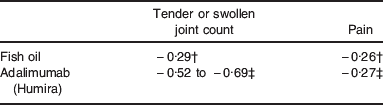
* Hedges' g was used to calculate the standardised mean difference, which is the difference between means divided by the pooled standard deviation.
† Goldberg and Katz(Reference Goldberg and Katz4).
‡ Calculated from data in FDA(67).
Summary and conclusions
Meta-analysis provides high-level evidence for symptomatic benefits of fish oil in RA. In addition, there is biological plausibility for the effects of fish oil. However, the uptake of fish oil in clinical management of RA is limited. While there may be perceptions of relatively modest benefits compared with the expensive biological agents, some benefits may be comparable. It is probable that the main barrier to clinician acceptance is the promotion of pharmaceutical use as the dominant treatment modality by the pharmaceutical industry sales force that attends to the ‘detailing’ of doctors. In the absence of an equivalent marketing effort for fish oil, rheumatologists are not inclined to consider, or even be aware of fish oil as a potential component of routine therapy for RA patients, despite the efficacy for symptom relief, the NSAID sparing and the benefits for cardiovascular health, which is compromised in RA patients due to their disease. Future trials need to examine recent-onset RA and use designs that allow ‘real-world’ drug use in order to enhance the external validity of the findings for modern rheumatology treatment.
Acknowledgements
There are no conflicts of interest for any author. The main body of this work received no specific grant from any funding agency in the public, commercial or not-for-profit sectors. The data represented in Fig. 3 are from a study supported by Monsanto Company and published previously as stated in the legend. All authors contributed substantially to the writing and editing of the manuscript.



