


The sacred status that many human societies have conferred to caves has generally discouraged the disturbance of cave-dwelling species living within them (Sponsel & Natadecha-Sponsel, Reference Sponsel, Natadecha-Sponsel and Gottlieb2004; Sponsel, Reference Sponsel and Brunn2015). This form of customary protection has thus contributed to the conservation of bat diversity (Robinson & Smith, Reference Robinson and Smith1997; Metcalfe et al., Reference Metcalfe, Ffrench-Constant and Gordon2010; Furey & Racey, Reference Furey, Racey, Voigt and Kingston2016). The protection provided by sacred caves is particularly important on tropical islands, on which endemic species are common (Conenna et al., Reference Conenna, Rocha, Russo and Cabeza2017). Madagascar has a high level of bat endemicity, with at least 32 of its c. 44 species (73%) being endemic (Cardiff & Jenkins, Reference Cardiff and Jenkins2016). Cave systems in the western part of the island are particularly important in this respect (Goodman et al., Reference Goodman, Andriafidison, Andrianaivoarivelo, Cardiff, Ifticene and Jenkins2005; Cardiff, Reference Cardiff2006).
The inherent spiritual respect that caves evoke in many Malagasy cultural traditions (Hobbs, Reference Hobbs2001) has conferred protection on cave-dwelling bats. As a result, the recognition of sacred caves is important for bat conservation (Schachenmann, Reference Schachenmann2006). However, numerous endemic cave-dwelling bat species, such as the Vulnerable Eidolon dupreanum, Near Threatened Roussetus madagascariensis and Near Threatened Hipposideros commersoni, are increasingly under threat, probably as a result of hunting pressure and other anthropogenic disturbances (Jenkins et al., Reference Jenkins, Racey, Andriafidison, Razafindrakoto, Razafimahatratra and Rabearivelo2007; Cardiff et al., Reference Cardiff, Ratrimomanarivo, Rembert and Goodman2009; Andrianaivoarivelo et al., Reference Andrianaivoarivelo, Andriafidison, Rahaingonirina, Raharimbola, Rakotoarivelo and Ramilijaona2012).
We know relatively little about the effectiveness of sacred caves in conserving bat diversity. Some authors have shown that numerous bat species of conservation concern can roost safely in sacred caves (Robinson & Smith, Reference Robinson and Smith1997; Metcalfe et al., Reference Metcalfe, Ffrench-Constant and Gordon2010), whereas others suggest that the cultural values underpinning these sites are eroding (Golden & Comaroff, Reference Golden and Comaroff2015a; Kingston, Reference Kingston, Voigt and Kingston2015). It is also unclear whether these island-like refuges can effectively protect mobile species that forage beyond the boundaries of sacred sites. Thus, the effectiveness of sacred caves in conserving bats cannot be taken for granted if spiritual values become eroded.
With empirical evidence on this matter still largely lacking, we set to explore local attitudes towards bats and sacred caves among two ethnic groups (Tanalana and Vezo) inhabiting the karstic area in and around Tsimanampetsotsa National Park in south-western Madagascar (Fig. 1). The Vezo live by the sea and are predominantly fishers; the Tanalana live inland and are mostly agro-pastoralists. Some sacred caves in this area are within the National Park, whereas others are governed only through customary institutions. Customary governance of sacred caves is articulated through an intricate combination of community rules, cultural taboos (fady), and ancestral customs (Tahirindraza, Reference Tahirindraza2015; Fritz-Vietta et al., Reference Fritz-Vietta, Tahirindraza and Stoll-Kleemann2017).
Map of the study area with the four sacred caves surveyed (white circles) and the main towns in the area (dark squares). Specific names and locations of the sacred caves are not provided in order to protect the bat colonies. Specific names and locations of the villages where interviews were conducted are not provided in order to protect the anonymity of the interviewees.

In this complex landscape of governance diversity we conducted semi-structured interviews with 54 adults in eight villages, to gain insights into cultural values, local uses and knowledge of bats, and the local management of sacred caves. Fieldwork took place in November 2016, adhering to the Code of Ethics of the International Society of Ethnobiology. Free, prior and informed consent was obtained from all individuals participating in this study, as well as from the relevant political organizations in the area. For details of the interview protocols, sample composition and construction of quantitative variables see Supplementary Material 1 and Supplementary Tables 1–2. To contextualize our social data, we also carried out mist-netting surveys to gather information on bat species in four sacred caves (Supplementary Table 3).
The sacred caves of Tsimanampetsotsa were often described by interviewees as spaces at the interface between the natural and supernatural worlds, being a focus of spiritual devotion. Some interviewees believed in the presence of spirits in the depths of the caves. Evidence of traditional uses such as funerary ceremonies or ritual offerings were found in the entrance of two of the four caves surveyed (Plate 1). Bats were also believed to roam at the junction between the physical and spiritual realms, protecting treasures out of human reach. People usually reported respecting the roosting bats, by avoiding entering the caves, mainly because they feared being harmed by spirits. These caves are home to at least six bat species, including the threatened Madagascar fruit bat Eidolon dupreanum. They harbour some of the largest maternity colonies of molossid bats within the region, with hundreds to thousands of individuals roosting together. These roosts are used at least during the breeding season, given that pregnant and lactating females were detected (Supplementary Table 3).
Entrances of the four caves surveyed in this study. Numbers correspond to the locations in Fig. 1. 2a–b show some of the ritual offerings found in one of the sacred caves: blood of a sacrificed black goat and bottles of locally brewed alcohol (e.g. toaka gasy) for the spirits.

Malagasy people not only have spiritual connections with sacred sites but also an extensive system of species- and place-specific taboos, which shape social behaviour and cultural practices around wildlife. Many of these taboos relate to consumptive uses of animals, potentially offering protection to a great number of species (Jones et al., Reference Jones, Andriamarovololona and Hockley2008). In particular, bat taboos are common among many Malagasy ethnic groups (Rahaingodrahety et al., Reference Rahaingodrahety, Andriafidison, Ratsimbazafy, Racey and Jenkins2008; Golden & Comaroff, Reference Golden and Comaroff2015b). This is also true in Tsimanampetsotsa, where we found that 22% of the interviewees recognized bat-related taboos inhibiting bat hunting and consumption. The public acceptance of bat-related taboos was slightly higher than the recognition of the sacredness of caves (15%; Fig. 2a). Both site- and species-related taboos were reported more often in Tanalana communities (63%) than among the Vezo (17%), although there was some variation between villages and age groups in both cases. Such heterogeneity in the knowledge of, and/or adherence to, bat taboos has been documented elsewhere in Madagascar (Golden & Comaroff, Reference Golden and Comaroff2015a).
(a) Percentages of self-reported recognition of the customary and legal instruments protecting bats and caves. (b) Percentages of community-reported (CR) and self-reported (SR) use of bats for food, guano and medicinal purposes.
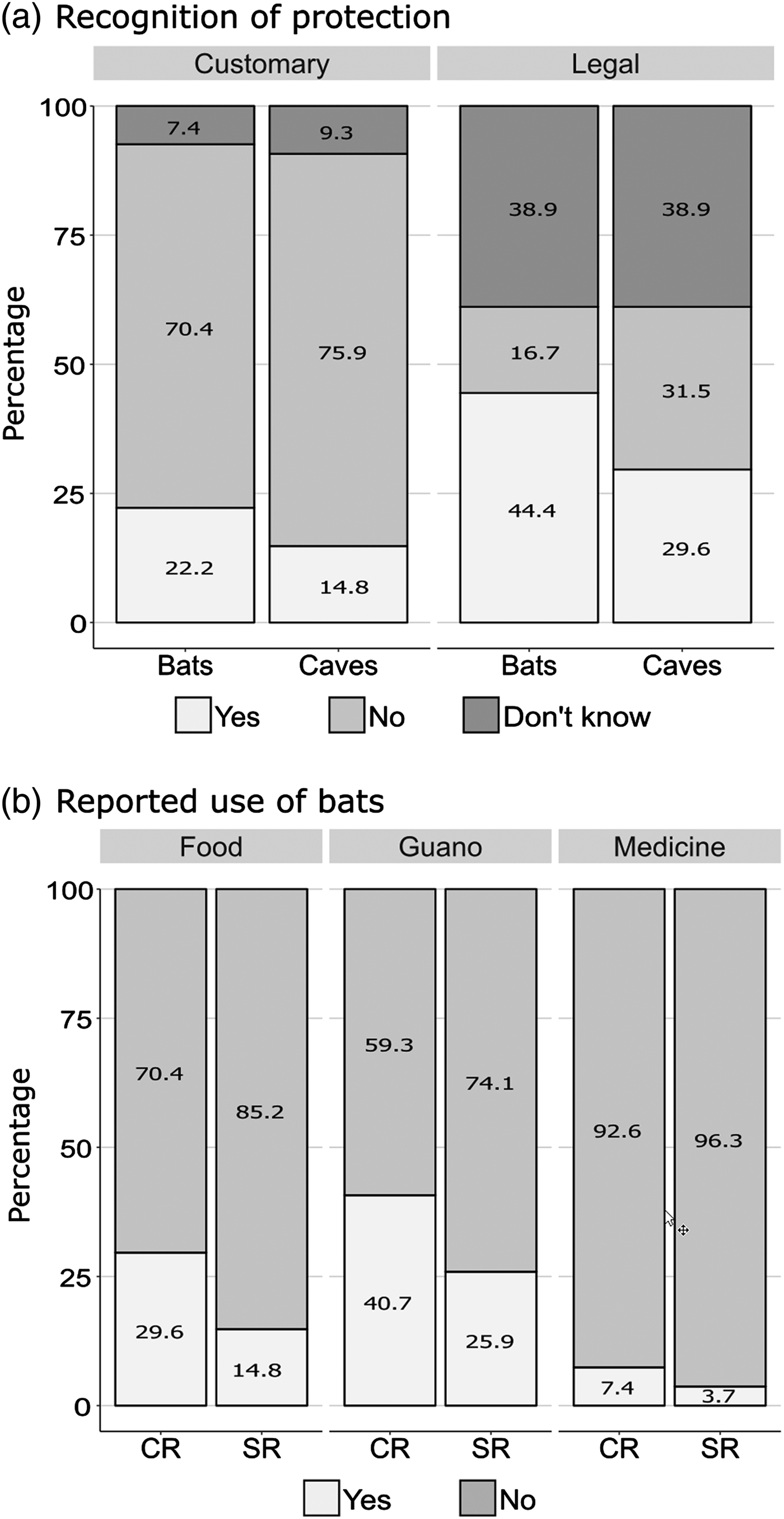
The existence of legal regulations conveyed through the National Park was often more widely acknowledged (30%) than the role of customary institutions (sacred sites and taboos; Fig. 2a). Nevertheless, the lack of knowledge of conservation policy and related legal regulations was high, with 39% of respondents expressing confusion about what was protected, where and, most notably, by whom. Although many local people recognized the functions of the National Park in conserving bats, others complained about recent changes in regulations limiting their access to sacred caves. Park management rules allow certain cultural uses (e.g. sacred rituals), but many informants expressed concerns about having lost cultural connections to spiritual sites inside the Park, because access to these sites now requires the payment of a Park entrance fee. This could explain why customary management of sacred caves was generally undervalued.
We also found widespread evidence of people using sacred caves for bat hunting. Up to 30% of the people interviewed reported bat consumption in their communities (Fig. 2b). Hunting of bat species, such as E. dupreanum or Mormopterus jugularis, was often performed with nets, sticks and stones in sacred caves (both within and outside the National Park). Reports of hunting within the park were, however, more anecdotal, taking place mostly in times of famine. For instance, in 2007, during a period of acute drought and consequent food insecurity, a large number of bats were killed with fire in a sacred cave within the National Park. According to several local informants, these bats ‘fed 200 people for 2 months’. In general, people reported that hunting in caves maximized the probabilities of a successful hunt, given that bats are more easily accessible when they are roosting. For example, a Tanalana informant stated ‘People do not catch bats in the village; they prefer to catch them in the cave, when they sleep. They throw stones to catch them, and eat them’.
Bat hunting was also linked to children's games in school buildings and caves, a phenomenon reported by 26% of all interviewees. Several bat species roost in school buildings in Madagascar (López-Baucells et al., Reference López-Baucells, Rocha, Andriatafika, Tojosoa, Kemp, Forbes and Cabeza2017), which facilitates encounters with children. They often capture bats during playtime in school, tying them with ropes and singing a well-known tune (Kinnakina baka nihina), alluding to bats being killed to stop their snoring. Such games usually end with the death of the bat. We also found anecdotal reports of medicinal uses of bats, mostly in the form of a ‘bat oil medicine’ made by decanting the oil obtained from boiling a bat in water. According to the interviewees, this oil is traditionally applied on the scalp to aid hair growth, or to cure coughs. Similar findings have been reported from Andringitra National Park (Jenkins & Racey, Reference Jenkins and Racey2008).
Although bat consumption is common across Madagascar (Jenkins & Racey, Reference Jenkins and Racey2008), no evidence of bat trade was found in the area. However, guano collection for commercial purposes was explicitly mentioned as an important source of income. Guano extraction is often tolerated in certain sacred sites, although it was always reported as occurring outside the National Park. Extraction is carried out in exchange for economic compensation (e.g. job opportunities or infrastructure development) on the condition that the companies perform certain rituals (e.g. spilling a few drops of alcohol by the entrance) and agree not to touch certain venerated sites (Buliga, Reference Buliga2010). The growing presence of guano companies in the area is of concern, given that human disturbance inside the caves often leads to displacement of bat populations (Cardiff & Jenkins, Reference Cardiff and Jenkins2016). In addition, companies usually modify the geological structure of caves to facilitate guano extraction, altering the microclimate required for bat roosting (IUCN SSC, 2014). Although bats were present in some caves following guano harvesting, without prior knowledge of these populations the effects of harvesting are unclear.
The economic benefits derived from guano collection could motivate people to conserve bats and their habitats, as suggested by a Tanalana man stating ‘Now the parents tell the kids to protect the caves. In 2014 there was a company who came and bought all the guano’. In fact, most of the value that our informants attributed to bats can be directly traced to guano-related income (41% of all respondents), whereas relational values such as aesthetic appreciation or cultural identity (15%) were less relevant. This suggests that harvesting guano could, under certain circumstances, benefit bat conservation, although this is not currently allowed within the National Park. However, caution is required, given that guano extraction is often performed through destructive and exploitative practices.
None of the interviewees who had extracted guano reported any sacred values or taboos related to caves. Similarly, none of the people who recognized caves as sacred reported extracting guano. Given that mentioning a taboo does not necessarily mean respecting it (Golden & Comaroff, Reference Golden and Comaroff2015a), these results cannot be taken as direct proxies for taboo adherence. They do, however, open avenues for further research on the role of cultural values in bat conservation.
Although sacred sites and taboos exist for social and cultural reasons other than biodiversity conservation (Rutte, Reference Rutte2011), their role in wildlife management is increasingly emphasized in conservation discourses in Madagascar (Schachenmann, Reference Schachenmann2006; Rahaingodrahety et al., Reference Rahaingodrahety, Andriafidison, Ratsimbazafy, Racey and Jenkins2008). However, our study questions the current effectiveness of sacred sites and taboos, at least in conserving bats, and confirms the pervasive erosion of customary institutions in Madagascar (Jenkins et al., Reference Jenkins, Keane, Rakotoarivelo, Rakotomboavonjy, Randrianandrianina and Razafimanahaka2011; Golden & Comaroff, Reference Golden and Comaroff2015a). If the spiritual values associated with bats and caves are lost, the effectiveness of these sacred sites for protecting bat populations will be in jeopardy.
Given that cave-dwelling bat species tend to form the largest colonies (McCracken, Reference Mccracken1986), protection of such roosts is paramount for bat conservation. Cave-dwelling bats are particularly vulnerable to hunting pressure because capturing large numbers is facilitated by the enclosed space (Jenkins et al., Reference Jenkins, Racey, Andriafidison, Razafindrakoto, Razafimahatratra and Rabearivelo2007). This is particularly problematic on islands, where most bat species are endemic and have restricted ranges (Conenna et al., Reference Conenna, Rocha, Russo and Cabeza2017). Because both bat-specific and cave-specific taboos now have a relatively low prevalence among communities in Madagascar, probably because of rapid cultural changes, the extent to which they offer effective protection for bats is questionable. It is thus essential to better understand the complex interactions between sacred sites, taboos and protected areas in preserving bat diversity.
Acknowledgements
Research permits were issued by the Ministry of the Environment, Ecology and Forests of Madagascar (Agreement Nr. 275/16/MEEF/SG/DGF/DSAP/SCB.Re) and Madagascar National Parks. The research leading to these results has received funding from the Academy of Finland (grant agreement nrs. 311176 and 292765). We thank the Tanalana and Vezo people who have generously opened the doors of their houses and their sacred worlds for us, Madagascar National Parks for their support, Association SAME for their help during fieldwork and translation services, and A. Pyhälä and V. Reyes-García for insightful comments on a previous version of the interview protocol.
Author contributions
AFLL, ALB, RR and MC designed the study. All authors collected data. DB analysed the data. AFLL, ALB, DB and RR prepared the figures and tables. AFLL and ALB led the writing, with contributions from all co-authors. MC supervised the project through all its phases.
Biographical sketches
All authors are members of the Global Change and Conservation research group (GCC; http://gcc.it.helsinki.fi) at the Department of Biosciences, University of Helsinki, Finland. GCC is known for its interdisciplinary cross-cutting conservation research, integrating social and ecological data at multiple scales. Álvaro Fernández-Llamazares is an ethnoecologist interested in biocultural approaches to conservation. Adrià López-Baucells, Ricardo Rocha and Laura Torrent work on bat ecology and conservation. Santatra F.M. Andriamitandrina, Zo Emmanuel Andriatafika and Eric Marcel Temba conduct research on the human dimensions of conservation in Madagascar, with emphasis on bird communities. Daniel Burgas is a conservation ecologist with experience in designing collection of field data and interest in optimal ecological sampling. Mar Cabeza is the leader of GCC and her work spans a broad range of research topics related to conservation planning and assessments, with a strong focus on applied conservation challenges in Africa.


 Open access

