


Vitamin A deficiency (VAD) is a major nutritional concern in poor societies, especially in lower-income countries(1, Reference Underwood2). It has been reported by the WHO that about 33·3 % preschool children and 15 % pregnant women are at risk of VAD in the world, most of whom are in developing countries consuming a plant-based diet. In China, about 40 % of children aged 3–12 years are marginally vitamin A deficient(3). The cause of VAD is chronically having a diet with insufficient vitamin A to support tissue growth, normal body metabolism, resistance to infection, etc. VAD can result in anaemia, reduced resistance against infection, xerophthalmia and, ultimately, blindness and death(Reference Sommer and West4).
There are several strategies that have been developed to increase the dietary intake of vitamin A. Vitamin A supplementation has been distributed to children with vitamin A malnutrition and it has been found that it can effectively reduce childhood blindness(Reference Sommer5) and mortality(Reference Sommer, Tarwotjo and Djunaedi6–Reference West, Pokhrel and Katz8) in vitamin A-deficient populations. However, this approach reaches only limited groups. Vitamin A fortification into common food items is also acceptable. However, in less developed areas, it is dependent on central manufacturing facilities, distribution chains and other processes. In China, 70 % dietary vitamin A is from provitamin A carotenoids(Reference McLaren and Frigg9), the absorption and bioconversion of which are influenced by various factors(Reference Micozzi, Brown and Edwards10, Reference Brubacher and Weiser11). Increasing the intake of highly bioavailable provitamin A carotenoids is a challenge for populations with a largely plant-based diet in China.
Spirulina is a photoautotroph alga and is considered to be a valuable additional food source of some macro- and micronutrients, including high-quality protein and carotenoids (mainly β-carotene)(Reference Ciferri12–Reference Gireesh, Nair and Sudhakaran14). A human supplementation study showed that ‘Bitot's spot’, a symptom of VAD, decreased from 80 % to 10 % after 1 g spirulina per d for ≥150 d in 5000 preschool-age children in Chennai, India(Reference Seshadri15). In another study with 400 school children, a daily dose of β-carotene from 2 g spirulina increased the children's vitamin A status to the same level as those administered pure vitamin A(Reference Annapurna16). Our previous study also showed that spirulina could bioconvert to retinol at a high efficacy of 4·5:1 by weight in Chinese adults and may improve their vitamin A status(Reference Wang, Wang and Wang17). However, there has been no study that evaluated the efficacy of spirulina in improving vitamin A status of Chinese children.
In the present study, we aimed to investigate the efficacy of daily consumption of spirulina in improving the vitamin A status of Chinese school-age children by using a paired isotope dilution technique assessing the total-body stores of vitamin A.
Subjects and methods
Subjects
The study was carried out in an elementary school in Hunan Province about 1000 km south of Beijing. Most inhabitants are from an agricultural middle-income socio-economic population.
Children who were aged 6–11 years, were generally healthy and could eat meals at school were eligible to participate in this study. Children with fever (>38°C) or C-reactive protein >10 mg/l at the time of enrolment were excluded from the study. Children with serum retinol <0·70 µmol/l were referred to the hospital for treatment. A total of 228 children met the eligibility criteria and were enrolled in the study.
This study was conducted according to the guidelines laid down in the Declaration of Helsinki and all procedures involving human subjects were approved by the Committee on Human Research, Institute of Nutrition and Food Safety, the Chinese Center for Disease Control and Prevention and the Institutional Review Board of Tufts-New England Medical Center. Written informed consent was obtained from the parents before each child's participation.
Study design
At 2 weeks before the study, all the subjects were instructed to eat their usual diet at home but to avoid nutritional supplements and foods rich in β-carotene or vitamin A, such as spinach, carrots, or liver products. Each subject kept a 3-d food record at the beginning of the study. Albendazole tablets (400 mg per child) were given to all the children 2 weeks before the study. Faecal analysis was done 1 d before the study to make sure there was no parasitic infection in any of the children participating in the study.
During the 10-week dietary intervention, 228 children were randomly divided into three groups: 4 g spirulina supplement group (n 78), 2 g spirulina supplement group (n 74) and the control group (n 76). All the children ate three meals at school with 4, 2, or 0 g spirulina in their breakfast as cakes, sweet rice dumpling or rice noodles. The nutrients in their standard daily diet provided at school contained 7531 (sd 418·4) kJ with 65 (sd 5) g protein, 60 (sd 5) g fat and 200 (sd 20) retinol activity equivalents retinol, 50 % of the RDA of vitamin A for Chinese children in this age group. At weekends, the children ate at home and noted foods they ate.
Before and after dietary intervention, the study subjects were given 0·5 mg of 2H-labelled vitamin A in an oil capsule with a fat-containing meal at school. [2H4]retinyl acetate was administered at baseline, and [2H8]retinyl acetate was administered 10 weeks later to distinguish serum [2H8]retinol from any residual [2H4]retinol.
At 3 and 21 d after each 2H-labelled vitamin A dose, fasting blood samples (3 ml) were collected from all the subjects for the analysis of serum retinol and carotenoid levels as well as the total-body vitamin A stores since the labelled retinol is supposed to attain an equilibrated state after 21 d. Blood samples were covered by aluminium foil to protect them from light, kept at room temperature for 30 min and then centrifuged at 4°C and 800 g for 15 min. Serum was stored at −20°C for ≤10 d and then packed with dry ice and transported to the Institute for Nutrition and Food Safety (Beijing, China), where it was stored at −80°C. All frozen samples with a frozen Ice BrickTR were sent by air to the Carotenoids and Health Laboratory of the US Department of Agriculture Human Nutrition Research Center on Aging at Tufts University (Boston, MA) for analysis.
Stable isotopes of vitamin A
2H4-labelled retinyl acetate (10,19,19,19-[2H4]retinyl acetate) and 2H8-labelled retinyl acetate (10,14,19,19,19, 20,20,20-[2H8]retinyl acetate) were synthesised by Cambridge Isotope Laboratories. We prepared capsules (no. 3 gelatin capsule) containing 0·5 mg (1·51 µmol [2H4]retinyl acetate or 1·49 µmol [2H8]retinyl acetate) of these stable isotopes dissolved in 170 mg of maize oil.
Spirulina
Spirulina powder was purchased from Hainan Food Company. During the intervention period, wheat flour was chosen as the carrier to mix with spirulina (2 or 4 g) to make noodles or other foods. Chlorophyll instead of spirulina was added to the wheat flour used for making the foods given to the control group during the same period, giving the foods the same appearance as those with added spirulina. Foods such as noodles and cake were made in advance, packed in coded bags and stored at −20°C. Food with added spirulina was given to the children 5 d/week for 10 weeks, served with soup or porridge at breakfast time. Soups or porridge provided for breakfast contained no β-carotene or vitamin A. The feeding periods were supervised and daily consumption was recorded for each individual as the relative amount of the food served.
HPLC for carotenoid concentrations in spirulina
An HPLC (Waters 2695 separation module and Waters 2996 photodiode array detector; wavelength 250–600 nm; Waters Corporation) and a Pronto SIL C30 column (Bischoff Chromatography) were used to analyse carotenoid concentrations in spirulina(Reference Yeum, Booth and Sadowski18).
To analyse carotenoids in spirulina, 100 mg spirulina powder were weighed and put into a 50 ml glass vial and then 3 ml methanol were added to the vial. Spirulina in the vial was homogenised by using a Polytron (PT1600E; Kinematica AG) at speed 10 for 30 s in an ice bath and then washed with 5 ml methanol. The vial containing the mixture was stored at 4°C for 12 h. Then, the vial was mixed by vortex for 30 s and centrifuged at 4°C and 800 g for 5 min. The methanol layer was transferred to a 50 ml volumetric flask by using a pipette gun. Tetrahydrofuran was used to extract carotenoids four times (10 ml of tetrahydrofuran for the first three times and 5 ml for the fourth time); vortex mixing and centrifuging were involved each time. The tetrahydrofuran layers were collected into the methanol extract contained in a volumetric flask, to which tetrahydrofuran was added to a volume of 50 ml and mixed well. The extract (1 ml) was evaporated under the N2 flow of an N-EVAP nitrogen evaporator (Organomation Associates Inc.)(Reference Yeum, Booth and Sadowski18). The residue was resuspended in 1 ml ethanol, and 20 µl were injected into the HPLC. Triplicate samples were analysed.
A linear gradient procedure started from 100 % solvent A for 21 min, then changed to 45 % A and 55 % B and held for 1 min, changed to 5 % A and 95 % B in 11 min and held for 4 min and changed back to 100 % A in 2 min and held for 20 min. The HPLC pump flow was set at 0·4 ml/min. Carotenoid concentrations were calculated according to the standard curves of α-carotene, trans-β-carotene, 9-cis- and 13-cis-β-carotene (all Sigma-Aldrich Inc.), lutein, zeaxanthin and α, β-cryptoxanthin (all Roche Vitamin Inc.).
EMPOWER PRO software (version 2.0; Waters Corp.) was used to control the HPLC system and data analysis. Carotenoids were detected at 450 nm.
HPLC for collecting retinol fraction from serum
To collect retinol from serum, 400 µl serum, 100 µl internal standards (retinyl acetate + echinenone), 500 µl saline (0·85 %) and 5 ml of a mixture of chloroform and methanol in the ratio of 2:1 (v/v) were added to a glass tube (16 × 100 mm), mixed by using a vortex mixer (Labnet International Inc.) for 1 min and then centrifuged at 4°C and 800 g for 10 min. The lower layer (chloroform layer) was collected into another glass tube (13 × 100 mm) by using a glass pipette. Hexane (3 ml) was added to the aqueous layer, mixed by vortex and centrifuged again. The hexane layer and the chloroform layer were combined and dried under N2 on the N-EVAP nitrogen evaporator. The residue was dissolved in 100 µl of a mixture of ethanol and tetrahydrofuran in the ratio of 2:1 (v/v), mixed and sonicated for 20 s and then transferred to a vial. The dissolved residual solution (70 µl) was injected into the HPLC.
A Waters HPLC (616 pump, 717 Plus autosampler and 996 photodiode array detector; Waters Corporation) with a Pecosphere C18 column (PerkinElmer Life and Analytic Sciences) and an FC203 collector (Gilson Inc.) were used to analyse the concentration and collect the retinol fraction from serum samples. The HPLC mobile phase included solvent A (methanol–tetrahydrofuran–water (M–T–W), 50:20:30 by vol.) and solvent B (M–T–W, 50:44:6 by vol.) with 1·5 % ammonium acetate in water. A linear gradient solvent procedure started at 100 % solvent A for 6 min, changed to 70 % A and 30 % B in 4 min, changed to 50 % A and 50 % B in 5 min, changed to 30 % A and 70 % B in 3 min and changed to 15 % A and 85 % B in 4 min. Finally, the gradient went back to 100 % A in 16 min and held for 8 min to stabilise the system before the next sample was injected. The column temperature was 12°C, and the flow rate was 1 ml/min. Retinol was eluted at 9 min, so the eluent fluid from 8 to 10 min was collected in a 2-ml flask (Pyrex Labware; Corning Inc.).
GC-electron capture negative chemical ionisation–mass spectrometer for the enrichment of labelled retinol in serum
The retinol fraction from the HPLC was dried under N2. We added 10 µl N,O bis(trimethylsilyl) trifluoroacetamide (10 %, BSTFA TMCS; Pierce) to the residue, capped the flask with a stopper to avoid moisture and put it into an oven at 70°C for 30 min. Then, the flask was cooled to room temperature. The derivatised retinol (3 µl) was injected into a GC-electron capture negative chemical ionisation–mass spectrometer (Agilent 6890 Series GC System and 5973 Network Mass Selective Detector; Agilent Technologies). A Zebron ZB-1 ms Capillary GC column (Phenomenex Inc.) was used to separate compounds. He and CH4 were used as the carrier gas and the reaction gas, respectively. The GC oven temperature was increased from 53 to 220°C at a speed of 40°C/min, to 230°C at 15°C/min and to 320°C at 40°C/min; it remained at 320°C for 5 min. This method produced a trans-retinol peak at 12 min.
The mass spectrometer was set to scan at a mass-to-charge ratio (m/z) of 260–280. Retinol molecular mass was equal to 286, and lost one group of H2O during the negative chemical ionisation process, which made the major fragment of retinol at m/z 268(Reference Tang, Qin and Dolnikowski19).
Paired isotope dilution technique procedure for estimating total-body vitamin A stores
The ratio of non-2H-labelled to 2H-labelled retinol (H:D) in serum was determined by GC-MS, and total-body stores of vitamin A were calculated as previously reported(Reference Tang, Qin and Hao20). Briefly, a modified version of the formula of Bausch and Rietz(Reference Tang, Qin and Dolnikowski19) for the assessment of vitamin A stores in rats was used as follows: total-body vitamin A stores (in mmol retinol) = F × dose × (S × a × (H:D – 1)),(Reference Sommer and West4) where F = 0·5 (fraction of the dose to be stored in liver)(Reference Bausch and Rietz21), ‘dose’ is the labelled vitamin A in mmol, S = 0·65 (correction for H:D in serum)(Reference Hicks, Gunning and Olson22), and a = e−kt, a correction factor to the H:D that is due to the continued daily intake of dietary vitamin A (k = ln2/t 1/2; t 1/2 is the half-life of vitamin A turnover in the liver and is estimated to be about 32 d for the children(Reference Olson23–Reference Haskell, Lembcke and Salazar25), and t is the time (in d) since the isotope dose was administered), and H:D (1H:2H) is the enrichment of retinol after a labelled dose of vitamin A.
Statistical analyses
Means, standard deviations, medians and ranges are reported. ANOVA was used to determine the differences in serum concentration of the major carotenoids, vitamin E and retinol between the groups. The Student's paired t test was used to compare the mean concentrations of total-body vitamin A stores before and after a 10-week intervention. A probability of <0·05 was considered to be statistically significant. All the statistical analyses were performed with SPSS software (version 13.0; SPSS Inc.).
Results
The characteristics of the three groups of children at baseline are listed in Table 1. These three groups were well balanced with respect to age, height, weight and BMI. No significant difference was found in Hb concentrations between the three groups.
Serum retinol concentrations of children by group at baseline ( ) and 3 d after the end of the intervention (
 ). Group 1, control group (n 76); group 2, group given food with 2 g added spirulina, 5 d/week for 10 weeks (n 74); group 3, group given food with 4 g added spirulina, 5 d/week for 10 weeks (n 78). Serum retinol concentrations were determined using HPLC equipped with a UV detector. Values are means, with standard deviations represented by vertical bars. ANOVA was used to compare differences between the groups. No significant differences were found.

Serum β-carotene concentrations of children by group at baseline ( ), 3 d after the end of the intervention (
 ) and 21 d after the end of the intervention (
 ). Group 1, control group (n 76); group 2, group given food with 2 g added spirulina, 5 d/week for 10 weeks (n 74); group 3, group given food with 4 g added spirulina, 5 d/week for 10 weeks (n 78). Serum β-carotene concentrations were determined using HPLC equipped with a UV detector. Values are means, with standard deviations represented by vertical bars. ANOVA was used to compare differences between the groups (P < 0·05).

Characteristics of study subjects by group (Mean values, standard deviations and ranges)

Group 1, control group; group 2, group given food with 2 g added spirulina, 5 d/week for 10 weeks; group 3, group given food with 4 g added spirulina, 5 d/week for 10 weeks.
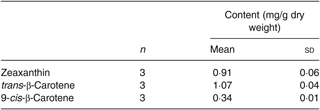
The provitamin A carotenoid content in spirulina powder consisted mainly of zeaxanthin, all-trans and 9-cis-β-carotene. The powder contained about 0·91 mg zeaxanthin, 1·07 mg β-carotene and 0·34 mg 9-cis-β-carotene per g (Table 2).
Carotenoid content of spirulina powder (Mean values and standard deviations)
In the intervention study, wheat flour, as a food vehicle to mix with spirulina (2 or 4 g), was used to make noodles, cakes or rice dumplings. After it was cooked, a serving size of cake (70 g), with added 2 or 4 g spirulina, was found to contain 2·73 and 3·67 mg β-carotene, respectively. An amount of 70 g (with added 2 g spirulina) or 140 g (with added 4 g spirulina) of rice noodles given to children in different groups could provide 2·34 and 4·69 mg β-carotene, respectively (Table 3).
Carotenoid content in cooked food with added spirulina (μg per serving, n 3) (Mean values and standard deviations)

There were no significant differences in baseline serum concentrations of retinol, β-carotene, cryptoxanthin, lutein/zeaxanthin and vitamin E of children in the three groups (Table 4). Serum retinol concentrations did not change significantly over time in the three groups, even in the children supplemented with 2 g (P = 0·621) or 4 g (P = 0·358) spirulina for 10 weeks (Fig. 1). Serum β-carotene level increased significantly for children supplemented with 2 g (P = 0·031) and 4 g (P = 0·012) spirulina after 10 weeks as shown in Fig. 2. Children supplemented with 4 g spirulina had a serum β-carotene concentration almost twice as high as those supplemented with 2 g spirulina (P = 0·026). An obvious reduction in serum β-carotene concentrations was observed 3 weeks after the spirulina supplementation finished; however, it was still significantly higher than that of the control group.
Baseline serum concentrations of retinol, carotenoids and vitamin E of subjects by group (μmol/l) (Mean values and standard deviations)

Group 1, control group; group 2, group given food with 2 g added spirulina, 5 d/week for 10 weeks; group 3, group given food with 4 g added spirulina, 5 d/week for 10 weeks.
Total-body vitamin A stores of the children in the three groups are presented in Table 5. There was no significant difference in total-body vitamin A stores of children in the three groups at baseline. A significant increase was found in children supplemented with 2 or 4 g spirulina (P < 0·001), with a median increase of 0·160 and 0·269 mmol, respectively. A small but not significant increase was observed in the control group (P = 0·539).
Total-body stores of vitamin A in subjects before and after intervention (Median values, mean values and standard deviations)

Group 1, control group; group 2, group given food with 2 g added spirulina, 5 d/week for 10 weeks; group 3, group given food with 4 g added spirulina, 5 d/week for 10 weeks.
** Mean value was significantly different from that at baseline (P < 0·01; Student's paired t test).
Discussion
Spirulina (Spirulina platensis) is a photoautotroph alga and has a long history of use in the diet(Reference Khan, Bhadouria and Bisen26). There are reports that spirulina was used traditionally by Mexicans and natives in the Lake Chad area(Reference Ciferri and Tiboni27). Its safety for human food has been established through various toxicological studies. Spirulina has high-quality protein and carotenoids, especially β-carotene(Reference Ciferri12, Reference El-Baky, El Baz and El-Baroty13). A certain amount of spirulina powder is mixed with traditional foods and cooked using methods such as steaming, baking, etc. About 90 % of β-carotene in spirulina can be preserved. As shown in Table 3, a serving of cake (70 g) with 2 g added spirulina can provide 2·73 mg β-carotene. A serving with 4 g added spirulina contained 3·67 mg β-carotene, which indicated that wheat flour is an appropriate food vehicle to deliver spirulina β-carotene to the study subjects. Therefore, it is not surprising that the serum β-carotene concentrations of the subjects increased significantly after consumption of the foods with a certain amount of added spirulina. An obvious decrease in serum β-carotene levels was observed 3 weeks after the intervention study finished. However, the children's serum β-carotene concentration still significantly higher than the baseline level.
The greater improvement in serum β-carotene concentration compared with the changes in serum retinol is not surprising because it is recognised that circulating retinol is homeostatically controlled over the physiological range of liver vitamin A concentrations(Reference Olson28). Serum retinol values tend to fall precipitously when liver vitamin A concentrations are <0·07 µmol/g (20 µg/g) and tend to increase steeply when liver concentrations are >1·05 µmol/g (300 µg/g)(Reference Olson28). Within the cited range, however, circulating concentrations respond with a very shallow slope to increments in liver vitamin A across the aforementioned range. In this study, no significant changes in serum retinol were observed after a 10-week intervention even though the children's total-body vitamin A stores increased significantly. This also implies that serum retinol concentration is not a sensitive indicator of vitamin A status over a wide range of vitamin A nutriture, which may be the reason why some intervention studies are not as efficacious as hoped(Reference de Pee, West and Muhilal29, Reference Bulux, de Serrano and Giuliano30) with serum retinol concentration as a biomarker to evaluate vitamin A status.
The paired isotope dilution technique is one of the most advanced and accurate methods currently available for assessing vitamin A status(Reference Tang, Qin and Hao20, Reference Ribaya-Mercado and Solomons31). This procedure has been used to assess the total-body stores of vitamin A in children, adults, or both in the USA(Reference Tang, Qin and Hao20, Reference Haskell, Islam and Handelman32), Bangladesh(Reference Haskell, Islam and Handelman32–Reference Haskell, Mazumder and Peerson34), Philippines(Reference Ribaya-Mercado, Solon and Dallal35–Reference Ribaya-Mercado, Solon and Fermin37), Peru(Reference Haskell, Lembcke and Salazar25) and China(Reference Tang, Qin and Hao20, Reference Tang, Gu and Hu38). The present study employed the paired isotope dilution technique to evaluate the changes of total-body vitamin A stores of children supplemented with spirulina. The estimated mean total-body vitamin A stores in Chinese school-age children at baseline were lower than the value of 1·02 mmol reported for one 6-year-old child in the USA(Reference Haskell, Islam and Handelman32) and higher than the mean value of Chinese children reported by Tang et al. (0·13 and 0·27 mmol)(Reference Tang, Qin and Hao20, Reference Tang, Gu and Hu38). After children were supplemented with 2 or 4 g spirulina for 10 weeks, their total-body vitamin A stores increased by 83·3 and 137·3 %, respectively, which approached the value reported for US children. For subjects in the control group without spirulina supplementation, their total-body vitamin A stores remained stable during the 10-week period. Therefore, we could conclude that spirulina supplementation contributes to the increase in total-body vitamin A stores in the intervention group. Spirulina contains a high amount of β-carotene. It is well known that β-carotene can be cleaved into retinol in the intestine by carotenoid mono-oxygenases I and II after it is absorbed from food(Reference Kiefer, Hessel and Lampert39, Reference Lindqvist and Andersson40). Our previous study showed that the conversion factor of spirulina β-carotene to vitamin A is as high as 4·5 to 1 by weight in Chinese adults(Reference Wang, Wang and Wang17). By this conversion factor, 2 or 4 g spirulina can provide about 0·5 or 1 mg vitamin A. Therefore, it is not difficult to explain that total-body vitamin A stores of children supplemented with spirulina can be increased significantly. Green-yellow vegetables and sweet potatoes are also good dietary sources of β-carotene. It has been reported that green-yellow vegetables can sustain the total-body vitamin A stores of kindergarten children, but no obvious increase was observed(Reference Tang, Gu and Hu38). Jaarsveld et al. found that consumption of orange-fleshed sweet potatoes could improve vitamin A liver stores(Reference Jaarsveld, Faber and Tanumihardjo41). Recently, studies have shown that golden rice also has a vitamin A equivalence as high as 3·8 (sd 1·7) to 1 by weight(Reference Tang, Qin and Dolnikowski42); however, no data on its effect on total-body vitamin A stores have been reported.
From this study, it is safe to conclude that spirulina can significantly increase subjects’ serum β-carotene and total-body vitamin A stores monitored by using a paired stable-isotope dilution technique, which suggests that spirulina is a good dietary source of β-carotene and vitamin A.
Acknowledgements
The research leading to these results received funding from the Nestlé Foundation and the China Scientific Supporting Programs (grant no. 2008BA158B00). None of the authors had a financial or personal conflict of interest with regard to the present study. L. L. participated in HPLC and GC-MS analyses of serum, data analysis and the writing of the manuscript; S. Y., X. Z. and J. W. supervised the human study and collected blood samples. S. Y. and G. T. designed the study and revised the manuscript; G. T. and T. M. supervised the HPLC and MS analyses; P. M. S. proposed the project and revised the manuscript. All the authors read and approved the final manuscript. There are no conflicts of interest with regard to the present study.


 Open access

