




Introduction
In the midst of the rapid changes the world is experiencing today, along with increasing globalization and interaction, higher-education institutions play an important role as a central space for shaping students’ socio-cultural awareness and strengthening their sense of identity within multicultural contexts. As an interdisciplinary field concerned with studying culture, identity, and social relations, cultural studies have become one of the most important academic specializations gaining increasing prominence in university curricula, especially in environments of demographic and cultural diversity, as is the case in the United Arab Emirates (Kassab et al., Reference Kassab, Rathan, Schmidt and Hamdy2024) Recent studies in the field show that including cultural studies in higher-education programmes helps to enhance students’ understanding of social values, in addition to improving their ability to cope with cultural diversity, along with developing their critical-thinking skills and raising awareness of their own social environment (Hall, Reference Hall2019; Ibrahim & Jarrar et al., Reference Jarrar, Al Dhaheri, Lightowler, Cheikh Ismail, Al-Meqbaali, Bataineh, Alhefeiti, Albreiki, Albadi, Alkaabi and Thondre2022).
The UAE offers a unique model of social and cultural environment of great diversity, as it hosts people from more than 200 nationalities (Deveci et al., Reference Deveci, Elgamal, Dalton and Langille2021). It also has ambitious national strategies aimed at increasing the value of cultural identity and enhancing the importance of promoting social cohesion (UAE, 2023). Some documents relevant to the National policy of the United Arab Emirates, such as “We the UAE 2021” and the National Identity Agenda, emphasize the significant role of education in safeguarding the cultural heritage of the country. This led to have a generation that is fully aware of its ethical and social identity and can cope with the world around them efficiently (Sun & Geeraert, Reference Sun and Geeraert2021). Recent studies in the UAE higher education indicate that courses that focus on culture and identity contribute to developing students’ understanding of ethical values, national identity and cultural diversity, as well as improving their ability to participate thoughtfully and consciously with their community (Al-Hammadi & Alkaabi, Reference Al-Hammadi and Alkaabi2021; Ridge et al., Reference Ridge, Dingus and Han2020).
Global literature also shows that students’ exposure to well-structured cultural content contributes to developing their intercultural communication skills and increasing their levels of empathy, ethical awareness and social responsibility (Deardorff, Reference Deardorff2019; UNESCO, 2023). In the UAE context, these findings sound more significant, as it hosts students from various cultural backgrounds and seeks to prepare graduates who can be actively integrated into a global knowledge-based economy (Wren, Reference Wren2021). Accordingly, cultural studies offer one of the strategic educational tools that contribute to shaping students’ cultural and intellectual character, enabling them to approach diversity as a fundamental human value, which is considered by international organizations an essential graduate competency in the twenty-first century (OECD, 2021).
Despite this growing value, literature indicates that there is a big research gap in the evaluation of the role of cultural studies in raising socio-cultural awareness within the UAE higher education. Most previous studies focus on general subjects related to identity or intercultural education, away from providing a systematic analysis of the influence of cultural courses on students’ knowledge, attitudes and social skills (Šantek et al., Reference Šantek, Kavoura and Briciu2025). This suggests that there is an urgent need for in-depth empirical studies that aim to bridge this gap, especially from the students’ own perspective as primary agents in the learning process.
In light of this, the study seeks to examine two core dimensions: (1) To what extent do cultural studies assist in raising the socio-cultural awareness of higher education students in the United Arab Emirates? (2) What are students’ perceptions of the effectiveness of cultural studies in improving their knowledge, attitudes and skills related to socio-cultural understanding? The present study offers findings that provide a better understanding of how to develop curriculum, improve teaching practices, and support national efforts that aim to enhance and enrich the moral values, identity and social principles of future generations. Furthermore, the study adds scholarly value to global literature on cultural education and identity formation in multicultural communities. Thus, it provides a model that is well related to the regional context and applicable to comparable international settings.
Through its empirical contributions, this research intends to support practical curriculum development by unravelling the mechanisms through which cultural studies and heritage education can integrate with environmental and sustainable learning in higher education.
Statement of problem
The higher education sector in the UAE has recently witnessed a remarkable expansion in the cultural studies curricula (James & M. Shammas, Reference James and M. Shammas2013). This expansion is aimed at underscoring national identity and promoting students’ socio-cultural awareness in a society characterized by diverse cultural backgrounds. This aligns with the country’s vision that stresses the effective role of cultural values and national identity in the transmission and enhancement of socio-cultural awareness among students in the UAE higher education sector. However, despite the adoption of these courses, literature reveals a lack of studies that assess the effectiveness of all these courses in achieving the educational and culture-based outcomes. According to (Shanti et al., Reference Shanti, Cho, Byon, Yeun, Kim, Kim and Altunaiji2021), most research related to the field of cultural studies in the context of the UAE focuses on citizenship and moral education. Such Studies revealed a lack of research addressing the role of cultural studies in promoting socio-cultural awareness among students and how students perceive their impacts. This leads to a clear gap in literature related to the effectiveness of cultural studies in promoting students’ socio-cultural awareness and how students perceive the impacts of these courses.
Accordingly, this research gap represents a real knowledge gap that requires an empirical study that explores the effectiveness of these courses from students’ perspectives and measures their impact on their socio-cultural awareness, and reveals the degree of their compatibility with the goals of higher education in the UAE, especially in light of the rapid social and cultural transformations that Emirati society is experiencing.
Research objectives
-
a. To what extent do cultural studies contribute to promoting sociocultural Awareness among students in the UAE higher education?
-
b. How do students perceive the effectiveness of cultural studies in enhancing their knowledge, attitudes and skills related to socio-cultural understanding within the UAE higher education?
Significance of the study
This study offers a distinctive aspect as it sheds light on the impact of cultural studies on promoting socio-cultural awareness among students in the UAE higher education, an area of research that is not widely explored in the field of social Sciences in the context of the UAE.
Additionally, this study is significant as it clarifies how cultural studies are embedded within the UAE higher education system, how students perceive their impact, and how outcomes are relatively aligned with the UAE’s national vision.
The study also provides an analytical lens beyond syllabi and course descriptions, highlighting whether heritage, cultural identity, values, and digital citizenship are being nurtured in ways that meet the new era demands and are consistent with the UAE’s national agenda.
Finally, by adopting a mixed-method approach, this research converts cultural studies from a broad abstract into tangible educational practices that contribute to promoting awareness among stakeholders regarding the importance of culture and values in preserving nations’ identities.
Literature review
This study is informed by Lev Vygotsky’s sociocultural learning theory, which defines learning as a socially mediated process shaped by cultural tools, language, and interaction within specific historical and social contexts (Vygotsky, Reference Vygotsky1978).
From this perspective, knowledge is not developed independently, but is constructed through participation in culturally embedded practices and shared meaning-making. (Vygotsky, Reference Vygotsky1978) Grounded in sociocultural learning theory and place-based education perspectives, this study emphasizes that learning and meaning-making are shaped by cultural context, identity, and social interactions. These perspectives inform the interpretive work on participants’ perceptions of cultural studies and heritage education.
The concept of cultural studies and its cognitive dimensions
Cultural studies are considered a multidisciplinary field that examines cultural phenomena, identity, social values, and codes within society (Hall, Reference Hall2019; Botha et al., Reference Botha, van Rooy and Coetzee-van Rooy2020). The theoretical framework of these works is based on research by Stuart Hall, Richard Hebdige and others at the Birmingham School who argued that culture is more than practices and customs. Intellectual practices contribute to provide consciousness, assist in shaping identity, and generate social power (Hall, Reference Hall2019). In the context of education, cultural studies curricula examine the interaction between education and culture, aiming at exploring the methods that help students grasp and interact with social environment (Lo et al., Reference Lo, Leung, Fedrizzi and Barker2021). Within the same context, several studies confirmed that the integration of cultural studies into the sector of higher education contributes to promoting critical awareness, improving reflective skills, and empowering students’ abilities to interpret varied social contexts (Lo et al., Reference Lo, Leung, Fedrizzi and Barker2021). According to Deardorff (Reference Deardorff2019), cultural studies comprise three dimensions:
-
1. Affective dimension: It is related to the process of developing positive attitudes regarding tolerance and accepting others.
-
2. Cognitive dimension: It is relevant to students’ gaining of different concepts which relate to identity, diversity, culture, social codes, and citizenship.
-
3. Behavioural dimension: It demonstrates students’ willingness and desire to apply their knowledge in realistic situations, and practice cultural communication skills effectively.
Socio-cultural awareness and its role in higher education
Socio-cultural awareness refers to an individual’s understanding of social structures that shape society, involving norms, values, cultural differences, and social dynamics (Ridge et al., Reference Ridge, Dingus and Han2020). In multicultural country such as the UAE, this socio-cultural awareness is set to be one of the most significant outcomes of the higher educational sectors, as it equips students and prepares them to participate in real life and engage with diverse ethnicities (Lo et al., Reference Lo, Leung, Fedrizzi and Barker2021).
Recent literature shows that higher education programmes integrating well-structured cultural courses can achieve three main objectives:
-
1. Enriching students’ national identity in the context of globalization (Al-Hammadi & Alkaabi, Reference Al-Hammadi and Alkaabi2021).
-
2. Improving students’ intercultural communication skills and their ability to engage effectively in a variety of settings (OECD, 2021).
Instilling moral and social values that support and enhance the sense of belonging and community commitment (Ridge et al., Reference Ridge, Dingus and Han2020).
The impact of cultural studies on students’ knowledge
Cultural studies have a significant impact on students when teaching materials are designed around history, fieldwork, and storytelling combined with guided reflection (Deveci et al., Reference Deveci, Elgamal, Dalton and Langille2021). This approach moves culture away from being a set of facts, and changes it to be a daily habit related to students’ own lives (Valencia Arnica et al., Reference Valencia Arnica, Ccasani Rodriguez, Rucano Paucar and Talavera-Mendoza2023). It is also argued that effective courses are holistic, combining knowledge with real culture and heritage (Deveci et al., Reference Deveci, Elgamal, Dalton and Langille2021). Cultural identity lasts when students practice and engage more in courses linked to students’ culture and heritage (Binbin et al., Reference Binbin, Sereerat, Songsiengchai and Thongkumsuk2024), (Binbin et al., Reference Binbin, Sereerat, Songsiengchai and Thongkumsuk2024; Wepub Editorial, 2024). Recent studies have shown that courses or projects related to culture in higher education help preserve traditions, values, and heritage among students (Greaves et al., Reference Greaves, Hamari and Rowe2023). In the United States (US), Universities such as Georgia State University link courses and projects related to traditions to community research and preservation. This enables students to gain practical and immersive learning, which will result in gaining more documentation, advocacy, and more solid resources for culture and identity preservation (The Guardian, 2025). In China, cultural education was linked with gains in positive psychology and well-being in comparison with controlled groups. This outcome is set to support civic participation and persistence (Xue, Reference Xue2023). In the context of the UAE, cultural studies are primarily embedded in general education departments as a requirement for all students (UAEU, 2023). This requirement aims to consolidate national identity, pride and citizenship among students by introducing them to the UAE’s history, heritage, values, social development, multiculturalism, women’s empowerment and renewable energy (HCT, 2025). In the UAE, cultural studies are reinforced by the national agenda and policies. National visions such as “We the UAE 2031” explicitly support identity and cultural values preservation among students in higher education (UAE Government, 2024). Visions of the UAE treat identity, culture and heritage as measurable and lived commitments, as “We the UAE 2021,” for instance, places culture and heritage at the heart of Society. In tandem, the National Strategy for Cultural and Creative Industries (UAE, 2026), conceptualizes culture as a civic engine and economic factor, targeting around 5% of Gross Domestic Product by 2031 (UAE Government, 2024). Within the same context, the Ministry of Culture priorities heritage preservation, the Arabic language and global cultural presence, confirming partnership with cultural institutions (Ministry of Culture, 2025).
Methodology
This chapter seeks to present the methodological procedures adopted in the study to examine the effectiveness of cultural studies in enhancing socio-cultural awareness among higher education students in the United Arab Emirates. It includes the research design, sample, study instrument, procedures for validity and reliability, and the steps for data collection and analysis.
The present study adopts a descriptive quantitative approach, for it is suitable for research aimed at measuring students’ world views and analysing relationships between variables without researcher intervention (Creswell & Poth, Reference Creswell and Poth2018). Additionally, the study used a survey approach through an electronic questionnaire completed by both students and instructors.
The questionnaire was posted to a set of students from a university in the United Arab Emirates. The students have had cultural or social courses during the academic year of 2024–2025, and a stratified random sample of 85 students was chosen. The students selected represent various colleges and specializations in order to ensure the desired inclusiveness and diversity.
The study also adopted a validated questionnaire, which was developed in accordance with international models for measuring socio-cultural awareness and intercultural competence. These include Deardorff’s model (Deardorff, Reference Deardorff2019) and the Cultural Identity Scale.
As for establishing validity, the questionnaire was assessed by three referees specialized in cultural studies and curriculum design who affirmed its appropriateness and suggested minor modifications. With the purpose of establishing consistency, Cronbach’s alpha was used. It produced high coefficients (0.92 for the dimension of effectiveness, 0.89 for the dimension of awareness, and 0.94 for the overall scale), which proves good internal consistency.
The data were collected electronically after gaining official approvals from the authorities involved, and data analysis was conducted using SPSS.
The study was keen on observing research ethics strictly. These ethics include ensuring the confidentiality of participants, not collecting identifying data, allowing participants to withdraw at any stage and conforming to the protocols set by the research ethics committee.
Data analysis
The analytical framework of this study is guided and then informed by effective, cognitive and behavioural dimensions lenses. Therefore, the findings are discussed in terms of self-reported experiences and perceived orientations.
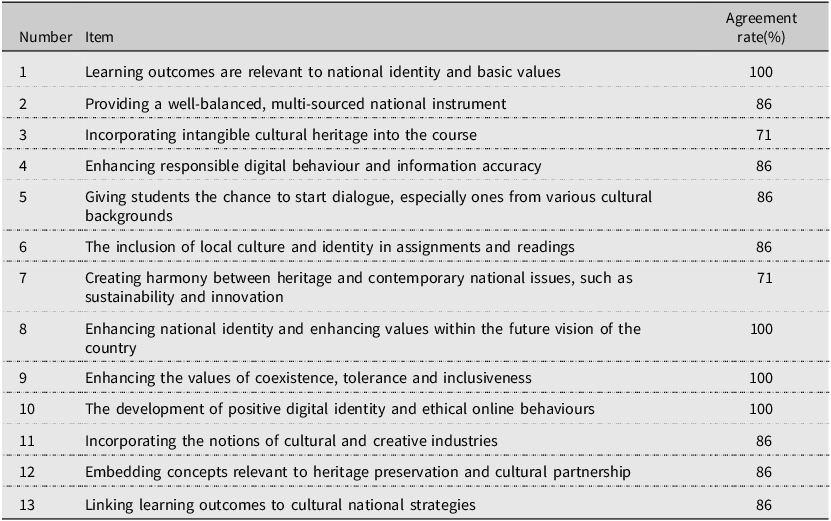
The results of the instructors’ survey (11 participants) in Table 1 reveal strong consensus on the effective role of cultural courses in developing national identity and enhancing the students’ socio-cultural awareness. The data reveal a higher level of consensus on many key statements, indicating a general educational tendency to teach culture in higher education in the United Arab Emirates.
Statements of the instructors’ questionnaire

All instructors indicated that the course learning outcomes evidently incorporated national identity and values. They also confirmed that the course explicitly addresses the values of coexistence and tolerance and fosters ethical digital behaviour accompanied by a positive digital identity for students. This strong agreement shows the course’s educational vision is explicitly geared toward enhancing comprehensive awareness of Emirati identity, not only at the cognitive level but also in terms of values, social interactions and digital practices. The consistency between the course content and its outcomes helps to achieve the study’s first objective, namely evaluating the contribution of cultural courses to raising socio-cultural awareness among higher education students.
The findings of the present study also confirm that 86% of instructors agreed that the course delivered a balanced national strategy based on multiple sources, encourages dialogue among students of various cultural backgrounds, and incorporates aspects of local culture and national identity in both readings and assignments. This consensus suggests that the instructors create a classroom environment that involves critical dialogue, which in turn encourages pluralistic thinking and enhances the development of good socio-cultural awareness. Thus, it supports the second objective, namely examining stakeholders’ – the students’ – perceptions regarding the effectiveness of cultural courses.
Survey responses show that 71% of the instructors include intangible cultural heritage in their instructions and connect it to modern concerns, such as sustainability, innovation, and creative economy. Although this percentage is encouraging, and given the sample size, it reflects variability in the application of practical components and the elements of living heritage within the cultural curriculum. Hence, this emphasizes the need to increase the integration between the course and active cultural institutions, such as museums, the national archive, and cultural authorities, to ensure that heritage becomes a living, interactive component of the educational experience, rather than theoretical knowledge.
In addition, a percentage of 86% of the instructors see the course involves aspects of both the cultural and creative industries, aligning content with national, cultural and value-based strategies. Hence, these findings indicate that there is institutional commitment to embedding cultural education within the national framework and the future vision adopted by the Emirates. This balanced educational vision provides evidence which supports the conclusion that cultural courses do not provide content severed from the main educational line, but they are an essential part of the process of shaping identity and forward-looking social awareness.
In general terms, the findings suggest that instructors believe that cultural courses are impactful educational tools that improve students’ national identity, assert values of coexistence and inclusiveness, and foster responsible digital conduct. Additionally, the findings call for more integration of living heritage. This contributes to positioning cultural studies courses as a practical element rather than a theoretical source. Hence, the instructors’ survey findings reflect how effective cultural courses are and reinforce the significant role of the pedagogical context – including its content, structure, and educational approaches – in achieving the main goals of the present study.
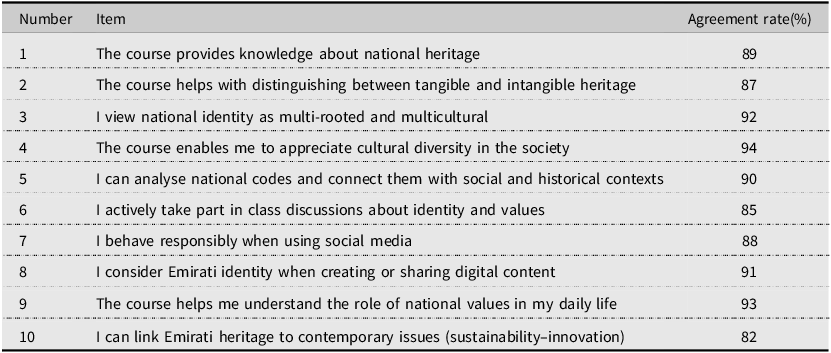
On surveying 85 participants, findings revealed a consistent high level of agreement regarding the cultural course’s acquisition of knowledge, socio-cultural awareness, and the cultivation of responsible digital practices. Figures 1 and 2 indicate that students interact with the course as a comprehensive learning experience that blends theoretical knowledge, values, and practices. Thus, as reflected, the overall agreement rates (agree + strongly agree) are between 82% and 94%. Even when the course is not perceived as a traditional academic subject, it clearly suggests that cultural courses in higher education play a significant role in raising students’ awareness and enhancing their understanding of society and national identity.
Agreement rates on course content and value.

Agreement rates on course impact and personal values.

The highest level of agreement appears in items evaluating socio-cultural awareness, with 94% of students indicating that the course contributes to enhancing their appreciation of cultural diversity in the country and views it as a source of social empowerment and cohesion. Moreover, 93% of students agree that the course content increases their understanding of the significant role of national values in everyday life. However, 92% of students express a consistently increasing capacity to grasp national identity from a pluralistic and multi-rooted perspective. The findings show that the course embraces national identity in a non-uniform manner, enabling students to engage in a more nuanced and mature perspective of local culture within an internationally diverse setting.
As for the cognitive dimension, 89–91% of students reported that the course made it easier for them to understand the national heritage, differentiated between its tangible and intangible aspects, and supported their analysis of national codes within historical and social contexts. This indicates that the cognitive aspect of the course is strong and well-balanced, offering a cohesive and coherent framework that helps students understand the relationship between heritage and identity in their general meanings.
With regard to the behavioural dimension, the data show that students surveyed as shown in Table 2, develop responsible digital practices supported by national identity values. This is because 88–91% expressed their adherence to ethical behaviour on online platforms and commitment to positively representing national identity. This high level of agreement demonstrates that the course covers not only knowledge and values but also practical behaviour. This clearly indicates that there is good digital literacy and awareness in online identity expression, which is a significant element of modern higher education settings.
Statements of the students’ questionnaire

On the other hand, the lowest level of agreement (82%) was spotted regarding the ability to link national heritage to current issues, including sustainability and innovation. This indicates that there is space for strengthening the applied aspect of the course by including activities that link heritage to projects focused on national development, which makes heritage a living knowledge source that addresses present and future issues rather than a mere historical element presented in a fixed context.
Overall, the findings of the students’ survey clearly indicate that courses relevant to cultural studies play a strong academic and educational role in knowledge acquisition, the consolidation of awareness, and the promotion of ethical and digital behaviours. They also suggest great agreement with instructors’ views on the effectiveness of the course, indicating consistency between the pedagogical design and the educational experience, which in turn reinforces the credibility and interpretive value of the findings.
When comparing the responses of students and instructors, a strong concordance is observed regarding the effectiveness of cultural courses. However, there are minor discrepancies that can be attributed to each group’s perspective on the course’s purpose and function within the higher education setting. Taken together, suggests that the educational process functions in accordance with a common vision that has a strong pedagogical impact on the learners.
In terms of areas of agreement, data from the instructors’ questionnaire show unanimous 100% consensus that the course successfully integrates national identity, values, coexistence and ethical digital conduct. This can be clearly seen in students’ responses, as agreement rates range from 89% to 94% on items related to understanding heritage, appreciating cultural diversity, analysing national codes and adopting value-based digital behaviour. These results clearly indicate that the course’s educational design, from the instructors’ perspective, effectively engages students and promotes socio-cultural awareness, which is in line with both the course objectives and the study’s first goal, which focuses on assessing the role of cultural studies in raising students’ cultural and social awareness.
The students and instructors also agree that the pedagogical environment of university classrooms is characterized by fostering dialogue, interaction and critical thinking. This finding gains more credibility since 86% of the instructors who were surveyed reported that they provided chances for students to initiate dialogues, especially the ones from various cultural backgrounds. However, 94% of students reported that the course contributes to increasing students’ appreciation of cultural diversity. This harmony between the structural vision of the course (instructors) and the experiential perspective (students) proves the strength and effectiveness of the practices adopted by teachers in achieving the study’s second goal, which is related to stakeholders’ perceptions of the effectiveness of cultural courses.
As for areas of divergence, minor discrepancies emerged concerning the applied dimension of cultural content, especially in relation to the incorporation of intangible cultural heritage and its linkage to contemporary national and global issues. However, 71% of instructors reported that they touch upon living heritage in the lessons and link it to sustainability and innovation while the students showed 82% of higher agreement. Despite being a positive sign, it suggests that students may not feel the same level of connection between heritage content and contemporary settings, or that their engagement with these aspects is less significant, if compared to the course’s theoretical and value-based components.
This gap may reflect a difference between instructors’ integration plans and what students grasp; instructors may believe that heritage and contemporary issues are well integrated into lessons, while students may not feel that there is sufficient connection between them. The study, therefore, suggests the need to strengthen practical applications, such as field visitations, workshop projects, collaboration with heritage institutions, or the integration of more interactive learning stimuli.
Furthermore, the comparison between instructors and students indicates that 86% of instructors view the course as covering the cultural and creative industries and addressing national policies related to culture, while students demonstrate relatively high, but comparatively lower awareness of these elements across other areas. Hence, there is considerable space for enhancing the applied and economic dimensions of cultural education within cultural studies.
Overall, the comparison between the surveys shows a significant convergence on the course’s main goals: identity, values, coexistence and digital behaviour; in addition to minor differences in more advanced applied aspects, including living heritage, cultural industries, and links to national strategies. This clearly suggests that although the current form of the course is effective, there is space for further enhancement in its practical and experiential components, as this could offer a deeper and more contextually relevant understanding among students, consistent with the present realities and future vision of the country.
Research findings and conclusions
The present study seeks to analyse and explore the influence of cultural courses on increasing socio-cultural awareness among higher education students in the country, by considering the findings of the two questionnaires: The students’ questionnaire (85 participants) and the instructors’ questionnaire (11 participants). The findings clearly suggest a high degree of agreement between instructors and students, and this reflects the effectiveness of the course in both its instructional design and outcomes. The study’s findings are aligned with extant literature that highlights the importance of culturally grounded and place-based approaches in supporting environmental awareness, embedding sustainability values, and promoting meaningful, contextually relevant learning outcomes in higher education settings.
The course’s impact on the development of cultural knowledge
By examining the students’ survey, it is evident that high levels of agreement (ranging from 87% to 91%) were recorded on items evaluating comprehension of national heritage, the differences between tangible and intangible elements, and the interpretation of national codes. This pattern can be linked to the instructors’ consensus (100%) that the course evidently integrated elements of identity and values into its learning outcomes.
When explored from the perspective of the socio-cultural learning theory, cultural knowledge can be acquired not only through transferring information, but also through active engagement with social and coded contexts. The findings of this study reinforce this conclusion, which emphasizes harmony between the content introduced by instructors and students’ understanding.
Increasing socio-cultural awareness
This finding is one of the primary findings in this study. Students’ responses indicated that around 94% of students agree that the course of cultural studies play a significant role in promoting their awareness regarding diversity and multiculturalism in the UAE. This finding is in line with 86% responses of instructors who agreed that such courses usually provide students with opportunities for open dialogues with students from different ethnicities and nationalities, which assist in acceptance and better intercultural understanding. Additionally, it is worth mentioning that this primary finding connects with one of the UAE’s visions that is related to promoting coexistence.
Enhancing responsible digital practices
The students’ survey (88–91%) suggests that the course enhances responsible digital behaviour and increases respect for the representations of national identity on online platforms. This is well-linked to instructors’ consensus that the course promotes ethical digital practices and suggests that cultural education in the country is not limited to history and heritage, but also addresses digital identity, indicating a pedagogical approach that caters to the requirements of the digital age (Ridge et al., Reference Ridge, Dingus and Han2020).
Key strengths of the cultural course
-
• Clarity of learning outcomes related to identity and values (instructors’ consensus).
-
• High students’ critical awareness of culture and identity (ranging from 92% to 94%).
-
• Full alignment between the course structure (instructors) and the learning impact (students).
-
• Successful integration of values of coexistence and tolerance.
-
• Promotion of responsible digital conduct.
-
• Only 71% of instructors reported incorporating intangible cultural heritage into their instructional practices.
-
• The same proportion (71%) indicated connecting heritage to contemporary issues, including sustainability and innovation.
-
• Students’ responses in these areas were comparatively lower than in other dimensions, averaging around 82%.
This discrepancy may reflect a gap between what the teacher plans and what the student perceives, indicating the need to strengthen practical activities and field visitations, and to link heritage content to contemporary developmental issues.
Conclusion
This study contributes original empirical evidence from the UAE higher education context and identifies perceptions regarding the role of cultural studies and living heritage between instructors and students. These findings establish foundational evidence that can inform future mixed-methods research and curriculum development in both cultural and environmental education.
The study’s findings confirm that these courses play an essential role in increasing students’ knowledge, raising their socio-cultural awareness, and supporting their behavioural practices. This was underpinned by Lev Vygotsky in the literature reviewed in this study (Vygotsky, Reference Vygotsky1978). Agreement across all domains indicates that students interact with cultural content cognitively, while incorporating it into their understanding of themselves as responsible members of society with people of various cultural backgrounds and cultural experiences.
The responses of the instructors reflect the fact that the design of the course emphasizes national identity, tolerance, cultural pluralism and ethical digital practices. These components are clearly reflected in the students’ responses. This coherence between the design and actual impact provides strong evidence of the effective role of cultural courses in implementing educational strategies.
Furthermore, the study shows that the applied aspects – particularly living heritage and cultural industries – require more enhancement to ensure that all students can connect their country’s heritage with contemporary and future issues as argued by (Lo et al., Reference Lo, Leung, Fedrizzi and Barker2021). This offers an opportunity to design cultural courses with stronger connection with cultural institutions and community initiatives at country level.
Additionally, the findings underscore the importance of consistent development of cultural courses and positioning them as a major pedagogical tool for fostering national identity, promoting coexistence and cultivating digital citizenship, as an essential element of the national vision of preparing a generation that is well-educated, patriotic and aware of global changes.
Finally, the findings of this study highlight the need for more practical and experiential approaches to heritage and cultural education. Policy makers can benefit from adopting or designing culture-based curriculum courses that are set to link these courses to global socio-environmental challenges. This study suggests that this process can be achieved through collaboration between heritage organizations and cultural institutions which will help in enhancing students’ abilities to perceive culture and heritage as relevant to their society and daily life.
The findings suggest a need for more explicit, practice-oriented approaches to heritage education. This finding was discussed by Greaves et al. (Reference Greaves, Hamari and Rowe2023) as they argued that cultural studies are more effective when they are embedded in practical approaches across all year groups. Designing heritage-based curriculum modules that intentionally connect cultural content to contemporary socio-environmental challenges through project-based and inquiry-driven learning. At the policy level, supporting structured collaboration between higher education institutions and cultural or heritage organizations can offer extra support for students to perceive heritage as relevant to present-day sustainability concerns and wider societal issues.
By demonstrating how cultural studies and heritage-based learning can support sustainability-oriented thinking and place-based understanding, this study contributes meaningfully to environmental education within higher education settings.
The findings provide actionable implications for environmental educators, curriculum designers, and policymakers engaged in sustainability-oriented and culturally responsive pedagogy, offering insights into how heritage-based learning can be meaningfully integrated within environmental education in higher education.
Limitations of the study
On addressing the questionnaire to 11 instructors and 85 students, the study recommends that the sample size will be large, which may add to the study’s credibility and reliability of the findings. The study recommends adopting a qualitative design, such as semi-structured interviews or focus groups with both students and instructors which would assist in clarifying how participants perceive and then interpret living heritage, which adds to the depth of conducted research.
Furthermore, this study does not allow for investigating the effectiveness of the curriculum, as it is a non-experimental design, which relies on self-reported experiences.
Moreover, the small sample size limits the generalizability of this study’s findings, which should be perceived as an initial work in the field of higher education in the UAE.
Future research
Future research might conduct similar studies in various universities in the country or in the Gulf region. Moreover, future research might use different types of data collection and analysis methods, which adopt sequential approaches, including interviews and the triangulation of data collected.
Acknowledgements
The authors would like to thank the Research Centre at Ajman University for providing the opportunity to participate in the Family Conference and for supporting the publication of this research.
Ethical statement
This study was conducted in accordance with established ethical standards for educational research and the guidelines of Ajman University. Informed consent was obtained from all participants, and confidentiality and anonymity were strictly maintained.
Financial support
This research received no specific grant from any funding agency, commercial, or not-for-profit sectors.
Author Biography
Alaaeddin Alahmad is an Assistant Professor at the College of Humanities and Sciences at Ajman University, with over 16 years of experience in the academic field. He holds a Ph.D. in Arabic Language and Literature from the University of Malaya, as well as a Ph.D. in Education from the British University in Dubai. He has held various teaching positions in universities in the UAE, including Ras Al Khaimah Medical and Health Sciences University, Ajman University, University of Fujairah. Dr Alahmad has published peer-reviewed research on learning Arabic Education.



 Open access

