

Introduction
“You either have land or you have nothing,” the man says to the camera, while behind him companions watch despondently as excavators crisscross and clear what had been an agricultural plot in the riverine landscape of Basra province in southern Iraq.Footnote 1 Date palm trees line the plot, which is located in ʿIzz al-Din al-Salim subdistrict, but rather than arching up into the sky they lie motionless on the sides of trunks that have been severed violently from the earth; palm tree roots contort in the air, gasping for water. As the news broadcaster narrates how the Iraqi Oil Ministry recently ordered the seizure of the plot, the camera cuts to an oil installation, likely one of the nearby fields that Chinese and Russian firms now operate alongside state-owned companies, made unmistakable by the gas flares that ceaselessly hurl carcinogenic pollutants into the air. Although the viewer learns that the ʿIzz al-Din al-Salim residents have faced violent threats for protesting Oil Ministry policies, one of them nevertheless pleads with the oil minister to intercede. “Save us from these mafias, save us from this criminality” he cries out in what was surely a reference to the party-militias that systematically siphon public revenues from the Iraqi state institutions under their control. The language of “mafia criminality” echoes analyses that construe land grabs in the Basra oil industry as depredations stemming from post-2003 state failure.Footnote 2 In this article, however, I present a less parochial account of extraction and dispossession. Far from being signs of the deficiencies of the Iraqi state, such moments of dispossession reveal its powers as a sovereign landlord in an era of hydrocarbon extraction. I historicize the political-legal status of the Iraqi landlord state and the capacities which accrued to it not through a monopoly over oil rents but rather through the material assemblage of oil infrastructures. In doing so, this article explains the particular political trajectories that many extractive land grabs have taken in Iraq, where ensuing struggles over property and compensation revolve around the Iraqi state rather than multinational fossil capital. I locate one origin of the Iraqi landlord state in mid-twentieth-century Basra, a commodity frontier in transition from agrarian to extractive capitalism.
The relatively few social histories of oil in Iraq and the wider Middle East rarely foreground land struggles. When such works do broach the topic, they mostly do so by implicit reference to narratives of primitive accumulation or accumulation by dispossession. In the early twentieth century, the multinational corporations that established the first oil industries in states like Saudi Arabia, Kuwait, and Iran are said to have alienated lands that agrarian and especially pastoral communities customarily held or used in common.Footnote 3 In such accounts the apparent enclosure, privatization, and commodification of the commons for the purpose of extraction anticipate the “enclaved” and neocolonial character of regional oil industries that remained under the control of foreign corporate consortia until the 1970s.Footnote 4
These critical accounts have eroded the celebratory narratives of oil development that public relations arms of British Petroleum, Exxon, and other members of the cartel known as “the majors” put forth in the twentieth century. Nevertheless, by framing land struggles along the region’s hydrocarbon frontiers mainly as a process of enclosure by multinational capital, the historiography of oil in the Middle East has echoed the teleology and functionalism generally characteristic of left-populist theories of the “new enclosures” and accumulation by dispossession.Footnote 5 As Michael Levien notes, most contemporary land grabs “involve dispossessing land—often already held within capitalist social relations—for a variety of economic purposes … [and] reflect not an early stage of capitalism but advanced capitalist demands on land… Far from being a product of ‘weak states’ bowled over by global capital… [dispossession] involves a deliberate use of state force.”Footnote 6 This article examines the contingent deployment of such force in a region where enclosure, privatization, and commodification long preceded hydrocarbon extraction.
Although the oilfields of Basra now rank among the world’s largest, when the multinational consortium behind the Iraq Petroleum Company (IPC) began significant operations in the province in the late 1940s the wealth of the region still lay in its date palm gardens. For nearly a century prior to the arrival of the IPC, landholders, tenant-cultivators, and landless workers in the Ottoman province of Basra responded to rising global demand for dates by expanding a belt of gardens and estates along the Shatt al-ʿArab river’s 200-kilometer course from the union of the Tigris and Euphrates south into the Persian Gulf.Footnote 7 Prior to the 1950s oil boom, Basrawi dates were Iraq’s most valuable export commodity and a vital source of revenue to the national state emerging under British military occupation in World War I.Footnote 8 Amid ramifying financial investments, deepening local market dependence, and intensifying global commercial competition, stratified agrarian classes in Basra were able to anchor exceptionally strong proprietary and usufructuary claims to agricultural land.Footnote 9 The land in Basra across which the IPC sought to open wells, lay pipelines, and build port infrastructure had long since been enclosed and commodified. The challenge for the IPC in Basra was therefore not to open a market in land held in common, but rather to bypass or dismantle the existing land market at minimal financial and political cost.
To navigate analytically the unfamiliar terrain of the Basra oil frontier, this article engages with the rich anthropological and sociological literatures on extractive land grabs in the global South. Enclosures and enclaves are central concepts in this scholarship, which frequently compares the recent wave of land grabs by mining or logging firms to the colonial dispossession of indigenous territories by settler states and movements.Footnote 10 In defining oil frontiers as dynamic spaces where conditions for extractive accumulation are established, rather than as merely carbon-rich territorial peripheries, Michael Watts has noted their similarity to colonial frontiers: “typically land and property rights are contested, the rule of law is in question, and frontier populations (often racialized and excluded because of the coercive forms of capital accumulation in train) inhabit a zone in which violence and political negotiation [are] … at the center of social and economic life.”Footnote 11 In such accounts, however, land grabs on extractive frontiers do not appear as foregone tragedies. Rather, anthropologists and sociologists of Latin America, Asia, and Africa stress their contingency, showing how factors like agrarian class inequality and racialized legal regimes have shaped the varied terms and outcomes of extractive land grabs.Footnote 12
This article likewise shows that land struggles on the Basra oil frontier were contingent and variable. The IPC had to adapt its tactics for territorial acquisition depending on the particular area of the Basra date belt where it operated, while the response among different agrarian classes ranged from accommodation to confrontation. The central argument of this article, however, is that in all cases an outcome was the expansion rather than a diminution of Iraqi state power. The Iraqi state shaped extractive land struggles in Basra in three ways: as a sovereign landlord that reconstituted cultivators, investors, and corporations as different kinds of tenants; as a legal nexus for conflicting claims on land and its value; and as a political authority responsible for managing the social consequences of dispossession. In advancing this argument, I view the Iraqi state as neither a unitary political instrument nor simply useful to the needs of multinational extractive capital. The variegated, loosely-interlocking institutions that constituted the Iraqi state in this period presented different options to different actors on the Basra oil frontier. Officials across the state apparatus expressed distinct and even contradictory objectives as they engaged with different constituencies. Even as the nature of the world oil market continued to impose structural constraints on Iraqi state capacity, resource nationalists redirected the same state powers most useful to the IPC in the 1950s against the firm a decade later.Footnote 13
By tracing how extractive land struggles expanded the remit of the Iraqi state, this article departs from most accounts of Middle Eastern oil and follows in the tracks of the burgeoning global historiography of this commodity. The latter has shifted the focus from neocolonial enclaves to foreground the importance of “sovereign landlords” to oil and gas firms, especially in postcolonial settings where subsoil minerals are national patrimony.Footnote 14 References to “landlord states” are suggestive but often elusive because there are few social histories charting how these states have exercised their territorial prerogatives in specific geographies. The lack of sustained attention is especially surprising for postcolonial agrarian states like India or Iraq where re-purposing agricultural or pastoral territory for extraction could mean a radical break in the use of land that historically underpinned social reproduction and political control.Footnote 15 To grasp how this process occurred in a post-Ottoman context, I draw on the insights of wider scholarship on land and property in the modern Middle East. A central theme of this literature is how the state, especially in the Ottoman Empire and post-Ottoman polities, “constituted property” through its legal regimes and administrative apparatuses.Footnote 16 This concern reflects the fact that in the agrarian Ottoman social formation the ownership over almost all land ultimately lay with the state, an arrangement with ambiguous legacies. On the one hand, the flexibility of the Ottoman “state land” category enabled many to assert collective and individual ownership claims and anchor capitalist investments in land.Footnote 17 On the other, the redefinition of state land facilitated dispossession in post-Ottoman polities, most dramatically in the case of Palestine under settler-colonial rule.Footnote 18 Yet, even in such cases of apparently straightforward dispossession, “property is never a straightforward assertion of a right … claims are cobbled together across different government institutions and legal regimes … claim-making is a historical practice that can transform which part of the past is most meaningful.”Footnote 19 This article likewise highlights the historicity and uncertainty of struggles over state land, but in the context of hydrocarbon extraction. By redeploying the state land category to appropriate territory, the IPC at once revived early modern powers of sovereign landlordism and allowed for the redeployment of those powers for a quintessentially twentieth-century purpose: nationalization. Similarly, the ensuing land disputes helped dissolve both the political and moral economies of date cultivation in Basra. As we will see, capitalist investments in Basrawi date land rested on a system of rights which, in turn, depended on meeting expectations of “productive use.” On the emergent oil frontier, however, what the Iraqi state understood as “productive” was changing rapidly.
There are three sections of the article. The first examines how the 1938 IPC concession articles dealing with surface land use in Basra cast the relationship between state and company as one between landlord and tenant. An overview of rural land tenure in Basra shows how the concession collapsed prevailing notions of property and implicitly revived older practices of agrarian statecraft. The second section uses IPC records to trace the company’s territorial acquisitions in the late 1940s and early 1950s, when the firm aspired to make Basra a new hub of regional hydrocarbon supplies. Looking at Iraqi Interior and Finance Ministry archives, I demonstrate how de jure private property holders accommodated the IPC while manipulating expropriation and compensation proceedings. Even as they channeled property conflicts along legalistic pathways, these landholders destabilized the relationship between the value and price of land amid the transition from cash crop agriculture to oil extraction. The third section finds in agrarian labor contracts evidence of the de facto private property rights that cultivators had held in commercial date gardens, gardens that the Iraqi state granted to the IPC on the pretext that they were merely “state land.” It reads the cultivator opposition mentioned in Iraqi Interior Ministry reports as a sign of more expansive forms of political protest targeting the Iraqi state that hydrocarbon extraction sometimes unleashed within and beyond the countryside. A brief conclusion reflects on the article’s findings in reference to prevailing narratives about the relationship between oil rents and state power.
Landholding between Concession and Law
The landlord-tenant relationship between the Iraqi state and the IPC in Basra derived from the concession agreement for the province.Footnote 20 The Basra agreement was signed on 29 July 1938 by representatives of the Iraqi Economics Ministry and an IPC subsidiary in which one of the consortium partners—the Anglo-Iranian Oil Company (AIOC), today British Petroleum—would direct field operations to meet production targets. On paper, the Basra concession mirrored agreements that governments in early twentieth-century Latin America and the Persian Gulf had signed with the so-called “majors.” By jointly investing in nationally scaled firms like the IPC, the multinational oil corporations were able to coordinate supply, pricing, and profit-sharing in novel ways. Whereas in older oil frontiers such as the southwestern United States firms had to negotiate with individual landholders, in the Gulf and Latin America they could negotiate with governments claiming state sovereignty over all subsoil mineral wealth. It is common to interpret the relationship between majors and petrostates under varying forms of imperial domination as one in which the former were “replacing the government and establishing a ‘state within a state,’” given the sweeping powers over production and pricing majors acquired through such concessions.Footnote 21 Accounts of oil politics in Iraq have likewise portrayed the IPC concessions as stripping the Iraqi state of its sovereignty while enriching multinational fossil capital and Western imperial powers.Footnote 22 Although such critiques point toward the inequity of oil politics in Iraq, especially with regard to rent distribution, they miss how other aspects of the IPC concessions inscribed the firm firmly within the political geography of Iraq and the legal architecture of the postcolonial state.Footnote 23
Article 23 of the Basra concession regulating IPC land acquisitions construed the firm as merely a tenant of the Iraqi state. It also discursively collapsed the legal regime and social relations that organized landholding in mid-century Basra. The English version of the article recognized three classes of land that the IPC could lease. First, there were “lands belonging to the Government which … are unsuitable for cultivation” which the IPC could lease for a nominal fee. Second, it referenced “cultivable land belonging to the Government,” which the IPC could lease “at a fair rent on the basis of the surface value of the lands.” The concession held that “if such lands are in the occupation of some other person the Company shall in addition to the rent pay such sums as may be reasonable to such person to compensate him for the termination of his occupation of the land.” Finally, the article recognized “privately owned land and legal rights in land,” which the IPC could purchase from landholders or request to be expropriated by the Iraqi Interior Ministry on the grounds that they were “required for a work of public utility.” The IPC was to bear any costs that expropriation incurred—including, presumably, compensation to landholders—with the stipulation that “in fixing the value of such lands no regard shall be had to the purpose for which they may be used by the Company.”Footnote 24 In contrast to “Government land,” which entailed a rental payment, the IPC would not pay any rent for access to the private property that the state had expropriated and registered in its own name.Footnote 25
Several features of Article 23 are worth highlighting. The first is the distinction it made between surface and subterranean wealth, a bifurcation that was and remains common in many extractive concessions.Footnote 26 This provision benefited the IPC, because it prohibited Iraqi officials from renting state land to the firm based on the value of subsoil hydrocarbons. This reinforced a problem whereby the Iraqi central state could only capture hydrocarbon wealth indirectly, through royalties on future IPC exports, rather than by directly setting prices on the world market (or, in this case, by appraising land of interest to the IPC holistically in reference to its subsoil mineral wealth). Second, the article skirted around how the value of expropriated private property was to be “fixed.” It merely alluded to other Iraqi laws in place governing expropriation and stipulated that hydrocarbon extraction could not figure in the compensation process. We will see below how de jure landholders in Basra would eventually exploit the ambiguities in those laws to contest property valuations and extract greater wealth from the Iraqi state rather than the IPC. Finally, the article stipulated that the IPC relinquish land that it had not used productively within a reasonable time frame. This condition of productive use was a notable if implicit reference to prevailing agrarian land regimes in Iraq, where holders of state land were theoretically obliged to maintain cultivation or risk confiscation.Footnote 27
In general, however, the concession positioned the IPC as a tenant in a way that collapsed the legal and social claims that structured agrarian property relations in mid-century Basra. It effectively revived an older tradition of statecraft in Iraq that stretched back to the period of Ottoman imperial rule and revolved around the state’s prerogative to command labor and land in the name of “productivity.” Land deemed agriculturally unproductive reverted to the state, which would then strategically redistribute the use rights or put up them up for auction.Footnote 28
The most significant elision of Article 23 lay in its reference to “land belonging to the Government.” As I have mentioned, in Iraq at this time almost all land was miri; that is, land over which the state claimed ultimate ownership.Footnote 29 Previous studies of oil in Iraq have suggested that IPC concessions referred specifically to miri sirf land, or “pure” state land that was under the immediate disposal of the Iraqi Finance Ministry (and distinct from other classes of state land that I enumerate below).Footnote 30 Miri sirf land technically encompassed all lands that the previous holders had either not registered or endowed, or had kept fallow for an extended period.Footnote 31 In practice, however, the Finance Ministry did not manage miri sirf land but rather distributed it through tax-farm contracts and direct-lease contracts that were often “virtually permanent and heritable.”Footnote 32 Individuals who held such contracts had to contend with a range of customary rights to use and cultivation belonging to both pastoral and sedentary communities often organized along tribal lines.Footnote 33 Thus, even at this basic level, this undifferentiated concept of “government land” shredded the lattice of overlapping proprietary and usufruct claims that still prevailed on “pure” state land.
The elision of the complexities of “pure” state land had implications for Basra. As the third section of the article elaborates, much miri sirf land lay in agricultural estates where tenants had leveraged the labor demands of date cultivation to become independent landholders and even “landowners” in the eyes of contemporary observers.Footnote 34 These date cultivators were among those people whose “occupation” would need to be terminated at the request of the IPC if it wanted their land. Article 23, notably, did not specify whether the IPC had to pay out the value of the lease or simply bear the costs of damages and resettlement of the contract holder. The concession thus recast the expropriation and eviction of miri sirf landholders as merely the re-leasing of state land to another tenant. Here the terminological difference between the English and Arabic versions of the agreement is illuminating: the latter rendered the “occupation” of state land as hiyaza, a term that in practice meant “possession” and, in the agrarian social formation of Iraq, implied ownership that the English version of the concession agreement did not capture.Footnote 35
Other implications of the IPC’s elision of the “state land” category are evident if we consider how the Arabic version of the concession formulated the term. Contrary to what may have been the case in other IPC concessions, in Basra the agreement did not refer specifically to miri sirf or “pure” state land as distinct from other classes of state land.Footnote 36 In fact, nowhere did the Arabic version of the concession agreement use the term miri sirf; it just distinguished between, on the one hand, a generic category of “state land” that the state could re-lease to the IPC and, on the other, “non-state land” that the state could expropriate on behalf of the company.Footnote 37 It thus erased entire classes of state land other than “pure” miri sirf land. The latter included miri tapu land, which was property that the Finance Ministry had alienated to landholders on the condition of productive use and payment of a registration fee. Although the Iraqi state retained the right to confiscate such land, miri tapu actually “did not differ significantly from private property, the more inasmuch as the government never exercised its theoretical right of escheat.Footnote 38 As such, despite the English version of Article 23 recognizing “rights in land” alongside de jure private property, those who had gained formal title to state land would not be eligible to negotiate a sale to the IPC under the Arabic version. The concession had recast their title as just another, newly precarious lease or an even more vague and tenuous “occupancy.” This asserted the Iraqi state’s prerogative as sovereign landlord that had little resonance in mid-twentieth-century Basra. It instead recalled much older forms of agrarian statecraft that had managed land use through the practice of conditional entitlements.
A system of state land management based on conditional entitlements originated in the political and fiscal strategies of the early modern Ottoman Empire. To better extract rural surpluses, incorporate provincial interest groups, and maintain provisions necessary for social peace, Ottoman imperial authorities had conditionally granted rights to collect agricultural revenue and use land. This practice reflected an early modern distinction between land and property, with the latter functioning as claims on shares of concrete agricultural wealth (e.g., crops like rice and dates, in the case of Basra province). Nevertheless, the centrality of state land ownership neither halted agrarian classes in Iraq from articulating proprietary rights in land nor hindered the emergence of the kinds of market dependence that are characteristic of agrarian capitalism. In fact, as early as the eighteenth century, provincial landed elites in parts of Iraq had transformed Ottoman imperial entitlements to public revenue into de facto proprietary rights to private rents.Footnote 39 Rights to use and revenue further transformed into rights over land amid the passage of nineteenth-century Ottoman reform laws, which sought to maximize agricultural revenues by allowing for the alienation of state land through the transfer of title, albeit still on the condition of “productive use” (i.e., cultivation).Footnote 40
The nineteenth-century land reforms theoretically left ultimate ownership of most land in the hands of the Ottoman state. On the ground in Basra and other Ottoman provinces, however, landholders continued to leverage access to miri land to anchor investments in commercial date agriculture and rural credit markets.Footnote 41 After the end of Ottoman rule in World War I, the British colonial state drew on the support of urban notables, merchant investors, and tribal elites to reconstitute Ottoman categories of land ownership and ease conditions on productive use.Footnote 42 So, while the early modern boundary between land and property had practically dissolved in Basra by the time the IPC arrived in the 1940s, the legal pretense of ultimate and universal state ownership still technically reigned. In Basra, the only class of land which decisively fell outside the state’s remit was mulk, which the historiography of Iraq routinely glosses as de jure “private property” historically free from the risk of escheat.Footnote 43 The Arabic version of the Basra concession agreement included mulk in its sweeping reference to “non-state land,” while the English version more clearly named this category by referring to “privately owned land.” To enable the expropriation of mulk land, the concession agreement for Basra again positioned the IPC as a mere tenant of the Iraqi state but now buttressed with reference to the notion of “public utility.”
As noted above, Article 23 required the IPC to attempt to negotiate with mulk landholders to purchase their property. If the landholders agreed to sell to the company, then the land would either be re-registered in the name of either the IPC or the Iraqi Finance Ministry (if state officials took interest in the land). If mulk holders refused to sell their properties to the IPC, then the Interior Ministry would expropriate their land, register it in the name of the Finance Ministry, and place it at the disposal of the IPC. The article said nothing about the fate of the tenant-cultivators, who typically worked mulk date land, in the event that landholders sold their properties to the IPC or the state ordered their expropriation. Although the IPC was obliged to compensate mulk holders for the surface value of land that it seized, the relevant provisions of the article construed the relationship between state and firm in striking terms. The state appeared as a straightforward servant of the firm. “In expropriation proceedings,” Article 23 concluded, “the Government will so far as the law permits act in accordance with the requirements of the Company as if the Government were the agent of the Company.”Footnote 44 Nevertheless, in another indication of how the IPC concession agreement did not operate outside the political geography of the Iraqi state, the same provision implicitly invoked the state’s wider legal architecture. When the article justified the expropriation of mulk properties on the basis that they would be “required for a work of public utility,” it copied almost verbatim the language of existing Iraqi laws governing the expropriation of such properties “if they have been allocated for the public interest.”Footnote 45 In this context, it is worth recalling Grietje Baars’s insight into the history of “public utility” as a concept that was central to the first “corporations”; that is, the incorporated bodies such as municipalities that early modern sovereigns approved the formation of because of their “public utility.”Footnote 46 Hence, parallel to how the IPC revived the early modern practice of conditional grants of state land, in the Basra concession the reference to “public utility” simultaneously served corporate objectives and reified the authority of the Iraqi state.
The foregoing comparison of landholding as it featured in the IPC concession versus Iraqi law has remained at the level of textual analysis but already points toward an alternative reading of the IPC concession. While the Basra concession dismayed Iraqi resource nationalists because it favored the IPC consortium partners and their backers in Western governments, the agreement nevertheless significantly expanded the role of the Iraqi state in land use management along the oil frontier. It remade the Iraqi state into a sovereign landlord essentially by fiat. In a manner reminiscent of how coal companies in nineteenth-century India purchased zamindari land rights that were ostensibly “customary” but in fact were quite novel, we may see the IPC as having re-animated older forms of statecraft through which land had been disposed of in Iraq.Footnote 47 In doing so, the concession also displaced onto different branches of the Iraqi state apparatus the responsibility for carrying out the dispossession necessary.
My interpretation of how the IPC concession related to Iraqi legal regimes on the question of land echoes recent critiques of the “enclave” as a metonym for extraction. As Hannah Appel has argued, although energy firms seek to maximize hydrocarbon extraction and minimize local investment, they are constantly forced to maintain physical and institutional connections with the political economies and ecologies outside the enclaves of company compounds.Footnote 48 Historians of the Middle East have yielded similar insights into the dynamics of company towns of firms like Saudi Aramco.Footnote 49 The rest of the article explores such imbrication of the extractive enterprises and the societies and environments in which they are operating as manifest in struggles over property in Basra, where landholders and cultivators on the oil frontier engaged with different parts of a re-vivified Iraqi landlord state.
Value and Price
The IPC did not meaningfully activate the Basra concession and explore land acquisitions in the province until the late 1940s, after wartime logistical disruptions had subsided. By then, the oil fields of Basra had become newly important to the IPC, which had earlier delayed development there as part of the consortium’s broader effort to engineer global oil scarcity. Demand for Middle Eastern oil was rising dramatically at this time, even as threats to regional supplies appeared to multiply. At the very moment when the US-led reconstruction of postwar Europe required cheap energy, global oil prices were spiking as eastern Mediterranean pipelines shut down amid the 1948 Palestine War and Britain led an embargo of Iranian oil following the Mossadegh government’s nationalization of the Anglo-Iranian Oil Company in 1951. Hence, by the late 1940s and early 1950s, IPC officials in Basra accelerated their efforts to acquire land on which to extract and circulate hydrocarbons and reproduce its growing workforce.Footnote 50
IPC infrastructures in Basra province were varied and extensive (see figure 1). They included oil rigs, flow lines, and access roads in the arid landscapes of Zubayr subdistrict west of Basra City, pipelines running several hundred kilometers southeast from Zubayr through the lush date gardens of Abu al-Khasib district, and a riverside export terminal and housing estate in the Faw subdistrict near the Gulf’s northern shore. Between 1948 and 1954, IPC sought to access almost 40,000 acres of land for its operations, assembling a portfolio of leases and properties that was among the largest in Basra.Footnote 51 Most of this land centered on Zubayr, which did not host date agriculture, so acquisitions were of less concern for the IPC and Iraqi state officials than those farther south. As noted, the IPC had crafted the Basra concession in ways that limited the value of agricultural land and the cost of compensation for any expropriations of de jure private properties. The response of landholders on de jure private property (mulk date land) compelled the IPC to summon several distinct Iraqi state institutions to circumvent their initial opposition. The subsequent legal disputes unsettled what Iraqi state officials claimed was a transparent link between the value of land and its price.
Distribution of IPC fields, pipelines, and export terminal, ca. 1955. Source: British Petroleum Archives 119011. © BP plc

According to the 1938 agreement, the IPC had to first try to purchase mulk property from landholders before requesting its expropriation. Internal company correspondence betrays the anxiety which with IPC officials viewed the prospect of negotiations with landholders, and the political headaches that expropriation proceedings could yield. They recalled the carrying trade that emerged a decade prior in the oil-producing regions of northern Iraq, where merchant speculators raced to purchase deeds for mulk land and resell them to the firm at a much higher price. Some landholders in the north refused to sell to both speculators and the IPC, which then found itself embroiled in expropriation proceedings that were both “painfully slow” and deeply unpopular among local communities.Footnote 52 Speculative land purchases do not appear to have preceded the IPC’s arrival in Basra. However, in seeking to acquire over a dozen mulk plots, the IPC confronted landholders refusing to sell amid the prevailing conditions of the agrarian political economy. Given that agricultural land values were still booming in Basra, with date prices having tripled amid global wartime food demands, some landholders may not have wished to sell to either speculative land investors or the IPC.Footnote 53 The IPC duly requested that the Interior Ministry seize the mulk properties by force.
Opposition to the IPC from mulk holders may have also reflected a calculation that they could get more from the state in compensation fees than by selling to the company. One expropriation case from 1953, concerning land that belonged to the Sabah household of Kuwait that the IPC sought to acquire for a pipeline expansion project, illustrates this. As the plot in question lay fallow at the time, IPC officials likely anticipated relatively low compensation costs.Footnote 54 Under Iraqi law governing immovable asset expropriation, provincial and municipal councils were to appoint four Lands Directorate experts plus one representative from each party to appraise the property in question by “tak[ing] into consideration recent sale prices for the same property or those of comparable properties nearby.”Footnote 55 This formulation equated the “value” of the land (qima) with its market “price” (thaman). In July 1953, the committee for the Sabah property appraised the plot modestly, valuing it at just 15 Iraqi Dinars (ID) per dunam (about US$496 per acre in today’s money).Footnote 56 The Sabah quickly challenged the appraisal and sought to move the dispute onto the more favorable terrain of the local courts. Within several months, Sabah representatives had petitioned the local Court of First Instance on the grounds that the compensation sum was far smaller than that for a recently-appraised adjacent plot.Footnote 57 The court duly ordered the municipality to form a second appraisal committee consisting of just two municipal council members alongside representatives of the two parties to the dispute, the Sabah household and the Iraqi Finance Ministry. The IPC withdrew as a party because the family was technically appealing the state’s valuation rather than any direct action by the oil company itself. After several years of legal proceedings, the second committee ultimately revised the valuation of the land to ID 50 per dunam, over the objections of the Finance Ministry representative.Footnote 58 The Sabah household had thereby tripled the original sum and obtained a price comparable to actively-cultivated agricultural properties of the same size, even though the plot in question lay fallow during the appraisal.Footnote 59 At a time when the IPC was effectively expropriating and de-capitalizing commercial date properties in Basra to allow for the production of a new global commodity, the Sabah landholders were able to temporarily re-valorize this particular piece of fallow land as if it were a commercial date garden.
Two elements of the reappraisal are significant for my purposes. First, the IPC receded from view as an actor, as landholders began to confront the Iraqi state as the entity directly responsible for property expropriation and even compensation. Although this appears to have contradicted the terms of the IPC concession for Basra, it reflected the fact that de jure landholders like the Sabah were formally contesting the state’s assessment rather than that of the firm. Second, the scope for “expertise” in the valuation process narrowed markedly, as municipal council members who generally belonged to a small group of provincial notables replaced Lands Directorate surveyors and tax assessors. It was likely the longstanding influence of the Sabah over these municipal council members that enabled them to inflate the appraisal. To an extent, their moves echoed how absentee landholders in other hydrocarbon frontiers like the Bolivian highlands provided access to oil and gas firms to solidify otherwise dubious property claims.Footnote 60 In the case of Basra, however, large landholders like the Sabah or Sakr leveraged hydrocarbon extraction for immediate financial benefit rather than for long-term security of property rights.
It is worth noting that, although inflated revaluations occurred for other mulk properties that the IPC acquired for the pipeline corridor, some landholders did not appear to have the same local clout or apparent interest in such legal challenges. Members of the Sakr household, for example, did not protest the initial valuation for any of the three mulk plots that they lost to the IPC in July 1954. The reasons for this are not clear from the documentary evidence, although it is possible that they lacked the same influence necessary to pressure local courts to order a reappraisal and curry favor with the urban notables who sat on the secondary committees. The effort necessary to contest appraisals may also have dissuaded larger de jure landholders in Basra from pursuing legal challenges, especially as material incentives to remain active in date agriculture began to diminish. Indeed, many larger landholders had already begun to move out of the stagnating date economy and into more profitable sectors of urban contracting during the 1950s oil boom.Footnote 61 In response to central state coercion, however, some de jure landholders were evidently willing and able to exploit the local state apparatus to defend a greater share of their wealth at the moment of dispossession.
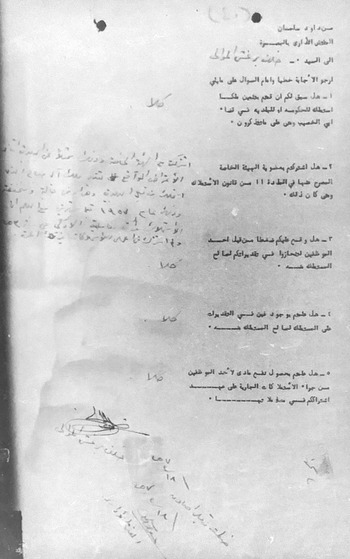
The blatantly political nature of valuation, in which local networks of influence appeared decisive, disturbed Iraqi officials at higher echelons of the state apparatus. Several years after the IPC expropriations concluded, the Cabinet of Ministers in Baghdad called for an official inquiry to determine whether graft had marred valuation processes in Basra. They demanded that local Interior Ministry officials who had overseen expropriation proceedings account for “the enormous sums that have been paid out for expropriations in Abu al-Khasib district, and which have come at the expense of the Treasury and created opportunities for fraud.”Footnote 62 The subsequent inquest involved interviewing dozens of members of the appraisal committees, and soliciting pledges that they had valued the lands in question fairly and had not inflated their price in exchange for a share of the compensation fees. None openly admitted to participating in graft.Footnote 63 The pledges were extremely rote (see figure 2), and seemingly meant to conjure a veneer of legality and systematicity rather than empirically document the appraisal processes. Nevertheless, as I have suggested, the case for inflated valuations is extremely plausible. The landed notable and merchant households who typically staffed the appraisal committees—on the basis of their grip over the local political and administrative offices that nominated these committees—had long maintained close commercial and social ties with one another.Footnote 64 They had previously collaborated with each other to defend their wealth from new property and tax regimes, and formed coalitions to secure central state protection for their investments in date land.Footnote 65 The particular way that hydrocarbon extraction unfolded in Basra, where provincial and municipal state institutions played significant roles in land acquisition, created opportunities for similar kinds of collusion among local elites.
A Sabah representative’s pledge regarding IPC expropriation proceedings, ca. 1957. Source: Iraqi National Library and Archives 32050/7448.

This article is less concerned with adjudicating claims of “corruption” in the IPC expropriation proceedings than with highlighting the epistemological and political questions that they raise. In line with Iraqi laws governing expropriation, which formally distinguished but practically equated the “value” (qima) of the land and its market “price” (thaman), Interior Ministry officials had sought to determine “whether the compensation fees had been estimated in relation to the prices that were prevailing generally or to those of comparable properties in Abu al-Khasib.”Footnote 66 Implicit in the ministry’s attempt was the economistic assumption that sale prices for date properties elsewhere in Basra accurately reflected the objective value of such lands (presumably understood in terms of “natural” or ecological attributes like soil fertility and water availability). For Iraqi state officials, oil development in Basra had evidently distorted the value of landed wealth—but not because of the possible presence of subsoil minerals, which the IPC concession had formally separated from “surface wealth.” The effect of hydrocarbon extraction was rather more indirect in their eyes. The IPC expropriation proceedings had ostensibly allowed landholders to artificially raise the natural price of land at the expense of the state, politicizing otherwise natural market transactions. What the perspective of the state obscured was that all land prices in Basra were politically constituted, insofar as they reflected the power of landlords to realize monopoly rents. By extracting the highest rents possible from tenants or withholding land that is scarce until such rents can be met, landlords also determine land prices generally.Footnote 67 IPC expropriations in Basra therefore did not distort the “real value” of land, so much as they enabled de jure landholders to establish a different political basis for wealth extraction. De jure landholders deftly switched from using their monopoly power to using their influence over local administrative institutions and redeploying “expertise” to obtain higher prices for land in the pipeline corridor.
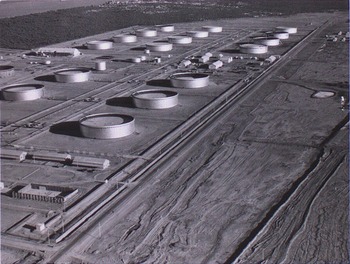
The tactics of the IPC shifted as the firm moved from the pipeline corridor, where it sought relatively small amounts of de jure private property, to the site of its export terminal at Faw near the northern shores of the Gulf. Whereas the IPC had successfully divested itself of responsibility as land grabs in the pipeline corridor became channeled into legalistic pathways, the firm adopted more bureaucratic forms of cover from potential opposition or criticism in struggles over land at the terminal site. At Faw, the IPC would eventually build a complex of depot tanks, electrical sub-stations, and riverside jetties stretching across about 500 dunams, or 309 acres (see figure 3). All of this land was mulk property held by the Sabah household and much of it, like many plots expropriated for the pipelines, had hosted commercial date cultivation.Footnote 68 Aware of the enormous financial and political costs of expropriating such a large area and evicting tenant-cultivators to whom the Sabah household had already leased this land, IPC officials were keen to avoid direct involvement in expropriation proceedings. They instead proposed that the Basra Port Directorate (BPD) exercise its powers of eminent domain, expropriating the land in question and then renting it to the IPC. This situation differed from the pipeline corridor, where the Iraqi Finance Ministry had expropriated de jure private property and then simply left it at the disposal of the IPC. At the export terminal, the IPC would be a formal tenant of the BPD, which was officially owned by the Economics Ministry but operated effectively an independent commercial enterprise with its own geographic jurisdiction, financial interests, and portfolio of landholdings.Footnote 69 For its part, the BPD may have been willing to bear the costs of expropriation in the hope that IPC would build its terminal within an area subject to BPD dues rather than at a deep-water port outside its jurisdiction. In any case, the financial savings to the IPC were significant: the BPD had agreed to lease the Faw property to the IPC at just 5 percent annually of the sum that it was forced to pay out in compensation (ID 32,000, or about US$1.6 million in today’s money). The company obtained explicit agreement to raze date palm trees and build structures without any obligation to pay compensation for these damages.Footnote 70
The IPC export terminal at Faw, sited in land formerly devoted to date cultivation, ca. 1956. Source: British Petroleum Archives 223591. © BP plc

In addition to financial savings, IPC also achieved political gains in the Faw project by going through a state-owned enterprise rather than requesting expropriations from the state directly. From the outset IPC officials had regarded the proposal to lease the Faw lands from the BPD as favorable because it would avoid “much bad feeling, on the part of land-owners and cultivators, towards the [company].”Footnote 71 Shielded by a state-owned enterprise in the BPD, the IPC circumvented a long and acrimonious dispute with landholders who were sure to challenge the expropriation in court and mount public criticisms of the company (as they had with regard to plots expropriated for the pipelines). The IPC thus anticipated strategies of present-day oil and gas firms, which generally try to insulate themselves institutionally and materially from both risk and regulation. As Hannah Appel has found in her ethnography of the oil and gas industry in contemporary Equatorial New Guinea, the splintered corporate forms and remote physical infrastructures that characterize this industry today partly reflect the interest of firms in “attenuat[ing] or spreading of liability for everything from offshore platform pollution to labor contestation.”Footnote 72 The IPC achieved a similar “distancing” effect in Basra by, paradoxically, entering into ever closer relationships with institutions variously connected to the Iraqi state.
The foregoing analysis suggests how, in areas of de jure private property, conflicts between the IPC and landholders pushed these actors to mobilize different parts of the state apparatus. Whereas the IPC could compel central state institutions like the Finance Ministry and state-owned enterprises like the BPD to acquire property by force, landholders leveraged their connections with local state institutions like the municipal council in which fellow provincial notables held sway. When the IPC began to expand the scope of the Iraqi central state—by reanimating its latent powers as a sovereign landlord—it also created opportunities for other political actors to make their own demands upon other parts of this institutional apparatus. The same dynamic is evident in the next section, which examines interactions between the IPC and cultivators in areas of the pipeline corridor further north in Abu al-Khasib district, where a distinctive form of land tenure prevailed, endowing Iraqi state officials with different powers.
States of Expectation
In contrast to the legalistic and bureaucratic pathways that extractive land struggles followed in zones of de jure private property, land grabs in areas of de facto private property provoked more direct forms of mass political protest—while displacing many of these conflicts outside the countryside itself. Between 1950 and 1953, while laying multiple pipelines from the Zubayr oil fields to the Faw export terminal, the IPC obtained 3,155 dunams, or 1,947 acres of what it construed as “government-owned land.”Footnote 73 Although some parts of the pipeline corridor passed through marginal land, much of it ran directly parallel to the Shatt al-ʿArab river and hence through territory where cultivators were actively engaged in commercial date agriculture.Footnote 74 This form of land use had produced a kind of tenure that granted effective ownership to these cultivators, who were nominally tenants on state land.
For at least a century, landholders in Basra province had organized date cultivation through a special, proprietary type of sharecropping agreement. The fundamental goal of this system, which was known as taʿba, was to entice cultivators to remain on the land as tenants and commit to the long-term labor needs of date agriculture, in which trees usually took at least five years to bear a commercially viable date crop. The contracts that landholders signed with tenant-cultivators (known as taʿabs) guaranteed two things: first, a share in the annual date crop; and second, upon completion of the contract, either a monetary payment equivalent to a value of the portion of the plot or a portion of the date palm trees themselves.Footnote 75 This system was one reason for the remarkably small size of agricultural holdings in mid-twentieth-century Basra—about 25 dunams, or 15 acres on average, whereas in other provinces absentee urban investors and rural tribal shaykhs had consolidated estates on the scale of 4,000 acres or more.Footnote 76
While much of the date land in Basra lay in the lands of private landholders as de jure private property, almost 10 percent of all agricultural land in the province fell into a special class of state land that I refer to here as crown property.Footnote 77 The origins of crown properties stretched back to the early twentieth century, when the Ottoman Imperial Treasury assumed control of date gardens that Sultan Abdul Hamid II had previously purchased as a personal commercial investment. The imperial state had empowered a provincial administrative council in Basra to grant or auction off short-term tax-farm contracts for the crown properties to local notables, who then signed hundreds of sharecropping contracts with cultivators on both an individual and joint basis.Footnote 78 Here I refer to these tenant-cultivators as crown taʿabs. Effective control of the gardens fell into the hands of the crown taʿabs themselves during the British occupation of Basra in World War I, after which the emergent colonial state tried to collect revenue from these cultivators directly. In theory tax officials were to visit these estates at the start and end of each summer date harvest to assess the 50 percent share that the state would take from the annual crop as payment of rent (on top of whatever tithe was appropriate to the given grade of land).Footnote 79 In the period under study here, then, the crown properties through which the IPC sought to lay its pipelines were legally the property of the Iraqi Finance Ministry in Baghdad; and, in theory, the taʿabs on the ground in Basra were merely tenants.
In fact, by the time the IPC began to identify this land as desirable for oil pipelines, the crown taʿabs had come to wield de facto proprietary rights in land. The most visible evidence of their growing autonomy was that the crown taʿabs had begun to successfully evade rental payments to tax assessors as early as the mid-1930s and continued to do so throughout the 1940s.Footnote 80 On a more fundamental level, however, crown taʿabs operated the date gardens in a way that transformed them into agrarian petty commodity producers rather than peasant subsistence producers or strictly sharecroppers. For example, although crown taʿabs did distribute some of the date crop among their households for personal consumption, they primarily sold this product to local and foreign date trading companies. And while crown taʿabs did compel members of their households to perform tasks such as tilling soil and pruning date palm trees, they also regularly hired out the labor of landless peasants who were socially and legally distinct (see figure 4).Footnote 81 Few crown taʿabs were capable of systematically expanding their productive assets and engaging in date trading themselves, embodying the “contradictory combination of both capital and labor in a single enterprise” that is characteristic of agrarian petty commodity producers.Footnote 82
Agricultural labor in the summer date harvest, ca. 1953. Source: British Petroleum Archives 223595. © BP plc

Perhaps the most significant indication of the existence of de facto property in date land was that crown taʿabs had regularly bequeathed, sold, and mortgaged their labor contracts both in whole and in part.Footnote 83 The way that they formulated such transactions balanced their ownership claims against those of the Iraqi state. For example, in one sale agreement from 1946 that was typical of others I have seen, two crown taʿabs selling a contract for an acre of date land referred to “the date plot which is under our control and whose taʿabs is in our possession … lying on state land.”Footnote 84 The specific Arabic formulation construed the contract as “belonging” at once to themselves and to the date plot that they had cultivated on state land. What crown taʿabs theoretically exchanged, therefore, was not the land itself but rather the right (and obligation) to labor in cultivating date palm trees and to benefit from their wealth. That it was in practice difficult if not impossible to separate the trees from the land in which they grew reflected conceptions of agrarian revenue collection that, as I mentioned earlier, were a legacy of the Ottoman period. Notwithstanding their inability to effectively collect rent on the crown properties, local state officials in mid-twentieth-century Basra appeared content to let taʿabs dispose of their properties as they wished—so long as they maintained cultivation of what was still a key cash crop. Local officials routinely approved the sale of the contracts if the buyers were “capable of undertaking cultivation.”Footnote 85
Hence, taʿba on crown property functioned precisely as the kind of “rights in land” that the English version of the IPC concession for Basra had explicitly recognized. By allowing for these rights be “expropriated” and not merely “terminated,” the concession construed them as proprietary rather than usufructuary. The Arabic version of the concession, meanwhile, erased the reality of taʿba completely through the simplistic binary of “state land” and “non-state land.” In an ironic reversal of the taʿabs deployment of the language of “belonging,” the IPC Lands Department officials simply referred to the crown lands as “belonging to the government.” Under the terms of the concession, therefore, the company could request to lease this land from the state—which would have to simply terminate any present “occupation” on the land. Taʿba contracts had given weight and shape to an everyday agrarian liberalism in the Basra countryside, even as collective ownership was common and hence transcended the individualism associated with bourgeois commercial culture.Footnote 86 The conceit of the IPC concession was to overwrite this system with another kind of contract that—quite apart from the formal equality and substantive inequality of company and state—nevertheless expanded the power of the Iraqi state as a sovereign landlord concerned to take active control of “state land.”
It is not surprising, therefore, that while the hundreds if not thousands of crown taʿabs who lost land to the IPC described the process as an encroachment on their rights, it was the Iraqi state which they beseeched as the entity directly responsible for their dispossession.Footnote 87 In December 1952, for instance, ʿAbd al-Hasan al-Ramthani and fifteen other taʿabs resident at a village in central Abu al-Khasib district petitioned the district executive to protest the multiple eviction orders that had been received on behalf of the IPC. Al-Ramthani and his companions reminded the executive that the eviction orders had come on the eve of seasonal winter rains, which threatened to induce yet another of the terrible floods that had struck Basra province recently, drowning date palm trees and spreading infectious diseases. Hence they pleaded with the executive, on behalf of more than a hundred families, “to show them sympathy and compassion” by working to either halt the evictions altogether; or, at least, delay the eviction until the spring, so that the taʿabs could remain in the brick houses they had built to wait out the winter floods until alternative state land could be found for them to rent.Footnote 88 In another case from the next year, a crown taʿab near the village of Sihan protested to local officials that the IPC had “prevented him from using the state lands that belonged to him.”Footnote 89 In keeping with a genre of petitions that stretched back to the late Ottoman period and the moral economy of that social formation, crown taʿabs were careful not to blame the state as such for the injustice that they had suffered.Footnote 90 They instead highlighted the duplicity of individual officials while investing the state with the responsibility to intercede on their behalf.
The response of Iraqi state officials to the petitions of crown taʿabs facing dispossession was ambivalent. Local administrators were more responsive than provincial and central state officials, but their influence and resources were limited. For example, the Abu al-Khasib district executive Ibrahim al-Rifaʿi and the provincial State Lands Directorate were eventually able to find state land on which to resettle ʿAbd al-Hasan al-Ramthani and his companions, although it took them three months to do so. By this time, the winter rains had already rolled over whatever temporary housing they might have erected after their eviction from Siba. Moreover, the new land was located more than 50 kilometers away in swampland that would need to be reclaimed if it were to support date cultivation.Footnote 91 By comparison, in reference to the Sihan petitioner who had protested the IPC’s encroachment on the “state land belonging to him,” the governor of Basra province, Muzaffar Ahmad, dismissed the taʿab’s complaint as a “baseless claim.” In a memo to the Finance Ministry in Baghdad, the governor explained that the IPC had merely “rented state lands in Sihan, with those taʿabs who were impacted having already been compensated.”Footnote 92 There was no mention of resettlement in the case of the Sihan petitioner. It is likely that he joined the thousands of cultivators then migrating from the date belt for Basra City amid widespread agrarian immiseration and the breakdown of interwar rural coalitions.Footnote 93
Evident in the Basra governor’s response is an exercise of the new prerogative that the IPC concession had inscribed in the Iraqi state as a sovereign landlord. As I noted above, institutions like the State Lands Directorate had, in the hope of maximizing revenue from cash crop agriculture, routinely authorized the transfer of state land among tenant-cultivators to whom it had long since alienated proprietary rights. Central and provincial state authorities now reoriented those same institutions to reclaim land as they sought to make the Basra countryside serve an extractive rather than agrarian developmental model. Although the full story of that developmental transition lies outside the scope of this paper, it bears emphasizing that the date export economy in Basra had entered a secular decline by the early 1950s—coinciding precisely with the oil boom that followed the signing of a fifty-fifty profit-sharing agreement in 1950 between the IPC and the Nuri al-Saʿid government.Footnote 94 The Iraqi state had long struggled to capture the full profits of the Basrawi date trade, given the durable monopsony power of foreign export firms and the emergence of rival date producers in North Africa and North America. By the 1950s, revenues from the sale of Basrawi dates abroad fell rapidly behind revenue deriving from royalties on the sale of Basrawi oil on a world market that—while still dominated by the monopolistic international majors—Iraqi resource nationalists had increasingly begun to challenge and reconfigure on more equitable grounds.Footnote 95 This dynamic appeared as a clear fiscal imperative to Iraqi Finance and Agriculture Ministry officials, who generally anticipated using windfall oil revenues to either reclaim additional land for cultivators or import food supplies as needed.Footnote 96 However, if re-purposing agricultural land for extraction seemed an unproblematic developmental priority for state elites in Baghdad, officials on the Basra commodity frontier itself saw firsthand the unintended social and political consequences of dispossession.
Reports from the annual tours that the Interior Ministry Administrative Inspector conducted in Basra shed light on the ambiguous effects of oil development in the countryside. The inspector Amin Khalis observed that in parts of the province material benefits had appeared to accrue due to the growth of IPC operations. The effects of the 1947–1948 financial crisis in Iraq, for example, were less severe for popular classes in Basra than in other parts of Iraq because IPC investment had allowed for greater employment opportunities.Footnote 97 Moreover, by 1950 public revenues were reportedly beginning to rise in Faw as IPC personnel constituted a new source of consumption for local officials to tax. The local subdistrict director, ʿIsa al-Qirtas, cited rumors that the estate on which the IPC export terminal was located was to expand to such a degree that almost half of the town of Faw would be expropriated and incorporated into the IPC compound. In this way, al-Qirtas expressed to Inspector Khalis, he anticipated that local state institutions might be able to offload the cost of electricity and water provision.Footnote 98 Al-Qirtas’s speculation is a fleeting but vivid example of the uneven appearance of oil as a “magical” substance of development.Footnote 99 For cash-strapped local administrative units like the Faw subdistrict, it was not the grants of new, oil-funded central state agencies like the Iraqi Development Board that promised development, but the activities of the IPC itself.Footnote 100
On the other hand, Interior Ministry reports from Basra also betrayed the political anxiety that oil development had provoked among some state officials, specifically in reference to the prospect of militant worker mobilization in the oil industry. Administrative Inspector Khalis was particularly preoccupied with the social mixing that came with such rapid population growth. Khalis explicitly argued for greater police presence at Faw because of the overpopulation “arising from the construction of the Basra Petroleum Company station and numerous houses [nearby], with people from all different provinces coming to the area in search of work.”Footnote 101 The Arabic term that Khalis used to identify the problem of overpopulation (takaththuf al-sukkan) is revealing: while derived from a root associated with density (e.g., population density), the term takaththuf can mean literally “condensation” and also, more figuratively, consolidation or mixing—here the mixing of peoples. Fears of rural deracination and general miscegenation had long occupied the political imagination of Iraqi state officials in the borderland province of Basra, but they implied new dangers in the context of IPC development.Footnote 102 Such dangers had materialized in the communist literature that Faw police had recently discovered circulating among workers at the IPC export terminal, many of whom were former date cultivators. For Inspector Khalis, this development represented “a malignant cancer that, unfortunately, is found wherever workers hailing from so many different specimens of people are assembled, just as has happened with the other oil companies in Kirkuk and ʿAyn Zala (Mosul).”Footnote 103 As Faw lay just across the river border separating Iraq from Iran, social mixing of this kind carried especially dangerous implications for Inspector Khalis and other Interior Ministry intelligence officers. After all, for years, the militant Iranian communist movement had been mobilizing workers in the nearby oil refinery city of Abadan to demand democratic control over oil resources; now, the same currents threatened to sweep into the urban masses of Basra. Khalis’s fears turned out to be well-founded, and within a year of issuing his report, communist oil workers in Basra City led a general strike that rocked the national political scene. This uprising constituted the last mass mobilization to occur in the city prior to the 1958 Revolution that ultimately toppled the monarchical regime then in power.Footnote 104
In the eyes of Iraqi state officials on the ground in Basra, then, the expansion of the oil frontier appeared to be dissolving an ostensibly traditional political and social order in the countryside. Their observations should not be taken at face value. Rural outmigration, for example, was a general and secular phenomenon in twentieth-century Iraq and not specific to areas of oil development. More important than the empirical veracity of such concerns, however, is how they index the unpredictable nature of oil as a source of state power. On the one hand, it had visibly enriched the Iraqi central state institutions like the Finance Ministry and Iraq Development Board that were best positioned to capture rents on oil sales. On the other hand, oil had seemed to produce social problems that the more local branches of the state apparatus were increasingly unable to manage. The sovereign landlord state was capable of enacting dispossession, but not necessarily containing the effects that arose in consequence. It is significant that Iraqi state officials saw oil catalyzing political dangers not in the countryside itself but in the urban areas where most oil workers congregated. Implicit in their diagnoses of social unrest on the Basra oil frontier is an indication that hydrocarbon land grabs ultimately provoked the most social contestation at the point of extraction rather than the point of dispossession. Without resorting to workerist narratives of oil politics in mid-century Basra—where ostensibly “non-economic” concerns of social inclusion and political decolonization were frequently central to oil worker mobilizations—it is fair to characterize these popular struggles as concerned with labor more than land as such.Footnote 105 This was yet another legacy of how the oil encounter had politically and legally reconstituted agrarian classes in Basra. The IPC had compelled the Iraqi state to reduce de facto landholders to mere tenants of the sovereign landlord and on that basis displace them from the countryside, while also ultimately transforming many of them into workers engaged directly in hydrocarbon extraction. Nevertheless, even as former date cultivators encountered the IPC again as employees, the Iraqi state would remain the immediate object of their demands (and sometimes the horizon of their politics).
Conclusion
This article has explored just one moment in the remaking of the modern Iraqi landlord state. Others might be considered. I have focused on Basra in the mid-twentieth century because this setting offers a unique vantage point into the place of the sovereign landlord in a commodity frontier reorienting from agrarian to extractive capitalism. Regarding the history and politics of hydrocarbon extraction in Iraq specifically, the experience of the oil-rich north in the 1930s will surely offer distinct, equally valuable insights; as will the contemporary dynamics of oil development in the southern governorates of Dhi Qar and Misan. Crucially, of course, in Iraq as elsewhere dispossession has never been the hallmark of extractive development alone. As a modality of political rule, dispossession has featured prominently throughout the history of modern Iraq. We see it in the property requisitions and prison labor campaigns of British colonial rule (1914–1932); in the rural land grabs that occurred under the Hashemite monarchy (1932–1958); in the industrial nationalizations of the republican era (1958–1968); in the waves of ethnic cleansing undertaken by the Baʿthist regimes (1968–2003); and in the militia depredations that have proliferated in the two decades since the U.S.-led invasion.
Yet it has been my goal here to present a less parochial account of dispossession by putting hydrocarbon extraction at the center of its application in Iraq. Too often, accounts of oil politics in the Middle East accept at face value the notion that extractive firms really do inhabit enclaves with little connection to the political orders and social formations that surround them. While such a notion obviously serves the contingent interests of oil and gas firms concerned to minimize scrutiny and liability by downplaying their own presence in extractive frontiers, there are also deeper epistemological dimensions. The stubborn persistence of rentier-state theory, a kind of sector-specific intellectual edifice built atop a broader commodity fetish, makes it difficult to apprehend oil as anything other than cash; that is, the windfall profits that accrue solely to states and in the process ostensibly perverts them.Footnote 106 This article has sought to turn the theory on its head by explaining how the sovereign landlord state, a key emblem of the oriental despotism haunting much rentier-state theory, was a necessity for rather than a consequence of rentierism. That is to say: rather than see the despotic and autonomous petrostate as the abstract “effect” of purportedly deviant windfall fortunes, we should understand this political form as both preceding oil extraction and emerging concretely from the very social processes through which an extractive regime was forged, in struggles over land and property.Footnote 107 Considering the state powers that emerged from those struggles, it is all the more ironic that their exercise in Iraq today, in places such as ʿIzz al-Din al-Salim where this article began, is considered “state failure.”
By foregrounding the old and new powers that the Iraqi state came to wield in the Basra oil frontier, as well as the various expectations it now bore in exercising these powers, I have tried to avoid both romantic and instrumentalist accounts of extractive capital. The available historical evidence from Basra does not suggest a story of multinational oil and gas firms descending upon prelapsarian peasant communities to abrogate collective rights and forcibly set in train capitalist relations. Instead, it demonstrates that land had already been enclosed and commodified long before the arrival of extractive capital, such that the Iraqi state would have to take a central role in mediating between old and new claims to landed property. Such mediation also changed the form of the state apparatus, which was far from unitary, as IPC officials, landholders, and cultivators sought to exercise varying degrees of influence over one another of its branches. Perhaps the clearest evidence against an instrumentalist interpretation of this process is that the IPC would eventually fall victim to the same political logic that it had helped instantiate with the assertion of Iraqi sovereign landlordism. After all, when the nationalist regime of ʿAbd al-Karim Qasim seized almost all of the IPC’s concessionary territory in 1961, it did so on the pretext that the company had not productively used the land that had been leased to it. The Iraqi state could therefore claim that it was merely reclaiming its property, rather than nationalizing company assets or abrogating the concession agreement. Of course, for landholders on the extractive frontier, the long march toward nationalization did not mean a restoration of their own property rights. Dispossession would continue under a different guise, now on behalf of a state-owned oil company that may have appeared no less alien than the foreign firms that came before it.
Acknowledgments
This article would not have come to fruition without the support of numerous people. Camille Cole, Rohan Advani, Matt Shutzer, Arang Keshavarzian, Sara Pursley, and Zachary Lockman helped me formulate early versions of its arguments, which originated in a chapter of my doctoral dissertation. The LSE International History Research Seminar provided a useful opportunity to receive feedback from scholars outside my subfield, while a timely discussion with faculty from Brown University’s Center for Middle East Studies pushed me to engage further with scholarship from outside my discipline. The CSSH reviewers offered exceptionally generous critiques and suggestions, which made the article much sharper. Finally, I remain indebted to colleagues in Iraq for helping me obtain and make sense of much of the article’s historical evidence, especially Lubna Riyadh and Jaʿfar al-Mansur, and Najat ʿAbd al-Sadah.



 Open access

