





Introduction
In 2021, Bayer Crop Science (St. Louis, MO, USA) announced its intentions to launch a Convintro™ brand of herbicides, one being a premixture targeted for use in soybean. The premixture will include diflufenican (Weed Science Society of America [WSSA] Group 12), metribuzin (WSSA Group 5), and flufenacet (WSSA Group 15) for use preplant up to 3 d after planting (DAP). Flumioxazin, metribuzin, and metolachlor rank among the top three most-used active ingredients preemergence (PRE) in soybean (Schwartz-Lazaro et al. Reference Schwartz-Lazaro, Norsworthy, Steckel, Stephenson, Bish, Bradley and Bond2018). In addition, WSSA Groups 2 and 3 are alternative sites of action (SOAs) recommended for use PRE in soybean (Barber et al. Reference Barber, Butts, Wright-Smith, Ford, Jones, Norsworthy, Burgos and Bertucci2024). Norflurazon, another Group 12 herbicide, is sold under the trade name Solicam® DF and is labeled for use in soybean (Anonymous 2015). However, it is priced for the ornamental market and is restricted to use in the mid-southern United States; therefore the herbicide is not used in soybean production. If labeled, diflufenican will add a new SOA labeled for use in soybean throughout the United States.
Diflufenican was originally discovered in 1979 and commercialized in the 1980s for use in wheat (Triticum aestivum L.) and barley (Hordeum vulgare L.) production in Europe (Haynes and Kirkwood Reference Haynes and Kirkwood1992). Diflufenican provides effective residual control of broadleaf weed species, leading to wide adoption of the herbicide for use PRE in cereal production in Europe (Cramp et al. Reference Cramp, Gilmour, Hatton, Hewett, Nolan and Parnell1987). Owing to the herbicide selectivity, diflufenican is typically paired with other herbicides, such as flufenacet (Anonymous 2020), for broad-spectrum weed control. In the United States, diflufenican is being commercialized to control Amaranthus spp. (Bayer 2021). Palmer amaranth ranks as the most problematic weed soybean producers face annually (Van Wychen Reference Van Wychen2022). Yield reductions of up to 17% have occurred from a density as low as 0.33 Palmer amaranth plants m−1 of row in soybean (Klingaman and Oliver Reference Klingaman and Oliver1994). Palmer amaranth has evolved resistance to nine different SOAs, including Groups 2, 3, 4, 5, 9, 10, 14, 15, and 27, leaving limited options for producers PRE.
Previous research has evaluated diflufenican alone and the potential factors contributing to soybean injury. Up to 50% injury has occurred from diflufenican at 360 g ai ha−1 7 d after emergence (DAE), with greater soybean response occurring when the herbicide was applied 3 to 4 DAP compared to a preplant application (Laplante Reference Laplante2022). Similar results have been observed for metribuzin at 0.6 or 1.1 kg ha−1 with applications occurring 3 wk before planting, resulting in less soybean injury than PRE applications (Moshier and Russ Reference Moshier and Russ1981). Additionally, greater crop response to diflufenican was observed in Canada for early-planted soybean (May 20 or 31, 2020) compared to later planting dates (June 9, 2020), for which rainfall amounts impacted soybean injury (Laplante Reference Laplante2022). Injury to soybean in 2020 ranged from 3% to 42% when rainfall occurred 1 to 3 DAE for an early or mid-May planting; however, the injury never exceeded 15% when the crop was planted in mid-June and minor rainfall events occurred 7 DAE (Laplante Reference Laplante2022). Currently, soybeans are planted in early to mid-May to maximize yield potential in Arkansas and Michigan (Ross et al. Reference Ross, Elkins and Norton2022; Singh Reference Singh2022).
With the application timing of the diflufenican + metribuzin + flufenacet (DFF-containing) premixture ranging from preplant (PP) to 3 DAP, one potential concern is the length of residual control if a producer utilizes the herbicide preplant compared to a PRE application. Palmer amaranth emergence following soybean planting was lower for PP applications of commonly used herbicides than for a PRE application through 28 DAP (Priess et al. Reference Priess, Norsworthy, Roberts and Gbur2020). However, Palmer amaranth emergence was greater for all herbicide combinations evaluated, except S-metolachlor + metribuzin, when applied PP compared to PRE applications in another year, likely because of rainfall differences for activation. Applying an herbicide PP increases the likelihood of rainfall activation; however, rainfall amounts can dictate the persistence of a particular herbicide and the associated weed control (Oliver et al. Reference Oliver, Klingaman, McClelland and Bozsa1993).
Metribuzin ranks among the top three PRE-applied herbicides in soybean (Schwartz-Lazaro et al. Reference Schwartz-Lazaro, Norsworthy, Steckel, Stephenson, Bish, Bradley and Bond2018) and effectively controls Palmer amaranth (Whitaker et al. Reference Whitaker, York, Jordan and Culpepper2010); hence it is utilized as a component of the DFF-containing premixture. However, soybean cultivars differ in tolerance to metribuzin. Several factors, including metribuzin rate, cultivar, soil texture, soil pH, soil organic matter, and amount of rainfall or overhead irrigation, impact the extent of metribuzin injury on soybean (Coble and Schrader Reference Coble and Schrader1973; Hardcastle Reference Hardcastle1974; Ladlie et al. Reference Ladlie, Meggit and Penner1976; Smith and Wilkinson Reference Smith and Wilkinson1974). Previous research has documented that the number of soybean plants killed increased and plant height decreased as soil pH increased (Ladlie et al. Reference Ladlie, Meggit and Penner1976); hence the herbicide is not recommended when soil pH is 7.5 or higher (Anonymous 2014). Metribuzin is not recommended on sandy, sandy loam, or loamy sands with <2% organic matter (Barber et al. Reference Barber, Butts, Wright-Smith, Ford, Jones, Norsworthy, Burgos and Bertucci2024). The typically recommended use rate for metribuzin in soybean is 420 to 1,120 g ai ha−1, depending on soil texture (Anonymous 2014); however, the metribuzin ratio in the DFF-containing premixture is such that the metribuzin rate will be lower than when the herbicide is applied as a stand-alone product.
The objective of this research was to evaluate different application timings and rates of the DFF-containing premixture for soybean tolerance; to determine if application timings of the DFF-containing premixture influence weed control; and, last, to determine if the addition of metribuzin to the DFF-containing premixture increases injury for metribuzin-sensitive cultivars in a high-pH soil compared to diflufenican alone.
Material and Methods
Common Methodology
The soil seedbed was prepared using conventional tillage in the spring, which included disking and cultivation at all Arkansas and Michigan locations. In addition, a fall chisel plow tillage event occurred for experiments conducted in Michigan. In Arkansas, beds were pulled before planting, whereas trials were flat planted in Michigan. Preplant fertilizer was applied when needed based on soil test results for each location and on fertilizer recommendations from the University of Arkansas and Michigan State University (MSU) for soybean (Ross et al. Reference Ross, Elkins and Norton2022; Warncke et al. Reference Warncke, Dahl and Jacobs2009). Furrow or overhead irrigation occurred if 2.5 cm of rainfall did not occur within a 7-d period for trials in Arkansas beginning 6 wk after emergence. Trials in Michigan were conducted under nonirrigated conditions, a common practice for soybean grown in this region. In Arkansas, herbicide applications were made using a CO2-pressurized backpack sprayer and a four-nozzle boom calibrated to deliver 140 L ha−1 at 4.8 km h−1 using TeeJet® AIXR 110015 nozzles (TeeJet® Technologies, Springfield, IL, USA). In Michigan, applications were made using a tractor-mounted sprayer calibrated to deliver 178 L ha−1 at 6.1 km h−1 using TeeJet® AIXR 11003 nozzles (TeeJet® Technologies).
Influence of Application Timing of a Diflufenican-Containing Premixture on Soybean Tolerance and Weed Control
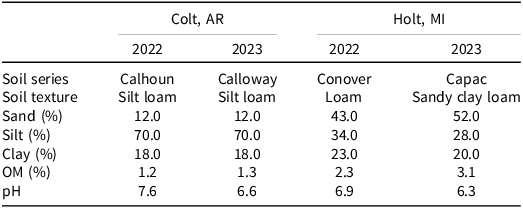
Field experiments were conducted at the Milo J. Shult Agriculture Research and Extension Center in Fayetteville, AR (36.097°N, 94.175°W), and at the MSU Horticulture Research and Extension Center in Holt, MI (35.676°N, 90.085°W), in 2022 and 2023 (Table 1). Following ground preparation, soybean cultivar ‘AG45XFO’ (Bayer Crop Science) was planted at 346,000 seeds ha−1 into four-row plots (91-cm spacing) measuring 6.1 m in length at Fayetteville, AR. An ‘AG24XF1’ and ‘AG26XF3’ soybean cultivar was planted at 371,000 seeds ha−1 in 2022 and 2023 at Holt, MI, into four-row plots (76-cm spacing) measuring 9.1 m in length.
Soil series, texture, organic matter, and pH for Fayetteville, AR, and Holt, MI, in 2022 and 2023 for application timing tolerance and weed control experiments a, b .

a Abbreviation: OM, organic matter.
b Soil series and texture were obtained from USDA-NRCS (2024).
c Trial was conducted in an adjacent location within the field in 2022 and 2023.
The experiment was designed as a randomized complete block with four replicates and two factors for the tolerance trials (herbicide rate and application timing) and one factor (application timing) for the weed control trial. For the tolerance trials, the DFF-containing premixture was applied at 120:240:330 (1X) and 240:480:660 (2X) g ai ha−1 in Arkansas. In Michigan, the DFF-containing premixture was applied at 150:300:410 (1X) and 300:600:810 (2X) g ai ha−1 due to the adjusted rates for the different soil textures (Table 1). For the weed control trials, only a 1X rate of the DFF-containing premixture was utilized for each location. Four application timings were evaluated in tolerance and weed control trials, including 14-d preplant (DPP), 7 DPP, PRE, and 3 DAP (Table 2). The tolerance trial was weed-free throughout the growing season using standard postemergence (POST) soybean herbicides.
Dates for herbicide applications and planting for application timing tolerance and weed control experiments conducted in Fayetteville, AR, and Holt, MI, in 2022 and 2023 a .

a Abbreviations: DAP, days after planting; DPP, days preplant.
Influence of Soybean Cultivar Tolerance Response to Diflufenican and Diflufenican + Metribzuin + Flufenacet Premixture
Field experiments were conducted at the Pine Tree Research Station near Colt, AR (35.125°N, 90.931°W), and at the MSU Horticulture Teaching and Research Center in Holt, MI (35.676°N, 90.085°W) in 2022 and 2023 (Table 3). In Arkansas, three Asgrow soybean cultivars (Table 4) were cone planted at 346,000 seeds ha−1 into four-row plots (76-cm spacing) measuring 6.1 m in length. Cultivars for Arkansas were selected based on the University of Arkansas System Division of Agriculture 2021 metribuzin tolerance screening, with two cultivars being “moderately” sensitive to metribuzin and one rated as “highly” sensitive (Ross et al. Reference Ross, Norsworthy, Barber and Butts2021). In Michigan, three Asgrow cultivars (Table 4) were planted at 371,000 seeds ha−1 into four-row plots (76-cm spacing) measuring 9.1 m in length. Of the cultivars utilized, one was moderately sensitive, one was highly sensitive, and the third had an unknown sensitivity to metribuzin.
Cultivar, location, metribuzin sensitivity, and maturity group for cultivars utilized in soybean variety experiments a .
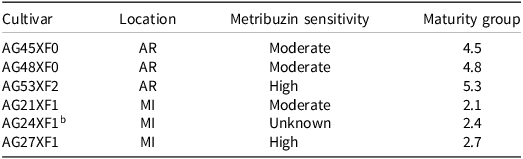
a All cultivars were manufactured by Bayer Crop Science (St. Louis, MO, USA).
b Metribuzin sensitivity was unknown; however, the cultivar behaved similarly to ‘AG27XF1’ in regard to injury and therefore was included in the high–metribuzin sensitivity group.
The experiments were designed as a randomized complete block with four replicates and three factors (metribuzin sensitivity, herbicide, and rate). At all locations, diflufenican and the DFF-containing premixture were applied PRE. Diflufenican was applied at 120 (1X) and 240 (2X) g ai ha−1 in Arkansas and at 150 (1X) and 300 (2X) g ai ha−1 in Michigan. In addition, the DFF-containing premixture was applied at 120:240:330 (1X) and 240:480:660 (2X) g ai ha−1 in Arkansas and at 150:300:410 (1X) and 300:600:810 (2X) g ai ha−1 in Michigan due to the differences in soil texture (Table 3). All trials were managed as weed-free using standard POST soybean herbicides.
Data Collection
Visible injury ratings were collected 14, 28, and 42 DAP for the application timing and soybean cultivar tolerance trials. In addition, weed control ratings of annual grasses (broadleaf signalgrass [Urochloa platyphylla (Munro ex C. Wright) R.D. Webster], goosegrass [Eleusine indica (L.) Gaertn.], and foxtail ssp. [Setaria ssp.]), common lambsquarters (Chenopodium album L.), common ragweed (Ambrosia artemisiifolia L.), Palmer amaranth, and velvetleaf (Abutilon theophrasti Medik.) (Table 5) were collected 28 and 42 DAP. All ratings were taken on a scale of 0% to 100%, with 0% representing no crop injury or weed control and 100% representing complete crop death or weed control (Frans and Talbert Reference Frans and Talbert1977). For the soybean cultivar tolerance trials, stand counts of two 1-m sections of the row were collected at 14 DAP in Arkansas in 2022 and 2023. Ground coverage images were captured using an unmanned aerial system (DJI Mavic Air 2S, DJI Technology, Shenzhen, China) 14 and 42 DAP for Arkansas application timing tolerance trials. Overhead images were analyzed using FieldAnalyzer (Green Research Services, Fayetteville, AR, USA) to determine the percentage of crop groundcover. Palmer amaranth density was collected in two 0.5-m2 quadrats plot−1 in Arkansas in the application timing weed control experiments in 2022 and 2023. In addition, Palmer amaranth biomass was collected at harvest from each plot by cutting weeds present at the soil surface and placing them into biomass bags. All harvested plant material was placed into an oven at 66 C for 2 wk, and dry biomass was recorded. Last, soybean grain yield was collected by harvesting the center two rows of each plot at each location using a small-plot combine and was adjusted to 13% moisture.
Weed species present each year across locations for the diflufenican + metribuzin + flufenacet premixture application timing weed control experiment.

Data Analysis
Statistical analysis was performed using R Studio (version 4.3.2, R Core Team 2022) and the glmmTMB function (glmmTMB package; Brooks et al. Reference Brooks, Kristensen, Van Benthem, Magnusson, Berg, Nielsen, Skaug, Machler and Bolker2017). For the application timing tolerance experiments, injury, relative groundcover, and relative yield were fit to a generalized linear mixed-effect model by evaluation timing (GLMM). For the injury model 14 DAP, data from Michigan in 2022 and 2023 were excluded because of the lack of injury violating the ANOVA assumptions for variance (Emerson Reference Emerson2022). Additionally, injury data from Michigan in 2023 were excluded from the model at 28 DAP because of the lack of variance. By 42 DAP, all sites were included in the model because injury was observed at all sites. Site-year, herbicide rate, and application timings were considered fixed effects owing to the drastic differences in injury among sites, which can be attributed to the total differences in rainfall or irrigation (Table 6). Replication was considered a random effect, and all injury data were bound between 0 and 1 and analyzed using a beta distribution (Gbur et al. Reference Gbur, Stroup, McCarter, Durham, Young, Christman, West and Kramer2012). Groundcover and yield were made relative to the nontreated check and analyzed using a Gaussian or normal distribution after the residual failed to violate the Shapiro–Wilks normality test.
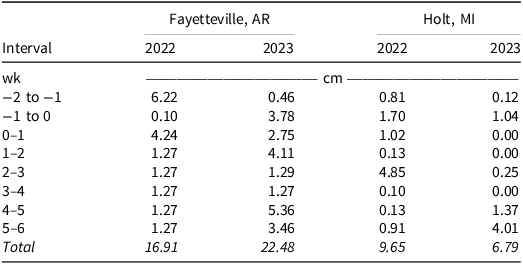
Rainfall or irrigation totals ranging from 14-d preplant until 42 d after planting for the diflufenican + metribuzin + flufenacet premixture application timing tolerance experiment at Fayetteville, AR, and Holt, MI, in 2022 and 2023.
For the application timing weed control experiment, Palmer amaranth, annual grasses, common lambsquarters, common ragweed, and velvetleaf control; Palmer amaranth density and biomass; and grain yield were fit to a GLMM by evaluation timing. Weed control ratings were excluded for PRE treatments in Michigan in 2022 owing to a sprayer malfunction. Application timing was considered a fixed effect, and replication nested within a location was considered random. All control data were analyzed using a beta distribution (Gbur et al. Reference Gbur, Stroup, McCarter, Durham, Young, Christman, West and Kramer2012). Palmer amaranth density was analyzed using a Poisson distribution. Palmer amaranth biomass and grain yield were analyzed using a Gaussian or normal distribution. Injury, stand counts, and grain yield were fit to a GLMM by evaluation timing for the soybean cultivar tolerance experiments. Soybean cultivars were grouped based on metribuzin sensitivity (moderate vs. high). The metribuzin sensitivity of the ‘AG24XF1’ cultivar was unknown, but the injury was comparable to that of the ‘AG27XF1’ cultivar; therefore it was included in the “high”–metribuzin sensitivity group. Metribuzin sensitivity, herbicide, and herbicide rate were considered fixed effects, and replication nested within location was considered random. All injury data were analyzed using a beta distribution (Gbur et al. Reference Gbur, Stroup, McCarter, Durham, Young, Christman, West and Kramer2012). Stand counts and grain yield were made relative to the nontreated check and analyzed using a Gaussian or normal distribution. ANOVA was performed on each fitted model using the car package (Fox and Weisberg Reference Fox and Weisberg2019) with the Type III Wald chi-square test. Estimated marginal means (Searle et al. Reference Searle, Speed and Milliken1980) were obtained using the emmeans package (Lenth Reference Lenth2022). The Sidak method was used to adjust for multiple comparisons (Midway et al. Reference Midway, Robertson, Flinn and Kaller2020), and a compact letter display was generated using the multcomp package (Hothorn et al. Reference Hothorn, Bretz and Westfall2008) to visually represent significantly different groups.
Results and Discussion
Influence of Application Timing of a Diflufenican-Containing Premixture on Soybean Tolerance
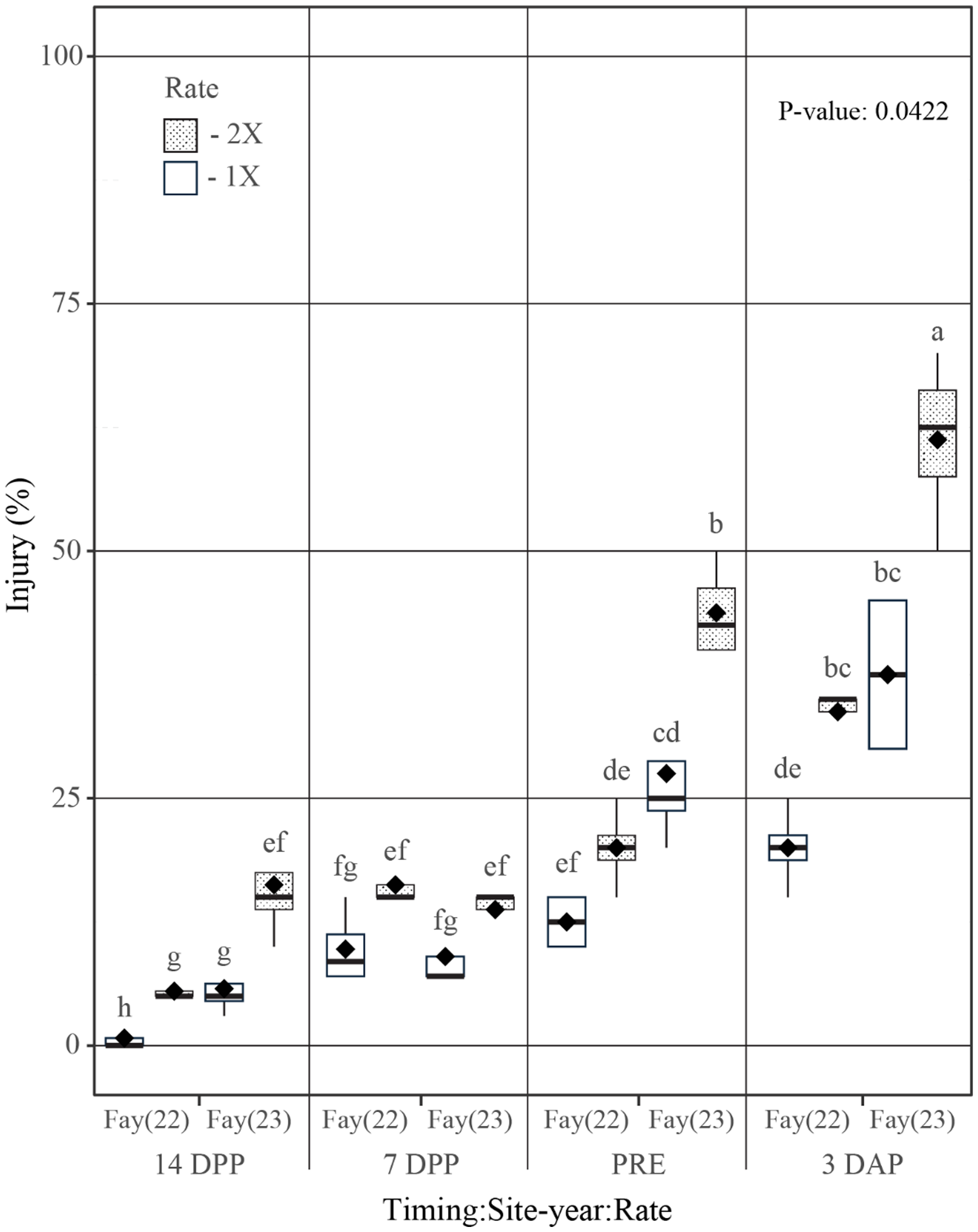
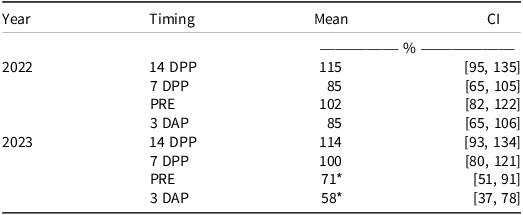
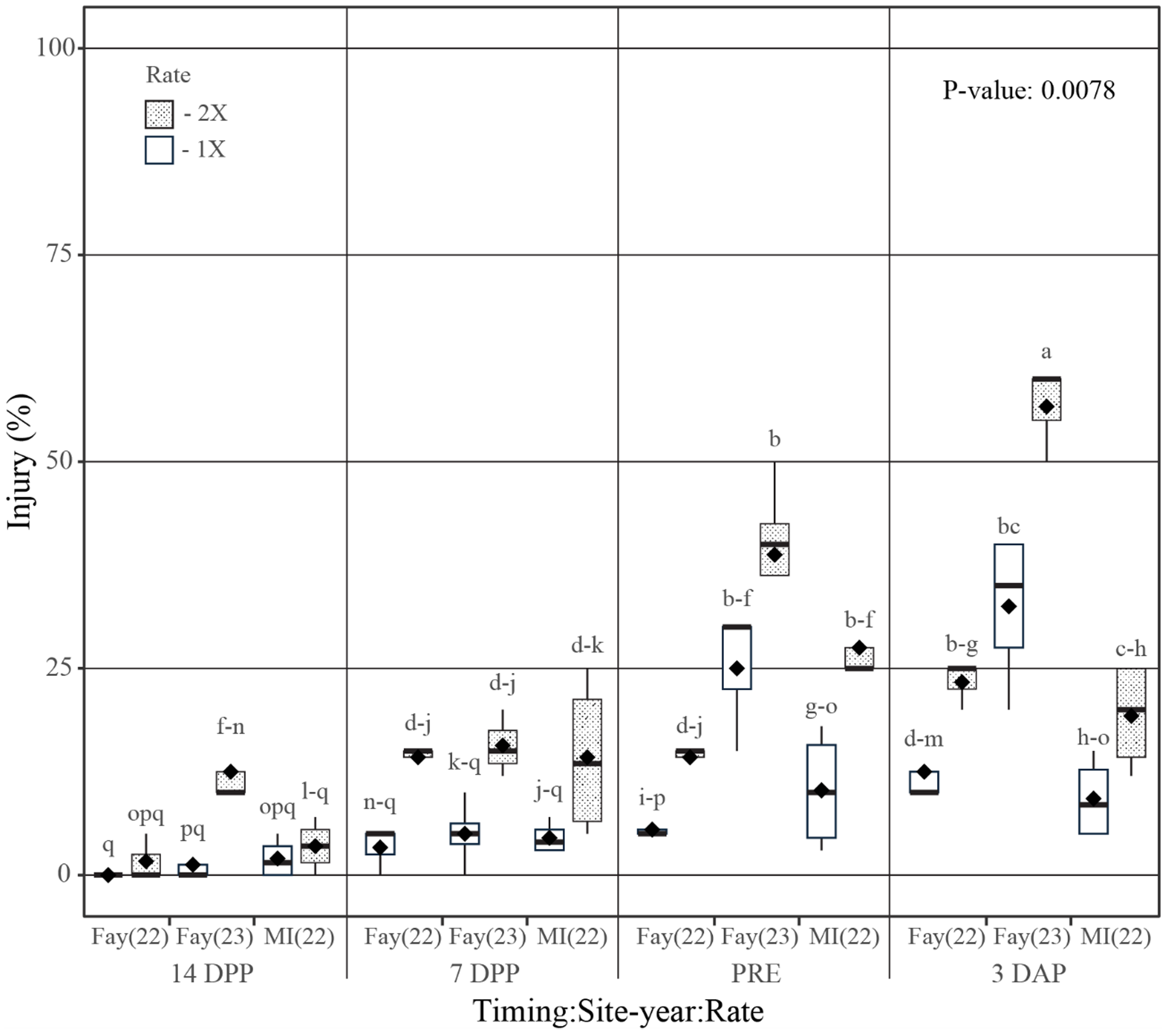
Soybean injury ranged from 0% to 60% across the site-years, application timings, and rates of the DFF-containing premixture evaluated 14 DAP (Figure 1). Injury observed at 14 DAP included bleaching, necrosis, and reduced crop vigor, with bleaching being the most prominent symptom. The greatest injury occurred in Arkansas in 2023, with no crop response in Michigan in 2022 and 2023 at 14 DAP. Variability in injury across the locations and site-years can likely be attributed to the drastic differences in rainfall. At the Arkansas site, >11.5 cm of rainfall occurred from 2 wk before planting until 2 wk after planting; however, only 1.1 cm of rainfall occurred in the same period at the Michigan site in 2023 (Table 6). Previous research has shown that soybean injury from diflufenican alone was greater during years of higher rainfall amounts (Laplante Reference Laplante2022). In addition, injury increased the closer the application of the DFF-containing premixture was made to soybean emergence in Arkansas in 2022 and 2023 (Figure 1). Similarly, in other research, soybean injury from metribuzin, sulfentrazone, and sulfentrazone + cloransulam-methyl was reduced when applying the herbicides PP compared to PRE applications (Moshier and Russ Reference Moshier and Russ1981; Priess et al. Reference Priess, Norsworthy, Roberts and Gbur2020). Soybean injury from the 2X rate of the DFF-containing premixture was higher than it was from the 1X rate at all application timings, except 7 DPP in 2022 and 2023 and PRE in 2022. Ground coverage by soybean 14 DAP was reduced for the PRE and 3 DAP application timings in Arkansas in 2023 relative to the nontreated check (Table 7). The reduction in ground coverage is attributed to the high degree of visible injury caused by the DFF-containing premixture applied PRE and 3 DAP.
Box-and-whisker plots depicting injury from the diflufenican + metribuzin + flufenacet premixture across application timings, locations, and rates 14 d after planting (DAP). Bars containing the same letter are not statistically different according to the Sidak method (α = 0.05). Injury evaluations were collected at Fayetteville, AR, and Holt, MI, in 2022 and 2023; however, no injury occurred at Holt in 2022 and 2023. Abbreviations: DPP, days preplant; Fay(22), Fayetteville 2022; Fay(23), Fayetteville 2023.
Influence of application timing of the diflufenican + metribuzin + flufenacet premixture averaged over rate on ground coverage for Fayetteville, AR, in 2022 and 2023 at 14 DAP a, b, c .
a Abbreviations: DAP, days after planting; DPP, days postplant.
b The Timing × Location interaction was significant (<0.001); therefore rates of the diflufenican + metribuzin + flufenacet premixture were averaged over application timing.
c Means that do not contain an asterisk are not statistically different from the nontreated check.
A similar trend occurred at 28 DAP, with soybean injury ranging from 0% to 55% across site-years, application timings, and herbicide rates (Figure 2). Unlike the 14 DAP evaluations, soybean injury was observed at 28 DAP in Michigan in 2022, attributed to 4.9 cm of rainfall after the first evaluation (Table 6). Additionally, the trend of greater soybean injury occurring the closer the application of the DFF-containing premixture was made to soybean emergence remained (Figure 2). However, injury from the 2X rate of the DFF-containing premixture was only greater than from the 1X rate at one location for applications occurring at 14 DPP, two locations for 7 DPP applications, one location PRE, and one location 3 DAP.
Box-and-whisker plots depicting injury from the diflufenican + metribuzin + flufenacet premixture across application timings, site-years, and rates 28 DAP. Bars containing the same letter are not statistically different according to the Sidak method (α = 0.05). Injury evaluations were collected at Fayetteville, AR, and Holt, MI, in 2022 and 2023; however, no injury occurred in Holt in 2023. Abbreviations: DPP, days preplant; Fay(22), Fayetteville 2022; Fay(23), Fayetteville 2023; MI(22), Michigan 2022.
Excluding the 2X rate of the DFF-containing premixture in Arkansas in 2023, soybean injury was <20% across site-years, application timings, and herbicide rates by 42 DAP (Figure 3). Soybean injury was first observed at this evaluation in Michigan in 2023, likely due to 5.3 cm of rainfall following the 28 DAP evaluation (Table 6). In addition, this indicates that the DFF-containing premixture can persist at a level that causes crop response up to 42 DAP. At Arkansas, the bleaching symptomology observed at previous evaluation timings had subsided by 42 DAP, and the injury observed was in the form of reduced crop vigor or stunting. Applications that occurred PRE and 3 DAP were the most injurious at 42 DAP; however, soybean injury was <15% for the 1X rate of the DFF-containing premixture at all locations (Figure 3). In addition, no reductions in ground coverage occurred relative to the nontreated check by 42 DAP in Arkansas in 2022 and 2023 (data not shown).
Box-and-whisker plots depicting injury from the diflufenican + metribuzin + flufenacet premixture across application timings, site-years, and rates 42 DAP. Bars containing the same letter are not statistically different according to the Sidak method (α = 0.05). Injury evaluations were collected at Fayetteville, AR, and Holt, MI, in 2022 and 2023. Abbreviations: DPP, days preplant; Fay(22), Fayetteville 2022; Fay(23), Fayetteville 2023; MI(23), Michigan 2023.

Soybean grain yield in the nontreated control was 3,700 kg ha−1 and 4,900 kg ha−1 in Arkansas in 2022 and 2023, respectively, and 4,500 kg ha−1 and 3,300 kg ha−1 in Michigan in 2022 and 2023, respectively (data not shown). Overall, there were no differences in grain yield regardless of application timing or rate of the DFF-containing premixture at each location relative to the nontreated check, indicating that the early-season injury and negative effects of the DFF-containing premixture did not translate to yield loss. Soybean was planted during the optimal portion of the growing season in both states. Any delay in planting and subsequent injury would likely reduce its ability to recover before reproductive development and increase the likelihood of yield loss.
Influence of Application Timing of a Diflufenican-Containing Premixture on Weed Control
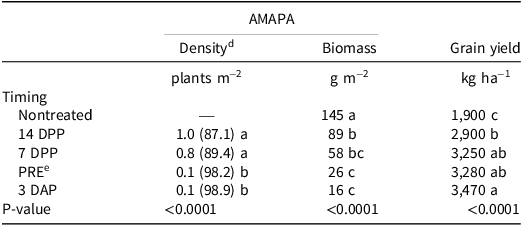
Soybean injury was <5% for all application timings by 28 DAP in the weed control experiments (Table 8). More than 80% control of all weeds was observed for all application timings of the DFF-containing premixture at 28 DAP. Control of annual grasses, velvetleaf, and Palmer amaranth increased the closer the applications of the DFF-containing premixture occurred to soybean emergence. A similar trend occurred for Palmer amaranth density 28 DAP, with PRE and 3 DAP application timings having the lowest densities (Table 9); however, all application timings reduced Palmer amaranth emergence >85% relative to the nontreated control. Common lambsquarters control was greatest for the 7 DPP and 3 DAP application timings, and no differences occurred in the control of common ragweed across application timings (Table 8).
Influence of different application timings of a diflufenican + metribuzin + flufenacet premixture on soybean injury and Palmer amaranth, common ragweed, velvetleaf, common lambsquarters, and annual grass control averaged over location 28 DAP a, b, c .

a Abbreviations: ABUTH, velvetleaf; AMAPA, Palmer amaranth; AMBEL, common ragweed; ANGR, annual grasses; CHEAL, common lambsquarters; DAP, days after planting; DPP, days preplant; INJ, injury.
b Means within a column followed by the same letter are not different according to the Sidak method (α = 0.05)
c Site-years for evaluations: INJ, 4; AMAPA, 2; AMBEL, 2; ABUTH, 2; CHEAL, 3; ANGR, 4.
d Annual grasses included foxtails, goosegrass, and broadleaf signalgrass.
e Preemergence treatment was omitted due to sprayer issues in Holt, MI, in 2022.
Influence of different application timings of a diflufenican + metribuzin + flufenacet premixture on Palmer amaranth density 28 DAP, Palmer amaranth biomass at Fayetteville, AR, and grain yield a, b, c .
a Abbreviations: AMAPA, Palmer amaranth; DAP, days after planting; DPP, days preplant.
b Means within a column followed by the same letter are not different according to the Sidak method (α = 0.05).
c Site-years for evaluations: density, 2; biomass, 2; grain yield, 4.
d Numbers in parentheses represent Palmer amaranth density reduction relative to the nontreated check.
e Preemergence treatment was omitted for yield at Holt, MI, in 2022 due to sprayer issues.
Previous research found that Palmer amaranth density was lower for herbicides applied PRE compared to PP 28 DAE in a year when adequate rainfall occurred (Priess et al. Reference Priess, Norsworthy, Roberts and Gbur2020). However, another site-year provided an example of timely activation via rainfall that did not occur, causing higher Palmer amaranth density in plots receiving PRE rather than PP treatment. Herbicides that are applied PP have a greater chance of obtaining adequate rainfall for herbicide activation; however, cumulative rainfall amounts dictate the length of persistence (Oliver et al. Reference Oliver, Klingaman, McClelland and Bozsa1993). Soybean in Arkansas is grown under irrigated conditions, allowing for activation of PRE herbicides if sufficient rainfall does not occur; however, soybean is grown in Michigan under nonirrigated conditions and requires adequate rainfall to activate PRE herbicides. Therefore, if the DFF-containing premixture was applied PRE and adequate rainfall did not occur, producers would have to rely on POST herbicides to control weeds, increasing the chance of weeds evolving resistance to POST herbicides (Norsworthy et al. Reference Norsworthy, Ward, Shaw, Llewellyn, Nichols, Webster, Bradley, Frisvold, Powles, Burgos, Witt and Barrett2012).
By 42 DAP, the trend remained for applications of the DFF-containing premixture being more effective closer to soybean emergence, where greater control of velvetleaf, Palmer amaranth, and annual grasses occurred (Table 10). However, common lambsquarters control was greatest for the 7 DPP application timing of the DFF-containing premixture. Although the DFF-containing premixture did provide >70% control of all weeds evaluated, producers cannot rely on the DFF-containing premixture alone for season-long weed control. Therefore producers should make POST applications after applying the DFF-containing premixture PRE in combination with soil residuals to achieve season-long weed control (Meyer et al. Reference Meyer, Norsworthy, Young, Steckel, Bradley, Johnson, Loux, Davis, Kruger, Bararpour, Ikley, Spaunhorst and Butts2015; Norsworthy et al. Reference Norsworthy, Ward, Shaw, Llewellyn, Nichols, Webster, Bradley, Frisvold, Powles, Burgos, Witt and Barrett2012).
Influence of different application timings of a diflufenican + metribuzin + flufenacet premixture on soybean injury and Palmer amaranth, common ragweed, velvetleaf, common lambsquarters, and annual grass control averaged over location 42 DAP a, b, c .

a Abbreviations: ABUTH, velvetleaf; AMAPA, Palmer amaranth; AMBEL, common ragweed; ANGR, annual grasses; CHEAL, common lambsquarters; DAP, days after planting; DPP, days preplant; INJ, injury.
b Means within a column followed by the same letter are not different according to the Sidak method (α = 0.05)
c Site-years for evaluations: INJ, 4; AMAPA, 2; AMBEL, 2; ABUTH, 2; CHEAL, 3; ANGR, 4.
d Annual grasses included foxtails, goosegrass, and broadleaf signalgrass.
e Preemergence treatment was omitted due to sprayer issues in Holt, MI, in 2022.
All application timings of the DFF-containing premixture reduced Palmer amaranth biomass relative to the nontreated check by soybean harvest (Table 9). However, greater reductions occurred the closer the herbicide application occurred to soybean emergence. In addition, soybean grain yield was reduced with a 14 DPP application of the DFF-containing premixture compared to 3 DAP, indicating inferior season-long weed control with the earlier application timing.
Influence of Soybean Cultivar Tolerance in Response to Diflufenican and Diflufenican + Metribzuin + Flufenacet Premixture
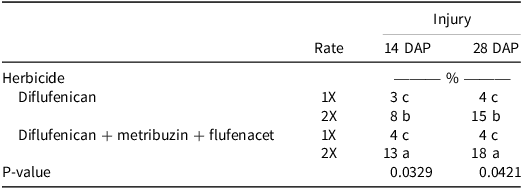
Soybean sensitivity to metribuzin as a main effect or all possible interactions involving the factor was insignificant at 14 and 28 DAP (data not shown). Across locations, soybean injury was <15% for diflufenican and the DFF-containing premixture at a 1X and 2X rate of each herbicide 14 DAP. However, injury was greater with a 2X rate of both herbicides relative to the 1X rate, and greater injury occurred following the 2X rate of the DFF-containing premixture than following the 2X rate of diflufenican alone. The soybean density in the nontreated control averaged 19 plants m−1 of row (248,000 plants ha−1) for the “moderate” and “high” metribuzin sensitivity groups in Arkansas (data not shown). Overall, no reductions in soybean density occurred regardless of metribuzin sensitivity, herbicide, or herbicide rate 14 DAP.
Previous research has shown that soil pH is a key component of metribuzin injury in soybean. Metribuzin at a rate of 0.6 and 0.8 kg ai ha−1 on a silty clay loam at pH 6.6 caused 15% to 26% injury; however, the same rates of metribuzin on a silt loam at pH 7.9 resulted in >60% soybean injury (Moomaw and Martin Reference Moomaw and Martin1978). Soil pH at all research locations ranged from 6.3 to 7.6 (Table 3); however, the lack of greater soybean injury to “high” metribuzin-sensitive cultivars can likely be attributed to the low metribuzin rate in the DFF-containing premixture. The metribuzin rate in the DFF-containing premixture was 240 g ai ha−1 for the anticipated 1X rate on a silt loam, which is less than the lowest recommended rate for metribuzin alone (420 g ai ha−1) (Barber et al. Reference Barber, Butts, Wright-Smith, Ford, Jones, Norsworthy, Burgos and Bertucci2024). However, it is not uncommon for premixtures containing metribuzin to have reduced herbicide rates. For example, Boundary® (Syngenta Crop Protection, Greensboro, NC, USA), a widely used PRE option in soybean, containing S-metolachlor and metribuzin, has a recommended rate of only 260 g ai ha−1 of the latter herbicide on a silt loam (Anonymous 2023; Schwartz-Lazaro et al. Reference Schwartz-Lazaro, Norsworthy, Steckel, Stephenson, Bish, Bradley and Bond2018).
By 28 DAP, soybean injury averaged over metribuzin sensitivity was <20% regardless of herbicide and herbicide rate. The trend of higher injury with a 2X rate with both diflufenican and the DFF-containing premixture compared to 1X rates was observed (Table 11). In addition, greater injury caused by the 2X rate of the DFF-containing premixture than by the 2X rate of diflufenican alone remained. By 42 DAP, soybean injury was ≤5%, with no differences in herbicide or herbicide rate (data not shown).
Influence of various rates of diflufenican and diflufenican + metribuzin + flufenacet premixture averaged over metribuzin sensitivity and location for soybean injury 14 and 28 DAP a, b .
a Abbreviation: DAP, days after planting.
b Means within a column followed by the same letter are not different according to the Sidak method (α = 0.05).
Soybean grain yield in the nontreated control was 3,430 kg ha−1 for the “moderate” metribuzin-sensitive group and 3,700 kg ha−1 for the “high” metribuzin-sensitive group across locations (data not shown). Overall, no differences in grain yields occurred regarding metribuzin sensitivity, herbicide, or herbicide rate relative to the nontreated control.
Practical Implications
On the basis of the research reported here, the DFF-containing premixture has a flexible application timing that should be 7 DPP until PRE to reduce soybean injury. A crop response should be anticipated if producers plan to plant early and more than 2.5 cm of rain is forecast. The soybean injury observed was transient and did not translate to grain yield reductions. Regarding weed control, producers should not apply the DFF-containing premixture earlier than 7 DPP, or else a reduction in efficacy is likely. Under growing conditions in Arkansas, producers can delay the application closer to planting owing to the ability to activate the herbicide with irrigation, which exists in most fields; however, nonirrigated systems, typical to Michigan, should utilize the herbicide PRE, or planting should occur when adequate rainfall is forecast. The DFF-containing premixture applied PRE or 3 DAP provided ≥90% control of problematic weeds like Palmer amaranth at 42 DAP, offering producers with Group 14 or 15 resistance an effective alternative PRE option. However, the DFF-containing premixture alone will not achieve season-long weed control and should be utilized as part of a season-long herbicide program. Although the DFF-containing premixture does contain metribuzin, the herbicide will likely be able to be used across all soybean cultivars, as soybean injury was comparable regardless of metribuzin sensitivity due to the low rate of metribuzin in the premixture. Overall, the DFF-containing premixture provides a new tool that soybean producers can integrate into a season-long herbicide program to control problematic weeds.
Acknowledgments
The authors thank Bayer Crop Science, the University of Arkansas System Division of Agriculture, and Michigan State University for supporting this research.
Funding
Funding for this research was provided by Bayer Crop Science.
Competing interests
The authors declare no conflicts of interest.


 Open access

