

Introduction
The problems that refugee children experience are multidimensional and complicated. The issue of refugees has actively been in the spotlight in Türkiye since 2011. Refugees displaced due to the civil war in Syria have an important place among the immigrant population in Türkiye. Currently, the population of Syrians under temporary protection in Türkiye is 3,214,780 (Presidency of Migration Management, 2024). While the most significant surge in international protection requests and irregular migration occurred between 2017 and 2018, by 2023, there were 13,068 Afghan, 2,776 Iraqi, and 1,416 Iranian international protection applicants. Additionally, there were 68,687 Afghan, 58,621 Syrian, and 18,113 Palestinian undocumented migrants reported (Presidency of Migration Management, 2024). Refugees and immigrants are faced with a range of difficulties, such as language barriers, culture and belief differences, and perceived ethnic discrimination, that increase the risk of victimisation (Jugert and Titzmann, Reference Jugert and Titzmann2017). Undoubtedly, schools are one of the important institutions where these and similar problems are experienced. A school system that implements a central curriculum and where the level of teacher competencies is inadequate may not be able to meet the educational needs of refugee and immigrant children.
The literature indicates that the academic success levels of refugee students remain below their classmates’ academic success levels in many countries (Dimitrova et al., Reference Dimitrova, Chasiotis and van de Vijver2016). Additionally, several studies performed in Türkiye stated that refugee children faced difficulties related to language (Emin, Reference Emin2016; Erdem, Reference Erdem2017; Gencer, Reference Gencer2017; Güven and İşleyen, Reference Güven and İşleyen2018; İçduygu and Şimşek, Reference İçduygu and Şimşek2016; Kardeş and Akman, Reference Kardeş and Akman2018; Sarmini et al., Reference Sarmini, Topçu and Scharbrodt2020; Hallaçlı and Gül, Reference Hallaçlı and Gül2021; Atalay et al., Reference Atalay, Kılıç, Anılan, Anılan and Anagün2022), adaptation to school (Emin, Reference Emin2016; Türk, Reference Türk2016; Gencer, Reference Gencer2017; Levent and Çayak, Reference Levent and Çayak2017; Kardeş and Akman, Reference Kardeş and Akman2018; Hallaçlı and Gül, Reference Hallaçlı and Gül2021), registration and grade-level equivalence paperwork (Levent and Çayak, Reference Levent and Çayak2017), discipline, violence, attendance, hygiene and nutritional deficiencies (Güven and İşleyen, Reference Güven and İşleyen2018; Hallaçlı and Gül, Reference Hallaçlı and Gül2021), access to education and participation, teacher inadequacy or negative attitudes, attention deficit, the inadequacy of educational programmes and teaching materials, physical infrastructure, poverty, child labour, and social acceptance (Emin, Reference Emin2016; Gencer, Reference Gencer2017).
Schools are a cultural context where this context is expected to make it easier to adjust to a multicultural society and globalising world (Schachner, Reference Schachner2019). For this reason, education not only has transformational potential if it is organised by considering students’ cultural differences, but it can also resolve educational inequality and problems for students with different cultural characteristics (Gay, Reference Gay2015). In Türkiye, refugees are integrated into the existing education programme without a separate curriculum. Teachers receive support training, but there is a lack of multilingual and multicultural education support (UNICEF, 2019). A comparative study, for example, on refugee education in Germany, Austria, Sweden, and Türkiye revealed that while refugee students receive intensive language support to learn the language of the host country, only Sweden offers native language education. In order to help the refugee children, various adaptation and compensation measures are implemented, such as welcome classes in Germany, transition classes in Austria, preparatory classes in Sweden, and accelerated education programmes in Türkiye (Toprakçı and Yazıcı, Reference Toprakçı and Yazıcı2021). In another setting, the Lebanese government aimed to enroll the majority of Syrian refugee children in afternoon classes reserved only for the Syrians, but this method led to minimising interaction these Syrian students had with the Lebanese students (Akar and Van Ommering, Reference Akar, Van Ommering, Pace and Sen2018). Lebanon also offers an accelerated learning programme and informal education for Syrian refugees (Crul et al., Reference Crul, Lelie, Biner, Bunar, Keskiner, Kokkali, Schneider and Shuayb2019). In recent years, despite the growth in the interest and number of studies about culturally diversified curriculum and teaching approaches, the topics related to how culturally responsive education may or may not exist within country-level policies and school-level practices still require attention so that standardised approaches can be developed (Schachner, Reference Schachner2019). Considering that Syrian refugees constitute the largest refugee group in Türkiye, examining their current situation in the education system will provide valuable insight for the development of culturally responsive education policies that may also be used with the other refugee communities within the country.
This study attempted to determine whether the educational curriculum is adjusted in state primary schools to meet the educational needs of Syrian refugee children, whether in-service training related to the education/teaching of refugee children exists in schools, and what educational needs Syrian refugee students may have. Answers to the following research questions were sought:
-
What types of policies, if any, are present in primary schools to adjust curriculum and school organisation, considering the needs of refugee students?
-
What policies, if any, are implemented to meet the needs of refugee students during the learning-teaching process?
-
What policies, if any, are implemented to meet the language needs of the refugee students?
-
In the context of education and curriculum needs, and in terms of the culturally responsive education of refugee children, what are the needs of refugee children?
-
What is some information related to the living situation and family composition of these Syrian refugee students that might shed light on their educational experiences?
Conceptual framework
Culturally responsive education
Education responsive to cultural values is a critical pedagogic understanding that ensures students understand themselves and others, participate in social interaction, and gain increased knowledge levels (Ladson-Billings, Reference Ladson-Billings1990). The concept is called education responsive to cultural values because it includes comprehensive qualities based on democracy and equality principles for all students (Taylor and Sobel, Reference Taylor and Sobel2011), culturally relevant pedagogy (Ladson-Billings, Reference Ladson-Billings1995), or culturally responsive teaching (Gay, Reference Gay2002a). It first emerged in the United States of America with the intention to cultivate students who were academically successful, displayed cultural competency, and understood and could criticise the current social pattern. Later research under a broad range, culturally responsive education was defined as effective education in meeting the academic and social needs of students with different cultural values (Ladson-Billings, Reference Ladson-Billings1995; Gay, Reference Gay2002a, Reference Gay2018). At the same time, the movement was expressed to be an effort to make learning activities more interesting and effective for students by paying attention to the cultural knowledge, past experiences, and learning styles of students (Gay, Reference Gay2002a, Reference Gay2015). The content of education responsive to cultural values offers students a way to respond to their previous experiences and natural learning paths by using teaching techniques sensitive to different cultures that are included in the educational environment. For this reason, culturally responsive education is accepted as the reflection of the multicultural concept in practice in the class environment (Rychly and Graves, Reference Rychly and Graves2012; Kotluk and Kocakaya, Reference Kotluk and Kocakaya2018). Culturally responsive education aims to preserve the cultural integrity of students with differences, to develop their individual competencies and academic successes, and to ensure that students simultaneously gain free, democratic, and critical awareness (Gay, Reference Gay2018).
Culturally responsive curriculum and teacher characteristics responsive to cultural values
Some studies have indicated that culturally responsive curriculum and classroom environments promote the well-rounded development of students with different cultural characteristics (Castagno and Brayboy, Reference Castagno and Brayboy2008; Gay, Reference Gay2018). In educational environments where such programmes are implemented, students can learn about their own and others’ cultural heritage, how the lives of different ethnic groups are interconnected, the moral and ethical dimensions of living and learning, and the skills necessary for participation in social transformation, in addition to academic competence (Gay, Reference Gay2002b). A culturally responsive curriculum contributes to the development of citizenship and social justice and fosters the adoption of ideas related to social change and equality (Bassey, Reference Bassey2016). Cooperation and collaboration are prioritised, and a multicultural classroom environment, free of ethnic prejudices, is provided (Gay, Reference Gay2002b). Various studies have shown that culturally responsive educational environments are associated with several outcomes such as longer attention span, active participation, increased time allocated to reading and writing, higher level of comprehension, high-level and analytical thinking, higher satisfaction with school, and boosted academic competence and self-efficacy (e.g., Castagno and Brayboy, Reference Castagno and Brayboy2008; Gay, Reference Gay2018).
Creating a curriculum responsive to cultural values involves important elements such as knowing cultural differences, the inclusion of cultural differences in plans and programmes, sensitivity to cultural differences, creation of cooperative and democratic learning communities, and the use of teaching methods and techniques that pay attention to intercultural communication and differences (Gay, Reference Gay2018). At this point, being able to implement a curriculum responsive to cultural values effectively and productively is linked to adaptation and support firstly by teachers but also by all teacher educators (Karataş, Reference Karataş2020). To be able to create a culturally responsive educational environment, teachers must be able to make connections with students and their cultural pasts and life experiences, minimise the impact of cultural incompatibility in class, and create a positive class environment through effective communication with students (Howard, Reference Howard2003). Szente et al. (Reference Szente, Hoot and Taylor2006) indicated that teachers should be able to effectively communicate with refugee students by assisting children in coping with trauma and academic adjustment and forming positive relationships with the parents. Teachers should be able to assist students in identifying, understanding, and criticising existing social inequalities, while also encouraging academic success and cultural competency (Kotluk, Reference Kotluk2018).
Teachers who are responsive to cultural values are expected to have features such as being aware of the cultural histories of themselves and their students (Risko and Walker–Dalhouse, Reference Risko and Walker–Dalhouse2007), knowing that every student is different, respecting and managing these differences (Ladson-Billings, Reference Ladson-Billings1999; Gay, Reference Gay2018; Sarıdaş and Nayır, Reference Sarıdaş and Nayir2021), being able to understand the effect of cultural differences on the learning process, and considering these different cultural values in the teaching process (Risko and Walker–Dalhouse, Reference Risko and Walker–Dalhouse2007; Kotluk, Reference Kotluk2018). Additionally, being empathic, having knowledge about different cultures, reflecting both their own culture and other cultures (Rychly and Graves, Reference Rychly and Graves2012), encouraging active class participation, creating a critical thinking environment, ensuring the adoption of universal values, guiding students in reflecting democratic principles in the educational environment, and reinforcing cooperative learning (Ladson-Billings, Reference Ladson-Billings1990; Reference Ladson-Billings1999; Gay, Reference Gay2002a; Reference Gay2018) are also included among culturally responsive teacher characteristics. Culturally responsive teachers work to include parents with different cultural values in the educational process and fight against prejudice and othering by opposing possible negative attitudes toward differences from other teachers and students (Ladson-Billings, Reference Ladson-Billings1995; Gay, Reference Gay2018).
Culturally responsive teacher training
The role of the teacher in shaping culturally diverse contexts in schools is gaining increasing importance. In one study, it was found that having teachers who value diversity and cultural multiplicity was associated with less perceived discrimination among minority students (Brown and Chu, Reference Brown and Chu2012). However, a lack of intercultural knowledge and experience reduces the probability of teachers including multicultural topics in their teaching (Gobel and Helmke, Reference Gobel and Helmke2010). Kotluk (Reference Kotluk2018), on the other hand, identified that not only do culturally different student groups experience low expectations, low motivation, academic failure, lack of self-confidence, and feelings of deprivation, but also that teachers do not know what strategies to apply to approach these types of difficulties. Research by Erdem (Reference Erdem2017) concluded that teachers were inadequate in organising content, teaching materials, and objective assessment processes according to the needs of refugee students. Results of research in six European countries showed that the majority of teachers had not received any education or only inadequate education about being able to manage cultural diversity in class (Fine-Davis and Faas, Reference Fine-Davis and Faas2014). A majority of teachers in Lebanon have reported challenges in class management, discipline, and punctuality when dealing with Syrian refugee students (Crul et al., Reference Crul, Lelie, Biner, Bunar, Keskiner, Kokkali, Schneider and Shuayb2019). Similarly, Roxas (Reference Roxas2010) emphasised that the majority of teachers did not have adequate knowledge and experience to meet the needs of refugee students from different cultures.
For teachers to be able to engage in culturally responsive teaching, they must be competent in topics such as cultural history and awareness, democracy and human rights, current and effective teaching methods and techniques, class management, learning-teaching approaches, social psychology, cooperative learning, and life-long learning (Vavrus, Reference Vavrus and Good2008). At the same time, they should have the content knowledge and professional competency to ensure a multidimensional assessment of student performance (Ladson-Billings, Reference Ladson-Billings1990; Reference Ladson-Billings1995; Gay, Reference Gay2018). For this reason, it is recommended to provide preservice teachers with training on how to gain knowledge and skills about cultural awareness, cultural interaction, analysis of cultural differences, and how to use cultural resources during the teacher training process (Howard, Reference Howard2003; Vavrus, Reference Vavrus and Good2008). It is recommended that preservice teachers learn about pedagogical principles, methods, and materials belonging to different groups, and helped to use this knowledge in their teaching practice (Gay, Reference Gay2002b). Hayes and Juarez (Reference Hayes and Juarez2012) indicate that teacher training programmes should be designed according to cultural diversity considering the probability that preservice teachers will teach classes with cultural diversity in the future. A study by Ritosa (Reference Ritosa2017) mentioned the efficacy of teacher training programmes responsive to cultural values developed for teachers or preservice teachers. Therefore, all curricula should be structured to ensure teachers and students can manage difficulties. In Türkiye, where the level of cultural diversity is increasing, it is important to identify the perceptions of refugee children and their teachers around educational programming, curriculum, and teaching/learning experiences so that different ways to help the teachers provide culturally responsive education and handle students’ problems related to culture can be determined.
Method
The descriptive survey model was employed in this research study. The descriptive survey model is used to define the structure of objects, societies, and institutions, and the process of events (Cohen et al., Reference Cohen, Manion and Morrison2011). In this study, the aim was to define the current structure and operation of the educational curriculum in meeting the needs of refugee students and to determine refugee students’ experiences related to their school life.
Study group
The sample in this study comprised 294 primary school teachers who teach refugee children and who are employed in state schools located in six cities from different geographical zones of Türkiye (i.e., Aydın, Ağrı, İstanbul, Rize, Siirt, and Izmir). The sample also included 372 Syrian refugee students attending these primary schools. In the process of forming the study sample, first the schools with refugee students across various regions of Türkiye were identified using data obtained from the Turkish Ministry of National Education. Then, a group of cities and schools within these cities were selected randomly. Next, all teachers working in these schools and every attending Syrian refugee student were asked to participate in the study.
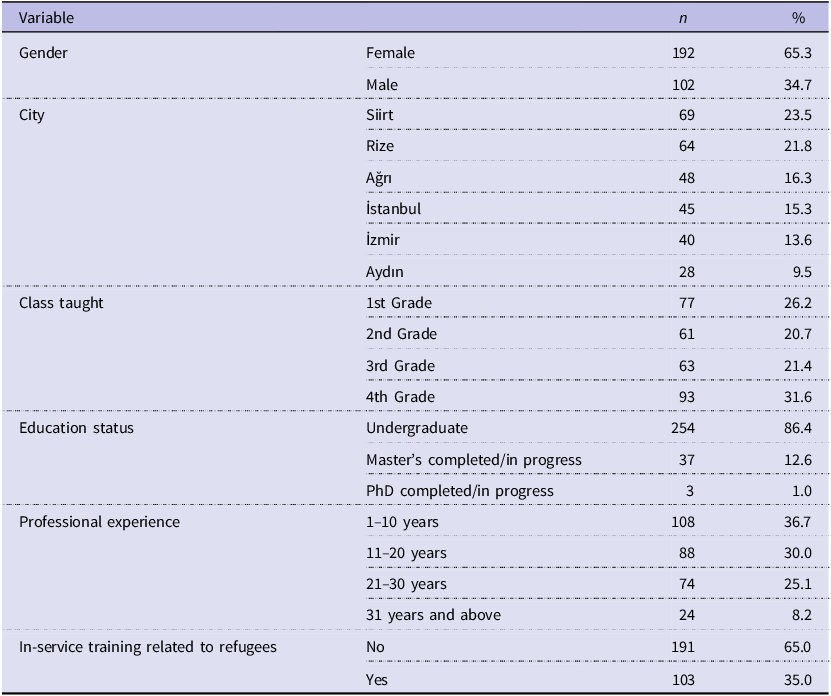
The teachers’ gender, current city, grade level taught, education level, and whether they received in-service training related to Syrian refugee students are presented in Table 1.
Demographic characteristics of participant teachers

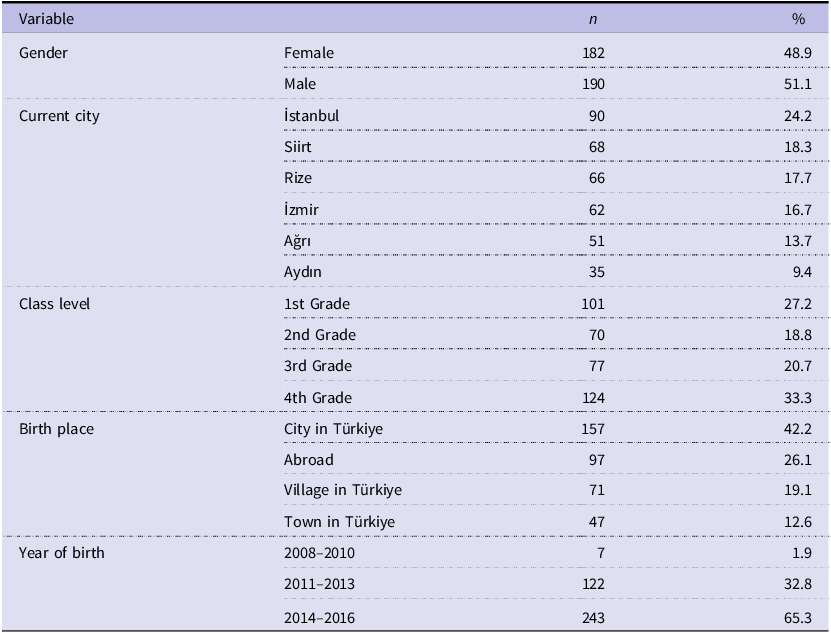
Personal and familial information were gathered from the refugee students, to delineate their living conditions and experiences related to school life. Information on the participants’ gender, current city, grade level of education, birthplace, and year of birth is presented in Table 2.
Demographic characteristics of participant students

In addition to the information presented in Table 2, close to half (n = 152, 40.9 per cent) of the refugee students stated knowing a low level of Turkish; 32.5 per cent (n = 121) at a moderate level; 19.1 per cent (n = 71) at a good level; and 7.5 per cent (n=28) at a very good level. Majority of the students (n = 283, 76.9 per cent) stated having learned Turkish at their school; 10.9 per cent (n = 40) indicated having learned it with the help of their friends; and 9.5 per cent (n = 35) with the help of their family members. The rest of the students stated that they learned Turkish on their own or by watching movies (n = 10, 2.7 per cent). Almost one out of every four students reported having lost a close person or a family member due to the war in Syria (n = 86, 23.1 per cent).
Data collection tools
The “Inventory to Determine Education and Curriculum Requirements of Refugee Primary School Students,” prepared by the researchers, was utilised as a data collection tool in this study. The inventory helped in determining the opinions of primary school teachers of refugee children about the curriculum implemented in schools, their teaching practices, the educational needs of refugee students, and if/how the current curriculum is adjusted to meet the needs of these students. In the context of the related literature, the dimensions of the culturally responsive curriculum were identified and incorporated into the inventory. The inventory comprised twenty-one questions and three sections about teachers. The part for students comprised forty-eight questions and two sections.
Data collection and analysis
A permission to collect data was received from the Turkish Ministry of National Education and relevant school administrators. The survey forms were sent to the schools by mail. The families of the students were informed about the study, and parental permission to participate was obtained by utilising an informed consent form. The survey form was administered face-to-face by school administrators to both teachers and refugee students. Next, the completed surveys were returned to the first author by the school administration through postal mail. The data obtained from the teachers and the students were analysed with International Business Machines (IBM) 24 SPSS and transformed into percentage and frequency tables.
Findings
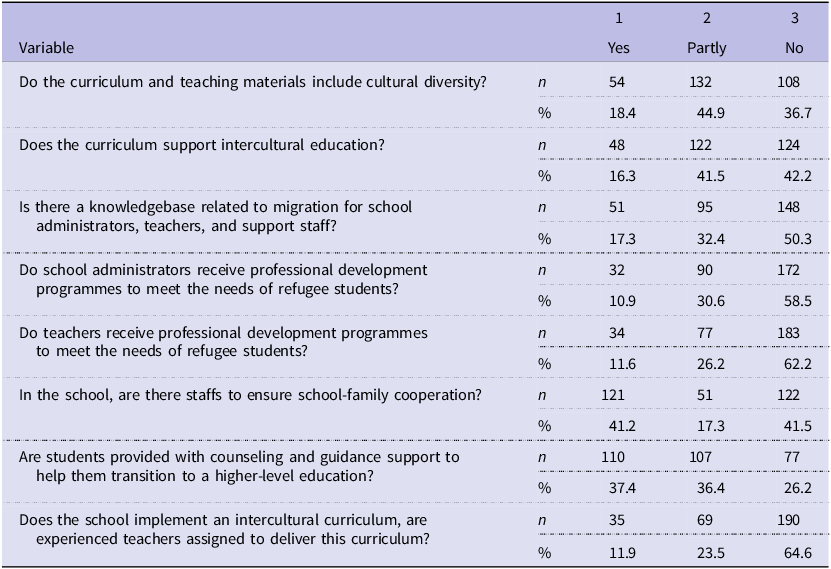
The research findings were analysed in two stages; the first stage included data related to the teachers, and the second the students. Participant teachers’ opinions about the current policies implemented to adapt curriculum and school organisation in primary schools to the needs of refugee students are presented in Table 3.
Participants’ opinions about policies implemented to adapt the curriculum and the school organisation to the needs of refugee students

As seen in Table 3, it appears that the majority of the teachers considered that the primary school curriculum at their institution either partly included or did not include cultural diversity suitable for the needs of Syrian refugee students. Over 40 per cent of the sample also stated that their curriculum did not support intercultural education. The research findings also indicate that school administrators and teachers did not have an adequate level of knowledgebase about refugee students and professional development programmes were not offered; some schools had staff to ensure school-family cooperation and guidance and counseling services for refugee students, while most schools did not implement intercultural curriculum. The perceptions of participant teachers about the school policies implemented to meet the needs of refugee students during the learning-teaching process are presented in Table 4.
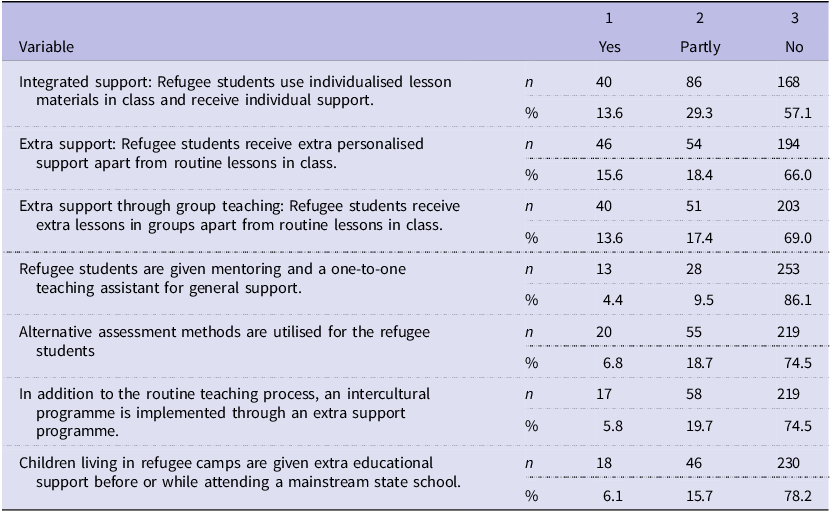
Teachers’ perceptions about the school policies implemented to meet the needs of refugee students in the learning-teaching process

Table 4 indicates that the majority of schools did not implement on-site integrated support for refugee students, extra personalised support, extra support through group teaching, mentoring and one-to-one teaching assistance, alternative assessment methods, intercultural programmes through extra support, or extra educational support for children in refugee camps. This finding indicates that teachers believe that adequate policies are not implemented to meet the needs of refugee children during the learning-teaching process. The opinions of participant teachers about policies implemented to meet the language needs of refugee students are presented in Table 5.
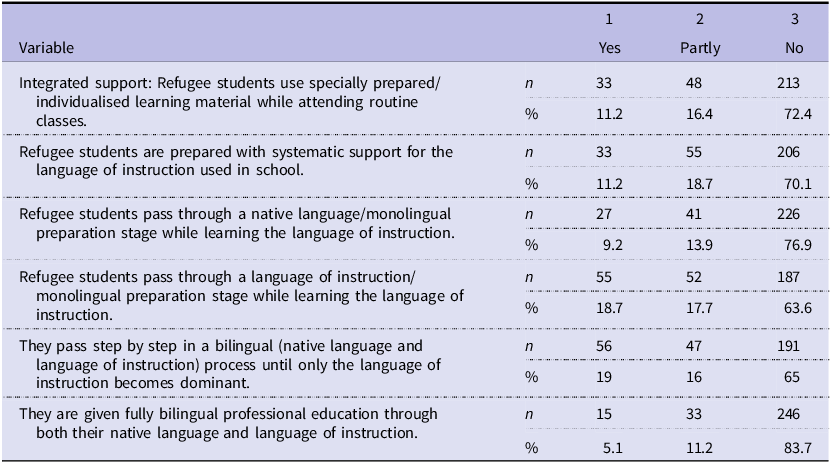
Participants’ opinions about policies implemented to meet the language needs of refugee students

As seen in Table 5, the research findings reveal that rarely there are support opportunities such as integrated support with individualised learning materials for refugee students, systematic preparation in the language of instruction, a monolingual preparatory stage where either the native language or language of instruction is dominant while learning the language of instruction, a gradual transition to the language of instruction from a bilingual process, or bilingual professional education. Teachers believed that adequate policies to meet the language needs of refugee students were not implemented.
Student participant profiles were determined based on the education and curriculum needs of students included in the research. Within this scope, their living conditions and experiences related to the school life of the students were investigated. Information related to the family structure of the students is presented in Table 6 to describe their living conditions.
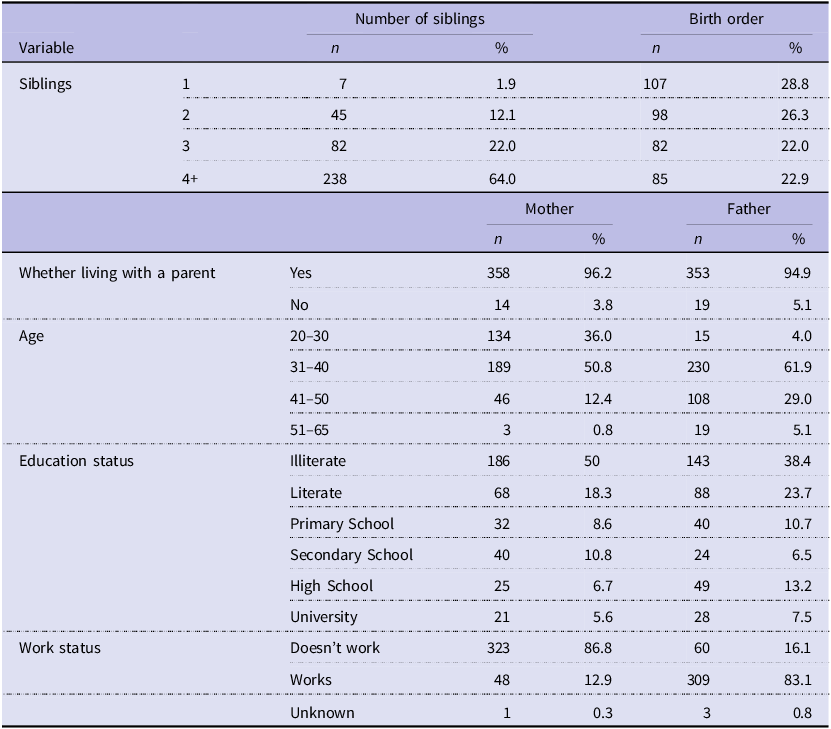
The family structure of the student participants

As Table 6 shows, the majority of participants had a crowded family structure and lived together with their mother and father; the mothers were generally younger than forty years and fathers were between thirty and fifty years old. The research findings additionally showed that the majority of the parents were either illiterate or literate but had not graduated from any school level. In addition, the majority of mothers were not employed.
When the findings related to the family structure and place of residence of participants are investigated, in addition to the data in Table 6, it was determined that the majority of the students lived in rental properties (n = 352, 96.2 per cent) while a small number (n = 14, 3.8 per cent) owned a home. It is also observed that most students lived in apartments (n = 255, 70.8 per cent), while some lived in detached houses (n = 73, 20.3 per cent) or in slums (n = 32, 8.9 per cent). The majority of students did not have their own room (n = 318, 85.5 per cent). They generally shared a room with their siblings (n=260, 70.1 per cent) or parents (n = 111, 29.9 per cent). Most siblings had a primary education level (n = 255, 68.5 per cent), some had secondary education (n = 52, 14 per cent), a few had higher education (n = 12, 3.3 per cent) and the rest (n = 53, 14.2 per cent) had other levels of education. Most participants lived with both parents (n=340, 91.4 per cent), while the rest of the students (n = 32, 8.6 per cent) lived with a single parent or with other adults. Most students had a core family structure (n = 264, 69.3 per cent). However, 30.7 per cent (n = 117) of the students stated that they lived with someone else such as a grandparent, grandfather, aunt, etc., and that they had an extended family structure. When family income was investigated, most families appeared to have an income of 4,000 Turkish Liras a month (around 240 American dollars at the time of data collection) or less (n = 333, 89.5 per cent). Family income was mostly provided by the father (n = 298, 65.9 per cent), followed by the mother (n = 67, 14.8 per cent), siblings (n = 50, 11.1 per cent), relatives (n = 23, 5.1 per cent), and social services (n = 14, 3.1 per cent). The general information related to the education and school lives of participants is presented in Table 7.
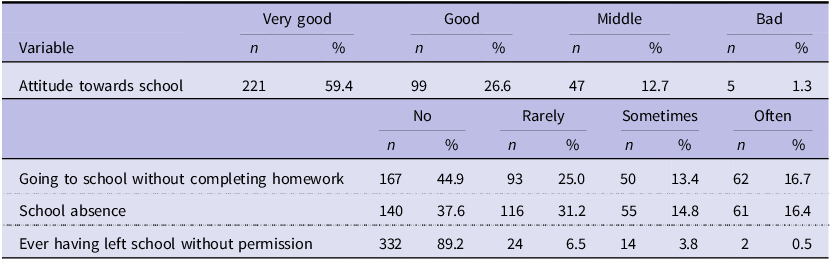
The education and school lives of participants

Table 7 shows that most students had a very positive attitude towards school, did their homework on time, did not miss school or rarely missed it, and did not leave school without permission. When the findings related to the school life of participants is investigated, in addition to the data in Table 7, it was found that most participants had not received preschool education (n = 291, 78.2 per cent). Most of them also reported not experiencing discipline-related problems in school (n = 304, 81.7 per cent). A large number of the students (n = 273, 73.4 per cent) stated that there are no activities related to refugees in their schools. The majority of the students were able to share their problems with others in school (n = 267, 71.8 per cent). They indicated that they shared these problems generally with the classroom teacher (n = 319, 63.7 per cent), other staff members, such as counselors and administrators (n = 108, 21.6 per cent), and friends (n = 74, 14.7 per cent). Additionally, a big group of students reported being academically successful (n = 173, 46.5 per cent), and only around a quarter of them reported being academically unsuccessful (n = 103, 27.6 per cent). Only a very small percentage reported skipping school (n = 16, 4.3 per cent) or running into disciplinary problems (n = 10, 2.7 per cent).
When the work status of participants was investigated, it was identified that the majority had not previously worked in a job (n = 347, 93.2 per cent) and a large number was not currently working in a job (n = 363, 97.5 per cent). They mostly did not have someone as a role model (n = 195, 52.4 per cent). The majority of the students had a friend group within their neighborhood (n = 283, 76.1 per cent); the rest of the students stated that they did not have one. Students spent their leisure time mainly watching TV/internet (n = 220, 30.5 per cent), at home (n = 159, 22.1 per cent), with friends (n = 133, 18.4 per cent), reading books (n = 120, 16.7 per cent) or in sports/game activities (n = 89, 12.3 per cent). They reported spending most of their time outside of school in the streets/parks (n = 262, 72.2 per cent), at home (n = 72, 19.9 per cent), and in gyms/youth cents (n = 29, 7.9 per cent). The majority of students stated they receive attention from their father (n = 273, 73.4 per cent), 88.4 per cent (n = 329) of the students indicated that they receive attention from their mother. They shared their problems mostly with their mothers (n=271, 44.6 per cent) followed by fathers (n = 136, 22.4 per cent), teachers (n = 80, 13.1 per cent), siblings (n = 79, 13 per cent), and friends (n = 31, 5.1 per cent). The rest of the students stated they did not share their problems with anyone (n = 11, 1.8 per cent). Additionally, the families of most participants wanted them to continue their formal education beyond their current grade (n = 350, 94.1 per cent).
Discussion and conclusion
This study determined if the curriculum implemented in state primary schools is adjusted based on the educational needs of the Syrian refugee children and if there is in-service training for the school personnel. In this study, the school systems implementing centralised curriculum, and the level of teacher competency were revealed to be inadequate to meet the educational needs of Syrian refugee children.
The research results revealed that the policies implemented in schools to adjust curriculum and school organisation to the needs of refugee children are mostly insufficient or do not exist:
-
Curriculum and teaching materials tend not to include cultural diversity and culturally responsive components.
-
Current curriculum mostly does not support intercultural education.
-
Most of the school administrators, teachers, and support staff lack a knowledgebase related to migration.
-
Only a few school administrators and teachers received professional development programmes to meet the needs of refugee students.
-
Schools do not have adequate staff to ensure school-family cooperation.
-
Most schools either do not implement or only partially implement an intercultural curriculum, and rarely assign experienced teachers to deliver it.
-
Students have partial counseling and guidance support to transition to a higher educational level.
In Türkiye, the education of Syrian students at state schools is free as a state policy (UNHCR, 2016). Despite all the existing rights for refugee students to enroll in state schools, the Ministry of National Education (MoNE) implements a single curriculum in Türkiye. Previous research indicated that the present curriculum is inadequate to meet the needs of refugee students (e.g., Aydın and Kaya, Reference Aydın and Kaya2019; Erdem, Reference Erdem2017). Since the curriculum, materials, and books are prepared centrally, teachers indicate that they are inadequate in reflecting the lives and cultural differences of students (Kotluk, Reference Kotluk2018). Syrian families, on the other hand, not only are concerned but also experience a weakened sense of trust in state schools because of the lack of adjustment, preparation, or orientation classes at state schools in Türkiye and a lack of counseling services for traumatised Syrian children (Içduygu and Şimşek, Reference İçduygu and Şimşek2016). Aydın and Kaya (Reference Aydın and Kaya2017) emphasised the lack of interpersonal skills of teachers educating refugees, the use of deficient and inadequate materials, content not regulated according to the needs of Syrian students, and the implementation of a single-culture curriculum distant from multicultural education. In this context, the need to organise a culturally responsive curriculum with the inclusion of the cultural values of students with cultural diversity within the official curriculum and observation of cultural differences in content emerges (Gay, Reference Gay2018). Similar to Kardeş and Akman (Reference Kardeş and Akman2018) and UNICEF (2015), based on the results of our study, we also recommend that MoNE develop different programmes to meet the needs of refugee students and to ensure the continuity of their education.
The ability to work and give lessons in a multicultural environment and respect for cultural differences are among the qualities that teachers should have (Demir Başaran, Reference Demir Başaran2021). The success of students is known to be connected to the teachers’ skills in overcoming cultural boundaries and connecting with young students (Richards et al., Reference Richards, Brown and Forde2007). However, teachers generally do not have adequate information and education to be able to meet the needs of refugee students (MacNevin, Reference MacNevin2012). Teacher training programmes tend to be insufficient to ensure that preservice teachers can communicate with students coming from different cultures (Kotluk, Reference Kotluk2018). Teachers need more support to become better aware of sensitivity to different cultures and for schools to be better able to respond to the needs of refugee students (Magos and Margaroni, Reference Magos and Margaroni2018). In this sense, it is necessary to train teachers both pre- and in-service to ensure effective teaching in classes containing students from different cultures (Mogli et al., Reference Mogli, Kalbeni and Stergiou2020). Teachers must be offered more support and training to handle challenges in the increasingly multicultural classes and to communicate with the families of refugee students (OECD, 2018).
Other results in this research study revealed that the policies implemented to meet the needs of refugee students in the learning-teaching process are inadequate:
-
More than half of the students could not access individualised learning materials within their class and did not receive individual support.
-
Majority of the students did not receive extra individual or group support, outside of routine lessons in class.
-
A large number of the students were not given mentoring or one-to-one teaching assistance for general support.
-
Very few students received alternative assessment methods.
-
The curriculum was rarely supplemented with intercultural programmes (e.g. Turkish language support, sports and arts activities for refugee children in schools).
-
Children staying in refugee camps mostly did not receive extra educational support before or during attending a regular state school.
The lack of a motivational learning environment and resource/material problems are highlighted to be among the most important elements affecting the education of refugee students (Aydeniz and Sarıkaya, Reference Aydeniz and Sarıkaya2021; UNICEF, 2015). By using diverse strategies like ensuring fair playing opportunities for the cultural features of students newly joining a class (Trawick-Smith, Reference Trawick-Smith2010) and remarking values like social justice and fairness (Boutte, Reference Boutte2008), the learning-teaching process can be made more responsive to culture (Isik-Ercan et al., Reference Isik-Ercan, Demir-Dagdas, Cakmakci, Cava-Tadik and Intepe-Tingir2016). The creation of a preparatory class for refugee students is recommended as one of the factors easing this process (Aydeniz and Sarıkaya, Reference Aydeniz and Sarıkaya2021). In the learning process, allowing each student to talk about their cultural values in the learning environment and creating learning groups with cooperation between students with different cultural values may ensure that students act in line with a common goal and develop a positive attachment to each other (Ladson-Billings, Reference Ladson-Billings1995). When this type of learning environment is provided and teachers integrate their pedagogic content knowledge with the cultural values of students, it may be possible for all students to participate in education-teaching activities and for all students to develop as a whole in social, affective, and academic terms without experiencing discrimination (Ladson-Billings, Reference Ladson-Billings1995; Gay, Reference Gay2002b; Kotluk, Reference Kotluk2018).
Another result of this research study was about the insufficiency of the policies to meet the language needs of refugee children:
-
The vast majority of the students were not given an individualised learning material when attending routine classes.
-
Only about a third of the students were systematically prepared for the language of instruction used in schools.
-
Many the students did not go through a native language/monolingual or bilingual preparation stage when learning the language of instruction.
-
A fully bilingual education curriculum through native language and the language of instruction was hardly ever implemented.
Linguistic sufficiency is connected to social, communicative, and educational skills (Toppelberg and Collins, Reference Toppelberg and Collins2010). In this context, the importance of using native language in the learning process is underlined (Skutnabb-Kangas et al., Reference Skutnabb-Kangas, Phillipson, Mohanty and Panda2009), and it was identified that education in one’s native language or bilingual education positively affected academic success (Ball, Reference Ball2011). Uzun and Bütün (Reference Uzun and Bütün2016) emphasised that for lessons to operate functionally in a class environment, it was necessary to solve the language problems of refugee students. The generally lower academic success of refugee students is largely associated with not having an adequate grasp of the language of the host country (Bešter and Medvešek, Reference Bešter and Medvešek2015). Additionally, the lack of language and deficient contextual knowledge in the class environment creates a barrier between students and teachers and deepens the isolation of some refugee students within the educational environment (Aydın et al., Reference Aydın, Gündoğdu and Akgül2019). In this context, native language-based bilingual/multilingual education programmes are an effective approach to preserving cultural and linguistic diversity and to fostering the success of all children in the learning process and life (Ball, Reference Ball2011).
Finally, the results of this research study revealed the following information concerning the educational needs and living situations of the majority of the refugee students:
-
They lived in crowded families where parents belonged to low socioeconomic status and presented with low educational levels.
-
They lived in a rental apartment where they did not have their own room.
-
They had positive attitudes toward school and almost half described themselves as academically successful.
-
They were diligent in topics like homework, attendance, and discipline.
-
They had not received preschool education.
-
They spent their leisure time using TV/internet at home or in the street/park with friends.
-
Their families encouraged them to continue their education beyond their current grade.
Considering that academic progress is profoundly influenced by living conditions, education programmes should integrate robust connections with other services and sectors (Akar and Van Ommering, Reference Akar, Van Ommering, Pace and Sen2018). Refugee families generally live in low socioeconomic conditions, in disadvantaged regions, and with fewer resources (Childs, Reference Childs2018). In parallel with the research results of this study, when the profiles of immigrant and non-migrant parents are compared, immigrant children are known to generally live in poor households, with low parental education and low maternal employment (Matthews and Ewen, Reference Matthews and Ewen2006). Until 2016, Syrian refugees in Türkiye were not permitted to work legally, leading to the emergence of a market characterised by underpaid jobs (Shuayb et al., Reference Shuayb, Al Maghlouth, Held, Ahmad, Badran and Al Qantar2016). Due to the low economic income of families, refugee students may have to work and contribute to the family economically, rather than remain in school (Emin, Reference Emin2016). When low-income refugee children are absent from school, the language obstacle remains, and this continues to be one of the most detrimental factors affecting children’s level of social belongingness and academic success in school (Matthews and Ewen, Reference Matthews and Ewen2006). In our research study, there was a small percentage of students working in a job. It is possible that most families do not need income from a child to survive or that most refugee families in this study believe that a child’s main responsibility should be to attend school and get good grades in order to reach better opportunities in life. In fact, it is known that immigrants mostly have more hopeful and optimistic perspectives about the future and this situation is called immigrant optimism (Lee and Zhou Reference Lee and Zhou2015; Cebolla-Boado et al., Reference Cebolla-Boado, Ferrer and Nuhoḡlu Soysal2021). Refugee parents who know the importance of effective communication, even though they do not have linguistic adequacy, may be able to support and admire their children’s academic success (Atwell et al., Reference Atwell, Gifford and McDonald-Wilmsen2009).
Limitations of the research and recommendations
This study is limited to the education of children from families migrating from Syria and primary schools with refugee students in some cities located in Türkiye. It is recommended that research be performed in schools at different educational stages and in different cities with various refugee communities. Additionally, it might be beneficial to perform studies in different countries due to the international context of educational needs of refugee children. In this study, an inventory was used as a data collection tool with the aim of determining the educational needs of refugee children and policies implemented. Constructing studies using different data collection tools may ensure development of diverse perspectives. Additionally, ethnographic and phenomenological studies performed with refugee students and families will contribute to in-depth investigation of the subject. Within the scope of the research, to be able to meet the educational needs of refugee children, it is recommended to structure primary school education curriculum and school organisation based on a culturally responsive perspective. Another recommendation is that language support should be ensured for integration of refugee children into education, considering that the language problem is one of the greatest obstacles faced by refugee students. Additionally, it is recommended that training programmes are designed and offered to help teachers learn more about cultural diversity and how to adjust their teaching strategies to meet the needs of different groups of students.

 Open access

