




Introduction
During the first millennium BC, the radiation of horse-mounted groups out of the inner Asian steppes dramatically rewrote the cultural and political landscape of Eurasia. From Mesopotamia to the Mediterranean, early historic records chronicle interactions with these steppe cultures (Parzinger Reference Parzinger2004). Greek authors, such as Herodotus, elaborated upon aspects of the economy and culture of ‘Scythians’ at the margins of the Pontic-Caspian steppe and archaeologists are increasingly able to draw parallels between the historical Scythians and the first millennium horse cultures of the Altai and southern Siberia, half a continent away. Over time, the term Scythian has come to refer to a broader cultural and archaeological phenomenon loosely defined through the association of horse gear, weapons and items decorated animal style.
Cultural links between Inner Asia and the Scythians of the western steppe is largely substantiated through ancient DNA studies, showing that the first millennium BC saw a rise in Altaian ancestry in eastern European ‘Scythian’ populations (Järve et al. Reference Järve2019). The widespread adoption of horseback riding during the first millennium BC (Drews Reference Drews2004; Taylor et al. Reference Taylor2020a) certainly led to an intensification of trans-Eurasian cultural connections, increasing the flow of goods, people and technologies along the Eurasian steppe corridor. Yet the genetic evidence paints a convoluted picture of the Early Iron Age steppes, revealing complex human population dynamics that defy simple modelling (cf. Unterländer et al. Reference Unterländer2017; Damgaard et al. Reference Damgaard2018; Gnecchi-Ruscone et al. Reference Gnecchi-Ruscone2021). Understanding the genesis of this incredible transcontinental movement of ideas requires deeper engagement with the archaeological record of Inner Asia, which is often poorly integrated into western scientific models.
Although arguments have been made for earlier experimentation with horse domestication (Outram Reference Outram2023), recent archaeological scholarship suggests that the ancestors of domestic horses, known as the DOM2 lineage, first appeared in the western steppes of the Black Sea and trans-Ural regions sometime during the late third millennium BC (Librado et al. Reference Librado2021). Soon thereafter, these DOM2 horses radiated throughout much of Inner Asia over a period of only a few centuries. The origins of equestrianism itself are harder to tease out, with osteological evidence suggesting that horses may have been bridled during the early centuries of the second millennium BC in the Ural region (Chechushkov et al. Reference Chechushkov, Usmanova and Kosintsev2020) but that humans could have been riding mounts in Eastern Europe and the western steppes even before genetic evidence of horse domestication emerged (Trautmann et al. Reference Trautmann2023).
Domestic horses first appear in funerary contexts in southern Siberia in the mid-second millennium BC (Legrand Reference Legrand2006), together with horse bridle equipment that demonstrates their use in transport (Chechushkov et al. Reference Chechushkov, Epimakhov and Bersenev2018). Despite a decline in archaeological visibility to the west during the late second millennium BC (Outram et al. Reference Outram, Stear, Kasparov, Usmanova, Varfolomeev and Evershed2011), a dramatic increase in the archaeological visibility of horses took place in the Late Bronze Age of the Mongolian steppe (Taylor et al. Reference Taylor, Jargalan, Lowry, Clark, Tuvshinjargal and Bayarsaikhan2017). Beginning c. 1200 BC, a stark increase of horses at funerary and ceremonial sites of the Mongolian Deer Stone-Khirigsuur (DSK) culture is evident, radiating into areas of China, Tuva and beyond (Bayarsaikhan Reference Bayarsaikhan2022). At these sites, a ‘head and hoof’ sacrificial tradition is observed, in which partial horse remains (the head, neck, hooves and occasionally the tail) were buried in individual stone mounds around burials or standing stones (Fitzhugh Reference Fitzhugh, Bemmann, Parzinger, Pohl and Tseveendorzh2009). Trauma and butchery marks suggest the intentional slaughter of the horses and the removal of meat and other soft tissues before burial (Taylor et al. Reference Taylor2020b). Careful dating and taphonomic analysis at individual sites suggests that some DSK horse assemblages represent several discrete events and that, at least sometimes, horses were left exposed on the surface for some time prior to burial (Lepetz et al. Reference Lepetz, Zazzo, Bernard, de Larminat, Magail and Gantulga2019). Although no associated horse equipment has been found, the bones reveal evidence of bridling and heavy exertion linked with the use of horses in transport. Without more complete skeletons, it remains difficult to assess conclusively whether these horses were used only for drawing chariots or whether they were also used for riding (Zhang et al. Reference Zhang2023).
Towards the end of the DSK period (c. ninth–eighth centuries BC; Taylor et al. Reference Taylor, Jargalan, Lowry, Clark, Tuvshinjargal and Bayarsaikhan2017; Zazzo et al. Reference Zazzo, Lepetz, Magail and Gantulga2019), large burial mounds (kurgans) began to be constructed in the Uyuk Valley in Tuva (Caspari Reference Caspari2020). The earliest of these contain wooden structures made from larch logs and a wealth of archaeological material linked with early riding (Gryaznov Reference Gryaznov1980). Horses at Arzhan 1 (the most well-known royal tomb in the valley, excavated in the 1970s) were buried with a wide range of horse tack, including bridles and bits made of bronze and organic materials. Previous excavations have also revealed important architectural connections with the early DSK culture regarding site elements and layout (Sadykov et al. Reference Sadykov, Caspari and Blochin2020; Caspari Reference Caspari, Baumer, Novák and Rutishauser2022). The later emergence of vibrant equestrian and horse-riding groups across Inner Asia—often associated with ‘Scythian’ cultural horizons such as the Pazyryk—is revealed through osteological and palaeopathological analysis of archaeological horse remains (Levine Reference Levine, Mills and McDonnell2005; Benecke et al. Reference Benecke, Čugunov, Parzinger and Nagler2010; Li et al. Reference Li2020). By the end of the first millennium BC, large pan-Eurasian polities such as the Xiongnu had coalesced, linking the continent in extraordinary networks of cultural and genetic exchange (Lee et al. Reference Lee2023). However, beyond the inhumation of horses in kurgans and occasional insights into aspects of their demographics or health (Levine et al. Reference Levine, Whitwell and Jeffcott2005; Bendrey et al. Reference Bendrey, Cassidy, Bokovenko, Lepetz and Zaitseva2011), a detailed picture of the role of horses in pre-Scythian funerary rituals during the early first millennium BC in the Altai largely remains lacking.
The key source on the Scythian burial ritual is the Greek historian Herodotus. Although the credibility of Herodotus’ accounts has been questioned, some details are archaeologically verifiable, including human and horse sacrifices (Ivantchik Reference Ivanchik, Menghin, Parzinger, Nagler and Nawroth2007). Horse sacrifices are apparent across all Scythian-type cultures during the first millennium BC and especially in the context of elite funerary rituals (Figure 1) but the practice varies substantially. A distinction must be made between situations where horses are buried within the tomb and where the animals are part of post-funerary rituals outside the tomb. We discuss an unequivocal example of the latter here. The use of horses in post-funerary rituals may be seen at the Scythian site of Certomlyk, in the western steppes. Piles of intermingled horse and human bones and bridle elements were discovered at regular intervals around the kurgan; these had not been buried but left exposed on the original surface (Alekseev et al. Reference Alekseev, Murzin and Rolle1991). These findings closely mirror the descriptions of the burial ritual of Scythian kings provided by Herodotus:
They take the most trusted of the rest of the king's servants […] and strangle fifty of these and fifty of their best horses and empty and clean the bellies of them all, fill them with chaff, and sew them up again. Then they fasten half of a wheel to two posts, the hollow upward, and the other half to another pair of posts, until many posts thus prepared are planted in the ground, and, after driving thick stakes lengthways through the horses’ bodies to their necks, they place the horses up on the wheels so that the wheel in front supports the horse's forequarters and the wheel behind takes the weight of the belly by the hindquarters, and the forelegs and hindlegs hang free; and putting bridles and bits in the horses’ mouths, they stretch the bridles to the front and fasten them with pegs. Then they take each one of the fifty strangled young men and mount him on the horse; their way of doing it is to drive an upright stake through each body passing up alongside the spine to the neck leaving enough of the stake projecting below to be fixed in a hole made in the other stake, which passes through the horse. So having set horsemen of this fashion around the tomb, they ride away (Herodotus, Histories 4.72; Godley Reference Godley1920).
Here, we present new archaeological data for this ritual and an analysis of domestic horse remains from Tunnug 1, in the Uyuk Valley, Tuva.
Locations of sites with elite burials from Scythian-type material cultures across the Eurasian steppes (figure by authors).

The royal mound Tunnug 1 (Arzhan 0)
Preliminary survey and excavation of Tunnug 1 identified a royal burial mound with radial wooden architecture like that seen at Arzhan 1 in the same valley. A construction of larch logs beneath the mound provided material for radiocarbon dating and dendrochronology, allowing a secure first date for the construction in the late ninth century BC (Caspari et al. Reference Caspari, Sadykov, Blochin, Bolliger and Szidat2020). Remote sensing, geophysical investigation and excavation have further revealed an extensive periphery around the tomb (Caspari et al. Reference Caspari, Sadykov, Blochin, Buess, Nieberle and Balz2019). The earliest traces of anthropogenic activity at the site date back to the Middle Bronze Age Okunev culture (c. 2500–1700 BC), represented by a small number of ceramic fragments in the vicinity of the mound (Caspari et al. Reference Caspari, Sadykov, Blochin and Hajdas2018). The site then formed the beginning of a tradition that led to the construction of hundreds of large burial mounds in the Uyuk Valley during the early Scythian Period (c. ninth–seventh centuries BC) (Caspari Reference Caspari2020). From the second to the fifth centuries AD, a burial ground of the Kokel culture was established in the site's southern periphery (Sadykov et al. Reference Sadykov, Caspari, Blochin, Lösch, Kapinus and Milella2021; Pawełczyk et al. Reference Pawełczyk, Hajdas, Sadykov, Blochin and Caspari2022) and funerary activities continued during the Turkic period (c. sixth–eighth centuries AD) (Chan et al. Reference Chan, Sadykov, Blochin, Hajdas and Caspari2022). The site therefore effectively formed a persistent place of ritual activity in the landscape over a period of 2500 years.
Distribution of the deposits
Three clusters of horse bones were documented on the burial mound (Figure 2). Stratigraphically, all three clusters are located on top of a layer of clay architecture but buried under the stone casing of the tumulus. In some cases, bones and small finds are slightly pressed into the clay layer. Thus, the bones and finds must have been deposited on the surface of the kurgan after the construction of the clay architecture but prior to it being covered with stones. The horse and human bones appear to correspond with underlying trapezoidal compartments within the mound (divided by both wooden beam structures and clay architecture). The mound is divided into 16 wedged sectors for excavation (see Figure 2); horse bones are documented in all six of the sectors excavated to date and their distribution suggests that the clusters might continue beyond the margins of the excavated area (Sadykov et al. Reference Sadykov, Caspari and Blochin2020).
The site of Tunnug 1 shown as a digital elevation model (left), including the excavated area and the location of clusters 1, 2 and 3 of sacrificed horse bones, and as an oblique drone image before the start of excavation (right) (photograph by T. Wallace, figure by authors).

In contrast to the well-preserved larch log construction found under the clay architecture, the preservation of the bones from atop the clay is poor; cortical surfaces are weathered and the bones were brittle and fragmented. Many of the horse bones were, however, found in anatomical order and the horse tack was often located near fragmented crania and teeth. Numerous pieces of wood lay below the stones, suggesting that the clay surface might once have been covered with a wooden platform on which the horses were presented.
Cluster 1 in sectors EF and FG
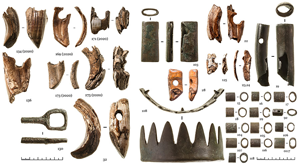
Cluster 1 contains the bones of at least five different horses (identified from non-repeating cranial elements) and some individual human bones (Figure 3). Most artefacts from this cluster are parts of horse tack, predominantly bits and parts of bits. Left upper boar tusks were located near the left (Figure 3: nos. 274, 276, 303) and the right parts of the mandible (Figure 3: no. 311) of horse FG-03, and an imitation of a right upper boar tusk made from antler was located nearby (Figure 3: no. 206). Broken lower boar tusks have been found only in cluster 1 (Figure 3: nos. 129, 136). Partial bronze bits were also recovered (Figure 3: nos. 203, 204); bit 204 was situated among the cranial bones of horse FG-02.
Plan (left) and detail (right) of finds from cluster1 – photoscale 50mm, drawing scale 10mm (figure by authors).

Two small belt fittings decorated in the Scythian animal style were also recovered (Figure 3: nos. 7, 138). These most likely belong to different sets of tack as they were found at a distance from each other. This style of decoration was in its very early stage at the time the burial was constructed in the ninth century BC. Together with some items from Arzhan 1, these small bronze artefacts are among the earliest manifestations of this artistic style.
Cluster 2 in sectors GH and HI
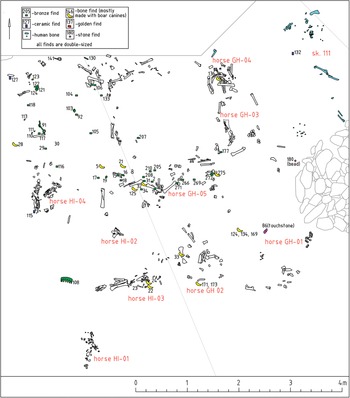
Cluster 2 contains the bones of at least nine horses and some individual human bones (Figure 4). The complex continues towards the centre of the kurgan. The relatively complete skeleton of a human female, estimated to have been 20–25 years old at death, was documented nearby (skeleton 111). The majority of finds in this cluster are bronze beads or clips with an oval cross section and an inner diameter of between 8–14mm. While we first interpreted these as belt fittings, residues inside the clips were identified microscopically as preserved birch (Betula sp.) wood. It is possible that the clips were originally part of a wooden structure, as they are distributed over an area of 2.5 × 3.0m.
Plan of cluster 2 (figure by authors).

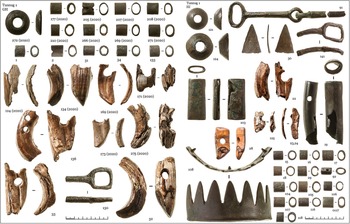
The cluster also includes two hollow cylindrical objects (Figure 5: nos. 19, 103), perforated semi-spherical bronze items (Figure 5: nos. 272, 121, 124), broken bits (Figure 5: nos. 130, 91, 141) and artefacts made from boar tusks and imitations thereof made from antler (Figure 5: no. 28), as well as several arrowheads (Figure 6: nos. 110, 113, 122). A bronze artefact with seven spikes and three loops, possibly for fastening, on the inside (Figure 5: no. 108) so far eludes interpretation. A fragment of a potentially similar artefact (Figure 5: no. 30) was found separately.
Finds from cluster 2: left) sector GH – photoscale 50mm; right) Sector HI – photoscale 50mm (figure by authors).

Finds from between the clusters of horse bones – photoscale 50mm (figure by authors).

Cluster 3 in sectors IJ and JK
Cluster 3 contains the bones of at least four horses and some individual human bones (Figure 7). The complex continues towards the unopened sector JK and towards the centre of the kurgan but seems to have been disturbed by later anthropogenic activity in its southern part, where two intact bits lay (Figure 7: nos. 80, 94). A piece of gold foil (Figure 7: no. 137) and worked boar tusks—both complete and fragmentary—are also likely to be part of the horse gear. The tusks (Figure 7: nos. 144, 145, 146) found near horse IJ-1 are probably part of the same set; as with horse FG-3, the tusks are located at the corresponding sides of the jaw and an additional tusk (Figure 7: 144) lies next to it.
Plan (left) and detail (right) of finds from cluster 3 – photoscale 50mm (figure by authors).

Artefacts between clusters
The spatial distributions of clusters 1, 2 and 3 are clearly distinguishable but some small finds occur in the spaces between. A bronze knife, a tanged bone arrowhead and two socketed bronze arrowheads are documented between clusters 2 and 3 (Figure 7: nos. 13, 96, 73, 75). The bronze arrowheads are of the same type as found in cluster 2 (Figure 7: nos. 110, 113, 122). Individual ceramic sherds were also located both inside and between clusters (Figure 7: nos. 9, 10, 11, 26, 115, 132, 133, 174, 182, 284). To date, this type of ceramic is unique to Tunnug 1.
Human and horse bones
The bones of both horses and humans from the clay surface of Tunnug 1 are in a fragmented state. In only one instance are the human bones articulated and in anatomical order (skeleton 111, Figure 4; see online supplementary material (OSM) Table S1 for a list of skeletal elements). No signs of skeletal trauma could be determined.
The abundance of horse bones allows for a more extensive analysis. Fragments of crania were found in all three clusters. The minimum number of individuals was determined based on cranial fragments and, where possible, we estimated the age and sex of the animals (after Levine Reference Levine, Wilson, Grigson and Payne1982 and Jones et al. Reference Jones, Jack and Evans2007) (see Tables S2 & S3). Table 1 summarises the results of this osteological analysis. At least 18 individual horses have so far been documented. Due to the fragmentary skeletal record, it is unclear whether some horses were female, but in all 10 cases where the sex could be determined, the horses are male. Most horses are between nine and 15 years of age. Three individuals are up to 20-plus years old, showing heavy wear of the teeth. Only one individual is younger (3–4 years old). Components from the entire equid skeleton are identifiable within each cluster (see Table S4) but, given the state of preservation, it is not possible to explore the association between specific cranial and postcranial fragments. Despite the fragmented state of the assemblage, there are enough skeletal elements in anatomical position to indicate that these were complete animals that were likely killed on site and deposited in situ.
Age and sex estimates of sacrificed horses (in years).

Indet. = indeterminate.
Radiocarbon dates
Despite the clear stratigraphic position of the horse bones within the architecture of the tomb, it was not clear how much time had passed between the construction of the larch log structure, the sacrifices and the covering of the mound in its stone casing. Horse bones were therefore sampled from each of the clusters for radiocarbon dating (Table 2) using the method described in Szidat and colleagues (Reference Szidat, Vogel, Gubler and Lösch2017) and modified according to Steuri and colleagues (Reference Steuri2023). Dates were calibrated with OxCal v4.4.4 (Bronk Ramsey Reference Bronk Ramsey2021) using the IntCal20 calibration curve (Reimer et al. Reference Reimer2020). Clusters 1 and 2 date to 820–780 cal BC (BE-17208.1.1) and 830–780 cal BC (BE-17210.1.1), respectively (both at 95.4% probability), a steep part of the calibration curve before the Hallstatt plateau. The sample from cluster 2 did not contain enough collagen to provide a reliable date. These dates are in line with results obtained by wiggle-matching from the wooden architecture of the tomb, c. 833–800 BC (95.4% probability) (Caspari et al. Reference Caspari, Sadykov, Blochin, Bolliger and Szidat2020). Therefore, our results provide high confidence that the burial and the horse bones both stem from the turn of the ninth and eighth centuries BC.
Radiocarbon dates for horse bones from each cluster.

Horse tack
Complete and broken bronze snaffle bits and drilled boar tusks make up most of the horse-tack assemblage. The most common item found near the sacrificed horses are drilled boar tusks and, in some instances, imitation tusks made from antler. The boar tusks show different arrangements of holes that likely relate to their function within the tack. A number of these items have also been recovered from Arzhan 1, where they are identified as ‘pendants’ (Gryaznov Reference Gryaznov1980). Based on their association with horse remains at Tunnug 1, we argue that their functionality is to be sought within the context of horse tack, though at present there is no clear correlation between the arrangement of holes and the position of the finds near the skull. In two cases, the tusks form a set, which remained roughly in situ associated with the mandibles of horses FG-03 and IJ-01 (see above; Figure 3: nos. 206, 274, 276, 303, 311; Figure 7: nos. 144–146). No other finds are associated with these crania, possibly indicating that the tusks were used for simple haltering or bridling.
Composition of copper-alloy items
The composition of each copper-alloy item was determined by x-ray diffraction analysis (see Table S5). There are noticeable differences in metal composition of artefacts stemming from different clusters of horse bones. Except for the bits and arrowheads, the alloy artefacts from cluster 2 are made of tin bronze. Artefacts from clusters 1 and 3 are mostly arsenic bronze. Most bronze items are fittings with traces of wood inside. Based on their location, the similar composition of the metal and residue analysis, it can be assumed that these fittings were part of one large item made of light and durable birch wood. Wood preservation in the layer is poor, so it is not possible to trace the remains of wooden structures but a cylindrical bronze object (Figure 5: no. 19) may be a fragment of a finial. Such objects are never found in the equipment of riding horses, but various kinds of pommels are known from chariot-related contexts, including Scythian contexts in the North Caucasus (Petrenko Reference Petrenko2006). The half-crown shaped artefact (Figure 5: no. 108) is also made of tin bronze and might have been used as part of a noseband. The three arrowheads from cluster 2 (Figure 7: nos. 110, 113, 122) and the two bullet-type arrowheads found between clusters 2 and 3 (Figure 7: nos. 73, 75) are cast from arsenic copper without the addition of tin.
Discussion
New finds from Tunnug 1 reveal important aspects of early Iron Age ceremonial horse use in southern Siberia and show an introduction of cultural practices from Bronze Age Mongolia. Although their origins are clearly recognisable, material culture and practices are reshaped in Tuva and morph into one of the first assemblages which can be considered to fit the concept of the ‘Scythian triad’—that is, the combination of Scythian animal-style items, weapons and horse gear widespread on the Eurasian steppes in the first millennium BC.
Horse remains
The three clusters of horse remains at Tunnug 1 differ slightly, both in terms of spatial distribution and stratigraphy, from contexts containing horses at Arzhan. In Arzhan 1, dating to the ninth or eighth century BC, horses were interred inside wooden chambers. Of approximately 100 of these chambers, nine contained horse remains and, in two instances, human bones accompanied the horse bones. At least 160 horses were sacrificed at Arzhan 1, most of which were mature males (Gryaznov Reference Gryaznov1980). DSK horse burials usually include a separate row of primarily adult male horses (Taylor Reference Taylor2017), while all horses interred in first millennium BC funerary contexts linked to the Pazyryk cultures in Mongolia and Kazakhstan are male and usually greater than 10 years of age (Lepetz et al. Reference Lepetz, Debue, Batsukh, Pankova and Simpson2020). A similar pattern in the selection of old male horses is observed at Tunnug 1. The inclusion of tack at Tunnug 1 further solidifies the close material connections with the royal tomb of Arzhan 1 that are apparent in the architectural structure of the mound (Caspari Reference Caspari, Baumer, Novák and Rutishauser2022).
Snaffle bits
Identification of typological variation in snaffle bits at Arzhan 1 sparked debate over whether these differences are rooted in chronological or social distinctions (Bokovenko Reference Bokovenko2000). The bits from Tunnug 1 also vary stylistically but are associated with radiocarbon dates that form a relatively narrow time window. This could mean that the bits mark synchronous tribal or familial traditions rather than chronological development, or simply that a diversity of configurations and materials were used to produce tack in this region during the first millennium BC. If each spatial cluster represents a different social grouping, this pattern might also explain the different composition of the copper alloys that correlate with the individual clusters of horses.
Dating of the monument
Radiocarbon dates from horse bones help to narrow down the date for the construction of Tunnug 1. Similar dates obtained from the bones and from the underlying larch log construction exclude the possibility of significant old wood effects and indicate that the entire tomb dates to the late ninth or early eighth century BC and is thus contemporary with Arzhan 1. The exact chronological relationship between the two major royal tombs of the early Scythian period remains unresolved but detailed dendrochronological studies will ultimately provide clarity. In conjunction with similarities in burial architecture, the ritual presence of numerous horses at Tunnug 1 reveals deep connections to the DSK complex (Sadykov et al. Reference Sadykov, Caspari and Blochin2020; Caspari Reference Caspari, Baumer, Novák and Rutishauser2022).
Scythian connections
Finds decorated in Scythian animal style are extremely rare at this early date. The two items uncovered on Tunnug 1 add to the limited corpus of materials which iconographically mark the transition from the Late Bronze Age to the Early Iron Age. The motif of a raptor head seen on the cuboidal bronze items (Figure 3: tng21-EF-0007 & no. 138) occurs more frequently in the steppes after the seventh century BC, providing further evidence of artistic and cultural links to the Scythian cultural horizon.
The positioning of horses and human bones on top of the burial mound is reminiscent of post-funerary rituals of the Scythians described by Herodotus (Rolle Reference Rolle1989: 28). The scattered horse and human bones in combination with remains of birch wood stakes suggest the creation of sacrificial installations of “spectral riders” (Herodotus, Histories 4.72; Godley Reference Godley1920). The physical evidence on the surface of Tunnug 1, albeit fragmented, strongly mirrors the description of these post-funerary rituals. The scattered nature of the remains are exactly what one would expect to see from such open-air installations. Unfortunately, the preservation of both bone and wood on the surface of the royal burial mound is poor, and thus the exact nature of the arrangement is still unclear. The arrangement of animal and human remains on Tunnug 1 might indicate, through shared rituals, deeper connections between southern Siberia and the ‘Scythians’ of the Pontic-Caspian steppe than previously assumed. The persistence of traditions might also be hinted at because they were chronicled by Herodotus in the fifth century BC, three or more centuries after the construction of Tunnug 1 (Ivanchik Reference Ivanchik, Gerasimova, Malashev and Moshkova2010). The above insights were revealed only due to improved excavation and documentation methods employed over the course of the past decade of research on the Eurasian steppes.
Conclusion
Domestic horses helped reshape the ancient cultural landscape of Inner Asia, facilitating the emergence of transcontinental connectivity and early equestrian cultural horizons, including the ‘Scythians’ described in classical texts. Our investigation of horse bones and tack from the site of Tunnug 1, associated with the earliest Scythian horizon in southern Siberia, suggests that elements of Scythian funerary ritual were already present in this region during the early first millennium BC, and may have derived from earlier antecedents in the Mongolian steppe. Typological variability in the tack at Tunnug 1 highlights the diversity of stylistic expression in bridles at this early period. Together, these finds demonstrate the emergence of pan-steppe cultural linkages, showing agreement between geographically dispersed etic written sources and archaeological material.
Acknowledgements
We wish to thank Y. Kapinus (Volga-Ural Center for Paleoanthropological Research, Samara) for providing anthropological definitions and K. Chugunov (Hermitage Museum, St Petersburg) for advice.
Funding statement
This research was funded by the Russian Academy of Sciences (FMZF-2022-0012, FMZF-2022-0014 and FMZF-2022-0016), the Russian Geographical Society (N 16/06/2021), the Russian Ministry of Culture (1205/12-20), the Schweizerischer Nationalfonds zur Förderung der Wissenschaftlichen Forschung (P400PG_190982), the Foundation for ArchaeoExploration and the Society for the Exploration of EurAsia.
Online supplementary materials (OSM)
To view supplementary material for this article, please visit https://doi.org/10.15184/aqy.2024.145 and select the supplementary materials tab.




 Open access

