





1. Introduction
The issue at stake in the philosophical debate on the problem of free will is, roughly speaking, the compatibility or incompatibility between determinism and agents’ power and control over their own choices. In a nutshell, the standard incompatibilist argument can be summarized as follows:
Premise 1. If an agent has free will, then it is necessary that the agent is able to do otherwise.
Premise 2. Determinism implies that the agent's actions are determined so that the agent cannot do otherwise.
Conclusion. Either the agent has no free will, or determinism is false.
The argument raises a dilemma: either determinism or free will must be dismissed. Dismissing determinism is not attractive: determinism is an implicit assumption in many fields concerned with the discovery of the general laws governing the human body, from physics, to chemistry, to molecular and cell biology. However, dismissing free will is problematic for all fields where the notion of agency plays a relevant role, from psychology, to ethics, to jurisprudence. If one dismisses free will, the attribution of deliberation and responsibility to agents becomes at least very controversial, if not completely unsustainable. Hence the problem of free will and determinism.Footnote 1
Compatibilists have attempted to avoid the dilemma by showing that determinism and free will are instead compatible. To this end, the two concepts have been spelled out in various and slightly different ways along the centuries and over a literature too vast to be comprised in a single paper. For additional background, we refer the reader to Christian List's recent paper Free Will, Determinism, and the Possibility of Doing Otherwise (List Reference List2014).
We refer to the paper by List for three reasons. First, it is clear and concise in its presentation and distinctions. Second, we find List's conceptualization and regimentation of the problem's premises both informative and convincing. Third, his proposed compatibilist solution to the free will problem is the subject of the first contribution of this paper: following a presentation of List's position in section 2, we argue – in sections 3 and 4 – that his proposed solution is inadequate in that it does not satisfactorily allow the agent to do otherwise. Section 5 turns to the second contribution: we show that both compatibilist and incompatibilist arguments invoking reduction or supervenience relations suffer from a foundational shortcoming. In essence, we argue that without a specific reduction or supervenience relation in place, the inferential tie between the premises of the incompatibilist argument above is not well-defined. By virtue of compatibilism and incompatibilism being positions concerning whether this inferential tie holds or not, these positions in turn inherit the foundational problem. Our argument is – to make an analogy upon which we will expound – that it is not meaningful to ask whether two premises allow the derivation of a contradiction when the premises are stated in different languages, but no translation is known. In section 6, we conclude with a discussion of the epistemological foundations of the free will/determinism debate, given the current status of the sciences.
2. List's compatibilism
As the ability to do otherwise is the keystone of Premises 1 and 2, it is where List commences his analysis. He identifies three main interpretations of such an ability: the traditional conditional interpretation, the new dispositional interpretation, and the modal interpretation.Footnote 2 To quote List, these three may respectively be summarized by (C), (D) and (M):
(C): If the agent were to try (or choose) to do otherwise, he or she would succeed in doing otherwise.
(D): The agent has the disposition to do otherwise when, in appropriate circumstances (to be spelt out further), he or she tries to do otherwise.
(M): It is possible (in a sense to be spelt out further) for the agent to do otherwise.
Although the conditional and the dispositional interpretations look more favorable to the compatibilist's counter-argument, List argues that only the modal interpretation properly captures the concepts of free will and free choice. We agree with List that both the conditional and the dispositional interpretation would only allow for a “watered-down” concept of the ability to do otherwise: although the respective concepts resulting from (C) or (D) might escape the incompatibilist argument, they do not do justice to the control over own actions needed for a proper account of e.g. moral and legal responsibility. For an account based on the modal interpretation to be successful, though, there is in (M) a notion of possibility to be spelt out further.
2.1. Physical possibility and agential possibility: a two-level model
Having interpreted modally the ability to do otherwise, List offers a sharpening of Premise 1 inserting a suitable substitution:
Premise 1. Free will requires that (at the time of interest) more than one alternative course of action is possible for the agent.
However, he notes that performing the same substitution in Premise 2 results in a misleading formulation:
Premise 2−. Determinism implies that (at the time of interest) only one alternative course of action is possible for the agent.
Premise 2− is misleading as proper determinism only concerns the notion of physical possibility, not a notion of possibility for the agent. Hence, List notes, Premise 2− is not validly inferable from the assumption of determinism.
A sharpening of Premise 2 that is validly inferable from determinism, List continues, is obtained through a distinction between physical possibility and agential possibility. For List, the distinction is a consequence of an underlying, independently motivated distinction between a physical level and an agential level of phenomena.Footnote 3 Loosely, the physical level is understood as constituted by physical states of the world described with physical properties such as atomic configuration, the action of specific forces, and the like: in short, the concepts of our current best physical theories. In contrast, the agential level is not specified by physical properties, but instead consists of agential states of the world, described with agential properties such as psychological dispositions, mental states, actions, and similar: in short, the concepts of our current best theories of agency.Footnote 4 With the distinction between physical states and agential states – of which List takes the former as primitive – comes, then, a disconnection between physical possibility and agential possibility.
2.2. Relating physical states and agential states
List further argues that for an analysis based on the notion of agential possibility to be of interest, it is essential to get the notion of agential possibility right. In his words:
The challenge, in particular, is to arrive at a notion of possibility that is neither too restrictive, nor too permissive. If it is too restrictive, for instance by inheriting all the restrictions that determinism imposes on physical possibility, then it seems hard for the possibility of doing otherwise to get off the ground in a deterministic world. If it is too permissive, for instance by admitting possibilities ruled out by our scientific understanding of the world, then the claim that the agent can do certain things loses its bite. (List Reference List2014: 160)
To obtain a reasonable notion of agential possibility, List then connects the physical level and agential level through two foundational tenets:
Multiple Realizability: Every agential state is typically realized by more than one physical state.
Supervenience: Every variation in the agential state implies a variation in the physical state, but not necessarily vice versa.
Each of these theses is given a formal rendition below.
2.3. Determinism, free will, and their compatibility
Given the distinction between physical possibility and agential possibility, we may faithfully to List's presentation use the following:
Definition 1: Physical Determinism. Physical determinism is satisfied if, given any state of the world, exactly one sequence of future states of the world is physically possible.
Pace this understanding of determinism, List maintains, Premise 2 should – to be validly inferable from Definition 1 – be rephrased as:
Premise 2*. Determinism implies that (at any given time) only one future sequence of events is physically possible.
Only Premise 2*, and not Premise 2−, is validly inferable from the assumption of determinism as only the former makes use of the appropriate notion of possibility.
Finally, to state List's argument in full, let us specify the second core concept involved in the dilemma:
Definition 2: Free Will. An agent has free will at a given agential state if it is agentially possible for her to do otherwise.
In a nutshell, List then argues for the compatibility of free will and determinism as follows:Footnote 5
(i) each agential state corresponds to a set of physical states (by supervenience and multiple realizability);
(ii) the future physical states are uniquely determined by the actual physical state, but the agent still has the possibility of doing otherwise at the agential level (compatibility of free will and physical determinism), because
(iii) although agential states supervene on physical states, agential states are not reducible to single physical states, since they are multiply realizable by physical states.
To see the full force of the argument and the intuitions on which it builds, further details are highly instructive. In List's paper, such additional details are provided by a formal model.
2.4. List's formal model
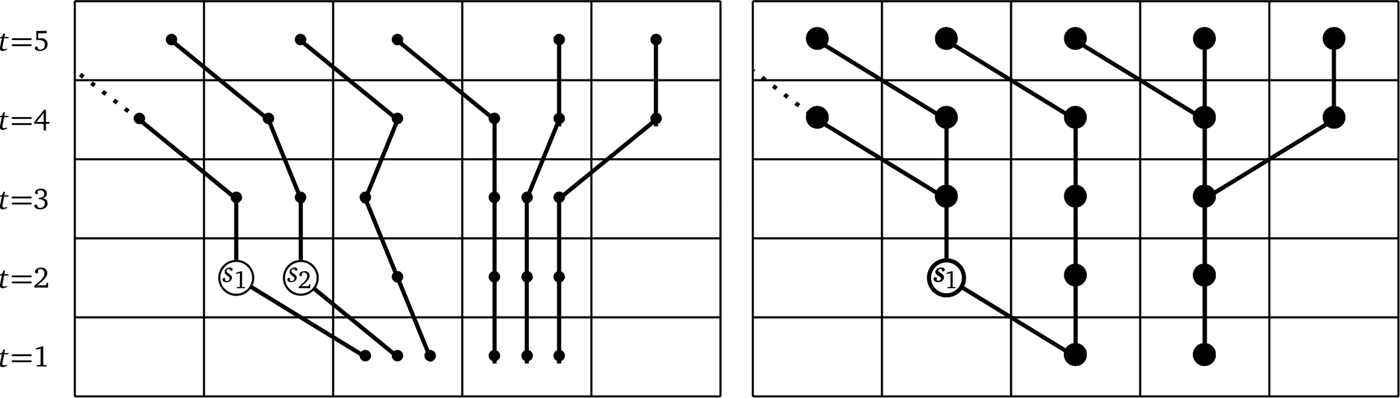
Formalization, where possible, often helps clarify ideas, and List promptly offers a formal model making his conception of physical and agential states and possibility – and their relationship through supervenience and multiple realizability – precise. Figures 1 and 2 illustrate the main constructions: Figure 1 shows how physical histories are built from physical states and time, while Figure 2 shows how agential states and histories are constructed from physical foundations.
Physical states and histories, with time on the vertical axis, history names at the bottom. Each dot represents a physical state (those in h 1 have been named) and each full sequence of dots connected upwards in time by a black line constitute a physical history. The time-indexed physical accessibility relation R t may be read off the physical histories: a history h′ is physically accessible (physically possible) from a history h at time t iff h′ and h are the same up to time t. Histories h 1–h 4 then satisfy the requirement of physical determinism, whereas h 5 and h 6 violate it: h 1–h 4 have unique physically possible futures, while h 6 is physically accessible from h 5 at time t = 2 even though the two histories are not fully identical.

Physical (left) and agential (right) states and histories. Each agential state is a collection of physical states: all those that occupy the corresponding box. I.e., the agential state s1 consists of physical states s 1 ands 2. The physical histories satisfy physical determinism, as no history branches – each physical state has a unique successor. This determinism does not carry over to the agential level.
As in the conceptual construction, the two-level model takes physical states to constitute the basis for agential states: taken as primitive is a set S of physical states of the world together with a set of times, T. Choosing T to be, e.g., the naturals ℕ results in discrete time, whereas the positive reals yield continuous time. No matter one's choice, List considers a physical history to be a map h assigning to every time point t ∈ T some physical state h(t) ∈ S. For simplicity, we assume discrete time: by identifying T with ℕ, we may identify each physical history with an infinite sequence of physical states s 1, s 2, … ∈ S. Physical histories are related through an accessibility relation indexed by a time parameter R t. A history h′ is then physically accessible (physically possible) at time t from the history h (written hR th′) if and only if h and h′ are the same up to time t. That h and h′ are the same up to time t means that  $h_t = h_t^{\prime} $, where h t and $h_t^{\prime} $ are the truncations of the two histories at time t. The physical accessibility relation R t is then an equivalence relation: it is reflexive, symmetric and transitive. Given this setup, determinism may then be defined formally as follows:
Definition 3: Physical Determinism. Physical determinism is satisfied if for all times t, for all physical histories h, h′, h and h′ are related at time t if, and only if, the histories are fully identical:  $\forall t\forall h, \;{h}^{\prime}( {hR_t{h}^{\prime}{\mkern 1mu} \Leftrightarrow {\mkern 1mu} h = {h}^{\prime}} ) $.
Turning to the agential level of the model, agential states are then defined as emerging from physical states, as illustrated in Figure 2. The situation is symmetrical at this level, sporting a set of agential states s, s′, … ∈ S, agential histories h, h′, … ∈ H, and a time-indexed agential accessibility relation Rt.
Crucially, the agential states are not primitives of the model: each agential state s is a set s = {s, s′, …} satisfying the requirement that no two agential states contain the same physical state – i.e., for all s, s′, if s′ ≠ s, then  ${\boldsymbol s}\cap {\boldsymbol {s}^{\prime}} = \emptyset $. Additionally, List makes the assumptionFootnote 6 that each physical state belongs to some agential state, i.e., that $\boldsymbolgcup\limits_{{\bf s}\in {\bf S}} {\bf s} = S$. Hence, S is a partition of S with each s an equivalence class. As a consequence of the definition of agential states, every variation in the agential state implies a variation in the underlying physical state, but not necessarily vice versa.
The foundational tenets that specify the relationship between the physical level and the agential level may now be defined formally as follows:
Definition 4: Multiple Realizability. An agential state s is said to be multiply realizable by exactly the physical states s, s′, … ∈ s.
Definition 5: Supervenience. An agential state s is said to supervene on exactly the physical states s, s′, … ∈ s.
Pertaining to agential accessibility, an agential history h′ is then agentially accessible at time t from the history h (written hRth′) if and only if h and h′ are the same up to time t, i.e.,  ${\boldsymbol h}_t = {\boldsymbol h}_t^{\prime} $, with ${\boldsymbol h}_t, \;{\boldsymbol h}_t^{\prime} $ truncations. The agential possibility to do otherwise (as used in the definition of free will) may now be given the following formal rendition:
Definition 6: Possibility of Doing Otherwise. The agent has the possibility of doing otherwise at time t in agential history h, i.e., at ht, if there is at least one alternative agential history h′ ≠ h agentially possible at time t, i.e., hRth′.
In List's two-level model, determinism at the physical level is consistent with free will at the agential level: agential histories can branch, in accordance with free will and the possibility of doing otherwise. A concrete example of the consistency of determinism and free will is shown in Figure 2: at time t = 3, the left-most physical history exhibits determinism while the agent has free will at the corresponding agential state.
3. Contra List
Before detailing his formal model, List is keenly aware that his analysis relies on getting the notion of agential possibility right, as per the quote above. Formally, his two-level model seems to adequately reach the desired middle ground. However, there is more to the possibility of doing otherwise than a many-to-one supervenience relation from agential states to physical states. For the model to shed light on the represented phenomenon, the mathematical definition of agential states and agential possibility needs to be accompanied by a philosophical interpretation. In this respect, we find List's treatment insufficient, as it provides no explicit interpretation. Below, we present two candidate interpretations before concluding this section with a general argument against the successfulness of his approach.
3.1. An epistemic interpretation
A first interpretation of agential states may be given in epistemic terms. The actual physical state gives rise to a unique agential state interpreted as the agent's range of uncertainty: the physical states on which the agential state supervenes are exactly those indistinguishable to the agent from the actual physical state.Footnote 7 All continuations of these physical states then give rise to agential states not ruled out as future states by the agent's current information. I.e., such agential continuations are deemed epistemically possible futures by the agent.
Now, even if the agent is constrained to bring about states in accordance with the actual physical history, alternative agential histories remain agentially possible. However, this arguably amounts to understanding free will as an epistemic illusion: there is but one alternative, be this known or not.
This interpretation seems at odds with List's position for at least two reasons. First, though List explicitly mentions the understanding of free will as an illusion (Reference List2014: 157), he does not ascribe to this position. Second, in discussing to forfeit Premise 1, List does not accept a notion of free will which never includes the ability of doing otherwise (Reference List2014: 157), and the illusory epistemic interpretation does just that.
3.2. An ontic interpretation
An alternative to the epistemic interpretation may be given in ontic terms as follows: the actual physical state gives rise to a unique agential state which defines the agent's range of choice – the agential states that the agent is able to realize (given the current agential state) are those supervening on physical states which are continuations of the current physical states on which the current agential state supervenes. In Figure 3, from the agential state s1, the agential states s2 and s3 are both within the agent's range of choice, whilst s0 is not.
A small model with physical histories depicted on the left and the corresponding agential histories depicted on the right. Some physical and agential states are named for easy reference in the text. The names are arbitrary.
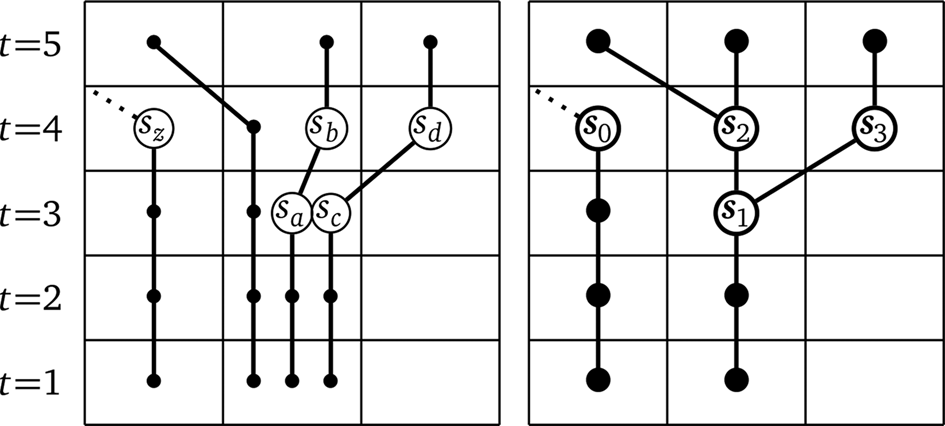
The question that then arises is in which manner the agent is able to choose s 2 instead of s 3 from agential state s 1. Specifically, suppose that the actual physical state of the world at time t = 3 is s a, thus specifying the physically determined history. At time t = 4, the physical state is then preordained to be s b. At time t = 3, both agential states s 2 and s 3 are possible for the agent – i.e., the agent has free will at s 1. For this free will not to be illusory, the agent should somehow be able to bring about s 3 – entailing that s d should be the actual physical state at time t = 4.
To ensure that s d is the actual physical state at time t = 4 seems problematic if not outright impossible. It could be achieved by the agent “fusing” physical histories – i.e., by making s d the uniquely physically possible state from s a, ceteris paribus. However, this would contradict List's definition of physical determinism, which implies unique pasts as well as unique futures – and the agent's choice would therefore bring indeterminism down to the physical level. To avoid fusing histories, s d and s b could be made to swap pasts – as to make s a the predecessor of s d and s c the predecessor of s b – but introducing the problem of what that agential ability consists in makes the free will/determinism controversy pale in comparison. Finally, the agent could make the actual physical state switch from s a to s c – i.e., switch the current actual physical world for one with a different history up to the time of choice, but again, it is far from transparent how such “history jumping” could be made a viable ability.
Broadly, each of these options seems highly unsatisfactory, all for the same reason: they require that the agent is able to change the fabric of physical possibility – contrary to List's stated desire to achieve a notion of agential possibility which is not overly permissive, cf. the above quote. Hence, it seems, the agent cannot bring about s d. If the agent cannot bring about s d, then the agent cannot bring about s3, meaning that – under the ontic interpretation – s3 is not agentially possible from s1. But then only s2 is agentially possible from s1 – in contradiction with the supposition that the agent has free will at s1. Hence, it seems, the ontic interpretation will not do either.
3.3. Variants of formal supervenience
Though there may be alternatives to the ontic and epistemic interpretations, none are evident from List's paper. Both the interpretations we suggested above fail to reconcile physical determinism with free will, but do so for different reasons: the epistemic interpretation waters down the notion of free will while the ontic interpretation still falls prey to an incompatibilist argument.
Focusing on the ontic interpretation – the interpretation we would find the more substantial – the model allows a precise framework over which one may pinpoint the unresolved tension between List's solution and the incompatibilist argument. The root of the incompatibilist objection depends on the retention of the link between the physical and agential levels, formally rendered by the many-to-one supervenience relation. This is not unique to List's model, but characteristic of the free will/determinism problem.
In the free will/determinism debate at large, supervenience has been suggested as a weakening of reductionism, capturing the relation between mental and physical states. In List's model, it is clearly seen how supervenience is the weaker assumption: where a supervenience relation is given by a map σ:S → S assigning to every physical state s ∈ S the agential state σ(s) = s that supervenes on it, a reduction would be a map ρ:S → S satisfying the additional requirement of being one-to-one: if s ≠ s′, then ρ(s) ≠ ρ(s′). Conceptually, by making the weaker assumption of supervenience, one could hope to circumvent the incompatibilist objection. However, if our analysis of List's model is correct, then it shows the shortcoming of the supervenience construction, when formally defined in the two-level model.
If (formal) supervenience is too strong to circumvent the incompatibilist objection, then it is natural to consider other formal alternatives. There are three assumptions in play. The first assumption is that the supervenience function σ may be many-to-one. Giving up this requirement is tantamount to instead requiring that σ is a reduction, hardly alleviating the problem.
The second assumption – made implicitly – is that σ is a total map: every physical state belongs to some agential state. This restriction can mathematically – and fairlyFootnote 8 – be given up by assuming σ to be a partial map instead: for some physical states, σ(s) may be undefined. However, this weakening does nothing to solve the problem: the same incompatibilist argument still applies whenever σ(s) is defined.
Third, by the assumption that each agential state s is a set of physical states s = {s, s′, …}, it follows that the supervenience map σ has to satisfy that for all agential states s, there is at least one physical state s such that σ(s) = s. I.e., the map σ is assumed onto. This requirement cannot – by virtue of agential states being defined as sets of physical states – be given up as easily as the previous two: it follows directly by the definition of agential states as realized by physical states that σ is onto. Thus, giving up this requirement amounts to giving up the definition of agential states as sets of physical states – that is, to formally disconnect the two.
In short, the first two alternatives are insufficient, while the third requires radical change to the fundamental construction of List's two-level model.Footnote 9
3.4. Formal supervenience is not sufficient for a reasonable account of agential possibility
A strong suit of List's two-level model is that it elegantly allows for a mathematically rigorous definition of the concept of supervenience, facilitating clear demarcations of physical and agential possibility, and of supervenience and reduction. The latter distinction is important also in the historical context, in that supervenience was classically introduced as a concept of dependency weaker than reductionism, cf. Davidson (Reference Davidson1970).
Our analysis of List's model shows that it is difficult – if at all possible – to reconcile formal supervenience over a deterministic system with free will, in a non-illusory manner: all but possibly the last variant of the supervenience relation considered above falls prey to the same incompatibilist argument. Of course, a suitable interpretation of the notion of agential possibility used in the modal interpretation of the ability to do otherwise may salvage the model, but as of yet, that piece of the puzzle is missing.
A more radical approach may be to formally disconnect agential states from physical states, as suggested by the third alternative above. This is to give up on supervenience, and, as a consequence, multiple realizability. Giving up supervenience may, according to List, be at odds with obtaining a reasonable modal interpretation of the ability to do otherwise: as per the quoted passage above, a notion of agential possibility unguided by physical possibility through supervenience may turn out to be too permissive. List hence argues that if agential possibility is unrestricted by physical possibility, the model may entail that the agent has the possibility – i.e., the ability – to choose things ruled out by our best scientific understanding of the world. Further, List continues, the model construction he offers is sufficient to ensure agential possibility is suitably restricted. As such, supervenience may be seen as a safeguard against a degenerate notion of agential possibility.
We agree that any model that would allow unreasonable agential possibilities is of no benefit, but do not see that supervenience achieves the proper restriction. In support of supervenience, it does rule out, e.g., the possibility of choosing unaided flight as a means of transport. However, it is not sufficient to rule out other unrealistic agential possibilities: agents’ skill sets, legal status and socio-economic constructs equally limit agential possibility – it is, e.g., not possible for either of the authors to perform Bach's Goldberg Variations, to run for the US presidential elections or to purchase Frank Zappa's Bosendorfer grand piano, even though current physical theories do not exclude these possibilities. Yet eliminating such options as candidates for agents to do otherwise is key in many of the domains where free will is of conceptual importance.
Down this path lies a general point: where free will, understood as the modally interpreted ability to do otherwise, is foundational to an agential theoretical apparatus, physical possibility is not the only candidate for modal primacy. Other notions of possibility yielding other restrictions on what agents are able to do may prove as – if not more – important for a well-founded notion of free will. But this is jumping ahead.
Before moving on to this general point in section 5, we first elaborate on the critique of the ontic interpretation in relation to the autonomy of the agential level from the physical level.
4. On the autonomy of the agential level from the physical level
In List's formal model – which we believe we have rendered fairly and accurately above – agential and physical states are thus not independent: agential states supervene on physical states. This assumption of List's model we above argued leads to determinism at the agential macro-level.
However, in a number of other passages, List explicitly argue for indeterminism at the macro-level, a necessary condition for the existence of free will. For example, he writes:
[T]he claim that the system's micro-state would be enough to fix all subsequent macrostates does not contradict macro-level indeterminism at all. It merely reasserts the already known fact that the system is deterministic at the micro-level. As an objection to macro-level indeterminism, it fails, because the definition of macro-level indeterminism does not – and should not – refer to the system's micro-states. Macro-level indeterminism means that the system's macro-state at a particular time does not determine the subsequent sequence of macro-states. This definition is unambiguously satisfied in [the relevant cases], and it is the right definition in light of the pluralistic case for considering each level on its own terms. (List Reference List2019b)
Given this, from List's perspective, our critique of the ontic interpretation of agential possibility may be thought to focus too much on lower-level considerations while not taking the autonomy of higher-level facts and properties from lower-level facts and properties sufficiently seriously.Footnote 10 This is most important, as such an autonomy could save both macro-level indeterminism and free will.
4.1. Actual states contradict actual macro-level indeterminism
In our opinion, however, the quote's interpretation of the formal model is untenable. Specifically, it is unwarranted to conclude from the formal model to the quote's claim:
Claim 1: That the system's micro-state fixes all subsequent macrostates does not contradict macro-level indeterminism.
Claim 1 may be read as either making a limited claim about List's two-level model, or as making a broader claim about the relationship between micro-states and macro-level determinism. We agree with the claim in the former context, but not in the latter.
Concerning Claim 1 as about List's two-level model, we agree it is correct. To formally argue this, macro-level indeterminism must be formally defined. We believe it is in the spirit of List (Reference List2014) to define it as the lack of macro-level determinism, with the latter defined using the same schema as in List's definition of physical determinism:Footnote 11
Definition 7: Macro-Level Determinism. Macro-level determinism is satisfied if for all times t, for all agential histories h, h′, h and h′ are agentially related at time t if, and only if, the histories are fully identical:  $\forall t\forall {\boldsymbol h}, \;{\boldsymbol {h}^{\prime}}( {{\boldsymbol h}{\boldsymbol R}_t{\boldsymbol {h}^{\prime}}{\mkern 1mu} \Leftrightarrow {\mkern 1mu} {\boldsymbol h} = {\boldsymbol {h}^{\prime}}} ) $.
Definition 8: Macro-Level Indeterminism. Macro-level indeterminism is satisfied if, and only if, macro-level determinism is not satisfied. I.e., iff for some time t, some agential histories h, h′, h and h′ are agentially related at time t, but the histories are not fully identical:  $\exists t\exists {\boldsymbol h}, \;{\boldsymbol {h}^{\prime}}( {{\boldsymbol h}{\boldsymbol R}_t{\boldsymbol {h}^{\prime}}{\mkern 1mu} \wedge {\mkern 1mu} {\boldsymbol h}\ne {\boldsymbol {h}^{\prime}}} ) $.Footnote 12
This definition of macro-level indeterminism implies that a model satisfies macro-level indeterminism if, and only if, there exists some time t at which the agent has the possibility of doing otherwise. Hence, under this definition of macro-level indeterminism, Claim 1 is correct: this is exactly shown by List's formal argument that, in his two-level model, determinism at the physical level is consistent with free will at the agential level (cf. section 2.4 above).
Concerning Claim 1 as making a general point about macro-level indeterminism, we do not find it warranted. The reason we do not find Claim 1 thus warranted stems from a lack in List's model of essential assumptions concerning the existence of an actual physical state, an actual agential state, and the supervenience relation between them. Adding minimal, intuitive assumptions about these matters to the assumptions of List's model contradicts that we enjoy actual macro-level indeterminism (Definition 10 below), which we find necessary for a non-illusory free will.
In its formal sense, as defined above, multiple realizability holds that each agential state is realized by the physical state(s) that it supervenes on. It is a precise set-theoretic relation, and its construction entails that when a physical state is given, then an agential state is uniquely specified in consequence. Beyond this, we claim that the temporal development described by List's model must satisfy the following two assumptions to be reasonable:
Actuality 1: At each time t, there is a unique physical state which in fact obtains (called the actual physical state at time t), and there is a unique agential state which in fact obtains (called the actual agential state at time t).
Actuality 2: At each time t, the actual agential state at time t supervenes on the actual physical state at time t.
We find Actuality 1 almost vacuous: denying it entails a system where either (i) there is no physical state (absurd), (ii) there is no agential state (and thus no agents, in which case the current debate is mute), (iii) two distinct physical realities obtain simultaneously in the same history (contradicting the model), or (iv) that some agent is in fact in two different agential states at the same time (absurd: for at least some property p, the agent would satisfy both p and ¬p).
We find Actuality 2 vacuous too, to the degree that it is difficult to argue for. Denying it entails that the in fact obtaining agential state needs not supervene on the in fact obtaining physical state. It must then supervene on other physical states, none of which, by Actuality 1, are in fact occurring. This consequence, while not in direct contradiction to any of List's assumptions, is so far removed from his desideratum that agential possibility should be reasonably restricted by physical possibility that it must be rejected.
Actuality 1 and 2, together with the assumptions of List's model, do not contradict macro-level indeterminism (Def. 8): it is consistent to satisfy all these assumptions simultaneously.
However, the assumptions are not consistent with actual macro-level indeterminism, which is important because it captures that the agent's choices may in fact make a difference as they may change what state actually comes about:
Definition 9: Actual Macro-Level Indeterminism. Actual macro-level indeterminism is satisfied if for some time t, some actual agential histories h, h′, h and h′ are agentially related at time t, but the histories are not fully identical:  $\exists t\exists {\boldsymbol h}, \;{\boldsymbol {h}^{\prime}}( {{\boldsymbol h}, \;{\boldsymbol {h}^{\prime}}\in {\boldsymbol A}{\mkern 1mu} \wedge {\mkern 1mu} {\boldsymbol h}{\boldsymbol R}_t{\boldsymbol {h}^{\prime}}{\mkern 1mu} \wedge {\mkern 1mu} {\boldsymbol h}\ne {\boldsymbol {h}^{\prime}}} ) $ where A ⊆ H is the set of actual agential histories.
The inconsistency may be argued as follows. Once the actual physical state is determined, the actual agential state is also determined: necessarily, by supervenience and multiple realizability, it is the only agential state supervening on the actual physical state. Actuality 1 and 2 then push this determinism through time: with the actual physical state determined, the actual future physical history is also determined (by physical determinism), and hence, by Actuality 1 and 2, all future agential states are determined. Therefore, at the macro-level, the development of the actual agential history is deterministic.
That actual macro-level indeterminism is impossible in the augmented model may be summarized by saying that in it the actual agential history is actually deterministic.
That the actual agential history is actually deterministic is, however, not in contradiction with the claim that multiple agential states are agentially possible from the actual agential state, per List's definition. Hence, again per List's definition, the agent may have free will in an actually deterministic agential history. But this shows that the notion of free will obtained by List's model is illusory: among the possible agential states, none but the pre-determined, actual successor to the actual agential state is actually realizable. Hence, in the matter of future agential states, there is little free choice.
4.2. On the plurality of levels
Beyond the formal model, List's recent works (List Reference List2014, Reference List2019a, Reference List2019b, Reference List2019c, Reference List2019d) also provide a broader theoretical perspective on the free will debate. In this over-arching theory, the model and its compatibilist claim are central, but do not stand alone. In addition to them, List contributes a general, non-formal view on the free will debate with which we very much agree. In particular, we agree with List that
[T]he physical level is just one among many different levels at which we may describe and explain the world, and other levels, such as the chemical, biological, psychological, and social ones, are no less important from a scientific perspective. (List Reference List2019b)Footnote 13
In consequence, the position on the free will problem we present below is not far from List's in its spirit and general premises. We support the idea that each scientific field has its own fundamental concepts and laws, that these make sense in the scientific field of pertinence, and that it is misleading to think that some notions are more fundamental than others: e.g., the fundamental notions of economics are to economics as fundamental as the fundamental notions of physics are to physics.Footnote 14 However, we do not agree that the formal two-level model renders this view in a complete and satisfactory way. The relationships it enforces between the physical and agential levels instead restrict the autonomy and independence of levels. On this point – which we turn to next – we believe a stronger disconnect is needed.
5. Translation before inconsistency
To shortly recap, List bases his compatibilist solution on the following rephrased premises of the incompatibilist argument:
Premise 1: Free will requires that (at the time of interest) more than one alternative course of action is possible for the agent.
Premise 2*: Determinism implies that (at any given time) only one future sequence of events is physically possible.
As List points out, these premises are not directly contradictory and may hence allow a solution to the incompatibilist argument.
The problem we see in List's proposal is, then, that when the two premises are combined with the additional assumption of his formal supervenience, the incompatibility problem reappears. It might seem, therefore, that we reach a (second-order) dilemma: either forgo supervenience and accept some version of dualism, or face the classic dilemma of choosing between free will and determinism.
However, a third option is possible: to accept that physical theories, biological theories, agential theories and other scientific theories are informative about specific aspects of their respective phenomena of study, while taking the epistemologically humble position that until we are presented with a concrete explication of how any of these theoretical domains relate, we cannot worry about their mutual inconsistency.
A direct argument for this position may also be made. To illustrate the general point, we use a simple analogy. For effect, consider the following sentences:
• Sofia er ungmø
• Sofia è sposata
Are they compatible? One might be uncertain about the answer, if not in possession of the necessary knowledge of the two languages involved. What is missing is the “reduction” of the two sentences to a single, common language: only having a translation from Italian to Danish (or vice versa) allows one to reach a conclusion. Merely knowing that a translation exists is not in itself sufficient: we hope the reader is incompetent enough with one of the two languages to feel uncertain about evaluating the sentences’ compatibility, thereby illustrating the point. What is necessary in order to obtain an answer is a specific translation to some common language: before acquiring a suitable dictionary, it makes little sense to commence an analysis of the sentences’ compatibility.
In analogy, applying this ‘common language requirement’ to the incompatibilist argument amounts to requiring the existence of two statements
1. Free will implies X
2. Determinism implies Y
where X and Y are of the same language, where (a) and (b) acceptably captures the premises of the incompatibilist argument, and where X and Y may be shown to be mutually inconsistent.Footnote 15
In this light, List may be seen as arguing for the case that the incompatibilist argument stated in the Introduction violates this ‘common language requirement’ (cf. List Reference List2019c). Premises 1 and 2 are only superficially of the same language, but in fact, the notion of possibility used in the two premises comes from different languages: one is from the language of agential theories, the other from the language of physics. Having thus eliminated the prima facie inconsistency, List specifies the precise relation – the “translation” – between the physical and the agential domains. This relation, we have argued, is what allows for the reemergence of the incompatibilist argument.
5.1. An implicit premise
For the claims that free will and determinism are compatible or incompatible, it is necessary to have a common ground allowing for precise explications of the required definitions, premises, and a proper consistency check. That such a common ground not only exists, but is additionally assumed known, is an implicit premise of the incompatibilist argument:Footnote 16
Premise 3. A relation between agential states and physical states is given, and this relation entails that physical determinism excludes that more than one alternative course of action is possible for the agent.
Premise 3, though, is not easy to satisfy. To conclude whether free will and determinism are compatible or not, a unified theoretical framework for physical and agential states must be presented. With determinism a notion pertaining to the ontology of physics and free will pertaining instead to the ontology of the agential sciences, a general bridge between these domains is required to evaluate their (in)compatibility. In linguistic terms, ‘determinism’ is well-understood in the language of physics, while ‘free will’ is so in the language of the agential domain. To evaluate their (in)compatibility, a translation between the two is needed.
In the incompatibilist argument, this bridge – this translation – is assumed to be in existence, often in the form of some reduction or supervenience relation with a model of physics as the fundamental common ground. However, as argued, the mere existence of the bridge (itself a matter of debate) is not sufficient for the claims of compatibilists and incompatibilists to be well-founded – and a concrete rendering is something the current state of the art is very far from achieving.
5.2. Dogmatism or abstentism
We are then faced with two alternatives concerning the bridge between the agential and physical domains – be it a reduction, a supervenience relation or something else entirely. The first is, it seems, the mainstream in the debate: dogmatically maintain the assumption that a bridge exists. The second embraces a more radical uncertainty: abstain from the assumption of a bridge's existence.
In the first case, the compatibilism/incompatibilism debate is not settled until the specific nature of the assumed existing bridge emerges, but the dogmatic position retains the bivalent logic of the issue: compatibilists and incompatibilists may continue to argue about which nature of the bridge would settle the question one way or the other. If a proper bridge is established, these speculations may then possibly fill the intermediate steps in concluding the consistency or inconsistency of free will with determinism.
The second case is epistemically more cautious: by accepting that the question of the bridge's existence may well remain unresolved, one accepts that the epistemic foundations for settling the debate may be unattainable, thereby abstaining from passing judgments based on what may be linguistic confusion. As such, it presents a conciliatory position, one embracing the current uncertainty and accepting that our epistemic limitations may never provide us with a unified picture of the world we perceive.
Such reconciliation may come across as an unsatisfactory position, as it does not seek to settle in favor of one party or the other – it is not a reconciliation of free will and determinism, but a reconciliation with the idea that it may be epistemically infeasible to provide our softer agential concepts with a hard physical foundation.Footnote 17 However, it would be rash to construe the position as dismissing the problem out of hand. On the contrary, it questions the foundation of the debate from a general epistemological perspective.
6. The dappled world
Human understanding rests on conceptualization; we categorize, systematize, seek patterns. When pursued in a structured and rigorous manner, the product is a model of the phenomenon under consideration. The sciences – the empirical sciences in particular – are in essence model construction and evaluation.
Stemming from their vastly different subject matters, the sciences work with different levels of abstraction, from physics’ elementary particle and forces, to biology's cells and organisms, to the humanities and social sciences’ concepts of free will, responsibility and legal persons. Throughout time, a desire for understanding the relations between these different levels of abstraction has informed philosophy of science.
The free will/determinism debate is an example of a clinch between two layers of abstraction: the concept of determinism belonging to the realm of physics and the concept of free will to that of agential theories (as List argues convincingly). Were these levels bridged, the problem would be dissolved. At the problem's core, then, lies the epistemological desire that the two concepts should not merely coexist, but coexist in a unified model.
Such a desire for unity is widespread, exemplified most vividly by the unity of science thesis: in principle, a joint, consistent and exhaustive model can be produced encompassing all the scientific disciplines.Footnote 18 Quine, for instance, may be seen as subscribing to this thesis, and his epistemological holism in Two Dogmas of Empiricism shares a presupposition with the free will/determinism debate (Quine Reference Quine1951). In the Two Dogmas, Quine describes our system of knowledge as a corporate body, jointly facing the tribunal of experience, for which he posits that in incorporating new information into this body, we do so by eliminating inconsistencies while retaining our most entrenched notions. This position outright requires the possibility of a meaningful and coherent treatment of our current body of knowledge from across the disciplines. This is not to say that his position requires that the sciences have indeed been unified – the requirement is weaker: our current knowledge must be presented in a manner that allows for the discovery and resolution of internal inconsistencies. This, then, is the shared presupposition: both Quine and the compatibilist and incompatibilist positions presuppose that between the claims of the relevant disciplines, there exists a notion of inconsistency. However, for a notion of inconsistency to be well-defined, it is a prerequisite that the disciplines’ concepts are inter-translatable. Without translations – without having a specified bridge between the differing ontological domains – applying the concept of consistency is void of meaning.
The current state of the scientific disciplines do not in general satisfy this presupposition. Examples are legion: general intelligence is not well-understood algorithmically, there is no accepted notion of life given in terms of chemical processes, and general relativity and quantum mechanics are yet to be harmoniously unified. It is unfounded to think of the current state of science as a unified whole, as a unique and coherent construction. As Cartwright describes the scientific status quo in The Dappled World: A Study of the Boundaries of Science:
Science as we know it is apportioned into disciplines, apparently arbitrarily grown up; governing different sets of properties at different levels of abstraction; pockets of great precision; large parcels of qualitative maxims resisting precise formulation; erratic overlaps; here and there, once in a while, corners line up but mostly ragged edges; and always the cover of law just loosely attracted to the jumbled world of material things. (Cartwright Reference Cartwright1999: 1)
The view that the sciences at status quo are not unified is, we suppose, utterly uncontroversial. More controversial is the stronger thesis of the disunity of science, that inherently, metaphysically, the sciences stand disunited – a view advocated e.g., by Dupré (Reference Dupré1993). Between the unity and disunity extremes lies soft agnosticism: instead of assuming the existence or impossibility of suitable ontological bridges, one does not a priori commit to either position.
Pertaining to the problem of free will and determinism, the three positions then place themselves as follows. The unity of science thesis entails the dilemma, and conversely, holding either a compatibilist or incompatibilist position implies, by the argument from translation, a commitment to at least a weak unity of science metaphysics.Footnote 19 The disunity of science thesis dissolves the problem in that the two main concepts involved are ontologically disconnected by belonging to different scientific realms – by assumption. A soft agnosticism – to currently not commit to either extreme – merely entails that as things stand, we are not in an epistemic position suited to meaningfully discuss the problem.
Free will is a fundamental building block of the humanities, the social sciences, and more broadly of the core institutions of society. Without free will, subjectivity, rationality and responsibility are void notions. As a theoretical concept, it belongs to the fields of law, psychology, economics, and other agential domains. Determinism, on the other hand, is fundamental to the discovery of general laws, belonging in its well-established form to the field of physics. At present, no satisfactorily detailed translation between these two domains is known. Accordingly, questions concerning the determinism of an agent's actions are as ill-posed as questions concerning the free will of an atom: atoms might or might not have free will, but until we have a clear conception of free will in terms meaningfully applicable to atoms (i.e., in the language of physics), the question is nonsensical. Symmetrically, asking about the physical determinism of agents’ actions is – at the present – nonsensical: it leads to linguistic confusion to transfer isolated concepts between not yet bridged fields. We should recognize that questions that implicitly or explicitly make this move are asking too much of our current epistemic state.



 Open access

