


Introduction
The oldest metallurgy of pre-Columbian America originated and evolved in the Andes, reaching high levels of technical sophistication. Well-known examples of this craftsmanship (e.g. Moche, Chimú, Quimbaya and Muisca) derive from various regions of innovation in South America (Lleras Pérez Reference Lleras Pérez2007, Reference Lleras Pérez2010; Lechtman Reference Lechtman, Roberts and Thornton2014); even the pre-Hispanic metallurgy of Mexico originated from the Andes (Hosler Reference Hosler1999). The discovery of interesting metallurgical experiments in the Peruvian Andes (Lechtman Reference Lechtman, Roberts and Thornton2014: 369–70) has reinforced the popular idea that the early technical advances all took place in Peru. Furthermore, as complex societies later emerged in what is now the Central Andean region, there is a tendency to assume that all technological innovations did too. This is part of an enduring neo-evolutionary mindset that assumes that all of these changes co-occurred, even though some of the evidence appears to contradict it (e.g. this article). The assumption of a Peruvian origin may indeed explain why attention has been rarely directed to early archaeological evidence for metalworking from north-west Argentina. Despite many years of research, little is known about the roots of this ancient technology, as early evidence of copper metallurgy in the Central Andean region is rare. Although overlooked in the relevant literature (Lechtman Reference Lechtman, Roberts and Thornton2014: 369), some crucial evidence points towards communities of the southern Andes—specifically north-west Argentina and northern Chile—as being among the precursors of this technology. Several archaeological discoveries identify the Southern Andes as an area of innovation that made important contributions to the metallurgical traditions of the broader region (González Reference González and Benson1979, Reference González1999, Reference González and Goretti2012; Núñez Reference Núñez1999). The fact that some of the most important copper mines are located in Argentina, Chile and Bolivia provides additional support for this argument.
The discovery of an anthropomorphic copper mask in a funerary context dating to 3000 years BP—a time of transition from mobile hunter-gatherer bands to agro-pastoral villages (Aschero Reference Aschero, Nielsen, Rivolta, Seldes, Vázquez and Mercolli2007)—leads the present authors to argue that the Cajón and nearby valleys were an important focus of copper metallurgy, and that the mask itself represents a very early tradition of metalworking in north-west Argentina. This mask is the oldest intentionally shaped copper object recovered from the Andes, with an associated radiocarbon date that suggests that metalworking technology did indeed originate in more than one region of the Andes.
The anthropomorphic mask
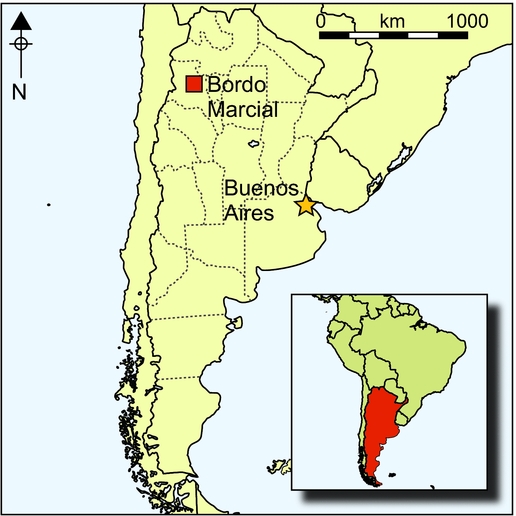
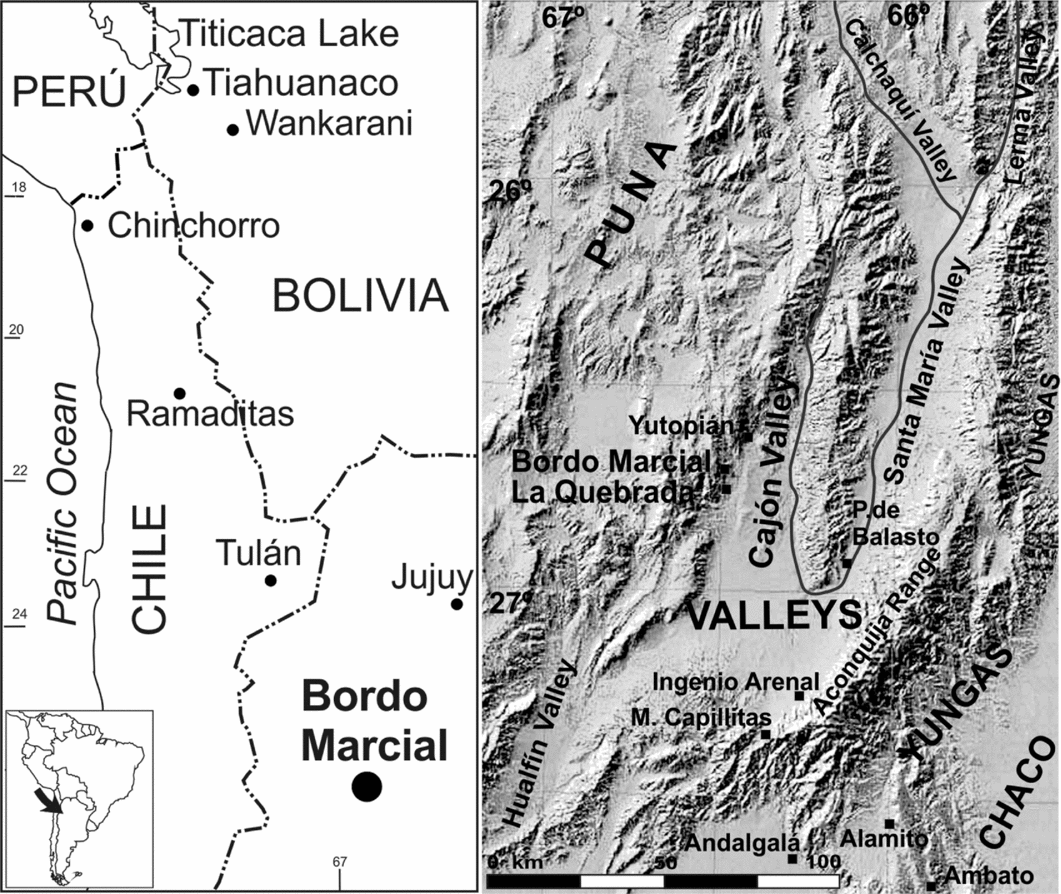
In April 2005, after the summer rainy season, local residents from the small village of La Quebrada (Cajón Valley, Catamarca Province) (Figure 1) found an exceptional metallic mask protruding from the ground surface, along with several human bones (Figure 2). Alerted to this fortuitous discovery, our archaeological team—which has been working in the area since 2004—conducted an excavation to identify the context. The burial was situated on a prominent point of the landscape, at a short distance from the archaeological site of Bordo Marcial, c. 1800–1900 14C yrs BP (Scattolin et al. Reference Scattolin, Cortés, Bugliani, Calo, Pereyra Domingorena, Izeta and Lazzari2009), an early agricultural village of the Formative period (c. 1500 BC–AD 600) (Korstanje et al. Reference Korstanje, Lazzari, Basile, Bugliani, Lema, Pereyra Domingorena and Quesada2015).
The archaeological site of Bordo Marcial in the La Quebrada locality, north-west Argentina, southern Andes.
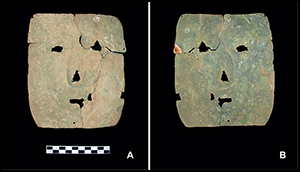
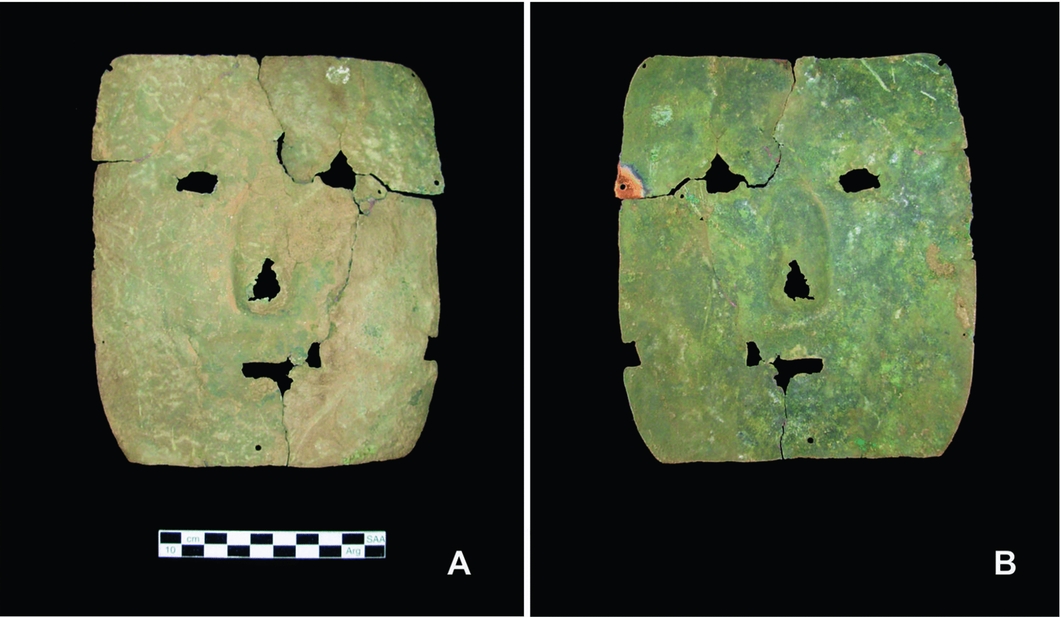
3000-year-old copper mask: A) front; B) reverse. Some of the small circular perforations near the edges are identifiable.
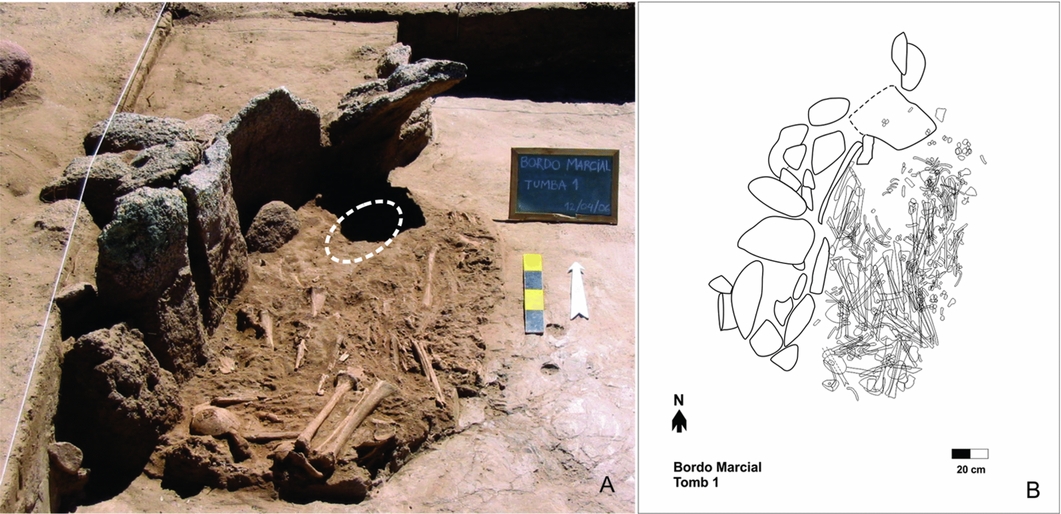
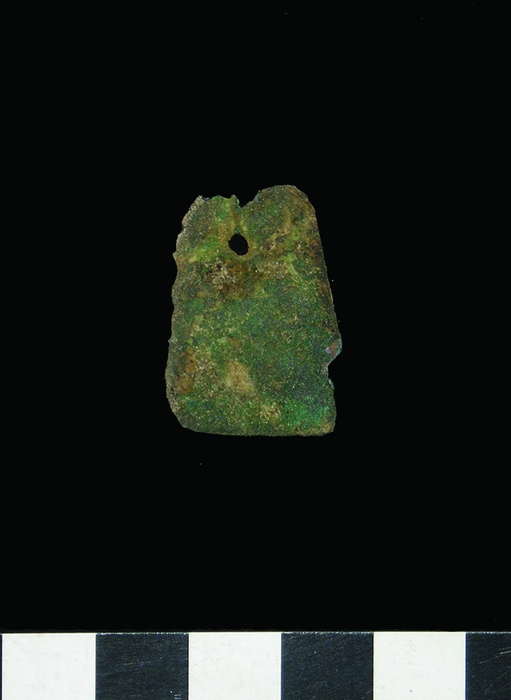
The excavation revealed a collective burial of at least 14 individuals, including both female and male adults, and children of different ages. The human remains were fragmented, commingled and disarticulated (Figure 3). The mask had been placed on top of remains at the northern corner of the interment. Several skeletal elements were stained with the characteristic green colour of copper carbonate, thus confirming the association of the skeletons and the mask. Human remains (a second permanent superior left molar) directly associated with the mask were dated by AMS to 3001±49 14C yrs BP (AA-82256: 1377–1010 BC at 95.4%; date modelled in OxCal 4.2, using SHCal13 calibration curve (Bronk Ramsey Reference Bronk Ramsey2009; Hogg et al. Reference Hogg, Hua, Blackwell, Niu, Buck, Guilderson, Heaton, Palmer, Reimer, Reimer, Turney and Zimmerman2013)). On its western side, the tomb was delimited by a single-row, slightly concave, stone wall. Adjacent to this, another stone wall delimited a second burial. This burial belonged to a young child of approximately 8–12 years of age, associated with a small stone bead and a perforated pendant, also thought to be made of copper (Figure 4). The child was dated to 3057±50 14C yrs BP (AA-82257: 1414–1087 BC at 95.4%), hence both tombs were found to be statistically contemporaneous.
A) Bordo Marcial tomb 1 and localisation of the mask; B) drawing scheme.
Pendant, probably made of copper, dated to 3057±50 14C yrs BP, from Bordo Marcial, north-west Argentina.
The mask was 180mm high, 150mm wide and 1mm thick. Anthropomorphic traits—eyes, nose and mouth—were created by repoussé from the reverse (rear face) of the mask. Nine small circular perforations were made near the edges of the piece, set out in groups of two on each side, at the superior corners, and on the middle, bottom and top margins. These perforations suggest that the mask could have been attached with threads, or may have been part of a more complex object composed of other materials that have not survived. A perforation for a repair is evident near the left eye. The mask is fractured and covered by a layer of corrosion resulting from natural weathering. To preserve the integrity of the object and prevent further damage to the mask, it was decided not to remove this layer. Results of the analyses performed on the mask, as well as a brief review of other comparable archaeological evidence, are considered in the following sections.
Chemical composition and manufacturing technique
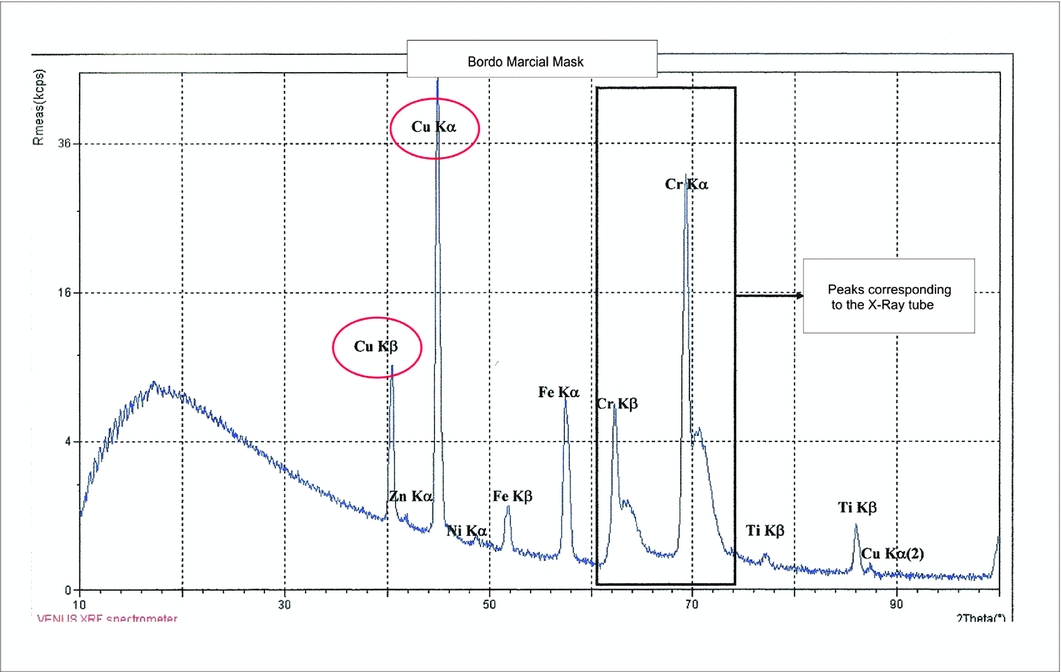
The chemical composition of the mask was determined by energy-dispersive X-ray spectroscopy (EDS), wavelength-dispersive X-ray spectroscopy (WDS) and X-ray fluorescence (XRF). EDS analyses were performed with an EDAX Phoenix 3.2 detector in a scanning electron microscope (Philips SEM 515). WDS analyses were performed with a CAMECA SX 50 electron microprobe. XRF analyses used a WDS X-RayFluorescence Spectrometer Venus 200 Minilab Panalytical. Analyses were conducted by specialists at the Department of Materials-GAEN and the Chemistry Activity Unit at the Comisión Nacional de Energía Atómica (CNEA), Argentina. Measurements were made on a 2mm2 surface of the mask, following exposure by mechanical polishing on the rear face of the piece. Semi-quantitative EDS analysis showed the single presence of copper (Cu). WDS analysis, with detection limits between 100 and 500ppm, tested for the presence of tin (Sn) and arsenic (As). The presence of either (or both) elements would indicate intentional alloying to create bronze—a technique most commonly employed during pre-Hispanic times in north-west Argentina (González Reference González2004). A ternary copper-arsenic-nickel (Cu-As-Ni) alloy has also been detected in both the Bolivian Altiplano and northern Chile, the examples being associated with later Middle Horizon contexts (Maldonado et al. Reference Maldonado, Rehren, Pernicka, Núñez and Leibbrandt2013). WDS analysis ruled out the presence of arsenic. Of a total of ten measurements for tin, only one signalled the occurrence of this element within the limit of detection, indicating that if the artefact did contain tin, it must be in quantities of less than 500ppm. To determine whether tin was present, XRF trace detection analysis was performed. This revealed no tin to be present (Figure 5), thereby ruling out its intentional use as an alloy. Results concluded that the mask was made of pure copper. These analyses, however, could not determine the original mineral, whether native copper or a combined copper ore.
X-ray fluorescence spectrum results. Copper (Cu) peaks in red; chromium (Cr) peaks correspond to the X-ray tube. Small amounts of titanium (Ti) and iron (Fe) could be due to superficial contamination from the soil. Nickel (Ni) and zinc (Zn) peaks could indicate small quantities of impurities within the metal. As the measurement was taken on the surface, it is impossible to quantify these traces.
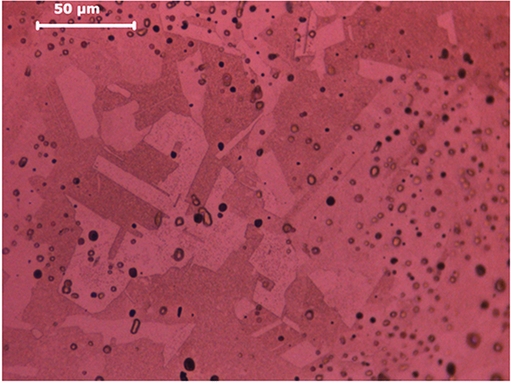
To understand the manufacturing method, optical metallographic studies using an OM-Olympus BX60M optical microscope were performed on two sections of the reverse side of the mask. The observed microstructure corresponds to recrystallisation grains with the typical annealing twins (Figure 6). This is the classic outcome of copper subjected to a process of alternate hammering and annealing (Scott Reference Scott1991). The extensive corrosion, affecting the entire thickness of the mask, hampered the possibility of revealing other details of the manufacturing process, such as the specific procedure employed to make the small perforations on the edges, or the tools used to cut and shape the edges of the plate.
Microstructure of heating and hammering technique, showing the recrystallisation grains with the typical annealing twins. Black dots are the remains of corrosion crust.
The mask in a socio-historical context
In the wider context of Andean archaeology, the copper mask from the Cajón Valley stands out due to its early date. In north-west Argentina, the second millennium BC witnessedsubsistence diversification through the introduction of plant cultivation and camelid domestication. This period marked a transition from the specialised hunter-gatherers of the Archaic Period to the early farming villages of the Formative Period (Aschero Reference Aschero, Nielsen, Rivolta, Seldes, Vázquez and Mercolli2007). In the puna—the high plateau between northern Chile and Argentina—this stage of incipient pastoralism was characterised by a low-density, sparsely distributed population, reduced residential mobility, craft specialisation, weak social hierarchies and long-distance exchange networks (Yacobaccio Reference Yacobaccio2004). Evidence indicates that a major environmental change had, by the Middle Holocene (8400–5200 BP), encouraged modification in hunter-gatherer mobility patterns, pre-dating both the appearance of llama (Lama glama)-sized animals and the construction of corral structures that suggest the keeping of camelids in captivity (Yacobaccio Reference Yacobaccio2003). Archaeological evidence from this period is generally associated with sites in caves and rockshelters, some of which were modified by simple stone walls. It is assumed that these relatively mobile groups participated in extensive artefact and raw material exchange, which connected all environments from the highland puna to the chaco eastern lowlands (Aschero Reference Aschero, Nielsen, Rivolta, Seldes, Vázquez and Mercolli2007; Aschero & Hocsman Reference Aschero and Hocsman2011). In north-west Argentina, the adoption of pottery occurred roughly at the same time as in the South Central Andes (Hoopes Reference Hoopes1994). Experimentation with pottery manufacture was already underway by 3830±50 14C yrs BP (Cremonte et al. Reference Cremonte, Botto, Canafoglia, Hocsman, Rodríguez, Aschero, Gazzoli, Bertolino, Cattáneo and Izeta2010). While early findings of proper pottery are dated to 3600–3300 14C yrs BP (Muscio Reference Muscio2004; Martínez et al. Reference Martínez, Mauri, Mercuri, Caria and Oliszewski2013), the more widespread daily use of this material throughout the puna, the arid valleys and the humid yungas of the eastern Andean slope was established around 2500 14C yrs BP, along with the sedentary agro-pastoral lifestyle.
An important element of the archaeological record of the second millennium BC in north-west Argentina is the appearance of isolated, usually unfurnished human burials. Nonetheless, there are rare cases of preserved basketry, cordage and personal stone and shell ornaments. The survival of this material is usually due to the exceptional preservation conditions within caves. There are no ceramics associated with tombs of this early age, although metal objects are occasionally included as part of these burial assemblages. The copper mask of Bordo Marcial is a predecessor to the tradition of stone anthropomorphic masks in the valleys of north-west Argentina (mainly in the Catamarca and Tucumán Provinces), where more than 50 specimens have been found. Due to extensive looting, only three of them have provenance data: these were stone funerary masks dating to c. 2500–1500 14C yrs BP. In Jujuy Province, a smaller group of silver and gold masks were found in association with human burial contexts (Scattolin et al. Reference Scattolin, Bugliani, Cortés, Pereyra Domingorena and Calo2010), and dated to c. 1500–900 14C yrs BP.
Although not strictly comparable, certain Chinchorro burial techniques from the northern coast of Chile should be mentioned here, as they may represent the only South American precedent for the use of copper sheets as masks. Mummies recovered from the sites of Pisagua Viejo and Patillos had their faces covered with “green facial masks, the products either of soil rich in copper or of corrosion of thin ornamental sheets of presumably native copper” (Arriaza Reference Arriaza1995: 51). The Chinchorro mummies date from c. 8000–1500 BC (Arriaza Reference Arriaza1995), but the precise chronology of these green masked mummies is still unknown.
Early evidence of copper metalworking in the Andes
The oldest evidence for Andean metalworking consists of several laminated native gold sheets shaped as beads from the northern Titicaca area of Peru, and has been dated to 3733±43 14C yrs BP (Aldenderfer et al. Reference Aldenderfer, Craig, Speakman and Popelka-Filcoff2008). Slag from copper smelting is reported from Wankarani contexts (Bolivian Altiplano) dated to between 3160±110 and 2200±80 14C yrs BP (Ponce Sanginés Reference Ponce Sanginés1970: tab. 2, fig. 35). Fragments of laminated copper have been reported from Mina Perdida, Valle del Lurín (Burger & Gordon Reference Burger and Gordon1998). Associated dates of 3120±130 and 3020±100 14C yrs BP indicate that these are approximately contemporaneous with the tombs of Bordo Marcial yet, as the authors state, “none of the artifacts had been intentionally shaped into a recognizable form, nor were any perforated or shaped into three-dimensional objects” (Burger & Gordon Reference Burger and Gordon1998: 1109). In northern Chile, Núñez et al. (Reference Núñez, Cartajena, Carrasco, De Souza and Grosjean2006: tab. 2) highlight evidence for mining and metallurgical work during the Tilocalar Phase (3140±80 14C yrs BP to 2380±70 14C yrs BP), in the form of the “presence of a maray [masher], mining and milling hammers, cast copper, and abundant presence of milled copper ore” (Núñez et al. Reference Núñez, Cartajena, Carrasco and De Souza2005: 303, our translation). Also in northern Chile, Tulán 55 has yielded remains of ground copper mineral, and smelted and hammered copper sheets. This site dates to between 3010±40 and 2700±100 14C yrs BP (Núñez et al. Reference Núñez, Cartajena, Carrasco, De Souza and Grosjean2006: 96–97), although the association of the radiocarbon dates with the metal pieces is uncertain (Table 1). A pin on smelted copper modelled in the form of a snake, dating to 2855±85 14C yrs BP, was discovered in grave 75 at the Azapa 71 site in northern Chile (Núñez & Santoro Reference Núñez and Santoro2011: fig. 10a). A copper spoon from Tulán 85 was dated to 2660±80 14C yrs BP, while laminated gold objects from Tulán 54 yielded dates of 2490±80 and 2630±70 14C yrs BP (Núñez et al. Reference Núñez, Cartajena, Carrasco, De Souza and Grosjean2006). The Cardón Mocho site in the Hualfín Valley of north-west Argentina (approximately 100km south-west to Bordo Marcial), provided fragments of a copper plate associated with a cemetery. The fragments yielded a radiocarbon age of 2550±60 and 2000±60 14C yrs BP (Desántolo et al. Reference Desántolo, Lamenza, Drube, Dulout, Guichón, Calandra, Salceda, Sempé, Rodríguez and López2015: 264).
The oldest evidence of Andean metalworking before 3000 14C yrs BP.
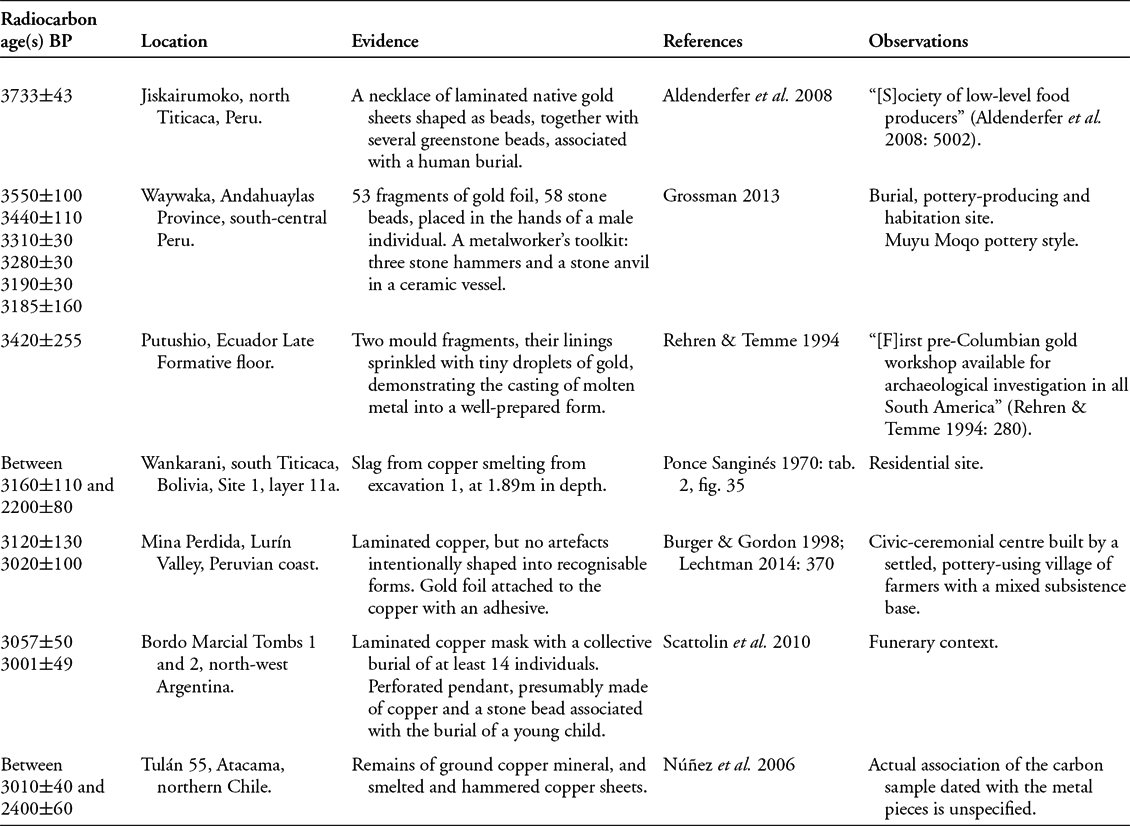
Evidence for metalworking activity was found at the Ramaditas site in the Chilean desert, consisting of copper smelting slag and an object of smelted copper. These were dated to 2040±60 14C yrs BP (Graffam et al. Reference Graffam, Carevic and Rivera1997). Furthermore, “analysis of a metal sample shows that at Ramaditas, people were smelting copper [. . .] at a temperature close to 1250°C” (Graffam et al. Reference Graffam, Carevic and Rivera1997: 55, 57, our translation). Approximately 10km north of the Bordo Marcial site is the ancient village of Yutopián, which dates to between 1970±90 and 1600±80 14C yrs BP. Here, fragments of malachite and vitrified fuel ash from a domestic hearth dating to 1777±45 14C yrs BP attest to different stages of the metalworking process (Gero & Scattolin Reference Gero, Scattolin, Nelson and Rosen-Ayalon2002). These fragments were heated to a temperature of 1000°C. Together with Bordo Marcial and the neighbouring Cardonal site, Yutopián is a remarkable example of the early agricultural settlements of the Formative Period of north-west Argentina (Scattolin et al. Reference Scattolin, Bugliani, Pereyra Domingorena, Cortés, Lazzari, Izeta, Calo, Korstanje, Lazzari, Basile, Bugliani, Lema, Domingorena and Quesada2015). This period has been described as a time of sedentary groups with little social hierarchy, mixed agriculturally based subsistence systems, hunting and herding, increasing and diversified domestic toolkits, and a settlement pattern of sparse or conjoined dwellings (Scattolin Reference Scattolin2006). Although mostly self-sufficient, these communities were also involved in dynamic social interactions oriented towards the distribution and exchange of local products on a regional scale (Lazzari et al. Reference Lazzari, Pereyra Domingorena, Scattolin, Cecil, Glascock and Speakman2009).
In addition to Yutopián, two other Formative villages in north-west Argentina revealed evidence for domestic metal production among groups with low levels of social hierarchy. At Ingenio del Arenal-Falda del Cerro, for example, fragments of ceramic crucibles containing traces of vitrified smelting slag were found (Scattolin & Williams Reference Scattolin and Williams1992: fig. 7, 8, 9). Unit R20 level 7 of this site has been dated to 1795±36 14C yrs BP (Scattolin Reference Scattolin2006: 373). At several sites in the Alamito locality (1950±50 to 1560±100 14C yrs BP), crucibles, chimney-like ceramic ducts, slag and finished metal objects associated with Formative Period Condorhuasi contexts have also been reported (Angiorama Reference Angiorama1995, Reference Angiorama1998).
One kilometre east of the mask burial at Bordo Marcial, fragments of copper and laminated gold were discovered on the surface of a large sand dune that had been used as a cemetery during the Formative Period. The skeleton of a male recovered from the Duna Cemetery was dated to 1915±47 14C yrs BP (Cortés Reference Cortés2012). Uriondo and Rivadeneira (Reference Uriondo and Rivadeneira1958) reported an extensive collection of gold objects from the Cajón Valley, although their specific provenance is unknown. Additionally, the Vázquez Archeological Collection, presumed to have come from the Cajón Valley, stands out for its remarkable number of gold objects (González Reference González and Benson1979: figs. 4, 5, 7a). At least 80 copper bracelets belonging to the Rudolf Schreiter Collection (now in the Varldskulturmuseerna, Gothenburg, Sweden) were found in association with adult skeletons buried at La Quebrada (Stenborg & Muñoz Reference Stenborg, Muñoz, Stenborg and Muñoz1999), in the same geographic area as the mask. Unfortunately, none of these bracelets are dated or have provenance information.
The source of the raw copper mineral for the Bordo Marcial mask was most probably the large Capillitas Mine, near the Hualfín Valley in the Catamarca Province. At a distance of 70km from La Quebrada, Capillitas remains one of the principal copper mines in north-west Argentina today. It contains sulpharsenide deposits apt to yield arsenical bronze. Gold ores are also present. Closer still, only 45km from Bordo Marcial, is Punta de Balasto, an area of copper mines that may have been exploited during Inca and Colonial times (González Reference González1998). The short distance to the copper ores and the extensive use of funerary masks in the region suggest that the Bordo Marcial mask was manufactured locally. As several researchers have noted, Capillitas is the source that provided minerals with natural cuproarsenical alloys for the manufacture of objects attributed to the Condorhuasi style (González Reference González and Goretti2012: 72; Lechtman Reference Lechtman, Roberts and Thornton2014: 397). It has been specifically argued that the analysis of arsenic and tin bronze objects from the Condorhuasi culture “provide[s] strong evidence [. . .] that prior to the Middle Horizon, smelting technologies required to produce arsenic bronze from arsenic-bearing ores were already in place” (Lechtman Reference Lechtman, Roberts and Thornton2014: 398). Furthermore:
Data tend to support the hypothesis that in the first place, this area of the Northwest [Argentina] was a centre of early management of arsenical bronzes [. . .] Secondly, there is little doubt that the tin present in [Condorhuasi] metals was added intentionally in order to obtain a product of culturally determined desirable qualities (González Reference González1999). This evidence faces us with the earliest tin bronzes in the Andean region and leads us to question stances that prefer to consider the [Bolivian] Altiplano as the diffuser of this technology (González Reference González and Goretti2012: 73).
In summary, the Cajón Valley, together with the neighbouring valleys of Santa María, Hualfín, Andalgalá, Alamito and Ambato, constitute a territory with a long-standing metalworking tradition. This was an important place in the early development of metallurgy, the invention of new techniques and the production of objects of high technical and stylistic complexity (González Reference González2001, Reference González and Goretti2012). At a larger regional scale, the mask from Bordo Marcial, along with metalwork from the sites of Yutopián and Cardón Mocho (Argentina), Wankarani (Bolivia), Titicaca (Peru), and Tulán and Ramaditas (Chilean Southern Andes) represent some of the earliest occurrences of copper metalworking in the Andean region.
Conclusions
Although north-west Argentina has been considered “the center of tin bronze production in the prehistoric Andes” (Lechtman Reference Lechtman, Roberts and Thornton2014: 410) and an early focus of arsenical copper production (González Reference González and Goretti2012: 72), discussions of the origins of Andean metallurgy have usually neglected much of the oldest archaeological evidence from north-west Argentina and northern Chile. The discovery of an anthropomorphic copper mask dating to 3000 years BP has led the authors to argue that the Cajón and neighbouring valleys were an important place for early experimentation with metals.
Results showed that the mask from Bordo Marcial was made of copper (with impurities lower than 1 per cent), probably using ores from Capillitas. Some 3000 years ago, artisans shaped the mask by a process of cold hammering and reheating, before depositing it in direct association with human remains. This date pushes back the timeline for the production of an intentionally shaped copper artefact in the Andes. Proof of copper smelting and annealing further highlights the north-west Argentinian valleys and northern Chile as early centres in the production of copper. This data is essential to any narrative that seeks to understand the emergence of Andean metallurgy.
Acknowledgements
Special thanks to the Chaile family and the inhabitants of La Quebrada for their hospitality. Analyses were conducted by specialists Silvia Balart, Ricardo Montero and Rubén González (Departamento de Materiales, GAEN, Comisión Nacional de Energía Atómica) and Graciela Custo (Unidad de Actividad Química, Comisión Nacional de Energía Atómica), Argentina. Research was funded by Agencia Nacional de Promoción Científica y Tecnológica (ANPCYT-PICT Raíces 116), Consejo Nacional de Investigaciones Científicas y Técnicas (CONICET-PIP 256) and Universidad Nacional de La Plata (UNLP-N11-436). We would like to acknowledge the useful comments provided by Mary Van Buren and two referees to improve this paper.



