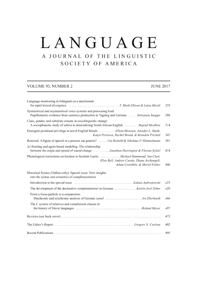
Dependent clauses are one of the prominent examples illustrating the ability to generate recursive structures by a computational mechanism. Three types of dependent clauses have usually been distinguished in a broader sense: (i) complement clauses, (ii) adverbial clauses, and (iii) correlative or relative clauses. The question of whether these three types can be reduced to a single abstract structure has inspired several fruitful lines of research, resulting in a mass of new empirical findings and leading to novel results. For example, many authors have proposed to analyze different types of dependent clauses as correlative/relative clauses (see Arsenijevic 2009, Bhatt & Pancheva 2006, Caponigro & Polinsky 2011, Geis 1970, Haegeman 2012, Kayne 2014, Krapova 2010, Kratzer 2006, Moulton 2009, 2015, among many others). This special issue of the Historical Syntax section of Language, entitled New insights into the syntax and semantics of complementation, focuses in particular on the diachronic syntax and semantics of dependent clauses and shows to what extent complement, adverbial, and relative/correla- tive clauses may be related to each other.