


The United States has been undergoing a dramatic increase in partisan social polarization, a trend made clear by the hyper-partisanship exhibited in the 2016 presidential election. The divide goes beyond just differences in policy preferences; individuals’ social and psychological attachments to their political party trigger emotional responses and biases that permeate a wide variety of opinions and behaviors (Mason Reference Mason2015). Individuals harbor increasingly negative sentiment toward the opposite party (Abramowitz and Webster Reference Abramowitz and Webster2016), refuse exposure to outparty perspectives (e.g., Levendusky Reference Levendusky2013; Mutz Reference Mutz2006; Stroud Reference Stroud2008), reject social interaction with outparty members (Iyengar, Sood, and Lelkes Reference Iyengar, Sood and Lelkes2012), and impede upon the civil rights of those with conflicting views (e.g., Crawford and Pilanski Reference Crawford and Pilanski2014). Growing partisan polarization has contributed to legislative gridlock (Binder Reference Binder1999; Jones Reference Jones2001), lower levels of trust in government (Banda and Kirkland Reference Banda and Kirkland2018; Hetherington and Rudolph Reference Hetherington and Rudolph2015), and even job discrimination in nonpolitical domains (Gift and Gift Reference Gift and Gift2014).
While the divisiveness of partisan identities is relatively new, social identities such as race and ethnicity have long been contentious. One of the most promising solutions to intergroup conflict has been empathy—or the sharing of others’ perspectives or emotions (for a review, see Batson and Ahmad Reference Batson and Ahmad2009). For example, psychology research demonstrates that feelings of empathic concern for a member of a stigmatized group, such as a homeless person or an AIDS victim, can reduce stigmatization and prejudice (e.g., Batson et al. Reference Batson, Polycarpou, Harmon-Jones, Imhoff, Mitchener, Bednar, Klein and Highberger1997; Batson et al. Reference Batson, Chang, Orr and Rowland2002). Other research has shown that empathy for racial and ethnic groups can generate higher support for civil rights policies that protect undocumented immigrants and suspected terrorists (Sirin, Valentino, and Villalobos Reference Sirin, Valentino and Villalobos2016, Reference Sirin, Valentino and Villalobos2017). Perhaps inspired by this research, then-Senator Barack Obama identified an “empathy deficit” as the root of many problems in American politics (for a scholarly take on the topic, see Ditto and Koleva Reference Ditto and Koleva2011). If Americans could understand the feelings and perspectives of their opponents, perhaps we might be able to find more common ground and reduce partisan acrimony.
But while empathy might have the potential to reduce intergroup conflict, that potential may not always be realized. Many of the more optimistic findings regarding empathy’s utility in reducing conflict come from laboratory experiments involving direct manipulations of the experience of empathy, but the effects derived from forced exposure experiments may differ from those under self-selection (for discussion, see Gaines and Kuklinski Reference Gaines and Kuklinski2011). This methodological point is crucial because people are systematically biased in how they experience empathy on a day-to-day basis (Bloom Reference Bloom2016) and tend to display greater empathy toward ingroup members (Sirin, Valentino, and Villalobos Reference Sirin, Valentino and Villalobos2017). When given the choice, people seek out environments that minimize contact with dissimilar others and ideas (e.g., Flache and Macy Reference Flache and Macy2011; Gimpel and Hui Reference Gimpel and Hui2015; Hart et al. Reference Hart, Albarracin, Eagly, Brechan, Lindberg and Merrill2009; Sears and Freedman Reference Sears and Freedman1967). People perceive empathy as tiring and personally costly, leading to the motivated down-regulation of compassion and empathy (Cameron, Harris, and Payne Reference Cameron, Harris and Payne2016; Cameron and Payne Reference Cameron and Payne2011). Moreover, we are more likely to understand and share in the experiences of in- versus outgroup members, creating an “empathy gap” (Gutsell and Inzlicht Reference Gutsell and Inzlicht2012). This empathy gap leads to real-world consequences, such as reducing the likelihood of helping an outgroup member (Kunstman and Plant Reference Kunstman and Plant2008; Sterling and Gaertner Reference Sterling and Gaertner1984; Stürmer, Snyder, and Omoto Reference Stürmer, Snyder and Omoto2005) and the devaluation of their lives (Pratto and Glasford Reference Pratto and Glasford2008). And even when individuals are willing and able to place themselves in the shoes of another, this can actually increase conflict by reinforcing negative stereotypes or triggering anger (Skorinko and Sinclair Reference Skorinko and Sinclair2013; Vitaglione and Barnett Reference Vitaglione and Barnett2003). So while the experience of empathy toward an individual or group can reduce bias in some circumstances, individuals in the real world may rarely place themselves in situations that would encourage them to do so.
As a result, even the most empathic individuals may fail to experience empathy toward their partisan opponents. Worse yet, empathy may even trigger anger toward one’s opponents if they are seen as harming ingroup members. Thus, people who are most disposed to feeling empathy may be more politically polarized than those who are less prone to experiencing empathy. In this paper, we bridge literatures on political science and psychology and test how empathy impacts multiple manifestations of interparty hostility. First, using a nationally representative survey, we show that those who are higher in dispositional empathic concern are more likely to show inparty favoritism, but less likely to avoid outparty contact. Second, using an experimental design, we show that individuals high in empathic concern tend to exhibit greater partisan bias in expressions of tolerance and the experience of schadenfreude. Overall, our results suggest that dispositional empathy tends to fuel, rather than reduce, partisan polarization.
CONNECTING EMPATHY AND POLARIZATION
Political scientists have long taken a policy-focused approach to studying polarization in the mass public (e.g., Abramowitz and Saunders Reference Abramowitz and Saunders2008; Fiorina, Abrams, and Pope Reference Fiorina, Abrams and Pope2011). However, while partisan elites have been steadily dividing over policy, there is only weak and inconsistent evidence that the mass public has followed suit (Hetherington Reference Hetherington2009). In contrast, scholars taking a social identity approach to studying mass polarization have found compelling evidence of polarization among the public, as sentiment toward the outparty has become increasingly negative (e.g., Hetherington, Long, and Rudolph Reference Hetherington, Long and Rudolph2016; Iyengar, Sood, and Lelkes Reference Iyengar, Sood and Lelkes2012). In this view, mass polarization is more a product of the heightened salience of partisanship, rather than issue preferences (c.f. Webster and Abramowitz Reference Webster and Abramowitz2017). Salient group identities, in turn, lead to clear divides between members of the two major parties.
This type of polarization goes beyond just negative feelings. Past research (e.g., Iyengar and Westwood Reference Iyengar and Westwood2015) evidences behaviors that are consistent with the first three levels of Allport’s (Reference Allport1954) framework of prejudice—verbal antagonism, avoidance of outgroup members, and actual discrimination—both in and out of the political realm. For example, Lelkes and Westwood (Reference Lelkes and Westwood2017) find that individuals are more likely to reject outpartisans as team members, and more likely to support the suppression of outparty speech. Even more, there is evidence of schadenfreude, as individuals report taking greater pleasure in misfortunes such as troop casualties and economic downturns when those misfortunes are attributed to the opposite party (Combs et al. Reference Combs, Powell, Schurtz and Smith2009). In sum, partisan politics among the US electorate appears to increasingly be a matter of “us” versus “them.”
Empathy, then, emerges as a potential tool for bridging this divide. Empathy is commonly thought of as a singular process, but psychologists widely agree that it consists of multiple overlapping processes (e.g., Batson and Ahmad Reference Batson and Ahmad2009; Davis Reference Davis1983; Decety and Svetlova Reference Decety and Svetlova2012). According to the dominant typology of empathy, there are four related, but distinct aspects of dispositional empathy (Davis Reference Davis1983). We focus our attention on the dimension that is perhaps closest to the popular conception of the term, empathic concern.Footnote 1 Empathic concern refers to the tendency to experience other-oriented emotions, such as sympathy or compassion, for another person who is in distress. To put it differently, empathic concern can be thought of as a trait-like disposition, while sympathy (or compassion) is the corresponding state-level emotional reaction. The other-oriented moral emotion of compassion is the mechanism through which empathic concern motivates individuals to take action to assist others or alleviate harm (e.g., Batson, Fultz, and Schoenrade Reference Batson, Fultz and Schoenrade1987; Wilhelm and Bekkers Reference Wilhelm and Bekkers2010). Empathic feelings of compassion also play a central role in the research on reducing intergroup conflict. Indeed, it is consistently the most immediate driver of reductions of group prejudice (Batson et al. Reference Batson, Polycarpou, Harmon-Jones, Imhoff, Mitchener, Bednar, Klein and Highberger1997; Pettigrew and Tropp Reference Pettigrew and Tropp2008). Thus, not only is empathic concern most closely related to popular arguments regarding empathy and polarization, but it is also the strongest predictor of approach-oriented actions and prosocial behaviors (e.g., Bekkers Reference Bekkers2005; Jordan, Amir, and Bloom Reference Jordan, Amir and Bloom2016; Wilhelm and Bekkers Reference Wilhelm and Bekkers2010).
But while those who are dispositionally high in empathic concern are more likely to experience compassion in a variety of situations, we contend that empathic concern should actually exacerbate rather than alleviate many of the manifestations of polarization discussed above. For one, the expression of empathy is biased. Because empathy can be both psychologically and monetarily costly, there are many factors that regulate whether a person experiences empathy. Crucial among these factors is the individual’s relationship to the target, as individuals more readily experience empathic concern toward ingroup members (for a review, see Cikara, Bruneau, and Saxe Reference Cikara, Bruneau and Saxe2011). For example, a recent neuroscientific study manipulated group identity through affiliation with a soccer team (Hein et al. Reference Hein, Silani, Preuschoff, Batson and Singer2010). Participants reported greater empathic concern for another’s pain and were more willing to personally endure pain to reduce another’s pain when that individual was an ingroup member rather than an outgroup member. Both of these responses were consistently associated with activation of the left anterior insula. This type of intergroup bias in the experience of empathy may result in part from greater shared experiences with ingroup members, which facilitate empathy (e.g., Hodges et al. Reference Hodges, Kiel, Kramer, Veach and Villanueva2010). More generally, empathy toward ingroup members serves to enhance cooperation and the gains that flow from it. In contrast, indiscriminate empathy toward outgroup members, particularly when resources are limited or during times of intergroup conflict, can be costly (Zaki Reference Zaki2014). As a result, we expect that people are more likely to experience empathy toward partisan ingroup members, which will contribute to partisan favoritism. We expect to observe this in two forms:
Empathic concern should predict more positive affect for copartisans, relative to outpartisans (H1).
Empathic concern should increase negative affect for outpartisans (H2).
But while those high in empathic concern may dislike outpartisans, they also might not avoid them. So although empathy may fuel many manifestations of polarization, it may reduce at least one: social distance. This may seem counterintuitive, but it is consistent with evidence that individuals high in empathic concern are not passive or conflict-avoidant. Rather, empathic concern corresponds with an “approach” motivation that serves to facilitate prosocial behavior.Footnote 2 Thus, people high in empathic concern should not be repelled by the prospect of encountering contradictory views or having a disagreement with an outpartisan acquaintance. Instead, empathy should increase individuals’ acceptance of the potential for contact or interaction with a diverse set of others (Butrus and Witenberg Reference Butrus and Witenberg2013; Gerson and Neilson Reference Gerson and Neilson2014) and should generally motivate people to “behave in a more supportive way toward others, independent of how much they like them” (Dovidio, Gaertner, and Kawakami Reference Dovidio, Gaertner and Kawakami2003, 10). We expect, then, that empathic concern will create an approach motivation that reduces social distance (H3).
This willingness to engage with outpartisan ideas and individuals does, however, have limits. Individuals high in empathic concern should be more open to contact with the outparty when the interaction is neutral or benign. That is, works showing greater acceptance among the empathic generally focus on more non-antagonistic scenarios such as being in the same social setting as an outgroup member. But when groups and/or potential interactions with them are presented as more threatening or competitive, empathic concern can facilitate more negative moral emotions, such as anger or a desire to punish (Dovidio et al. Reference Dovidio, Johnson, Gaertner, Pearson, Mikulincer and Shaver2010; Nelissen and Zeelenberg Reference Nelissen and Zeelenberg2009; Vitaglione and Barnett Reference Vitaglione and Barnett2003). The combination of bias toward the ingroup and anger at the outgroup can also lead to another, more negative alternative to empathy: schadenfreude (Smith et al. Reference Smith, Powell, Combs and Schurtz2009). Especially in situations with heightened intragroup competition, an outgroup loss may provide pleasure if it can be seen as an ingroup gain (Leach and Spears Reference Leach and Spears2009).
These more negative empathic reactions should easily translate to interparty competition. Beliefs about harm and feelings of anger appear to be pervasive in American partisan politics. According to a recent survey (Pew 2016), a near majority of both Democrats (41%) and Republicans (45%) reported seeing the opposing party as a threat to the nation’s well-being. Similar proportions of Democrats (47%) and Republicans (46%) also reported being angry with the opposing party. Moreover, many political scenarios are, in fact, zero-sum games. To illustrate, consider a situation in which embarrassing personal photos of a sitting legislator are leaked to the media. Highly empathic outparty members may feel compassion for the legislator and his or her family, as they are facing public humiliation. But because empathy also drives them to favor their own party and perceive that legislator’s party as harmful, these feelings may be tempered by satisfaction that the scandal is just punishment or delight at the potentially increased prospects of replacing that legislator with an inparty candidate. Thus, when there is a perceived harm from the opposing party, people who are dispositionally empathic should react with stronger feelings of anger and a greater desire to minimize the perceived harm inflicted by outpartisans. This leads us to two additional hypotheses:
Empathic concern increases the desire to censor public expressions of antagonistic outpartisan viewpoints (H4). Footnote 3
While empathic concern should generally reduce schadenfreude, this effect should be weaker for suffering partisan opponents than for suffering copartisans (H5).
Of course, we are not the first to suggest that partisan disagreements may lead to anger and negative affect toward the outparty. Indeed, anger toward the outparty candidate is often used as an indicator of affective polarization (Mason Reference Mason2015). And research has shown that ideological disagreement influences anger (Webster and Abramowitz Reference Webster and Abramowitz2017). Our contribution, however, is to incorporate empathy into the story and show that those who display the most concern on behalf of others are also the most socially polarized. Thus, polarization is not a consequence of a lack of empathy among the public, but a product of the biased ways in which we experience empathy.
In the next sections, we present analyses testing these expectations. We begin with an examination of an original national survey that allows us to explore the relationships between empathy and partisan favoritism and social distance. We then leverage a survey experiment to more clearly specify the causal paths linking empathy to social polarization and probe tendencies toward censorship and schadenfreude.
STUDY 1: AFFECT AND SOCIAL DISTANCE
We first test our expectations with data from an original survey fielded by YouGov during May 2016. YouGov interviewed 1,181 respondents from their opt-in internet survey panel and matched 1,000 respondents to the population on gender, age, race, ideology, political interest, voter registration, and partisanship. The sampling frame was constructed from the 2010 American Community Survey, 2010 Current Population Survey, and 2007 Pew Religious Life Survey. See Online Appendix B for more information about sample demographics.
Our first hypothesis (H1) is that those higher in empathic concern will favor their own party relative to the outparty. To examine this type of partisan favoritism, we utilize responses to two questions asking respondents to rate the Democratic and Republican Parties on a seven-point scale ranging from “very favorable” to “very unfavorable.”Footnote 4 We then subtract respondents’ ratings of the opposite party from their ratings of their own partyFootnote 5 to create an ordinal measure that ranges from six (highest inparty rating, lowest outparty rating) to −6 (lowest inparty rating and highest outparty rating).Footnote 6, Footnote 7 To test our expectation of greater outparty negativity among the empathic (H2), we simply examine the seven-point favorability rating of the outparty.
To capture social distance (H3), we rely on two questions asking respondents how upset they would be if (a) a family member married a member of the opposite party or (b) a neighbor placed a sign for the opposite party’s presidential candidate in his or her yard (both measured on a five-point scale). While opposition to the latter may seem to fall into the category of censorship (H4), we contend that the mere placement of a positive campaign sign is not threatening enough to trigger more negative empathic reactions. That is, we only expect censorship when outparty speech is explicitly antagonistic.Footnote 8 We averaged the two responses, resulting in a measure ranging from 1 (not upset by either scenario) to 5 (extremely upset by both scenarios). The scale has a mean of 2.0, with 41% of respondents falling into the bottom category.
We measure empathy using the Interpersonal Reactivity Index (IRI), a widely used and well-validated measure of dispositional empathy (Davis Reference Davis1983; Davis and Franzoi Reference Davis and Franzoi1991). The IRI asks respondents to use a five-point scale to indicate how well each of a series of 28 statements describes them.Footnote 9 Our focus is on the seven questions designed to measure empathic concern. The full text of the IRI battery and the factor loadings can be found in Online Appendix A, but the empathic concern items include statements like “When I see someone being taken advantage of, I feel kind of protective toward them” and “Sometimes I don’t feel very sorry for other people when they are having problems” (reverse coded). We rescale all responses to range from 0 to 1 and use the mean of these empathic concern items as our key independent variable (α = 0.75;  $\bar{X} = 0.68$, s.d. = 0.18). The remaining questions are used to construct similar, seven-item indices to represent the other three dimensions of empathy: personal distress (α = 0.77), perspective-taking (α = 0.76), and fantasy (α = 0.76).Footnote 10 At present, we treat these variables as controls, and take up discussion of their theoretical implications later in the manuscript.
In addition, we control for strength of party identification, ideological extremity, and news interest, as polarization should be greatest among the most committed and engaged citizens (e.g., Abramowitz Reference Abramowitz2011). We also include a dichotomous indicator of party membership to account for any potential differences between Democrats and Republicans. Lastly, we control for respondents’ education, age, gender, race, and income.Footnote 11
Table 1 presents the results of three ordinal logistic modelsFootnote 12—one for each of our dependent variables. We begin with the two models examining partisan sentiment. The results are as expected. The significant, positive coefficient for empathic concern in the relative inparty favorability model indicates that as dispositional empathy increases, individuals are more likely to be biased toward their own party. The left-hand panel of Figure 1 illustrates the magnitude of this effect. Shifting from the minimum to the maximum value of empathic concern results in about a 0.14 increase in the probability of having the highest regard for the inparty and the lowest regard for the outparty (Relative Inparty Favoritism = 6). Thus, these results support our claim that dispositional empathy facilitates affective polarization.
Partisan Affect and Social Distance as a Function of Empathic Concern, YouGov Survey

Coefficients and standard errors estimated using weighted ordinal logistic regression. Cutpoints are estimated but not shown.
* = p < 0.05.
Predicted Probabilities of High Partisan Favoritism by Empathic Concern
The figures plot the predicted probabilities of being in the highest category of relative inparty favoritism (6) and the lowest category of outparty favorability (1). Predictions generated from the models in Table 1. Solid lines represent point estimates holding all other covariates at their mean or modal values. Dashed lines represent the 95% confidence intervals calculated via the delta method.
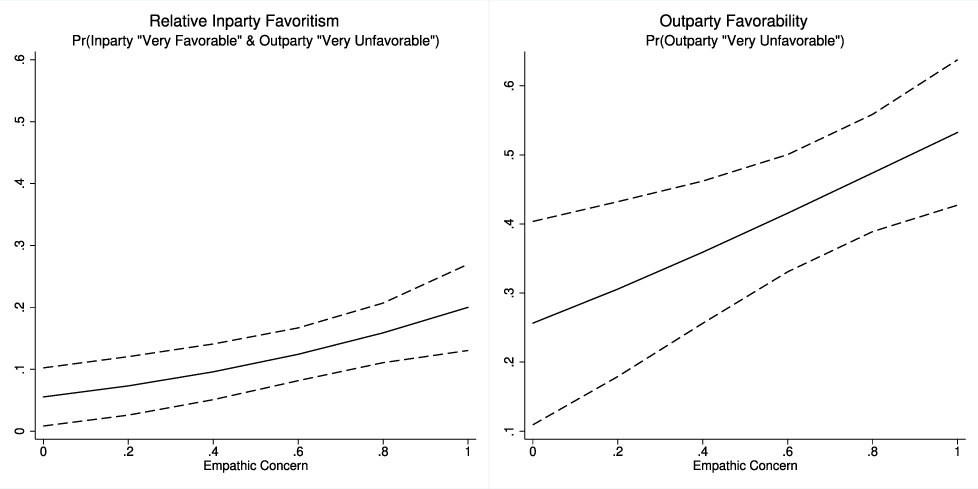
These findings may be less worrisome if they are driven primarily by positive feelings toward copartisans rather than negative feelings toward partisan opponents. However, the outparty favorability model presented in Column 2 of Table 1 provides clear evidence that empathic concern promotes rather than dampens outgroup hostility. This result is illustrated in the right-hand panel of Figure 1. Here, a min–max shift in empathic concern increases the probability of expressing the least outparty favorability by about 0.27. Together, these results suggest that empathic concern promotes affective polarization, and does so by driving negative outgroup affect.
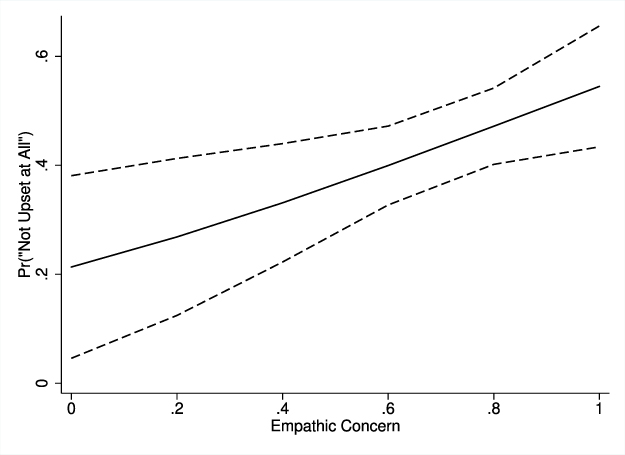
Turning to social distance, empathic concern is again a significant predictor. But whereas empathy increases relative and absolute dislike of the outparty, it lowers this form of affective polarization by increasing comfort with outparty contact. As illustrated in Figure 2, those high in empathic concern are less likely be upset by the prospect of having a family member or neighbor who belongs to the opposite party. A shift from the minimum to the maximum of empathic concern increases the probability of being in the lowest category—saying that you are not bothered at all by either scenario—by 0.32. Thus, while empathic concern may generate more negative feelings toward partisan opponents, the approach-oriented aspect of empathic concern seems to encourage contact with outparty members, perhaps with the goal of altering behavior that is seen as harmful.
Predicted Probabilities of Low Social Distance by Empathic Concern
The figure plots the predicted probabilities of being in the lowest category of social distance (1). Predictions generated from the model in Table 1. Solid lines represent point estimates holding all other covariates at their mean or modal values. Dashed lines represent the 95% confidence intervals calculated via the delta method.
Moderating Effects of Partisan Identity
According to our argument, people are biased toward experiencing empathy toward their ingroup members over outgroup members. Given our focus here on partisan identity, the effects of empathic concern should be clearest among those who hold a partisan identity and those who hold that identity most strongly.Footnote 13 We tested this expectation with a series of additional models, shown in Online Appendix B. In the first set of models, we interacted empathic concern with a dummy variable indicating whether the respondent identifies as a partisan or an independent (including leaners). We first examined the absolute value of relative partisan affect.Footnote 14 As expected, empathic concern significantly predicted polarization among partisans (b = 1.64, p = 0.017), but not among independents (b = 0.62, p = 0.355), though the interaction term is not statistically significant (p = 0.244). We took a similar approach and interacted empathic concern with partisan strength, estimating the effect of empathy separately at each level of partisan strength. Also as expected, the effect was clearest among strong partisans (b = 1.72, p = 0.047) and weak partisans (b = 1.56, p = 0.118), but weaker among leaners (b = 0.62, p = 0.559) and pure independents (b = 0.63, p = 0.373), though the interaction terms are not statistically significant. In contrast, when examining social distance, we find that the effects are largely constant across partisan identity, suggesting that, consistent with theory, comfort with outgroup members reflects the more general approach motivations of those high in empathic concern.
Robustness Checks
While our results are consistent with our hypotheses, there are several possible concerns about the models presented above. First, the moderate correlation between empathic concern and perspective-taking (r = 0.52) may raise concerns. However, our results are highly similar when empathic concern is the only dimension of empathy included in the models (see Online Appendix B). Second, the relationship between empathic concern and liberalism (r = 0.12) could cause empathy to work differently among Democrats and Republicans. However, as shown in Online Appendix B, we find no evidence of an interaction between empathic concern and partisan identity in predicting relative partisan affect (p = 0.579), outparty affect (p = 0.885), or social distance (p = 0.965).Footnote 15
Another concern is that dispositional empathy is redundant to other personality traits, such as the Big Five, which have been shown to relate to partisan affect (Abramowitz and Webster Reference Abramowitz and Webster2018; Webster Reference Webster2018). As shown in Online Appendix B, empathy is related to the Big Five traits, though no more strongly than the Big Five traits relate to each other. The strongest Big Five correlates of empathic concern are Agreeableness (r = 0.52) and Openness (r = 0.27).Footnote 16 However, none of our substantive conclusions change after including measures of the Big Five (see Online Appendix B). Moreover, even when excluding empathy from our models, neither Agreeableness nor Openness are significant predictors of any of our polarization outcomes and there is only one instance where a Big Five trait is a significant predictor of polarization.Footnote 17 From a theoretical perspective, these findings are to be expected, as empathy deals explicitly with sharing others’ feelings and perspectives, while the Big Five are intended to catch a broader set of behavioral tendencies.
STUDY 2: CENSORSHIP AND SCHADENFREUDE
To expand upon our survey results and to better distinguish polarization from a general dislike of both political parties (Klar, Krupnikov, and Ryan Reference Klar, Krupnikov and Ryan2018), we next present results from an original experiment that allows us to test our expectations about censorship (H4) and schadenfreude (H5). Our experiment was embedded into a survey of 1,232 undergraduates from the University of Houston.Footnote 18 Though a convenience sample, it is relatively diverse and offers more than sufficient variation on our key independent variable, empathic concern ( $\bar{X} = 0.69$, s.d. = 0.17),Footnote 19 which was again measured using the IRI.Footnote 20
Subjects were randomly assigned to receive one of two versions of a short article describing a recent protest on a college campus. Full texts of the treatments are available in Online Appendix C, but several key facts are held constant across conditions. In both versions, campus police had to shut down a group of partisan students who were protesting a speech to be given by an individual known for making inflammatory comments about that party. In both versions, a bystander who was attempting to hear the speech was struck by a protestor. And in both versions, the protestors succeeded in getting the speech canceled. Within the text, we randomly varied only the partisan implications. In one condition, the speaker criticized Democrats and was protested by the College Democrats; in the other condition, the speaker criticized Republicans and was protested by the College Republicans.
After exposure to the treatment, we asked a series of questions gauging feelings about the speaker, the protestors, and the bystander who was struck by a protestor. We begin with our expectations about reactions to the speaker. Whereas we found that those high in empathic concern were more comfortable with relatively benign outparty contact, we expect that the speaker’s explicit attacks on the respondent’s party should make those high in empathic concern more prone to negative emotions. That is, we expected that partisan bias would increase the desire to shut down a speaker who was criticizing the respondent’s own party, and that this partisan bias in censorship would be magnified by empathic concern. To test this, we assessed censorship by asking respondents to use a seven-point scale to rate their agreement with four statements about whether the speaker should have been invited in the first place, whether the protesters were justified, whether the speech should have been allowed despite the protest, and whether the university should have done more to protect speech. We use the mean of these four responses to construct a continuous measure of censorship of the speaker that ranges from one to seven, with a mean of 3.45 (s.d. = 1.06) and a median of 3.50.
Next, we consider reactions to the partisan protestors. We asked subjects about support for three different forms of punishment for the students involved in the protest: banning the group from holding future events, suspending the students involved, and expelling the students involved. After taking the mean of all three items, the desire to punish the protesters was relatively low in our sample ( $\bar{X} = 2.81$ on the seven-point scale). Still, we expect that subjects will be more likely to want to punish the protesters when they are from the opposite party (i.e., the students were protesting a speaker from the subject’s own party), and that these treatment effects will be greatest among those highest in empathic concern.
Lastly, we consider reactions to the student who was struck by a protestor. We created a measure of sympathy by averaging two questions about compassion and sympathy for that student ( $\bar{X} = 3.10$). Similarly, we averaged two items asking how funny and amused respondents felt about the injured student to create a five-point measure of schadenfreude ( $\bar{X} = 1.82$) (Combs et al. Reference Combs, Powell, Schurtz and Smith2009). Since the bystander was struck while attempting to hear the speaker, we expect that those higher in empathy will express less concern and greater amusement when the speaker was from the opposite party. That is, when the bystander is prevented from hearing the subject’s copartisan, there should be more sympathy and greater outrage. But when the bystander is prevented from hearing the other side, a subject high in empathic concern should be less inclined to care and may even take delight in the fact that her side succeeding in keeping someone from hearing the opposition.
In sum, when presented with an outparty versus inparty speaker, we expect that those higher in empathic concern will express a greater desire to censor the speaker, a lower desire to punish the students who were protesting, and less sympathy but more schadenfreude for the student struck while trying to hear the speaker. To test each of these expectations, we use ordinary least squares (for the continuous censorship and punishment variables) and ordinal logistic regression (for the ordinal sympathy and schadenfreude variables) to model our four outcomes as a function of receiving the out- versus inpartyFootnote 21 speaker treatment, empathic concern, and the interaction of the two.Footnote 22 The results of these four models are displayed in Table 2.
The Interaction of the Partisan Treatments and Empathic Concern, Student Sample

Coefficients and standard errors estimated using OLS and ordinal logistic regression as noted. Cutpoints for the logistic regression models are estimated but not shown.
* = p < 0.05.
Beginning with censorship, we find a statistically significant interaction between the treatment and empathic concern. The left-hand panel of Figure 3 illustrates this effect. While those at the lower end of the empathic concern scale do not distinguish between the two types of speakers, those at the higher end are significantly more likely to want to stop the speech when the speaker is from the opposite party. More specifically, for an individual who is one standard deviation above the mean of empathic concern, the desire for censorship increases from 3.22 (on the five-point scale) to 3.77 (p < 0.01). These findings then fit with our expectations that dispositional empathy serves to exacerbate partisan bias.
The Effects of the out- versus Inparty Speaker Treatment by Level of Empathic Concern
The figures plot the predicted effects of the out- versus inparty speaker treatments on the continuous censorship scale and the probability of having the lowest value of schadenfreude (1; which is also the modal value). Predictions generated from the models in Table 2. Solid lines represent point estimates. Dashed lines represent the 95% confidence intervals calculated via the delta method.
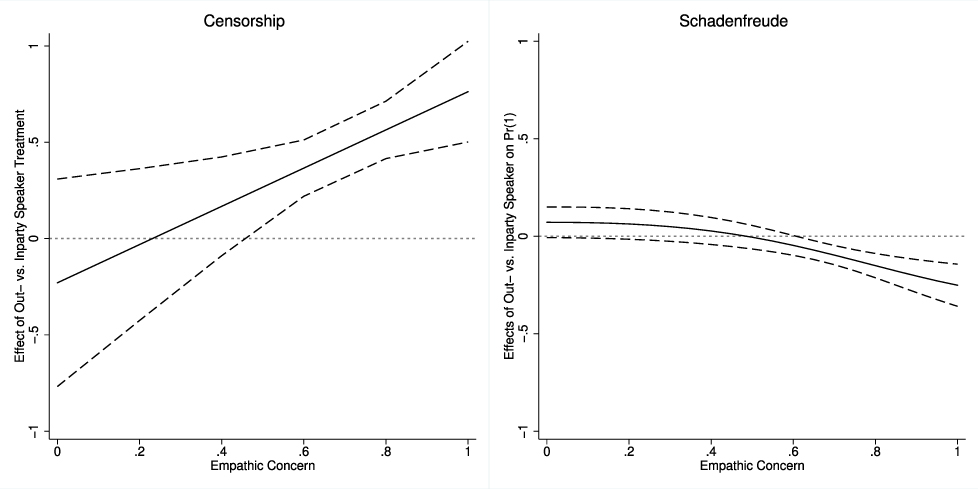
Looking at the desire to punish the protestors and sympathy for the bystander struck by the protestors, we do not find a significant interaction effect. Empathic concern consistently lowers the desire to punish and increases sympathy, regardless of the party of the speaker. Although empathy does not exacerbate partisan bias for these outcomes, the coefficients on the interaction terms indicate that empathy also does not provide any buffer against partisan bias, either. Lastly, when looking at schadenfreude, we again observe a statistically significant coefficient for the interaction between the treatment and empathy. To illustrate, the right-hand panel of Figure 3 plots the predicted differences in the probabilities of those in the out- versus inparty speaker conditions being in the lowest category of schadenfreude, one, which is the modal value. Because this is the lowest possible value, the effects for those at the higher end of the empathic concern scale are significant and negative, indicating that they are significantly less likely to be in this low category, and subsequently, more likely to be in a higher category. As an example, again consider the individual whose empathic concern score is one standard deviation above the mean. Our model predicts that the cumulative probability of being in any category greater than one is 0.68 when the bystander was injured attempting to hear a speaker from the opposite party, but only 0.54 when the speaker is from the same party. Additional analyses presented in Online Appendix C show that these substantive effects are consistent whether looking at Democrats or Republicans.Footnote 23 Thus, these experimental findings serve to bolster our argument that empathic concern does not reduce partisan animosity in the electorate and in some respects even exacerbates it.
PERSPECTIVE-TAKING TO THE RESCUE?
Overall, our results are largely consistent with more pessimistic views of the effects of empathy. Yet, we have focused on empathic concern, while some research suggests that perspective-taking might lessen some forms of affective polarization.Footnote 24 In contrast to empathic concern, perspective-taking does not involve an emotional reaction to another person’s situation. Rather, perspective-taking “allows an individual to anticipate the behavior and reactions of others” (Davis Reference Davis1983, 115). Thus, perspective-taking might afford better intergroup understanding without the negative emotional responses. Indeed, perspective-taking, not empathic concern, best facilitates negotiations and the ability to discover hidden agreements, and high perspective-takers are less likely to stereotype (Wang et al. Reference Wang, Ku, Tai and Galinsky2013), more likely to tolerate disagreement (Mutz Reference Mutz2006), and more likely to be attracted to opportunities for political debate and dialogue (Clifford, Kirkland, and Simas Reference Clifford, Kirkland and Simas2019). As such, perspective-taking could potentially reduce any of the forms of polarization explored here.
However, the expectations for perspective-taking are not so clear. Some have described this disposition as a “relational amplifier” (Pierce et al. Reference Pierce, Kilduff, Galinsky and Sivanathan2013) that enhances the cooperative or competitive nature of a relationship. In line with this perspective, some research has found that people high in perspective-taking are more prone to strategic (selfish) behavior in competitive games (Epley, Caruso, and Bazerman Reference Epley, Caruso and Bazerman2006) and more willing to engage in unethical behavior in competitive contexts (Pierce et al. Reference Pierce, Kilduff, Galinsky and Sivanathan2013). In fact, there are a number of contexts in which perspective-taking may fail or even backfire (Sassenrath, Hodges, and Pfattheicher Reference Sassenrath, Hodges and Pfattheicher2016). As a result, perspective-taking may not reduce political polarization either.
Consistent with these mixed expectations, we find little evidence that perspective-taking reduces the types of polarization explored here. In Study 1, we found no evidence that perspective-taking predicts partisan affect (see Table 1). When excluding controls for empathic concern and other aspects of empathy, we do find a significant, negative association between perspective-taking and social distance (see Online Appendix B), but still fail to connect perspective-taking to inparty favoritism or outparty favorability. And as Table 3 shows, perspective-taking does not significantly reduce partisan bias in our Study 2 experiment.
The Interaction of the Partisan Treatments and Perspective-Taking, Study 2 Student Sample

Coefficients and standard errors estimated using OLS and ordinal logistic regression as noted. Cutpoints for the logistic regression models are estimated but not shown.
* = p < 0.05.
Yet, there are many other ways that polarization can manifest itself beyond those explored in our two studies. The more cognitive nature of perspective-taking may help lessen partisan divides by facilitating behaviors such as policy debate or exposure to outparty news sources. But, we fail to find any evidence that perspective-taking reduces fundamental aspects of polarization, such as outgroup hostility. It is, of course, too early to reject perspective-taking as a partial solution to easing polarization, but our initial findings are not promising.
CONCLUSION
The experience of empathic concern for an outgroup member has played a critical role in reducing intergroup conflict, making increased empathy an appealing solution to partisan polarization. Yet, as we have argued here, empathic dispositions may serve to encourage polarization in practice. People tend to display more empathy toward ingroup members and are more sensitive to perceived harmful behaviors committed by outgroup members. Our findings generally support this claim, as our survey results show that empathy fuels negative feelings toward the outparty, while our experimental findings show that highly empathic individuals also display greater partisan bias in the censorship of ideas and feelings of schadenfreude. In sum, the evidence we present implies that the real-world effects of empathy are not as positive as they are often assumed to be.
Indeed, when paired with recent evidence regarding the increased nature of “us versus them” politics (Mason Reference Mason2015), increased sorting of parties (Levendusky Reference Levendusky2009), and the role of group identity in affective polarization (Iyengar, Sood, and Lelkes Reference Iyengar, Sood and Lelkes2012; Mason Reference Mason2016), these results seem quite concerning. Even those who are most prone to feeling empathy for others are unlikely to find common ground in the face of these powerful identities. Those predisposed toward empathic responding, our results suggest, are more likely to dislike their partisan “opponents” and perhaps even enjoy their suffering or failures. President Obama’s call for greater empathy may be a salve to polarization when Americans can perceive of one another as having common political identities (Levendusky Reference Levendusky2018), but in an environment polarized along partisan lines, our results suggest that increased empathy may actually make things worse for those hoping to facilitate tolerance and understanding. While we have focused here on affective responses and tolerance, our findings suggest empathy may play a role in other important outcomes. For example, those high in empathic concern may also be more susceptible to partisan bias in blame attribution (Bisgaard Reference Bisgaard2015; Healy, Kuo, and Malhotra Reference Healy, Kuo and Malhotra2014). Those high in empathic concern are more likely to blame outpartisans for the suffering of inpartisans than vice versa, an implication worthy of future research. Given their increased outgroup antipathy, those high in empathic concern may also be less willing to entertain policy proposals from opponents whom they disproportionately blame (relative to copartisans) for social ills. These patterns may contribute to decreased willingness to compromise with the opposing party and more negative attitudes toward bipartisanship. Partisan polarization has only increased in the years since our studies were conducted. In particular, the rise of Trump coincided with (and likely exacerbated) deepening hostilities (Abramowitz and McCoy Reference Abramowitz and McCoy2019), and thus, we expect the partisan empathy gap has grown as well.
Yet, the implications of our findings are not universally negative. We did find that those high in empathic concern were more likely to be comfortable with contact with members of the opposite party. Given persistent evidence that intergroup contact reduces prejudice (see Pettigrew and Tropp Reference Pettigrew and Tropp2011 for a review), there is perhaps potential for empathic concern to lower polarization among those who have the most interaction with outparty members. If citizens highest in empathic concern are most motivated to participate in the political process as a way to reduce harm, this would suggest a strongly altruistic motive for high levels of participation (Fowler and Kam Reference Fowler and Kam2007), a rather encouraging result. Such a suggestion is consistent with findings that higher levels of empathic concern are associated with a greater attraction to the more prosocial aspects of running for and holding political office (Clifford, Kirkland, and Simas Reference Clifford, Kirkland and Simas2019). However, if highly empathic individuals seek social contact with outpartisans primarily for the purpose of persuasion, censorship, or punishment, then contact may be unlikely to reduce polarization. As such, an important direction for future research is to further explore the mechanism behind greater social contact among those high in empathic concern and how that mechanism influences the quality of contact.
We have focused here on dispositional differences in empathy, rather than directly manipulating the experience of empathy. This was an intentional choice on our part to study how empathy operates in practice, rather than how it might operate in controlled circumstances. Of course, while dispositional empathy seems to exacerbate polarization on average, some people might be more prone to experiencing empathy for outpartisans. Similarly, recent research shows that some people report having high levels of empathy for racial outgroups, a tendency that is separable from general empathic dispositions (Sirin, Valentino, and Villalobos Reference Sirin, Valentino and Villalobos2016, Reference Sirin, Valentino and Villalobos2017). Outgroup empathy tends to stem partly from increased contact and shared experiences, and it may be those who are broadly disposed to empathy who benefit most from these environmental factors. These findings suggest that a promising research agenda might examine the tendency to experience empathy toward partisan opponents and the factors that promote this form of outgroup empathy. Clearly, any call for empathy as a resolution to partisan conflict must consider who that empathy is for and how it will be achieved.
SUPPLEMENTARY MATERIAL
To view supplementary material for this article, please visit https://doi.org/10.1017/S0003055419000534.
Replication materials can be found on Dataverse at: https://doi.org/10.7910/DVN/RJL2DK.




Comments
No Comments have been published for this article.